

The Sin of Cremation: What Does the Bible Say? When Pastor Daniel Whitmore received the phone call just after sunrise, he already knew something was wrong. The voice on the other end belonged to Anna Reed, a woman from his church who had always spoken softly, even when life was breaking her heart.
“Pastor,” she whispered, “my father passed away last night.” Daniel closed his eyes. For a moment, he said nothing. He had known Harold Reed for almost fifteen years. Harold was seventy-eight, stubborn in the way old men sometimes are, but kind beneath the sharp edges.
He had sat in the same wooden pew every Sunday, third row from the front, always with a worn Bible open on his lap.
“I’m so sorry, Anna,” Daniel said gently. “Was he in pain?”
“No,” she answered. “He went peacefully. My mother was holding his hand.”
“That is a mercy.”
Anna was silent for a few seconds.
Then her voice broke.
“Pastor, there’s something else.”
Daniel looked toward the church window, where morning light was beginning to touch the stained glass.
“What is it?”
“My father left instructions,” Anna said. “He wanted to be cremated.”
Daniel did not answer right away.
He had heard this question many times before.
Sometimes it came from grieving children.
Sometimes from worried widows.
Sometimes from elderly believers who were planning ahead and did not want to burden their families.
But every time, the question carried fear.
Anna continued, “My mother is upset. My brother says cremation is a sin. He says we’ll dishonor Dad if we follow his wishes. He said God won’t raise ashes.”
Her breath trembled.
“Pastor, is that true?”
Daniel leaned back in his chair.
Outside, a sparrow landed on the church steps.
“No,” he said softly. “That is not true.”
Anna began to cry.
“But what does the Bible say?”
Daniel looked down at his desk.
His Bible was already open from his morning reading.
He placed his hand over it.
“The Bible does not directly forbid cremation,” he said. “But it does speak often about burial, dignity, the body, and the hope of resurrection. This is not a question we should answer with fear. We must answer it with Scripture, wisdom, and reverence.”
Anna sniffed.
“Can you come over?”
“I’ll be there soon.”
By the time Pastor Daniel arrived at the Reed family home, the house was full of grief.
The curtains were drawn halfway.
A pot of coffee sat untouched on the kitchen counter.
Relatives moved quietly from room to room, speaking in whispers, as though loud voices might disturb the dead.
Anna met him at the door.
Her eyes were red.
Behind her stood her younger brother, Matthew.
Matthew was a tall man in his forties with a tense face and tightly folded arms.
He had not attended church in years, but grief had a way of pulling old religious fears back to the surface.
“Pastor,” Matthew said before Daniel could even take off his coat, “tell my sister she cannot burn our father’s body.”
Anna flinched.
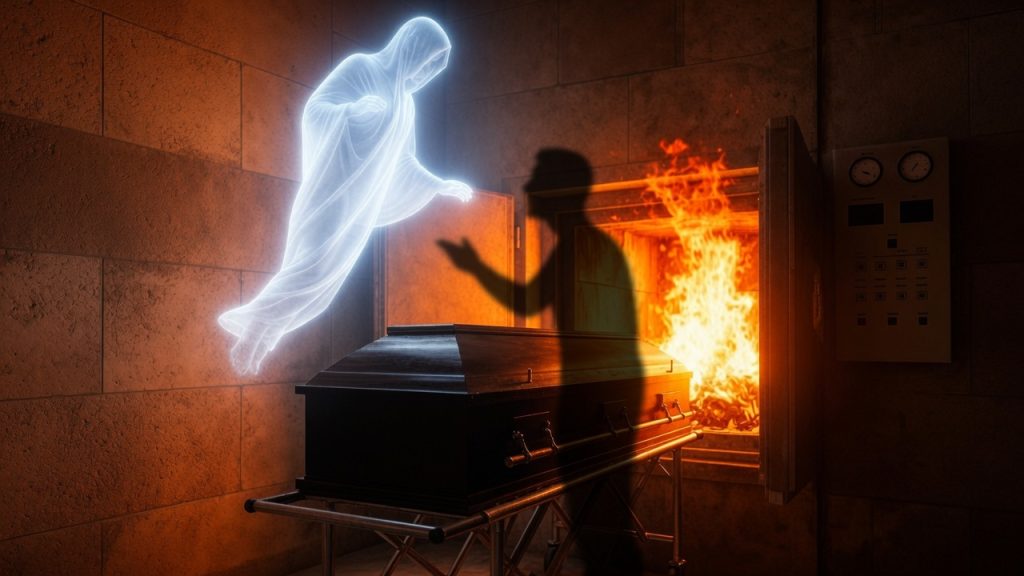
Daniel looked at him calmly.
“Matthew, I know this is painful.”
“It’s wrong,” Matthew insisted. “Christians bury their dead. We don’t cremate them. That’s pagan.”
Anna wiped her cheek.
“Dad wrote it down, Matthew. He didn’t want Mom spending money on an expensive funeral.”
“He was confused,” Matthew snapped. “He didn’t know what he was asking.”
From the living room, their mother, Evelyn, spoke faintly.
“He knew.”
Everyone turned.
Evelyn Reed sat in Harold’s old recliner.
She looked small beneath a gray blanket, her silver hair pinned loosely at the back of her head.
Her eyes were dry, but her face carried the exhaustion of a woman who had spent the night saying goodbye.
“He talked about it for months,” Evelyn said. “He said the money should go to the grandchildren, not into the ground.”
Matthew shook his head.
“Mom, this is not about money. This is about his soul.”
Daniel stepped into the room.
“Matthew,” he said, “your father’s soul is not in the hands of a funeral home. It is in the hands of God.”
The room went still.
Matthew stared at him.
Daniel sat across from Evelyn.
Anna stood near the fireplace, clutching a tissue.
“I think we need to talk about what the Bible says,” Daniel said. “But first, we need to remember who Harold was. He was not a man trying to mock God. He was not rejecting Christ. He believed in the resurrection. He trusted Jesus. He read his Bible until the print became too small for his eyes.”
Evelyn smiled weakly.
“He used a magnifying glass at the end.”
Daniel nodded.
“That matters.”
Matthew’s jaw tightened.
“But cremation destroys the body.”
Daniel turned to him.
“So does time.”
Matthew opened his mouth, but no words came.
Daniel continued gently.
“When a body is buried, it returns to dust. That is what Scripture says. Some bodies are lost at sea. Some are destroyed in fires. Some believers were killed in wars, disasters, and persecutions. Do we believe God cannot raise them?”
“No,” Anna whispered.
“No,” Daniel repeated. “The power of resurrection does not depend on the condition of the body. It depends on the power of God.”
Matthew looked away.
But he was listening now.
Daniel opened the Bible he had brought with him.
“In Genesis, we see Abraham bury Sarah with great honor. In the Gospels, Jesus was placed in a tomb. Burial was the normal practice among God’s people. That is true. And many Christians still choose burial because it beautifully symbolizes waiting for the resurrection.”
He paused.
“But the Bible does not give a command that says every believer must be buried and must never be cremated.”
Matthew frowned.
“What about the body being the temple of the Holy Spirit?”
“That verse teaches us to honor God with our bodies in life,” Daniel said. “And yes, even after death, a body should be treated with dignity. But dignity can still be shown in cremation if it is done reverently, with prayer, love, and faith.”
Evelyn lowered her head.
“Harold said he wanted a simple service. Hymns. Scripture. No fancy coffin. No debt.”
Anna sat beside her mother and took her hand.
Matthew paced to the window.
Outside, the neighborhood was quiet.
The world had continued moving, even though their family had stopped.
“That doesn’t feel right,” Matthew said. “Fire feels like judgment.”
Daniel nodded slowly.
“I understand why it feels that way. In Scripture, fire can symbolize judgment. But fire can also symbolize purification, God’s presence, and sacrifice. We must be careful not to build a doctrine only from how something feels.”
Matthew turned around.
“So you’re saying it doesn’t matter?”
“No,” Daniel said firmly. “I’m saying it matters deeply. But maybe not in the way you think.”
Matthew was silent.
Daniel closed the Bible halfway.
“The real question is not only, ‘Burial or cremation?’ The deeper question is, ‘Are we honoring God? Are we honoring the person who died? Are we acting from faith or fear?’”
Anna whispered, “I don’t want to sin.”
Daniel looked at her.
“Wanting to honor God is not sin.”
Evelyn began to cry quietly then.
Anna wrapped an arm around her shoulders.
Matthew’s face softened for the first time.
For a long moment, nobody spoke.
Then Evelyn reached toward a small wooden box on the side table.
“Anna,” she said, “bring me your father’s letter.”
Anna stood and picked up an envelope.
It was labeled in Harold’s handwriting.
To My Family.
Her hands shook as she opened it.
“Read it,” Evelyn said.
Anna unfolded the letter.
Her voice trembled as she began.
“My dear Evelyn, Anna, and Matthew. If you are reading this, then the Lord has called me home. Do not spend your strength arguing over what remains of me. I am not in the room where I died. I am not in the bed. I am not in the body that failed me. I am with Christ, which is far better.”
Anna stopped and pressed the paper to her chest.
Daniel bowed his head.
Matthew turned back toward the window, but Daniel saw him wipe his eyes.
Anna continued.
“I know some of you may struggle with my request for cremation. I understand. I grew up believing burial was the only Christian way. But I have prayed, studied, and spoken with Pastor Daniel. I do not make this request because I think the body is worthless. I make it because I know the body belongs to God, and God does not lose what belongs to Him.”
Evelyn let out a broken sob.
Anna read on.
“Bury me in your hearts, not in your debt. Scatter nothing carelessly. Treat my remains with respect. Gather at church. Sing Amazing Grace. Read John 11. Remember that Jesus stood before a tomb and declared Himself the resurrection and the life. Whether I am dust or ash, He knows my name.”
Matthew covered his mouth with his hand.
Anna’s voice broke completely at the last line.
“Do not fight over my ashes. Love one another. That will honor me more than any stone in the ground.”
The paper lowered slowly.
The room was heavy with silence.
Matthew sat down at last.
His anger seemed to leave him all at once, replaced by something much older and more fragile.
Fear.
“I just don’t want to do the wrong thing,” he said.
Daniel nodded.
“I know.”
Matthew looked at him.
“I haven’t been to church. I haven’t prayed like Dad did. I think when I heard cremation, I panicked. It felt like losing him twice.”
Anna moved beside him.
“We all lost him,” she said softly.
Matthew stared at the letter.
“He still wrote like Dad.”
Evelyn laughed through tears.
“He corrected the grammar twice.”
For the first time that morning, a small warmth entered the room.
But grief was still there.
It sat with them like another family member.
Over the next two days, the Reed family planned Harold’s memorial.
There were disagreements, but they were gentler now.
Matthew still struggled with the idea of cremation, but he no longer accused his mother or sister of sin.
Anna chose Harold’s favorite hymns.
Evelyn selected a simple urn made of dark wood.
Pastor Daniel prepared a message from John 11, where Jesus said, “I am the resurrection and the life.”
The service was held on a cloudy Saturday morning.
The church filled slowly.
Neighbors came.
Old friends came.
Men from Harold’s Bible study sat together in the third row, leaving his usual seat empty.
On the communion table rested the urn, a framed photograph, Harold’s Bible, and a small vase of white lilies.
Matthew stood in the hallway before the service, staring through the open sanctuary doors.
Daniel approached him.
“How are you holding up?”
Matthew swallowed.
“I keep thinking I should have called him more.”
Daniel said nothing.
Sometimes silence is kinder than advice.
Matthew looked toward the urn.
“It still hurts.”
“It will.”
“I thought knowing the answer would make it easier.”
Daniel smiled sadly.
“Truth gives us ground to stand on. It does not remove grief.”
Matthew nodded.
Inside the sanctuary, the piano began to play.
The family walked in together.
Evelyn held Anna’s arm.
Matthew walked beside them, his face pale but steady.
During the service, Pastor Daniel spoke carefully.
He did not turn Harold’s funeral into a debate.
He did not use grief as a classroom.
But he knew many people in the room had the same question.
So after speaking about Harold’s faith, kindness, and stubborn love for Scripture, Daniel addressed it gently.
“Some of us come today with questions,” he said. “Questions about death. Questions about the body. Questions about what is honorable before God. Harold himself asked those questions before he died. And he found comfort not in a method of burial, but in the promise of Christ.”
People listened closely.
Daniel placed his hand on the Bible.
“The Bible often shows burial as a respectful practice among God’s people. We should not dismiss that. Burial can be a meaningful picture of waiting for resurrection. But Scripture does not teach that God is powerless over ashes. Scripture does not say that a believer’s hope depends on a coffin, a tomb, or the preservation of earthly remains.”
Evelyn closed her eyes.
Anna held her hand.
Matthew stared at the floor.
Daniel continued.
“From dust we came, and to dust we return. But our God is the Creator of dust. He formed Adam from the ground. He knows every hair on our heads. He remembers every child who belongs to Him. No grave is too deep. No sea is too wide. No fire is too final. The resurrection is not a human achievement. It is the work of Almighty God.”
A few people began to cry.
Daniel’s voice softened.
“So today, we do not place our trust in what has been done with Harold’s body. We place our trust in what Christ has done for Harold’s soul. And because Harold trusted Jesus, we grieve with hope.”
The congregation sang Amazing Grace.
Evelyn’s voice was weak, but she sang.
Anna cried through the second verse.
Matthew did not sing at first.
He stood stiffly, hands gripping the pew in front of him.
But by the last verse, his lips began to move.
When the service ended, people came forward one by one.
They hugged Evelyn.
They shared stories.
One man remembered how Harold had fixed his porch railing and refused payment.
Another remembered how Harold prayed with him during cancer treatment.
A young woman from the church said Harold had once slipped grocery money into her Bible when she was a single mother.
Evelyn had never known.
She covered her face and wept again.
Later, when most people had gone, Matthew remained in the sanctuary.
Anna found him standing near the communion table.
He was looking at their father’s Bible.
“Do you remember this?” he asked.
Anna stepped closer.
Inside the Bible, Harold had written notes in the margins.
Beside John 11, in shaky handwriting, he had written:
Jesus does not forget the dead.
Anna smiled through tears.
“That sounds like him.”
Matthew touched the edge of the page.
“I was angry because I thought cremation meant we were erasing him.”
Anna shook her head.
“No one can erase Dad.”
Matthew looked at the urn.
“I still wish he had chosen burial.”
“That’s okay,” Anna said.
He looked at her.
“It is?”
“Yes. You can feel that way. But we can still honor his request.”
Matthew breathed deeply.
“I’m sorry for what I said.”
Anna hugged him.
For a moment, they stood there like children again, brother and sister clinging to each other in a world that had suddenly become too large.
That evening, the family gathered at Evelyn’s house.
There was food everywhere, because church people always brought food when words were not enough.
Casseroles.
Rolls.
Pies.
Fruit trays.
Someone had brought Harold’s favorite lemon cake.
Evelyn sat at the kitchen table and smiled when she saw it.
“He would have eaten dessert first.”
Matthew laughed softly.
“He always said life was uncertain.”
Anna added, “And frosting was biblical.”
The laughter faded into tears, but the tears were gentler now.
After everyone left, the three of them sat together in the living room.
The house felt different without Harold.
His chair was empty.
His slippers were still near the door.
His reading glasses remained on the side table beside the lamp.
Evelyn reached for them, then stopped.
“I don’t know what to do with his things,” she whispered.
Daniel, who had stayed to help clean up, said gently, “You don’t have to decide tonight.”
Evelyn nodded.
Matthew looked at the pastor.
“Can I ask something?”
“Of course.”
“If the Bible doesn’t forbid cremation, why do so many people say it does?”
Daniel folded his hands.
“Sometimes Christians confuse tradition with command. Tradition can be good. It can carry wisdom. But we must be honest about what Scripture clearly says and what it does not clearly say.”
Matthew listened.
“Also,” Daniel continued, “death frightens people. When we are afraid, we often want firm rules because rules feel safer than mystery. But faith requires trusting God even when the details are beyond us.”
Anna looked down.
“So it’s a conscience issue?”
“For many believers, yes,” Daniel said. “Some Christians will choose burial because their conscience leads them there. Others may choose cremation without rejecting Scripture. The important thing is reverence, not rebellion. Faith, not fear. Honor, not carelessness.”
Evelyn looked toward Harold’s chair.
“He was afraid people would judge him.”
Daniel’s expression grew sad.
“People often judge what they do not understand.”
Matthew lowered his head.
“I did.”
Evelyn reached across the table and took his hand.
“You loved him. Fear spoke before love did.”
Matthew squeezed her hand.
A week later, the family returned to the church garden.
Behind the sanctuary was a small memorial area with roses, stone benches, and a wooden cross.
Harold had helped build the benches years earlier.
He had sanded the wood himself, complaining loudly the whole time but refusing to let anyone else do it.
The family had decided to place the urn in a small memorial niche near the garden wall.
It was quiet there.
Simple.
Peaceful.
Pastor Daniel read from Scripture.
Evelyn held a white rose.
Anna held Harold’s Bible.
Matthew held the wooden urn.
His hands trembled slightly, but he did not pull away.
Daniel prayed.
“Lord, we thank You for Harold’s life. We thank You for his faith, his love, his work, and his witness. We commit what remains of his earthly body to Your care, knowing that his soul rests with You. Teach this family to grieve with hope. Remind them that nothing is lost to You. Not dust. Not ashes. Not tears. Not memory. In Christ, even death must bow.”
When the prayer ended, Matthew placed the urn in the niche.
He stepped back slowly.
Then he whispered, “I love you, Dad.”
Evelyn placed the rose beside it.
Anna closed her father’s Bible.
The wind moved gently through the garden.
For a moment, no one spoke.
Then sunlight broke through the clouds and touched the wooden cross.
Matthew looked at it and exhaled.
“I think I understand now,” he said.
Anna turned to him.
“What?”
He wiped his eyes.
“The question was never whether God could raise him.”
Daniel smiled faintly.
“No.”
Matthew looked at the memorial wall.
“The question was whether I trusted God enough to let go.”
Evelyn leaned against him.
“And do you?”
Matthew looked at his mother, then at his sister, then at the cross.
“I want to.”
Daniel nodded.
“Sometimes that is where faith begins.”
Months passed.
The Reed family still missed Harold.
Grief did not disappear after the memorial.
It returned in small moments.
When Evelyn made too much coffee.
When Anna heard an old hymn.
When Matthew reached for his phone to call his father and remembered there would be no answer.
But something changed in Matthew.
The man who had arrived angry and afraid began attending church again.
At first, he sat in the back.
Then, slowly, he moved forward.
One Sunday, Anna walked in and found him sitting in the third row from the front.
Harold’s row.
She smiled but said nothing.
After the service, Matthew stayed behind to speak with Pastor Daniel.
“I’ve been reading John 11,” he said.
Daniel smiled.
“That is a good place to begin.”
Matthew held up his father’s Bible.
“Dad wrote a lot in here.”
“He did.”
Matthew opened to the page.
“Beside the verse where Jesus says Lazarus, come out, Dad wrote, ‘One day He will say my name too.’”
Daniel felt his throat tighten.
“That is the Christian hope.”
Matthew looked toward the cross at the front of the sanctuary.
“I spent so much time worrying about what happened to Dad’s body that I forgot what Dad believed about Jesus.”
Daniel placed a hand on his shoulder.
“Your father did not forget.”
Matthew nodded.
“I know that now.”
Later that afternoon, Matthew went to the church garden alone.
The roses had begun to bloom.
He stood before the memorial niche and read his father’s name.
Harold James Reed.
Beloved husband, father, grandfather, and servant of Christ.
Beneath it was the verse Evelyn had chosen:
“I am the resurrection and the life.”
Matthew stood there for a long time.
Then he spoke quietly.
“I’m sorry, Dad. I was scared.”
The garden was silent.
But Matthew did not feel alone.
He looked at the cross, then at the sky.
For the first time since his father’s death, he felt something stronger than fear.
Hope.
He finally understood that cremation had not stolen his father from God.
Death itself could not do that.
The grave could not.
Fire could not.
Ashes could not.
Time could not.
Because the promise of resurrection was not held together by human hands.
It was held by Christ.
And Christ does not lose what belongs to Him.
So what does the Bible say about cremation?
It says the body matters.
It says death is real.
It says grief is holy when brought before God.
It shows burial as a beautiful and honorable tradition.
But it does not clearly call cremation a sin.
It does not teach that ashes are beyond God’s reach.
It does not say the method of handling a body is stronger than the mercy of the Savior.
For the Christian, the final hope is not in earth or flame.
Not in a coffin.
Not in an urn.
Not in a cemetery.
Not even in memory.
The final hope is in Jesus Christ, who stood before a tomb and spoke life into death.
That is why believers can mourn and still sing.
That is why they can bury and still hope.
That is why even ashes are not the end.
Because one day, the trumpet will sound.
The dead in Christ will rise.
And every believer, whether remembered by stone, dust, or ash, will stand whole before the Lord who never forgot their name.
THE END! THANK YOU FOR READING!