

I counted the calls because the clock on the hospital wall was directly across from my bed. Nine. Nine times my thumb trembled against the hospital phone while the monitors beeped softly beside me. Nine times I called my mother, then my father, then the family group chat.
Nine times the same answers came back. Voicemail. Silence. One brief text from Mom that said, “We’re at Lauren’s. Is this urgent?” I stared at the word urgent until the letters blurred. The day before, a delivery truck had run a red light and crashed into the driver’s side of my car. I remembered the screech of brakes, the sudden flash of white metal, then the taste of blood in my mouth while strangers shouted outside my shattered window.
By the time I woke up after surgery, a nurse was standing over me, telling me not to move.
My ribs were bruised.
My left wrist was fractured.
There was a deep cut near my hairline.
The doctors said the swelling around my lungs needed to be watched carefully for the next twenty-four hours. They used calm voices, but their eyes kept shifting to the monitors as if they were listening for something I couldn’t hear.
So yes, I thought as I stared at my mother’s text.
It was urgent.
It had always been urgent when Lauren needed something.
When Lauren cried because her college roommate was mean, my mother drove four hours at midnight.
When Lauren failed her first driving test, my father took three days off work to “rebuild her confidence.”
When Lauren wanted a wedding bigger than her fiancé’s family could afford, my parents emptied their retirement account and called it love.
But when I woke up in a hospital bed after nearly dying, they were unavailable because Lauren had moved into a new suburban house in Ridgefield.
A white kitchen.
A nursery she wasn’t using yet.
A husband named Bradley who believed heavy lifting was something other people did.
At 6:40 p.m., my phone buzzed.
Lauren had posted a video.
“Couldn’t have done today without Mom and Dad!” she sang, turning the camera toward them.
My father was carrying a lamp.
My mother was arranging throw pillows.
Lauren laughed behind the camera and said, “They’re the best parents in the world.”
I watched the video twice.
Not because I wanted to.
Because some part of me needed proof.
Proof that they weren’t trapped in traffic.
Proof that they hadn’t lost service.
Proof that they had received my calls and simply decided that helping Lauren unpack plates mattered more than sitting beside their injured daughter.
A nurse named Marisol came in to adjust my IV.
She was small, calm, and kind in a way that made me want to cry even harder.
“You okay, honey?” she asked.
I looked away from the phone.
“No,” I whispered.
She touched the rail beside my bed. “Pain?”
I almost laughed.
“Yes,” I said. “But not that kind.”
Her eyes moved to my phone screen, then back to my face. She didn’t ask nosy questions. She simply stood there.
Some people know how to be present without making noise.
I envied that.
I pressed the call button again after she left, but not for pain medication.
When Marisol came back, I asked her to call the number saved under “Harding & Vance — Estate.”
She hesitated.
“Are you sure?” she asked gently.
“Completely.”
My voice was weak, but I spoke every word clearly.
The firm answered after two rings.
By 8:15 p.m., my estate lawyer, Julian Vance, stood at the foot of my bed in a navy suit, his briefcase resting on the chair near the window.
He had represented me since I sold my medical software company two years earlier.
The sale had changed my life in a way my family never truly understood.
To them, I was still Miranda, the responsible one.
The daughter who handled things.
The daughter who didn’t need rescuing.
The daughter who could be disappointed quietly and still show up for everyone else.
They knew I was wealthy.
They had no idea how wealthy.
More importantly, they had no idea they were still listed in my will.
My father was still named as an emergency financial contact.
My mother and Lauren were still beneficiaries on several old trusts I had created years ago when I still believed family loyalty meant something.
Lauren’s future children, children she talked about constantly but did not yet have, had education funds ready for them.
My parents had access to the lake house every summer.
They had seats waiting for them on the board of the charitable foundation I had built after selling my company.
They loved mentioning that foundation at parties.
They loved saying, “Our Miranda created something wonderful.”
But they never loved asking whether Miranda was lonely.
They never loved asking whether Miranda needed them.
Julian opened his briefcase carefully.
“Miranda,” he said, his voice low, “you don’t have to do this tonight.”
“Yes,” I whispered. “I do.”
He pulled up a chair.
The room smelled like antiseptic and rain. Outside the window, the city lights flickered behind thin curtains. Somewhere down the hall, a machine alarmed, then quieted.
Julian read every change aloud.
My parents were removed as beneficiaries.
Lauren was removed entirely.
Their access to my emergency accounts was revoked.
My medical decision authority was reassigned to my longtime friend, Naomi Brooks, the only person who had shown up at the hospital within forty minutes of hearing what happened.
The lake house was transferred into a trust for a youth recovery charity.
The education accounts set aside for Lauren’s future children were redirected to a scholarship fund for children who had lost parents in accidents.
The charitable foundation board seats my parents loved bragging about were cancelled before they ever became official.
Gone.
All of it.
Each signature hurt because my wrist was weak, and Julian had to steady the papers while I signed with my right hand.
But with every mark of ink, my breathing became easier.
Not physically.
My ribs still burned.
But something inside me, something old and tired, finally stopped begging to be chosen.
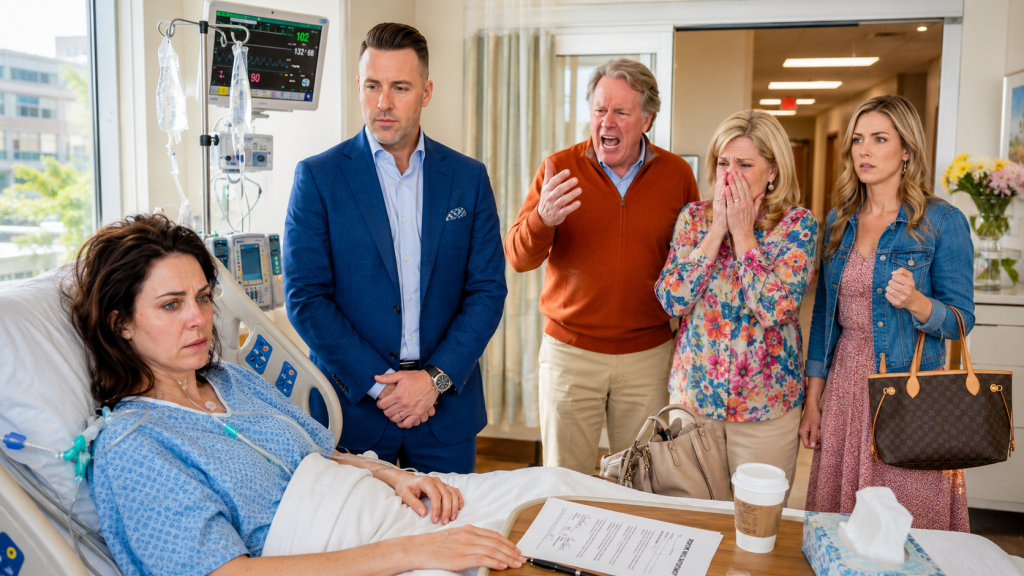
At 10:03 p.m., my mother finally walked into my hospital room holding a takeout coffee.
My father followed her with his phone in one hand, frowning at the screen.
They looked mildly inconvenienced.
Not terrified.
Not broken.
Not like parents who had almost lost a daughter.
“Miranda,” Mom sighed, “you scared us.”
Julian turned from the window.
I looked straight at both of them.
“No,” I said quietly. “You scared me.”
My mother blinked like she hadn’t understood.
Dad stepped in behind her, still smelling faintly of cardboard dust and Lauren’s expensive vanilla candles.
“Don’t start,” he muttered. “We came as soon as we could.”
I looked at the clock.
“Fifteen hours after my surgery.”
Mom’s face tightened.
“Lauren needed us. You had doctors.”
There it was.
Not even hidden.
Not even softened.
Lauren needed parents.
I had staff.
Julian cleared his throat, and for the first time, my father seemed to notice him.
His eyes narrowed.
“Who is this?”
“My lawyer,” I said.
The room went still.
Mom’s fingers tightened around her coffee cup.
Dad looked from Julian to me, then back again.
“Why is your lawyer here?” he asked.
Julian’s expression remained calm.
“Ms. Hale asked me to come tonight.”
“Miranda,” Mom said slowly, “what did you do?”
I did not answer right away.
I wanted them to feel the silence.
Just once, I wanted them to sit in uncertainty the way they had left me sitting in fear.
“I updated my estate,” I said.
My father gave a short laugh.
It was the laugh he used when he thought I was being dramatic.
“Good grief, Miranda. You get into one accident and suddenly you’re rewriting wills from a hospital bed?”
“One accident,” I repeated.
My voice cracked, but I kept going.
“A truck hit my car. I had surgery. The doctors weren’t sure how the night would go. I called you nine times.”
Mom looked down.
Dad’s jaw tightened.
“We were busy,” he said.
I stared at him.
“With throw pillows?”
His face darkened.
“Watch your tone.”
I smiled faintly.
Even that hurt.
“I almost died, Dad. You don’t get to correct my tone.”
My mother stepped closer to the bed.
“Miranda, we didn’t know it was that serious.”
“You didn’t ask.”
“I texted you.”
“You asked if it was urgent.”
She looked wounded, as if I had been cruel enough to quote her accurately.
Julian closed his briefcase with a soft click.
That sound seemed to unsettle my father more than anything I had said.
“What exactly did she change?” Dad demanded.
Julian looked at me for permission.
I nodded.
“Ms. Hale has removed several individuals from her estate plan,” Julian said. “She has also revoked access to emergency financial accounts, changed her medical power of attorney, and reassigned future charitable and trust distributions.”
Mom’s lips parted.
Dad’s face drained of color.
“What individuals?” he asked.
I answered before Julian could.
“You. Mom. Lauren.”
For a second, neither of them moved.
Then my mother laughed once, a fragile, disbelieving sound.
“You don’t mean that.”
“I signed it.”
“You’re emotional,” she said. “You’re in pain. You’re punishing us because we were helping your sister.”
“No,” I said. “I am protecting myself because my family showed me exactly where I stand.”
Dad stepped forward.
“Don’t you dare use money to manipulate us.”
That almost made me laugh.
All my life, my parents had treated my success like a family resource.
When Lauren wanted a down payment, they hinted that I had “more than enough.”
When Dad’s golf club dues went up, he joked that I could sponsor him.
When Mom wanted to remodel their kitchen, she sent me photos with captions like, “Wouldn’t this be lovely for family holidays?”
And I paid.
Not always.
But often enough.
Because some lonely part of me thought generosity might finally earn tenderness.
“I’m not manipulating anyone,” I said. “I’m saying no.”
Mom’s eyes filled with tears.
That used to destroy me.
Not tonight.
“You’re really taking the lake house away from us?” she whispered.
Not, You were afraid.
Not, I’m sorry.
The lake house.
“Yes.”
“But your father loves that place.”
“I loved believing you would come when I needed you.”
Dad pointed a finger at me.
“Miranda, you’re making a mistake. Family fights. Family gets over things.”
“Family answers the phone.”
His mouth shut.
For a moment, all I heard was the monitor beside me.
Beep.
Beep.
Beep.
Then my mother’s phone rang.
Lauren’s name lit up the screen.
Mom glanced at it, then at me.
“Don’t answer,” Dad muttered.
But Mom was shaken and not thinking clearly.
She tapped the screen.
Lauren’s voice filled the room.
“Mom? Did you finally get there? Is Miranda done being dramatic? Bradley says if she’s okay enough to call a lawyer, she’s okay enough to stop ruining everyone’s night.”
The silence that followed was immediate and brutal.
My father sat down.
My mother stared at her phone as though it had betrayed her.
I looked at Julian.
Even he looked uncomfortable.
“Lauren,” Mom whispered, “you’re on speaker.”
There was a pause.
Then Lauren said, “Oh.”
Just that.
Not apology.
Not concern.
Only irritation at being caught.
Something inside me settled into place.
Not anger.
Not grief.
Clarity.
“Hi, Lauren,” I said.
Another pause.
Then she laughed lightly.
“Miranda, I didn’t mean it like that.”
“You meant it exactly like that.”
“Well, you know how you get,” she said. “Everything becomes a production. Mom and Dad were exhausted from helping me move. You can’t expect everyone to drop everything every time you have a crisis.”
Marisol, who had stepped into the doorway to check the monitors, froze.
My mother’s face went pale.
Dad looked at the floor.
I closed my eyes for one second, then opened them.
“Lauren, do you remember when you called me from Rome because your purse was stolen?”
She hesitated.
“What?”
“You were twenty-six. You had gone on vacation with friends. Your passport was fine. Your credit card was frozen for two hours. You called me crying, and I stayed on the phone with the embassy, the bank, and your hotel until three in the morning.”
“That was different.”
“Do you remember when Bradley lost his job and you asked me not to tell Mom and Dad because you were embarrassed?”
“Miranda—”
“I paid your mortgage for six months.”
My mother turned sharply toward the phone.
“What?”
Lauren’s voice sharpened.
“That was private.”
“So was my will,” I said. “Until tonight.”
Dad looked at Mom, then back at me.
“You paid their mortgage?”
“Yes.”
Mom’s mouth opened, then closed.
I could see numbers moving behind her eyes.
Every gift.
Every rescue.
Every favor they had accepted without asking where it came from.
Lauren’s voice rose.
“Why are you bringing that up? You offered.”
“I did.”
“So don’t act like I stole from you.”
“I’m not. I’m reminding you that when you needed me, I answered.”
Lauren scoffed.
“You always make yourself sound like some saint.”
“No,” I said. “I made myself useful because I thought useful daughters eventually became loved daughters.”
Nobody spoke.
That sentence hung over the room longer than I expected.
My mother’s eyes filled again, but this time, I saw something else beneath the tears.
Recognition.
Maybe shame.
Maybe fear.
Lauren broke the silence.
“This is insane. Mom, tell her she can’t do this.”
Mom did not answer.
“Dad?” Lauren snapped.
My father rubbed a hand over his face.
His voice came out rough.
“What exactly did you lose, Lauren?”
Another silence.
“Excuse me?” Lauren said.
“The mortgage,” Dad said. “How much did Miranda pay?”
“That’s not the point.”
“How much?”
“Bradley handled most of it.”
“Lauren.”
She let out an angry breath.
“I don’t know. Maybe forty thousand.”
Mom pressed a hand to her mouth.
Forty thousand.
Not because I couldn’t afford it.
I could.
But because my sister had stood in her new home that afternoon, filming my parents like trophies, while hiding the fact that I had helped keep her old home from foreclosure.
Dad stood slowly.
His face looked older than it had ten minutes ago.
“End the call,” he said to Mom.
“Dad!” Lauren cried. “Don’t let her turn you against me!”
Mom ended the call.
The room became quiet again.
For the first time all night, my parents looked at me like they were actually seeing the hospital bed.
The IV.
The bruises.
The bandage near my hairline.
The way my left hand rested uselessly against the blanket.
Mom stepped closer.
“Miranda,” she whispered, “why didn’t you tell us it was this bad?”
I stared at her.
“I did.”
“No, you said you were in the hospital.”
“I said I had been in an accident. I said I had surgery. I said I needed you.”
She flinched.
“I thought—”
“You thought I would be fine because I always am.”
Her tears spilled over.
I looked away.
There had been a time when seeing my mother cry would have made me apologize for my own pain.
That time was over.
Julian moved toward the door.
“I’ll give you privacy,” he said softly.
“No,” I said.
He stopped.
“I would like you to stay.”
My father looked offended, but I didn’t care.
I no longer trusted them with my most vulnerable moments.
That knowledge hurt more than the fractured wrist.
Dad lowered his voice.
“Miranda, we made a mistake.”
I looked at him.
“You made a choice.”
He swallowed.
“We didn’t understand.”
“You didn’t want to understand.”
Mom sat down in the chair beside my bed.
Not close enough to touch me.
Maybe she was afraid I would pull away.
Maybe she was afraid I wouldn’t.
“What do you want us to say?” she asked.
The old Miranda would have told her.
The old Miranda would have handed her the apology like a script, then accepted it when she read the lines badly.
But I was tired.
So tired that even breathing felt like work.
“I don’t want you to say anything,” I said. “I want you to leave.”
Mom recoiled.
“Miranda—”
“I need rest.”
Dad’s face hardened again, shame transforming into anger because anger was easier.
“You’re really throwing us out?”
“Yes.”
“We came here.”
“Eventually.”
“That’s cruel.”
I laughed once, and the pain shot through my side so sharply that Marisol stepped forward.
“Careful,” she murmured.
I breathed through it.
Then I looked at my father.
“No, Dad. Cruel was watching my calls come in while you carried lamps.”
He had no answer.
My mother stood slowly.
She looked smaller now, not because she was weak, but because the story she had told herself no longer fit around her.
At the door, she turned.
“We’ll come back tomorrow.”
“No,” I said.
Her hand tightened on the doorframe.
“I’ll decide when I’m ready.”
Dad looked as if he might argue, but Julian’s presence kept him from saying what he wanted.
They left without hugging me.
Without touching my hand.
Without saying they loved me.
The door closed softly behind them.
For a few seconds, I stared at it.
Then the tears came.
Not loud.
Not dramatic.
Just quiet, steady tears sliding into my hair while the machines kept counting proof that I was still alive.
Marisol came to my side and placed a tissue in my good hand.
“You did something hard,” she said.
“I did something late,” I whispered.
She shook her head.
“Hard is still hard, even if it’s late.”
The next morning, Naomi arrived with clean clothes, a thermos of homemade soup, and the kind of fury only a true friend could carry on your behalf.
She had slept in the hospital waiting room despite my telling her to go home.
When I woke, she was standing by the window, speaking quietly to Julian.
The moment she saw my eyes open, she rushed over.
“Don’t move,” she ordered, as if I had planned to dance.
I smiled weakly.
“You’re bossy.”
“You nearly died. I’ve earned bossy.”
Julian left after reviewing the documents one more time. He promised to file everything immediately and arrange additional security for my home, office, and lake property.
“Do you think that’s necessary?” Naomi asked.
Julian glanced at me.
“I’ve represented enough families to know that money does not create character. It reveals it.”
He was right.
By noon, Lauren had called twenty-three times.
Mom had called seven.
Dad had sent one message.
We need to talk.
No apology.
No How are you feeling?
No Are you scared?
Just command.
We need to talk.
Naomi read the message over my shoulder and snorted.
“No, they need a calculator.”
Despite everything, I laughed.
It hurt terribly.
Worth it.
By the second day, the family story had begun to change.
A cousin texted me, saying she had heard I “disinherited everyone over a misunderstanding.”
An aunt left a voicemail saying, “Your mother is devastated, Miranda. Whatever happened, don’t destroy your family.”
Destroy.
That word stayed with me.
Interesting how setting a boundary looked like destruction to people who benefited from my silence.
Naomi took my phone away for three hours after that.
When she gave it back, there was a message from Lauren.
It was long.
Too long.
I read only the first line.
I know you’re upset, but you need to think about how this affects everyone.
I deleted it.
On the third day, my parents returned to the hospital.
They did not come alone.
Lauren came with them.
She wore a camel-colored coat, perfect makeup, and the expression of someone preparing to win in public.
Bradley trailed behind her, staring at his phone.
Marisol stepped into the room first.
“You have visitors,” she said carefully. “Do you want them here?”
That question almost broke me.
No one in my family had ever asked that.
Do you want them here?
I looked at Naomi, who was sitting near my bed with her arms crossed.
She arched one eyebrow.
“Your call,” she said.
I nodded.
Marisol opened the door wider.
My family entered as if walking into a courtroom.
Lauren’s eyes immediately moved to Naomi.
“Oh,” she said. “You’re here.”
Naomi smiled without warmth.
“I answer calls.”
Lauren’s mouth tightened.
Mom looked exhausted. Dad looked stiff. Bradley looked bored.
I felt strangely calm.
Maybe because I had already lost the version of them I wanted.
The people standing in front of me were just the truth wearing familiar faces.
Mom stepped forward first.
“We wanted to talk as a family.”
“No,” I said. “You wanted to talk because there are consequences now.”
Lauren rolled her eyes.
“Miranda, can we not turn this into one of your speeches?”
Naomi stood.
“Careful.”
Lauren glanced at her.
“This doesn’t concern you.”
“It does now,” I said. “Naomi is my medical power of attorney.”
Mom flinched.
Dad’s eyes widened.
“You gave that to her?”
“Yes.”
“I’m your father.”
“You were my father yesterday too.”
His face tightened.
Lauren threw up her hands.
“This is exactly what I mean. You’re being vindictive.”
I looked at her.
“Do you know what happened to me?”
She blinked.
“What?”
“Tell me what the doctors said about my condition.”
She looked at Mom.
Mom looked down.
Dad cleared his throat.
“You had surgery.”
“What kind?”
Nobody answered.
I nodded slowly.
“You came here to talk about money, and none of you even know what injuries I have.”
Lauren’s cheeks flushed.
“That’s not fair.”
“No. It’s accurate.”
Bradley finally looked up from his phone.
“Look, Miranda, nobody wants to fight. We just think making huge financial decisions while medicated might not hold up.”
There it was.
The angle.
Not concern.
Strategy.
Julian had warned me.
I pressed a button on my phone.
Julian’s voice came through on speaker.
“Yes, Miranda?”
“My family is here. Bradley just suggested my documents may not hold up because I was medicated.”
Bradley’s face changed instantly.
Julian’s voice remained pleasant.
“All documents were executed with medical clearance confirming capacity. A hospital witness and attending nurse documented Ms. Hale’s lucidity. I would strongly advise against pursuing that claim unless you are prepared for it to become part of a formal record.”
Bradley went silent.
Naomi smiled.
“Thank you, Julian,” I said.
“Call if you need anything else.”
I ended the call.
Lauren stared at me with open fury.
“You set us up.”
“No. I protected myself.”
“From your own family?”
“Yes.”
The word landed hard.
Mom covered her face.
Dad whispered, “Miranda.”
But I kept my eyes on Lauren.
“You asked if I was done being dramatic while I was lying in a hospital bed.”
“I was upset,” Lauren snapped.
“Because my accident interrupted your moving day.”
“You always do this. You make everyone feel guilty for having lives.”
“No,” I said. “I make everyone uncomfortable by remembering the truth.”
Her eyes flashed.
“You think money makes you better than us.”
“No. I think money made you nicer to me.”
She recoiled like I had slapped her.
But she did not deny it.
I looked at my parents.
“I spent years trying to be easy to love. I paid bills quietly. I hosted holidays. I gave gifts. I forgave missed birthdays, forgotten surgeries, cancelled dinners, every time you chose Lauren and told me I was strong enough to understand.”
Mom was crying openly now.
“I never meant to make you feel unloved.”
“But you did.”
Dad stared at the floor.
I continued.
“And when I was lying here, scared and hurt, I finally realized something. If I had died that night, you would have arrived after helping Lauren unpack, cried over my body, and still inherited everything I built.”
The room went completely still.
Even Lauren had no answer.
“That thought made me sicker than the accident,” I said.
Mom sobbed.
Dad sat down heavily in the chair.
Lauren’s expression wavered, but only for a second.
Then she folded her arms.
“So what now? You just cut us off forever?”
“I don’t know.”
That answer surprised her.
It surprised me too.
“I know you are cut off financially,” I said. “That won’t change.”
Lauren’s face hardened again.
“Of course.”
“But personally?” I looked at my parents. “That depends on what you do when there’s nothing left to gain.”
Mom looked up.
“What can we do?”
“For starters, leave me alone while I recover.”
Dad swallowed.
“And after that?”
“After that, if you want a relationship with me, you can start by learning who I am when I’m not useful.”
No one spoke.
I looked at Lauren.
“And you can repay the mortgage money.”
She laughed sharply.
“You’re kidding.”
“I’m not.”
“I don’t have forty thousand dollars lying around.”
“You had money for a new house.”
“That’s different.”
“Everything is different when it’s yours.”
Bradley shifted uncomfortably.
Dad turned slowly toward Lauren.
“Did you tell us Miranda paid your mortgage?”
Lauren’s eyes darted.
“No, because it was none of your business.”
“You let us think Bradley handled it.”
Bradley muttered, “Leave me out of this.”
Naomi laughed under her breath.
Lauren turned on him.
“Seriously?”
For the first time, my perfect sister looked less perfect.
Not ruined.
Just exposed.
And exposure, for someone like Lauren, was worse than punishment.
My mother wiped her face.
“Lauren, apologize to your sister.”
Lauren stared at her.
“What?”
“Apologize.”
“You’re taking her side because she has money.”
Mom’s face crumpled.
“No,” she whispered. “I’m taking her side because she was alone.”
Lauren looked at Dad.
He did not defend her.
That was when her confidence cracked.
“This is unbelievable,” she said, her voice shaking. “One accident and suddenly I’m the villain.”
“No,” I said softly. “You were not made by one accident. You were revealed by one.”
She grabbed Bradley’s arm.
“We’re leaving.”
Bradley did not argue.
They walked out first.
My parents remained.
For a long moment, neither of them moved.
Then Dad stood and approached my bed.
He stopped a few feet away.
“May I?” he asked, gesturing toward my hand.
The question was awkward.
Late.
But it was a question.
I nodded once.
He touched my good hand gently, as if afraid of breaking something he had only just realized was fragile.
“I am sorry,” he said.
The words were rough.
Not polished.
Not enough.
But real enough to make my throat tighten.
Mom came to the other side of the bed.
“I’m sorry too,” she whispered. “I don’t expect you to forgive me today.”
“Good,” Naomi muttered.
Mom actually nodded.
“I deserve that.”
I studied my mother’s face.
For years, I had wanted an apology so badly that I would have accepted almost anything.
Now that one was here, I understood something painful.
An apology could open a door.
It could not rebuild the whole house.
“I need time,” I said.
Mom nodded quickly.
“Of course.”
Dad squeezed my hand once, then let go.
“We’ll go.”
At the door, my mother turned back.
“Miranda?”
I looked at her.
“This time, we’ll wait until you call us.”
Then they left.
Not dramatically.
Not angrily.
Quietly.
That mattered more than I wanted it to.
The next two weeks were slow.
Pain made time strange.
Some hours stretched forever. Others vanished beneath medication and sleep.
Naomi stayed at my apartment after I was discharged, turning my guest room into what she called “recovery command.” She labeled pill bottles, argued with insurance representatives, and threatened to throw my laptop into the river if she caught me working before the doctor cleared me.
My parents sent flowers once.
Not expensive ones.
Not the massive arrangements they used to send when they wanted public credit.
Just a small vase of yellow tulips with a card.
No pressure. We love you. Rest.
I kept the card.
I did not respond.
Lauren sent nothing.
But I heard from Julian that Bradley had called the firm asking whether there was “a repayment schedule option” for the mortgage money.
Julian asked if I wanted to pursue it legally.
I said no.
Not yet.
I didn’t need the money.
I needed Lauren to understand that my generosity had never been her inheritance.
Three months later, I visited the lake house for the first time after the accident.
The air smelled like pine and cold water. The porch boards creaked beneath my feet. My wrist was out of the cast, though still weak, and the scar near my hairline had faded into something only I noticed.
Naomi came with me.
So did Julian, carrying the final papers transferring the property into the youth recovery trust.
My parents arrived separately.
I had invited them.
Lauren was not invited.
Mom stepped out of the car holding a small box.
Dad carried nothing.
For once, he seemed to understand that this was not a weekend getaway.
This was goodbye.
We walked through the house together.
The blue guest room where Lauren used to sleep late and complain about the sunrise.
The kitchen where Mom made pancakes every summer.
The dock where Dad taught me to fish when I was eleven, back when I still believed his attention could be permanent if I behaved well enough.
Mom cried quietly in the living room.
“I loved this place,” she said.
“I know.”
Dad looked out toward the lake.
“You’re really giving it away?”
“Yes.”
“To strangers?”
“To children recovering from loss.”
He nodded slowly.
“That’s good.”
I looked at him, surprised.
He gave a sad smile.
“I’m trying, Miranda.”
I believed him.
Not completely.
Not safely.
But enough to stand beside him for a few minutes without needing to leave.
Mom handed me the small box.
Inside was a stack of old photographs.
Me at six, missing two front teeth.
Me at twelve, holding a science fair ribbon.
Me at seventeen, standing beside my first used car.
I frowned.
“I thought these were in your hallway.”
“They were,” Mom said. “I realized most of the pictures in my house were of Lauren. I told myself it was because she gave me more photos. But that wasn’t the whole truth.”
Her voice broke.
“I’m sorry I made you invisible in your own family.”
That apology reached a place the hospital apology had not.
I closed the box.
“Thank you.”
She nodded.
She did not ask for forgiveness.
That helped.
Later, after the papers were signed, we stood on the porch watching sunlight move across the water.
My father cleared his throat.
“Lauren is angry.”
“I assumed.”
“She says you ruined the family.”
I smiled faintly.
“No. I stopped financing the illusion.”
Dad looked at me.
Then, slowly, he nodded.
“Maybe that’s true.”
Mom wiped her eyes.
“She wants us to convince you to reconsider.”
“Will you?”
“No,” Mom said.
I turned toward her.
She looked nervous but steady.
“We told her she needs to apologize. Really apologize. Not for the money. For the way she treated you.”
“And?”
Mom sighed.
“She hung up.”
That sounded like Lauren.
For once, it did not hurt the way it used to.
Naomi came out onto the porch with three cups of coffee.
She handed one to me, one to Mom, then looked at Dad.
“I only had two hands,” she said.
Dad blinked.
Then he laughed.
A small, embarrassed laugh.
“I’ll get my own.”
“Progress,” Naomi murmured.
I nearly smiled.
A year after the accident, the first group of children arrived at the lake house.
The foundation had renovated it carefully, keeping the porch, the dock, the old stone fireplace, but adding ramps, therapy rooms, and a bright art studio overlooking the water.
I attended the opening ceremony.
My parents came too.
They sat in the second row, not the first.
They did not introduce themselves as my parents to everyone.
They did not mention the old ownership.
They simply listened.
A little girl with a pink backpack cut the ribbon with oversized scissors while everyone clapped.
I felt something loosen in my chest.
For so long, I had thought inheritance meant leaving things to family.
But sometimes inheritance meant taking something that had been used to measure love and turning it into shelter for people who needed real care.
After the ceremony, my mother approached me.
“You look happy,” she said.
“I am.”
“I’m glad.”
I believed her.
Dad joined us, holding a paper plate with a cookie on it.
He held it out to me.
“I saved you the chocolate chip. Naomi said you’d want it.”
I looked at the cookie, then at him.
It was such a small thing.
Ridiculously small.
But love, I had learned, was often measured in whether people remembered small things when there was nothing to gain.
“Thank you,” I said.
He nodded.
His eyes were wet.
Across the lawn, I saw Lauren.
She stood near the parking area, wearing sunglasses and a pale blue dress.
Bradley was not with her.
For a moment, I considered pretending I hadn’t seen her.
Then she removed her sunglasses.
She looked thinner.
Less polished.
Still Lauren, but without the shine of certainty.
My parents followed my gaze.
Mom stiffened.
“I didn’t know she was coming.”
“I know,” I said.
Lauren walked toward us slowly.
Naomi appeared at my side like a guard dog in human form.
“Want me to bite?” she asked.
“Not yet.”
Lauren stopped a few feet away.
For the first time in my life, she looked unsure of how to begin.
“Miranda.”
“Lauren.”
She glanced at our parents, then at Naomi, then back at me.
“I’m not here to ask for anything.”
Naomi coughed.
Lauren swallowed.
“I deserved that.”
That surprised me.
She opened her purse and pulled out an envelope.
“I can’t repay everything at once. But this is the first payment. I set up monthly transfers through Julian’s office.”
I did not take the envelope immediately.
“Why?”
Her eyes flickered.
“Because I owe it.”
“That’s not what I asked.”
She looked away toward the lake.
For a long moment, she said nothing.
Then her voice lowered.
“Bradley left.”
Mom inhaled softly.
Lauren’s mouth twisted.
“He said everything got too messy. That I wasn’t fun anymore. That my family drama was embarrassing.”
She laughed once, but there was no humor in it.
“I guess I finally learned what it feels like to call someone and realize they only loved the easy version of you.”
I studied her carefully.
A year ago, those words might have satisfied me.
Now they only made me sad.
“I’m sorry,” I said.
She looked startled.
“I didn’t say that so you’d feel bad.”
“I know.”
She held out the envelope again.
“I’m also sorry for what I said on the phone. And for the hospital. And for acting like your life was only important when it helped mine.”
Her voice broke on the last sentence.
“I don’t know how to fix that.”
I looked at my sister.
The little girl who used to crawl into my bed during thunderstorms.
The teenager who borrowed my sweaters and never returned them.
The woman who had learned, because we all taught her, that her needs belonged at the center of every room.
Maybe she had chosen selfishness.
Maybe we had all helped build it.
Both could be true.
“You don’t fix it with one apology,” I said.
She nodded quickly.
“I know.”
“You don’t get access to my money again.”
“I know.”
“And I’m not going back to who I was.”
Her eyes filled.
“I know.”
Only then did I take the envelope.
Not because I trusted her completely.
Not because everything was healed.
Because for the first time, she had come to me carrying responsibility instead of expectation.
That was a beginning.
Not a happy ending.
A beginning.
Later that afternoon, I stood alone on the dock.
The lake moved gently beneath the sunlight. Behind me, children laughed near the porch. Naomi was arguing with a volunteer about chair placement. My parents were helping set out lemonade without making a show of it. Lauren was sitting at a picnic table, speaking quietly with my mother.
Nothing was perfect.
Nothing was magically repaired.
But the air felt different.
Cleaner.
A year before, I had lain in a hospital bed counting unanswered calls, believing my family’s absence was proof that I was impossible to love.
Now I understood the truth.
Their absence had never measured my worth.
Only their capacity.
And mine had grown the moment I stopped shrinking to fit inside their neglect.
My phone buzzed.
A message from Julian.
The trust transfer is complete. Congratulations, Miranda.
I looked back at the lake house.
Once, it had been the place my family expected to inherit.
Now it was filled with children who needed rest, safety, and sunlight.
I slipped the phone into my pocket and breathed in slowly.
For the first time in a long time, no one was calling me because they needed something.
No one was demanding that I forgive quickly.
No one was asking me to prove my love by giving more than I could afford to lose.
I was simply standing there.
Alive.
Chosen by the people who stayed.
And finally, finally, chosen by myself.
THE END! THANK YOU FOR READING!