

Dad said, “We’ll handle this at home,” after another fight with my sister landed me in the emergency room. But when the doctor reviewed my scans, she noticed signs my family had been hiding for years, and one phone call brought people to the hospital who uncovered everything.
“We’ll handle this at home,” Dad insisted after my sister lost control. His voice was low and steady, the way it always became when he expected everyone to stop asking questions. My mother stood beside him in the emergency room, twisting the strap of her purse until her knuckles turned white.
My older sister, Brittany, sat three chairs away with her arms crossed, staring at the vending machine as though nothing serious had happened.
I was sixteen.
Brittany was nineteen.
My parents always described her as difficult.
Moody.
Sensitive.
Under pressure.
But those words no longer explained what had happened that afternoon.
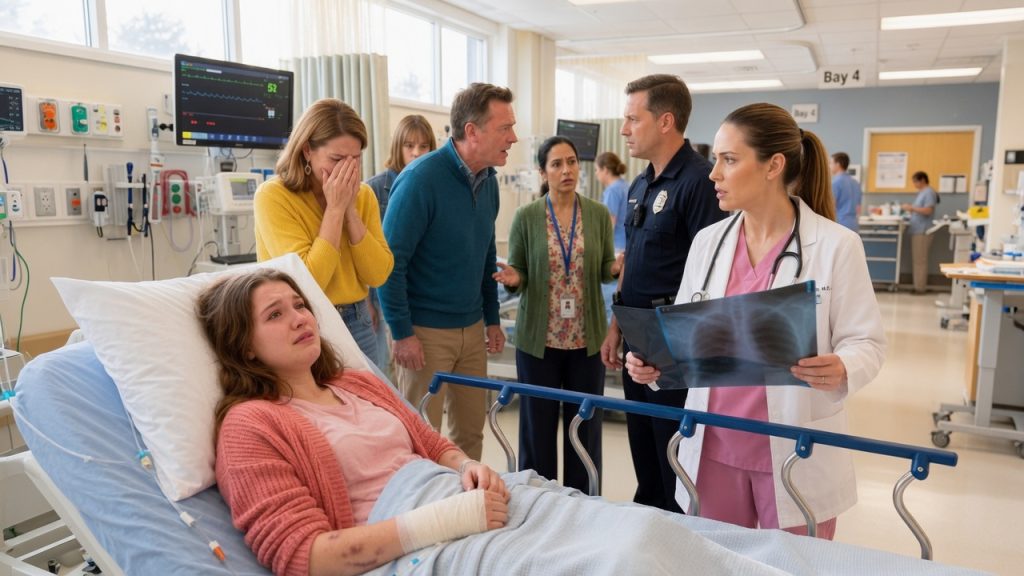
After an argument, I ended up in the emergency room with injuries that could not be ignored, and even raising my left arm sent pain through my side.
The ER doctor, Dr. Marisol Grant, stepped behind the curtain carrying my X-rays.
Before she spoke, I saw something change in her expression.
“Mr. and Mrs. Whitaker,” she said, “I’d like to speak with you outside for a moment.”
Dad shook his head.
“She’s my daughter. You can talk here.”
Dr. Grant looked at me, then back at him.
“Your daughter has several injuries that require treatment,” she said carefully. “I also noticed signs that suggest this may not be an isolated incident.”
The room fell silent.
Mom’s lips parted slightly.
Dad’s expression hardened.
“Kids get hurt,” he replied. “She’s always been clumsy.”
Dr. Grant did not argue.
Instead, she said calmly, “I’ve also observed injuries that appear to have happened at different times. As a physician, I’m required to report concerns like these.”
Brittany turned toward her.
“What does that mean?”
“It means I’m required by law to contact Child Protective Services.”
Dad took one step forward.
“You are not calling anyone.”
Before Dr. Grant answered, a hospital security officer appeared beside the curtain.
That was when I realized she had already alerted someone.
My stomach tightened.
For years, Dad’s voice had been enough to stop teachers, neighbors, relatives, and even me.
But inside that hospital room, his voice did not stop the doctor.
It did not stop the security guard.
And it did not stop the truth from moving closer.
About twenty minutes later, two women arrived.
One introduced herself as CPS investigator Angela Moore.
The other was Detective Claire Nolan.
Angela had kind eyes and a folder pressed against her chest.
Detective Nolan looked calm, but there was something sharp in the way she watched my father.
The moment they walked into the room, my father’s confidence faded for the first time in my life.
Angela asked if she could speak with me alone.
Dad answered first.
“No.”
Detective Nolan looked at him and said, “Sir, step back.”
I had never heard anyone speak to my father that way.
Behind them, Brittany suddenly began crying.
“I didn’t mean for anyone to get hurt,” she said. “She provoked me.”
That sentence was so familiar that I almost felt embarrassed hearing it out loud.
She provoked me.
Emily knows how to push buttons.
Emily is dramatic.
Emily exaggerates.
Emily should have walked away.
Angela quietly pulled the curtain closed.
Then she sat beside my hospital bed and said softly, “Emily, I need you to tell me what happens in your house when no one else is watching.”
For the first time, with my family waiting outside the curtain, I told the truth.
At first, my voice barely came out.
I stared at the white blanket over my knees and watched my fingers curl into the fabric.
Angela did not rush me.
Detective Nolan stood near the foot of the bed, quiet, patient, listening.
Dr. Grant stayed near the monitor, pretending to check notes so I would not feel surrounded.
I told them about Brittany’s anger.
How it came suddenly.
How the whole house learned to shift around it.
How Mom would lower her voice the moment Brittany’s footsteps sounded different.
How Dad would say, “Not tonight,” before anything even happened.
How everyone protected Brittany from consequences, and somehow that meant no one protected me.
Angela asked, “How long has this been happening?”
I swallowed.
“I don’t know exactly.”
“Years?”
I nodded.
“Since I was little.”
My voice cracked at the words.
Because saying it made it real in a way I had avoided for too long.
Brittany had always been bigger than me, louder than me, and better at convincing people she was the one hurting.
When we were kids, she broke my favorite music box and cried before I could speak.
Mom comforted her.
Dad told me to stop upsetting my sister.
When I was ten, she shoved me into a bookshelf during a fight over the television remote.
My shoulder hurt for days.
Dad said sisters fought.
When I was twelve, she threw my school project into the trash because I had gotten praised at parent-teacher night.
Mom told me not to brag around Brittany.
When I was fourteen, she locked me outside during a winter rainstorm after I refused to give her my phone.
I got sick for a week.
Dad said I should have apologized sooner.
Every incident became a lesson about how I had failed to keep the peace.
I learned not to cry loudly.
I learned not to ask for help.
I learned where to stand in rooms so I could reach the door first.
I learned which floorboards creaked outside Brittany’s bedroom.
I learned to hide bruises under hoodies, long sleeves, and stories about falling off my bike.
Angela’s eyes filled with sadness, but she stayed professional.
“Did your parents know?”
I looked toward the curtain.
Outside, Dad was speaking in a harsh whisper.
Mom was crying quietly.
Brittany was saying something I could not make out.
“Yes,” I whispered.
“Did they ever take you to a doctor before?”
I hesitated.
“Sometimes. But only when they had to.”
Dr. Grant glanced up from the chart.
Angela leaned forward slightly.
“What happened when they took you?”
“They said I fell. Or that I was clumsy. Or that I played too rough.”
“Did you say anything different?”
My throat tightened.
“No.”
“Why not?”
I looked down.
“Because Dad told me families don’t destroy each other in public.”
The room went still.
Detective Nolan wrote something in her notebook.
Angela’s voice softened.
“Emily, what happened today?”
I closed my eyes.
The memory came back in pieces.
The kitchen.
The smell of burnt toast.
Brittany standing near the island, scrolling through my phone because she had grabbed it from my backpack.
Me asking for it back.
Her laughing.
Me reaching for it.
The sharp crack of my phone hitting the tile.
My own voice saying, “Why do you always get away with this?”
Then the silence.
The dangerous silence.
Brittany’s face changing.
Mom gasping.
Dad stepping into the room too late.
Pain.
The floor.
My brother’s old soccer trophy tipping off a shelf.
Mom crying, “Brittany, stop!”
And Dad saying, “Enough. Both of you.”
Both of you.
Even then.
Even when I could barely breathe.
He had looked at me and Brittany as though we had caused the same damage.
I told Angela everything I could remember.
Not because I wanted revenge.
Not because I hated Brittany.
But because I was tired.
Tired of being the price everyone paid to keep her calm.
Tired of pretending a family was healthy just because it could look normal from the sidewalk.
When I finished, Angela placed a hand on the bed rail.
“You did the right thing telling us.”
I did not feel brave.
I felt terrified.
“What happens now?” I asked.
Angela looked at Detective Nolan.
Then she looked back at me.
“Right now, our job is to make sure you’re safe.”
Safe.
The word sounded foreign.
Outside the curtain, Dad’s voice rose.
“This is ridiculous. She’s a minor. She’s coming home with us.”
Detective Nolan opened the curtain halfway.
“Mr. Whitaker, lower your voice.”
“My daughter is not being questioned like a criminal.”
“She is not being questioned like a criminal,” the detective said. “She is being protected like a child.”
Dad’s face flushed red.
Mom stood behind him with tears on her cheeks.
Brittany sat with her arms wrapped around herself, rocking slightly.
When she saw me looking, her expression twisted.
“You’re lying,” she said.
I flinched.
Angela stepped between us.
“Brittany, you need to remain seated.”
“This is her fault,” Brittany shouted. “She always does this. She makes everyone hate me.”
Mom moved toward Brittany instantly.
“Honey, calm down.”
And there it was again.
Honey.
Calm down.
Not Emily, are you okay?
Not Emily, I’m sorry.
Even in the emergency room, with my ribs aching and strangers asking questions, my mother crossed the room to comfort the person who had hurt me.
Something inside me quietly broke.
Not loudly.
Not dramatically.
Just a small, final crack.
Dr. Grant returned with another physician, a pediatric specialist named Dr. Harris.
They explained that my scans showed more than injuries from that day.
There were signs of older healing fractures.
Evidence that my body had been hurt before and left to heal without proper care.
I watched my mother cover her mouth.
Dad shook his head.
“No. That’s impossible.”
Dr. Grant’s voice remained steady.
“The findings are consistent with repeated trauma over time.”
Dad glared at me.
“You told them that?”
I did not answer.
Detective Nolan stepped closer.
“Do not speak to her like that.”
Dad stared at the detective as if he could not understand how he had lost control of the room.
For as long as I could remember, my father had controlled stories.
At church, we were the Whitakers, the polished family in the third pew.
Dad owned a local insurance agency and sponsored Little League teams.
Mom organized charity bake sales and smiled in every photo.
Brittany was the misunderstood older daughter who needed patience.
I was the quiet one.
The easy one.
The good one.
The one who adjusted.
The one who forgave.
The one who never made things harder.
That day, in the hospital, strangers looked behind the story my father had built.
And the story collapsed.
Angela told my parents I would not be released into their care that night.
My father exploded.
“You can’t do that.”
“We can,” Angela said. “And we are.”
Mom began sobbing.
“We only tried to keep the family together.”
Detective Nolan looked at her.
“By hiding what was happening to a child?”
Mom had no answer.
Brittany screamed my name.
Security stepped in before she reached the curtain.
The officer guided her back, and for the first time in my life, someone stopped Brittany before she got close to me.
Angela turned to me and said, “Emily, is there anyone safe you trust? A relative? A family friend?”
My mind went blank.
Dad had made our world small over the years.
People who asked too many questions stopped being invited over.
Neighbors who noticed things were called nosy.
Teachers who expressed concern were told I had anxiety.
Relatives who challenged Dad became “bad influences.”
Then I thought of Aunt Lisa.
My mother’s younger sister.
She had disappeared from our lives when I was eleven.
Not literally.
She lived two towns away.
But Dad said she was toxic.
Mom said talking about her upset Brittany.
Brittany said Aunt Lisa hated her.
So Aunt Lisa became a name no one mentioned.
But I remembered her.
She used to bring me strawberry cupcakes on my birthday.
She used to call me Emmy.
She used to kneel down when she spoke to me, like my words mattered.
The last time I saw her, she had argued with Dad in our driveway.
I had watched from the upstairs window.
Aunt Lisa had pointed toward the house and said something I could not hear.
Dad had shouted back.
After that, she was gone.
“I have an aunt,” I whispered. “Lisa Harper.”
Angela wrote it down.
“Do you know her phone number?”
I shook my head.
“But she owns a flower shop. Harper Blooms.”
Detective Nolan stepped out to make a call.
While she was gone, Dr. Grant gave me medicine for the pain and explained what treatment I needed.
She spoke gently, but not like I was fragile glass.
She spoke like I deserved to know what was happening to my own body.
That alone nearly made me cry.
About forty minutes later, Detective Nolan returned.
“We reached your aunt,” she said.
My heart pounded.
“She’s coming.”
Dad heard through the curtain.
“No,” he snapped. “Absolutely not.”
Detective Nolan looked at him.
“You don’t get to decide that right now.”
Dad’s face turned pale.
That was when fear truly entered his eyes.
Not fear for me.
Fear of exposure.
Aunt Lisa arrived less than an hour later.
I knew it was her before I saw her because my mother started crying harder.
Then the curtain opened.
A woman with dark blond hair, a raincoat, and red eyes stepped inside.
She looked older than I remembered, but the moment she saw me, her face crumpled.
“Oh, Emmy.”
That name undid me.
I started crying before she reached the bed.
Aunt Lisa did not grab me.
She did not overwhelm me.
She stopped beside the bed and asked, “Can I hug you?”
I nodded.
She wrapped her arms around me carefully, avoiding my injured side.
For the first time all day, I felt like someone had come for me.
Not to defend the family.
Not to silence me.
To protect me.
“I tried,” she whispered into my hair. “I tried so many times.”
I pulled back and looked at her.
“What?”
She wiped her cheek.
“I called. I came by. I reported concerns when you were younger. Your father convinced everyone I was bitter. Your mother stopped answering. Then they moved you to a different school, and I couldn’t get close anymore.”
I stared at her.
All those years, I thought she had left.
But she had been pushed out.
Angela asked Aunt Lisa several questions.
Did she have a safe home?
Was she willing to be considered as a temporary kinship placement?
Could she cooperate with CPS?
Aunt Lisa answered yes before Angela finished.
“Yes. Whatever she needs. She can come with me. She can stay forever if she wants.”
Forever.
The word scared me.
Hope scared me more than pain sometimes.
Because pain was familiar.
Hope asked me to imagine a life I did not know how to trust.
Dad saw Aunt Lisa through the curtain opening.
“You have no right to be here,” he said.
Aunt Lisa turned slowly.
For years, I had imagined their last argument as something dramatic and unclear.
But now I saw the truth in her face.
She was not afraid of him.
“You kept me away from her because I saw what was happening,” Aunt Lisa said.
Dad pointed at her.
“You know nothing about my family.”
“I know enough,” she replied. “I knew enough when Emily was eleven and flinched every time Brittany walked into a room. I knew enough when your wife called me crying and then denied it the next day. I knew enough when you threatened to call the police if I came near your house again.”
Mom whispered, “Lisa, please.”
Aunt Lisa looked at her sister.
“No, Karen. Not anymore.”
My mother’s face folded in on itself.
For a second, I saw her not as the mother who failed me, but as a woman who had been afraid for a long time.
Then I remembered every night she had chosen silence.
Her fear might have explained things.
It did not excuse them.
Detective Nolan asked my parents to step into a separate room.
Dad refused.
Then the detective said something about obstruction and interfering with an investigation.
He went.
Mom followed.
Brittany stayed seated, guarded by the security officer.
She looked smaller now.
Not harmless.
Just smaller.
She stared at me with wet eyes.
“You ruined my life,” she said.
I looked at her for a long moment.
For years, those words would have destroyed me.
I would have apologized.
I would have promised not to tell.
I would have tried to make myself smaller so she could breathe easier.
This time, I said nothing.
Because I finally understood something.
I had not ruined her life by telling the truth.
The truth had only uncovered what everyone else had been burying.
Later that night, a social worker brought me a sweatshirt from the hospital donation closet because my shirt had been taken for documentation.
It was navy blue and too big.
Aunt Lisa helped me pull it over my head.
She moved slowly, asking before touching me, treating every wince like it mattered.
Angela explained that there would be an emergency protection plan.
I would leave the hospital with Aunt Lisa once medically cleared.
CPS would investigate.
Detective Nolan would continue gathering statements.
My parents would not be allowed to take me home.
Brittany would be questioned separately.
The words sounded official and impossible.
“Can I get my things?” I asked.
Angela’s expression softened.
“Not tonight. We can arrange for essentials later.”
My things.
My room.
My sketchbooks under the bed.
My favorite sweater.
The photo strip from freshman year with my best friend Mia.
My life was still in that house.
But I was not going back to sleep under that roof.
That realization made me tremble.
Aunt Lisa noticed.
“You don’t have to think about everything tonight,” she said.
“What if they hate me?” I whispered.
She brushed hair from my forehead.
“Then they hate the truth. That is not the same as hating you.”
I wanted to believe her.
At nearly midnight, Dr. Grant returned with discharge instructions.
She stood beside my bed and looked me in the eyes.
“Emily, I want you to remember something,” she said. “You did not cause this by telling us. The injuries were already there. The danger was already there. Speaking up allowed people to help.”
I nodded, though my throat tightened again.
“Thank you,” I whispered.
Dr. Grant smiled sadly.
“I’m glad you came in tonight.”
At the time, I did not understand how much those words would mean to me later.
I’m glad you came in tonight.
Not I’m sorry this happened.
Not you poor thing.
Glad.
Because coming in meant I had survived long enough to be seen.
When Aunt Lisa drove me away from the hospital, the city lights blurred through the car window.
I sat in the passenger seat with a seatbelt pulled carefully across my lap.
My body hurt.
My phone was broken.
My parents were at the hospital with investigators.
My sister was somewhere behind us, still crying that I had betrayed her.
But outside the car, the night looked strangely normal.
Gas stations glowed.
Traffic lights changed.
People carried groceries.
A couple walked a dog under a streetlamp.
The world had not ended.
Mine had split open, but the world kept going.
Aunt Lisa’s house was small and warm.
There were flower catalogs on the kitchen table, a yellow kettle on the stove, and a quilt folded over the back of the couch.
She gave me the guest room.
Not the couch.
Not an air mattress.
A room.
The bedspread had tiny blue flowers on it.
A lamp glowed softly on the nightstand.
Beside it sat a framed photo I had not seen in years.
Me at eight years old, missing a front tooth, holding a cupcake with pink frosting.
Aunt Lisa saw me looking.
“I kept it,” she said quietly. “I kept all of them.”
She opened a drawer and showed me an envelope filled with birthday cards.
Each one had my name on it.
Emily.
Emmy.
Sweet girl.
They had never reached me.
“I sent them every year,” she said.
My hands shook as I touched the envelopes.
“Dad said you forgot about me.”
Aunt Lisa closed her eyes.
“No. Never.”
I cried again that night, but it was different.
At home, crying had always been dangerous.
Someone would accuse me of being dramatic.
Someone would tell me to stop making Brittany feel worse.
Someone would say, “This is why things escalate.”
At Aunt Lisa’s house, no one punished my tears.
She sat in a chair by the door until I fell asleep because I asked her not to leave yet.
The next morning, sunlight came through lace curtains.
For a moment, I did not know where I was.
Then pain reminded me.
Memory returned.
Hospital.
CPS.
Aunt Lisa.
Truth.
I found Aunt Lisa in the kitchen making oatmeal.
She had dark circles under her eyes, like she had not slept much.
“Morning,” she said gently. “How’s your pain?”
I shrugged.
“Okay.”
She gave me a look.
A real look.
The kind adults give when they want the truth.
“Hurts,” I admitted.
“Thank you for telling me.”
She handed me the medicine schedule Dr. Grant had written and a glass of water.
That was the first small lesson of my new life.
When I told the truth, nobody exploded.
After breakfast, Angela came by.
She sat with me and Aunt Lisa at the kitchen table.
There were forms.
Questions.
Plans.
She explained that a judge would review the emergency placement.
I might have to speak with more people.
There could be interviews, court hearings, and therapy.
She said my parents were already claiming everything had been exaggerated.
Dad said I had always been attention-seeking.
Mom said she never saw anything serious.
Brittany said I had attacked her first.
I listened quietly.
My hands were wrapped around a mug of tea.
Aunt Lisa’s hand rested near mine on the table, not touching unless I wanted it.
Angela watched my face.
“You don’t have to prove everything today,” she said. “There are medical records now. There are scans. There are people looking.”
People looking.
That was new too.
For years, I had felt invisible in plain sight.
Teachers saw me tired and believed I was shy.
Church ladies saw me quiet and called me polite.
Neighbors heard shouting and turned up their televisions.
Doctors accepted stories because Dad spoke confidently and Mom cried convincingly.
But now, people were looking.
And once they looked, they found more.
Over the next week, the investigation widened.
Detective Nolan spoke with my school counselor.
She found records of unexplained absences.
Visits to the nurse.
A report from middle school where a teacher wrote that I seemed afraid to go home.
There were notes from Aunt Lisa’s old calls.
Not enough at the time, maybe.
Scattered concerns.
Small red flags.
But together, they formed a map.
A map of all the moments when someone had almost seen me.
Angela also spoke with neighbors.
One woman admitted she had heard screaming more than once.
Another said she had seen me sitting on the porch late at night in cold weather.
A former babysitter said Brittany had always been frighteningly jealous of me, even when we were little.
Slowly, the perfect Whitaker family became something else.
Not in whispers.
Not in gossip.
In records.
Statements.
Evidence.
Dad tried to regain control.
He called Aunt Lisa’s house again and again until Detective Nolan warned him to stop.
He left voicemails saying I was confused.
Then angry ones saying I was ungrateful.
Then soft ones saying the family missed me.
Mom texted Aunt Lisa because she was not allowed to contact me directly.
Please tell Emily we love her.
Please tell her Brittany is not doing well.
Please tell her this is tearing the family apart.
Aunt Lisa showed Angela every message.
She did not show them to me unless I asked.
At first, I asked every time.
I could not help it.
I wanted to know if Mom had finally said she was sorry.
But every message was about Brittany.
Brittany is crying.
Brittany feels abandoned.
Brittany might lose everything.
Brittany needs her sister.
After the fourth message, I stopped asking.
Aunt Lisa found me in the guest room holding one of the unopened birthday cards.
“You don’t have to read them all at once,” she said.
“I keep hoping one says something that makes it all make sense.”
She sat at the edge of the bed.
“Sometimes adults fail children because they are selfish. Sometimes because they are scared. Sometimes because they convince themselves the easier lie is kindness.”
I looked at her.
“Which one was Mom?”
Aunt Lisa’s eyes filled.
“All three, maybe.”
That answer hurt.
But it felt honest.
A few days later, Angela asked if I wanted to attend a supervised meeting with my parents.
She made it clear I could say no.
At first, I did.
Then I changed my mind.
Not because I wanted to go home.
Not because I wanted them to convince me.
Because there was one question burning inside me.
Why me?
The meeting happened in a county office with beige walls and a round table.
Angela sat beside me.
Aunt Lisa waited outside because I asked her to stay close.
Detective Nolan observed from the back of the room.
Dad wore a suit.
Mom wore the same pearl earrings she wore to church.
They looked like parents from a school awards ceremony.
Normal.
Respectable.
Worried.
For a second, my body believed the old story.
Then Dad spoke.
“Emily, this has gone too far.”
And just like that, the spell broke.
Angela said, “Mr. Whitaker, this meeting is not for pressuring Emily.”
He inhaled sharply.
Mom leaned forward.
“Sweetheart, we’re so sorry you’re hurt.”
I waited.
She wiped her eyes.
“But you have to understand, your sister has struggles. She has always had struggles. We were trying to protect both of you.”
I stared at her.
“Protect both of us?”
Mom’s lips trembled.
“We didn’t want Brittany’s future destroyed over mistakes.”
“What about my future?”
She looked down.
Dad answered instead.
“You had food. A roof. A private school. Don’t act like you were neglected.”
Angela’s voice sharpened.
“Mr. Whitaker.”
But I raised my hand slightly.
I wanted to speak.
For once, I wanted to speak before someone else explained me away.
“You taught me that being loved meant being quiet,” I said.
Dad frowned.
“That’s not fair.”
“You taught me that peace mattered more than my safety.”
Mom started crying harder.
I looked at her.
“You saw me. You knew when I was limping. You knew when I stopped wearing short sleeves. You knew when I slept with a chair under my doorknob.”
Mom covered her face.
Dad said, “Enough.”
The word hit the room like a slammed door.
For a second, I was back in the kitchen.
Back on the floor.
Back being told both of us were wrong.
But Angela’s hand touched the table near mine.
Detective Nolan shifted in her chair.
Aunt Lisa was outside.
I was not alone.
“No,” I said.
My voice shook, but it held.
“Not enough. You don’t get to say enough anymore.”
Dad stared at me.
I had never spoken to him like that.
Mom whispered, “Emily…”
I looked between them.
“I came here to ask why you let it happen.”
Neither answered.
And that was the answer.
There was no reason good enough.
No explanation that could turn neglect into love.
No family reputation worth a child’s safety.
No sister’s pain that justified making me carry all of it.
I stood up.
Angela stood with me.
“I’m done,” I said.
Then I walked out.
Aunt Lisa was waiting in the hallway.
The moment she saw my face, she opened her arms.
This time, I walked straight into them.
Weeks passed.
Then months.
I started therapy.
At first, I hated it.
The therapist, Ms. Rowe, had plants in her office and a soft voice that made me suspicious.
She asked questions that seemed too simple.
Where do you feel fear in your body?
What happens when someone raises their voice?
What would you say to your younger self?
I wanted to say, “I’d tell her to run.”
But one day, after a long silence, I said, “I’d tell her she wasn’t hard to love.”
Ms. Rowe nodded like that was important.
Maybe it was.
School changed too.
I transferred to a public high school near Aunt Lisa’s house.
On my first day, I wore a loose sweater even though it was warm.
I expected everyone to know.
To stare.
To whisper, “That’s the girl whose family got investigated.”
But no one knew.
A girl named Harper asked if I wanted help finding chemistry.
A boy in art class complimented my sketch of a sunflower.
A teacher noticed I froze when someone dropped a metal ruler and quietly asked if I needed a minute.
Small kindnesses felt huge.
Aunt Lisa gave me space to rebuild.
She did not force me to talk.
She did not get angry when I startled.
She did not take it personally when I locked my bedroom door.
In fact, she bought me a better lock.
Not to trap me.
To make me feel safe.
“This is your room,” she said. “People knock here.”
People knock here.
I wrote that sentence in my sketchbook.
Then I drew a door with flowers growing around it.
The court process took longer than I expected.
There were hearings.
Evaluations.
Reports.
Dad’s lawyer tried to paint the situation as sibling conflict blown out of proportion.
But Dr. Grant’s medical findings changed everything.
So did the old records.
So did Aunt Lisa’s documented attempts to report concerns.
So did my own statement.
Eventually, the court kept me in Aunt Lisa’s care.
My parents were ordered to complete services before any visitation could be reconsidered.
Brittany faced consequences too, though because she was nineteen, her case moved differently.
I heard she was required to attend counseling and anger management.
I heard Dad was furious.
I heard Mom blamed stress.
I heard many things.
For a while, every update felt like a hook trying to pull me backward.
Then one afternoon, I was helping Aunt Lisa at the flower shop when Angela came in.
She was off duty, wearing jeans and a green sweater.
She bought a small bouquet of daisies.
Before leaving, she looked at me.
“You look different,” she said.
I smiled a little.
“Good different?”
“Safe different.”
After she left, I went into the back room and cried.
Not because I was sad.
Because someone had noticed healing too.
The first time Mom wrote me a real letter, it came five months after the hospital.
Aunt Lisa handed it to me and said I could read it, save it, or throw it away.
I sat on the porch with it for nearly an hour before opening it.
Emily,
I do not know how to write this without making excuses, and I am trying not to make excuses anymore.
I failed you.
I saw more than I admitted.
I told myself I was preventing something worse.
I told myself Brittany needed me more because you were stronger.
That was a terrible thing to put on a child.
You were not stronger. You were surviving.
I am sorry.
I do not expect forgiveness.
I only want you to know I am finally telling the truth.
Mom.
I read it three times.
Then I folded it and placed it back in the envelope.
I did not forgive her that day.
But I did not throw it away.
That was all I could offer.
Dad did not write a letter.
Not then.
Not for a long time.
When he finally did, it was full of sentences like, “Mistakes were made,” and “Everyone suffered,” and “I hope one day you see the full picture.”
I gave it to my therapist.
She read it and asked what I felt.
I said, “Tired.”
She said, “That is an answer.”
I never responded.
Brittany sent one message through her lawyer.
It said she was sorry things got out of hand.
Out of hand.
As if what happened to me was a cup slipping off a counter.
As if years of fear were an accident.
I did not respond to her either.
People sometimes think healing means dramatic closure.
A courtroom confession.
A tearful apology.
A family reunion where everyone finally understands.
But my healing came quietly.
It came the first time I slept through the night.
The first time I laughed in Aunt Lisa’s kitchen and did not immediately look around to see if someone was annoyed.
The first time I wore a short-sleeved shirt to school.
The first time I told a friend, “I don’t want to talk about that,” and she said, “Okay,” without punishing me.
It came when I turned seventeen and Aunt Lisa threw me a small birthday dinner.
There were strawberry cupcakes.
Just like when I was little.
Mia came, because Aunt Lisa helped me reconnect with her.
Harper from school came too.
Dr. Grant sent a card through Angela, careful and professional, simply wishing me well.
I cried before blowing out the candles.
Aunt Lisa asked if I was okay.
I nodded.
“I just didn’t know birthdays could feel like this.”
“Like what?”
I looked around the table.
Quiet.
Warm.
No one waiting for Brittany’s mood to change.
No one measuring my happiness against someone else’s pain.
“Mine,” I said.
Aunt Lisa smiled.
“Because it is.”
The next year, I stood in a courthouse again.
This time, it was not for an emergency hearing.
It was for guardianship.
Aunt Lisa had petitioned to become my legal guardian until I turned eighteen.
My mother did not contest it.
My father did.
But the judge reviewed everything.
The medical records.
The reports.
My statement.
My therapist’s recommendation.
Aunt Lisa’s home study.
When the judge approved it, Aunt Lisa squeezed my hand so tightly I almost laughed.
Outside the courthouse, she asked, “How do you feel?”
I looked up at the sky.
It was bright blue, almost painfully clear.
“I don’t know.”
“That’s allowed.”
After a moment, I said, “I feel like I can breathe.”
She nodded, tears in her eyes.
“Then we’ll start there.”
By the time I graduated high school, I had stopped checking for my parents’ car outside every event.
Aunt Lisa sat in the front row with a bouquet of yellow roses.
When my name was called, she stood and clapped louder than anyone.
For a second, as I crossed the stage, I thought about the girl in the hospital bed.
The girl who could barely lift her arm.
The girl who believed telling the truth would destroy everything.
In a way, it did.
It destroyed the lie.
It destroyed the version of our family that only survived by sacrificing me.
It destroyed my father’s control.
It destroyed my mother’s silence.
But it did not destroy me.
After graduation, Aunt Lisa drove me to the flower shop.
In the back room, she had set up a small cake.
On top, in blue icing, it said:
You made it, Emmy.
I laughed and cried at the same time.
That summer, I volunteered at a youth support center.
At first, I only organized supplies.
Then I helped paint a mural in the counseling room.
Sunflowers.
Open windows.
A blue door with flowers growing around it.
One afternoon, a girl about thirteen sat nearby while I cleaned brushes.
She wore a hoodie in July.
She kept pulling the sleeves over her hands.
I recognized the movement.
Not the story.
Not the details.
Just the instinct to disappear.
She glanced at the mural and said, “Did you paint the door?”
“Yeah,” I said.
“Why are there flowers around it?”
I looked at the blue door.
“Because sometimes a door is not just something that keeps people out,” I said. “Sometimes it is something that lets you choose when to open it.”
She thought about that.
Then she nodded.
I did not ask her questions.
I did not push.
But before she left, I told her, “There are people here who listen.”
She looked at me for a long moment.
Then she whispered, “What if no one believes me?”
I felt the old ache in my chest.
“They might,” I said. “And if the first person doesn’t, keep telling. The truth deserves more than one chance.”
That night, I told Aunt Lisa about the girl.
She listened while arranging roses for a wedding order.
When I finished, she said, “You know, you’re becoming someone younger you would have needed.”
I looked down at my hands.
They were steady now.
Not always.
But more often.
“I hope so,” I said.
Years later, people would ask why I went into social work.
Some expected a simple answer.
Because of what happened.
Because I wanted to help kids.
Because the system saved me.
All of that was true, but incomplete.
The real answer was Dr. Grant’s face when she saw what others had ignored.
Angela’s voice when she told me I was not going home.
Detective Nolan standing between me and my father.
Aunt Lisa arriving at midnight, saying my childhood nickname like she had been carrying it in her heart for years.
The real answer was the moment I realized that one adult looking closely could change everything.
I never became fearless.
I still flinched sometimes.
I still hated shouting.
I still had days when guilt knocked on the door and sounded like my mother’s voice.
But I learned not to open every door.
I learned love did not require silence.
I learned family was not proven by how much pain you could hide.
And I learned that being believed is not a small thing.
It can be the first breath after years underwater.
On my twenty-first birthday, Aunt Lisa gave me a small wrapped box.
Inside was the old photo of me with the cupcake, newly framed.
Behind it, tucked carefully, were copies of every birthday card she had sent.
“I thought you should have them now,” she said.
I ran my fingers over the envelopes.
Years of proof.
Years of love that had been intercepted but never erased.
At the bottom of the box was a note.
Emmy,
They made you believe you were forgotten.
You were not.
They made you believe silence was loyalty.
It was not.
They made you believe surviving quietly was your only choice.
It was not.
I am so proud of the life you are building.
Love,
Aunt Lisa.
I held the note against my chest.
Then I looked around her kitchen.
The yellow kettle.
The flower catalogs.
The same warm light that had welcomed me the night I left the hospital.
For the first time, I did not think of that night only as the night everything fell apart.
It was also the night everything began.
Because my father said, “We’ll handle this at home.”
But the doctor looked closer.
She saw what my family had hidden.
She made one phone call.
And that call brought people to the hospital who finally understood what I had been trying to survive.
They uncovered the truth.
They opened the door.
And for the first time in my life, I walked through it.
THE END! THANK YOU FOR READING!