

My name is Mary Davis.
I am fifty-four years old, a widow, a mother, and the kind of woman who still believes dinner can fix almost anything.
A warm kitchen.
A full table.
Sweet tea sweating in glass pitchers.
Pot roast soft enough to fall apart under a fork.
That was how I raised my daughter, Danielle.
With food.
With prayers.
With warnings she rolled her eyes at.
And with a love so deep I thought she would always know how to come home.
But that night, when my twenty-two-year-old daughter brought her boyfriend over for dinner, I learned something terrible.
Sometimes a child comes home smiling because she is too scared to scream.
Danielle called me three days before.
“Mom,” she said, “I want you to meet Evan.”
There was something careful in her voice.
Not happy.
Not nervous.
Careful.
Like she was reading from a card.
“Evan?” I asked, drying a plate at the sink.
“My boyfriend.”
I smiled even though she couldn’t see it.
“Well, that’s big news.”
“He’s important to me.”
“Then he’s important to me.”
A pause.
Then she said, “Please don’t judge him.”
That made my hands still.
“Why would I judge him?”
“He’s different.”
“How different?”
“He’s older.”
“How much older?”
“Thirty-four.”
I closed my eyes.
Danielle was twenty-two.
Still young enough to forget coats in winter.
Still young enough to think love meant being chosen.
But I kept my voice gentle.
“If he treats you well, I’ll listen.”
“He does,” she said quickly.
Too quickly.
“He saved my life, Mom.”
Those words stayed with me.
Saved her life.
From what?
Danielle had always been independent, but lately she had been disappearing into herself.
She didn’t answer calls right away.
She canceled lunch twice.
She stopped posting pictures with her friends.
When I asked about work, she said she had quit.
When I asked why, she said Evan thought she needed rest.
Evan thought.
Evan said.
Evan wanted.
His name had started appearing in every answer.
Still, I made dinner.
Because mothers hope.
Even when their stomachs know better.
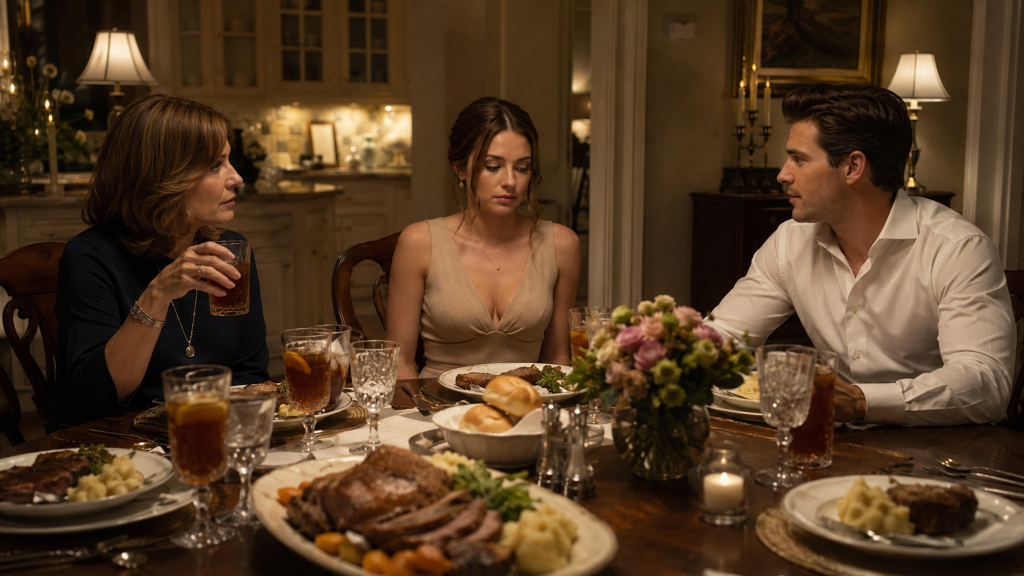
They arrived at eight.
Danielle came first, stepping onto my porch in a beige dress I had never seen before.
It was pretty.
Too pretty for a simple dinner.
Her hair was pinned back.
Her lipstick was perfect.
Her smile was wrong.
Behind her stood Evan.
Tall.
Handsome.
White shirt.
Dark trousers.
Flowers in his hand.
He looked like the kind of man strangers trusted.
“Mrs. Davis,” he said warmly. “A pleasure.”
He hugged me before I offered my hand.
The flowers brushed my shoulder.
His cologne was expensive.
But underneath it, there was something cold.
Not a smell exactly.
A feeling.
Like a locked door.
“Call me Mary,” I said.
His smile widened.
“Of course, Mary.”
Danielle’s eyes flicked toward him.
Not at me.
At him.
As if checking whether that was allowed.
I noticed.
Mothers notice everything.
At the table, Evan sat beside Danielle, not across from her.
Close enough that their shoulders touched.
Close enough that he could reach her knee under the table.
I poured sweet tea.
Danielle whispered, “Thank you.”
Before I could answer, Evan laughed softly.
“She doesn’t drink sweet tea anymore.”
I looked at my daughter.
Since when?
Danielle loved sweet tea.
She used to drink it straight from the pitcher when she thought I wasn’t looking.
“She can have water,” Evan said.
“I can ask her,” I replied.
A tiny silence fell.
Then Danielle said, “Water is fine, Mom.”
Her voice had no weight.
Like it had been emptied.
Dinner began.
Evan talked beautifully.
That was the worst part.
He knew how to sound charming.
He complimented the roast.
He asked about my late husband.
He told me he owned businesses in Dallas.
He said he believed in discipline, ambition, and building a legacy.
Then he placed his hand over Danielle’s and said, “Danielle is a woman who needs direction.”
My fork paused halfway to my mouth.
“Direction?” I asked.
He smiled.
“She’s emotional. Creative. Easily influenced. I help her focus.”
Danielle stared at her plate.
I looked at her hand under his.
Her fingers were stiff.
“Danielle has always had a good head on her shoulders,” I said.
Evan’s smile did not move.
“I’m sure you did your best.”
There it was.
The insult wrapped in politeness.
I gripped the napkin in my lap.
Every time I asked Danielle a question, Evan answered.
“How is work?”
“Danielle isn’t working right now.”
“How is Rachel? You two still close?”
“Danielle needed distance from certain friends.”
“Are you still painting?”
“Danielle gets distracted by hobbies.”
Danielle barely ate.
Her mashed potatoes stayed untouched.
Her roast went cold.
Once, I saw her move her foot under the table.
Evan’s jaw tightened.
Then came the fork.
Clink.
His fork hit the floor.
“How clumsy of me,” he said.
He bent down slowly.
When he came back up, he looked at me.
Not embarrassed.
Not amused.
Watching.
A few minutes passed.
Clink.
The fork fell again.
This time, Danielle flinched.
Not much.
Just a tiny jerk of her shoulder.
But enough.
“Everything okay, sweetie?” I asked.
“Yes, Mom.”
But that was not my daughter’s voice.
That was fear pretending to be manners.
I studied Evan’s hands.
Clean nails.
Expensive watch.
No wedding ring.
Then I looked at Danielle’s neck.
There was makeup near her collarbone.
Too much makeup.
My stomach twisted.
The third time, the fork fell near my chair.
Before Evan could bend, I leaned down.
And then I saw it.
His right shoe was planted on top of Danielle’s foot.
Not resting there.
Pressing.
Crushing her foot against the floor.
Danielle’s toes were curled inside her shoe.
Her whole body was frozen.
But that wasn’t what made my blood go cold.
It was her calf.
There were bruises there.
Old ones.
Yellow at the edges.
Purple in the middle.
And a bandage poorly hidden beneath the hem of her dress.
Then I saw the paper.
A small folded note taped under her dress near her knee.
Placed exactly where only someone bending under the table would see it.
Placed for me.
My hand trembled.
Evan bent down too.
“I’ll get it, ma’am.”
He smiled.
But his eyes told me not to touch anything.
I grabbed the fork with one hand.
With the other, I ripped the paper loose and closed it inside my fist.
Then I stood.
“I’m going to get more napkins,” I said.
I walked to the kitchen.
Slowly.
Because if I ran, he would know.
Because if Danielle cried, he would punish her.
Because my home had become a trap, and my daughter was sitting inside it.
By the sink, I opened the note.
Six words.
Written in black eyeliner.
Mom, don’t argue. He’s armed.
For one second, the room tilted.
I gripped the counter.
My baby.
My little girl who used to sleep with a nightlight.
My Danielle, who cried when a bird hit the window.
My daughter had taped a warning to her own skin because speaking could get her killed.
From the dining room, Evan called, “Everything okay, Mom?”
Mom.
As if he had already claimed me too.
I opened the drawer where I kept recipe cards and old receipts.
My cell phone was there.
I dialed 911.
I did not speak at first.
I placed the phone beside a glass and turned on the faucet.
The operator answered.
“911, what is your emergency?”
I whispered, “Private residence. My daughter is in danger. There is an armed man.”
“Ma’am, are you safe?”
“No.”
“Can you stay on the line?”
Footsteps.
Evan’s chair scraped.
“Mary?” he called.
Closer now.
“Who are you talking to?”
I hung up.
I shoved the phone into my apron pocket.
When I turned, Evan stood in the kitchen doorway.
He was no longer smiling.
Danielle stood behind him, crying silently.
“I thought you needed napkins,” he said.
“I did.”
His eyes dropped to my apron pocket.
Then back to my face.
“How curious,” he said. “Danielle told me you were an obedient woman.”
My daughter whispered, “Mom, I’m sorry.”
I looked at her hands.
Empty.
Then I looked at Evan’s belt.
There it was.
The black grip of a handgun.
Partly hidden under his shirt.
My mouth went dry.
Before I could speak, the doorbell rang.
Once.
Twice.
Evan moved fast.
He pulled the gun and pressed it against Danielle’s waist.
“Smile,” he whispered. “Both of you.”
The doorbell rang again.
Then a firm voice came from outside.
“Police department. We received a disconnected emergency call. We need to make sure everyone is okay.”
Relief almost broke through my face.
I buried it.
Evan leaned toward my ear.
“One wrong word,” he whispered, “and she dies first.”
Danielle trembled.
I forced my hands to stay still.
“I’ll send them away,” I said.
“You will.”
He pushed Danielle forward, using her body to shield the gun.
We walked to the front door.
Every step felt like stepping across thin ice.
The officer knocked again.
“Ma’am?”
I opened the door only a few inches.
Two officers stood on the porch.
A man and a woman.
Their eyes moved quickly.
My face.
My apron.
Danielle behind me.
Evan’s shoulder.
“Good evening,” the male officer said. “I’m Officer Harris. We got a call from this address.”
I smiled.
It felt like glass cracking.
“I’m sorry. That must have been an accident.”
The female officer looked at Danielle.
“Is everyone okay here?”
Evan’s hand tightened on my daughter’s waist.
Danielle nodded.
“Yes.”
Her voice shook.
Officer Harris looked past me.
“Sir, could you step into view?”
Evan smiled instantly.
Like someone had switched on a light.
“Of course, Officer.”
He appeared behind Danielle, one arm around her.
The gun was hidden behind her body.
“We were just having dinner with Mary. Family nerves, you know.”
Family.
I wanted to spit the word back at him.
Officer Harris did not smile.
“May we come in?”
Evan answered before I could.
“Is that necessary?”
The female officer’s eyes dropped.
To the floor.
To Danielle’s feet.
Her left shoe was slightly twisted.
Her toes were pressed downward.
She noticed.
Thank God, she noticed.
“Ma’am,” the female officer said to Danielle, “could you step out here for a moment?”
Evan laughed softly.
“She’s shy.”
Danielle’s eyes met mine.
One second.
That was all we had.
I remembered when she was six and got stuck in the old oak tree.
I had stood beneath her and said, “When I count to three, jump.”
She had cried, “I’m scared.”
I said, “Be scared and jump anyway.”
Now my daughter looked at me the same way.
Scared.
Waiting.
I took a breath.
Then I dropped the glass pitcher of sweet tea.
It shattered across the floor.
Evan’s eyes snapped toward it.
Danielle moved.
She slammed her heel down on his foot and twisted away.
The gun flashed into view.
The female officer shouted, “Gun!”
Everything happened at once.
Officer Harris grabbed Danielle and pulled her onto the porch.
The female officer drew her weapon and ordered Evan to drop his.
Evan grabbed my arm.
Hard.
He dragged me backward into the hallway.
The front door slammed half open.
Danielle screamed, “Mom!”
Evan pressed the gun near my ribs.
“Back up!” he shouted. “Back up or I’ll shoot her!”
The officers froze outside.
My heart pounded.
But I felt something else too.
Anger.
Not panic.
Anger.
Pure and hot.
This man had touched my child.
Bruised her.
Silenced her.
Made her afraid inside her own skin.
And now he was standing in my house, acting like fear made him powerful.
“You should have stayed out of it,” he hissed in my ear.
I looked at Danielle on the porch.
She was sobbing, held back by Officer Harris.
I wanted to comfort her.
But first I had to survive.
“Evan,” I said calmly. “Listen to me.”
“Shut up.”
“You don’t want to do this.”
He laughed.
“You don’t know what I want.”
“I know men like you.”
His grip tightened.
“You don’t know anything.”
“I know you picked a young woman because you thought she’d be easy to control.”
He breathed hard.
“I know you answered every question for her because you’re terrified of what she might say.”
“Stop talking.”
“And I know you’re not as calm as you pretend.”
The gun pressed harder.
Outside, the female officer said, “Evan, put the weapon down.”
He shouted, “You don’t even know my last name!”
But I did.
Because while he had talked at dinner, bragging about Dallas and businesses and legacy, he had mentioned one company.
Vale Security Consulting.
And I had remembered.
My late husband, Frank, used to say, “When someone talks too much, let them. They’ll hand you the rope.”
I said quietly, “Evan Vale.”
He went still.
That was enough.
The officers heard it.
The female officer repeated, “Evan Vale, drop the weapon.”
His breathing changed.
Now he knew the mask was gone.
He dragged me toward the back of the house.
“Move.”
I moved.
Slowly.
The officers followed from a distance.
Danielle kept crying my name.
Evan backed through the dining room.
The table was still set.
Pot roast cooling.
Candles burning.
A fork lying on the floor.
It looked like a normal dinner interrupted by a nightmare.
He pulled me into the kitchen.
The back door was there.
So was my cast-iron skillet on the stove.
Heavy.
Within reach.
But not close enough.
“Keys,” he said.
“What?”
“Car keys.”
“In my purse.”
“Where?”
“By the door.”
He cursed.
He needed a way out.
That meant he was afraid.
Good.
Fear makes men careless.
The 911 operator had likely heard enough before I hung up.
The police would not leave.
More were probably coming.
I just had to keep him talking.
“Evan,” I said, “you can still walk out alive.”
“Don’t act like you care.”
“I don’t care about you.”
He shoved me against the counter.
Pain shot through my hip.
“I care about my daughter.”
His face twisted.
“Your daughter belongs to me.”
Something inside me snapped.
Not loudly.
Quietly.
Completely.
“No,” I said. “She never did.”
His eyes burned.
“You think she came here because she wanted you? She came because I let her.”
“No,” I whispered. “She came because some part of her still knew I would see her.”
For the first time, he looked uncertain.
Then sirens sounded in the distance.
Faint.
Growing.
Evan heard them.
His hand jerked.
In that instant, I moved.
I threw my elbow backward into his stomach.
Not hard enough to stop him forever.
Hard enough to bend him.
The gun shifted.
I grabbed the pot of mashed potatoes from the counter and threw it at his face.
Hot potatoes hit his shirt and chin.
He yelled.
The gun fired once.
The sound cracked through the kitchen.
A cabinet door splintered.
I dropped to the floor.
The back door burst open.
Officers flooded in.
“Drop it!”
“Hands!”
“Drop the weapon now!”
Evan tried to turn.
But his foot slipped on sweet tea that had run from the hallway into the kitchen.
He went down hard.
The gun skidded under the table.
An officer kicked it away.
Three men pinned him before he could breathe.
He screamed.
Not words.
Just rage.
I crawled backward until my back hit the refrigerator.
Then Danielle was there.
Somehow she had gotten past the officers.
She fell to her knees beside me.
“Mom! Mom, are you hit?”
I touched my chest.
My arms.
My side.
No blood.
“No,” I breathed. “No, baby.”
She collapsed into my arms.
And for the first time that night, my daughter made a sound that was fully hers.
A broken sob.
I held her like she was five years old again.
Like I could wrap my whole body around her and undo every bruise.
“I’m sorry,” she cried. “I’m so sorry.”
“No,” I said into her hair. “You came home. That’s all that matters.”
Behind us, Evan was handcuffed.
He was still shouting.
“She’s mine! Danielle, tell them! Tell them you love me!”
Danielle buried her face in my shoulder.
Officer Harris crouched beside us.
“Ma’am, we need medical to check you both.”
Danielle shook violently.
“He has cameras,” she whispered. “At my apartment. On my phone. He tracks my car. He has pictures. He said if I left, he would hurt Mom.”
The female officer softened.
“What’s your name, sweetheart?”
“Danielle Davis.”
“Danielle, you are safe right now.”
Danielle looked at Evan.
He was still fighting.
The officer repeated, “Right now, he cannot touch you.”
Those words broke something open.
Danielle cried harder.
The paramedics arrived.
They checked my blood pressure.
Too high.
They checked Danielle’s foot.
Bruised and swollen.
They checked the marks on her calf.
Her wrist.
Her shoulder.
Every bruise was a sentence she had never been allowed to speak.
At the hospital, Danielle sat under a blanket in a private room.
Her makeup had been wiped away.
Without it, I could see more.
A fading bruise near her jaw.
A cut near her lip.
Dark circles under her eyes.
She looked younger.
And older.
Both at once.
I sat beside her bed and held her hand.
For a long time, neither of us spoke.
Then she said, “I thought I was smart.”
“You are smart.”
“No, Mom. I let him do this.”
I squeezed her hand.
“Abuse is not something you let happen. It is something someone chooses to do to you.”
She stared at the blanket.
“He wasn’t like that at first.”
“They never are.”
“He was charming. He listened. He told me I was special. He said he understood me better than anyone.”
I nodded.
“He bought me things. Fixed my car. Paid my rent one month. Then he said Rachel was jealous of us. Then he said my boss was disrespectful. Then he said my clothes made men stare. Then he said my apartment was unsafe, so I should stay with him.”
Her voice cracked.
“By the time I realized I was trapped, I didn’t know how to explain it without sounding stupid.”
I brushed hair from her face.
“You never have to explain pain perfectly for me to believe you.”
She looked at me then.
Really looked.
Like she was returning from somewhere far away.
“He made me practice dinner.”
My throat tightened.
“What?”
“He told me what to say. What to wear. How to smile. He said if you suspected anything, he’d make me watch him hurt you.”
I swallowed hard.
“The note?”
“I taped it in the bathroom before we came. I thought maybe if he dropped something, maybe you’d see.”
“You planned that?”
She gave a weak nod.
“He drops things when he wants to scare me. At restaurants. At his friends’ houses. Under the table, he steps on my foot if I talk too much.”
I closed my eyes.
My daughter had turned his cruelty into a signal.
She had found one tiny doorway in a locked room.
And she had used it.
“You saved yourself,” I said.
She shook her head.
“No, Mom. You did.”
“We did it together.”
The next morning, detectives came.
They asked questions gently but carefully.
Danielle told them everything.
How Evan had isolated her.
How he had taken her passwords.
How he had hidden her ID.
How he kept a gun in the car, in the nightstand, sometimes in his waistband.
How he threatened her friends.
How he told her no one would believe her because he was respected.
A businessman.
A donor.
A charming man with clean shirts and perfect manners.
The detective, a woman named Carla Ruiz, listened without interrupting.
Then she opened a folder.
“Danielle,” she said, “you are not the first.”
Danielle froze.
Detective Ruiz placed photos on the table.
Three women.
All young.
All connected to Evan.
One had filed a complaint and withdrawn it.
One had disappeared for six months before returning to her family in another state.
One was still missing.
Danielle covered her mouth.
“He told me they were crazy.”
Detective Ruiz nodded.
“That is usually part of the pattern.”
My daughter began to shake again.
I wrapped an arm around her.
The detective looked at me.
“Mrs. Davis, your call saved more than your daughter tonight.”
I did not feel heroic.
I felt furious.
Furious that my daughter had needed saving at all.
Furious that men like Evan learned to wear politeness like a costume.
Furious that danger could sit at my table, praise my cooking, and call me Mom.
Evan was denied bail after police found weapons, fake IDs, surveillance equipment, and files on multiple women in his apartment.
Danielle’s apartment was swept for cameras.
There were three.
One in the smoke detector.
One near the bookshelf.
One facing her bed.
When she found out, she vomited into a hospital trash can.
I held her hair back and said, “He is the shame. Not you.”
She moved back into my house.
Not because she was weak.
Because healing needs a safe address.
The first week, she slept with the lights on.
The second week, she cried when a car slowed near our mailbox.
The third week, she finally laughed at something on television, then cried because laughing felt strange.
We took it day by day.
I learned not to rush her.
Not to say, “You’re safe now,” as if fear obeys facts.
Instead I said, “I’m here.”
Again and again.
I’m here.
Rachel came by with flowers and no questions.
Danielle sobbed when she saw her.
“I’m sorry I stopped talking to you,” she said.
Rachel hugged her.
“I knew it wasn’t you.”
Neighbors brought casseroles.
Church ladies brought prayer cards.
Officer Harris stopped by once with information about court dates and victim services.
Detective Ruiz called every few days.
The world, which had felt so dangerous, slowly began offering hands.
One month later, Danielle asked if we could have pot roast again.
I stared at her.
“You sure?”
She nodded.
“I don’t want him to own that memory.”
So I cooked.
Pot roast.
Mashed potatoes.
Sweet tea.
This time, Rachel came.
So did my sister Linda.
We set the table differently.
Danielle sat beside me.
No one answered for her.
No one told her what to drink.
No one put a foot on hers.
Halfway through dinner, her fork slipped.
Clink.
Every person at the table went silent.
Danielle stared at the fork on the floor.
Her face went white.
I reached down slowly, picked it up, and placed it beside her plate.
Then I got her a clean one.
No drama.
No fear.
Just a fork.
Danielle breathed out.
Then she whispered, “Thank you.”
I said, “Always.”
The trial took eight months.
Danielle testified.
Her voice trembled at first.
Then it strengthened.
Evan sat across the courtroom in a suit, still trying to look like the victim of misunderstanding.
But this time, no one let him control the story.
The other women testified too.
One by one.
Their voices joined Danielle’s.
A chorus of truth.
When the guilty verdict was read, Evan finally looked small.
Not sorry.
Just small.
Danielle squeezed my hand so hard it hurt.
Outside the courthouse, reporters shouted questions.
Danielle ignored them all.
Then she turned to me and said, “Can we go home?”
Home.
The word nearly broke me.
“Yes,” I said. “We can go home.”
That evening, we sat on the porch with sweet tea.
The sun was low.
The neighborhood was quiet.
Danielle’s foot had healed.
Some bruises had faded.
Others could not be seen.
Those would take longer.
She leaned her head against my shoulder.
“I keep thinking about that note,” she said.
“What about it?”
“I almost didn’t write it.”
I looked at her.
“Why?”
“I thought maybe you’d be disappointed.”
“In you?”
She nodded.
My eyes burned.
“Danielle, look at me.”
She did.
“There is nothing you could bring to my door that would make me stop being your mother. Fear, shame, danger, mistakes, all of it. You bring it home. I will open the door.”
Tears slid down her cheeks.
“I forgot that.”
“I know.”
“I won’t forget again.”
I kissed the top of her head.
Neither would I.
People later called me brave.
But bravery is not what I remember most from that night.
I remember my daughter’s fake smile.
I remember the sound of a fork hitting the floor.
I remember six words written in eyeliner.
I remember the moment I realized evil does not always storm into your house.
Sometimes it arrives with flowers.
Sometimes it says please and thank you.
Sometimes it calls you Mom.
But I also remember this.
My daughter found a way to ask for help.
And I listened.
That is why she is alive.
That is why we are both still here.
And every Sunday now, Danielle comes to dinner.
Sometimes she brings Rachel.
Sometimes she brings no one.
Sometimes we talk.
Sometimes we sit quietly.
But she eats.
She laughs.
She chooses her own drink.
And when her foot rests under the table, it is free.
Completely free.
THE END.