

My husband had two children with his secretary, and I stayed completely silent.
But during a routine medical checkup, the doctor looked at him and asked, “Hasn’t your wife told you yet?”
In that instant, his smile disappeared.
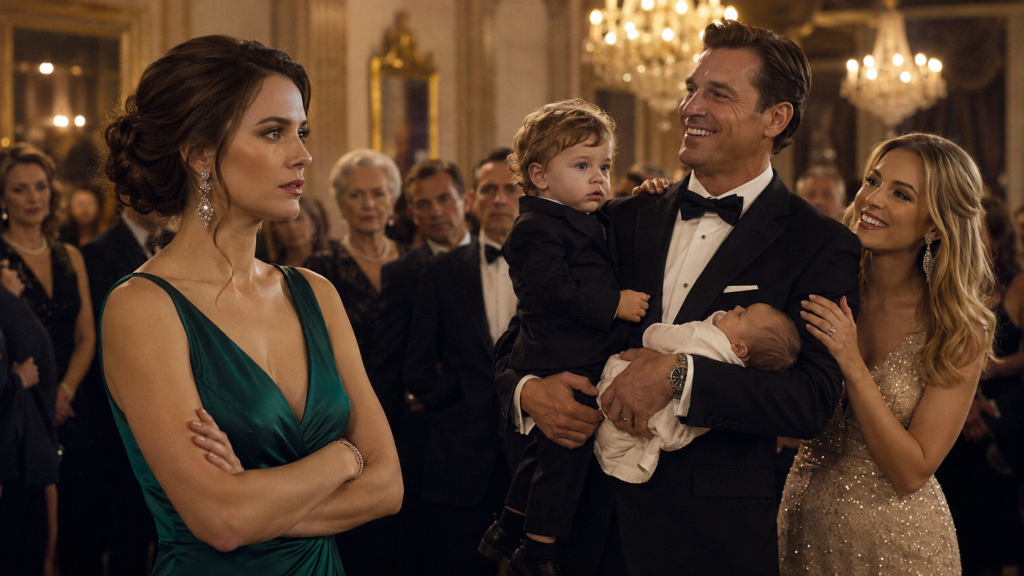
The first time I saw my husband holding his secretary’s second baby, I smiled so calmly that everyone thought something inside me had finally shattered.
It had not.
I was counting.
Martin Voss loved applause more than truth.
At the annual charity gala for Voss Meridian, he walked in with Clara Hayes on his arm, a toddler gripping his jacket and a newborn sleeping against his chest.
Cameras flashed.
Guests whispered.
Then Martin lifted the baby and announced loudly enough for the donors to hear, “My legacy keeps growing.”
Across the ballroom, Clara turned toward me with a sweet little blade of a smile.
I was his wife of nine years.
I was also the woman he had told everyone was “too fragile” to give him children.
When people came over to comfort me, I thanked them.
When his mother squeezed my hand and murmured, “Endure quietly, Evelyn. A man needs heirs,” I nodded.
When Martin leaned close and whispered, “Don’t embarrass me tonight,” I looked at the two children and said, “I wouldn’t dream of it.”
He mistook silence for surrender.
That was his first mistake.
Five years earlier, during a fertility consultation he had abandoned halfway through, Martin had refused to hear the results.
He hated any room where he was not admired.
He hated doctors who spoke plainly.
He hated facts that did not bow.
We had been trying to have children then, or at least I had been trying.
I took the vitamins.
I tracked the calendars.
I endured the tests, the questions, the quiet pity in nurses’ eyes.
Martin showed up for the first appointment wearing a navy suit and annoyance.
Halfway through, when the doctor explained that both partners needed full evaluation, Martin stood.
“I have a meeting,” he said.
The doctor blinked. “Mr. Voss, these results are important.”
Martin adjusted his cufflinks.
“Call my wife,” he said. “She handles unpleasant details.”
Then he walked out.
So the doctor called me.
Permanent infertility.
Not low odds.
Not stress.
Not something vitamins, rest, or time could repair.
A childhood surgery had left him unable to father a child naturally.
I remember sitting in my car outside the clinic with the paper folded in my lap.
The sky was gray.
Rain tapped gently on the windshield.
I called Martin three times.
He did not answer.
By evening, he was drunk in a hotel bar with Clara Hayes, his new assistant.
I cried that day.
Not because of the diagnosis.
I cried because I understood that I was married to a man who would rather let me carry shame than face his own truth.
When he came home after midnight, smelling of whiskey and Clara’s jasmine perfume, I was sitting at the kitchen island with the medical envelope beside my hand.
“Martin,” I said softly, “we need to talk.”
He loosened his tie and laughed.
“God, Evelyn, not tonight. Can’t you ever be easy?”
I looked at the envelope.
Then I looked at him.
“Tomorrow, then.”
Tomorrow became a week.
A week became months.
Every time I tried, he turned cold.
Every time I mentioned children, his face hardened.
“You’re obsessed,” he snapped once.
Another time, he said, “Maybe motherhood just isn’t meant for you.”
By the end of that year, his mother had begun praying for my “womb” at Sunday dinner.
His father avoided looking at me.
His sisters sent me links to fertility teas.
And Martin let them.
He did not just let them.
He fed them.
“She’s sensitive,” he would say.
“She’s struggling.”
“Don’t press her too much.”
He made himself the patient husband.
He made me the broken wife.
Then Clara became pregnant.
I found out at breakfast.
Martin stood in the doorway wearing the expression of a man who had won a prize.
“I need to tell you something,” he said.
I put down my coffee.
He did not look ashamed.
He looked proud.
“Clara is expecting.”
The room became very still.
I heard the hum of the refrigerator.
I heard a bird strike the window and fly away.
I heard my own heart change rhythm.
Martin watched my face, waiting for collapse.
I gave him none.
“Is it yours?” I asked.
He smiled.
“Obviously.”
Obviously.
That word almost made me laugh.
Instead, I folded my napkin.
He stepped closer, cruel excitement shining in his eyes.
“See?” he said. “The problem was never me.”
There it was.
The sentence he had been waiting years to say.
Not sorrow.
Not confession.
Not guilt.
Victory.
I looked at his handsome face, stupid with triumph, and something inside me went cold and useful.
The truth would mean nothing if I screamed it.
He would call me jealous.
Clara would call me barren.
His family would call me desperate.
So I became quiet.
I said, “I see.”
Martin frowned.
That was not the reaction he wanted.
“You’re not going to make a scene?”
“No.”
“You’re not going to threaten Clara?”
“No.”
His smile returned.
He thought I was weak.
That was his second mistake.
Clara’s first child was born on a rainy Thursday.
Martin sent flowers to her hospital room from our joint account.
He told me he was in Chicago for meetings.
The charge appeared under “regional client hospitality.”
I printed it.
Three months later, Clara moved into an apartment with marble countertops and river views.
Voss Meridian paid the rent.
The invoice said “executive lodging.”
I copied it.
Martin bought a stroller that cost more than some used cars.
The company card covered it under “marketing display materials.”
I saved the receipt.
I learned where the money went.
I learned who signed what.
I learned which accounts Martin thought I never looked at.
Before I married him, I had been an attorney.
A good one.
The kind who read every sentence before signing anything.
The kind who could smell a hidden clause from across a conference table.
But Martin liked saying marriage had “softened” me.
He introduced me at events as his “beautiful wife” and forgot to mention my law degree.
He encouraged me to leave my firm after his company expanded.
“We don’t need two careers fighting for attention,” he said.
At the time, I believed that was love.
Later, I realized it was containment.
But he had married the wrong woman if he thought silence meant ignorance.
I still had my license.
I still had my contacts.
I still had a memory sharp enough to cut.
I called the attorney who drafted our prenup.
The attorney who happened to be me.
Martin had never read the final version.
He had only smiled and signed because he was certain I was too in love to protect myself.
The prenup was simple.
Infidelity with financial misconduct triggered a forfeiture clause.
Company assets diverted to a romantic partner would be recoverable.
Any attempt to transfer shares to children conceived outside the marriage while using marital or corporate assets would open Martin to civil action and board review.
He had laughed when I added that part.
“Lawyers,” he had said, kissing my forehead. “Always imagining disasters.”
Now his disasters had names.
Clara.
Liam.
Baby Sophie.
Or so Martin believed.
When Clara announced her second pregnancy, Martin did not even pretend regret.
He became theatrical with fatherhood.
He had professional photos taken in a cream sweater, holding the toddler on his shoulders.
He posted captions about legacy, bloodline, future.
His mother framed one of the photos and placed it on her mantel.
Not a single photo of me had ever stayed there longer than a season.
At family dinners, Clara’s children were discussed as if I were not in the room.
“Liam has Martin’s eyes,” his mother said.
“He has the Voss chin,” his sister added.
Martin smiled like a king receiving tribute.
I studied the child across the table.
Sweet little Liam, with Clara’s honey hair and a dimple Martin did not have.
I did not hate him.
That was the strange part.
I never hated the children.
They were innocent.
They had been placed inside a lie before they had words to defend themselves.
Sometimes, when Clara brought them to events, Liam would wander toward me.
He liked the silver bracelet I wore.
Once, he touched it and asked, “Pretty?”
I smiled and said, “Yes, very pretty.”
Clara rushed over and pulled him away.
“Come to Mommy, sweetheart.”
The fear in her eyes lasted only a second.
But I saw it.
Clara had secrets too.
I just did not know whose.
Not yet.
The annual charity gala changed everything.
Martin wanted the world to see his perfect scandal.
He wanted me present, elegant, silent, and defeated.
I wore emerald silk.
His favorite color on me.
Not because I cared what he liked.
Because I wanted every camera to catch me looking calm.
The ballroom glittered beneath chandeliers.
Donors circled like sharks in evening gowns.
The Voss family stood near the stage, glowing with pride and moral decay.
Then Martin entered with Clara.
A toddler gripping his jacket.
A newborn sleeping against his chest.
The room gasped.
Clara wore white.
Of course she did.
Martin lifted the baby.
“My legacy keeps growing,” he announced.
Everyone clapped because wealth teaches people to applaud before they understand what they are applauding.
I stood near the back and smiled.
Martin’s mother came to me.
“Endure quietly, Evelyn,” she whispered. “A man needs heirs.”
I looked at her hand squeezing mine.
She wore a diamond bracelet Martin had bought with money transferred through a shell consulting account.
I knew because I had the invoice.
“Of course,” I said.
Martin approached me later, after donors had congratulated him.
“Don’t embarrass me tonight,” he whispered.
I looked past him at Clara.
She was pretending to adjust the baby’s blanket while making sure I saw her ring.
A sapphire.
Purchased from a luxury jeweler in Paris.
Billed as “international donor appreciation.”
“I wouldn’t dream of it,” I said.
Martin relaxed.
That was his third mistake.
Three weeks later, the board ordered executive medical checkups.
Voss Meridian had recently taken on new investors, and the insurance requirements were strict.
Spouses were asked to attend the final consultation for family health planning.
Martin hated it.
But he hated disobeying the board more.
“Wear something respectable,” he told me that morning.
I was standing at the bedroom mirror, fastening pearl earrings.
“I always do.”
He checked his watch.
“And don’t mention Clara. This is routine.”
I turned.
“Why would I mention Clara?”
His eyes narrowed, searching my face.
He found nothing.
We rode to the medical center in silence.
The clinic smelled like lemon disinfectant and expensive anxiety.
Martin strutted through the lobby as if illness itself would step aside for him.
A nurse greeted us and led us into a consultation room.
The doctor arrived with a tablet and a folder.
He was older now, with silver hair and careful eyes.
The same doctor from five years ago.
Dr. Albright.
He recognized me first.
I saw it happen.
A flicker.
A pause.
Then professional calm.
“Mr. and Mrs. Voss,” he said.
Martin shook his hand.
“Let’s make this quick. I’m very healthy.”
Dr. Albright smiled politely.
“I have your current results here, and I also reviewed historical records.”
Martin leaned back, relaxed.
He loved good reports.
Blood pressure fine.
Cholesterol manageable.
Heart strong.
He smiled wider with every sentence.
Then Dr. Albright opened the older file.
His brow furrowed.
He looked at Martin.
Then at me.
Then back at Martin.
“Hasn’t your wife told you yet?”
Martin’s smile vanished.
“Told me what?”
The doctor hesitated.
That hesitation was the sound of a match being struck.
“Your records from several years ago show irreversible infertility following childhood surgery. I assumed Mrs. Voss had discussed the diagnosis with you.”
Silence swallowed the room.
Martin stared at him.
Then laughed once.
A sharp, ugly sound.
“That’s impossible.”
Dr. Albright remained still.
“I understand this may be surprising.”
“I have two children.”
The doctor slowly closed the file.
“Medically speaking, based on these records, natural conception would not be possible.”
Martin turned toward me.
His face had gone pale beneath his tan.
“You knew?”
I met his eyes.
“For five years.”
His hands trembled.
“Why didn’t you tell me?”
“I tried.”
“No, you didn’t.”
“I called you the day Dr. Albright gave me the results. You didn’t answer. I waited up with the envelope. You came home drunk and told me not to be difficult.”
Martin’s jaw flexed.
“You should have forced me to listen.”
I almost smiled.
“Interesting. For years you told everyone I was broken. Now you’re upset I didn’t force you to hear the truth.”
Dr. Albright looked deeply uncomfortable.
“I can step out.”
“No,” Martin snapped.
Then he lowered his voice.
“Are you saying Clara’s children are not mine?”
Dr. Albright folded his hands.
“I cannot speak to paternity without testing.”
Martin stood so quickly the chair scraped the floor.
Outside the glass wall, Clara sat in the waiting area.
She had insisted on coming.
Not into the appointment, of course.
Just close enough to be seen.
She held the newborn while Liam played with a toy truck on the carpet.
When Martin opened the door, Clara looked up and smiled.
Then she saw his face.
The smile died.
“Martin?”
He walked toward her slowly.
“Whose children are they?”
People nearby turned.
Clara blinked.
“What?”
“Whose children are they?”
Her hand tightened around the baby blanket.
“Lower your voice.”
Martin laughed, but it was not laughter anymore.
It was panic wearing sound.
“You told me they were mine.”
“They are.”
He pointed back toward the consultation room.
“The doctor says I can’t have children.”
Clara’s face changed.
Only slightly.
But enough.
Enough for me.
A woman who is falsely accused reacts with outrage.
Clara reacted with calculation.
“Doctors can be wrong,” she said.
Dr. Albright stepped into the hallway.
“Ms. Hayes, paternity testing would clarify the matter.”
Clara looked at him like she wanted him removed from existence.
Martin grabbed his phone.
“We’re doing it today.”
“No,” Clara said.
One word.
Too fast.
Too sharp.
Martin froze.
“What did you say?”
The waiting room had gone silent.
Liam looked up from his truck.
The newborn stirred.
Clara noticed the eyes on her and softened her voice.
“I mean, not like this. Not in public. You’re emotional.”
Martin stared at her.
For the first time since I had known him, he looked small.
Not humbled.
Small.
There is a difference.
Humility contains understanding.
Martin only contained fear.
I walked past them toward the exit.
He turned.
“Evelyn.”
I stopped.
“You’re leaving?”
“Yes.”
“We’re not finished.”
I looked at Clara, then at him.
“No, Martin. You are not finished. I finished years ago.”
That afternoon, he called me twenty-six times.
I did not answer.
By evening, his mother called.
I let it go to voicemail.
“Evelyn, whatever has happened, you must not act rashly. Think of the family.”
The family.
That word had been used as a leash around my throat for nearly a decade.
Think of the family.
Protect the family.
Don’t embarrass the family.
Endure for the family.
But family had never meant me.
The next morning, my attorney filed the petition.
Divorce.
Financial misconduct.
Breach of prenuptial agreement.
Misappropriation of corporate funds.
Preservation order for all business records.
Emergency injunction preventing Martin from transferring shares, trusts, or assets to Clara or the children until paternity and financial review were complete.
By noon, Martin stormed into the house.
I was in the library.
The same library where he once told me I looked “cute” pretending to understand contracts.
He slammed the door.
“You filed against me?”
I turned a page.
“Yes.”
“You’re destroying my life.”
“No, Martin. I documented how you destroyed it yourself.”
His face twisted.
“You knew the children weren’t mine and said nothing.”
“I knew you could not father children. That is not the same thing.”
“You let me look like a fool.”
I closed the book.
“You did that very well without help.”
He stepped closer.
“You think you’re clever?”
“I know I am.”
“You’ll get nothing. Do you hear me? Nothing.”
I stood and walked to the desk.
There were three folders waiting.
I placed them one by one in front of him.
Apartment invoices.
Jewelry receipts.
Emails promising Clara shares.
Messages calling me barren.
Company card statements.
Hotel records.
A copy of the prenup with his signature circled in blue.
Martin opened the first folder.
Then the second.
By the third, sweat had gathered at his temples.
“You had no right to spy on me.”
“I had every right to examine marital and corporate accounts when you used both to support your affair.”
His voice dropped.
“I can explain.”
I almost laughed.
Men like Martin always mistake explanation for absolution.
“You can explain to the board.”
He went still.
“What did you do?”
“The board received a copy this morning.”
His mouth opened.
No words came out.
That was the first honest thing I had ever seen from him.
By Friday, Voss Meridian announced an internal review.
By Monday, Martin had stepped down “temporarily.”
By Wednesday, Clara disappeared from the executive floor.
Her office was cleaned out before lunch.
The newspapers did not publish everything.
Wealth protects its own when possible.
But rumors have legs.
And Martin had spent too many years humiliating too many people.
People talked.
Former assistants.
Accountants.
Drivers.
A concierge at Clara’s building.
A jeweler in Paris.
A hotel manager with excellent memory and poor loyalty.
The paternity results came two weeks later.
Martin was not the father of either child.
I was in my attorney’s office when the news reached him.
He called once.
Then again.
Then a third time.
Finally, I answered.
His voice was raw.
“They’re not mine.”
“I know.”
“You knew.”
“No. I suspected. Now you know.”
There was a long silence.
Then he said something I never expected.
“I loved them.”
For one moment, I closed my eyes.
Because despite everything, that part sounded true.
Martin had loved the children as extensions of himself.
As proof.
As applause.
As legacy.
But perhaps somewhere inside the performance, real affection had grown.
That was the tragedy of it.
Even selfish men can bleed.
“Then don’t punish them for Clara’s lie,” I said.
He inhaled shakily.
“You care about them?”
“They are children.”
“They’re hers.”
“They’re innocent.”
He said nothing.
Then, quieter, “Who is the father?”
“I don’t know.”
He found out soon enough.
Clara’s secret was not romantic.
It was practical.
The father was Daniel Pike, Voss Meridian’s former chief operations officer.
Married.
Ambitious.
And very involved in a failed attempt to move company contracts through Clara’s side consulting firm.
Clara had not just betrayed Martin’s bed.
She had used his ego as a shield.
While Martin played proud father, Clara and Daniel moved money through false vendor accounts.
Martin had signed documents he barely read because Clara placed them in front of him with a smile.
That almost made me pity him.
Almost.
The board did not.
Daniel resigned before he could be fired.
His wife filed for divorce.
Clara was sued for fraud.
Martin was forced into a settlement that stripped him of voting control.
And I watched from a distance as the empire he thought was built on bloodline became a house of paper and signatures.
During the divorce proceedings, Martin tried anger first.
Then charm.
Then regret.
He sent flowers.
I donated them.
He sent a letter.
I returned it unopened.
He came to the house one evening, standing outside the gate in the rain.
The security camera caught him looking less like a powerful man and more like a boy locked out of his own myth.
I went outside with an umbrella.
He looked at me with red-rimmed eyes.
“Evelyn.”
“Martin.”
“I made mistakes.”
“Yes.”
“I was cruel.”
“Yes.”
“I let them blame you.”
“Yes.”
He swallowed.
“I don’t know how to live with what I did.”
“That is not my burden anymore.”
Rain slid down his face.
Or maybe tears.
With Martin, it was hard to tell.
“I thought if I had children, everything would make sense.”
“No,” I said. “You thought if you had children, everyone would forgive who you were.”
He flinched.
Good.
Some truths should land hard.
“I did love you once,” he said.
“I know.”
That was the painful part.
He had loved me in the only way he understood love.
As possession.
As decoration.
As comfort.
But not as an equal soul.
Not as a woman with a mind, a history, and a heart that could break quietly without becoming weak.
“I wanted a family too,” I said.
His face crumpled.
“I know.”
“No, Martin. You don’t. I wanted partnership. Honesty. Children, maybe. Or maybe not. I could have survived the diagnosis. I could have survived adoption. I could have survived a different life. What I could not survive was being buried alive under your lie.”
He lowered his head.
“I’m sorry.”
I looked at the man I had married.
The man I had once loved enough to fold my dreams around his.
Then I said the only thing left.
“I believe you are sorry now. But now is not the same as then.”
The settlement finalized in autumn.
I kept the house because my money had purchased it before the marriage.
I kept my investments.
I received damages under the prenup.
Martin lost his position, his public image, and most of the power he had worshipped.
Clara moved out of the river apartment after the company reclaimed funds.
Daniel Pike’s wife exposed him so thoroughly that he became a warning whispered in boardrooms.
The children went to Clara’s sister in Vermont for a while.
I heard that through attorneys.
Later, Martin petitioned for visitation.
Not as their father.
Not legally.
But as someone who had been part of their early lives.
Clara fought him.
Daniel denied responsibility until the court forced him to face it.
The case became ugly.
Children always suffer when adults use truth too late.
One afternoon, months after the divorce, I saw Liam at a courthouse.
He was holding his aunt’s hand.
He looked smaller than I remembered.
When he saw me, his eyes brightened.
“Pretty bracelet,” he said.
The same silver bracelet.
I knelt in front of him.
“You remembered.”
He nodded.
His aunt looked nervous.
I smiled gently.
“I hope you’re doing okay, Liam.”
He looked toward the courtroom door.
“Everyone talks loud.”
My heart tightened.
“I know.”
“Do you talk loud?”
“Not unless I have to.”
That made him smile.
I took off the bracelet and placed it in his small palm.
His aunt gasped softly.
“It’s alright,” I said.
Liam held it like treasure.
“For me?”
“For you.”
“Why?”
I looked at his innocent face and thought of all the adults who had turned him into evidence.
“Because sometimes people need something pretty to hold when the world is loud.”
His aunt’s eyes filled with tears.
I stood and walked away before anyone could mistake kindness for weakness.
A year later, I reopened my legal practice.
Not corporate law.
Not at first.
I began helping women quietly trapped inside polished marriages.
Women whose husbands controlled accounts.
Women whose families told them to endure.
Women who had been called unstable, barren, greedy, dramatic, ungrateful.
I knew those words.
I knew the rooms where they were spoken.
I knew how expensive silence could be.
My first client was a woman named Marissa whose husband had hidden assets under his brother’s name.
My second was a grandmother being pushed out of her home by her son-in-law.
My third was a nurse whose fiancé drained her savings while planning a wedding with another woman.
I did not save everyone.
No attorney does.
But I taught them to document.
To read.
To wait when waiting was strategy.
To speak when speaking would land.
People sometimes asked why I had stayed silent so long.
They expected shame.
Instead, I told them the truth.
“I was not silent. I was recording.”
Martin contacted me once more, two years after the divorce.
A handwritten letter arrived at my office.
This time, I opened it.
Evelyn,
I am not asking for forgiveness.
I do not deserve it.
I only wanted to tell you that Dr. Albright’s question saved me from a lie, but your silence saved you from mine.
I used to think power meant being obeyed.
Now I think power might be the ability to hear the truth before it destroys everyone around you.
I wish I had listened.
Martin.
I folded the letter and placed it in a drawer.
Not because I treasured it.
Because some endings deserve a file.
That winter, I attended another charity gala.
Not Voss Meridian’s.
My own foundation’s.
We funded legal aid for women and children caught in financial abuse.
The ballroom was smaller.
The chandeliers were less dramatic.
But the laughter was real.
Near the entrance, a young woman approached me with trembling hands.
“My sister told me you helped her,” she said.
“I’m trying to leave.”
I took her hand.
“Then we start with documents.”
She laughed through tears.
Across the room, cameras flashed.
Someone asked me to pose near the podium.
For a second, I remembered Martin lifting a baby beneath golden lights, announcing his legacy to people who mistook volume for truth.
Then I looked around my own room.
At women standing taller.
At children eating cake.
At lawyers volunteering their evenings.
At a future built not from bloodline, but courage.
When I stepped onto the stage, the applause rose.
I did not need it.
But I accepted it.
Not as proof of worth.
As evidence of survival.
I looked into the crowd and began.
“My name is Evelyn Voss,” I said.
Then I paused.
No.
That name belonged to a house I had left burning behind me.
I smiled.
“My name is Evelyn Hart,” I corrected. “And I am here to talk about the cost of silence.”
The room quieted.
I thought of every dinner where I had swallowed humiliation.
Every invoice I copied with steady hands.
Every whispered insult dressed as concern.
Every woman who had been told to endure quietly because a man needed heirs, comfort, power, forgiveness.
Then I spoke the words I wished someone had said to me years earlier.
“Silence is not always weakness. Sometimes silence is where a woman sharpens the truth. But when the time comes, speak. And when you speak, bring evidence.”
The applause came again.
This time, I smiled.
Not calmly.
Not politely.
Fully.
Because Martin had been wrong about legacy.
Legacy was not a child held up in a ballroom.
Legacy was not a name carved into a company wall.
Legacy was not applause bought with lies.
Legacy was what remained after truth finished taking everything false away.
And I remained.
Stronger.
Freer.
Finally heard.