

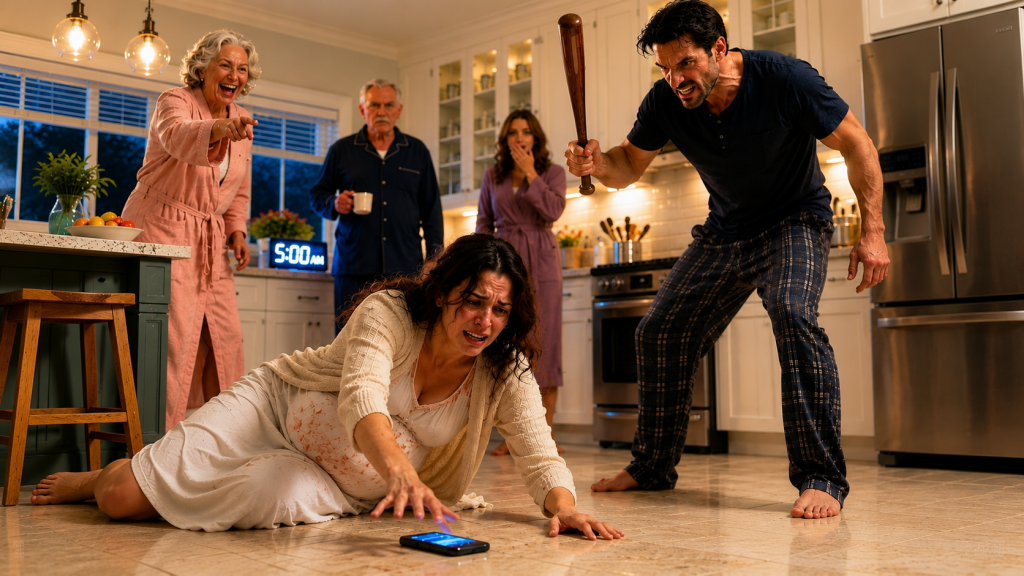
At five in the morning, my kitchen became the place where my old life ended.
I was six months pregnant, barefoot on the cold floor, with one hand wrapped around my belly and the other reaching blindly for a phone Trent had already destroyed.
The lights went out all at once.
Not flickering.
Not fading.
Gone.
The refrigerator stopped humming.
The stove clock died.
Nicole’s livestream cut off mid-breath.
For the first time that morning, Helen stopped laughing.
“What happened?” she snapped.
No one answered.
I stayed still on the floor, too afraid to move, too hurt to stand, too desperate to believe the darkness meant anything good.
Then I heard it.
Boots on gravel.
Slow.
Heavy.
Certain.
Trent heard it too.
His grip tightened around the wooden stick.
“Who’s outside?” he shouted.
Silence answered him.
Richard cursed and hurried toward the back door. The handle rattled, but the door did not open.
“It’s blocked,” he said, panic creeping into his voice.
Helen grabbed Trent’s arm.
“You said nobody knew,” she whispered.
Trent looked down at me, his face pale in the faint gray dawn coming through the kitchen window.
“You called someone,” he hissed.
I could barely speak.
“I pressed the button.”
His eyes widened.
Then a voice came from the hallway.
Calm.
Cold.
Familiar.
“Step away from my sister.”
My brother Alex stood in the doorway.
He was dressed in dark clothes, his shoulders filling the frame, his face unreadable. Behind him, two police officers moved quietly into position.
Trent raised the stick.
Alex did not flinch.
“Put it down,” he said.
Trent laughed, but it cracked in the middle.
“You broke into my house.”
Alex’s eyes moved to me on the floor.
Then to my belly.
Then back to Trent.
“No,” he said. “I came to stop a crime.”
Helen suddenly found her voice.
“She’s dramatic,” she said quickly. “She fell. Pregnant women fall. This is a family matter.”
One of the officers stepped into the kitchen.
“Ma’am, move away from her.”
Helen’s mouth opened, then closed.
Nicole backed into the counter, clutching her dead phone like it could still protect her.
Richard kept muttering that this was a misunderstanding.
But Alex was not listening to any of them.
He crossed the kitchen in three strides and knelt beside me.
The moment I saw his face close to mine, I broke.
Not because I was safe yet.
Because I had not realized how long I had been waiting for someone to look at me like I mattered.
“Lena,” he whispered. “I’m here.”
I tried to answer, but only a sob came out.
His hand hovered near my shoulder, careful not to hurt me.
“Don’t move. The ambulance is outside.”
Trent shouted, “She is my wife!”
Alex turned his head slowly.
“No,” he said. “She is my sister.”
The officers took the stick from Trent’s hand.
He resisted for half a second.
That was all it took.
They pushed him against the wall, cuffed his wrists, and read him his rights while he screamed that I had ruined his life.
Helen cried louder than I did.
“My son is a good man!” she shrieked. “She provoked him!”
Nicole started babbling about deleting the video.
But one officer had already picked up her phone.
The screen had gone dark, but the cloud had not.
Her private little chat group had seen enough.
So had the emergency dispatcher.
My SOS had gone through before Trent smashed my phone.
The ambulance lights painted the kitchen red and blue.
Paramedics rushed in with a stretcher.
When they lifted me, pain tore through my body, but my hands stayed locked over my stomach.
“My baby,” I cried. “Please check my baby.”
One paramedic leaned close.
“We will. Stay with us.”
Alex walked beside the stretcher all the way to the ambulance.
Trent was still yelling from inside the house.
Helen was still pretending to be a victim.
But their voices grew smaller as the doors closed.
For the first time in years, I could not see them.
And that felt like breathing.
At the hospital, everything became bright lights, hurried footsteps, and gentle voices.
A nurse cut away my sleeve.
Another checked my blood pressure.
A doctor pressed an ultrasound wand against my belly.
I stared at the ceiling, holding my breath.
Then the sound came.
Fast.
Tiny.
Steady.
My baby’s heartbeat.
I started crying so hard the nurse had to wipe my face.
“She’s alive?” I whispered.
The doctor smiled softly.
“Your baby is alive.”
I closed my eyes.
That was the first miracle.
The second was that I finally told the truth.
When the police came to my room, Alex sat beside me like a wall no one could climb.
For years, I had hidden everything.
The bruises.
The insults.
The locked doors.
The bank card Trent took from me.
The doctor appointments Helen insisted on attending.
The way Nicole recorded my humiliation and laughed with her friends.
The way Richard watched and did nothing.
I had told myself it was marriage.
I had told myself I was protecting the baby.
I had told myself no one would believe me.
But when the officer asked me what happened, I looked at Alex and saw the boy who used to carry me on his back when we were children.
The brother who had taught me to ride a bike.
The man who had begged me for years to leave Trent.
So I told them everything.
Not perfectly.
Not calmly.
But fully.
By sunrise, Trent was in custody.
So were Helen and Richard for their part in what happened.
Nicole was questioned too, especially after police recovered clips from her phone and messages from the private group.
I thought I would feel relief.
Instead, I felt empty.
That is something people do not always understand.
When the monster is finally removed, silence does not instantly become peace.
Sometimes silence becomes a room where all the memories return at once.
Alex stayed with me for three days.
He slept in a chair beside my hospital bed, arms crossed, chin tucked to his chest.
Every time I woke from a nightmare, he woke too.
“I’m here,” he would say.
Always the same words.
Always enough.
On the third day, a social worker came in with a folder.
She was kind, but direct.
“You need a safe place after discharge.”
“I can’t go home,” I said.
“No,” Alex answered before she could. “She’s coming with me.”
I looked at him.
“You have one bedroom.”
“I have a couch.”
“You work nights.”
“I’ll change shifts.”
“Alex—”
He leaned forward.
“You pressed that SOS because some part of you wanted to live. Don’t argue with the people who agree.”
That sentence stayed with me.
I moved into his small house two days later.
It smelled like coffee, laundry soap, and old wood.
There was a flag folded in a frame on the wall and a row of baby supplies stacked in the corner.
Diapers.
Blankets.
A crib still in the box.
I stared at them.
Alex rubbed the back of his neck.
“I didn’t know what to buy. The lady at the store helped.”
For the first time in weeks, I laughed.
It hurt.
But it was real.
The next months were not easy.
Trent’s lawyer tried to paint me as unstable.
Helen claimed I had always been dramatic.
Richard said he had not seen anything.
Nicole said the videos were jokes.
But evidence has a way of speaking when victims are exhausted.
The emergency call recorded enough.
The hospital documented enough.
The old messages said enough.
The neighbors admitted they had heard screaming before.
A woman from Nicole’s chat group came forward and said she had saved clips because she was disturbed by what she saw.
Piece by piece, the truth built a wall higher than their lies.
I also found out Trent had been planning something worse than divorce.
He had taken out loans in my name.
He had hidden money.
He had told people I was mentally unstable.
He had even spoken to a lawyer about claiming I was unfit after the baby was born.
When I heard that, my hands went cold.
Alex squeezed my shoulder.
“He doesn’t get to write your ending,” he said.
I wanted to believe him.
Some days, I did.
Some days, I was still afraid to open cabinets too loudly.
Still afraid of footsteps.
Still afraid of making someone angry by breathing wrong.
Healing did not arrive like a sunrise.
It arrived like small matches in the dark.
A warm bowl of soup.
A nurse saying, “You’re doing well.”
Alex painting the nursery pale yellow because I said I wanted the room to feel like morning.
A counselor telling me, “You survived. Now we teach your body that survival is not the only thing it gets to do.”
At thirty-seven weeks, my daughter was born.
I named her Hope.
Not because life was suddenly perfect.
Because she had fought for it before she ever saw the world.
She came out screaming with a strength that shocked everyone.
The nurse placed her on my chest, tiny and furious, and I sobbed into her dark hair.
Alex stood beside the bed with tears in his eyes.
“She’s loud,” he whispered.
I smiled.
“She gets that from you.”
He laughed and wiped his face.
Hope wrapped her little fingers around mine.
In that moment, I understood something.
Trent had tried to make my story end on the kitchen floor.
But my daughter had opened her eyes in a room full of light.
The trial happened when Hope was three months old.
I wore a blue dress Alex helped me choose.
My hands shook the entire ride to the courthouse.
When I saw Trent across the room, my body remembered fear before my mind could stop it.
He looked smaller than I expected.
Angrier too.
Helen sat behind him, glaring at me like I had betrayed the family by surviving.
Nicole avoided my eyes.
Richard stared at the floor.
When it was my turn to speak, I almost could not stand.
Then Hope made a tiny sound from Alex’s arms.
Not a cry.
Just a little breath.
I stood.
I told the court about the morning at five AM.
I told them about the years before it.
I told them how control does not always begin with fists.
Sometimes it begins with jokes.
With criticism.
With isolation.
With someone saying, “You’re too sensitive,” until you stop trusting your own pain.
I told them I stayed because I was afraid.
I told them I survived because one button worked, one brother came, and one baby refused to stop moving.
Trent stared at me with hatred.
But I did not look away.
For once, he was the one trapped in silence.
The verdicts did not erase what happened.
Nothing could.
But they mattered.
Trent was convicted.
Helen and Richard faced consequences for their actions.
Nicole’s videos became evidence against the very cruelty she once thought was entertainment.
After court, reporters waited outside.
I did not want to speak.
But a young woman stood behind the crowd, holding her coat closed with trembling hands.
She looked at me the way I must have looked for years.
Afraid.
Ashamed.
Listening.
So I stopped.
I faced the cameras.
“My name is Lena,” I said. “For a long time, I thought silence would keep me safe. It didn’t. Asking for help did.”
That was all.
But weeks later, the shelter told me three women had called after seeing that clip.
Three women.
Three doors opened.
Three lives reaching for air.
A year passed.
Then two.
Hope grew into a bright-eyed child who loved pancakes, yellow socks, and pulling every book off the shelf.
Alex became her favorite person in the world.
She called him “Uncle Axe” because she could not say Alex.
He pretended to hate it.
He absolutely loved it.
We built a life out of ordinary things.
Grocery trips.
Doctor visits.
Bedtime songs.
Birthday candles.
Rainy Saturdays.
A tiny garden behind the house.
Sometimes I still had nightmares.
Sometimes a slammed door made me freeze.
But the difference was this:
I no longer woke up alone.
And I no longer mistook survival for love.
One morning, almost three years after that terrible dawn, I went back to the old house.
Not alone.
Alex came with me.
So did a court-appointed officer.
The house had been sold after the legal proceedings, but I was allowed to collect what remained of my belongings.
The kitchen looked smaller than I remembered.
The marble counter was still there.
The floor had been cleaned.
The walls repainted.
But my body knew.
I stood in the doorway for a long time.
Alex asked, “You okay?”
I nodded, though tears slipped down my face.
“I thought this room killed me,” I said. “But it didn’t.”
He waited.
I stepped inside.
The morning sun came through the window, soft and gold.
I could almost see myself there on the floor.
Afraid.
Bleeding.
Praying.
Pressing buttons with shaking fingers.
I wanted to reach back through time and hold that woman.
I wanted to tell her the darkness was not the end.
It was the signal.
It was the moment help arrived.
It was the last time she would ever be alone with them.
I picked up one thing from the pantry shelf.
A chipped blue mug my mother had given me years before she died.
Helen had always hated it.
Called it ugly.
Cheap.
Useless.
I held it to my chest and laughed through my tears.
Alex smiled.
“That all you want?”
I looked around the kitchen one last time.
“No,” I said. “That’s all they didn’t take.”
Outside, Hope waited in the car with Alex’s friend, waving both hands when she saw me.
“Mommy!”
I ran to her.
She threw her arms around my neck.
And just like that, the house behind me became only a house.
Not a prison.
Not a grave.
Just wood, stone, paint, and ghosts that no longer owned me.
Years later, people would ask when my life changed.
They expected me to say it changed when Trent was arrested.
Or when Hope was born.
Or when the verdict came.
But the truth is, it changed at five in the morning, in the dark, when I was certain no one was coming.
Because someone did.
And after that, I learned to come for myself too.
I learned to speak.
I learned to leave.
I learned to raise my daughter in a home where love did not sound like shouting.
Where breakfast was made with music playing.
Where doors stayed unlocked.
Where mistakes were not punished.
Where laughter did not have teeth.
Hope grew up knowing the truth in pieces, soft enough for her age and honest enough for her heart.
When she was old enough to ask about her father, I told her he had made terrible choices and that adults are responsible for the harm they cause.
I never told her she came from violence.
I told her she came through it.
There is a difference.
On her fifth birthday, she blew out candles on a yellow cake in Alex’s backyard.
Friends clapped.
Balloons danced in the wind.
Alex lifted her onto his shoulders, and she squealed like the whole world belonged to her.
I stood by the porch, holding that chipped blue mug full of coffee, watching my daughter laugh under the morning sun.
For a second, I remembered the cold kitchen floor.
The darkness.
The boots on gravel.
The voice in the doorway.
Step away from my sister.
I closed my eyes and breathed.
Then Hope shouted, “Mommy, look!”
I opened my eyes.
She was smiling.
Alive.
Safe.
Free.
And so was I.