

Two hours after our baby was born, I looked at my husband, waiting for him to hold our child.
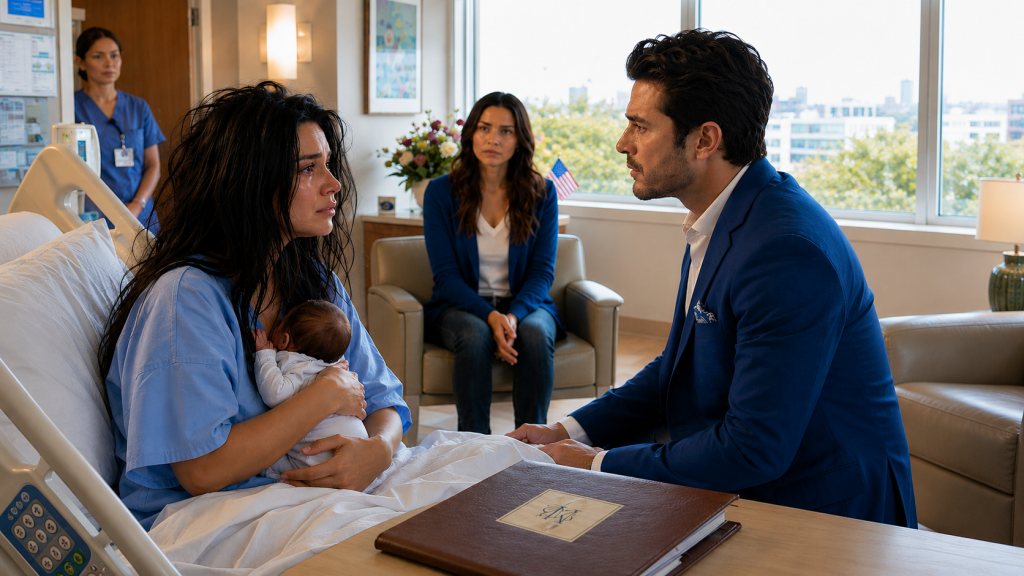
Instead, he leaned close and said, “I already have a son with someone else. I am not signing anything for this baby.”
I did not cry.
I did not argue.
I only looked at the tiny bracelet on my daughter’s wrist and whispered, “Then remember this moment.”
The next morning, he came back asking to see us, but the folder on my bedside table had already changed everything.
The hospital room was still bright with that strange morning light that makes everything look softer than it feels.
My daughter was wrapped against my chest in a white blanket with pink and blue stripes. Her little hospital bracelet hung loosely around one ankle, and her tiny mouth moved as though she were already trying to understand the world she had just entered.
Weston stood beside the window in a gray coat that cost more than my first car payment.
He had held my hand through eleven hours of labor.
He had told the nurse twice that he was excited to become a father.
He had kissed my forehead when our daughter cried for the first time.
Then I asked him to hold her.
He did not step forward.
“Weston?” I whispered.
His eyes stayed on the baby, but there was no love in them.
There was not even fear.
It was the expression a man gave a document he already knew would cost him something.
“Sable,” he said quietly, “there’s something you need to understand.”
The room changed before he finished the sentence.
A nurse’s cart squeaked somewhere in the hallway. The monitor beside my bed beeped softly. My hands were still shaking from delivery, but I pulled my daughter closer, as though my body understood what was happening before my mind did.
Weston moved near enough that nobody outside the room could hear him.
“I already have a son with Camille,” he said. “He was born four months ago.”
For one breathless second, I thought the words had landed in the wrong life.
Camille was his executive assistant.
Polished.
Quiet.
Always standing half a step behind him at company dinners with a tablet in her hand and a smile that never reached her eyes.
I had met her twice.
The first time was at a charity banquet, where she greeted me warmly and then spent the rest of the evening avoiding my gaze.
The second time was beside a holiday drink table.
She had asked how the nursery was coming along and excused herself before I could finish answering.
Now my husband was standing in a maternity room telling me she had a child with him.
A son.
His son.
“My family knows,” Weston continued. “They’ve met him. There are expectations I can’t ignore.”
I looked down at my daughter.
Marlo.
Two hours old.
Still damp at the hairline.
Still curled into herself as if she trusted the world because she had not yet been taught otherwise.
“What expectations?” I asked.
Weston straightened his coat.
That small movement told me more than his words did.
He was not speaking like a husband.
He was preparing a statement.
“My family needs clarity,” he said. “The Callaway name has responsibilities.”
“The Callaway name?” I repeated.
He glanced toward the door, as though someone important might walk in and catch him telling the truth.
“I’m not signing anything that places her in the family structure,” he said. “I can take care of things privately. I can make sure you’re comfortable.”
Comfortable.
I was lying in a hospital bed with stitches, ice chips melting on the tray table, and our daughter asleep against my chest while he offered to make me comfortable.
I did not raise my voice.
That surprised him.
I saw it in the way his jaw tightened.
“You’re choosing them,” I said.
“I’m choosing the future of my family.”
I looked at him then.
Really looked at him.
The expensive watch.
The perfect coat.
The clean shave.
The carefully controlled expression.
This was the same man who had painted the nursery sage green with his own hands.
The same man who cried during our first ultrasound.
The same man who told me Marlo sounded like a strong name.
Suddenly, all those tender memories looked less like proof of love and more like scenes he had known how to perform.
I smiled.
It was not happiness.
It was not peace.
It was the moment a door closed inside me.
“Then remember this moment,” I whispered. “Because it’s the last one you’ll ever get from us.”
Weston gave a small laugh.
Almost gentle.
Like I was exhausted.
Like I would call him by dinner.
Like women in hospital beds did not make decisions that rearranged entire families.
He left the room a few minutes later to take a call.
Through the cracked door, I heard only pieces of the conversation.
“Not here.”
A pause.
“I told you, Camille. I’m handling it.”
Another pause.
“My parents are on their way.”
My fingers tightened around Marlo’s blanket.
His parents.
Preston and Adele Callaway had never liked me in any obvious way.
They did not have to.
Adele was polite with the smoothness of a marble countertop, always complimenting my dress while checking the label.
Preston barely spoke unless the subject involved real estate, lenders, board schedules, or legacy.
At family dinners, I always felt like a guest in a house where the table had been set long before anyone knew I existed.
And now they were coming to meet the baby Weston had already decided not to claim.
I sat there with my daughter against my chest and understood that this betrayal had not begun in the hospital.
It had been arranged around me for months.
Maybe longer.
The old restaurant receipt I found in Weston’s coat pocket.
The calls he took in the driveway.
The way Camille looked away from me at the holiday party.
The sudden silence whenever I talked about our baby carrying the Callaway name.
I had collected all the wrong pieces.
I had simply refused to assemble them because the picture was too painful to face.
Weston’s parents arrived less than an hour later.
Adele walked in first, holding a pale pink gift bag.
Preston followed with his hands in his coat pockets and impatience written across his face.
Adele came to the side of the bed.
Her expression softened when she looked at Marlo, but only for a moment.
“She’s lovely,” she said.
“Her name is Marlo,” I replied.
Adele nodded as if I had just announced the weather.
Preston stayed near the door.
“Where is Weston?” he asked.
“On the phone with Camille.”
Neither of them reacted.
That told me everything.
Adele placed the gift bag on a chair.
“Sable, this situation is regrettable,” she said.
“Which part?”
Her eyes moved to Marlo and then back to me.
“The timing.”
I almost laughed.
Not the affair.
Not the secret baby.
Not the fact that their son had abandoned his newborn daughter two hours after her birth.
The timing.
“Weston has explained the family’s position,” Adele continued.
“Your family has a position on my daughter?”
“Please don’t make this unnecessarily ugly.”
I studied her face.
“Was it ugly when you met Camille’s baby?”
Preston shifted near the door.
Adele’s expression hardened.
“The boy is Weston’s first son.”
“He is not Weston’s first child.”
“In families like ours, these distinctions matter.”
I looked down at Marlo.
Her fingers had escaped from the blanket, opening and closing in the air.
I touched one tiny palm.
“You should leave,” I said.
Adele blinked.
“Sable—”
“Both of you.”
Preston stepped forward.
“You need to think carefully before creating conflict with this family.”
My body was weak, but something inside me stood up.
“You came into my hospital room and threatened me while I was holding your granddaughter.”
“That is not what I said.”
“It is exactly what you said.”
A nurse appeared in the doorway.
“Is everything all right in here?”
“No,” I said. “These visitors are leaving.”
Adele’s lips parted.
The nurse stepped inside.
“Ma’am, sir, the patient needs rest.”
Preston stared at me as if he could not understand how a woman he had dismissed for years had just ordered him out of a room.
Adele picked up the gift bag.
She did not leave it for Marlo.
That detail stayed with me.
They had not come to welcome my daughter.
They had come to assess the problem.
After they left, the room felt colder.
I stared at the empty doorway and tried not to tremble.
A few minutes later, the nurse returned with warm tea.
She had kind eyes and silver hair pulled into a loose bun.
“You did the right thing,” she said.
I looked at her.
“Did I?”
“You protected your peace.”
She adjusted Marlo’s blanket.
“Your daughter will need that more than she needs any family name.”
That night, my sister Odette drove four hours from Savannah.
She arrived before sunrise with her hair in a messy bun, her sweatshirt inside out, and her face set like she had come to hold up the walls.
She looked at Marlo first.
“Oh, Sable,” she whispered.
Then she looked at me.
“What do you need?”
Not where is he?
Not are you sure?
Not maybe there is an explanation.
Just: what do you need?
I almost fell apart then.
Odette took control quietly.
She spoke to the nurse, adjusted my pillows, held Marlo so I could sleep, and put my phone on silent when Weston’s name flashed across the screen.
But one number kept calling.
Josephine Nadeir.
My late uncle Elliot’s estate attorney.
She had been trying to reach me for three weeks, leaving neat, professional voicemails about a private folder my uncle wanted reviewed with me personally.
I had ignored the calls because I was nine months pregnant and convinced it was routine paperwork.
At 3:12 in the morning, with Marlo sleeping beside me and Odette curled in the visitor chair, I finally called back.
Josephine answered on the second ring, as though she had been waiting beside the phone.
“Sable,” she said, “I’m sorry this can’t wait.”
My throat tightened.
“What is this about?”
“Your uncle Elliot left you more than personal effects,” she said. “There is a folder involving an old partnership agreement connected to Callaway Holdings.”
I sat up too quickly.
Pain pulled sharply through my body.
“Connected to Weston’s family?”
“Yes.”
I looked across the room at Odette.
She was awake now.
“What kind of agreement?” I asked.
“Before Preston Callaway became the public face of the company, Callaway Holdings had two principal owners,” Josephine explained. “Preston’s father, Howard Callaway, and your uncle Elliot.”
I said nothing.
Uncle Elliot had never mentioned Weston’s family.
He had lived simply in an old brick house outside Charleston, spending more time restoring antique furniture than discussing business.
“Uncle Elliot owned part of Callaway Holdings?”
“Thirty-two percent,” Josephine said.
My hand tightened around the phone.
“That’s impossible.”
“It was deliberately kept private.”
“Why?”
“Because Elliot and Howard Callaway had a serious falling-out more than thirty years ago. They signed an agreement allowing the Callaways to operate the company while Elliot retained silent ownership and significant voting protections.”
I stared at the wall.
“And now?”
“Now those shares belong to you.”
I stopped breathing for a second.
Josephine continued.
“Your uncle placed the shares in a private trust. The trust was structured to transfer to you when two conditions were met.”
“What conditions?”
“That you reached thirty years of age and became a parent.”
My eyes moved slowly to Marlo.
She was sleeping peacefully, unaware that her first breath had activated an agreement older than her parents’ marriage.
“The transfer became effective when your daughter was born,” Josephine said. “Her birth certificate and hospital confirmation are enough to trigger the trust.”
“But Weston said he isn’t signing anything.”
“His signature is not required for you to register your child’s birth.”
“What does this mean for Callaway Holdings?”
“It means that you now control thirty-two percent of the company and hold special voting rights over changes in ownership, mergers, debt restructuring, and succession.”
I pressed my fingers against my forehead.
Josephine’s voice became even more serious.
“There’s more.”
Of course there was.
“What?”
“The partnership agreement contains a clause concerning undisclosed heirs and misuse of company assets.”
My heart began beating faster.
“Explain it.”
“If a senior Callaway executive uses company money to conceal an extramarital relationship or support an undisclosed child, the minority partner may initiate a full forensic audit.”
I looked at Odette again.
She had moved closer to the bed.
“Camille works for Weston,” I said.
“Yes.”
“She has a baby with him.”
“Yes.”
“And his family knows.”
Josephine paused.
“Then the situation may be considerably more serious than I feared.”
She explained that over the past year, several unusual payments had been made through a Callaway Holdings consulting division.
Apartment leases.
Medical costs.
A vehicle.
Large transfers labeled as executive relocation expenses.
Josephine and Uncle Elliot had suspected that company funds were being redirected, but they had not known where the money was going.
Until now.
“Do not confront Weston about the financial details,” Josephine warned. “Not yet.”
“He already told me about the child.”
“That was his mistake.”
I looked at Marlo’s tiny bracelet.
The nurse had written her name in careful blue letters.
MARLO CALLAWAY.
But Weston did not want her in his family structure.
He had been so certain that refusing his name would make her powerless.
He did not know that her birth had made me one of the most powerful people in his company.
“I can come to the hospital first thing in the morning,” Josephine said.
“Bring everything.”
At sunrise, Josephine arrived carrying a dark leather folder.
She was in her sixties, small and elegant, with short white hair and sharp brown eyes.
Odette stood beside her as she laid the documents on my bedside table.
Trust certificates.
Partnership agreements.
Voting provisions.
Letters signed by Uncle Elliot.
One handwritten note was addressed to me.
Sable,
If you are reading this, then you have finally become responsible for someone more vulnerable than yourself.
That is when power matters most.
Do not use what I left you to impress people.
Use it to prevent cruel people from deciding the future of those who cannot defend themselves.
I once trusted the Callaways to remember that a company is made of human lives.
I was wrong.
Perhaps you will have the courage I lacked.
Love,
Uncle Elliot
I covered my mouth with one hand.
Odette squeezed my shoulder.
Josephine opened another section of the folder.
“Your uncle also prepared an emergency board notice,” she said. “It only requires your signature.”
“What does it do?”
“It freezes major transfers and orders preservation of all financial records until an independent review is completed.”
“Will Weston know?”
“Immediately.”
I picked up the pen.
My hand shook once.
Then I signed.
Forty minutes later, Weston walked into the hospital room carrying flowers.
White roses.
The same kind he brought me whenever he had forgotten something important.
He wore the careful smile of a man who believed apologies could restore control.
“I want to see my daughter,” he said.
I rested my hand on the leather folder.
“Before you do,” I replied, “call your father.”
His smile weakened.
“What?”
“Call him and ask who owns Callaway Holdings now.”
Weston glanced at Josephine.
Recognition moved across his face.
“Ms. Nadeir.”
“Mr. Callaway.”
He looked back at me.
“What have you done?”
My daughter made a soft sound in the bassinet beside me.
I adjusted her blanket.
“I protected the future of my family.”
His phone rang.
Preston.
Weston stared at the screen.
“Answer it,” I said.
He stepped into the hallway.
Even with the door partly closed, I could hear his father shouting.
“What did she sign?”
A pause.
“Thirty-two percent? How?”
Another pause.
“You told me Elliot’s trust was inactive!”
Weston came back into the room with the color drained from his face.
“You knew about this?” he demanded.
“I learned about it last night.”
“This is company business.”
“No,” Josephine said. “It is Ms. Callaway’s business.”
Weston flinched at the name.
He looked toward Marlo.
“Sable, we need to talk privately.”
“You already spoke privately. Remember?”
His eyes hardened.
“I made a mistake.”
“You made several.”
“I was under pressure.”
“You abandoned your daughter.”
“I did not abandon her.”
“You refused to acknowledge her because your mistress gave you a son.”
The flowers trembled slightly in his hand.
Josephine closed the folder.
“Mr. Callaway, you should understand that all financial records related to Ms. Laurent and her child are now subject to preservation.”
“Camille has nothing to do with the company.”
“That will be determined by the audit.”
Weston’s expression changed.
Only slightly.
But I saw it.
Fear.
“What audit?” he asked.
“The one authorized by the company’s new minority shareholder.”
He looked at me.
“Sable, stop this before it gets out of control.”
“It was already out of control. I just stopped pretending otherwise.”
He set the flowers down.
“You don’t understand the damage this could cause.”
“To whom?”
“To thousands of employees. To our family. To everything my grandfather built.”
“If everything your grandfather built can be destroyed by somebody checking the books, then it was already damaged.”
He stepped closer.
Odette immediately moved between us.
Weston looked offended.
“I’m not going to hurt her.”
“You already did,” Odette said.
For the first time, Weston appeared to understand that he was no longer speaking to the wife who had spent years making excuses for him.
He looked at Marlo again.
“Can I hold her?”
The question nearly broke me.
Not because I wanted to say yes.
Because only one day earlier, that had been all I wanted.
I had waited for him to hold his daughter.
Now the moment felt contaminated.
“No,” I said.
His face tightened.
“She’s my child.”
“Yesterday she was a private inconvenience.”
“I was confused.”
“You were prepared.”
He had no answer.
“Leave,” I said.
“Sable—”
“You chose the future of your family. Go face it.”
This time, he did not laugh.
He left the flowers behind.
The hospital discharged us that afternoon.
Odette drove my car while I sat in the back seat beside Marlo.
I did not return to the house Weston and I had shared.
Josephine had already warned me that anything related to company finances might become evidence.
Instead, Odette took us to Uncle Elliot’s old home.
The house had passed to me with the trust.
I had visited it as a child, but I had not been there since his funeral.
It stood beneath live oak trees draped with Spanish moss, its red brick walls warmed by the setting sun.
Inside, the house smelled faintly of cedar and old books.
Uncle Elliot’s workshop remained untouched.
Half-restored chairs lined one wall.
Wooden drawers were filled with brass handles and careful handwritten labels.
I carried Marlo into the living room and sat in Uncle Elliot’s favorite chair.
For the first time since the hospital, I cried.
Not loudly.
Not dramatically.
The tears simply came.
Odette sat on the floor beside me.
“I feel stupid,” I whispered.
“You’re not.”
“I lived with him. I slept beside him. I defended him.”
“You trusted your husband.”
“I ignored things.”
“You believed what you needed to believe until you had enough truth to act.”
I looked down at Marlo.
Her whole hand wrapped around one of my fingers.
“I should have known.”
Odette shook her head.
“No. He should have been faithful.”
Over the next week, the Callaway family tried every possible method to bring me under control.
Adele called first.
She left a message saying we needed to avoid public embarrassment.
Preston called next.
He offered to purchase my shares at what he called a generous price.
The amount was enormous.
Josephine laughed when she heard it.
“It is less than half their current value,” she said.
Then Weston sent messages.
At first, they were apologetic.
He said he loved me.
He said Camille’s pregnancy had been an accident.
He said his parents had pressured him to recognize his son as the future Callaway heir.
He said he had panicked when Marlo was born.
When I did not respond, his tone changed.
He accused me of using our daughter as leverage.
He claimed Uncle Elliot had manipulated me from beyond the grave.
He warned that the audit would destroy innocent employees.
I saved every message.
The audit began quietly.
It did not stay quiet for long.
Investigators discovered that Camille had been receiving payments through three different company accounts.
Her apartment was leased by a Callaway subsidiary.
Her private maternity care was listed as executive wellness consulting.
The luxury SUV she drove was registered as a regional operations vehicle.
More troubling, Weston had approved nearly two million dollars in transfers to a shell company controlled by Camille’s brother.
When questioned, the brother claimed the payments were for market research.
No research existed.
Preston called an emergency board meeting.
Josephine advised me to attend remotely because I was still recovering from childbirth.
I refused.
Three weeks after Marlo’s birth, I walked into Callaway Holdings carrying my daughter in a soft gray sling.
Odette walked beside me.
The lobby went silent.
Employees recognized me.
Some stared at Marlo.
Others looked away, embarrassed by rumors they had already heard.
The boardroom occupied the top floor.
Weston sat on one side of the long table with Preston and Adele.
Camille sat behind them in a navy dress, her hands folded carefully in her lap.
It was the first time I had seen her since learning the truth.
She looked exhausted.
Not triumphant.
Not cruel.
Just frightened.
Preston stood.
“This is not an appropriate place for an infant.”
I looked around the room.
“It’s her company too.”
His face darkened.
I sat beside Josephine.
Weston’s gaze remained fixed on Marlo.
He had not seen her since the hospital.
She was awake, looking around with wide dark eyes.
For one fleeting second, pain crossed his face.
Then Preston began speaking.
He described the audit as disruptive.
He accused Josephine of exploiting an outdated agreement.
He argued that Elliot’s ownership should have been dissolved decades earlier.
Josephine responded by placing the signed partnership agreement on the screen.
The board members read in silence.
The language was clear.
My ownership was legal.
My voting rights were active.
The audit was authorized.
Preston turned toward me.
“What do you want?”
The room became very still.
Perhaps they expected me to demand Weston’s resignation.
Perhaps they thought I wanted the company, the house, the name, or the satisfaction of humiliating them.
“I want the truth,” I said.
“You have the truth.”
“No. I have the part Weston was forced to admit.”
I looked at Camille.
“Did you know he was married when your relationship began?”
She swallowed.
“Yes.”
“Did you know I was pregnant?”
Her eyes lowered.
“Yes.”
Weston shifted.
“Camille, you do not have to answer—”
“Yes, she does,” one of the independent directors said.
Camille looked at me again.
“He told me the marriage was over.”
“It wasn’t.”
“I know that now.”
“When did you learn?”
She glanced toward Adele.
“After my son was born.”
Adele’s expression did not change.
I saw something then.
Camille was guilty of betraying me.
But she was not the architect of everything.
“How did the company payments begin?” I asked.
Camille pressed her lips together.
“Weston said the family would take care of us.”
“Did you request two million dollars?”
Her head snapped up.
“What?”
The investigators exchanged looks.
Camille turned toward Weston.
“You said the consulting payments were for legal protection.”
Weston’s face went rigid.
Preston struck the table with his palm.
“This has gone far enough.”
“No,” I said. “It has finally gone far enough to be seen.”
The investigators revealed that Weston had moved money not only to support Camille but also to cover losses from several private investments.
Camille’s brother’s company had been used as a passageway.
Weston had told Camille it was necessary to protect their son.
He had told Preston the money funded confidential expansion projects.
He had told the board nothing.
The audit had not endangered the company.
Weston had.
By the end of the meeting, the independent directors voted to suspend him.
Preston tried to stop the vote.
My thirty-two percent made that impossible.
Weston stared at me as the decision was announced.
“You planned this,” he said.
I almost pitied him.
“You still believe everyone thinks the way you do.”
Security escorted him from the boardroom.
Camille remained in her chair.
Tears stood in her eyes.
“What happens to my son?” she asked.
It was the first honest question anyone in that family had asked.
“Nothing,” I said. “He is a baby. He did not do this.”
Her face crumpled.
Adele turned sharply toward me.
“You cannot possibly intend to protect her.”
“I intend to protect both children from adults who use them as weapons.”
Camille began to cry.
I did not forgive her.
But I understood that her son deserved more than becoming proof of his father’s importance.
The board terminated Camille’s employment because of the undisclosed relationship and financial irregularities, but the audit found no evidence that she understood the full extent of Weston’s transfers.
She cooperated with investigators.
That cooperation later protected her from criminal charges.
Weston was not as fortunate.
The state opened an investigation into financial fraud and misuse of corporate funds.
Preston was forced to resign as chairman after evidence showed he had discovered some of the transfers and concealed them to avoid scandal.
Adele disappeared from public events.
The Callaway family name survived, but the mythology surrounding it did not.
I became interim board chair six months after Marlo was born.
I did not accept because I wanted power.
I accepted because Uncle Elliot had been right.
Power mattered most when it was used to defend people who had none.
We established stronger financial oversight.
We restored benefits that had quietly been cut from hourly employees.
We created parental leave protections that applied to every employee, not only executives.
And we removed the old succession language that treated sons as natural heirs and daughters as optional branches of a family tree.
My divorce from Weston took almost a year.
He fought over everything except custody.
At first, he demanded visitation because he believed refusing it would look bad in court.
But he canceled twice before the first supervised visit.
When he finally arrived, Marlo was eight months old.
She sat on a blanket in a family-services room, holding a wooden ring.
Weston entered slowly.
He looked older.
The perfect hair and tailored suit remained, but the certainty had left him.
He sat across from her.
“Hello, Marlo,” he said.
She stared at him.
He reached out.
She turned and crawled toward me.
Weston lowered his hand.
For several minutes, neither of us spoke.
Then he looked at me.
“I made the worst decision of my life in that hospital room.”
“No,” I said quietly. “You revealed the decisions you had already made.”
His eyes filled with something that might have been regret.
“I loved you.”
“Perhaps in the way you understood love.”
“I think about that morning every day.”
“So do I.”
He looked at Marlo.
“Will she ever know who I am?”
“That depends on what you do from now on.”
He nodded.
It was not forgiveness.
It was not reconciliation.
It was only truth.
Over time, Weston began attending supervised visits more consistently.
I did not make promises for him.
I did not tell Marlo that her father had changed.
Children deserve evidence, not hopeful stories.
Camille moved to another state with her son, Julian.
Before she left, she wrote me a letter.
She apologized without asking me to forgive her.
She admitted that she had wanted to believe Weston’s marriage was ending because the alternative made her ashamed of herself.
She thanked me for ensuring Julian’s support came from Weston personally rather than stolen company funds.
I kept the letter.
Not for myself.
For Julian and Marlo, in case they ever wanted the truth.
On Marlo’s first birthday, we held a small celebration at Uncle Elliot’s house.
Odette hung paper stars across the porch.
Josephine brought a wooden music box that had belonged to Uncle Elliot.
Employees from Callaway Holdings sent flowers, books, and a framed copy of the company’s new family-leave policy.
I set Marlo’s hospital bracelet inside the music box.
The ink had faded slightly, but her name was still visible.
That bracelet reminded me of the moment my old life ended.
But it also marked the beginning of everything that came after.
As the sun lowered behind the oak trees, Odette carried out a cake with one pink candle.
Marlo clapped when everyone sang.
I helped her blow out the flame.
Later, after the guests left, I sat with her on the porch.
She rested her head against my chest, sleepy and warm.
The house was quiet except for summer insects and the faint creak of the porch swing.
I thought about Weston standing beside that hospital window.
I remembered how he had looked at our daughter as if she were a complication.
He had believed refusing to sign his name would erase her from his family.
Instead, Marlo’s birth exposed every secret they had built their lives around.
But that was not her greatest legacy.
Her greatest legacy was simpler.
She taught me that being chosen by someone else was not the same as having worth.
She taught me that family was not a name guarded by wealthy men in expensive rooms.
Family was my sister driving through the night with her sweatshirt inside out.
It was Josephine answering her phone at three in the morning.
It was a nurse protecting a tired mother’s peace.
It was Uncle Elliot leaving behind not only money, but a warning.
And it was the little girl asleep against me, trusting that I would build a safer world around her.
I kissed the top of Marlo’s head.
“You changed everything,” I whispered.
She shifted in her sleep and wrapped her fingers around mine.
One year earlier, her father had told me he was choosing the future of his family.
He was right about one thing.
That moment had decided the future.
Just not the future he expected.
The Callaway name no longer belonged to the people who used it to exclude others.
It belonged to the employees who kept the company alive.
It belonged to two innocent children who would never be punished for the choices of their parents.
And one day, if Marlo wanted it, it would belong to her.
Not because Weston had finally signed a paper.
Not because Preston accepted her.
Not because Adele decided she fit into their family structure.
It belonged to her because she had been born worthy.
She always had been.
And so had I.
THE END.