

My Husband Said His Mother Needed Peace—Then a Nurse Handed Me a Note
My mother-in-law, Patricia, suffered a stroke on a rainy Tuesday morning.
I still remembered the moment my husband called me.
I was standing in the kitchen, pouring coffee into two travel mugs before work, when Michael’s name appeared on my phone.
The second I answered, I heard panic in his breathing.
“Claire, it’s Mom,” he said. “She collapsed.”
The coffee pot slipped against the counter, splashing hot coffee across my hand.
“What happened?”
“The neighbor found her on the kitchen floor. The ambulance is taking her to St. Matthew’s Hospital.”
“I’ll meet you there.”
Michael and I had been married for eleven years.
During that time, Patricia and I had never been especially close, but we respected each other.
She was a proud, independent woman who rarely asked anyone for help. She had raised Michael alone after his father left when Michael was six.
Patricia could be stubborn, blunt, and difficult, but I had always admired her strength.
By the time I reached the emergency department, Michael was pacing near the reception desk.
His face was pale.
I ran to him, and he wrapped both arms around me.
“She can’t speak properly,” he whispered. “The doctor thinks it was a serious stroke.”
We spent the next six hours sitting beneath harsh hospital lights while doctors performed scans and tests.
Finally, a neurologist came to speak with us.
Patricia had survived, but the stroke had affected the right side of her body and damaged the part of her brain responsible for speech.
She would need weeks, perhaps months, of rehabilitation.
The doctor warned us that recovery would be slow.
Michael cried against my shoulder.
I held him while he told me he could not lose the only parent he had left.
For the first week, we visited Patricia together every evening.
She looked so small in the hospital bed.
The woman who had once carried grocery bags in both hands while refusing assistance could barely lift her right arm.
When she tried to speak, only broken sounds came out.
Her frustration was heartbreaking.
I brought her soft blankets, magazines, and the lavender hand cream she liked.
Michael sat beside her bed and held her hand.
At first, he appeared completely devoted.
Then something changed.
About ten days after the stroke, I came home from work and found Michael putting his coat on.
“I’m going to see Mom,” he said.
“I’ll come with you.”
He hesitated.
It lasted only a second, but I noticed it.
Then he smiled and shook his head.
“You’ve had a long day. Stay home and rest.”
“I’m fine.”
“The doctor said Mom needs peace and quiet right now. Too many visitors are exhausting her.”
I frowned.
“But I’m not exactly a visitor.”
“I know, honey. That isn’t what I meant.”
He stepped closer and kissed my forehead.
“The hospital is nearly an hour away. I’ll check on her and come straight back.”
I wanted to argue, but his mother had just suffered a stroke.
I did not want to make a difficult situation about me.
So I stayed home.
The next evening, Michael went alone again.
Then again two days later.
Whenever I offered to accompany him, he gave me the same answer.
“Mom needs quiet.”
“The doctors are limiting visitors.”
“She gets too agitated when too many people are around.”
“The rehabilitation team says she needs to focus.”
I believed him.
Why wouldn’t I?
Michael was my husband.
For more than a decade, I had trusted him with everything.
Our home.
Our finances.
My fears.
My future.
A few weeks later, Patricia was transferred to the rehabilitation wing of the same hospital.
Her insurance covered part of her care, but according to Michael, the remaining bills were overwhelming.
One evening, he sat at our dining table surrounded by paperwork.
He rubbed both hands over his face.
“I don’t know how we’re going to manage this,” he said.
I sat beside him.
“How much does she need?”
“Nearly thirty thousand dollars just to keep her in the rehabilitation program for another month.”
I stared at the papers.
They contained hospital logos, billing codes, and numbers I did not understand.
Michael’s eyes filled with tears.
“If she leaves now, she may never walk again.”
I had money in a separate savings account.
It was an inheritance from my grandmother.
I had planned to use it as a down payment on a small bakery.
Baking had always been my dream.
For years, I had worked as an office manager while taking pastry classes on weekends.
Michael knew how much the money meant to me.
He also knew Patricia’s health mattered more than any business dream.
“I have twenty-five thousand dollars,” I said quietly.
Michael looked at me.
“No, Claire. I can’t ask you to do that.”
“You didn’t ask.”
“That money is for your bakery.”
“The bakery can wait.”
He reached across the table and took my hands.
“You would really do that for her?”
“She’s your mother. She’s my family too.”
Michael stood, pulled me into his arms, and held me tightly.
“You’re saving her life,” he whispered. “I’ll never forget this.”
The following morning, I transferred twenty-five thousand dollars into our joint account.
Michael said he would take care of the payment.
For nearly a month, he continued visiting Patricia alone.
Sometimes he left after dinner and returned close to midnight.
Other times he claimed the doctors had called him during work.
He always came home emotionally exhausted.
He would sit on the edge of the bed and tell me how difficult rehabilitation had been.
“Mom tried to stand today,” he said one night. “She fell apart crying.”
Another evening, he told me Patricia had developed an infection.
A few days later, he said she had refused to eat.
I comforted him every time.
I prepared meals for him to take to the hospital.
I washed Patricia’s clothes.
I even wrote her short notes, although Michael said she was too tired to read them.
Looking back, I should have questioned more.
But grief and fear make liars seem believable.
They also make trusting people feel guilty for asking reasonable questions.
Whenever I said I wanted to see Patricia, Michael acted wounded.
“Don’t you trust me?”
Of course I trusted him.
That was exactly why his deception worked.
Then Michael left for a three-day business trip.
He worked in regional sales and occasionally traveled to conferences.
That morning, I drove him to the airport.
He kissed me at the curb and told me he would call after landing.
“Take care of yourself,” I said.
“You too.”
“And call the hospital.”
“I already did. Mom’s stable.”
He picked up his suitcase and disappeared through the sliding doors.
The next afternoon, my phone rang while I was at work.
The number belonged to St. Matthew’s Hospital.
“Is this Claire Bennett?” a woman asked.
“Yes.”
“My name is Dr. Evelyn Ross. I’m treating Patricia Bennett.”
My chest tightened.
“Is she all right?”
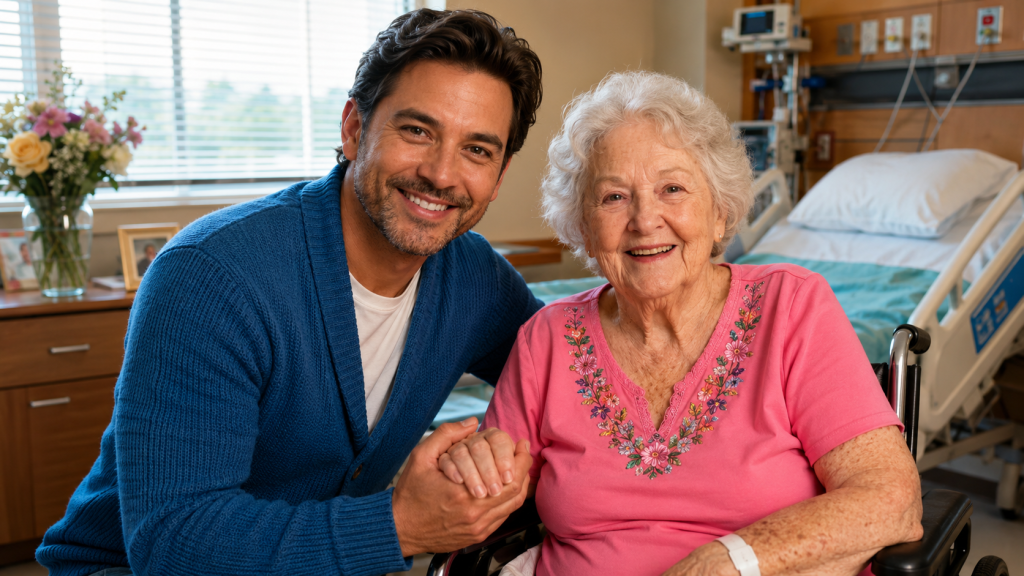
“Mrs. Bennett’s condition has suddenly worsened. She developed complications overnight. We have been trying to reach her son, but he isn’t answering.”
I glanced at the clock.
Michael should have been attending a conference meeting.
“What kind of complications?”
“I would prefer to explain in person. Could you come to the hospital immediately?”
“I’m leaving now.”
I grabbed my purse and rushed out without even shutting down my computer.
The drive took forty-seven minutes.
It felt like hours.
I called Michael repeatedly.
Every call went straight to voicemail.
I left three messages.
“Michael, the doctor called me.”
“Your mother is worse.”
“Please call me immediately.”
When I arrived at the hospital, I parked crookedly and ran inside.
The rehabilitation wing was on the fourth floor.
I hurried through the corridors, trying to remember Patricia’s room number.
Michael had never told me exactly where she had been moved.
I stopped near the nurses’ station.
“Excuse me,” I said. “I’m looking for Patricia Bennett.”
Before the receptionist could answer, another nurse approached me.
She was in her forties, with tired eyes and dark hair pulled into a bun.
“Are you Claire?”
“Yes.”
The nurse glanced around, then placed a folded piece of paper into my hand.
“I’m the one who asked Dr. Ross to call you,” she whispered.
My heart began hammering.
“What’s happening?”
“Read the note immediately.”
I unfolded it.
The handwriting was hurried.
Your husband is lying to you.
Go to Room 120.
I’ll show you the security camera footage.
Please stay calm and don’t tell anyone.
I looked up at the nurse.
“What does this mean?”
“Not here,” she said. “Follow me.”
Her name tag read Lena Ortiz.
She led me away from the main corridor and through a secured door marked STAFF ONLY.
Room 120 was a small administrative office containing a desk, two chairs, and several security monitors.
Lena closed the door behind us.
“Sit down,” she said.
“I don’t want to sit down. I want to see Patricia.”
“You will. But you need to understand what has been happening first.”
She turned toward a computer and entered a password.
My hands were shaking.
“Where is my husband?”
Lena looked at me carefully.
“That is what I’m about to show you.”
She opened a video file.
The date on the screen was from three weeks earlier.
The footage showed a corridor in the rehabilitation wing.
Michael appeared near the elevator carrying a large envelope.
I recognized it immediately.
It was the envelope containing the cashier’s check purchased with my inheritance money.
I leaned closer.
“That was supposed to pay Patricia’s hospital bill.”
Lena said nothing.
On the screen, Michael walked past Patricia’s hallway.
He continued toward the private recovery rooms on the opposite side of the building.
Then he entered Room 126.
A few minutes later, the door opened again.
A woman stepped into the hallway.
She was about thirty-five, with long blond hair.
She threw her arms around Michael’s neck.
He kissed her.
Not on the cheek.
Not like a friend.
He kissed her with the familiarity of a husband returning home.
My stomach turned.
“Who is she?” I whispered.
Lena paused the video.
“Her name is Vanessa Cole.”
I shook my head.
“I don’t know anyone named Vanessa.”
“She was admitted after a serious car accident. She suffered a fractured leg and spinal injuries. She has been receiving rehabilitation here for six weeks.”
Lena pressed play again.
Two children came running into the corridor.
A little girl who looked about seven wrapped herself around Michael’s waist.
A younger boy raised his arms.
Michael picked him up and kissed his forehead.
Even without sound, I could read the boy’s lips.
Daddy.
The room tilted.
I reached for the edge of the desk.
“No.”
“I’m sorry,” Lena said.
“No. Michael doesn’t have children.”
But as I stared at the screen, I saw Michael’s face in the little boy’s features.
The same dark eyebrows.
The same dimple in his left cheek.
The same way of tilting his head when he smiled.
The video continued.
Michael handed Vanessa the envelope containing my money.
She opened it and smiled.
Then she kissed him again.
My breath disappeared.
I stood so quickly the chair fell backward.
“My God,” I cried. “That’s what he’s been doing.”
The nurse caught my arm before I collapsed.
For eleven years, I had believed I knew my husband.
Yet there he was, holding another woman as their children called him Daddy.
“How long?” I asked.
Lena helped me back into the chair.
“I don’t know the full history. But hospital records list Michael as Vanessa’s emergency contact.”
I covered my mouth.
“Did Patricia know?”
“Yes.”
The answer came from behind me.
I turned.
Dr. Ross had entered the room.
She closed the door gently.
“Patricia tried to tell us several times,” the doctor said. “Because of her speech impairment, we struggled to understand her. Michael repeatedly told us she was confused because of the stroke.”
“Why didn’t anyone call me?”
“We didn’t have your contact information until yesterday. Patricia managed to write part of your name and phone number during therapy.”
Lena opened a drawer and removed a plastic folder.
Inside was a sheet of paper.
Patricia’s handwriting was shaky and uneven.
Claire.
Michael lies.
Money.
Other family.
Call Claire.
Tears filled my eyes.
“She was trying to protect me.”
“Yes,” Dr. Ross said. “Unfortunately, Michael often removed her writing pad and insisted that writing frustrated her.”
Anger surged through my grief.
He had not only lied to me.
He had silenced his own disabled mother.
“Is Patricia really dying?”
“She experienced a significant drop in blood pressure and difficulty breathing last night. We have stabilized her, but she is fragile.”
“Take me to her.”
Before we left, Lena held out another folder.
“There is more.”
“I don’t know how much more I can take.”
“You need to see this before Michael returns.”
Inside were copies of financial documents.
The first was a payment record showing that Patricia’s rehabilitation balance was only four thousand eight hundred dollars.
Not thirty thousand.
The second showed that Michael had used twenty thousand dollars to pay Vanessa’s medical debt.
The remaining five thousand had been transferred to an account in Vanessa’s name.
I turned to the final page.
It was a legal document giving Michael control over Patricia’s home and finances.
At the bottom was Patricia’s signature.
But I knew immediately that it was not hers.
Patricia always signed her name with a long, dramatic loop beneath the last letter.
This signature was stiff and uneven.
“When was this signed?”
“Two days ago,” Lena said.
“Patricia can barely hold a pen.”
“That is why I became suspicious.”
The document gave Michael authority to sell Patricia’s house.
I stared at it, feeling cold.
“Why would he sell her home?”
Lena exchanged a glance with the doctor.
“Vanessa told another patient that she and her children were moving into a larger house after her discharge.”
I understood.
Michael planned to take his disabled mother’s home and use it to build a life with his secret family.
My knees nearly gave out again.
But this time, anger held me upright.
“Where is Patricia?”
They led me to the critical-care section.
Patricia lay beneath a thin white blanket, oxygen tubes beneath her nose and monitors surrounding her bed.
Her eyes opened when I entered.
For a moment, she looked frightened.
Then she recognized me.
Tears rolled down the sides of her face.
I hurried to her bedside and took her left hand.
“I’m here,” I whispered. “I know everything.”
Patricia squeezed my fingers.
Her mouth moved.
Only a soft sound came out.
“You don’t have to speak,” I said. “Michael lied to both of us.”
She stared at me desperately.
“The house?” I asked.
Her fingers tightened.
“He tried to make you sign it over?”
Patricia blinked once.
The rehabilitation therapist had explained that one blink meant yes.
“Did you sign the document?”
She blinked twice.
No.
“Did Michael forge your signature?”
One blink.
A terrible silence filled the room.
I leaned close.
“He will not take your house. He will not take another dollar. I promise.”
Patricia began crying harder.
I rested my forehead against her hand.
“I’m sorry I didn’t come sooner.”
She slowly lifted her fingers and touched my cheek.
Despite everything, she was comforting me.
Dr. Ross contacted the hospital’s legal department.
Lena contacted security.
I called a lawyer named Rebecca Shaw, who had helped my company with an employment dispute.
After hearing the situation, Rebecca told me not to confront Michael until we had secured evidence.
“Save every message,” she instructed. “Download your bank records. Do not warn him.”
I spent the next two hours gathering documents from my phone.
Michael had texted me photos of fake hospital bills.
He had written messages thanking me for helping Patricia.
He had repeatedly claimed doctors would not allow me to visit.
Each lie was preserved in writing.
Rebecca arrived at the hospital just after six.
She reviewed the forged power-of-attorney document and immediately called the police.
Because Michael had attempted to gain control of a vulnerable adult’s property through fraud, the matter was far more serious than marital infidelity.
It involved elder abuse, forgery, financial theft, and potentially medical interference.
An officer interviewed Patricia using yes-and-no questions.
She confirmed that Michael had threatened to stop paying for her rehabilitation unless she signed the house over to him.
She had refused.
He forged the signature anyway.
The police also discovered something else.
Michael was not on a business trip.
There was no conference.
He had flown to Las Vegas with Vanessa.
Her hospital discharge had been approved two days earlier.
They were planning to marry.
“But he’s already married to me,” I said.
Rebecca looked at me.
“Vanessa may not know that.”
That possibility had not occurred to me.
I had imagined Vanessa laughing with Michael, fully aware he was betraying his wife.
But what if she had been deceived too?
Using the information in the hospital file, police contacted her.
Vanessa answered from a hotel room in Las Vegas.
At first, she refused to believe them.
Michael had told her that he and I had divorced four years earlier.
He claimed we remained in the same house temporarily because of financial problems.
He had shown her fabricated divorce papers.
He had also told her Patricia’s house had been promised to their children.
When Vanessa learned the truth, she began screaming so loudly the officer had to move the phone away from his ear.
Michael returned to our hotel room while she was still speaking to the police.
According to Vanessa, he tried to grab the phone.
Hotel security detained him until officers arrived.
He was arrested that night.
I did not see him again until three days later, when he appeared by video at a preliminary hearing.
He looked tired and frightened.
The confident man who had kissed me goodbye at the airport had disappeared.
His lawyer argued that the money had been a family gift.
Rebecca presented my bank transfer records and Michael’s messages stating the money would be used exclusively for Patricia’s medical care.
His bail was set high because investigators discovered he had recently applied for a passport for one of the children using false information.
He had apparently planned to leave the country with Vanessa after selling Patricia’s house.
When Michael finally called me from jail, I almost refused the call.
Then I decided I wanted to hear what kind of excuse a man could invent after destroying three families.
“Claire,” he said. “Please don’t hang up.”
I remained silent.
“You don’t understand.”
“I saw the footage.”
He exhaled.
“It wasn’t supposed to happen like this.”
“What wasn’t supposed to happen? The affair? The children? Stealing my inheritance? Forging your mother’s signature?”
“I was going to pay you back.”
“With money from your mother’s house?”
“Vanessa needed help.”
“Your mother needed help.”
“She had insurance.”
“You told me her insurance was barely paying anything.”
“I panicked.”
“No, Michael. Panic lasts minutes. You lied for years.”
He began crying.
“I love you.”
I almost laughed.
“You do not steal from someone you love.”
“I love both of you differently.”
“Then perhaps you should have married both of us.”
“Claire, please. Tell the police this was a misunderstanding.”
“You silenced your mother after she had a stroke.”
“I was protecting her.”
“From what?”
“Stress.”
“You threatened to remove her from rehabilitation unless she gave you her house.”
His voice hardened.
“She wasn’t using it.”
There it was.
The truth beneath all his excuses.
Patricia was not a mother to him.
I was not a wife.
We were resources.
People to use whenever he wanted something.
“You’re going to pay for this,” I said.
Then I ended the call.
I filed for divorce the following morning.
Vanessa contacted me through her attorney.
At first, I did not want to speak with her.
Then she sent me copies of messages Michael had written over the years.
He had met her six years earlier during a sales trip.
He told her he was divorced.
When she became pregnant, he promised they would live together as soon as he resolved a property dispute with his former wife.
The little girl was five.
The boy was three.
Michael had built an entire second life while telling both women that circumstances kept him from fully committing.
Vanessa had believed Patricia adored the children.
In reality, Patricia had only learned about them shortly before her stroke.
She had discovered photographs on Michael’s phone when he left it at her house.
They argued.
During that confrontation, Patricia became dizzy and collapsed.
Michael had delayed calling an ambulance for nearly twenty minutes while deleting messages from her phone.
Investigators later recovered the deleted emergency call Patricia had attempted to make.
Learning that nearly broke me.
His lies may not have caused the stroke, but his actions had endangered her life afterward.
Vanessa agreed to testify.
So did Lena.
Patricia spent another three weeks in the hospital.
I visited every day.
Gradually, she regained enough strength to sit upright.
Her speech remained difficult, but she could write short sentences with her left hand.
One afternoon, she wrote:
I failed you.
I shook my head.
“You did not fail me.”
Should have seen him.
“You raised him with love. His choices belong to him.”
She looked away.
I understood her shame because I carried my own.
I had slept beside Michael for eleven years without recognizing the man he truly was.
But Patricia and I slowly learned that trust is not foolishness.
The shame belongs to the person who abuses it.
Months later, Michael accepted a plea agreement after prosecutors presented overwhelming evidence.
He pleaded guilty to fraud, forgery, financial exploitation of a vulnerable adult, theft, and obstruction related to Patricia’s medical care.
The attempted property transfer was canceled.
My twenty-five thousand dollars was partially recovered from Vanessa’s hospital account.
Vanessa voluntarily returned what remained of the money Michael had given her.
She moved with the children to another state to live near her sister.
Before she left, we met once in a quiet café.
She looked exhausted.
“I hated you for years,” she admitted.
“Why?”
“Michael said you ruined his life. He said you were controlling and refused to finalize the divorce.”
“He told me he was visiting his sick mother.”
Tears filled her eyes.
“I feel so stupid.”
“So do I.”
We sat quietly for a moment.
Then I said, “But we weren’t stupid. We trusted someone who practiced lying every day.”
She nodded.
“I’m sorry you lost your bakery money.”
“I’ll rebuild it.”
“And I’m sorry about everything else.”
“So am I.”
We did not become friends.
There was too much pain between us.
But we left the café without blaming each other for a deception neither of us had created.
Patricia eventually returned home.
I helped install safety rails, arrange physical therapy, and convert the downstairs study into a bedroom.
At first, she assumed I would disappear after the divorce.
One evening, she wrote on her communication tablet:
You don’t have to stay.
I sat beside her.
“You are not Michael.”
She stared at me.
“You tried to warn me when you could barely speak. You are still my family.”
She reached for my hand.
A year after the nurse handed me that note, Patricia walked into my bakery using a silver cane.
Yes, I opened it after all.
The money I recovered was not enough, but Patricia insisted on investing part of her savings.
At first, I refused.
Then she wrote:
Not charity.
Business.
I laughed and agreed.
We named the bakery Second Rise.
The name referred to dough rising again after being pressed down.
But it also described us.
Patricia became a familiar presence near the front window.
Customers adored her.
Her speech improved slowly, and she took great pride in greeting people herself.
One morning, while I was arranging pastries, she called my name clearly.
“Claire.”
I froze.
It was the first time she had spoken my name without struggling.
I turned around.
She smiled.
“Family,” she said.
My eyes filled with tears.
“Yes,” I answered. “Family.”
Michael wrote several letters from prison.
I returned the first three unopened.
The fourth arrived on the anniversary of Patricia’s stroke.
This time, I read it.
He wrote that he had changed.
He said prison had given him time to understand the harm he had caused.
He asked whether Patricia would visit.
He asked whether I might forgive him someday.
At the bottom, he wrote:
I lost everything.
I folded the letter and placed it in a drawer.
He was wrong.
He had not lost everything.
He had thrown everything away.
There is a difference.
I did eventually forgive him, but not in the way he wanted.
Forgiveness did not mean returning.
It did not mean pretending the damage had never happened.
It did not mean giving him access to the life I rebuilt.
Forgiveness meant I stopped carrying his choices like stones inside my chest.
I let the law hold him accountable.
I let distance protect me.
And I let myself move forward.
The nurse’s note remained in my wallet for years.
The paper became soft along the folds.
Your husband is lying to you.
Those six words destroyed the life I thought I had.
But they also saved Patricia’s home, protected my future, and stopped Michael before he disappeared with everything.
Sometimes the truth does not arrive gently.
Sometimes it comes from a stranger in a hospital corridor, pressed into your shaking hand.
Sometimes it makes your knees give out.
But once you stand again, you realize the truth did not destroy you.
The lie did.
The truth simply opened the door.
And I finally walked through it.
THE END! THANK YOU FOR READING!