

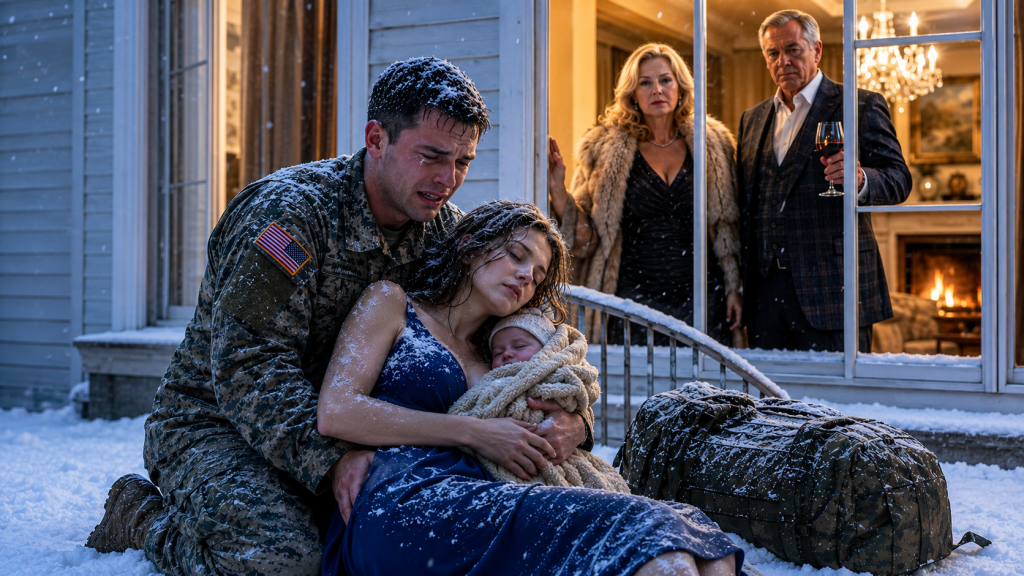
My plane landed after eighteen months overseas, but instead of my wife waiting with open arms, I found her collapsed barefoot in the snow outside my own house, shielding our six-month-old son with her freezing body.
“Your parents said we weren’t family anymore,” she whispered through blue lips.
In that instant, I stopped feeling like a soldier returning home and became a husband ready to reclaim everything they had stolen from us.
The blizzard had buried the driveway beneath thick drifts, yet it could not hide the sight of Emma lying beside the porch steps, clutching Noah beneath her coat to keep him alive.
One look at her frostbitten hands and exhausted eyes hurt more than every battlefield I had survived during the past eighteen months.
For one horrifying moment, I feared I was already too late.
I dropped my duffel bag and sprinted through the snow.
“Emma!”
Her eyes opened weakly.
“Ethan?”
She said my name as though she believed I was a dream.
Noah’s faint cries barely rose above the howling wind. Emma had wrapped him in layers of her clothing, leaving her own arms and feet exposed to the cold.
I tore off my military coat, wrapped it around them both, and lifted them into my arms.
“How long have you been out here?”
Emma tried to answer, but her teeth were chattering too violently.
I reached the front door and twisted the handle.
Locked.
I pounded once.
No one answered.
Through the living-room window, I saw the glow of the fireplace. Shadows moved inside. Someone laughed.
My family was warm while my wife and infant son were freezing to death outside.
I stepped back and kicked the door beside the lock.
The frame cracked.
A second kick sent the door flying inward.
Warmth spilled over us.
So did the smell of roasted meat, expensive bourbon, and burning cedar.
My father, Richard Cole, sat beside the fireplace holding a glass from the bottle I had saved for my homecoming.
My mother, Diane, wore Emma’s favorite cream cashmere robe as though it belonged to her.
My younger brother, Kyle, stretched across my couch with muddy boots resting on the coffee table Emma and I had chosen together.
All three stared at me.
My mother’s face lost its color.
“Ethan?” she blurted. “We weren’t expecting you until Friday.”
My return date had changed after a transport aircraft opened an earlier seat.
I had kept it secret because I wanted to surprise Emma.
Instead, I had surprised the people destroying her life.
I carried my wife and child across the room.
My father rose from his chair.
“Put her back outside.”
I stopped.
“What did you say?”
“She attacked your mother,” he replied. “She became hysterical when we explained the situation.”
Emma buried her face against my shoulder.
“They changed every lock,” she whispered. “They took my phone, my wallet, everything. They said the house belonged to them.”
Kyle gave a careless shrug.
“Legally, it does.”
He nodded toward the wall above the fireplace.
A framed property deed hung where Emma and I had once displayed our wedding portrait.
My father’s name appeared beneath the description of my property.
On the dining table sat mortgage documents, bank statements, legal notices, and a thick folder marked CUSTODY PETITION.
My mother crossed her arms.
“Emma became unstable while you were deployed. We had to protect your assets and your son.”
“You left them outside in a blizzard.”
“She refused to cooperate,” my father said.
No anger showed in his face.
That frightened me more than shouting would have.
I had seen men justify terrible actions with the same calm expression. They did not think of themselves as cruel. They believed they had the right to decide who deserved safety.
I carried Emma upstairs.
My mother followed.
“You cannot take the baby,” she said. “Our attorney advised us to keep Noah away from her.”
I turned so quickly that she stepped backward.
“Come near my son again, and the police will be the least of your problems.”
She froze.
I entered the master bedroom and locked the door.
The room barely resembled the home Emma and I had created.
My uniforms had been removed from the closet. Emma’s clothes were piled in boxes. Our photographs had vanished. My mother’s jewelry rested on Emma’s dresser.
I placed Emma and Noah on the bed, wrapped them in blankets, and checked their breathing.
Noah’s skin was cold, but he reacted when I touched his cheek.
Emma’s fingers had turned pale and waxy.
I pulled my satellite phone from my bag and called emergency services.
Then I contacted Major Lena Ortiz.
Lena was a military attorney who had helped me establish legal protections before my deployment. After seeing too many service members return home to stolen savings, ruined credit, and fraudulent divorces, she had insisted that every important asset be placed inside a trust.
My house, inheritance, military benefits, and investment accounts could not legally be transferred without my signature and biometric authorization.
“What happened?” Lena asked.
“My family forged documents, took control of my house, stole from our accounts, and tried to take custody of Noah.”
Her voice sharpened.
“Is Emma safe?”
“Barely. I found her outside in the snow.”
“Do not confront your family about the documents. Preserve everything. Police and military investigators need to see the scene exactly as it is.”
Downstairs, my father shouted that he was calling his attorney.
“I’ve already called mine,” I answered through the floor.
Then I looked at the small smoke detector above the bedroom door.
It was not a smoke detector.
Months before deployment, I had installed a hidden backup surveillance system after several homes in the neighborhood were burglarized.
The visible cameras could be disabled from the control panel.
The hidden ones could not.
Every recording was uploaded to an encrypted server only I could access.
My parents believed the dark indicator lights meant nothing had been captured.
They were catastrophically wrong.
The paramedics arrived twelve minutes later.
I carried Noah downstairs while they moved Emma onto a stretcher.
My father tried to block the doorway.
“You are making a serious mistake,” he told me. “That woman has manipulated you for years.”
A police officer stepped between us.
“Sir, move aside.”
“This is my house.”
“No,” I said. “It isn’t.”
Kyle laughed.
“The deed says otherwise.”
I glanced at the forged document.
“That paper is going to put someone in prison.”
His smile faded for half a second before returning.
At the hospital, doctors treated Emma for hypothermia and frostbite.
Noah’s temperature had fallen dangerously low, but because Emma had covered him with her own body, he avoided permanent injury.
The physician looked at me after examining them.
“Your wife likely saved your son’s life.”
I sat beside Emma’s bed and held her bandaged hand.
She looked thinner than when I had last seen her through a video call. Shadows lay beneath her eyes. A bruise darkened one cheek.
“How long has this been happening?” I asked.
Tears filled her eyes.
“Almost eight months.”
The answer felt like a bullet.
“Why didn’t you tell me?”
“I tried.”
She looked toward Noah sleeping in a hospital bassinet.
“Your parents began visiting after he was born. At first, they said they wanted to help. Your mother cooked meals and watched Noah while I slept. Your father handled repairs around the house.”
Emma swallowed.
“Then they started opening our mail.”
My father claimed it was an accident.
My mother said she only wanted to make sure Emma was paying the bills correctly.
Kyle began borrowing my truck without permission. When Emma objected, he mocked her for behaving like she owned it.
“They kept telling me I was only living there because you allowed it,” she said. “They said everything belonged to the Cole family, not to me.”
I tightened my grip on her hand.
“You are my family.”
“I know.”
Her voice broke.
“But they kept repeating it until I began questioning everything.”
My parents had isolated her slowly.
They told neighbors Emma was suffering from postpartum depression and could not be trusted.
They intercepted packages.
They cancelled appointments.
They convinced her that contacting my command would damage my career.
When she tried to tell me during video calls, my mother stayed nearby, pretending to help with Noah.
If Emma spoke privately, the internet connection mysteriously failed.
“I sent emails,” she said.
“I never received them.”
“They had access to the router. Kyle bragged that he could see everything I did online.”
My stomach turned.
My brother worked in information technology. He had helped configure our home network before deployment.
Emma continued.
“Three months ago, they moved into the house. Your father said there was a problem with their apartment. He promised it would only be for a week.”
They never left.
My father began controlling the household finances.
My mother took Emma’s car keys, claiming she was too exhausted to drive safely with Noah.
Kyle entered rooms without knocking and searched through drawers.
When Emma protested, they recorded her anger and called it evidence of instability.
Then the custody papers appeared.
“They said you had signed documents giving your father the house and making them Noah’s temporary guardians.”
“I signed nothing.”
“I knew that. But the paperwork looked real.”
Emma had tried to leave with Noah two days earlier.
My father stopped her at the door.
Kyle took her phone.
My mother grabbed the baby carrier and told Emma she could leave alone.
Emma fought to hold Noah.
During the struggle, my mother fell against a chair.
“That was the assault they mentioned,” Emma said. “She wasn’t hurt. She grabbed Noah, and I pulled him back.”
My family threatened to call the police and have Emma arrested.
Then, less than an hour before I arrived, my father forced her onto the porch.
He said she needed to calm down.
When she begged for shoes and a coat, he locked the door.
“They watched through the window,” Emma whispered. “Your mother was holding my phone. She smiled at me.”
I bowed my head.
Shame weighed heavily on my chest.
I had promised Emma that my family would help while I was gone.
I had given them keys.
I had trusted people who viewed kindness as weakness.
“You did nothing wrong,” she said softly.
“I brought them into our home.”
“You could not have known.”
But part of me had known.
My father had always demanded control.
When I was a child, he chose my friends, my clothes, and my future.
He believed joining the military was acceptable only because it brought honor to the family name.
My mother presented herself as gentle, but she supported every decision he made.
Kyle learned early that obedience earned rewards.
I learned that independence earned punishment.
When I married Emma, my parents behaved politely, but they never accepted that she came first.
My mother criticized the wedding.
My father questioned the prenuptial agreement.
Kyle joked that Emma had won the lottery by marrying me.
I had mistaken their silence after the wedding for acceptance.
It had only been patience.
The next morning, Detective Aaron Bell arrived at the hospital with Major Ortiz.
Lena placed a tablet on the small table beside Emma’s bed.
“We confirmed the deed is fraudulent,” she said. “The county records office received an electronically filed transfer bearing Ethan’s signature. The notary listed on the document died fourteen months before the filing date.”
Detective Bell almost smiled.
“Not exactly subtle.”
“What about the mortgage?” I asked.
“Your father used the fraudulent deed to obtain a home-equity loan for four hundred thousand dollars,” Lena explained. “Most of the money was transferred into accounts connected to Kyle.”
Emma stared at her.
“Four hundred thousand?”
Kyle had used the money to fund a failing software company, purchase a luxury vehicle, and cover gambling debts.
My mother had spent nearly sixty thousand dollars renovating rooms inside our house.
“They planned to sell the property,” Detective Bell said. “We found messages between your father and a real-estate developer.”
The land had increased dramatically in value because of a planned commercial project nearby.
My father expected to make more than a million dollars.
“And the custody petition?” Emma asked.
Lena’s expression hardened.
“They submitted fabricated medical reports claiming you were suicidal, violent, and addicted to prescription medication.”
Emma covered her mouth.
“I have never taken anything except what my doctor prescribed after childbirth.”
“We know. The doctor whose signature appears on one report denies writing it.”
The evidence was already overwhelming.
But the recordings would reveal more.
I accessed the encrypted surveillance server.
The system had captured months of footage.
We watched my mother search Emma’s purse.
We saw Kyle install monitoring software on her laptop.
We heard my father instruct a stranger to imitate my signature.
One video showed all three sitting around the dining table.
My father held the custody petition.
“Once the court grants emergency guardianship, Emma will have no leverage,” he said.
Kyle asked, “What happens when Ethan comes home?”
My mother answered.
“He will believe us. He has always believed family.”
Another recording showed Emma standing in the living room with Noah in her arms.
“You cannot take my child,” she said.
My father approached her.
“He is a Cole. You are temporary.”
My hands curled into fists.
Detective Bell paused the video.
“There is more.”
The recording from the previous night appeared.
Emma stood near the front door, crying and begging for her phone.
My mother held Noah’s blanket.
Kyle opened the door.
Snow blew into the house.
My father pointed outside.
“You can come back when you agree to sign the custody papers.”
“I won’t leave my baby.”
“You are leaving with him,” my mother said. “Maybe the cold will help you understand how helpless you are without us.”
Kyle pushed Emma onto the porch.
She fell to her knees.
My mother tossed Noah into her arms, then shut the door.
They watched through the window as Emma pounded against the glass.
After several minutes, Kyle asked whether they should let her back inside.
My father replied, “Not until she breaks.”
They walked away.
No one spoke in the hospital room when the video ended.
Detective Bell closed the tablet.
“That recording changes everything.”
My father, mother, and brother were arrested before noon.
Richard faced charges related to forgery, fraud, theft, unlawful eviction, child endangerment, and attempted coercion.
Kyle faced many of the same charges, along with cybercrime offenses.
My mother insisted she had only obeyed my father.
The video showed otherwise.
She had been an active participant from the beginning.
For the next week, Emma and Noah remained in the hospital.
I stayed beside them.
I fed Noah at night, changed his diapers, and walked the hallway with him pressed against my chest.
During deployment, I had watched him grow through a screen.
I had missed Emma’s pregnancy appointments, his birth, his first smile, and the first time he rolled onto his stomach.
I could not recover those moments.
But I could protect every moment that remained.
When Emma was discharged, we did not return home immediately.
The house was a crime scene, and even after investigators finished, Emma could not bear the idea of sleeping there.
We stayed at a secure residence arranged through the military.
At night, Emma woke from nightmares believing she was still outside in the snow.
Sometimes she checked the locks three or four times.
Sometimes she stood over Noah’s crib and cried without making a sound.
I wanted to promise that she would never feel afraid again.
But promises alone would not heal what had happened.
So I listened.
I attended counseling with her.
I took leave from active duty.
I let her decide what happened next.
Two weeks later, my father called from jail.
Against Lena’s advice, I accepted.
“Ethan,” he began, sounding offended rather than ashamed. “This situation has gone too far.”
“You left my wife and child outside to freeze.”
“That was poor judgment.”
“It was attempted murder disguised as discipline.”
“Do not be dramatic.”
Even from a jail telephone, he believed he could command me.
“You have always been too emotional about Emma,” he continued. “She has separated you from your family and poisoned you against us.”
“You forged my name.”
“I protected the estate.”
“You stole four hundred thousand dollars.”
“I invested in your brother’s future.”
“You tried to take my son.”
“He belongs with people who understand his heritage.”
I closed my eyes.
There it was.
The belief beneath every action.
My father did not see Noah as a child.
He saw him as property carrying the Cole name.
“You will never see him again,” I said.
“You cannot cut us off. Blood is blood.”
“No. Family is who stands between a child and the cold. Emma did that. You locked the door.”
His breathing changed.
For the first time, he understood that he had lost control.
“If you testify against us,” he said, “you will destroy your mother.”
“You did that yourself.”
I ended the call.
Kyle attempted a different strategy.
He sent a letter through his attorney, apologizing for becoming involved in a misunderstanding.
He blamed financial pressure, our father’s influence, and fear that his business would fail.
He offered to testify against our parents if I asked prosecutors for leniency.
I returned the letter unanswered.
My mother wrote fourteen pages.
She described raising me, attending my school events, caring for me when I was sick, and supporting my military career.
She mentioned Emma only twice.
She never mentioned the snow.
The criminal investigation uncovered damage beyond the house.
My family had opened credit accounts in my name.
They had redirected part of Emma’s mail.
They had withdrawn money from an emergency account by using forged authorization forms.
Kyle had even sent messages from a fake email address designed to resemble mine.
In those messages, “I” complained that Emma was unstable and asked my parents to monitor her.
They planned to use the emails during the custody case.
Their scheme depended on my absence.
They assumed distance had made me powerless.
What they had not considered was that every deployment taught me to document, verify, and prepare for betrayal.
The trust protected my assets.
The hidden cameras preserved the truth.
And Emma’s determination kept Noah alive long enough for me to come home.
Three months later, we attended the preliminary hearing.
Emma wore a dark blue dress and held my hand as we entered the courtroom.
My parents sat behind the defense table.
Kyle avoided my eyes.
My mother began crying when she saw me.
My father remained expressionless.
The prosecutor played selected security recordings.
The courtroom watched Emma being forced into the blizzard.
Several jurors looked away when Noah’s cries sounded through the speakers.
My mother covered her face.
My father stared directly ahead.
Their attorneys argued that no one intended serious harm.
They claimed Emma could have walked to a neighbor’s house.
The prosecutor showed weather reports documenting temperatures far below freezing and near-zero visibility.
Then the physician testified that another thirty minutes of exposure might have killed both Emma and Noah.
The judge denied bail.
Outside the courtroom, reporters waited.
Lena advised us not to speak.
But as cameras turned toward Emma, she stopped.
“I was told I did not belong in my own home,” she said. “I was told my son belonged to people with more money and power than I had. They believed no one would listen to me. I am speaking now for anyone who has been isolated, threatened, or made to believe they are helpless. You are not helpless. Ask for help. Keep records. Tell the truth until someone hears you.”
Then she walked beside me to the car.
I had never been prouder of anyone.
The house was eventually returned to us legally, though it had never truly left our ownership because the trust invalidated the forged transfer.
The fraudulent loan became the lender’s loss, and the bank pursued my father separately.
Kyle’s luxury vehicle was seized.
His business collapsed.
My parents’ accounts were frozen.
But reclaiming the house did not make it feel like ours.
Every room carried evidence of what Emma had endured.
She could not look at the porch without shaking.
One evening, I found her standing in the empty nursery.
“Do you want to sell?” I asked.
She nodded.
“I don’t want Noah growing up in the place where they tried to take him from us.”
“Then we sell.”
The next day, we contacted a realtor.
We removed the framed forged deed from above the fireplace and replaced it temporarily with our wedding photograph.
Before leaving for the last time, Emma stood on the porch.
Snow had begun falling lightly.
I moved beside her.
“You don’t have to stay out here.”
“I know.”
She looked at the place where I had found her.
“For months, I thought this house was proof that your family had won. But it’s only wood and stone. It never made us a family.”
She took my hand.
“You came back.”
“I should have protected you sooner.”
“You came back,” she repeated. “And this time, you listened.”
We bought a smaller house near a quiet lake, far from my parents and close to Emma’s sister.
It had wide windows, a red front door, and a nursery filled with morning sunlight.
Emma chose every lock.
I installed a security system, but I gave her complete control of it.
No one received a spare key without her approval.
I transferred to a stateside position that allowed me to spend more time at home.
The decision slowed my military advancement, but I no longer measured success by rank.
I measured it in Noah’s laughter.
In Emma sleeping through the night.
In breakfasts where no one feared footsteps in the hallway.
The trial began nine months after my return.
My father rejected every plea agreement.
He believed he could convince a jury that he had acted to protect Noah.
My mother accepted a reduced sentence in exchange for testimony.
Kyle did the same.
Their loyalty disappeared the moment prison became real.
Kyle testified that my father had planned the fraud.
My mother admitted she had fabricated stories about Emma’s mental health.
But neither could escape the recordings.
The evidence showed planning, cooperation, and cruelty from all three.
When Emma testified, the courtroom became completely silent.
She described the gradual isolation, the threats, the stolen phone, and the night in the blizzard.
My father’s attorney asked why she had not simply left earlier.
Emma looked directly at him.
“Because abuse does not begin with someone throwing you into the snow. It begins with small acts that make you doubt your right to object. By the time the door closes, you have been taught to believe no one will open it.”
The prosecutor showed photographs of her frostbitten hands.
Then he played the recording of my father saying, “Not until she breaks.”
The jury deliberated for less than five hours.
All three were convicted on the most serious charges.
My father received the longest sentence.
Kyle was sentenced to prison and ordered to pay restitution.
My mother received a shorter term because of her cooperation, though the judge made it clear that obedience did not excuse cruelty.
Before sentencing, my father asked to speak.
He stood and faced me.
“I gave my son everything,” he said. “I made him strong. I built the foundation for every success he achieved. Now he sits beside a woman who has convinced him to abandon his own blood.”
I rose when the judge permitted me to respond.
“You taught me that strength meant control,” I said. “Emma taught me that strength means protecting someone without owning them. You taught me that family loyalty required silence. She taught me that love requires truth. You did not lose me because she manipulated me. You lost me when you chose money, power, and pride over the lives of my wife and child.”
My father stared at me.
I continued.
“You once said I would always come back to my family. You were right. I came back to Emma and Noah.”
After the trial, we tried to live quietly.
Healing was not dramatic.
It happened in ordinary moments.
Emma planted flowers beside our red door.
I taught Noah to walk on the grass near the lake.
We attended therapy.
We argued sometimes.
We apologized.
We learned that survival did not erase pain, but it gave us the chance to build something beyond it.
On the anniversary of my return, snow began falling after sunset.
Emma stood at the window holding Noah, who was now eighteen months old.
He pressed both hands against the glass and laughed at the flakes.
I approached from behind and wrapped my arms around them.
Emma leaned against me.
“Do you ever think about that night?” she asked.
“Every day.”
“So do I.”
She was quiet for a moment.
“Sometimes I remember how cold I was. Then I remember seeing you run through the snow.”
“I thought I had lost you.”
“You didn’t.”
Noah turned and reached for me.
I lifted him into my arms.
Outside, the snow covered the road and trees in white.
Inside, the fireplace burned softly.
No one controlled the locks but us.
No forged paper could redefine our family.
No stolen money could purchase our silence.
No shared blood could excuse betrayal.
Eighteen months overseas had taught me how to identify threats, follow trails, and hunt people who believed they could disappear.
But coming home taught me something more important.
The most dangerous enemies do not always stand across a battlefield.
Sometimes they sit beside your fireplace, drink from your glass, wear your wife’s clothes, and call their cruelty love.
My parents had expected a tired soldier who would accept their version of the truth.
Instead, they met a husband who had finally understood where his loyalty belonged.
I reclaimed the house.
I recovered the money that could be recovered.
I cleared Emma’s name.
I protected my son.
But those were not the greatest things I took back.
I reclaimed Emma’s belief that she deserved to be heard.
I reclaimed the peace they had stolen from our marriage.
I reclaimed the right to define family by love instead of blood.
And as I stood inside our new home with my wife beside me and my son safe in my arms, I realized my father had been wrong about one final thing.
He believed the Cole name was the inheritance I would pass to Noah.
It wasn’t.
The inheritance I would give my son was the knowledge that no one who truly loved him would ever force him to earn warmth, safety, or belonging.
He would grow up knowing that home was not a deed on a wall.
It was not a surname.
It was not a fortune.
Home was the person who covered you with her own body when the world turned cold.
Home was the person who broke down the door to reach you.
Home was the place where love did not demand obedience before offering shelter.
The storm outside grew stronger, but I no longer feared it.
I kissed Emma’s forehead.
Then I held my family closer as snow covered the world beyond our windows.
This time, every door was locked against the people who had harmed us.
And everyone who truly belonged was already inside.
THE END! THANK YOU FOR READING!