

The call came at 6:47 a.m. on a Tuesday near the end of August, the kind of gray morning that already felt heavy before the day had even begun.
I remember the exact time because I had been awake since five, sitting alone in my office, staring at blueprints for the Morrison Tower project and forcing my exhausted mind into load-bearing calculations, steel-frame specifications, elevator shafts, emergency exits, and anything else that could keep me from thinking about the emptiness inside my own life.
Anything was better than remembering that I had not seen my daughters in two full years.
I had not touched their hair.
I had not heard their laughter in my kitchen.
I had not kissed their foreheads before sleep or listened to them argue over who got the pink cereal bowl.
My phone buzzed across the drafting table, vibrating against pencils, rulers, and marked-up plans.
An unknown Seattle number appeared on the screen.
For one suspended second, I almost let it ring.
Seattle was where they lived now, far from the Portland life they had once shared with me.
Seattle was where Graham had taken Sophie and Ruby after the judge declared me unfit, that ugly word still turning to ash on my tongue every time I remembered it.
But something deep in my chest tightened.
Before I could talk myself out of it, I picked up the phone.
“Ms. Hayes?”
The voice belonged to a woman. Calm and careful, but carrying the quiet urgency doctors use when they are trying not to frighten you too soon.
“This is Dr. Sarah Whitman from Seattle Children’s Hospital. I’m calling about your daughter Sophie.”
My daughter.
Those two words hit me so hard that I had to grip the edge of the table.
I had not been allowed to say them out loud for 732 days.
“What happened?” I asked, though my throat had gone dry. “Is she hurt?”
“Sophie was admitted to our emergency department early this morning,” Dr. Whitman said. “She has been experiencing fatigue, bruising, recurring infections, and persistent fever. Her initial bloodwork is concerning. We are running additional tests, but we suspect acute leukemia.”
The blueprints blurred in front of me until the careful black lines became nothing but streaks.
Leukemia.
My ten-year-old daughter, the little girl I had once rocked through fevers and nightmares, had cancer.
“I need you to come to Seattle immediately,” Dr. Whitman continued. “Sophie may require a bone marrow transplant, and we need to test close relatives as possible donors. Time is important.”
“I’m in Portland,” I said, already standing, already reaching for my keys with shaking fingers. “I can be there in three hours.”
“Good. Ask for me at the pediatric oncology unit when you arrive. And Ms. Hayes…”
She paused just long enough for dread to crawl up my spine.
“I know the custody situation is complicated, but right now Sophie needs every available chance.”
When the call ended, I stood frozen beside the drafting table.
Six months of work lay spread in front of me.
A multimillion-dollar contract.
The project that could rescue my struggling architecture firm from the edge of collapse.
My business partner, Marcus, had scheduled the presentation for nine. The clients were already flying in from San Francisco, expecting confidence, precision, and a future built in steel and glass.
I called Marcus before my courage could break.
“I need you to handle the Morrison meeting without me,” I said.
“What? Isabelle, this is our biggest project in two years.”
“My daughter has cancer.”
Silence stretched across the line.
Marcus knew about the custody battle.
He had watched me become a ghost after Graham took Sophie and Ruby away. He had seen me sell my house, borrow against the business, and spend every remaining dollar trying to fight a man who seemed to have endless money and endless influence.
“Go,” Marcus said at last. “I’ll handle Morrison.”
I grabbed my bag and ran out without looking back.
Interstate 5 north became a long gray tunnel of wet pavement, blurred headlights, and dark green pine trees sliding past my windows.
I drove with both hands locked around the steering wheel while Dr. Whitman’s words repeated in my mind.
Leukemia.
Bone marrow transplant.
Time is important.
I had not seen Sophie since the final custody hearing.
She had been eight then, small for her age, with Graham’s dark eyes and my stubborn chin. She had stood in the courthouse hallway clutching Ruby’s hand, trying to be brave while Graham’s attorney whispered to a social worker.
I had attempted to approach them.
Ruby saw me first.
“Mommy!”
She tore her hand from Sophie’s and ran toward me.
Graham stepped between us.
He grabbed Ruby by the shoulders and turned her away before I could touch her.
“You heard the judge,” he said quietly. “No unsupervised contact.”
“The order doesn’t start until tomorrow.”
“It starts now as far as I’m concerned.”
Sophie looked over his arm at me.
She did not cry.
That was somehow worse.
She just stared at me with a confusion no child should ever have to carry.
Then Graham led them away.
The judge had granted him sole custody based on a psychiatric evaluation claiming I suffered from bipolar disorder, alcohol dependency, and emotional instability severe enough to endanger my own children.
Every word had been a lie.
I did not have bipolar disorder.
I was not dependent on alcohol.
I had never endangered Sophie or Ruby.
But Graham had photographs of empty wine bottles found in our recycling bin.
He had statements from neighbors describing late-night arguments.
He had a report signed by a respected psychiatrist, Dr. Benjamin Pike, who claimed I had admitted to blackouts and violent thoughts during three private evaluations.
I had never met Dr. Pike.
I said so in court.
His attorney produced appointment records bearing my signature.
The signatures looked enough like mine to make the judge hesitate.
Graham sat across the room in a navy suit, wearing the wounded expression of a devoted father forced to protect his children from an unstable wife.
I watched him lie under oath without blinking.
And I lost everything.
After the hearing, I filed complaints against Dr. Pike.
His office claimed the records were confidential.
The licensing board said there was insufficient evidence of misconduct.
My attorney advised me that an appeal could cost another sixty thousand dollars.
I had already spent nearly everything.
Graham moved the girls to Seattle three weeks later.
He changed their school.
He changed their phone numbers.
He rejected every request for supervised visitation by claiming the girls became distressed when my name was mentioned.
Birthday gifts were returned unopened.
Letters disappeared.
Video calls were canceled.
Eventually, even the court-appointed supervisor stopped returning my messages.
The system had not only removed me from my daughters’ lives.
It had helped Graham erase the evidence that I had ever belonged there.
Now, two years later, that same system was calling me back because something inside my body might save Sophie.
By the time I reached Seattle Children’s Hospital, my hands were trembling so badly that I could barely sign my name at the front desk.
The pediatric oncology unit smelled like sanitizer, plastic tubing, and quiet fear.
Dr. Sarah Whitman met me outside a secured door, a clipboard pressed to her chest and kindness in her eyes.
“Ms. Hayes,” she said softly. “Thank you for coming so quickly.”
“I want to see her.”
“You will. But first we need to begin donor testing. Sophie’s condition is progressing quickly, and we cannot lose time.”
I nodded because I had no choice.
I would have cut myself open in that hallway if they had told me it might help her.
They drew my blood.
They took cheek swabs.
They asked questions about illnesses, pregnancies, medications, ethnic background, and family history.
I answered like a machine, my mind fixed on the room down the hall where my daughter was lying sick without me.
“How was the pregnancy?” a genetic counselor asked.
“Difficult at the end,” I said. “The girls were delivered by emergency cesarean at thirty-four weeks.”
“Any fertility treatment?”
“No.”
“Any blood transfusions?”
“During the delivery. I hemorrhaged.”
“Were the twins identical or fraternal?”
“Identical,” I answered automatically. “That’s what we were told.”
She studied the form.
“Were they tested genetically?”
“I don’t know. Graham handled most of the paperwork because I was unconscious for several hours after surgery.”
The counselor made a note.
I noticed it but did not ask why.
After the testing, a nurse led me toward Sophie’s room.
I stopped outside the glass wall.
For a moment, I could not breathe.
Sophie lay beneath a white blanket, smaller than I remembered. Her face was pale, her lips dry, and there were dark circles beneath her eyes. An intravenous line ran into her arm.
Ruby sat beside the bed, holding her sister’s hand.
She had grown taller.
Her hair, once cut evenly at her shoulders, now fell halfway down her back.
Graham stood near the window speaking on his phone.
He turned.
The moment he saw me, his expression hardened.
“What is she doing here?”
Ruby’s head snapped toward the doorway.
Her eyes widened.
“Mom?”
The word came out barely louder than a breath.
I pressed one hand against the glass.
“Hi, sweetheart.”
Ruby stood so quickly that her chair scraped across the floor.
She took two steps toward me.
Then she looked at Graham.
The old fear returned to her face.
Graham ended his call.
“You need to leave,” he said.
“Dr. Whitman asked me to come.”
“You were asked to provide a sample, not disrupt my daughters.”
“Our daughters.”
“You lost the right to call them that.”
Dr. Whitman stepped between us.
“This is a medical unit, Mr. Hayes. Sophie’s care is our priority. Ms. Hayes has completed the preliminary donor testing, and I authorized her presence.”
“I have sole custody.”
“Custody does not prevent the hospital from testing a biological parent who may be able to save a child’s life.”
Graham lowered his voice.
“You don’t know what she is.”
I looked through the glass at Sophie.
Her eyes were open now.
She was staring directly at me.
“I know exactly what I am,” I said. “I’m her mother.”
Sophie lifted one weak hand.
I entered the room before Graham could stop me.
Every step felt unreal.
I had imagined this reunion a thousand times.
In some versions, both girls ran into my arms.
In others, they hated me because Graham had convinced them I had abandoned them.
I had never imagined finding one of them in a hospital bed.
I stopped beside Sophie.
“Hello, my beautiful girl.”
She searched my face.
“You look different.”
“So do you.”
“Dad said you moved away.”
“I never moved away.”
“He said you didn’t want visits.”
My heart cracked quietly.
“I wanted every visit.”
Graham appeared behind me.
“That is enough.”
Sophie’s fingers closed weakly around mine.
“Did you get my birthday letter?” she asked.
“What letter?”
“The one I sent last year. I put it in the blue mailbox myself.”
“I never received it.”
She looked toward Graham.
His jaw tightened.
Ruby came to stand on the other side of the bed.
“I wrote one too,” she whispered.
Graham moved forward.
“Girls, your mother is confusing you.”
“No,” I said. “You are.”
A nurse entered and reminded us that Sophie needed rest.
Dr. Whitman asked Graham and me to step into a consultation room.
For the next hour, she explained the diagnosis.
Sophie’s bone marrow was producing abnormal cells that crowded out healthy blood cells. Chemotherapy would begin immediately. A transplant might be necessary depending on how she responded.
Ruby had already been tested as a possible donor.
She was not a sufficient match.
Graham’s results were also poor.
My preliminary markers looked more promising, but full compatibility testing would take additional time.
“Then take whatever you need,” I said. “Blood, marrow, anything.”
Dr. Whitman nodded.
Graham stared at the table.
“You should know,” he said, “that Isabelle has a history of psychiatric instability and alcohol abuse.”
Dr. Whitman’s eyes shifted toward me.
“I have no such history.”
“There are court records.”
“There are fabricated records.”
“This is not the place to relitigate our divorce,” Graham said.
“No,” I replied. “This is the place where your lies might stop me from saving Sophie.”
Dr. Whitman closed the file.
“A past psychiatric diagnosis would not automatically disqualify someone from donating. We evaluate each potential donor medically and psychologically. The hospital will make its own determination.”
Graham did not like that answer.
I could see it in the small movement of his mouth.
He had spent years building walls around the girls.
Now the hospital was quietly opening a door he could not control.
The first compatibility results came back that evening.
Dr. Whitman entered the waiting room carrying two pages.
At first, her face was professional.
Then her eyes moved across the report again.
Something in her expression shifted.
“Is something wrong?” I asked.
She did not answer immediately.
Instead, she said, “We need to repeat part of the test.”
“Why?”
“There may have been a laboratory error.”
Graham looked up sharply.
“What kind of error?”
“I don’t want to speculate.”
They drew another sample.
Another vial.
Another cheek swab.
Then another hour passed while I sat beneath fluorescent lights listening to distant monitors and wondering whether Sophie still remembered the songs I used to sing at bedtime.
When the second result came back, Dr. Whitman was not alone.
Two other physicians came with her.
Then a transplant specialist.
Then a genetic counselor carrying a sealed envelope.
They asked Graham and me to return to the consultation room.
Ruby remained with Sophie.
The doctors sat across from us.
No one spoke for several seconds.
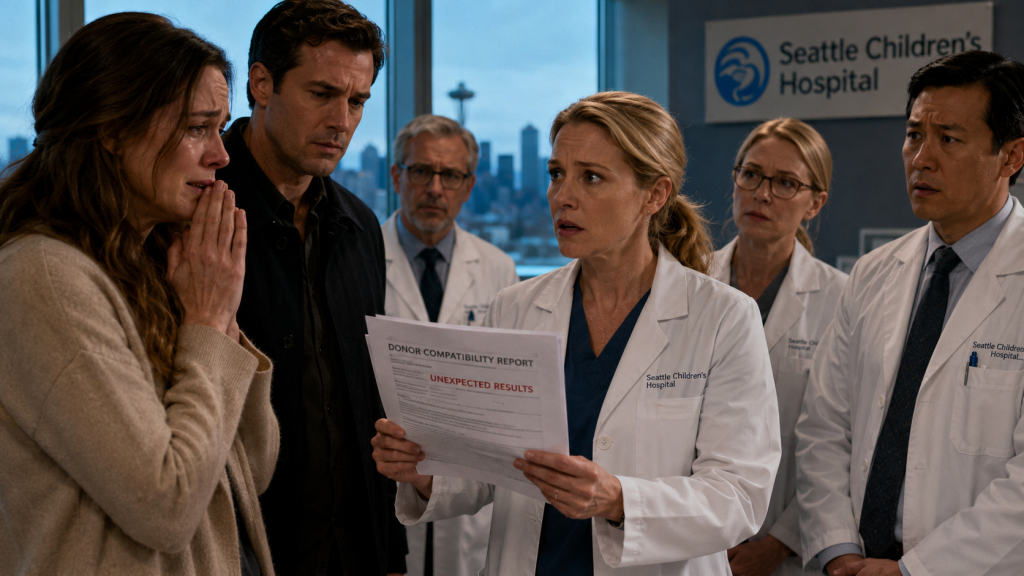
Finally, Dr. Whitman placed the report on the table.
“The repeat testing confirmed the original result,” she said.
“Am I a match?” I asked.
“Yes. You are a strong potential match for Sophie.”
Relief rushed through me so suddenly that I almost laughed.
“Then what is the problem?”
Dr. Whitman folded her hands.
“The compatibility testing also showed an unexpected genetic relationship.”
Graham’s face twitched.
“What does that mean?”
“We routinely examine inherited markers when evaluating related donors. Sophie inherited markers consistent with Ms. Hayes being her biological mother.”
“Of course she did,” Graham said impatiently.
“However, Ruby’s sample does not show that same maternal relationship.”
Silence fell across the room.
I stared at her.
“I don’t understand.”
Dr. Whitman spoke carefully.
“The results indicate that Sophie is biologically related to you as expected. Ruby is not.”
The room seemed to tilt.
“That’s impossible,” I whispered. “They’re twins.”
“That is why we repeated the testing.”
“They were born minutes apart.”
“I believe that is what you were told.”
Graham pushed back from the table.
“This is absurd. Your laboratory made a mistake.”
“We used separate samples, different technicians, and two independent analyses,” the transplant specialist said. “The results are consistent.”
I looked at Graham.
All the color had left his face.
He was not confused.
He was terrified.
Dr. Whitman noticed it too.
“Mr. Hayes,” she said slowly, “is there something about the girls’ birth or family history that we need to know?”
“No.”
His answer came too quickly.
The genetic counselor opened the envelope.
“We also reviewed the hospital records provided when Sophie was admitted. There are inconsistencies in the birth documentation.”
My heartbeat thundered in my ears.
“What inconsistencies?”
“The girls’ current birth certificates list the same delivery time, one minute apart, at St. Matthew’s Medical Center in Portland. But the archived neonatal logs show only one female infant assigned to Ms. Hayes after her emergency delivery.”
I gripped the table.
“One?”
“The records show a second female infant entering the neonatal intensive care unit approximately forty minutes later. That baby was transferred from another operating room.”
I looked at Graham again.
He would not meet my eyes.
“What did you do?” I whispered.
He stood.
“This meeting is over.”
Dr. Whitman remained calm.
“No, Mr. Hayes. We have a seriously ill child whose medical history may be inaccurate. We need the truth.”
“You have no right to accuse me.”
“I am not accusing you,” she said. “I am asking whether you know why one of the children raised as Ms. Hayes’s twin daughter is not biologically related to her.”
Graham reached for the door.
I moved in front of him.
“What did you do?”
“Get out of my way.”
“Tell me.”
His eyes flashed with the anger I knew so well, the anger he hid behind perfect suits and controlled sentences.
“You were unconscious,” he said.
Every person in the room went still.
I could barely hear my own voice.
“What happened while I was unconscious?”
He stared at me.
Then he looked toward the doctors as though calculating how much of the truth could still be contained.
“You were not supposed to survive the hemorrhage,” he said.
The words struck me harder than any physical blow.
“What?”
“The surgeon told me they couldn’t stop the bleeding. They said the baby was alive, but you might not make it.”
“Baby,” I repeated. “Singular.”
Graham closed his eyes.
For the first time since I had known him, he looked like a man standing at the edge of a cliff.
“We lost one of the twins before delivery,” he said.
I stopped breathing.
“No.”
“The second baby had no heartbeat.”
“No.”
“The doctor said you would wake up and blame yourself. You had spent seven months preparing for two children. Two cribs. Two names. Two of everything.”
“Sophie and Ruby.”
“Yes.”
My hands began to shake.
“So where did Ruby come from?”
Graham’s voice dropped.
“There was another woman at the hospital.”
The genetic counselor leaned forward.
“What woman?”
“She had delivered a healthy baby girl. She was alone. No family. No husband. She told a social worker she didn’t want the child.”
“You stole her baby?” I asked.
“No. I arranged a private adoption.”
“In forty minutes?”
He did not answer.
Dr. Whitman’s expression hardened.
“Legal adoptions do not occur in forty minutes.”
“The hospital administrator knew my father.”
The truth began assembling itself in front of me, piece by piece, uglier than anything I could have imagined.
Graham’s father had been one of the wealthiest real estate developers in Oregon.
He donated money to hospitals, political campaigns, universities, and judges’ charities.
His name opened doors.
Apparently, it could also close records.
“You replaced our dead baby,” I whispered. “You put another woman’s child beside Sophie and told me she was mine.”
“I gave you what you wanted.”
A sound escaped me, half laugh and half sob.
“You gave me what I wanted?”
“You woke up asking for the twins. The doctors were afraid the truth would destabilize you.”
“The doctors?”
“The administrator and one nurse knew. Your obstetrician signed the amended documents.”
“You let me believe I had carried Ruby.”
“You loved her.”
“I still love her!”
My voice broke against the walls.
“That is not the point. You stole my right to know the truth. You stole her right to know who she is.”
“I protected this family.”
“You built this family on a crime.”
Graham slammed his palm against the table.
“She was unwanted!”
Dr. Whitman stood.
“That is enough.”
He looked around the room, suddenly aware that every word was being heard by people he could not intimidate.
The genetic counselor spoke carefully.
“Do you know the birth mother’s identity?”
“No.”
I knew immediately that he was lying.
Dr. Whitman did too.
“Mr. Hayes, inaccurate medical history can endanger Ruby’s health. It may also affect Sophie’s treatment if family relationships have been misrepresented. We are required to document this.”
Graham’s eyes moved toward the door.
“You cannot release confidential information.”
“We can report suspected falsification of medical and identity records.”
His shoulders stiffened.
The man who had defeated me in court, stripped me of my children, and buried me beneath official papers suddenly looked very small.
But the deepest betrayal had not yet been spoken.
I stared at him.
“The custody case,” I said. “You called me unstable because you were afraid I would discover the truth.”
He said nothing.
“That psychiatrist never examined me.”
Still nothing.
“You fabricated the report.”
The silence answered for him.
The transplant specialist quietly left the room.
Perhaps he was giving us privacy.
Perhaps he was calling the hospital’s legal department.
I no longer cared.
Graham sat down.
His face had collapsed inward.
“You started asking questions,” he said.
“What questions?”
“After the girls turned seven, you noticed the blood types.”
I remembered.
Sophie had needed stitches after falling from a bicycle. Her hospital bracelet listed her blood type as A positive.
Ruby’s school health form listed hers as O negative.
I had mentioned that identical twins usually shared the same blood type.
Graham laughed and said school records were often wrong.
A month later, I found an old envelope in his study from St. Matthew’s Medical Center.
Inside was a receipt for an after-hours administrative service dated the night of the girls’ birth.
When I asked him about it, he accused me of invading his privacy.
Two weeks later, he filed for divorce.
“You thought I was going to investigate,” I said.
“I could not let you destroy Ruby’s life.”
“So you destroyed mine.”
“I needed custody.”
“You created psychiatric records.”
“I paid Pike to sign an evaluation.”
The admission landed with terrifying simplicity.
All those nights I had questioned my own memory.
All those mornings I had wondered whether grief had truly made me unstable.
All those hours in court, watching strangers discuss my mind as though I were not in the room.
It had all been purchased.
“How much?” I asked.
“What?”
“How much did it cost to erase me?”
He looked down.
“Fifty thousand.”
I almost smiled.
Two years of my daughters’ childhood had cost him less than the car he drove.
Dr. Whitman stepped toward the door.
“I am contacting hospital administration, social services, and law enforcement. Both children will remain under medical supervision while this is reviewed.”
Graham stood again.
“You cannot keep my daughters from me.”
The irony was so sharp that even he seemed to hear it.
I looked at him.
“That is exactly what you said when you kept them from me.”
Hospital security arrived ten minutes later.
They did not arrest Graham immediately.
They simply escorted him from the consultation room while investigators were contacted and emergency custody procedures began.
He turned once before disappearing through the doorway.
For years, I had imagined what justice would look like.
I thought it would feel triumphant.
Instead, watching him leave, I felt only grief.
Grief for the child I had lost during delivery without ever being allowed to mourn.
Grief for Ruby, whose life had begun inside someone else’s tragedy.
Grief for Sophie, fighting cancer while the foundation of her family cracked beneath her.
And grief for the years no legal ruling could return.
Dr. Whitman gave me a few minutes alone.
Then she led me back to Sophie’s room.
Ruby stood as soon as I entered.
“Where’s Dad?”
“He had to speak with some people.”
Her eyes searched my face.
“Is he in trouble?”
I did not know how much to say.
Not yet.
“There are things the adults need to understand.”
Sophie reached for me.
“Are you a match?”
I sat beside her.
“The doctors think I might be.”
A faint smile touched her mouth.
“I knew you would come.”
That sentence almost destroyed me.
“Did you?”
She nodded.
“Dad said you didn’t care anymore, but Ruby and I didn’t believe him.”
Ruby came closer.
“We kept writing letters.”
“I never got them.”
“We hid copies.”
She opened the drawer beside Sophie’s bed and pulled out a folded sheet of notebook paper.
The handwriting was uneven and childish.
Dear Mom,
I don’t know where you are. Dad says you are sick in your head and that seeing us makes you worse. I hope you get better. Sophie still sleeps with the rabbit you bought her. I still remember your pancakes. I love you even if I’m not supposed to.
I covered my mouth.
There are pains so deep they make no sound.
Ruby wrapped her arms around me.
For one second, I froze, terrified that the moment might disappear.
Then I held her.
She felt unfamiliar and completely known at the same time.
Sophie began to cry quietly.
I leaned over the bed and pulled her into the embrace too, careful of the intravenous line.
The three of us remained that way while machines beeped around us.
No judge.
No lawyer.
No forged report.
Just a mother and two daughters trying to reclaim one another.
The hospital moved quickly after Graham’s confession.
Detectives interviewed him that afternoon.
Records from St. Matthew’s were subpoenaed.
The retired administrator who had approved the altered birth documents was located in Arizona.
The nurse who had helped move Ruby into my recovery room was found living outside Eugene.
Dr. Benjamin Pike was questioned about the psychiatric evaluation.
At first, he denied everything.
Then investigators found a payment from one of Graham’s shell companies deposited three days before the report was signed.
By the end of the week, Pike’s attorney was negotiating his surrender.
The emergency family court hearing took place in a conference room at the hospital because Sophie was too ill to be moved.
My new attorney, a woman named Lena Ortiz, arrived with three thick binders and the expression of someone who had spent her career waiting to meet a man like Graham.
The judge who heard the emergency petition was not the same judge from my divorce.
She reviewed the hospital report, Graham’s recorded admission, the fabricated psychiatric documents, and two years of blocked visitation records.
Then she looked at me.
“Ms. Hayes, this court owes you more than an apology can repair.”
I had imagined hearing those words.
They brought no satisfaction.
“I don’t need an apology,” I said. “I need my daughters protected.”
Temporary custody was granted to me.
Graham was prohibited from contacting the girls except through court-approved therapeutic channels.
The false psychiatric findings were suspended pending formal removal.
A criminal investigation continued into kidnapping, document falsification, bribery, perjury, and custodial interference.
But none of that mattered as much as the transplant.
Sophie began chemotherapy.
The first days were brutal.
She vomited until there was nothing left in her stomach.
Her hair began falling out in soft strands across the pillow.
She developed mouth sores that made swallowing painful.
Some nights, she begged me to make the treatment stop.
I wanted to promise her that everything would be fine.
Instead, I told her the truth.
“I know it hurts. I know you are tired. But I am staying right here.”
Ruby stayed with me in a hospital family apartment.
She slept with the light on.
She asked questions at strange times.
While brushing her teeth, she asked whether Graham would go to prison.
During breakfast, she asked whether I had ever stopped loving her.
One night, she stood in the doorway wearing Sophie’s oversized sweatshirt.
“Mom?”
My heart still jumped every time she called me that.
“Yes?”
“If I didn’t come from your stomach, am I still your daughter?”
I pulled back the blanket beside me.
She climbed into bed.
“You became my daughter the first time they put you in my arms,” I said. “Nothing Graham did can change what happened after that. I fed you. I sang to you. I held you through colic and chickenpox and thunderstorms. Biology is part of a person’s story, but it is not the only part.”
“What if my real mother wants me back?”
“She is your biological mother. I am also your real mother. One truth does not have to erase the other.”
“Do you think she loved me?”
I looked into Ruby’s frightened face.
“I think there is more to her story than Graham told us.”
There was.
Investigators found Ruby’s biological mother three weeks later.
Her name was Elena Marquez.
She had been nineteen when Ruby was born.
She had not abandoned her child.
Elena had arrived at St. Matthew’s after a car accident triggered premature labor. She was injured, sedated, and separated from her newborn.
When she woke, hospital staff told her the baby had died from respiratory failure.
There had been no body for her to see.
No funeral.
Only paperwork and a sealed hospital certificate.
For ten years, Elena had believed her daughter was buried somewhere without a grave.
When detectives told her the truth, she collapsed.
She came to Seattle with her older sister.
We met in a private hospital room arranged by social services.
Elena entered holding a photograph of herself at nineteen.
The resemblance was immediate.
Ruby had her eyes.
Her delicate hands.
The same small dimple near the left corner of her mouth.
For a long time, neither of us spoke.
Then Elena said, “I did not give her away.”
“I know.”
“I looked for answers for years. The hospital threatened to have me committed when I refused to accept their story.”
“I believe you.”
Tears filled her eyes.
“You raised her.”
“Yes.”
“Was she loved?”
“Every day.”
Elena covered her face and began to cry.
I crossed the room and held her.
We were two mothers connected by the same man’s decision, both robbed in different ways.
When Ruby met Elena, she was frightened at first.
Elena did not ask to be called Mom.
She did not reach for her without permission.
She simply showed Ruby photographs of grandparents, cousins, and family members who shared pieces of her face.
Ruby listened.
Then she asked, “Did you name me?”
Elena swallowed.
“Lucia.”
Ruby looked at me.
I smiled through tears.
“It’s beautiful.”
Over the following months, Ruby began using both names privately.
Ruby Lucia Hayes.
The court allowed Elena supervised contact while everyone received counseling.
There was no easy solution.
No single legal order could untangle ten years of love, loss, and deception.
So we stopped looking for one.
We built something new instead.
Sophie’s transplant took place in November.
I was confirmed as her best available donor.
The procedure required preparation, injections, tests, and hours of explanation.
On the morning my cells were collected, Sophie gave me a paper bracelet she had made.
It read, MOM’S SUPERPOWER.
“I don’t feel very powerful,” I admitted.
“You drove three hours to save me.”
“I would have driven around the world.”
She smiled.
“I know.”
The transplant was not a miracle in the way stories often promise miracles.
There was no instant recovery.
There were infections, fevers, frightening nights, and days when her blood counts refused to rise.
But slowly, the new cells began to work.
A month later, Dr. Whitman entered the room with tears in her eyes and told us Sophie’s marrow showed healthy growth.
Ruby screamed.
I laughed and cried at the same time.
Elena brought flowers.
Marcus drove from Portland with the entire architecture office packed into two cars.
Even the Morrison clients came.
They had not canceled the contract.
After hearing why I missed the presentation, they gave Marcus an extension.
Months later, our firm won the project.
Graham was sentenced the following spring.
He accepted a plea agreement covering conspiracy, falsification of medical and identity records, bribery, perjury, and custodial interference.
The former hospital administrator and Dr. Pike were prosecuted separately.
Before sentencing, Graham asked permission to speak.
He stood in the courtroom wearing a plain gray suit.
For the first time, there was no expensive attorney beside him creating a cleaner version of the truth.
“I loved my daughters,” he said.
I believed that he believed it.
That was part of what made him dangerous.
He confused possession with love.
Control with protection.
Deception with devotion.
He looked at me.
“I thought I was preserving our family.”
“No,” I said quietly. “You were preserving your power.”
The judge sentenced him to prison and ordered financial restitution to Elena, to me, and to a fund established for the girls’ medical and therapeutic care.
Money could not replace what he took.
But accountability mattered.
The psychiatric report was formally erased from my record.
The original custody ruling was vacated.
I received full legal custody of Sophie.
Ruby remained legally my daughter, with Elena recognized through a carefully structured guardianship and visitation agreement created around Ruby’s needs.
We did not force her to choose between us.
That was the one mistake none of us would repeat.
A year after the phone call, Sophie returned to school.
Her hair grew back in soft curls.
Ruby joined a youth photography club and began taking pictures of doors, bridges, windows, and other things that connected one place to another.
Elena moved to Portland and rented an apartment fifteen minutes from our house.
Some evenings, she joined us for dinner.
At first, those meals felt awkward.
Then they became ordinary.
Ordinary was a gift.
One Tuesday morning, exactly a year after Dr. Whitman called me, I stood in the kitchen making pancakes.
Sophie sat at the table complaining about homework.
Ruby was showing Elena photographs on her camera.
Sunlight filled the room.
Marcus texted to remind me about the Morrison Tower groundbreaking ceremony.
For a moment, I simply stood there holding the spatula.
Two years earlier, I had believed my life had been permanently emptied.
I thought Graham had won because he had the court order, the money, and the official documents.
But paper had not made his lies true.
Distance had not made me stop being a mother.
And love, even when interrupted, had not disappeared.
Sophie looked up.
“Mom, the pancake is burning.”
I flipped it quickly.
Ruby laughed.
Elena reached over and turned down the stove.
The sound filled the kitchen, bright and unguarded.
I looked at my daughters.
One born from my body.
One placed into my arms through an unforgivable crime.
Both woven into my heart so completely that no test could measure it.
Graham had spent years trying to prove that biology, money, and legal power gave him ownership over our family.
In the end, a blood test exposed him.
But blood was not what rebuilt us.
Truth did that.
Courage did that.
The willingness to stay when staying was painful did that.
I carried the pancakes to the table and sat between my girls.
For the first time in years, no one was missing because another person had decided they should be erased.
We were not the family I had believed we were.
We were something more complicated.
Something wounded.
Something honest.
And finally, something free.
💬THE END! THANK YOU FOR READING!