

My father always believed success had a certain appearance.
A polished suit.
A respected title.
A person everyone could point at and say, “Look what they accomplished.”
For years, I thought he simply didn’t understand me.
Later, I realized the truth was harder to accept.
He understood exactly who I was.
He just didn’t want anyone else to know.
The night of my sister Caroline’s engagement dinner was supposed to be a celebration.
The entire family gathered at my parents’ house, the same place where I had grown up listening to my father compare me to my younger sister.
Caroline was always the daughter who made him proud.
She was outgoing.
Beautiful.
Social.
She knew exactly what to say at the right moment.
I was different.
I was quieter.
I spent more time studying than talking.
I preferred responsibility over attention.
And when I joined the Navy, my father never truly accepted it.
“You’re wasting your potential,” he told me years ago.
“A woman should have a balanced life. Not disappear into some government office.”
I remembered those words every time I packed my bags for another assignment.
Every time I missed Thanksgiving.
Every time I couldn’t attend a family vacation.
Every time my mother said, “Your father wishes you would choose a normal life.”
But I never regretted my choice.
The Navy gave me a purpose.
It challenged me.
It taught me leadership.
It showed me what I was capable of.
What my family never knew was that my career had taken me far beyond the position they imagined.
I wasn’t sitting behind a desk filing paperwork.
I wasn’t answering phones.
I wasn’t anyone’s assistant.
But I stopped explaining myself years ago.
People who truly respected me didn’t need an explanation.
And people who had already decided I was a disappointment wouldn’t believe me anyway.
That evening, I almost didn’t attend the engagement dinner.
I had just returned from Washington after a classified budget review.
I had spent weeks in meetings, reviewing information that affected thousands of service members.
I was exhausted.
Thirty-one hours awake.
Two flights.
No proper sleep.
All I wanted was a quiet room.
A hot shower.
A few hours without anyone asking questions.
Then my phone buzzed.
It was my mother.
“Please come tonight. Caroline wants the whole family together.”
I stared at the message for a long time.
I knew what it really meant.
My family wanted a perfect photograph.
A perfect dinner.
A perfect announcement.
And I was expected to smile.
So I changed into a navy-blue dress, fixed my hair, and drove to my parents’ home.
When I arrived, the house was already full.
Relatives filled the living room.
Champagne glasses sparkled beneath the lights.
Everyone was talking about one person.
Commander Nathan Reed.
Caroline’s fiancé.
The Navy SEAL commander.
The hero.
My father couldn’t stop talking about him.
“Now that’s a man with direction,” Dad said proudly.
“Discipline. Honor. Achievement.”
He repeated those words several times.
Almost as if he wanted everyone to hear them.
Nathan stood beside Caroline, wearing a dark suit that fit perfectly.
He was calm and respectful.
The kind of person who didn’t need to announce his accomplishments.
People noticed him anyway.
Caroline smiled proudly.
“I still can’t believe I’m marrying someone like him,” she said.
Everyone congratulated her.
Everyone admired her.
And I stood quietly near the dining room entrance.
I wasn’t jealous.
I wasn’t angry.
I was simply tired.
Then my father saw me.
His expression changed.
Not warmly.
Not happily.
More like he remembered something inconvenient.
“Oh,” he said.
Everyone turned.
“This is my older daughter, Evelyn.”
The way he said it made it sound like an apology.
Then he laughed.
“She works for the Navy too.”
A few people smiled.
Dad continued.
“Some kind of office job, I think.”
The laughter came immediately.
Small at first.
Then louder.
My mother looked down at her plate.
Caroline lifted her champagne glass.
“To family,” she said.
But her eyes were on me.
She knew exactly what was happening.
Dad put one hand on my shoulder for a brief second.
A gesture that looked affectionate to everyone else.
But I knew better.
It was a warning.
“Don’t worry, Commander,” Dad said to Nathan.
“We don’t expect you to be impressed.”
More laughter.
The room blurred for a moment.
Not because I was embarrassed.
Because I suddenly realized something.
My family had spent years creating a version of me that wasn’t real.
And everyone believed it.
I looked at my father.
The man who once held my hand when I was a child.
The man who told me I could become anything.
Somewhere along the way, he decided I wasn’t enough.
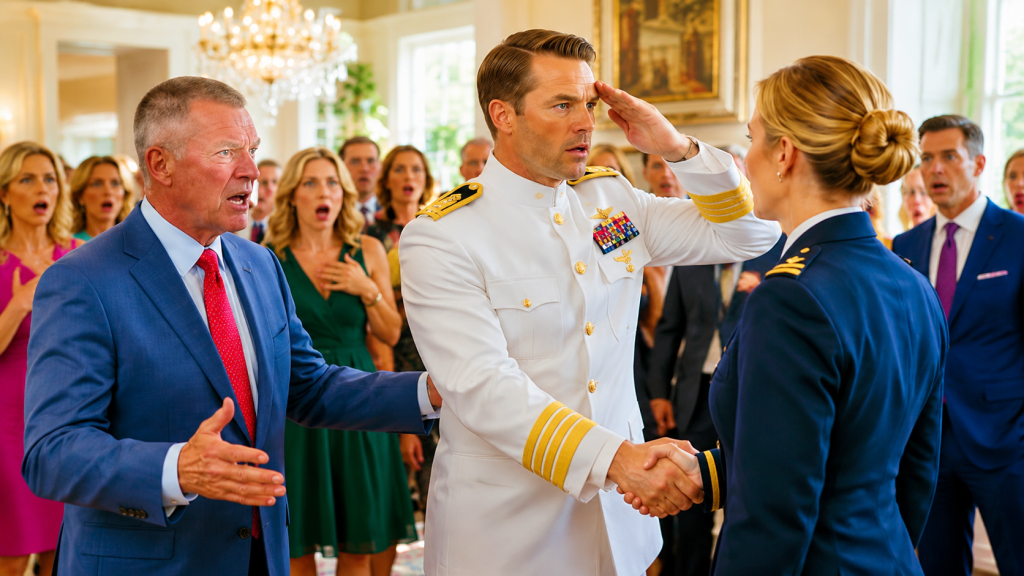
Then Nathan stepped forward.
“Nice to meet you, ma’am.”
His voice was polite.
Professional.
I smiled slightly.
“Nice to meet you too.”
We shook hands.
And then everything changed.
His eyes moved downward.
First to the small service pin on my dress.
Then to the ring on my right hand.
Then back to my face.
The polite expression disappeared.
Recognition
For a moment, Commander Nathan Reed didn’t say anything.
The room remained filled with quiet conversations that slowly faded as people noticed something had changed.
His grip loosened.
His expression became serious.
Not confused.
Not surprised.
Respectful.
Very respectful.
He released my hand, stepped backward, straightened his posture, and raised his hand in a military salute.
“Admiral, ma’am.”
The words landed harder than any insult my father had thrown at me that night.
Silence.
Complete silence.
The kind of silence where everyone suddenly realizes they misunderstood something important.
Caroline’s smile disappeared.
The champagne glass in her hand stopped halfway to her lips.
My father stared at Nathan as if he had spoken another language.
“What did you just call her?”
Nathan kept his salute.
“Rear Admiral Evelyn Hart, sir.”
My father blinked.
Once.
Twice.
Like his mind was trying to reject what his ears had heard.
Nathan continued.
“She chaired my promotion review board last year.”
Nobody laughed.
Nobody smiled.
Nobody looked away.
Every person in that room was now looking at me.
The same people who had spent the last ten minutes laughing.
The same people who believed I was just the quiet daughter who worked in some meaningless office.
The same people who had accepted my father’s version of my life without ever asking me.
I gave Nathan a small nod.
Only then did he lower his hand.
My father looked at me.
“Evelyn…”
His voice sounded different.
Not confident anymore.
Not proud.
Almost uncertain.
I picked up my glass of water.
“Yes, Dad?”
He opened his mouth.
Nothing came out.
Because suddenly he had too many questions.
And no comfortable way to ask them.
Caroline recovered first.
She forced a small laugh.
“Wait, are you serious?”
Nathan looked at her.
“Yes.”
She looked back at me.
“But… you never said anything.”
I smiled slightly.
“You never asked.”
That answer hurt her more than any explanation could have.
Because it was true.
Nobody had ever asked.
They had decided.
My father sat down slowly.
“I thought you worked in administration.”
“I do administration,” I replied.
“But not the kind you imagined.”
I didn’t raise my voice.
I didn’t need to.
For years, I had learned that confidence didn’t come from proving people wrong.
It came from knowing who you were even when nobody else recognized it.
My uncle leaned forward.
“So you’re actually an admiral?”
I nodded.
“Yes.”
The room became filled with whispers.
Questions.
Surprise.
My mother looked at me with wide eyes.
“I didn’t know you reached that level.”
I looked at her.
That sentence hurt more than Dad’s joke.
Because she was my mother.
She should have known.
“I tried telling you,” I said quietly.
She looked down.
“When?”
I remembered every conversation.
Every phone call.
Every moment I tried sharing something important.
But somehow the conversation always turned back to Caroline.
Caroline’s wedding.
Caroline’s career.
Caroline’s achievements.
My father cleared his throat.
“Well… you always kept things private.”
I looked at him.
“That was easier than being corrected every time I talked about my work.”
The room went quiet again.
Nobody moved.
Because everyone knew I was right.
My father had never celebrated my achievements.
He questioned them.
He minimized them.
He made them smaller so Caroline could look bigger.
Nathan stood nearby, watching silently.
Then he spoke.
“Sir, if I may say something.”
My father nodded.
Nathan looked around the room.
“Admiral Hart is one of the most respected officers I have ever met.”
Caroline looked uncomfortable.
Nathan continued.
“She doesn’t talk about her position because she doesn’t need attention from it.”
He paused.
“That is usually the difference between real leaders and people who only want to appear successful.”
My father’s face changed.
Those words were polite.
But they were impossible to misunderstand.
The man he had spent the entire evening praising had just described me as everything he wished Caroline’s fiancé represented.
Discipline.
Humility.
Leadership.
Respect.
Dinner continued after that, but it was no longer the same.
The energy had changed.
People who had ignored me all evening suddenly wanted to talk.
My aunt asked about my assignments.
My cousins asked about my experiences.
Everyone suddenly became interested.
But I noticed something.
The attention didn’t feel satisfying.
Because it came too late.
I didn’t need applause from people who only respected me after they learned my title.
I had already spent years respecting myself without it.
After dinner, I stepped outside onto the back porch.
The cold evening air felt peaceful.
For the first time that night, I could breathe.
A few minutes later, Nathan joined me.
“I hope I didn’t make things worse.”
I smiled.
“You didn’t.”
He looked toward the house.
“They don’t know you very well.”
“No,” I said.
“They know the version of me they created.”
Nathan nodded.
“I’ve seen that before.”
I looked at him.
“People assume quiet people have nothing to say.”
He smiled.
“Usually, quiet people are the ones everyone listens to when something important happens.”
For the first time that night, I laughed.
A real laugh.
Not the polite one I had been forcing all evening.
Then the back door opened.
My father stood there.
Alone.
No audience.
No jokes.
No confidence.
Just my father.
“Evelyn,” he said.
I turned around.
“I think we need to talk.”
And for the first time in years…
he wasn’t talking down to me.
He was asking me to listen.
I looked at my father standing in the doorway.
For most of my life, I had imagined this moment differently.
I imagined him finally understanding.
Finally seeing me.
Finally saying the words I had wanted to hear since I was a child.
“I’m proud of you.”
But standing there on that porch, I realized something important.
An apology from someone who only respects you after discovering your title feels different from an apology given because they understand your heart.
Still, he was my father.
So I stayed.
“Okay,” I said.
He stepped outside and closed the door behind him.
For several seconds, neither of us spoke.
The man who always had something to say suddenly seemed to have nothing.
“I didn’t know,” he finally whispered.
I looked at him.
“I know.”
“No, Evelyn. I mean… I really didn’t know.”
I folded my arms.
“Dad, you never asked.”
He looked away.
The confidence he carried inside the house had disappeared.
“I thought you were unhappy.”
That surprised me.
“Unhappy?”
He nodded slowly.
“You were always leaving. Always busy. Always somewhere else.”
I almost laughed.
Not because it was funny.
Because it was unbelievable.
“I was serving.”
“I know that now.”
“No,” I said quietly.
“You know my rank now.”
He looked at me.
Those words reached him.
Because they were true.
For years, he had mistaken my silence for failure.
He mistook my dedication for distance.
He mistook my humility for weakness.
“I should have listened,” he said.
I looked toward the backyard.
The same backyard where I used to sit as a teenager studying late at night while my father told Caroline she was the family’s future.
“I spent years trying to make you proud.”
His face changed.
“I never wanted you to feel that way.”
“But I did.”
The words came out softly.
Not angrily.
That almost made them harder.
“I remember when I graduated from my first command training. I called you.”
My father lowered his eyes.
“I remember.”
“You said congratulations.”
He nodded.
“And then you asked why I couldn’t be more like Caroline.”
His face tightened.
“I was wrong.”
“Yes,” I said.
“You were.”
The honesty surprised him.
Maybe he expected me to comfort him.
Maybe he expected me to say it was okay.
But some wounds don’t heal because someone finally admits they exist.
They heal because the person who was hurt finally stops pretending they weren’t.
“I’m sorry,” he said.
Two simple words.
Two words I had waited years to hear.
But they didn’t erase everything.
They didn’t erase every birthday missed.
Every achievement ignored.
Every time I walked into a room feeling like I had to prove I deserved to be there.
“I appreciate you saying that,” I replied.
He looked at me.
“But?”
“But I need you to understand something.”
I took a breath.
“My rank didn’t make me worthy of respect tonight.”
My father listened.
“I was worthy before you knew.”
His eyes became wet.
Because that was the lesson he had never understood.
A person’s value does not begin when others finally recognize it.
Nathan was right.
Real leaders don’t need to announce who they are.
Their actions speak.
The next morning, my phone was filled with messages.
Family members who had ignored me for years suddenly wanted to reconnect.
My aunt sent a long message saying she was proud.
My cousins asked about my career.
Even relatives who barely remembered my birthday wanted to know when I would visit again.
I answered politely.
But I noticed something.
Nobody apologized except my father.
And even his apology would need time to become real.
A week later, Caroline called.
I almost didn’t answer.
But I did.
“Evelyn?”
“Yes?”
There was silence.
Then she sighed.
“I owe you an apology.”
I sat quietly.
She continued.
“I was jealous.”
That surprised me.
Caroline had always seemed so confident.
“I thought because you didn’t talk about your achievements, you didn’t have any.”
I smiled sadly.
“That wasn’t true.”
“No.”
She paused.
“I made jokes because Dad did.”
That sentence bothered me.
Not because it was unexpected.
Because it explained everything.
My father created the story.
Caroline repeated it.
Everyone else believed it.
“I should have protected you,” she said.
“You’re my sister.”
I looked out the window.
“I didn’t need you to protect me.”
“Then what did you need?”
I thought about it.
“I needed you to know me.”
There was silence.
Then she whispered:
“I’m sorry.”
This apology felt different.
Maybe because Caroline was finally seeing the person behind the uniform.
Not the title.
Not the reputation.
Me.
Months passed.
Life returned to normal.
I continued my work.
I attended meetings.
I made decisions.
I carried responsibilities that most people would never understand.
But something changed.
My family changed.
Not immediately.
Not magically.
But slowly.
My father started asking questions.
Not about my position.
About my life.
“How are you?”
“How was your week?”
“Are you sleeping enough?”
Simple questions.
Questions he should have asked years earlier.
One evening, months after the engagement dinner, I received an invitation.
Another family gathering.
At first, I hesitated.
Old habits are difficult to break.
But I went.
When I arrived, my father was waiting at the door.
This time, he didn’t introduce me like an embarrassment.
He smiled.
He looked proud.
“Everyone,” he announced.
“This is my daughter, Evelyn.”
He paused.
“My daughter who has spent her life serving others.”
The room became quiet.
Then he added:
“And I’m proud to call her my daughter.”
For years, I wanted those words.
But hearing them now felt different.
Because I no longer needed them to know my worth.
I already knew.
I smiled.
And this time…
the silence that followed wasn’t uncomfortable.
It was respect.
After that night, family gatherings took on a new rhythm.
People who had once ignored my presence now listened.
Not because of my title, not because of the stories Nathan Reed had told them, but because they finally realized I had always been capable, always had a voice, always mattered.
Conversations were no longer dominated by comparisons or subtle jabs.
Caroline and I began talking more, sharing stories from our respective careers.
She admitted she had always admired my dedication, even if she never said it aloud.
I forgave her—not because I had to, but because resentment only weighed me down.
Dad, meanwhile, tried to make up for lost time.
He invited me to events I had never attended, asked for my advice on family matters, and even bragged about my accomplishments to relatives.
I let him, understanding it was as much for him as for me.
Nathan became a quiet ally at family events.
He never flaunted my rank, never corrected anyone overtly, but his presence reinforced the respect I had always deserved.
One afternoon, a year later, Caroline’s wedding day arrived.
I stood beside her as her maid of honor, fully aware of the eyes that followed me.
But this time, no one laughed.
No one doubted.
They saw me, not a title, not a shadow behind Caroline’s success.
When the ceremony ended, my father hugged me tightly.
“I’m proud of you,” he whispered sincerely.
I smiled, finally accepting it—not because he said it, but because I had never stopped being proud of myself.
As Caroline and Nathan walked past, hand in hand, I felt a peace I hadn’t known for years.
I had earned respect, commanded it, and finally, my family had learned to see me clearly.
The Navy had taught me discipline, leadership, and courage.
But that evening, I realized the greatest victories were sometimes closer to home: being recognized, finally, by the people who mattered most.
I straightened my uniform-inspired dress, lifted my chin, and stepped forward.
Because at last, I wasn’t just Evelyn, the quiet daughter in the background.
I was Rear Admiral Evelyn Hart.
And everyone in that room finally understood it.
The laughter, the doubts, the comparisons—they didn’t define me anymore.
The admiration I felt wasn’t just from my family or Nathan Reed—it came from myself.
Years of dedication, sacrifice, and unseen work had led to this moment of quiet triumph.
And as the sun set over my parents’ garden that evening, I realized something profound.
Life isn’t about proving others wrong.
It’s about knowing your worth, living with integrity, and letting actions speak louder than words.
I had done that.
And nothing—not even a lifetime of doubt—could take it away.
From that day forward, every family gathering, every conversation, every smile carried a subtle acknowledgment: Evelyn Hart was no longer overlooked.
She had earned her place, and she knew it.
The Navy had given me a title.
My family had finally given me respect.
And most importantly, I had given myself validation.
For the first time in my life, I was seen exactly as I deserved to be.
Not because I needed approval.
Not because anyone forced it.
But because I had always been extraordinary, even when no one else recognized it.
And now, at last, everyone finally could.
THE END! THANK YOU FOR READING!