

I bought thirty-three pounds of beef for our family barbecue, yet my daughter-in-law and her sixty-year-old mother arrived without bringing so much as a bowl of salad.
What they did bring were two oversized bags packed with empty food containers.
When my son began filling those containers with the meat I had purchased, prepared, and served, I walked over and said three words that made the entire backyard go silent.
I had bought thirty-three pounds of beef for our Sunday cookout.
Thirty-three pounds.
For a small family gathering, most people would have called that excessive.
But in my mind, a table covered with food had always meant one thing.
You are welcome here.
You are cared for.
You are loved.
My name is Betty Miller.
I am sixty-five years old, and I live with my husband, Tom, in a peaceful neighborhood just outside Fort Worth, Texas.
For most of our married life, our home had been the center of every family celebration.
We hosted birthdays, graduation parties, Fourth of July cookouts, holiday lunches, and more Sunday dinners than I could count.
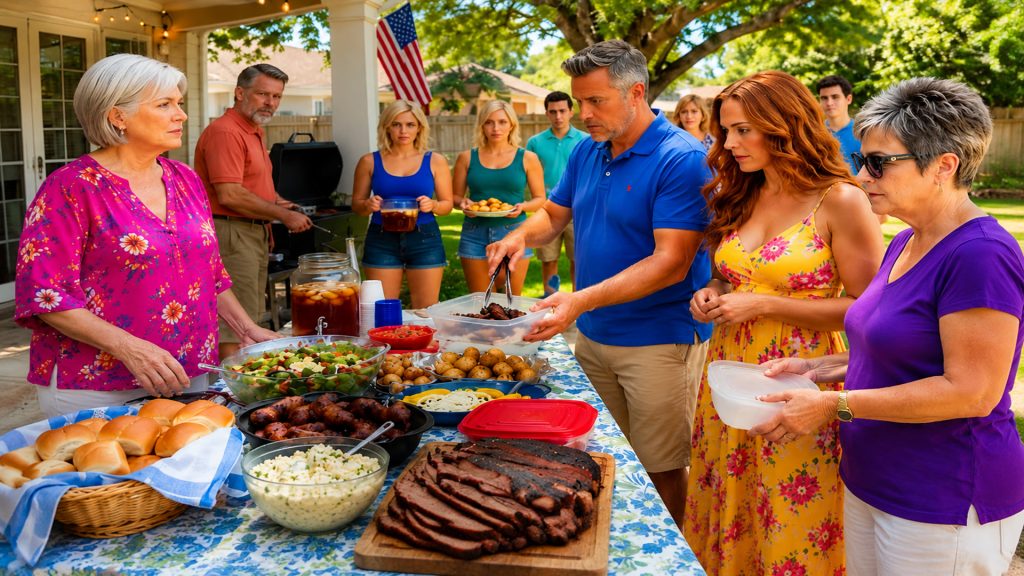
Whenever my relatives thought about family gatherings, I hoped they pictured our long wooden table beneath the patio shade, Tom standing proudly beside his aging grill, a pitcher of sweet tea covered in condensation, and enough food for everyone to return for seconds.
Looking back, perhaps that was where I made my mistake.
I had spent decades expressing love through generosity.
Somewhere along the way, I forgot that kindness without boundaries could easily become an invitation for people to take advantage.
On Saturday morning, I sat at the kitchen table with a notebook and planned the entire menu.
Brisket.
Beef ribs.
Skirt steak.
Sausages.
Roasted potatoes.
Green salad.
Fresh bread.
Grilled onions.
And three different kinds of cheese.
Tom lowered his newspaper and stared at the list.
“Betty, how many people are coming?” he asked.
“Are you planning to feed the entire Dallas Cowboys roster?”
I laughed.
“We’ll have leftovers.”
“We always have leftovers when you cook.”
“That’s how I prefer it.”
Later that morning, I went to Davis Market, where Mr. Davis personally helped me choose the best cuts.
By the time everything had been weighed, wrapped, and placed into bags, I had purchased thirty-three pounds of meat.
The total came to almost two hundred and fifty dollars.
I paid without complaining.
After all, it was for family.
My only son, Julian, would be there with his wife, Rachel, and Rachel’s mother, Stella.
Julian had always been thoughtful, dependable, and gentle.
But after marrying Rachel, small things about him began to change.
Before answering simple questions, he often glanced at her face first.
He canceled plans with us whenever Rachel became irritated.
When she made disrespectful comments, Julian usually stared at the floor or acted as though he had not heard them.
Rachel was attractive, sophisticated, and always dressed as though she were about to attend an important event.
Her mother was much the same.
Stella had a habit of examining people’s homes, clothes, and possessions as though she were silently grading them.
Still, when Julian asked whether she could join the barbecue, I agreed immediately.
My home had always been open to family.
Sunday morning, I began cooking before sunrise.
Tom prepared the grill while I seasoned the meat, washed vegetables, and arranged trays in the kitchen.
My nieces, Erica and Louisa, arrived first.
Erica brought a homemade pecan pie.
Louisa carried a large bowl of fruit salad and two bottles of wine.
“What can we do?” Erica asked before she had even removed her jacket.
Together, they sliced bread, arranged plates, filled glasses, and carried serving dishes outside.
Then the doorbell rang.
Julian stood on the porch with Rachel and Stella.
Neither woman had brought anything for the table.
No dessert.
No drinks.
No side dish.
Not even a bag of ice.
But they had not come empty-handed.
Rachel carried a large canvas tote filled with plastic food containers.
Stella held another bag stuffed with loose lids that rattled every time she moved.
Rachel leaned forward and gave me a light kiss near the cheek.
“Betty, everything smells amazing.”
Stella looked around the hallway.
“Your house is very cozy.”
The way she said cozy made it sound less like praise and more like a polite description of something old-fashioned.
I ignored the comment and led them into the backyard.
Tom lifted the grill lid with pride.
“Betty bought thirty-three pounds of meat for everyone.”
Rachel and Stella exchanged a quick glance.
It was not the look of two people feeling grateful.
It was the look of two people making a plan.
“Thirty-three pounds?” Rachel said, laughing.
“Good thing we brought containers.”
She smiled as though she had done us a favor.
“We wouldn’t want all that expensive food to go to waste.”
Lunch had not even started.
I said nothing.
While everyone else finished setting the table, Rachel and Stella sat down and watched.
Stella glanced toward my flower beds and remarked that they looked neglected.
Rachel called my late mother’s tablecloth “adorably outdated.”
Once the food was served, they complained that the sausages were too smoky, the salad dressing was too sharp, and the brisket had too much seasoning.
Yet neither of them stopped eating.
They cleaned their plates and returned for second helpings.
Rachel carefully arranged slices of meat on her plate, took several photographs, and posted them online as though she had prepared the entire barbecue herself.
Julian sat beside her with his shoulders tense, barely looking up from his food.
When lunch ended, Rachel leaned back in her chair and studied the remaining trays.
“There’s no chance all of this will get eaten,” she said.
Stella nodded.
“It would be a shame to waste meat this expensive.”
Then Rachel turned to my son.
“Bring the bags, babe.”
Julian stood immediately.
He did not ask me whether they could take anything.
He did not look at his father.
He did not even glance in my direction.
He carried both canvas bags to the patio table.
Rachel and Stella began pulling out one container after another.
Some were small.
Others were large enough to hold several full meals.
Then Julian picked up the serving tongs.
He started filling the containers with the finest pieces of brisket, ribs, and steak.
One by one, the conversations around the backyard stopped.
Tom stood motionless beside the grill.
Erica froze with the sweet-tea pitcher held above a glass.
Louisa slowly placed her fork on her plate.
I watched my only son pack away food I had bought with my own money.
Food I had spent hours seasoning and preparing.
Food I had never offered them to take.
Rachel and Stella had simply decided that it belonged to them.
In that moment, something became painfully clear.
If I remained quiet, I would be telling them that my kindness had no limits.
I would be teaching them that they could disrespect me in my own home and still leave with whatever they wanted.
So I walked across the patio.
I stopped beside Julian and looked down at the open containers filled with the best cuts of meat.
Then I said three words.
“Put it back.”
The entire backyard fell silent.
For several long seconds, no one moved.
The only sound was the distant hum of a lawnmower from a neighbor’s yard and the faint sizzle of leftover meat cooling on the grill.
Julian’s hand hovered over a container, tongs still gripping a thick slice of brisket.
His eyes met mine, wide with shock.
Rachel’s face twisted from surprise to indignation in an instant.
Stella set down her own container with a deliberate clatter, crossing her arms as if preparing for battle.
“Mom,” Julian finally stammered, his voice low and uncertain, “we were just… you always say there’s plenty.”
I kept my posture straight, drawing on years of quiet strength that had held our family together through harder times than this.
“Plenty for sharing at the table, Julian.
Not for loading up and leaving while others watch.
This isn’t a takeout counter.
This is our home, and today was supposed to be about family, not filling your bags.”
Rachel let out a sharp laugh that lacked any warmth.
“Betty, really?
After all the times we’ve come over and you’ve pushed seconds on everyone?
Now you’re clutching your precious meat like it’s gold?
We have a busy week ahead.
Stella and I thought we were doing you a favor by not letting it spoil.”
Her words stung, but I refused to let them show.
Instead, I glanced at the trays where half the feast still waited—juicy ribs glistening under the afternoon sun, sausages perfectly charred, potatoes roasted to golden perfection.
My nieces had helped me prepare every bit of it with love.
Erica stepped forward then, her voice gentle but firm.
“Aunt Betty is right.
We all contributed today.
It feels wrong to pack it away before we’ve even had dessert.”
Louisa nodded in agreement, setting her wine glass down.
Tom, ever the steady presence, moved to my side.
“Son, listen to your mother.
We’ve always been generous, but respect goes both ways.”
The tension thickened like the Texas humidity.
Stella huffed, “This is ridiculous.
In my day, family helped each other without making scenes.”
But her protest rang hollow against the backdrop of my carefully tended garden and the table I had set with my mother’s old cloth.
Julian shifted uncomfortably, looking between his wife and me.
For the first time in months, I saw a flicker of the boy I raised—the one who used to help me in the kitchen without being asked.
Slowly, he began emptying the containers, placing the meat back onto the serving platters.
Rachel snatched one bag and turned on her heel.
“Fine.
If this is how you want to treat us, we’ll just go.
Come on, Stella.”
They stormed toward the house, Julian trailing behind after a hesitant glance at me.
The door slammed behind them, leaving the rest of us in stunned quiet.
Erica hugged me tightly.
“You did the right thing, Aunt Betty.
We’ve all seen it building up.”
That evening, as the sun dipped low and painted the sky in oranges and pinks, we salvaged what remained of the gathering.
Tom fired up the grill for a few more rounds, and we shared stories from the old days.
My nieces helped clean up, and for the first time in a long while, conversation flowed freely without the undercurrent of judgment.
I felt a mix of sadness and relief.
Sadness for the son who seemed lost in his marriage, relief that I had finally drawn a line.
The next few days brought silence from Julian’s side.
No calls, no texts.
I busied myself with gardening and baking, reflecting on how my open-door policy had evolved—or devolved—over the years.
Tom and I talked late into the night.
“You’ve given so much, Betty,” he said, holding my hand.
“It’s okay to expect a little back.”
A week later, Julian showed up alone on our doorstep.
He looked tired, his usual neat shirt rumpled.
“Mom, can we talk?”
We sat on the patio where the confrontation had happened.
He apologized haltingly, admitting that Rachel’s influence had made him prioritize peace at home over everything else.
“She grew up differently,” he explained.
“Her family was always grabbing what they could.
But I shouldn’t have let it affect us.”
I listened without interrupting, then shared my heart.
“I love you, Julian.
And I want to love Rachel and Stella too.
But love isn’t one-sided.
If they come here, it has to be with respect.
No more empty containers unless invited.
No more criticism disguised as conversation.”
He nodded, eyes misty.
“I’ll talk to her.
Things have been strained since the barbecue.
She didn’t expect you to stand up like that.”
Over the following months, small changes emerged.
Rachel and Stella returned for a quieter dinner, this time bringing a store-bought cake and offering to help set the table.
It wasn’t perfect—old habits lingered—but conversations stayed civil.
Stella even complimented my flower beds once, though it sounded forced.
I continued hosting, but with new boundaries.
I planned portions more thoughtfully, encouraged everyone to contribute, and made it clear that taking home leftovers was a privilege, not an expectation.
The family dynamic shifted toward balance.
Julian visited more often by himself at first, then with Rachel in tow for genuine gatherings.
One crisp autumn evening, as we celebrated Tom’s birthday with a smaller group, Rachel pulled me aside.
“Betty, I owe you an apology.
I took advantage without realizing how much effort you put in.
The barbecue opened my eyes.”
Her words, though simple, felt sincere.
I smiled, pulling her into a hug.
“We’re family.
Let’s build this right from now on.”
As the years passed, our backyard barbecues became traditions again, but healthier ones.
Thirty-three pounds of beef turned into a symbol—not of excess, but of the moment I reclaimed my generosity with wisdom.
Tom and I grew closer, my nieces stayed involved, and Julian found his voice.
In the end, setting that boundary didn’t close doors; it strengthened the ones that mattered most.
The lessons lingered with me: love generously, but guard your heart.
Hospitality thrives on mutual respect.
And sometimes, three simple words can rewrite the future of a family.
Our table remained full, but now it overflowed with something even better—true connection, laughter without tension, and the quiet knowledge that everyone there truly belonged.
THE END! THANK YOU FOR READING!