

The Christmas I Finally Chose Myself
I never thought the hardest Christmas decision of my life would be the decision to leave.
For sixty-seven years, I had believed that family meant always being available.
I believed mothers were supposed to sacrifice.
I believed grandmothers were supposed to open their doors, prepare extra beds, cook extra food, and smile even when they were exhausted.
That was the lesson I learned from my own mother.
She used to say, “A family is built by the person willing to give the most.”
For decades, I carried those words with me.
I gave.
I gave when my children were young.
I gave when they moved away.
I gave when they married.
I gave when they had children of their own.
And somewhere along the way, I forgot that giving was supposed to come from love, not from being expected.
My name is Margaret.
I live in a quiet neighborhood outside Portland, Oregon.
My husband, Robert, passed away six years ago after forty-one years of marriage.
After he was gone, the house felt painfully large.
Every room carried a memory.
The chair where he read the newspaper every morning.
The coffee mug he refused to replace even though the handle was chipped.
The small mark on the kitchen wall from when we carried our daughter’s piano inside twenty-five years earlier.
At first, I hated being alone.
The silence felt like something heavy sitting on my chest.
But eventually, I learned how to enjoy my own company.
I planted flowers in my backyard.
I started walking every morning.
I joined a small book club at the community center.
I discovered that my life did not end when my children moved out.
It simply changed.
But every Christmas, everything changed again.
Because Christmas belonged to my family.
At least, that was what I told myself.
Every December, my peaceful home transformed into a holiday headquarters.
The moment Thanksgiving ended, my phone started ringing.
My daughter, Emily, would call.
“Mom, are we doing Christmas at your house again this year?”
She never asked.
She announced.
And every year, I answered the same way.
“Of course.”
Because what kind of mother says no?
What kind of grandmother closes her door during Christmas?
Those thoughts always stopped me from speaking honestly.
So I prepared.
I prepared more than anyone realized.
The week before Christmas, I would wake up early, make lists, check prices, organize rooms, and plan every detail.
Eight grandchildren meant eight different personalities.
Eight different favorite foods.
Eight different gifts.
I kept notes throughout the year.
Liam loved science kits.
Sophie loved art supplies.
Noah was obsessed with dinosaurs.
Emma loved books.
I remembered everything.
I saved money from my pension throughout the year because I wanted Christmas to feel magical.
Nobody forced me to do it.
That was what I always told myself.
Nobody forced me.
I chose this.
But deep down, I knew there was a difference between choosing something and feeling like you cannot stop.
The previous Christmas was when I started feeling tired.
Not physically tired.
Something deeper.
The kind of tired that comes when people only notice what you provide, not who you are.
I cooked for two days.
I prepared turkey, ham, casseroles, pies, cookies, and enough side dishes to feed a small neighborhood.
I cleaned every room.
I changed all the sheets.
I decorated every corner.
When my children arrived, they walked through the door smiling.
“Mom, this place looks amazing!”
“You always make Christmas perfect.”
“You’re the best.”
Those words sounded wonderful.
But I noticed something.
Nobody said:
“Mom, what can we do to help?”
Nobody said:
“Are you tired?”
Nobody said:
“Why don’t you sit down while we handle dinner?”
Instead, everyone naturally moved into enjoying the holiday.
The children played.
The adults talked.
The Christmas music played.
Phones came out for pictures.
Everyone gathered around the tree.
And I stood behind the camera.
Always behind the camera.
Always making sure everyone else had memories.
After dinner, everyone was laughing.
My daughter posted a photo online.
The caption said:
“Nothing better than family Christmas traditions.”
Hundreds of people commented.
“How beautiful!”
“Such a loving family!”
“Your mother is amazing!”
I looked at the picture.
Everyone looked happy.
Everyone looked close.
But nobody saw what happened after the picture was taken.
When everyone went to bed, I stood alone in the kitchen.
The counters were covered.
The sink was overflowing.
There were plates everywhere.
The living room floor was covered with toys and wrapping paper.
Eight grandchildren slept peacefully in my house.
And I quietly cleaned until almost two in the morning.
The next morning, everyone woke up refreshed.
I woke up exhausted.
But I smiled anyway.
Because that was what I always did.
I smiled.
I told myself I was lucky.
I told myself many grandmothers would love having their grandchildren around.
And that was true.
I did love them.
I loved those children more than anything.
The problem was not the children.
The problem was that everyone had forgotten I was a person too.
Then came the Christmas that finally changed everything.
One week before Christmas, my house looked exactly like it always did.
The lights were hanging outside.
The Christmas tree was glowing in the living room.
The kitchen smelled like cinnamon and fresh bread.
I had already bought most of the groceries.
The presents were wrapped.
The guest rooms were ready.
Everything was prepared.
I thought I was preparing for family.
I did not realize I was preparing to be used.
It happened on a Tuesday afternoon.
I was making coffee when I heard my daughter’s voice from the living room.
Emily had stopped by unexpectedly.
I was about to walk in and say hello when I heard her laughing.
“Mom will never say no.”
I stopped.
I don’t know why those words caught my attention.
Maybe because something inside me already knew they mattered.
She continued talking on the phone.
“Seriously, we’ll just leave all eight kids at Mom’s.”
My hand froze around the coffee mug.
My heart started beating faster.
“She can look after them while we enjoy a few quiet days away.”
A few quiet days away.
Those words stayed in my mind.
I stood there silently.
Listening.
Not because I wanted to.
Because I could not move.
Emily laughed again.
“She loves having them. And honestly, Mom’s house is easier anyway.”
Easier.
That word hurt more than I expected.
Because suddenly I understood.
I was not being invited into their Christmas plans.
I was part of their solution.
I was the convenient option.
The free babysitter.
The person who made their lives easier.
I slowly walked back to the kitchen.
I placed the coffee mug down.
Then I sat at the table.
For the first time in years, I allowed myself to admit something.
I was hurt.
Not angry.
Not hateful.
Just hurt.
Because the person saying those words was my daughter.
The little girl I held when she was sick.
The teenager I helped through heartbreak.
The young woman I supported when she became a mother.
I had spent my entire life making sure she never felt alone.
And now she casually assumed I would always be available.
I sat there for almost an hour.
Then I did something I had never done before.
I opened my calendar.
I looked at December 23.
I looked at Christmas Day.
And I asked myself a question.
“What if I don’t?”
What if I don’t cook?
What if I don’t host?
What if I don’t save everyone?
The thought felt strange.
Almost selfish.
But then another thought appeared.
What if, for once, I choose myself?
That evening, I made a decision that would shock my entire family.
I was leaving.
Not forever.
Not because I stopped loving them.
But because I needed them to understand that my love was not unlimited labor.
I opened my laptop.
I searched for a small hotel by the coast.
A place where I could hear waves instead of children asking for breakfast.
A place where nobody needed anything from me.
Two hours later, I booked a room.
Ocean view.
December 23 to December 26.
Three nights.
Three days.
For myself.
Then I quietly packed my suitcase.
No announcement.
No argument.
No dramatic goodbye.
Just a simple decision.
For the first time in years, Christmas was not something I was preparing for everyone else.
It was something I was giving myself.
The strange thing was that after I made the decision to leave, I felt lighter.
Not happy immediately.
Not completely free.
There was still a small voice inside me asking if I was doing the wrong thing.
That voice sounded like every expectation I had carried for decades.
A mother should always help.
A grandmother should always be available.
Family comes first.
But another voice, quieter but stronger, asked a different question.
“When did taking care of yourself become something to feel guilty about?”
I had no answer.
The next few days before Christmas felt different.
I continued preparing the house, but not in the same way.
I stopped rushing.
I stopped trying to make everything perfect.
I looked around my living room and realized something.
I had spent so much time creating a beautiful Christmas for everyone else that I had forgotten to ask what kind of Christmas I wanted.
So I made small changes.
I played my favorite music instead of the songs everyone else liked.
I made myself a cup of tea and sat beside the Christmas tree.
I read a book I had been trying to finish for months.
I watched the snow fall outside my window.
And for the first time in a long time, I enjoyed my own home.
On December 22, Emily called.
“Mom, are you ready for tomorrow?”
Her voice sounded cheerful.
Like everything was normal.
Like nothing had happened.
I held the phone quietly for a moment.
“Yes,” I answered.
She laughed.
“I knew you would be. The kids are so excited. They’re already asking about sleeping at Grandma’s.”
I closed my eyes.
There it was again.
Not one question.
Not one moment of concern.
Not one “Are you okay with this?”
She simply assumed.
I looked around my quiet kitchen.
The bags were packed.
The refrigerator was almost empty because I had canceled the large food order.
The guest rooms were untouched.
“Emily,” I said.
“Yes?”
“I won’t be home tomorrow.”
There was silence.
A long silence.
“What do you mean?”
“I mean I’m leaving.”
“Leaving where?”
“The coast.”
I heard confusion in her voice.
“The coast? Mom, what are you talking about? Christmas is tomorrow.”
“I know.”
“But the kids are coming.”
“I know.”
Another silence.
Then her voice changed.
“But… we already made plans.”
I looked out the window.
That sentence told me everything.
They had made plans.
Not we.
They.
And somehow, my role had already been assigned.
“I heard your conversation last week,” I said.
The silence became heavier.
“What conversation?”
“The one where you told someone you would leave all eight children here while you went away.”
Her breathing changed.
“Mom, you misunderstood.”
“No, Emily. I understood perfectly.”
“We weren’t trying to take advantage of you.”
I wanted to believe her.
I really did.
Because she was my daughter.
But after years of ignoring my own feelings, I finally allowed myself to be honest.
“Maybe you didn’t mean to hurt me,” I said softly. “But you did.”
She didn’t respond.
“I love your children,” I continued.
“You know that.”
“I would do anything for them.”
“But loving them does not mean I can always be responsible for them.”
“Mom…”
“I am sixty-seven years old, Emily.”
My voice shook slightly.
“I’m your mother. I’m not your childcare arrangement.”
Those words were difficult to say.
But once they were spoken, I felt something inside me change.
Emily became quiet.
For years, I had avoided saying anything that might upset her.
I had swallowed disappointment.
I had hidden exhaustion.
I had pretended everything was fine.
But now I finally said the truth.
“I hope you have a wonderful Christmas,” I told her.
“But this year, I need one too.”
Then I ended the call.
My hands were shaking.
I sat there for several minutes staring at my phone.
Part of me expected guilt to overwhelm me.
Instead, I felt calm.
A little sad.
A little scared.
But calm.
That night, I slept better than I had in months.
The next morning, December 23, I woke up early.
The house was peaceful.
The Christmas lights outside were still glowing.
The neighborhood was quiet.
Families were preparing for celebrations.
But I was preparing for something different.
I made coffee.
I took a long shower.
I packed the last few things into my suitcase.
Then I walked through every room of my house.
The living room.
The kitchen.
The bedrooms.
I looked at all the decorations I had carefully placed.
For years, this house had been a place where everyone came to receive comfort.
Today, it was a place where I was finally giving myself some.
Before leaving, I placed a small note on the kitchen counter.
Not an angry note.
Not a dramatic message.
Just the truth.
“I love you all. I hope you understand that I needed this.”
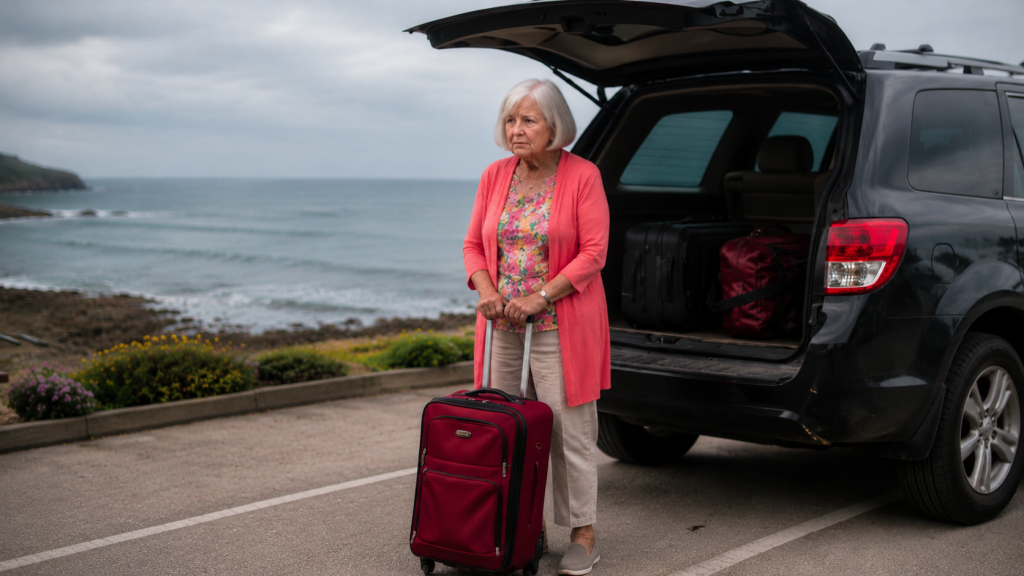
Then I carried my suitcase outside.
The winter air was cold.
The sky was gray.
But somehow, I felt warm.
I placed the suitcase in my trunk.
I sat behind the wheel.
For a moment, I looked at my house.
The place where I had raised my children.
The place where my husband and I celebrated forty-one Christmas mornings.
The place where countless family memories had been created.
Then I started the engine.
As I drove away, I expected to feel regret.
I expected tears.
Instead, I felt something I had almost forgotten.
Freedom.
The highway stretched ahead of me.
The city slowly disappeared behind me.
The Christmas decorations became fewer.
The traffic became lighter.
And eventually, I saw the ocean.
I pulled into the small coastal town just after noon.
The hotel was exactly what I needed.
Nothing extravagant.
Nothing fancy.
Just a quiet place facing the water.
The woman at the front desk smiled.
“Checking in for Christmas?”
I nodded.
“Yes.”
“Are you meeting family?”
I smiled slightly.
“No.”
She looked surprised.
“Traveling alone?”
“Yes.”
Then she smiled.
“Well, sometimes those are the best trips.”
I carried my suitcase upstairs.
When I opened the door to my room, I stopped.
The view was beautiful.
The ocean stretched endlessly in front of me.
The waves moved gently.
The room smelled clean.
There were no toys on the floor.
No dirty dishes.
No schedule.
No responsibility.
Just silence.
Beautiful silence.
I sat by the window for a long time.
I watched people walking along the beach.
I watched the sun slowly disappear.
And I realized something.
I had spent years worrying that my family would feel abandoned if I ever stopped helping.
But I never asked whether I felt abandoned when everyone depended on me without seeing me.
That evening, my phone started ringing.
First, it was Emily.
Then my son, David.
Then Emily again.
I looked at the screen.
For years, I had answered immediately.
No matter what.
But this time, I waited.
Not to punish them.
Not to make them worry.
I simply allowed myself to have a moment before responding.
Eventually, I answered my son’s call.
“Mom?”
“Hi, David.”
“Where are you?”
“At the coast.”
“Emily said you left.”
“Yes.”
There was a pause.
“Why?”
I looked out at the ocean.
And for the first time, I answered honestly.
“Because I needed someone to think about me.”
The line became quiet.
Then he said something I never expected.
“Mom…”
His voice sounded different.
Not angry.
Not defensive.
Just surprised.
“I never realized you felt that way.”
And maybe that was the hardest part.
They didn’t know.
Not because I had never felt it.
Because I had never told them.
I had spent years making everything look easy.
So they believed it was easy.
I had hidden my exhaustion so well that everyone thought I had no limits.
That night, I sat beside the window with a warm blanket around my shoulders.
The ocean moved in front of me.
My phone stayed silent.
And for the first time in years, I was not waiting for someone to need me.
I was simply enjoying being alive.
But I had no idea that back home, my family was beginning to understand exactly how much I had done for them.
And by Christmas morning, everything would change.
Christmas morning arrived quietly.
For the first time in decades, I did not wake up before sunrise to start cooking.
I did not check the oven.
I did not prepare coffee for a house full of people.
I did not hurry downstairs to make sure every gift was placed perfectly under the tree.
I simply opened my eyes, looked at the ocean outside my window, and smiled.
The first thought that came to my mind was not, “What needs to be done?”
It was something much simpler.
“I am here.”
I made myself a cup of coffee from the small machine in the hotel room.
I wrapped myself in a warm sweater and walked along the beach.
The sand was cold beneath my shoes.
The wind was gentle.
Families walked nearby, holding hands and laughing.
For a moment, I felt a small sadness.
Not because I regretted leaving.
Because I wished my family had understood me before it reached this point.
I wished my daughter had looked at me and seen her mother instead of someone who could always help.
I wished my children knew that behind every meal, every clean room, every wrapped present, and every holiday tradition was a woman who was quietly giving pieces of herself away.
After my walk, I returned to my room.
My phone had several messages.
The first was from Emily.
“Mom, can we talk?”
I stared at the message for a while.
Then another arrived.
“Please.”
I called her.
She answered immediately.
“Mom.”
Her voice sounded different.
Not the confident voice from before.
Not the voice of someone who already had everything planned.
She sounded tired.
“Hi, Emily.”
“I’m sorry.”
Two simple words.
But words I had waited years to hear.
I sat down near the window.
“What are you sorry for?”
“For assuming.”
She paused.
“For thinking you would always be there no matter what.”
I did not say anything.
She continued.
“Yesterday was a disaster.”
I almost laughed.
Not because I was happy.
Because I knew exactly what she meant.
“What happened?”
She sighed.
“When we realized you were really gone, we had no plan.”
She explained that she and her husband had to cancel their hotel trip.
The children needed someone to watch them.
They had to rearrange everything.
They had to actually do the work that I had always done.
“I know that sounds terrible,” she said.
“But I think I finally understand.”
“Understand what?”
“That Christmas at your house was never magic.”
Her voice became quiet.
“You made it magic.”
Those words touched something inside me.
Because for years, I had hoped someone would notice.
Not praise me.
Not thank me publicly.
Just notice.
“I should have asked you,” Emily said.
“I should have asked if you wanted to do it, not assumed you would.”
I looked down at my hands.
Hands that had cooked thousands of meals.
Hands that had wrapped hundreds of gifts.
Hands that had held my children when they were babies.
Hands that were now older and tired.
“I love being your mother,” I said.
“But I need you to understand something.”
“What?”
“I don’t want to spend the rest of my life proving I love my family by exhausting myself.”
Emily was quiet.
Then she whispered:
“I’m sorry, Mom.”
For the first time, I believed she meant it.
After we hung up, I sat there thinking about how strange life was.
Sometimes people do not understand what something is worth until they have to live without it.
Back home, my family experienced their first Christmas without me doing everything.
And it was not the disaster I expected.
It was something more important.
It was a lesson.
My son David called later that afternoon.
He was sitting with his children.
“Mom, can I ask you something?”
“Of course.”
“Why didn’t you ever tell us you were tired?”
I smiled sadly.
“Because every time I looked at everyone enjoying themselves, I thought that was enough.”
“But it wasn’t.”
“No.”
I looked toward the ocean.
“It was wonderful seeing everyone happy. But I forgot I was allowed to be happy too.”
There was a long pause.
Then David said:
“I think we all took your kindness for granted.”
That sentence meant more than any gift.
Because finally, someone saw it.
Not perfectly.
Not completely.
But enough.
When I returned home three days later, I expected things to feel awkward.
I expected my house to feel different.
But when I opened the front door, I found something unexpected.
The house was clean.
The kitchen was organized.
And on the table was a large envelope.
Inside was a letter from my children.
All of them had signed it.
Even the grandchildren had added their names.
The letter said:
“Dear Mom and Grandma,
We spent a lot of time talking these past few days.
We realized something important.
You have spent years creating memories for us, but we forgot to create memories with you.
We are sorry.
Starting now, holidays will be different.
Everyone will help.
Everyone will contribute.
And most importantly, we will ask what you want.”
I read that letter several times.
Then I cried.
Not because I was sad.
Because I finally felt seen.
The following Christmas was completely different.
My children came to my house again.
But this time, I did not spend the entire day in the kitchen.
My daughter arrived early and helped prepare food.
My son brought dishes and cleaned afterward.
The grandchildren decorated cookies.
Everyone had a job.
Everyone contributed.
At one point, I sat in my favorite chair and watched my family laughing together.
Nobody needed anything from me.
They simply wanted me there.
That was the difference.
Before, I was valuable because of what I provided.
Now, I was valuable because I was me.
As the evening ended, Emily sat beside me.
“Mom?”
“Yes?”
“I’m glad you left last year.”
I looked at her, surprised.
She smiled.
“I mean it. It scared us. But it taught us something we needed to learn.”
I squeezed her hand.
“What did it teach you?”
She looked around the room.
“That family is not one person doing everything while everyone else enjoys it.”
She smiled.
“Family means everyone showing up.”
I looked at the Christmas tree glowing in the corner.
For years, I thought saying no would make me a bad mother.
I thought choosing myself meant I was selfish.
But I learned something important.
Love does not disappear when you set boundaries.
Real love becomes stronger.
I was still a mother.
I was still a grandmother.
I still loved my family more than anything.
But I was also Margaret.
A woman who had lived sixty-seven years.
A woman who had dreams.
A woman who deserved quiet mornings, peaceful walks, and Christmases where she could sit down and enjoy the moment too.
The year I drove away to the coast, I thought I was leaving my family behind.
I was wrong.
I was teaching them how to finally walk beside me.
And from that Christmas forward, I was no longer the person everyone depended on.
I was the person everyone appreciated.
Because sometimes the greatest gift you can give your family is not another sacrifice.
Sometimes the greatest gift is showing them that you matter too.
THE END! THANK YOU FOR READING!