

My husband Richard had a vasectomy two years after Riley was born.
He said he was done with daughters and wanted no more chances.
I nodded and stayed quiet because that was what I had learned to do.
Two months later the test turned positive and my hands shook so hard I dropped the stick in the sink.
When I told him, the color drained from his face and then flooded back red.
He called me a liar and a cheat.
He said the baby couldn’t possibly be his and that I must have opened my legs for someone else the second his back was turned.
Before the night was over his fist found my ribs and I curled on the kitchen floor while Chloe and Riley cried in the next room.
He left the next morning with a suitcase and the words “I’m done with you and your useless girls.”
I thought that was the end.
I was wrong.
The pain in my side grew worse over the next two days.
A neighbor found me on the floor when she came to check on the girls and called an ambulance.
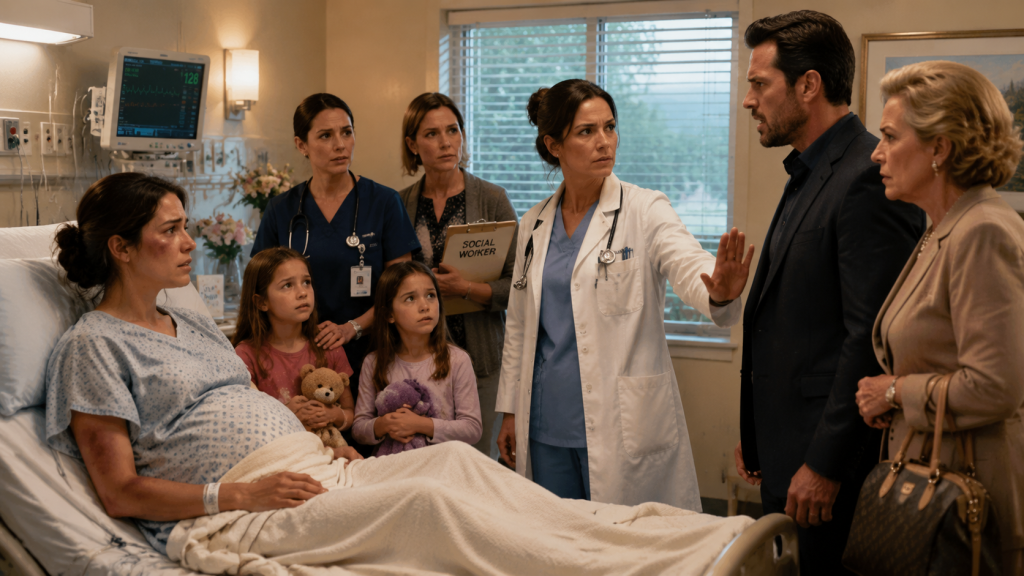
In the hospital the doctor took one look at the bruises already turning purple and the positive pregnancy test and stepped outside to make a call.
When he came back he told me Child Protective Services would be involved.
“You and your daughters need protection,” he said gently.
I tried to tell him Richard had never gone this far before, but the words died in my throat when the door opened and Richard walked in with his mother Eleanor behind him.
Eleanor clutched her black cardigan and demanded to know what they had done to her son.
She never looked at me.
The doctor turned to her and said, “Your daughter-in-law has serious injuries and she is pregnant.”
Eleanor went perfectly still.
Her eyes flicked to my stomach and then to the door as if she wanted to run.
“That can’t be,” she whispered.
Richard heard the fear in her voice and turned on her.
“Why can’t it be, Mom?”
She squeezed the cross on her necklace and said a mother knows things.
I tried to sit up but the pain in my ribs stole my breath.
Social worker Megan walked in then with a blue folder.
She told me Chloe and Riley were safe with the nurses and had eaten Jell-O.
I cried for the first time since the beating.
They had seen too much already.
Richard tried to push past Megan to get the girls but two security guards appeared at the door.
Eleanor put a hand to her heart and wailed that this was all my fault.
I looked at her and realized the shame I had carried for years was never mine to hold.
The doctor ordered another ultrasound.
They wheeled me down the long hallway under flickering fluorescent lights.
I closed my eyes when the cold gel hit my skin and prayed the blows hadn’t hurt the tiny life inside me.
Then I heard it—fast, stubborn, thump-thump-thump.
“There is your baby,” the doctor said.
“The heartbeat is strong.”
For a moment I felt my body was still mine, still capable of protecting something good.
The doctor moved the wand and frowned.
She asked if I had ever had a C-section.
I said no.
Both girls had been natural births.
She checked my chart again and called the records department.
An hour later she returned with a yellowed folder and Megan at her side.
“Mrs. Laura,” she said carefully, “we found an archived record from seven years ago.
You delivered twins that day—a girl and a boy.”
The room tilted.
I had only ever been told about Chloe.
They said I fainted from blood loss.
The doctor turned the page.
The boy had been declared deceased hours later, but there was no death certificate on file, no signature from me releasing the body, and Eleanor’s signature was on every form.
I whispered that I had been drugged.
Eleanor told me it was necessary.
The doctor and Megan exchanged a look.
Richard had been listening from the hallway.
He burst in and snatched the folder.
His hands shook as he read the word “male.”
Eleanor tried to say the boy was born wrong and weak and would have brought misfortune.
Richard’s voice cracked when he asked what she had done.
She broke then and screamed that she had saved the family name.
She had given the newborn to her cousin Mary in Charlotte because Mary’s husband was about to leave her over infertility.
She told Mary I had willingly given the boy up because I couldn’t afford two babies and was a bad mother anyway.
I felt something inside me shatter and catch fire at the same time.
“She stole my son,” I said.
Richard slumped into a chair.
For years he had beaten me for never giving him a boy while his own mother had hidden the son I did give him.
I looked at him and felt nothing but cold clarity.
“You broke my ribs,” I told him.
“You broke me in front of my girls.
You aren’t coming with me anywhere.”
Three days later, with a court order and two police officers, Megan and I drove to Charlotte.
My ribs were still taped.
I wore sunglasses to hide the bruises.
Mary’s yellow house looked cheerful with geraniums on the porch.
When she opened the door and saw me she dropped her coffee mug.
It shattered on the wood.
A seven-year-old boy appeared at the end of the hallway.
Thick dark hair, my eyes, the same small mole on his left cheek as Chloe.
He looked at me with innocent curiosity and asked Mary who I was.
The word “Mom” that came out of his mouth was meant for her, and it went through me like a blade.
I knelt down even though the pain made me sweat.
I told him my name was Laura.
He said his name was Michael.
Mary sobbed that she had raised him and loved him like her own.
I told her she had taken him from me.
Later, in police custody, she confessed Eleanor had handed her the newborn with forged adoption papers and the story that I was neglectful and had chosen to give him up.
She said she had wanted to believe it because she needed a child so badly.
The family court ordered DNA tests, psychological evaluations, and transitional counseling.
Michael did not run into my arms.
He came to supervised visits carrying crayon drawings and a quiet fear.
Chloe gave him her favorite blue marble.
Riley asked if he knew how to fold paper airplanes.
For weeks he called me Laura.
Then one afternoon in the therapy center parking lot he reached for my hand without thinking.
I cried behind my sunglasses.
The first time he asked if I had ever looked for him I told him the truth: I hadn’t known he existed, but from the second I found out I had not stopped fighting for him.
Richard was indicted for felony domestic violence.
Eleanor faced federal charges for kidnapping, fraud, and forgery.
Back in our small town people whispered that I was exaggerating, that a good mother wouldn’t put the father of her children in jail.
Then one afternoon while I was selling baked goods outside the elementary school to pay rent, a neighbor who used to shut her blinds when I walked by came to my table with red eyes and asked for forgiveness.
She said she had heard the shouting for years.
Other women started coming.
Some bought extra cookies and overpaid.
One offered me a steady job cleaning medical offices.
Life did not fix itself overnight, but it stopped hitting me.
My daughter Grace was born on a rainy Tuesday at dawn.
She was perfectly healthy and strong.
Chloe clapped.
Riley said she looked like a little pink marshmallow.
Michael, serious and careful, tucked the blanket around her tiny toes and asked what her name would be.
I looked at my four children and said, “Grace.”
No one in the room sighed in disappointment.
Richard asked to see me from the county detention center months later.
I went once with my lawyer.
He looked thinner, hollow-eyed.
Through the plexiglass he said he had lost everything.
I told him he had thrown it away.
He asked if Michael ever asked about him.
I said Michael asked about the truth, and the truth was that his father had the chance to love him and chose to hurt people instead.
Richard cried and asked if I would ever forgive him.
I thought of my girls covering their ears in the dark, of Michael growing up miles away believing I had thrown him away, of Grace moving inside me while Richard accused me of cheating.
I told him I didn’t live to hate him, but I wasn’t born to forgive him either.
I hung up the phone and walked out into the bright afternoon.
I bought four popsicles on the way home—lime for Chloe, strawberry for Riley, coconut for Michael, and a small cherry one I would save for Grace when she was older.
That night we ate warm chicken noodle soup around a wobbly secondhand table.
Michael pulled a crumpled paper from his backpack.
It was a drawing of our family.
He had drawn me taller than the house.
When I asked why, he shrugged and said, “Because you’re really there.”
I went into the bathroom to cry where he wouldn’t see.
Chloe followed me in and wrapped her arms around my legs.
I told her I was just breathing.
She didn’t understand everything, but she held on anyway.
Sometimes I still wake from nightmares of the old house, pinned on the floor, unable to get up.
Then I hear the steady breathing of my children in the next rooms and baby Grace shifting in her crib.
I see the pale pink dawn through the window.
I get up, brew coffee, braid hair, and when my children gather in the kitchen I tell them the same thing I tell myself every morning: In this house, no one is worth less for being born a girl.
No one is worth more for being born a boy.
In this house, we were all born to be loved.
Michael was the last one to leave for the school bus that morning.
He ran back, dropped his backpack, and hugged me hard.
“Bye, Mom,” he said.
The word was small and ordinary and it gave me back seven stolen years.
I held him the way you hold something precious that was lost and has finally come home.
Richard hadn’t taken my life away.
He had only delayed the beautiful moment I could finally start living it.
Years later
Three years have passed since that morning.
Michael is ten and a half now.
He plays soccer on Saturdays and reads chapter books to Grace before bed.
Chloe is nine and has decided she wants to be a doctor like the one who helped us in the hospital.
Riley is seven and still asks a thousand questions a day, most of them about why people can be so mean and how we make sure it never happens in our house again.
Grace is three and a half, fearless and funny, with a laugh that fills every room she enters.
She calls Michael “Mimi” and follows him everywhere.
I still work at the shelter three days a week.
Last month I helped a woman and her two daughters move into their first safe apartment.
When she hugged me at the door she whispered, “You gave me my life back.”
I told her she had done the hard part herself.
I just walked beside her for a little while.
We live in a small three-bedroom house now with a tiny backyard where the kids have a swing set and a garden bed they planted with sunflowers.
On Sunday mornings we still make pancakes.
Michael has gotten tall enough to reach the top shelf for the syrup without a stool.
Grace sits on the counter and “helps” by eating the chocolate chips straight from the bag.
Chloe sets the table and Riley tells everyone the latest story she made up about a brave princess who saves her whole kingdom.
The legal cases are long closed.
Eleanor is still in prison.
Richard was released on parole last year but has never contacted us, and I have made peace with that silence.
I do not hate him anymore.
I simply have nothing left to give him.
Sometimes Michael still asks quiet questions about the first seven years of his life.
I answer every one honestly and gently.
I show him the ultrasound picture from the day I found out he existed and the court papers that brought him home.
He listens, nods, and then usually asks if we can go get ice cream.
I always say yes.
Last week he brought home another drawing from school.
This time the whole family is standing in front of the sunflower garden.
He drew me in the middle, holding Grace’s hand, with Chloe and Riley on one side and himself on the other.
Above us he wrote in careful letters: “My real mom and my real family.”
I framed it and hung it in the living room where everyone can see it.
There are still hard days.
Money is tight some months.
Grace gets ear infections and Michael sometimes has nightmares of his own about being taken away again.
But the hard days are outnumbered by the ordinary beautiful ones—school plays, scraped knees kissed better, bedtime stories, and the sound of four children laughing together in the backyard while the sun goes down.
Every morning before the bus comes I gather them in the kitchen for the same small ritual.
I look at each of their faces and say the words that have become our family’s true foundation: “In this house, no one is worth less for being born a girl.
No one is worth more for being born a boy.
In this house, we were all born to be loved.”
Michael is always the last to leave.
He hugs me hard, says “Bye, Mom,” and runs out the door with his backpack bouncing.
I stand at the window and watch him go, grateful for every ordinary, miraculous second of the life that finally belongs to all of us.
THE END! THANK YOU FOR READING!