

On New Year’s Eve, my mother handed presents to every grandchild in the room except mine.
Not accidentally.
Not because she forgot.
She looked straight at my two children, smiled thinly, and placed the last glittering gift bag into my brother’s son’s hands.
My daughter Emma stared at the empty space beneath the tree where her name should have been.
My son Noah tucked his hands into the sleeves of his blue sweater and pretended not to care, which hurt worse.
Then my nephew Tyler laughed.
“Guess your kids weren’t good enough.”
The room went quiet for half a second.
My brother Brent chuckled into his champagne.
His wife, Melissa, lowered her eyes to her phone, pretending she had not heard.
My father reached for the remote and turned up the football game as if volume could cover cruelty.
I waited for my mother to correct Tyler.
She did not.
Instead, she folded her hands in her lap and said, “Children need to learn consequences. Maybe next year they’ll be more grateful.”
Emma’s eyes filled with tears.
Noah looked at me and whispered, “Mom, did we do something wrong?”
That was the moment something inside me went cold and clear.
For years, I had swallowed my mother’s little punishments.
The smaller birthday cakes.
The forgotten invitations.
The family photographs where my children were told to stand at the edge.
The vacations we heard about after everyone returned.
The Christmas cards featuring every grandchild except Emma and Noah.
I told myself my mother was aging.
I told myself Brent manipulated her.
I told myself keeping peace mattered more than being right.
But peace that requires your children to accept humiliation is not peace.
It is surrender.
I stood slowly.
My mother’s smile sharpened.
“Don’t make a scene, Julia.”
“I won’t.”
I helped Emma put on her coat.
Then I zipped Noah’s jacket and wrapped his scarf around his neck.
I picked up the casserole I had brought, still untouched on the sideboard, and tucked it under my arm.
Brent leaned back in his chair and laughed.
“Seriously? You’re leaving over toys?”
“No,” I said. “We’re leaving because all of you enjoyed watching children get hurt.”
My father finally looked away from the television.
“Sit down. It’s New Year’s Eve.”
I met his eyes.
“Never invite us again.”
The room stilled.
My mother blinked, surprised I had finally said it out loud.
Then we walked out.
The cold air struck my face as soon as I opened the front door.
Snow had begun falling in soft, silent flakes, covering my parents’ carefully decorated walkway.
Behind us, no one followed.
No one called Emma’s name.
No one apologized to Noah.
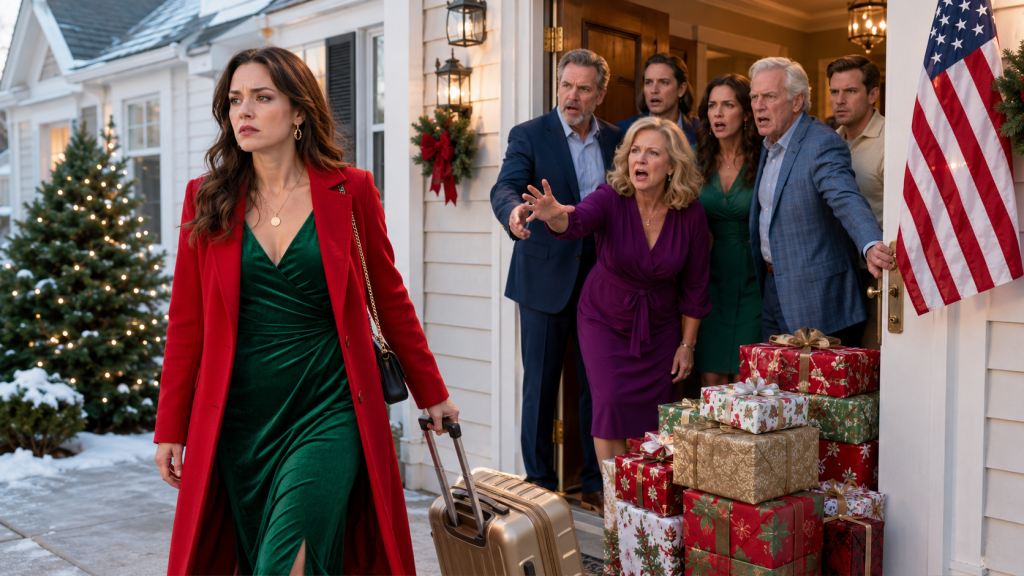
Through the front window, I saw my mother calmly reach for her champagne glass.
That image stayed with me as I guided my children toward the car.
Emma climbed into the back seat without speaking.
Noah struggled with his seat belt because his hands were shaking.
I set the casserole on the passenger-side floor and helped him fasten it.
“Mom,” Emma whispered as I closed the door, “Grandma hates us.”
I crouched beside the car.
“No, sweetheart.”
Emma’s tearful eyes met mine.
“Yes, she does.”
I wanted to deny it.
I wanted to tell her that adults were complicated and that Grandma loved her in her own way.
But children know when they are unwanted.
They recognize it long before adults are willing to admit it.
So I reached through the open door and held her hand.
“What Grandma did was wrong,” I said. “What everyone in that room did was wrong. You and Noah did nothing to deserve it.”
“Then why didn’t we get presents?”
“Because Grandma wanted to punish me, and she used you to do it.”
Emma looked down.
“Why is she mad at you?”
“That is a long story.”
“Is it because you don’t give Uncle Brent money anymore?”
Her question surprised me.
“What makes you think that?”
“I heard Aunt Melissa talking to Dad at Thanksgiving. She said Uncle Brent was angry because you stopped helping him.”
I glanced at Noah, but he was staring at the snow outside his window.
I had thought the financial arguments between the adults had remained private.
Clearly, I had been wrong.
“We’ll talk about it later,” I said. “Tonight, we’re going home.”
As I drove away, Emma cried silently against the glass.
Noah said he did not want gifts anyway.
I kept both hands tight on the steering wheel and promised them pancakes at midnight.
What I did not tell them was that, for three months, my attorney had been preparing documents my family knew nothing about.
My mother thought she was punishing my children.
She had forgotten who paid the mortgage on her house.
The truth went back seven years.
My father had owned a small construction supply business for most of his adult life.
For a while, it had done well.
Then a chain of larger stores opened nearby, offering lower prices and faster delivery.
My father refused to adapt.
He blamed the economy, his employees, his customers and eventually Brent, who had worked for him for less than a year before quitting.
By the time Dad finally admitted the business was failing, he had borrowed against the family home twice.
My parents owed more on the house than it was worth.
They were three months behind on payments.
The bank had already started foreclosure proceedings.
At the time, my husband Daniel was still alive.
Daniel and I had built a successful logistics software company together.
He handled development and operations.
I managed contracts and finances.
We were not wealthy in the private-jet sense, but we were comfortable enough to help my parents without risking our children’s future.
I had suggested selling the house and moving somewhere smaller.
My mother reacted as though I had asked her to sleep under a bridge.
“That house belongs to this family,” she said. “Your children should be able to visit the home where you grew up.”
So Daniel and I paid the overdue balance.
Then we refinanced the mortgage through a private family trust we controlled.
My parents signed an agreement stating that the trust would cover the monthly payment as long as they maintained the property, paid the taxes and followed a few simple conditions.
The most important condition was not financial.
It required them to treat both branches of the family equally in matters involving the grandchildren.
Daniel had insisted on it after watching my mother exclude Emma from a family birthday photograph.
“If we are helping them keep the family home,” he told me, “then they cannot use that home as a place to hurt our children.”
My mother signed without reading carefully.
My father read every page but assumed I would never enforce it.
For several years, I did not.
Then Daniel died.
A drunk driver crossed the center line on a rainy Tuesday evening and struck his car head-on.
He was forty-one.
Emma was eight.
Noah was five.
The weeks after Daniel’s death passed in a blur of funeral arrangements, insurance forms and nights spent holding two terrified children who believed every goodbye might be permanent.
My parents came to the funeral.
My mother cried loudly in the front row.
My father shook hands with Daniel’s business partners and accepted their sympathy.
Brent told everyone that he would “step up” and take care of me.
He did not.
Two weeks after the funeral, he asked if I planned to sell my share of the company.
A month later, he asked for fifty thousand dollars to start a restaurant.
When I refused, he accused me of becoming selfish.
My mother supported him.
“Daniel left you plenty,” she said. “Brent is your brother.”
“Daniel left that money for his children.”
“Your children already have more than Tyler ever will.”
That sentence should have warned me.
Instead, I kept making the mortgage payments.
I kept buying birthday presents for everyone.
I kept showing up with casseroles and flowers and carefully wrapped gifts.
I kept hoping generosity would soften them.
It did not.
It taught them that I would continue paying no matter how they treated us.
After we left my parents’ house on New Year’s Eve, I stopped at a twenty-four-hour grocery store.
Emma and Noah stayed close beside me as we bought pancake mix, strawberries, whipped cream and two small toys from the holiday clearance aisle.
Emma chose a set of watercolor pencils.
Noah picked a remote-control truck.
At home, we changed into pajamas and made pancakes shaped like stars.
We placed candles on the table, turned on music and counted down to midnight using the clock on the microwave.
At twelve, I raised a glass of sparkling cider.
“To new beginnings,” I said.
Emma managed a small smile.
Noah drove his truck across the kitchen floor.
For the first time that evening, he laughed.
After they fell asleep on the living-room couch, I covered them with blankets and sat alone beside the dark Christmas tree.
My phone showed nineteen unread messages.
Most were from my family group chat.
Mom: You embarrassed us in front of everyone.
Dad: Come back and apologize before this gets worse.
Brent: You are unbelievable.
Melissa: I think emotions were high. Maybe talk tomorrow.
Mom: You always ruin holidays.
Brent: Tyler was joking. Your kids need thicker skin.
Dad: Answer your phone.
Mom: After everything we’ve done for you, this is how you behave?
I read that final message twice.
After everything we’ve done for you.
I looked around the home Daniel and I had worked for.
I thought about the company I had kept running while grieving.
I thought about the mortgage payments I had made every month.
The property taxes I had covered when Dad claimed his pension check was late.
The new furnace I had purchased.
The roof repair.
The kitchen renovation my mother said was necessary because the old cabinets embarrassed her.
They had convinced themselves those things were gifts they deserved.
I opened my email and sent one message to my attorney, Rachel Kim.
Proceed exactly as discussed.
Rachel replied within ten minutes.
Understood. The notice will be delivered at 6:00 a.m.
At exactly six o’clock the next morning, my mother opened the front door expecting nothing more than the newspaper.
Instead, she found a process server standing on the porch with a certified envelope.
He confirmed her identity, handed her the documents and wished her a happy New Year.
Inside the envelope was a formal notice from the Whitmore Family Trust.
It stated that my parents had violated the terms of their occupancy and financial-support agreement through a documented pattern of discriminatory treatment toward two beneficiaries of the trust—Emma and Noah.
The trust would no longer subsidize the mortgage.
My parents had sixty days to refinance the remaining balance, purchase the property from the trust or vacate the house.
There was also a second notice.
The trust owned seventy-two percent of the house.
My parents owned the rest.
They had forgotten that detail because, for seven years, I had allowed them to behave as if the home belonged entirely to them.
At 6:14 a.m., my phone began ringing.
I silenced it.
At 6:18, my father called.
At 6:21, Brent called twice.
At 6:25, my mother left a voicemail.
“Julia, call me immediately. There has been some terrible mistake.”
There was no mistake.
At 6:32, she left another message.
“You cannot throw your parents out of their own home because of a misunderstanding.”
At 6:47, Brent sent a text.
This is financial abuse. Fix it now.
At 7:05, Dad wrote:
We need to speak privately before your mother has a breakdown.
I made coffee and watched the sunrise through the kitchen window.
Snow covered the yard in pale gold light.
For the first time in years, I did not feel guilty.
I felt tired.
But underneath the exhaustion was something stronger.
Relief.
Emma woke around eight and found me sitting at the table.
“Did Grandma call?”
“Yes.”
“Are we in trouble?”
“No.”
She studied my face.
“Is Grandma in trouble?”
“Grandma is facing the consequences of her choices.”
Emma climbed onto the chair beside me.
“Like she said we needed to do?”
I almost laughed.
“Yes,” I said. “Exactly like that.”
At ten that morning, my parents appeared at my house.
They did not call first.
My mother pounded on the front door while my father stood behind her holding the legal envelope.
Brent’s SUV pulled into the driveway seconds later.
I told Emma and Noah to stay upstairs, then opened the door but did not invite anyone inside.
My mother’s face was pale beneath her makeup.
“What is this?” she demanded, waving the papers.
“A legal notice.”
“I know what it is. I want to know what you think you’re doing.”
“Protecting my children.”
“By making your parents homeless?”
“You have sixty days to refinance.”
“You know we can’t qualify.”
“Then you can sell your share to the trust and move.”
Her mouth fell open.
Brent pushed past Dad.
“All this because Tyler made one joke?”
“No. This is because of years of behavior that every adult in that room witnessed and encouraged.”
Melissa had come with him.
She remained near the driveway, wrapped in a long gray coat.
Brent pointed at me.
“You cannot weaponize money against the family.”
“You mean the money you have expected me to provide while you insult my children?”
“We’re talking about Mom and Dad’s home.”
“It is mostly owned by the trust Daniel and I created.”
My father lowered his voice.
“Julia, let us come inside.”
“No.”
His expression changed.
Dad was not accustomed to hearing that word from me.
He had always been the quiet authority in our family.
Mom delivered the cruel comments.
Brent created the chaos.
Dad made everyone obey by refusing to intervene.
“Your mother handled last night badly,” he said. “But this response is extreme.”
“What would have been an appropriate response?”
“We could have discussed it.”
“I have discussed it with you for years.”
“I don’t remember that.”
“I do.”
Mom stepped closer.
“You are punishing us because you never got over being jealous of your brother.”
I stared at her.
Even after everything, she could not imagine a world in which her actions had consequences.
“This has nothing to do with jealousy.”
“You always resented Brent.”
“I paid forty thousand dollars toward his failed restaurant.”
“That was years ago.”
“I covered Tyler’s private-school tuition for two semesters.”
“Because you could afford it.”
“I paid your mortgage for seven years.”
“You offered.”
“Yes,” I said. “And now I am no longer offering.”
Brent laughed bitterly.
“You think Daniel would approve of this?”
The mention of my husband’s name changed the air between us.
“Daniel wrote the equal-treatment condition into the agreement.”
Brent’s smile disappeared.
My mother looked at Dad.
“You knew about that?”
Dad stared at the papers.
“I knew there was a clause.”
“You told me it was meaningless.”
“I thought it was.”
I folded my arms.
“It was not.”
Mom’s anger shifted toward him.
“You said she could never take the house.”
Dad looked older than he had the night before.
“She can’t take our share.”
“No,” I said. “But the trust can stop paying your debts.”
Brent stepped toward me.
“You’ll regret humiliating Mom.”
I held his gaze.
“My children were humiliated in front of the entire family. You laughed.”
“It was a joke.”
“Then explain what was funny.”
He opened his mouth but said nothing.
“Explain it,” I repeated. “Tell me why a ten-year-old girl crying beneath a Christmas tree was funny.”
Melissa looked down.
Dad rubbed his forehead.
Mom tightened her grip on the envelope.
“You have always been dramatic.”
“And you have always counted on me staying silent.”
A movement at the top of the staircase caught my attention.
Emma stood there in her pajamas.
She had heard everything.
My mother saw her.
For one second, I thought she might apologize.
Instead, she said, “Emma, tell your mother you understand that children who act spoiled don’t deserve presents.”
Emma’s face went white.
I stepped inside and closed the door.
My mother shouted my name from the porch.
I locked it.
Then I climbed the stairs and held my daughter.
That afternoon, Rachel came to the house.
She sat at my dining table and reviewed the documents with me again.
Everything was legal.
Everything had been properly served.
My parents had three options.
They could refinance and buy out the trust.
They could agree to sell the property and divide the proceeds according to ownership percentages.
Or they could remain until the sixty-day deadline, after which the trust could begin a partition action.
Rachel warned me that my family would likely attack me publicly.
“They may tell relatives you threw elderly parents into the street,” she said.
“They already started.”
My phone had been filling with messages from cousins, aunts and family friends.
Some called me heartless.
Others asked whether there was “more to the story.”
One cousin wrote that disagreements over Christmas gifts should remain private.
Another said I should remember that my parents would not live forever.
No one asked what my children had endured.
That evening, Brent posted a vague message on social media.
Some people use money to control their own parents. Never forget who stood by you before you became successful.
Within an hour, relatives were commenting with hearts and prayers.
I almost responded.
Rachel advised against it.
“Save screenshots,” she said. “Do not argue online.”
So I remained silent.
The next day, I received a call from my aunt Diane, my mother’s younger sister.
I almost ignored it.
Then I remembered that Diane had been watching from the corner of the room on New Year’s Eve.
I answered.
“Julia,” she said, “I’m sorry.”
Her voice broke.
I did not speak.
“I should have said something. We all should have.”
“Why didn’t you?”
“Because your mother punishes anyone who challenges her.”
“She was hurting children.”
“I know.”
“That should have been enough.”
“You’re right.”
I sat on the edge of my bed.
Aunt Diane told me something I had never known.
My mother had planned the gift exclusion weeks earlier.
She had called Diane and complained that I had refused to fund another business idea for Brent.
He wanted to purchase a struggling sports bar.
The price was four hundred thousand dollars.
He expected me to provide the down payment.
When I refused, my mother said I needed to be reminded that family loyalty went both ways.
“She said the children would be fine,” Diane whispered. “She said you’d get upset, then calm down and write a check like always.”
My stomach turned.
“So the presents were punishment.”
“Yes.”
“What did she buy for the other grandchildren?”
“Expensive things. Tyler got a gaming computer. The twins got tablets. She used the credit card you pay.”
I closed my eyes.
Years earlier, I had added my parents as authorized users on a card meant for household emergencies.
I had never removed them.
My mother had used my credit account to purchase thousands of dollars in presents for every grandchild except mine.
I thanked Diane for telling me.
Then I called the card company, froze the account and requested a full statement.
The charges were worse than I expected.
In addition to the holiday gifts, my parents had used the card for restaurant meals, clothing, weekend hotel stays and payments to one of Brent’s businesses.
More than twenty-eight thousand dollars had been charged during the previous year.
When confronted, my father claimed he thought the card was part of their support arrangement.
It was not.
Rachel sent another letter demanding repayment.
That was when the family campaign against me intensified.
My mother called relatives and told them I was mentally unstable from grief.
Brent claimed I had secretly planned to steal the house for years.
My father told people I had promised to support them for life.
Melissa remained silent.
Then, one week after New Year’s Day, she came to see me.
She arrived alone just after the children left for school.
I almost did not open the door.
“I only need five minutes,” she said.
I let her stand in the entryway.
She looked exhausted.
“I’m sorry about New Year’s Eve,” she began.
“You watched it happen.”
“I know.”
“You looked at your phone.”
“I was ashamed.”
“Not enough to intervene.”
She accepted that without arguing.
Then she handed me a folder.
Inside were printed emails between Brent and my mother.
They had discussed the gift plan in detail.
My mother wrote that humiliating the children would make me understand what happened when I “forgot my place.”
Brent replied that I would come crawling back within a week.
There were also messages about the sports bar.
Brent told Mom that once I felt guilty, she should ask me for two hundred thousand dollars rather than the original one hundred thousand.
I looked up from the pages.
“Why are you giving me this?”
Melissa’s eyes filled with tears.
“Because Brent used Tyler.”
“What do you mean?”
“He told Tyler to make that comment.”
The room seemed to tilt.
“He coached him?”
“Yes. He promised Tyler a new computer if he embarrassed Emma and Noah after the presents were handed out.”
I gripped the folder.
Tyler was thirteen.
Old enough to understand cruelty, but young enough to be manipulated by his father.
“Does Tyler know why?”
“He thinks this is about you refusing to help the family. Brent tells him you are selfish.”
“Why are you telling me now?”
“Because Brent wants me to lie.”
“About what?”
“He wants me to say you threatened your parents before New Year’s Eve. He thinks he can prove the trust acted in bad faith.”
“Will you lie?”
Melissa shook her head.
“I’ve spent fourteen years pretending not to see what kind of man I married.”
She removed her wedding ring and held it in her palm.
“I’m done pretending.”
Brent’s marriage began falling apart within days.
Melissa took Tyler and moved into her sister’s house.
She gave Rachel copies of financial records showing that Brent had quietly borrowed money from my parents and used their remaining equity as security.
My father had signed several documents without fully understanding them.
My mother had known.
She believed the sports bar would make Brent rich enough to repay everything.
The loan was in default.
If the trust had continued covering the mortgage, my parents might still have lost their share of the property because of Brent’s debt.
For the first time, my father began to understand that I had not created the crisis.
I had stopped hiding it.
He called me near the end of January.
His voice sounded small.
“Can we talk without your mother or Brent?”
We met at a coffee shop halfway between our homes.
Dad arrived early.
He looked thinner.
For several minutes, neither of us spoke.
Then he placed a worn envelope on the table.
Inside was a handwritten list of every time he remembered my mother excluding or humiliating my children.
Emma’s sixth birthday, when Mom arrived without a gift but brought one for Tyler because he was “feeling left out.”
The family reunion where Emma and Noah were left off the matching T-shirts.
The Thanksgiving dinner when my children were seated at a folding table in the laundry room while Tyler sat with the adults.
The Easter egg hunt where their eggs had been left empty.
The Christmas card.
The photographs.
The vacations.
The list covered three pages.
“You remembered,” I said.
Dad stared at his coffee.
“I told myself I didn’t.”
“Why?”
“Because admitting it meant I had to do something.”
“And you did not want to confront her.”
“No.”
His honesty hurt more than another excuse would have.
“You were their grandfather.”
“I know.”
“You watched them begin to believe they were worth less.”
His eyes filled.
“I know.”
I pushed the list back toward him.
“What do you want from me?”
“I want to apologize.”
“An apology will not restore their trust.”
“I understand.”
“Do you?”
He looked toward the window.
“Your mother has controlled this family for forty-three years. Whenever she was cruel, I told myself keeping her calm protected everyone else. I thought silence made me peaceful.”
“It made you useful to her.”
“Yes.”
We sat quietly.
Finally, he told me he was willing to sell the house.
He wanted his share placed into a modest retirement account.
He planned to move into a smaller apartment.
My mother refused.
“She says she will never leave,” he said.
“Then the legal process will continue.”
“She expects me to fight you.”
“Will you?”
Dad shook his head.
“No.”
It was not forgiveness.
But it was the first responsible choice I had seen him make in years.
The house was listed for sale in February.
My mother resisted until Rachel filed the first court documents.
Once she understood that a judge could order the sale, she agreed.
She did not apologize.
She told everyone I had stolen her home.
She removed my photographs from the walls before the realtor arrived.
She left the empty frames hanging.
The house sold quickly to a young family with three children.
After the mortgage, liens and fees were paid, my parents’ remaining share was much smaller than they expected.
Most of the trust’s proceeds returned to accounts established for Emma and Noah.
My mother moved into a one-bedroom apartment near Aunt Diane.
My father rented a small place across town.
They separated after forty-three years of marriage.
Brent blamed me for that too.
His sports-bar deal collapsed.
The lender sued him.
Melissa filed for divorce and requested full financial disclosure.
When the court examined their records, it became clear that Brent had hidden debts, forged Melissa’s signature on one loan application and spent money from Tyler’s education account.
His life did not fall apart because I took revenge.
It fell apart because I stopped protecting him from consequences.
In March, Tyler wrote Emma a letter.
Melissa asked me to read it before deciding whether to give it to her.
The handwriting was uneven.
Emma,
I’m sorry I said you were not good enough. Dad told me to say it. He promised me the computer, but I knew it was mean. I said it anyway. I don’t expect you to forgive me. I gave the computer back to Grandma before she moved. Mom says being told to hurt someone does not make it okay. I’m sorry I made you cry.
Tyler
I let Emma decide what to do.
She read the letter twice.
Then she placed it in her desk drawer.
“Do I have to forgive him?”
“No.”
“Can I forgive him later?”
“Yes.”
“Can I still not want to see him?”
“Yes.”
She nodded.
“I think I forgive him a little. But I don’t trust him.”
“That is allowed.”
Noah was slower to speak about what happened.
For weeks, he insisted that gifts did not matter.
Then one night, while I was tucking him into bed, he asked whether Grandma had excluded them because Daniel was dead.
The question broke my heart.
“Why would you think that?”
“Because when Dad was here, she was nicer.”
He was right.
My mother had been more careful around Daniel.
She knew he would challenge her.
After his death, she treated my grief as weakness.
I sat beside Noah and explained that some adults behave badly when they believe no one will stop them.
“Grandma made a wrong choice,” I said. “It had nothing to do with Dad being gone, and it had nothing to do with you.”
“Will she ever be nice again?”
“I don’t know.”
“Are we going to see her?”
“Not unless she takes responsibility and you feel safe.”
He thought about that.
“What does taking responsibility mean?”
“It means telling the truth without excuses. It means apologizing. It means changing.”
“Did Grandpa do that?”
“He is trying.”
Dad began attending family counseling on his own.
He also met with Emma and Noah’s therapist to learn how his silence had affected them.
Several months passed before I allowed him to see the children.
The first visit took place in a public park.
Dad arrived carrying no gifts.
That mattered to me.
He sat across from Emma and Noah at a picnic table and apologized without blaming my mother.
“I saw things that were wrong,” he told them. “I pretended not to see because I was afraid of an argument. That made you feel unimportant. You were never unimportant. I failed to act like your grandfather.”
Emma watched him carefully.
Noah asked, “Why did you turn up the football game?”
Dad’s face crumpled.
“Because I was ashamed, and I wanted to pretend nothing was happening.”
“It was loud,” Noah said.
“I know.”
“I still heard Tyler.”
Dad nodded.
“I’m sorry.”
Noah did not hug him.
Emma did not say she forgave him.
But when we left, she said Grandpa’s apology sounded real.
That was enough for a beginning.
My mother’s apology arrived in June.
It came as a text message.
I’m sorry you misunderstood what happened at New Year’s. I never intended for the children to be hurt. Families should not stay divided over material things.
I showed it to Rachel, who raised one eyebrow.
“That is not an apology.”
I deleted it.
Two weeks later, Mom appeared at Emma’s school recital.
She had not been invited.
She sat in the back row and tried to approach us afterward.
I stepped between her and the children.
“You need to leave.”
“I came to support my granddaughter.”
“You were told not to contact us.”
“You cannot keep them from me forever.”
“Watch me.”
People nearby turned toward us.
Mom lowered her voice.
“You enjoy humiliating me.”
“No. I am protecting them.”
“I am their grandmother.”
“That is a relationship, not a legal entitlement.”
Her face hardened.
“You have become cruel.”
I almost responded.
Then I remembered all the years I had spent explaining myself.
I took Emma’s hand, called Noah and walked away.
Mom did not follow.
That summer, I sold the large company office Daniel and I had purchased years earlier.
Most employees had been working remotely, and the building no longer made sense.
I used part of the proceeds to establish a scholarship in Daniel’s name for students who had lost a parent.
Emma helped design the application form.
Noah chose the logo.
We also took our first real vacation since Daniel’s death.
We rented a small house near the ocean.
There were no expensive resorts or elaborate schedules.
We built sandcastles, ate ice cream before dinner and stayed outside until sunset.
One evening, Emma asked whether I missed having a big family.
I looked at her and Noah racing along the shoreline.
“I used to think a big family meant never being alone,” I said.
“What do you think now?”
“I think the right people matter more than the number of people.”
She leaned against my shoulder.
“Are we enough?”
I kissed the top of her head.
“You are more than enough.”
In September, Melissa and Tyler moved into a townhouse nearby.
Emma chose to meet Tyler again.
The meeting was awkward.
He apologized in person.
Emma told him that what he had done was cruel and that she would not pretend it had not happened.
Tyler nodded.
“I know.”
“You don’t get to make jokes about us anymore.”
“I won’t.”
“And if Uncle Brent tells you to say something mean, you have to say no.”
“I will.”
It was not a magical reconciliation.
They did not become best friends.
Trust returned in small pieces.
A conversation at a school game.
A shared pizza.
A birthday card.
That was healthier than forced forgiveness.
As the next New Year’s Eve approached, my mother began contacting relatives.
She told them she wanted the family reunited at midnight.
Aunt Diane declined.
Dad declined.
Melissa declined.
Several cousins who had once criticized me also declined after learning more about the financial manipulation and the planned humiliation.
My mother sent me a final letter.
Unlike her text, it was four pages long.
She admitted that she had excluded Emma and Noah deliberately.
She admitted that she had wanted to punish me for refusing Brent’s business request.
She admitted that she had used the emergency card for personal expenses.
She admitted that she had relied on Dad’s silence and my guilt.
For the first time, there were no excuses.
At the end, she wrote:
I do not expect forgiveness. I am beginning to understand that saying I love my grandchildren means nothing if my actions taught them otherwise. I wanted control more than I wanted closeness. Now I have neither.
I read the letter several times.
Then I showed it to the children’s therapist.
We agreed that an apology did not require immediate access.
I wrote back with clear boundaries.
No visits.
No surprise appearances.
No gifts.
She could send one letter every three months.
If, after a full year, the children wanted contact, we would consider a supervised meeting.
My mother accepted the conditions.
That surprised me more than anything.
On December thirty-first, one year after the night beneath the Christmas tree, Emma and Noah helped me prepare our own celebration.
We invited Dad, Aunt Diane, Melissa and Tyler.
The guest list was smaller than my mother’s had been.
The house felt warmer.
Before dinner, Dad asked whether he could say something.
He stood beside the fireplace, holding a glass of sparkling cider.
“One year ago, I failed two children I love,” he said. “I cannot undo it. But I can promise I will never again confuse silence with kindness.”
Emma looked at him for a long moment.
Then she walked over and hugged him.
Noah joined them.
Dad closed his eyes.
At midnight, we went outside and lit sparklers in the snow.
Emma wrote Daniel’s name in the air.
Noah drew a crooked heart.
Tyler stood beside them, careful and quiet.
I watched the light reflect across their faces.
There were presents inside, but no one had been ranked.
No one had been excluded.
No child had been used as a weapon.
At six o’clock the next morning, I woke before everyone else.
For a moment, I remembered the certified envelope arriving at my parents’ door exactly one year earlier.
People had called it revenge.
Maybe part of me had wanted them to feel the shock I felt when Emma asked what she had done wrong.
But the documents were never the true gift.
The real gift was the boundary.
It was the moment I stopped financing my own mistreatment.
It was the moment my children learned that love does not require them to accept humiliation.
It was the moment my father chose accountability over avoidance.
It was the moment Melissa stopped protecting a dishonest husband.
It was the moment Tyler understood that obeying cruelty did not erase responsibility.
Most of all, it was the moment I finally understood that keeping a family together is not always the same as keeping it healthy.
Sometimes a family can only heal after someone is brave enough to let the false version of it fall apart.
I walked into the living room.
Emma and Noah were asleep on the couch beneath the same blankets I had used the year before.
The Christmas tree glowed softly in the corner.
On the coffee table sat a small envelope with my name on it.
Inside was a card from both children.
Emma had written the message.
Noah had drawn the picture.
Mom,
Thank you for taking us home last New Year’s Eve.
You taught us that we should never stay where people are happy to see us hurt.
We love our new family traditions.
Happy New Year.
The drawing showed the three of us holding hands beneath fireworks.
Above us, in large uneven letters, Noah had written:
WE ARE ENOUGH.
I pressed the card to my chest and cried.
Not because I was sad.
Because for years, I had believed protecting my children meant absorbing every insult so they would not lose their extended family.
I finally understood that protecting them meant showing them when to leave.
Outside, the first sunrise of the new year spread across the snow.
A year earlier, my family’s “gift” had arrived in a legal envelope.
This year, mine arrived in a child’s handwriting.
And it was worth more than any house, any inheritance or any glittering present beneath a tree.
THE END! THANK YOU FOR READING!