

At 12:43 a.m., my sixteen-year-old daughter called me from the curb outside our own house.
“Grandpa said my room belongs to Avery now,” Grace whispered, while I stood in a hospital medication room with one glove still on.
Behind her voice, I heard traffic sliding over wet asphalt and the thin rustle of a plastic bag.
“What plastic bag is that?” I asked.
“My pajamas. My backpack. Grandma put everything in a grocery bag and said I was being dramatic.”
For three seconds, the hospital around me went soundless.
The pharmacy refrigerator hummed. My patient’s chart lay open on the counter. Somewhere beyond the medication-room door, a monitor began beeping, followed by the quick footsteps of another nurse.
I was supposed to be calm under pressure.
I had spent fourteen years as an emergency-room nurse learning how not to panic when people were bleeding, screaming, or slipping away in front of me.
But this was my child.
My daughter was sitting outside in the November cold because my husband’s parents had decided our home was theirs to redistribute.
“Where’s your father?” I asked.
“On the porch,” Grace said. “He told Grandpa he thought this was going too far, but Grandpa yelled at him. Then Dad said he didn’t want to get in the middle.”
I closed my eyes.
My husband, Eric Whitmore, had always been an expert at vanishing while standing in plain sight.
“Grace, listen to me carefully,” I said, keeping my voice steady. “Go to Mrs. Keller’s porch. Do not go back inside. I’m calling her now.”
“What if Grandpa follows me?”
“He won’t.”
“How do you know?”
“Because he still thinks I’m afraid of making a scene.”
Mrs. Keller answered on the second ring.
By 12:49, she had Grace inside her home, wrapped in a blanket and drinking tea at the kitchen table.
By 12:52, I had called my charge nurse and told her I had a family emergency.
By 1:17, I pulled into our driveway and saw every light blazing in the house my late father had left to me.
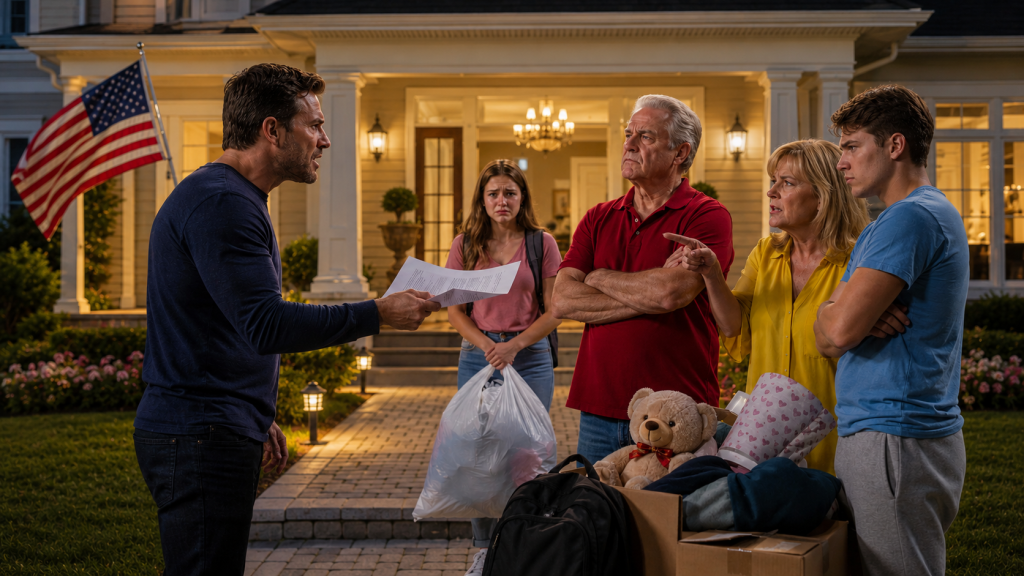
My in-laws, Richard and Patricia Whitmore, were standing in the foyer like hotel managers handling an unruly guest.
Behind them stood Avery, my seventeen-year-old niece, holding Grace’s favorite gray comforter against her chest.
Eric was at the foot of the stairs, pale and silent.
Patricia lifted her chin.
“Before you start yelling,” she said, “we made a practical decision. Avery needs stability. Grace can stay with friends for a few days until we sort this out.”
“In her own house?” I asked.
Richard folded his arms.
“This family has supported you long enough, Melissa. Eric’s name is on the mailbox too. We make the decisions for the collective good of this family.”
“Not on the deed,” I said.
The room changed.
Patricia blinked first.
I walked past them to the sideboard, opened the bottom drawer, and took out the folder I had kept there since my father’s funeral.
Deed.
Mortgage release.
Property-tax records.
Homeowner’s insurance.
Every page had one name printed on it.
Melissa Anne Carter.
Not Whitmore.
Carter.
“My father bought this house before I married Eric,” I said. “He left it to me. I let you stay here after your condo flooded. I did not give you authority to evict my daughter from her own bed.”
Richard’s face reddened.
“You wouldn’t throw out family.”
“No,” I said. “You already did.”
Avery shifted behind Patricia.
She wasn’t crying. She wasn’t embarrassed.
She looked annoyed.
“Mom said Grace barely uses that room,” she muttered. “She’s always at school or soccer practice.”
I stared at her.
“Whose mother said that?”
Before Avery could answer, Patricia stepped forward.
“It doesn’t matter. The point is that Avery needs privacy. She has college applications, and she can’t be expected to sleep in the den forever.”
“The den has a pullout sofa, a private bathroom, and a desk.”
“It doesn’t have a closet,” Patricia snapped.
Grace had been thrown into the cold because Avery wanted a closet.
I turned to Eric.
He looked as though he wanted the floor to open beneath him.
“You watched them pack our daughter’s things into a grocery bag.”
“Melissa, it happened fast.”
“It took them long enough to strip her bed.”
“I told Dad it wasn’t a good idea.”
“And when he ignored you?”
Eric rubbed both hands over his face.
“I didn’t want it to become a screaming match.”
“It became a sixteen-year-old girl sitting beside the road at midnight.”
Richard scoffed.
“She was not beside the road. She was on the curb. Don’t exaggerate.”
That was the moment something inside me became perfectly still.
Not angry.
Not frantic.
Still.
I had spent years negotiating with these people.
I had reduced my needs, softened my words, and swallowed insults to keep peace in a family that treated peace like my personal responsibility.
That night, I understood that people like Richard did not mistake kindness for weakness.
They depended on it.
I took out my phone.
Patricia gave a brittle laugh.
“Who are you calling at this hour?”
“My attorney.”
Richard laughed once.
It was a confident, dismissive sound.
He thought I was bluffing.
Patricia squeezed Avery’s shoulder and whispered that I was only upset because of a long shift.
Eric stared at the floor, saying nothing.
The silence answered every question I had ignored for years.
David Lawson answered on the fourth ring.
He had handled my father’s estate and had warned me, gently but repeatedly, never to place Eric or anyone else on the deed.
“Melissa?” he said groggily. “Is everything all right?”
“No. I need you to confirm something. My in-laws have no tenancy agreement, no ownership interest, and no legal authority over this property, correct?”
The room became so quiet that I could hear the clock ticking above the fireplace.
David’s voice sharpened.
“Correct. They are temporary guests. How long have they been there now?”
“Four months.”
Richard held up five fingers as if correcting me.
I ignored him.
“And Eric?” I asked.
“His marital status does not automatically create ownership in a house inherited solely by you, particularly when it has been maintained as separate property. Why? What happened?”
“They removed Grace’s belongings from her bedroom and put her outside. I need to know what I can legally do tonight.”
David was silent for a moment.
“Is Grace safe?”
“She’s with a neighbor.”
“Call the police non-emergency line. Explain that there has been a domestic dispute involving a minor being removed from her residence. Do not touch anyone’s property. Do not physically force anyone out. Tell the officers you are revoking permission for Richard and Patricia to remain in the house, but depending on local occupancy rules, formal removal may still require written notice.”
Richard smirked as though he had won.
Then David continued.
“However, if they threaten you, threaten Grace, damage property, or refuse lawful police instructions, that changes the situation. Eric is another matter. You can tell him to leave voluntarily, but because he is your spouse and resides there, removing him may require family-court action unless there is a safety issue.”
“Understood.”
“I’ll prepare formal notices first thing in the morning.”
“No,” I said.
David paused.
“I want them prepared now.”
“Melissa, it’s almost two.”
“I know what time it is.”
Something in my voice must have told him this was not a request.
“All right,” he said. “Send me photographs of the deed and any messages related to tonight. I’ll draft the documents.”
When I ended the call, Richard smiled.
“You heard him. You can’t throw us out.”
“I heard him say I can revoke permission for you to remain.”
“Paperwork takes time.”
“So does packing.”
Patricia’s mouth tightened.
“You’re being cruel.”
I looked at the woman who had put my daughter’s pajamas into a grocery bag.
“Grace has an exam tomorrow. You removed her from her room after midnight. I’m comfortable letting everyone here decide which one of us is cruel.”
I called the police non-emergency line.
While we waited, I went to Mrs. Keller’s house.
Grace was sitting at the kitchen table with a blanket around her shoulders.
Her dark hair was damp from mist, and her eyes were swollen.
Mrs. Keller stood behind her with one hand resting protectively on her shoulder.
“I saw them put her bag outside,” she told me. “I was about to call you myself.”
Grace looked at me.
“Are they still there?”
“For the moment.”
“Is Avery keeping my room?”
“No.”
“What about Dad?”
I hesitated.
That hesitation hurt her more than any answer could have.
Grace looked down at her tea.
“He didn’t even look at me when Grandpa told me to leave.”
I sat beside her.
“None of this was your fault.”
“I asked Dad to stop them.”
“I know.”
“He said Grandpa was stressed.”
“I know.”
She swallowed.
“Why is Grandpa’s stress always more important than mine?”
I had no answer that would not break something open between us.
So I told her the truth.
“It shouldn’t be.”
Mrs. Keller helped us carry the grocery bag back across the street.
When we entered the house, Patricia was already remaking Grace’s bed for Avery.
She had changed the pillowcases.
That small detail enraged me more than anything else.
Grace stopped in the doorway.
Patricia turned, holding one corner of the sheet.
“Grace, don’t make this harder. Avery has had a very difficult year.”
“So have I,” Grace said.
Patricia frowned as though Grace had spoken out of turn.
“Avery’s parents are separating.”
“My parents live in the same house and barely speak.”
Eric flinched.
Grace looked directly at him.
“You let them throw me out.”
“Sweetheart, I didn’t know your grandfather was going to make you leave the property.”
“You watched Grandma hand me the bag.”
“I thought you were going to cool off at a friend’s house.”
“At one in the morning?”
Eric’s mouth opened, but nothing came out.
Blue lights flashed through the living-room windows.
Two officers came to the door.
One was a woman in her forties named Officer Ramirez. The other was a younger man named Officer Cole.
I explained what had happened.
Grace told them that Richard had ordered her out, Patricia had packed her clothing, and Eric had refused to intervene.
Richard interrupted repeatedly.
“This is a family misunderstanding.”
“It was a bedroom reassignment.”
“The child became hysterical.”
“She chose to go outside.”
Officer Ramirez finally raised one hand.
“Sir, let her speak.”
Richard looked offended by the concept.
I showed Officer Ramirez the deed.
I showed her the folder bearing my name.
Then Grace showed her the text Patricia had sent twenty minutes before calling me.
You need to learn that your grandparents are in charge now. Stop embarrassing the family and find somewhere else to sleep tonight.
Officer Ramirez read it twice.
“Mrs. Whitmore, did you send this?”
Patricia’s face stiffened.
“She was shouting.”
“Did you send it?”
“Yes, but—”
“Did you place her belongings outside?”
“Only a few things.”
Officer Cole glanced toward the grocery bag.
“You removed a minor from her residence in the middle of the night.”
Richard stepped forward.
“She is our granddaughter. We have authority.”
“No,” I said. “You do not.”
Officer Ramirez asked Richard and Patricia to collect essential belongings and leave for the night.
Richard refused.
“This is my son’s home.”
“It is legally my home,” I said.
Eric finally looked up.
“Maybe everyone should just go to bed and discuss it tomorrow.”
I stared at him.
“Our daughter was denied that option.”
“Melissa, please.”
“No.”
He came closer and lowered his voice.
“You’re humiliating my parents.”
“They humiliated Grace.”
“They made a mistake.”
“A mistake is forgetting to buy milk. This was a decision.”
Richard pointed toward me.
“She has always been vindictive. She keeps that deed in a drawer so she can hold it over Eric’s head.”
“I keep it in a drawer because it is a legal document.”
“You never made him equal in this marriage.”
I looked at Eric.
“Is that what you told them?”
Eric’s eyes moved toward his father.
That was all the answer I needed.
Over the previous year, Eric had repeatedly suggested refinancing the house.
He said we could use the money to invest in a business opportunity with his older brother, Scott.
I had refused because the proposal made no sense and because my father had left the house debt-free.
Eric had called me controlling.
Richard had called me selfish.
Patricia had said a woman who truly trusted her husband would not keep property in her maiden name.
I had believed those conversations were about pride.
Standing in the foyer at two in the morning, I realized they had been about access.
Officer Ramirez repeated the instruction.
“You need to leave for tonight.”
Richard folded his arms.
“I’m not going anywhere.”
Officer Ramirez’s tone changed.
“Then you may be removed for refusing a lawful order during an active domestic disturbance.”
Patricia grabbed Richard’s sleeve.
“Let’s go. We’ll handle this tomorrow.”
Avery stared at them.
“Where are we supposed to sleep?”
“The den at your parents’ apartment,” I said.
Her head snapped toward me.
“You knew they had an apartment?”
“I knew your mother signed a lease three weeks ago.”
Patricia looked shocked.
So did Eric.
I had found out accidentally when a leasing-office envelope arrived at our home addressed to Scott and Diane Whitmore.
Avery’s parents were separating, but neither of them was homeless.
Scott had moved into a furnished rental near his office.
Diane had leased a two-bedroom apartment fifteen minutes away.
Yet Avery remained in my den because Patricia insisted that moving during her senior year would be “too disruptive.”
Apparently throwing Grace out of her bedroom was acceptable disruption.
Patricia recovered first.
“That apartment isn’t ready.”
“It has electricity, furniture, and two bedrooms.”
“The neighborhood isn’t as good.”
“Then perhaps Scott should spend some of the money he saved by leaving his daughter here for four months.”
Richard glared at Eric.
“You told her?”
Eric looked genuinely confused.
“I didn’t know.”
“No,” I said. “You usually don’t.”
Patricia and Richard packed overnight bags under police supervision.
Avery carried her suitcase downstairs but left Grace’s comforter on the bed.
At the door, Patricia turned to Grace.
“I hope you’re satisfied.”
Grace’s face crumpled.
Before I could speak, Officer Ramirez did.
“Do not blame a child for the consequences of your decisions.”
Patricia stared at her, speechless.
Richard walked out muttering about attorneys, elder rights, and family betrayal.
Avery followed them without apologizing.
The patrol car remained outside until their vehicle disappeared down the street.
Then Officer Ramirez gave me her card.
“Document everything,” she said. “Change any access codes they know. And consider whether your daughter feels safe with every adult currently in the home.”
Her eyes shifted toward Eric.
He looked away.
After the officers left, Grace stood at the bottom of the staircase.
“Can I have my room back?”
I wanted to cry when she asked.
It was her room.
Her walls were covered with soccer medals, photographs, and pencil sketches.
Her stuffed rabbit sat on the shelf above the bed.
Her father had painted the room pale blue when she was seven.
She should never have had to request it.
“Yes,” I said. “Right now.”
We spent the next hour restoring everything.
Patricia had boxed Grace’s books and pushed them into the hall closet.
Avery had already arranged perfume bottles on Grace’s dresser.
Her college brochures were spread across Grace’s desk.
Grace worked silently beside me.
Eric stood in the doorway.
“I can help.”
Neither of us answered.
After a minute, he began carrying Avery’s things to the den.
At three thirty, Grace finally crawled into bed.
I tucked the comforter around her.
“I’m sorry,” I whispered.
“You were at work.”
“I should have seen what was happening before tonight.”
“Grandma said you don’t understand how families work because Grandpa never had sons.”
I sat back.
“My father understood family very well.”
“He would have stopped them.”
“Yes.”
“Dad didn’t.”
“No.”
She looked toward the doorway.
“Are you going to divorce him?”
I had spent years believing that protecting a child meant keeping hard truths away from her.
That night, I understood that false reassurance could be another form of abandonment.
“I don’t know yet,” I said. “But things will not continue the way they have.”
Grace nodded.
“That’s what Mrs. Keller said.”
“What did she say?”
“She said people only keep doing things when everyone else keeps making room for them.”
Mrs. Keller was right.
At four fifteen in the morning, I sat at the kitchen table across from Eric.
He looked exhausted.
“So,” he said, “you’re actually throwing out my parents.”
“They threw out Grace.”
“You keep saying that as if they abandoned her in another city.”
“She was outside in the cold at midnight.”
“She had her phone.”
I stared at him.
He immediately looked ashamed, but he had already said it.
“Listen to yourself.”
“I’m not defending them.”
“You have done nothing but defend them.”
“I’m trying to explain that they didn’t think it through.”
“Richard planned it. Patricia packed Grace’s belongings. Avery moved her things upstairs. You watched.”
“I froze.”
“No, Eric. Freezing happens for a moment. You had time to watch them strip the bed, pack the clothes, walk Grace downstairs, and put her outside.”
He pressed his fingers against his temples.
“My father has been under pressure.”
“From what?”
“The condo insurance. Scott’s divorce. Money.”
“None of those things involve Grace’s bedroom.”
“He feels useless.”
“So you let him feel powerful by controlling our daughter?”
“That’s not what happened.”
“It is exactly what happened.”
Eric’s chair scraped against the floor as he stood.
“You’ve never understood what it’s like growing up with him.”
“No. But you are forty-three years old now.”
His face tightened.
“He knows how to make everything feel like a test. If you challenge him, he makes you pay for it for months.”
“And tonight you decided Grace should pay instead.”
Eric went still.
I slid my wedding ring off and set it on the table.
His eyes fixed on it.
“Melissa.”
“I’m not making a final decision tonight.”
“Then why take that off?”
“Because when Grace begged you for help, you chose your comfort over her safety. I need space to decide whether I can stay married to a man who does that.”
He sat down again.
“I love her.”
“Love that never acts is only a feeling.”
He began to cry.
Ten years earlier, his tears would have moved me.
Five years earlier, they would have made me soften my words.
That night, I felt tired.
“You can sleep in the den,” I said. “Tomorrow, you need to decide whether you are willing to protect your daughter even when your father disapproves.”
“And if I say yes?”
“Then you prove it over time.”
At eight in the morning, David emailed the formal revocation of guest permission and a written demand that Richard, Patricia, and Avery remove the rest of their belongings by appointment.
At eight fifteen, Richard called.
I let it go to voicemail.
His message began calmly.
“Melissa, we all said things we regret.”
By the middle, he was accusing me of kidnapping family property.
By the end, he threatened to sue me for the cost of improvements he claimed to have made to the house.
The only improvement Richard had made was replacing a bathroom faucet after he broke the original one.
Patricia sent eleven text messages.
The first called me heartless.
The second reminded me that she had cooked dinner three times that month.
The fourth said Grace needed discipline.
The seventh suggested that Eric had a legal right to half the house.
The final message read:
You have destroyed this family over one bedroom.
I replied once.
You removed my child from her home at 12:43 a.m. Do not contact Grace directly. Future communication regarding the property will go through my attorney.
Then I blocked her.
By noon, the family campaign began.
Eric’s brother Scott called.
His sister Rebecca called.
Two aunts I had not spoken to in years sent messages about forgiveness.
Richard had told everyone that I had thrown two elderly people and a vulnerable teenager into the street during a storm.
He did not mention that they had vehicles, money, an apartment, or other relatives nearby.
He did not mention Grace.
People like Richard depended on telling the story first.
At one thirty, Scott arrived without calling.
I saw him through the doorbell camera and did not open the door.
He pounded hard enough to shake the frame.
“Melissa, I know you’re inside.”
I spoke through the camera.
“You need to leave.”
“My daughter’s belongings are in there.”
“Your daughter’s belongings can be collected at the scheduled time.”
“You have no right to keep them.”
“I am not keeping them. David emailed your collection options.”
Scott stepped closer to the camera.
“You always thought you were better than us because your daddy left you a house.”
“My father left me a home. Your family treated it like an inheritance they were waiting to divide.”
“That’s ridiculous.”
“Why did Avery need Grace’s room when you and Diane already had places for her?”
He looked away.
“She didn’t want to stay with Diane.”
“Why?”
“That’s personal.”
“Then you should have handled it personally instead of sending your daughter to live in my house indefinitely.”
“Mom said you agreed.”
“I agreed to six weeks.”
He hesitated.
That hesitation told me something else.
“How much have you been paying your parents to care for Avery?” I asked.
His head snapped up.
“What?”
“Richard said your divorce was creating money pressure. Patricia insisted Avery remain here despite having other options. How much were you paying them?”
“That’s none of your business.”
“It became my business when they tried to take my daughter’s room.”
Scott stepped back.
“Talk to Eric.”
“I am talking to you.”
He left without answering.
That evening, I checked the joint bank account.
Three months earlier, Eric had transferred eight thousand dollars to Richard.
The memo line read temporary investment.
Two weeks later, he had sent another five thousand.
I felt cold.
That money had come from our shared emergency fund.
Money intended for medical expenses, household repairs, and Grace’s needs.
When Eric came home from work, I placed the statements on the table.
“What is this?”
He stopped moving.
“I can explain.”
“I’m listening.”
“Dad found an investment property. A foreclosure. He said if we helped with the down payment, we could renovate and sell it.”
“Where is the property?”
“The deal fell through.”
“Where is the money?”
“He said some of it is tied up in fees.”
“Which fees?”
Eric sat down.
“I don’t know all the details.”
“You transferred thirteen thousand dollars without telling me.”
“I was going to replace it.”
“With what?”
“My bonus.”
“Your bonus was four thousand dollars.”
He stared at the statements.
“Dad said we could double the money.”
“And you believed him?”
“He made it sound solid.”
“He always makes himself sound solid.”
“I wanted to do something for us.”
“No. You wanted his approval.”
He looked wounded.
I did not take the words back.
The financial betrayal explained more than the bedroom.
Richard had not merely grown comfortable in my house.
He had begun behaving as though he owned the entire family because Eric had funded the illusion.
The next morning, David ran a public-record search.
There was no foreclosure investment.
There was no property contract.
Richard had used part of the money to settle overdue condo-association fees that insurance did not cover.
Another portion had gone toward Scott’s divorce attorney.
Nearly three thousand dollars had been paid to a luxury travel agency.
When I showed Eric, his face collapsed.
“They told us the condo flood destroyed everything,” I said. “Yet they booked a cruise.”
Eric stared at the screen.
“I didn’t know.”
“You keep saying that as though ignorance is something that happened to you.”
“My father lied.”
“Yes. And you hid the transfer from me because you knew I would question him.”
He covered his mouth with his hand.
After a long silence, he said, “What do you want me to do?”
“I want you to stop asking me to design your conscience.”
That afternoon, David filed for emergency financial separation measures and prepared the first documents for a legal separation.
I had not yet decided whether the marriage was over.
But I knew our money could no longer remain available to Richard’s promises.
The belongings collection was scheduled for Saturday morning.
David arranged for a professional third-party monitor.
Officer Ramirez recommended that I keep the doorbell camera running and avoid being alone.
Grace went to Mrs. Keller’s house before they arrived.
At nine o’clock, Richard’s SUV pulled up.
Patricia climbed out wearing sunglasses despite the cloudy sky.
Avery followed, along with Scott.
Richard stopped at the front walkway when he saw the monitor holding a clipboard.
“What is this?”
“A documented property retrieval,” I said.
“This is humiliation.”
“No. This is organization.”
They were allowed inside in pairs.
Patricia walked through each room as if memorizing evidence of theft.
When she reached Grace’s bedroom, she stopped.
The room had been restored completely.
Grace’s photographs were back on the walls.
Her cleats sat beside the closet.
Her gray comforter covered the bed.
Patricia touched the doorframe.
“All this drama over a spoiled child’s room.”
The monitor looked at her.
“Please collect only the listed items.”
Avery began removing clothes from the den.
For the first time, she looked less arrogant than frightened.
When Patricia went downstairs, Avery remained near the bed.
“My mom’s apartment isn’t ready for me,” she said quietly.
I knew that was untrue, but I heard something behind it.
“What does ready mean?”
She shrugged.
“She’s always working. Dad’s staying with his girlfriend.”
There it was.
Not homelessness.
Not danger.
Abandonment.
Avery had been passed between adults who wanted someone else to carry the inconvenience.
Patricia had responded by passing the pain to Grace.
“I’m sorry your parents put you in that position,” I said.
Avery’s eyes filled.
“Grandma said Grace had everything.”
“Grace’s stability was not something your grandmother had the right to give away.”
“I didn’t ask her to throw Grace out.”
“You carried her comforter into the foyer.”
Avery looked down.
“I thought she was just going to Mrs. Keller’s for the night.”
“At midnight, with her belongings in a grocery bag.”
A tear slid down her cheek.
“I wanted the room.”
“I know.”
“I didn’t think—”
“That is what every adult here keeps saying.”
“I’m not an adult.”
“No. But you are old enough to understand when someone else is being hurt for your benefit.”
She nodded slowly.
“I’m sorry.”
It did not erase what happened.
But it was the first apology anyone had offered Grace.
“Tell her yourself when she is ready to hear it,” I said.
Downstairs, Richard was arguing over a television.
“I bought that.”
“You did not,” I said.
“I paid for it when the old one broke.”
I pulled out the receipt from the household file.
“My credit card. My name.”
Richard sneered.
“You keep records of everything.”
“My father taught me to.”
“Your father poisoned you against this family.”
“My father warned me never to confuse entitlement with love.”
Richard stepped closer.
“You think a piece of paper makes you powerful?”
“No. The paper proves ownership. Protecting my daughter is what makes me powerful.”
His face twisted.
“You’ll end up alone.”
“Better alone than surrounded by people who believe silence is the price of belonging.”
Eric had been standing near the kitchen doorway.
For the first time in years, he looked directly at his father.
“Stop.”
Richard turned.
“What did you say?”
“I said stop.”
The room fell silent.
Eric’s voice shook, but he continued.
“You lied about the investment. You took our money. You ordered my daughter out of her room, and I let you do it because I was afraid of you.”
Patricia gasped.
“Eric, your father was trying to help.”
“No. He was helping himself.”
Richard took one step toward him.
“You ungrateful coward.”
Eric flinched, but he did not move away.
“You’re right about one thing. I was a coward. Grace paid for it.”
Richard looked around as if expecting someone to support him.
No one did.
Even Scott stared at the floor.
“You’re choosing her over your own family,” Richard said.
Eric’s face changed.
“Melissa and Grace are my family.”
I wish I could say that sentence repaired everything.
It did not.
One act of courage could not erase years of surrender.
But it was the first honest step Eric had taken.
Richard walked out without another word.
Patricia followed, crying loudly enough for the neighbors to hear.
Scott carried the final box.
Avery paused at the door.
“I’m sorry,” she told me again.
“Tell Grace when she agrees to speak with you.”
After they left, the house felt enormous.
Not empty.
Released.
Grace came home that afternoon.
Eric asked if he could speak with her.
She agreed only if I stayed.
We sat in the living room.
Eric’s hands trembled.
“I failed you,” he said. “I knew what Grandpa was doing was wrong, and I was more afraid of arguing with him than I was afraid of what would happen to you.”
Grace stared at him.
“Were you going to let Avery keep my room?”
“I don’t know.”
“That means yes.”
Eric closed his eyes.
“Yes,” he whispered. “At least for that night. I told myself Mom would calm down, and we would fix it later.”
“You always fix things later,” Grace said. “After Mom comes home. After Grandpa leaves. After everyone stops yelling.”
“You’re right.”
“I called you first.”
“I know.”
“You told me not to make it worse.”
Tears ran down Eric’s face.
“I am so sorry.”
Grace did not forgive him that day.
She should not have been asked to.
Instead, she said, “I don’t trust you.”
Eric nodded.
“I understand.”
“No, you don’t. When Grandpa was yelling, you looked scared. But I was scared too, and I’m the kid.”
“You’re right.”
“I need you to move out for a while.”
Eric looked at me, then back at Grace.
“All right.”
He packed a suitcase that evening and rented a small apartment near his office.
He did not go to his parents.
That mattered.
Over the next three months, the truth spread through the Whitmore family.
Not Richard’s version.
The documented version.
The police report.
Patricia’s text.
The bank transfers.
The false investment.
The luxury cruise payment.
Scott admitted that Richard had used our money to cover part of his legal fees.
Rebecca revealed that Richard had borrowed from her too.
An aunt discovered Patricia had pressured their widowed cousin into paying for repairs that insurance had already covered.
The powerful family patriarch turned out to be a man standing on money, silence, and fear borrowed from other people.
Once one person stepped away, others began doing the same.
Richard and Patricia moved back into their repaired condo.
The cruise was canceled.
They sold a second vehicle to repay part of what they owed.
David negotiated the return of ten thousand dollars.
The rest became part of the financial settlement between Eric and me.
Avery moved in with her mother.
Two weeks later, she wrote Grace a letter.
Grace left it unopened on her desk for nearly a month.
When she finally read it, she did not show me.
She only said, “She apologized without blaming anyone else.”
“That’s a good start.”
“I’m not ready to be friends.”
“You don’t have to be.”
Eric began therapy.
Not couples therapy.
Individual therapy.
He learned words for patterns he had treated as weather: intimidation, enmeshment, financial manipulation, conflict avoidance.
He stopped asking me when he could come home.
Instead, he attended Grace’s soccer games when she invited him, paid back the missing emergency funds, and respected every boundary she set.
Sometimes people change because they lose everything.
Sometimes they change because they finally understand what they nearly lost.
Six months after that November night, Eric asked to meet me at a coffee shop.
He looked older.
Not ruined.
Awake.
“I signed the separation agreement,” he said, sliding the papers across the table.
I examined the signature.
“You didn’t contest the house.”
“It was never mine.”
“You used to say marriage made it ours.”
“I used marriage to avoid admitting I wanted your property to make me feel secure.”
I looked at him.
“That is unusually honest.”
“Therapy is expensive. I’m trying to get my money’s worth.”
I almost smiled.
Almost.
He wrapped both hands around his coffee.
“I’m not asking you to take me back.”
“Good.”
“I’m asking whether you think there is any future in which we build something different.”
I looked through the window.
Across the street, people hurried beneath umbrellas.
For years, I had thought marriage meant enduring every storm under the same roof.
My father had taught me something better, though I had forgotten it.
A home was not protected by walls.
It was protected by the people who refused to sacrifice one another to keep those walls quiet.
“I don’t know,” I said.
Eric nodded.
“But I know what would have to happen first.”
“Tell me.”
“You keep becoming a father Grace can trust whether I remain your wife or not.”
“I will.”
“You stay financially separate from Richard and Patricia.”
“I already closed every shared account with them.”
“You do not ask Grace or me to forgive on your schedule.”
“I won’t.”
“And you understand that saying the right thing once does not erase the night you said nothing.”
His eyes lowered.
“I understand.”
We remained separated for nearly a year.
Grace slowly allowed him back into ordinary moments.
A ride to soccer practice.
Dinner after a school event.
A parent-teacher conference.
The first time she handed him a spare key to her equipment locker, he cried in his car afterward.
He told me because he was learning not to hide shame behind silence.
Richard tried contacting Grace twice.
The first time, he mailed a birthday card containing a long explanation of why he had acted under pressure.
Grace returned it unopened.
The second time, he appeared at one of her soccer matches.
Eric saw him near the entrance.
I watched from the stands as Eric walked toward his father.
Richard began talking, gesturing toward the field.
Eric listened for less than a minute.
Then he pointed toward the parking lot.
Richard’s face turned red.
Eric did not raise his voice.
He did not look back at me for approval.
He simply held the boundary until his father left.
After the game, Grace approached him.
“What did Grandpa want?”
“To see you.”
“What did you say?”
“That he needed your permission first.”
Grace studied his face.
“Did he get mad?”
“Yes.”
“Were you scared?”
Eric took a breath.
“Yes.”
She nodded.
“But you still did it.”
“Yes.”
That was the moment she hugged him.
It lasted only a few seconds.
But it was real.
By the following spring, Eric and I decided not to divorce.
We also decided that returning to the old marriage was impossible.
So we built a new one carefully.
He moved back into the house after Grace agreed.
The deed remained solely in my name.
Eric never asked again.
We created separate personal accounts and one transparent household account.
Every major financial decision required two signatures.
Richard and Patricia were not invited into our home.
Not for holidays.
Not for birthdays.
Not because we wanted revenge.
Because access is not a family entitlement.
It is something sustained by respect.
Avery and Grace eventually spoke.
They met at a café with both mothers nearby.
Avery apologized again.
Grace listened.
They did not become close, but they became civil.
Sometimes healing does not look like reunion.
Sometimes it looks like two people walking away without carrying the same cruelty forward.
One year after the night Grace called from the curb, I came home from another late hospital shift.
The house was quiet.
A lamp glowed in the living room.
Eric had fallen asleep on the sofa with a book on his chest.
Upstairs, light showed beneath Grace’s bedroom door.
I knocked.
“Come in.”
She was sitting at her desk completing a college-preparation worksheet.
Her gray comforter was tucked around her legs.
The same comforter Avery had held in the foyer.
The same comforter Patricia had treated like a prize in a family contest.
Grace glanced at the clock.
“Long shift?”
“Very.”
She closed her laptop.
“Mom?”
“Yes?”
“Do you ever regret letting Grandpa and Grandma stay here?”
I thought about it.
“I regret ignoring the warning signs.”
“Do you regret helping them?”
“No. Helping someone is not wrong just because they later misuse the help.”
She considered that.
“Mrs. Keller says boundaries are doors with locks, not walls without windows.”
“That sounds like her.”
Grace smiled.
Then her expression became serious.
“When I called you that night, I thought you might tell me to listen to Grandpa.”
My chest tightened.
“Why?”
“Because everyone always did.”
I sat on the edge of her bed.
“I’m sorry you ever had reason to wonder.”
“You came home.”
“Always.”
She leaned against my shoulder.
Downstairs, I heard Eric wake and move around the kitchen.
The house creaked softly in the cold.
My father had left me the deed, but that paper had never been the greatest thing he gave me.
He had given me the certainty that a home should be the place where the vulnerable are protected, not where they are told to suffer quietly for the comfort of powerful people.
Richard had once asked whether I thought a piece of paper made me powerful.
It did not.
Power was answering the phone at 12:43 a.m.
Power was believing my daughter.
Power was walking into a bright foyer full of arrogant people and refusing to be intimidated by their numbers.
Power was understanding that family could not be measured by age, title, or blood.
It was measured by who stood up when someone smaller was ordered to disappear.
That night, Richard and Patricia believed they were removing a teenage girl from a bedroom.
Instead, they removed the last excuse I had for tolerating them.
They thought they had broken us.
What they actually broke was their control.
The deed only told them whose house it was.
What happened afterward showed them whose home it had always been.
THE END! THANK YOU FOR READING!