

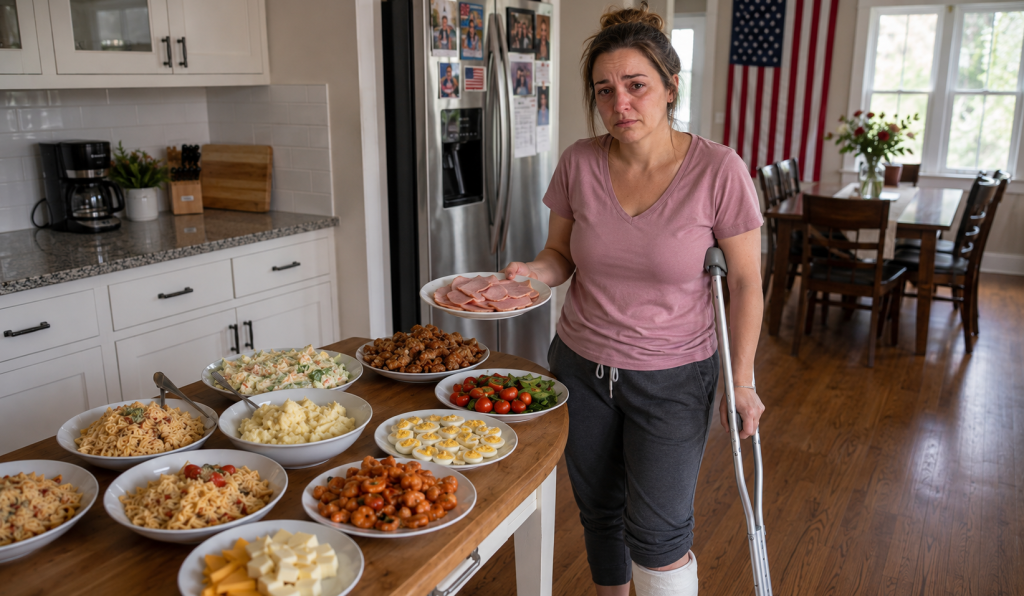
My husband made me cook for thirty guests at his birthday party while I had a broken leg.
Then his mother arrived and made him regret every single word he had said to me.
Three weeks before Donald’s fortieth birthday, I slipped on the wet steps outside our garage.
I had been carrying two bags of groceries when my left foot twisted beneath me. I heard a sharp crack before I hit the ground.
The pain was so intense that I could not even scream at first.
Our neighbor, Mrs. Patterson, heard me crying and rushed over. She called an ambulance while I lay on the driveway, staring up at the gray sky and trying not to panic.
At the hospital, the doctor showed me the X-ray.
The bone in my lower leg was fractured.
“You need to stay off it as much as possible,” he warned. “Use your crutches, keep the leg elevated, and do not stand for extended periods. If you put too much pressure on it, the bone may heal incorrectly.”
I nodded carefully.
Donald stood beside the examination table, scrolling through his phone.
The doctor looked directly at him.
“She will need help at home for several weeks.”
Donald finally glanced up.
“Of course,” he said. “I’ll take care of everything.”
I believed him.
We had been married for twelve years. Donald could be selfish, but I had always told myself that he loved me underneath his impatience.
During the first two days after the accident, he brought me water, reheated canned soup, and carried my laundry basket upstairs.
By the third day, he was already complaining.
He sighed whenever I asked him to bring me something.
He left dirty plates beside the sink.
He complained that the house looked messy.
One evening, he stood in front of the refrigerator and asked, “When are you going to start cooking again?”
I stared at him.
“My leg is broken.”
“You can still sit at the kitchen table and chop vegetables.”
I thought he was joking.
He was not.
After that, I began preparing simple meals from a chair.
I would sit beside the counter with my cast propped on a second chair, slowly cutting vegetables while Donald watched television.
Every movement took twice as long.
Carrying a pot while using crutches was impossible, so I had to slide things across the counter or hop short distances while holding on to cabinets.
Donald never seemed concerned.
As long as dinner appeared in front of him, he acted as though everything was normal.
Then, a few nights before his birthday, he walked into the living room with a huge smile.
“My fortieth birthday is coming up,” he announced. “Honey, I’m counting on you.”
I looked up from the book I was reading.
“For what?”
“The party.”
“What party?”
He laughed as though I had asked something ridiculous.
“I already invited thirty people. We’re having a pool party on Saturday.”
My stomach tightened.
“You invited thirty people?”
“Yes. Friends from work, some neighbors, a few people from the golf club.”
He began listing food he wanted.
Mini sandwiches.
Stuffed mushrooms.
Barbecue ribs.
Grilled chicken.
Potato salad.
Pasta salad.
Two desserts.
Fruit platters.
And cocktails.
I stared down at the heavy cast around my leg.
“Donald, how am I supposed to prepare all of that?”
He waved his hand dismissively.
“You can sit while you cook.”
“I can barely make dinner for the two of us.”
“It’s not like you’re dying.”
His voice became louder.
“It’s a broken leg, not some terrible disease.”
I felt as though he had slapped me.
“I thought we could have a quiet dinner with your mother and maybe your sister.”
“A quiet dinner?”
He burst out laughing.
“I’m turning forty. I want an amazing party, not boring family nonsense.”
“You should hire a caterer.”
“Do you know how expensive catering is?”
“Yes, because cooking for thirty people is a huge amount of work.”
“You always complain before every party, and then everything turns out fine.”
“I have never hosted thirty people with a broken leg.”
Donald rolled his eyes.
“You’re being dramatic.”
I tried to remain calm.
“The doctor told me not to stand for long periods.”
“Then don’t stand for long periods. Sit down, rest, and get back up.”
“That isn’t how recovery works.”
He folded his arms.
“I already invited everyone. What do you expect me to do? Cancel my birthday because you hurt your leg?”
The answer I wanted to give was yes.
I wanted him to cancel the party, order takeout, and care about my health more than impressing his coworkers.
Instead, I said, “At least help me prepare.”
“I’ll be busy setting up the pool area.”
“What does that mean?”
“Moving chairs. Buying ice. Making a playlist.”
I stared at him in disbelief.
He smiled as though the discussion was over.
“I knew I could count on you.”
Then he walked away.
That night, I lay awake beside him, listening to his breathing.
My leg throbbed inside the cast.
I thought about calling his mother, Margaret.
Margaret and I had always had a complicated relationship.
She was strong, traditional, and sometimes overly direct. She loved her son, but she had never treated him as though he could do no wrong.
Donald often complained that his mother embarrassed him by telling childhood stories or correcting his manners in public.
Over the years, Margaret had occasionally defended me when Donald became inconsiderate.
Still, I did not call her.
I did not want to sound like I was complaining about her son.
I also felt ashamed.
It is difficult to admit that the person who promised to care for you is treating you badly.
So I remained silent.
The next morning, Donald handed me a handwritten guest list.
Thirty-two names were on it.
“You said thirty people.”
“Two more confirmed.”
“Donald.”
“What? Two people won’t make a difference.”
He kissed the top of my head before leaving for work.
“Make me proud.”
I spent the next two days planning.
Not because I wanted to.
Because I had been trained by years of marriage to prevent conflict by solving every problem myself.
I made a shopping list and ordered groceries for delivery.
The cost was far more than Donald expected, and when he saw the receipt, he frowned.
“Why did you buy so much?”
“Because thirty-two guests need food.”
“Couldn’t you have found cheaper ingredients?”
“I bought what you requested.”
He shook his head.
“You really don’t know how to stay within a budget.”
I felt anger rising inside me, but I was too tired to fight.
On Friday night, the groceries arrived.
Donald carried the bags into the kitchen and dropped them on the floor.
“Can you put them away?” I asked.
“I’m exhausted.”
“So am I.”
“You’ve been sitting all day.”
I looked at him.
He did not seem to understand why that statement hurt.
He opened the refrigerator, took out a beer, and went to watch television.
I spent nearly an hour putting away groceries.
By the time I finished, my hands were shaking from gripping the crutches.
My leg felt swollen inside the cast.
I took a pain pill and went to bed early.
At four o’clock the next morning, my alarm rang.
For a moment, I did not remember why.
Then I saw the trays stacked on the dresser and remembered Donald’s party.
The house was silent.
Donald slept peacefully beside me.
I slowly pushed myself upright.
Pain shot through my leg the moment I lowered it from the pillows.
I dressed in loose clothes and made my way downstairs.
The kitchen looked overwhelming.
Meat needed seasoning.
Vegetables needed cutting.
Desserts needed baking.
Drinks needed mixing.
I placed a chair beside the counter and began.
For the first hour, I managed reasonably well.
I chopped vegetables while seated.
I mixed cake batter.
I prepared sauces.
Then I needed to move between the refrigerator, stove, sink, and pantry.
The chair became useless.
I balanced on one crutch while stirring pots with my free hand.
I carried ingredients in small containers tucked against my body.
Twice, I nearly fell.
At six-thirty, Donald entered the kitchen.
He was wearing swimming shorts and a new birthday shirt.
“Something smells good.”
I looked at him.
My hair was damp with sweat.
Flour covered the front of my clothes.
“Could you please stir this sauce while I sit down?”
He glanced toward the pot.
“I need to test the pool filter.”
“The pool filter was working yesterday.”
“I still need to check it.”
“Donald, I have been cooking since four.”
“And I appreciate it.”
“Then help me.”
He gave me an irritated look.
“I don’t want to spend my birthday in the kitchen.”
“But you expect me to spend it here.”
“It’s not your birthday.”
He grabbed a piece of bacon from a tray.
I slapped his hand away.
“That is for the guests.”
He laughed.
“Relax.”
Then he left.
I wanted to throw the entire tray into the trash.
Instead, I continued cooking.
At eight, Donald’s friend Carl arrived to help set up speakers.
They walked in and out of the kitchen several times, drinking coffee and discussing music.
Neither offered to help.
At nine-thirty, Donald’s sister, Melissa, arrived with her husband.
Melissa looked at me standing beside the stove.
“What are you doing?”
“Cooking.”
“With your leg like that?”
“Donald wanted the party catered from our kitchen.”
Melissa’s face tightened.
“Did he ask you to do all this?”
Before I could answer, Donald entered.
“Don’t start, Melissa.”
“I asked a question.”
“And I don’t need you criticizing me in my own house.”
Melissa looked at me again.
“I can help.”
Donald shook his head.
“No. I need you outside arranging the tables.”
“I think the woman with the broken leg needs help more than the tables do.”
“I have everything under control,” I said quietly.
It was not true.
But I could see the argument building, and I did not have the energy for it.
Melissa hesitated before going outside.
A few minutes later, she returned and placed a glass of water beside me.
“Call me if you need anything.”
Donald shouted her name from the patio.
She gave me an apologetic look and left.
By eleven, the sun was bright and the first guests began arriving.
Donald transformed into a charming host.
He greeted everyone with hugs.
He accepted bottles of wine and wrapped gifts.
He laughed loudly near the pool.
Music filled the yard.
I watched from the kitchen window as he jumped into the water while everyone cheered.
For a moment, I imagined walking outside and telling the truth.
I imagined saying, “Your host forced his injured wife to wake at four in the morning and cook for all of you.”
But I felt embarrassed.
I did not want their pity.
So I kept working.
I arranged appetizers on trays.
I carried them a few feet at a time, sliding them across counters and setting them near the back door for other people to take outside.
Whenever someone entered the kitchen, I smiled.
“Everything looks incredible,” one guest said.
“Donald is lucky to have you.”
I forced a laugh.
“Yes,” I said. “Very lucky.”
By noon, my pain had become unbearable.
My cast felt too tight.
My toes tingled.
I sat down and elevated my leg on another chair.
Donald entered seconds later.
“Why are the ribs not outside yet?”
“They need ten more minutes.”
“People are hungry.”
“There are six trays of appetizers.”
“Those are almost gone.”
“Then ask them to wait.”
He looked toward the oven.
“Can’t you turn up the temperature?”
“No.”
He sighed dramatically.
“I told everyone lunch would be ready at noon.”
“I have done my best.”
“Please don’t ruin this for me.”
Something inside me cracked.
“Ruin this for you?”
I lowered my voice so the guests would not hear.
“I have been awake since four. I have cooked everything alone. I can barely stand.”
“And I said thank you.”
“No, you didn’t.”
“I said I appreciated it.”
“That is not the same as caring.”
His expression hardened.
“Not now.”
“When, Donald?”
“After the party.”
“You always say that.”
He glanced toward the patio to make sure nobody was watching.
“Just finish the food.”
Then he left.
I sat there for another minute, fighting tears.
I wanted to go upstairs and lock the bedroom door.
But the oven timer sounded.
So I stood again.
Around one o’clock, Margaret arrived.
She was carrying a beautifully wrapped gift and wearing a pale blue summer dress.
I did not see her come through the front door.
I only heard her voice behind me.
“What on earth are you doing?”
I turned.
Margaret stood in the kitchen doorway, staring at me.
Her eyes moved from my crutches to the crowded counters.
“I’m finishing lunch.”
“Why?”
“For the party.”
She placed the gift on the table.
“Where is the caterer?”
“There isn’t one.”
“Then who prepared all this food?”
I did not answer.
Her gaze sharpened.
“Did Donald make you do this?”
“He asked me to cook.”
“With a broken leg?”
“He said catering was too expensive.”
Margaret’s face slowly changed.
The warmth disappeared from her eyes.
“How long have you been working?”
“Since four this morning.”
“Has he helped you?”
“He set up the pool.”
Margaret looked out the kitchen window.
Donald was floating on an inflatable chair with a drink in his hand.
His friends stood around the pool laughing.
Margaret turned back to me.
“Sit down.”
“I need to take the chicken outside.”
“No.”
“The guests are waiting.”
“Let them wait.”
Her voice was so firm that I obeyed.
She pulled out a chair, helped me sit, and lifted my leg onto another chair.
Then she crouched and examined my toes.
“They’re swollen.”
“I know.”
“You need to call your doctor.”
“I’ll be fine after I rest.”
“You should have been resting all morning.”
I looked away.
Margaret studied my face.
“Why didn’t you tell me?”
“I didn’t want to cause trouble.”
“You are not the one causing trouble.”
She stood.
“What else needs to be done?”
“Only the chicken, the ribs, the salads, and the drinks.”
She nodded once.
Then she walked out of the kitchen.
I watched her cross the patio.
Donald saw her and grinned.
“Mom! You made it.”
Margaret stopped beside the pool.
“Get out.”
Donald laughed.
“What?”
“Get out of the pool.”
Something in her expression made the people around him fall silent.
Donald climbed onto the pool steps.
Water ran down his shirt.
“What’s wrong?”
Margaret pointed toward the house.
“Your wife is in the kitchen with a broken leg.”
Donald looked embarrassed.
“Mom, don’t make a scene.”
“You made the scene.”
“Keep your voice down.”
“No.”
The music was still playing, but conversations had stopped.
Every guest was watching.
Margaret stepped closer to him.
“You forced your injured wife to cook for more than thirty people while you spent the morning swimming?”
“I didn’t force her.”
“You told her to do it.”
“She agreed.”
I had reached the patio by then, moving slowly on my crutches.
All the guests turned toward me.
Donald’s face became red.
“Go back inside,” he muttered.
Margaret heard him.
“Do not speak to her like that.”
“Mom, this is my birthday.”
“And you should be ashamed that you reached forty years old without learning basic decency.”
A few guests looked down at their plates.
Carl quietly set his drink on a table.
Donald folded his arms.
“You don’t know the whole story.”
Margaret pointed at my cast.
“I know enough.”
“She could sit while she cooked.”
A shocked murmur moved through the crowd.
Margaret’s eyes widened.
Then she did something nobody expected.
She picked up the microphone connected to the outdoor speaker.
The music stopped.
“Everyone,” she said, “I need your attention.”
Donald reached for the microphone.
“Give me that.”
Margaret stepped back.
“No.”
“Mom.”
“You wanted a memorable fortieth birthday. You are about to get one.”
The guests stood completely still.
Margaret looked around the patio.
“My daughter-in-law broke her leg three weeks ago. Her doctor ordered her to rest. Despite that, Donald invited all of you here and demanded that she prepare the entire party alone.”
Donald shook his head.
“That isn’t true.”
I looked at him.
“Yes, it is.”
The words came out quietly, but everyone heard them.
Margaret continued.
“She woke at four this morning. Donald has spent the day swimming while she cooked on crutches.”
A woman from his office covered her mouth.
Someone whispered, “That’s terrible.”
Donald’s humiliation quickly turned to anger.
“This is nobody’s business.”
“You made it their business when you invited them to eat food prepared through her pain,” Margaret said.
He looked at me.
“Why are you letting her do this?”
That question changed something inside me.
Why was I letting his mother expose his behavior?
Because I had been too afraid to expose it myself.
I tightened my grip on the crutches.
“I’m not letting her do anything. She is telling the truth.”
“You could have said no.”
“I did.”
“No, you complained.”
“I told you repeatedly that I could not do this.”
“You always exaggerate.”
Margaret lowered the microphone.
“Donald, stop.”
He ignored her.
He turned toward me, his voice sharp.
“You have embarrassed me in front of everyone.”
I stared at him.
“I embarrassed you?”
“Yes.”
“I cooked your entire birthday meal with a broken leg.”
“Nobody asked you to act like a martyr.”
The silence after that sentence felt enormous.
Even Donald seemed to realize he had gone too far.
Margaret’s face became pale.
She reached into her purse and removed a large white envelope.
That was when Donald screamed.
“No!”
He lunged toward her.
Margaret held the envelope behind her back.
“What is that?” I asked.
Donald’s eyes were filled with panic.
“Nothing.”
Margaret looked at me.
“This is something I intended to give Donald privately today.”
She held up the envelope.
“For the past five years, I have been preparing to transfer ownership of my lake house to him.”
Several guests knew about the property.
The lake house was large, beautiful, and worth more than a million dollars.
Donald had talked about it constantly.
He already behaved as though it belonged to him.
He often discussed renovations, vacation rentals, and selling it after Margaret died.
Margaret continued.
“The transfer documents are inside this envelope.”
Donald forced a nervous laugh.
“Mom, we can discuss this later.”
“We are discussing it now.”
She tore the envelope in half.
Donald screamed again.
“Mom!”
She tore it once more.
Pieces of legal paper fluttered to the patio.
Donald dropped to his knees and began gathering them.
“You can’t do this.”
“I just did.”
“That house was supposed to be mine.”
“No. It is mine.”
“You promised it to me.”
“I intended to give it to the son I believed I had raised.”
“I am your son.”
“Yes, and that makes your behavior even more painful.”
Donald stood, clutching torn pages.
“You’re punishing me because she cooked lunch?”
“I am protecting my property from a man who believes love means unpaid service.”
He pointed at me.
“She turned you against me.”
Margaret stepped between us.
“No one turned me against you. I watched you disrespect your injured wife in front of thirty people.”
Donald’s eyes filled with tears.
The tears did not move me.
They were not tears of regret.
They were tears for the lake house.
Margaret looked at the guests.
“The party is over.”
Donald stared at her.
“You can’t send people away from my house.”
Margaret raised an eyebrow.
“Your house?”
He froze.
I felt the blood drain from my face.
Margaret turned toward me.
“You should know the truth too.”
“What truth?”
She pointed toward the house.
“I paid the down payment when you and Donald bought this place.”
“I know.”
“What you do not know is that Donald asked me to keep my name on the deed because his credit was poor.”
I looked at Donald.
He would not meet my eyes.
Margaret continued.
“He told me he had corrected the ownership papers two years later.”
My heart began pounding.
“Did he?”
“No.”
Donald stepped forward.
“This is not the time.”
Margaret ignored him.
“I recently reviewed my estate records. My name is still on the deed with both of yours.”
“What does that mean?” I asked.
“It means he cannot throw you out, sell the house, or refinance it without my approval.”
Donald’s face twisted.
“Why are you telling her this?”
“Because she deserves to know she has protection.”
He looked around at his guests.
“Everybody leave.”
No one argued.
People gathered their belongings in uncomfortable silence.
A few guests approached me before leaving.
One woman apologized.
“I thought the food was catered. I would never have expected you to do this.”
Another guest offered to help clean.
Margaret thanked her but said it was not necessary.
Melissa hugged me.
“I should have stayed in the kitchen.”
“It wasn’t your responsibility.”
“No, but I knew something was wrong.”
Donald disappeared into the house.
Within fifteen minutes, the patio was nearly empty.
The tables remained covered with food.
Half-finished drinks sat beside the pool.
Birthday decorations moved in the breeze.
Margaret helped me back into the kitchen.
“You are going to the hospital,” she said.
“I don’t think—”
“That was not a suggestion.”
Melissa drove us.
The doctor examined my leg and ordered new X-rays.
The fracture had not moved, but the swelling was severe.
He warned me again that continuing to put pressure on the injury could delay healing.
He asked how I had spent the day.
When I told him, he stared at me.
“You cooked for thirty people?”
I nodded.
“With crutches?”
“Yes.”
He looked toward Margaret.
She shook her head.
The doctor adjusted my medication and instructed me to remain in bed for several days except when absolutely necessary.
On the drive home, Margaret sat beside me in the back seat.
“You are not going back there tonight.”
“Where will I go?”
“My house.”
“Donald will be furious.”
“Donald has been furious whenever anyone refuses to serve him. That is his problem.”
I looked out the window.
For years, I had organized my life around preventing Donald’s anger.
I cooked the meals he liked.
I attended events I hated.
I apologized when he forgot anniversaries because I did not want him to feel guilty.
I managed our home, paid bills, remembered birthdays, bought gifts for his relatives, and helped him advance at work by hosting dinners.
I told myself this was marriage.
But lying in the back seat with my leg throbbing, I finally understood that Donald did not see my efforts as love.
He saw them as obligations.
Margaret set up a guest room for me.
She placed water beside the bed, brought me dinner, and helped position pillows under my leg.
Before leaving the room, she paused.
“I owe you an apology.”
“For what?”
“For not noticing sooner.”
“You didn’t do this.”
“I raised him.”
“He is forty years old. His choices belong to him.”
Tears filled her eyes.
“I taught him better.”
“You did.”
She squeezed my hand.
“I will support whatever you decide.”
That night, Donald called eleven times.
I did not answer.
Then the messages began.
First, he was angry.
You ruined my birthday.
My coworkers think I’m a monster.
You let my mother humiliate me.
Then he became defensive.
You could have ordered pizza.
You never told me the pain was that bad.
I didn’t know you started at four.
Then he became desperate.
Please come home.
We need to talk.
I’m sorry.
I love you.
Finally, he sent the message that revealed what he truly feared.
Please tell Mom not to change her will.
I stared at the screen for a long time.
Then I turned off my phone.
The next morning, Margaret told me Donald was outside.
“He has been sitting in his car for twenty minutes.”
“I don’t want to see him.”
“You don’t have to.”
A few minutes later, the doorbell rang repeatedly.
Margaret went downstairs.
I heard Donald’s voice.
“Mom, let me in.”
“No.”
“My wife is in there.”
“She does not want to speak to you.”
“You can’t keep her from me.”
“She is not your possession.”
There was a pause.
Then Donald lowered his voice.
“Mom, I made a mistake.”
“Yes.”
“I was stressed about turning forty.”
“That is not an explanation.”
“I wanted the party to be perfect.”
“So you sacrificed your wife’s health.”
“I didn’t think.”
“That is the problem. You did not think about her at all.”
“I said I’m sorry.”
“You are sorry about the house.”
“That’s not true.”
“Then tell me what you are sorry for without mentioning your birthday, your reputation, or your inheritance.”
Donald remained silent.
Margaret waited.
Finally, he said, “Can I please talk to her?”
“No.”
The front door closed.
Margaret returned to my room.
“He left.”
“Thank you.”
She sat beside me.
“Do you want to stay married to him?”
The question frightened me.
Not because I did not know the answer.
Because I did.
“No,” I whispered.
Margaret nodded slowly.
“I thought that might be your answer.”
“I should have left before.”
“Do not blame yourself.”
“I kept excusing him.”
“You believed in your marriage.”
“I made myself smaller every year.”
“Then it is time to become yourself again.”
Two days later, I called a lawyer.
Her name was Rebecca Chen.
She specialized in divorce and property disputes.
Because I could not travel easily, she came to Margaret’s house.
I explained the party.
Then I explained the years before it.
The forgotten birthdays.
The financial control.
The insults disguised as jokes.
The way Donald treated every household task as my responsibility even though I also worked full-time from home.
The way he criticized my spending while purchasing golf equipment without discussion.
The way he became affectionate only when he wanted something.
Rebecca listened carefully.
“The birthday party was not the beginning,” she said.
“No.”
“It was simply the moment you could no longer deny the pattern.”
“Yes.”
She reviewed the property records Margaret provided.
Donald had secretly taken out a personal loan using his expected inheritance as justification.
He had also accumulated significant credit-card debt.
I knew nothing about either.
Rebecca advised me to separate our finances immediately.
With her help, I opened a new bank account and redirected my salary.
Margaret contacted her own attorney.
She removed Donald from her will and changed the lake house beneficiary.
She did not give it to me.
I never asked her to.
Instead, she placed the property in a trust for Melissa’s children and a local organization that provided temporary housing for injured women and elderly people recovering from surgery.
When Donald learned about the trust, he came to Margaret’s house again.
This time, I agreed to see him.
I sat in the living room with my cast elevated.
Margaret and Rebecca were both present.
Donald entered carrying flowers.
He looked exhausted.
His hair was uncombed, and dark circles surrounded his eyes.
He placed the flowers on the table.
“These are for you.”
“Thank you.”
He sat across from me.
“I’ve had time to think.”
I waited.
“What I did was wrong.”
“Yes.”
“I should have hired a caterer.”
“That is not the main problem.”
“I know.”
“Do you?”
He looked down at his hands.
“I treated you like a servant.”
The room remained quiet.
He continued.
“I was selfish. I cared more about the party than your injury.”
“Yes.”
“I’m ashamed.”
For the first time, he sounded sincere.
But sincerity did not erase twelve years.
He leaned forward.
“I want you to come home.”
“I’m filing for divorce.”
His face collapsed.
“No.”
“My decision is final.”
“You can’t end our marriage over one terrible day.”
“I’m not.”
“What does that mean?”
“I’m ending it because that day revealed what our marriage has become.”
“I can change.”
“I hope you do.”
“Then give me a chance.”
“I gave you twelve years.”
He began crying.
Unlike the tears beside the pool, these seemed real.
Still, I did not change my mind.
“I love you,” he said.
“I believe you love what I did for you.”
“That’s not fair.”
“Maybe not. But it is honest.”
He looked at his mother.
“You’re just going to let her leave me?”
Margaret’s expression hardened.
“She does not need my permission.”
“You’ve taken everything from me.”
“No,” she replied. “Your choices cost you everything.”
Donald wiped his face.
“What am I supposed to do now?”
I answered quietly.
“Learn.”
The divorce process lasted seven months.
Donald fought over the house at first.
Then Rebecca presented the financial records showing his hidden debt and misuse of shared funds.
Margaret also refused to sign any agreement that would allow him to keep the property.
Eventually, the house was sold.
After debts were paid, the remaining equity was divided according to the settlement.
It was not a fortune, but it was enough for me to start over.
I moved into a small one-story home near Margaret and Melissa.
By then, my leg had healed.
I still walked with a slight limp when I was tired, but the doctor said it would improve.
On the first morning in my new home, I made coffee and sat beside the window.
There were no dirty dishes waiting for me.
No one complained that breakfast was late.
No one told me what I owed them.
The silence felt unfamiliar.
Then it felt peaceful.
Margaret remained part of my life.
Some people found that strange after the divorce.
But she told me, “Ending your marriage to my son does not erase the years you were my family.”
We had lunch every Sunday.
Melissa often joined us with her children.
Donald stayed away at first.
He blamed both of us for the divorce and refused to speak to Margaret for nearly five months.
Then something changed.
His company did not promote him.
Several coworkers had attended the party, and although nobody officially mentioned what happened, his reputation suffered.
The charming, dependable image he had created no longer convinced everyone.
He also had to move into a small apartment and sell his expensive car to pay his debts.
For the first time in his adult life, he had to cook, clean, shop, and manage his own responsibilities.
Margaret refused to rescue him.
She answered his calls but did not send money.
“You are not helping him by protecting him from consequences,” she told Melissa.
Nearly a year after the party, Donald wrote me a letter.
It was six pages long.
He did not ask me to return.
He did not mention the lake house.
He apologized for specific things.
He apologized for making me cook while injured.
For dismissing my pain.
For treating my work as invisible.
For assuming my patience had no limit.
He admitted that he had attended counseling.
He wrote that he finally understood how often he had confused being loved with being served.
At the end, he said he did not expect forgiveness.
He only wanted me to know that I had been right.
I read the letter twice.
Then I placed it in a drawer.
I never returned to him.
But I did forgive him eventually.
Not because he deserved access to my life again.
Because I did not want anger to occupy the home I had worked so hard to rebuild.
Two years after the birthday party, Margaret invited me to a community fundraiser at the lake house.
The property had become a recovery retreat.
People healing from injuries or surgery could stay there at little or no cost.
The large rooms had been renovated with accessible bathrooms, handrails, ramps, and wide doorways.
The kitchen counters could be adjusted for people using wheelchairs.
When I entered the kitchen, I stopped.
A small plaque hung beside the doorway.
It read:
REST IS NOT LAZINESS.
CARE IS NOT A FAVOR.
LOVE SHOULD NEVER REQUIRE SOMEONE TO SUFFER IN SILENCE.
I touched the edge of the plaque.
Margaret stood beside me.
“This place exists because of what happened to you,” she said.
“I wish it had happened differently.”
“So do I.”
“But at least something good came from it.”
She smiled.
“Something very good.”
That afternoon, volunteers served lunch to the guests.
For once, I sat at a table while other people brought the food.
No one expected me to stand.
No one criticized me for resting.
Across the room, I saw a woman with her leg in a cast laughing with her teenage daughter.
A volunteer carried their plates.
The woman thanked him.
He replied, “You don’t have to thank me. You’re here to heal.”
Tears filled my eyes.
Margaret noticed.
“Are you all right?”
“Yes.”
And I was.
I had spent years believing strength meant enduring everything without complaint.
I thought a good wife should be endlessly patient, endlessly useful, and endlessly forgiving.
But strength was not waking at four in the morning to cook for thirty people on a broken leg.
Strength was admitting that I deserved better.
Strength was allowing others to help me.
Strength was leaving the moment I finally understood that love without respect was not love I could live with.
Donald’s fortieth birthday had been the worst party of his life.
But it became the first day of mine.
THE END! THANK YOU FOR READING!