

For twenty years, I raised my husband’s illegitimate son as my own.
His name was Ethan Caldwell, and he came into my life on a rainy night in Chicago, wrapped in a blue hospital blanket, his face red from crying and his tiny fists trembling in the cold air.
My husband, Richard Caldwell, stood in our doorway holding him like a burden he wanted to drop.
“His mother can’t keep him,” Richard said. “Her family found out. She’s leaving Illinois.”
I was thirty-one then. I had been married to Richard for seven years, and every doctor had already told me the same thing: I would probably never carry a child.
I still remember looking at that baby and feeling my heart split in two directions.
One side broke from betrayal.
The other reached for him.
“Is he yours?” I asked.
Richard looked away.
That was enough.
I should have left that night. Any woman with pride might have packed a suitcase, called a lawyer, and slammed the door behind her.
But Ethan was screaming.
He was hungry, cold, and innocent.
He had not chosen his father.
He had not chosen his mother’s circumstances.
And he had certainly not chosen me.
So I took him.
The moment I lifted him from Richard’s arms, Ethan stopped crying.
His small cheek pressed against my chest, and one tiny hand curled around the collar of my nightgown.
Richard sighed with relief.
That sound stayed with me for years.
It was not the sigh of a father whose child had found safety.
It was the sigh of a man who had successfully transferred his problem to someone else.
Richard gave Ethan money, a surname, and excuses.
I gave him everything else.
The first months nearly broke me.
Ethan woke every two hours. He suffered from terrible reflux and cried whenever I laid him down. I spent night after night walking through our apartment with him against my shoulder while rain or snow struck the windows.
Richard slept in the guest room because he said the crying interfered with his work.
He was an ambitious financial consultant then, always talking about clients, promotions, and the life we would have once he became a partner.
“We need the money,” he would remind me whenever I asked him to take a night feeding.
So I stopped asking.
I learned how to prepare a bottle with one hand.
I learned how to recognize the difference between Ethan’s hungry cry, his frightened cry, and the weak, exhausted sound he made when he was sick.
The first time he smiled, Richard was on a business trip.
The first time he rolled over, Richard was at a golf outing.
The first time Ethan called me “Mama,” Richard was standing in the kitchen reading the newspaper.
Ethan had crawled across the rug toward me, lifted both arms, and said it clearly.
“Mama.”
I cried so hard that I frightened him.
Richard lowered the newspaper.
“He doesn’t know what it means,” he said.
But I did.
By the time Ethan was three, he followed me everywhere.
He sat on the kitchen floor while I cooked. He waited outside the bathroom door. He climbed into my lap whenever thunder shook the windows.
When he began preschool, he refused to let go of my hand.
His teacher knelt beside him and said, “Your mommy will come back.”
Ethan looked up at me with tears filling his brown eyes.
“Promise?”
“I promise.”
That became the foundation of our life together.
No matter what happened, I came back.
When he fell from the playground climbing wall and needed stitches, I came.
When he was bullied in fourth grade because another child had heard rumors about his birth, I came.
When he sat alone after losing the regional spelling bee, too ashamed to look at me, I came.
When he was sixteen and called from a police station because he had been riding with a friend who had stolen beer, I came.
Richard rarely did.
He paid tuition, appeared for photographs, and corrected people when they said Ethan looked like him.
“He gets his ambition from me,” Richard liked to say.
Ethan never answered.
For years, I told myself Richard’s distance was better than cruelty.
He did not hit Ethan.
He did not scream at him.
He simply treated him like a financial obligation that occasionally appeared at the dinner table.
At family gatherings, Richard introduced Ethan as our son.
In private, when he was angry, he called him “the boy.”
“Tell the boy to move his shoes.”
“Did the boy damage the car?”
“Why does the boy need another school trip?”
I corrected him every time.
“His name is Ethan.”
Richard would roll his eyes.
“You know what I mean.”
I always knew what he meant.
He meant that Ethan was not fully human to him.
He was evidence.
He was the living proof of a mistake Richard wanted hidden but also controlled.
When Ethan was six, he asked me why he did not have any baby pictures with me in the hospital.
I told him families were formed in many different ways.
When he was nine, he asked why his hair was darker than mine.
I told him children were not required to look like their mothers.
When he was twelve, he asked me directly whether I had given birth to him.
I could not lie.
We sat together on the back steps beneath the maple tree, and I told him the truth as gently as I could.
I explained that another woman had carried him, but she had been unable to raise him.
I told him Richard was his biological father.
Then I said the words I had repeated silently for years.
“You did not grow beneath my heart, Ethan. You grew inside it.”
He cried against my shoulder until the sunlight disappeared.
“Are you still my mom?” he asked.
“I will be your mom for as long as you want me.”
He pulled back and looked almost offended.
“I’m always going to want you.”
Richard was furious when he learned I had told him.
“He was too young,” he said.
“He asked me.”
“You should have redirected him.”
“He deserved the truth.”
Richard paced across the kitchen.
“You’re going to make him curious about her.”
Her.
He never spoke Ethan’s biological mother’s name.
Whenever I asked, Richard said her name was irrelevant.
“She left,” he would say. “That’s all he needs to know.”
But Ethan became curious.
At fourteen, he searched through old documents in Richard’s office.
At fifteen, he asked whether we knew where his biological mother lived.
At sixteen, he asked whether she had ever tried to contact him.
Richard’s answer was always the same.
“No.”
I believed him.
That was one of the greatest mistakes of my life.
Ethan was eight when he needed emergency surgery.
He had complained of stomach pain for two days, but Richard insisted it was probably a virus.
When Ethan collapsed at school, I rushed him to the hospital.
His appendix had ruptured.
The doctors said we had arrived just in time.
Richard was in Boston for a conference and refused to come home.
“He’s already in surgery,” Richard said over the phone. “What exactly am I supposed to do?”
“Be his father.”
“I’ll be back Friday.”
It was Monday.
I spent four nights beside Ethan’s hospital bed.
He woke from anesthesia confused and crying.
“Mom?”
“I’m here.”
“Don’t leave.”
“I won’t.”
The insurance did not cover everything.
There were surgical bills, medications, and follow-up care.
Richard claimed he was experiencing a temporary cash-flow problem.
I sold the diamond bracelet my grandmother had left me.
I never told Ethan.
Years later, I discovered that Richard had purchased a luxury watch during the same month.
When Ethan was thirteen, he was invited to a summer science program at the University of Illinois.
He wanted to go more than anything.
Richard said it was too expensive.
“He can read science books at home.”
Ethan pretended not to care.
That night, I heard him crying in his room.
I took extra bookkeeping work for a small construction company and paid the tuition myself.
For six weeks, I worked until after midnight.
Ethan returned from the program with a model bridge, three new friends, and a belief that education could carry him beyond the walls of our home.
That summer changed his life.
Richard later told everyone he had encouraged Ethan’s academic interests.
By the time Ethan entered high school, Richard’s career had flourished.
We moved into a large house in Evanston.
He became a senior partner in his firm.
He wore expensive suits and served on charity boards.
To outsiders, Richard Caldwell was generous, disciplined, and devoted to family.
Inside our home, he was a man who could turn affection on and off depending on who was watching.
At Ethan’s football games, Richard stood near the other fathers and shouted advice.
During the drive home, he criticized every mistake.
At Ethan’s academic awards ceremony, Richard shook hands with the principal.
At dinner, he asked why Ethan had received second place instead of first.
Nothing was ever enough.
I tried to stand between them, but as Ethan grew older, he began protecting me instead.
When Richard mocked my bookkeeping job, Ethan defended me.
When Richard complained about my cooking, Ethan carried his plate to the sink and said the meal was delicious.
When Richard forgot our anniversary for the third year in a row, Ethan brought me flowers.
He was seventeen when he gave me a small silver pendant engraved with one word.
Mom.
“I bought it with money from my weekend job,” he said.
I wore it every day.
Richard noticed it once.
“Sentimental nonsense,” he muttered.
Ethan heard him.
For the first time, he looked at Richard with something colder than disappointment.
He looked at him with understanding.
Ethan attended Northwestern University on a combination of scholarships, grants, and money I had quietly saved.
Richard claimed he had paid for everything.
At parties, he told people, “My son attends Northwestern.”
But when the tuition bill arrived, he would place it beside my plate.
“Handle this.”
I handled it.
I used money from my bookkeeping business, which had grown over the years into a small financial management company.
Richard did not know how successful it had become.
He assumed I worked to occupy myself.
He never asked about my clients.
He never asked how much I earned.
He simply assumed my life remained smaller than his.
That assumption eventually destroyed him.
During Ethan’s second year of college, Richard began staying out late.
He claimed to have client dinners and emergency meetings.
I did not investigate.
After everything that had happened, I no longer feared discovering another affair.
The truth was worse.
I had stopped caring enough to look.
My marriage existed on paper, in photographs, and at formal dinners.
The love had disappeared years earlier.
What remained was habit, history, and my determination to protect Ethan until he was strong enough to protect himself.
After earning his bachelor’s degree, Ethan was accepted into a master’s program in data analytics.
He worked part-time and received another scholarship, but there were still expenses.
I paid them.
Richard promised to reimburse me.
He never did.
Two weeks before Ethan’s graduation, Richard suddenly became interested in organizing a celebration.
“We should do something impressive,” he said. “Invite the right people.”
“The right people?”
“My partners. Several clients. The family. People who understand what an accomplishment this is.”
I knew what he meant.
He wanted an audience.
Richard reserved a private room at an expensive restaurant overlooking the Chicago River.
He ordered champagne, hired a photographer, and invited relatives Ethan had not seen in years.
Then he told everyone he was proud to have financed his son’s education.
Ethan heard him say it twice.
He remained silent.
On the afternoon of the graduation, Ethan handed me a garment bag.
Inside was a navy-blue dress.
It was elegant but simple, with long sleeves and a soft silver detail at the waist.
“I saw it months ago,” he said. “It reminded me of you.”
“You shouldn’t have spent this much.”
“I used part of my first internship bonus.”
“Ethan—”
“Mom, please.”
His voice softened.
“You spent your whole life making sure I never felt like someone’s mistake. Let me give you one beautiful thing.”
I wore the dress.
I also wore the silver pendant he had given me at seventeen.
At the ceremony, Ethan crossed the stage in his cap and gown.
When his name was announced, I stood before anyone else did.
I clapped until my hands hurt.
Richard stood too, but he was watching the people around us, making sure they saw his pride.
Afterward, Ethan found me in the crowd and wrapped both arms around me.
“We did it,” he whispered.
“You did it.”
“No. We did.”
Richard approached with the photographer.
“Let’s get a family picture.”
He positioned himself in the center.
That photograph later appeared on his firm’s social media page with the caption:
Proud father celebrating his son’s academic achievement.
My name was not mentioned.
At the restaurant that evening, the room glittered with polished glass, candlelight, and expensive silverware.
Richard moved from table to table, accepting congratulations as though he had earned the degree himself.
He told his managing partner, “I always pushed Ethan to aim higher.”
He told his sister, “The tuition was painful, but children are worth the investment.”
He told an old college friend, “The boy gets his discipline from me.”
Each time, Ethan looked at me.
I smiled and shook my head, silently asking him not to ruin his evening.
I did not know he had already decided the truth would be told.
Dinner was nearly finished when Richard ordered another bottle of champagne.
His face had grown red.
His voice became louder.
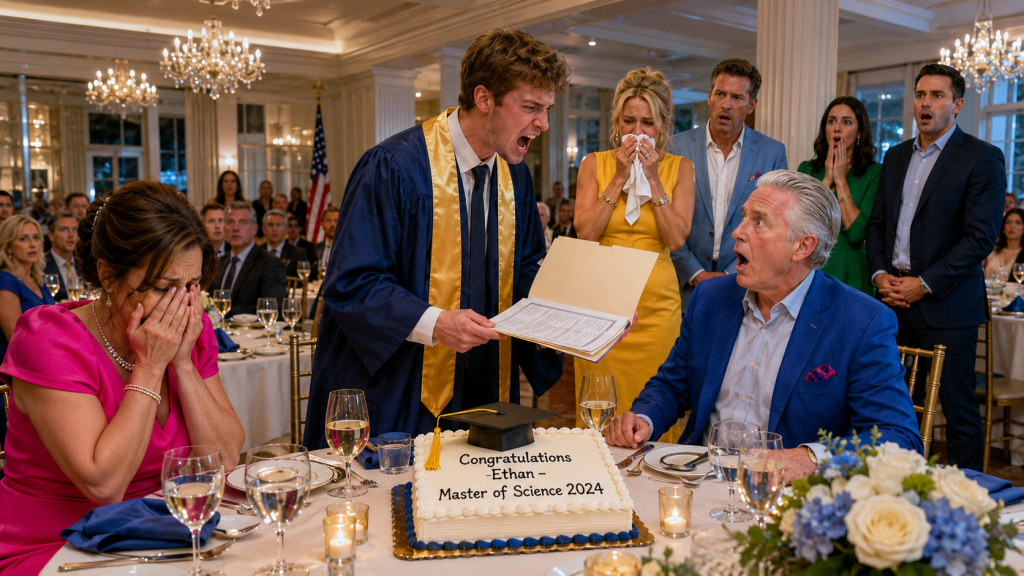
He stood and tapped his glass with a spoon.
“Everyone,” he announced, “I’d like to say a few words.”
The room quieted.
Ethan sat to my right.
Richard stood directly across from us.
“Today is a proud day for the Caldwell family,” he began. “Ethan has worked hard, but no one succeeds alone. A young man needs discipline, financial support, and a strong name behind him.”
Several guests nodded.
Richard smiled at his colleagues.
“I’m proud to have provided all three.”
My stomach tightened.
Ethan’s jaw hardened.
Richard lifted his glass.
“And of course, I must thank my wife, Margaret, for taking care of my mistress’s son all these years.”
The room froze.
My fork slipped from my hand and struck the plate.
Richard laughed as if he had made a clever joke.
“What?” he said. “It’s the truth. She raised him, and I paid for him. Teamwork.”
No one laughed.
Richard’s sister stared at him in horror.
His managing partner slowly lowered his champagne glass.
A cousin near the door whispered, “My God.”
I could not move.
For twenty years, I had survived betrayal, humiliation, and loneliness.
But Richard had never spoken the truth so cruelly in front of Ethan.
He had reduced our entire life to a vulgar joke.
Then Ethan slowly rose from his chair.
His face was calm.
His voice was not loud, but it cut through the room.
“You didn’t pay for me, Richard. Mom did.”
Richard’s smile vanished.
“What are you talking about?”
Ethan reached inside his jacket and placed a thick folder on the table.
“And tonight, everyone is finally going to know exactly what she paid.”
Richard reached for the folder.
Ethan pulled it back.
“You’ve controlled this story for twenty years,” he said. “Tonight, you’ll listen.”
He opened the folder and removed several bank statements.
“These are records from Mom’s business and personal savings accounts. Every major expense related to me came from her money.”
Richard scoffed.
“That’s ridiculous.”
“Hospital bills when my appendix ruptured. Summer science camp. High school fees. College housing. Graduate tuition. Textbooks. Health insurance. Everything.”
He placed copies on the table.
“You told everyone you financed my education. You didn’t. Mom did.”
Richard looked toward me.
“Margaret, what is this?”
I found my voice.
“The truth.”
“You kept financial records behind my back?”
“They were my accounts.”
“You’re my wife.”
“And I am not your property.”
Ethan removed another sheet.
“When I was eight, Mom sold her grandmother’s diamond bracelet to pay for my surgery.”
Richard’s sister covered her mouth.
Ethan continued.
“That same month, you bought yourself a fourteen-thousand-dollar watch.”
Several guests turned toward Richard’s wrist.
He instinctively covered it with his other hand.
Richard’s face darkened.
“This is inappropriate.”
“No,” Ethan said. “What you said about Mom was inappropriate. This is evidence.”
He placed another document on the table.
“When I was thirteen, Mom worked nights to send me to science camp because you said it was a waste of money.”
“I don’t remember that.”
“She remembers.”
Ethan looked at me.
“And I remember waking up at midnight and seeing her at the kitchen table with invoices stacked around her. I knew she was tired. I didn’t know she was doing it for me.”
My eyes filled with tears.
“You deserved to go,” I whispered.
Ethan nodded, then reached deeper into the folder.
“But these papers aren’t only about money.”
Richard’s anger shifted into fear.
“What else is in there?”
Ethan held up a sealed envelope.
“These explain why my biological mother disappeared.”
The color drained from Richard’s face.
For the first time that evening, he looked genuinely frightened.
“Put that away.”
Ethan’s eyes narrowed.
“You told me she abandoned me.”
“She did.”
“You told Mom that her family found out about the affair and forced her to leave Illinois.”
“That’s what happened.”
“No,” Ethan said. “It isn’t.”
He opened the envelope.
“Her name was Laura Bennett.”
The name moved through the room like a sudden wind.
I felt dizzy.
In twenty years, Richard had never told me her name.
Ethan unfolded a letter.
“Six months ago, I submitted my DNA to a genealogy database. I wasn’t expecting much. Then a woman named Rebecca Bennett contacted me. She’s Laura’s younger sister.”
Richard stepped toward him.
“You had no right.”
“I had every right.”
Ethan looked around the room.
“Laura did not leave because she didn’t want me. Richard threatened her.”
Richard laughed, but the sound was strained.
“That’s absurd.”
Ethan read from the letter.
“Laura was twenty-four when she worked as an assistant at Richard’s first consulting firm. Richard told her he was separated from Mom. When she became pregnant, she discovered he had lied.”
I turned toward Richard.
He would not meet my eyes.
Ethan continued.
“Laura wanted to keep me. She had already arranged childcare and planned to live with her sister. But Richard told her he would use his money and connections to take custody. He threatened to tell her deeply religious parents that she had deliberately pursued a married man.”
“That is not what happened,” Richard said.
Ethan placed another document beside the letter.
“This is a copy of the custody agreement you forced her to sign.”
Richard stared at it.
“I was protecting the child.”
“You were protecting yourself.”
Ethan’s voice finally shook.
“You offered her money to leave Illinois and never contact me.”
The guests were completely silent.
I could hear the faint noise of traffic beyond the restaurant windows.
Ethan removed copies of checks.
“You paid Laura twenty thousand dollars from a business account. Then you made her sign a statement surrendering custody.”
Richard’s managing partner leaned forward.
“What business account?”
Richard said nothing.
Ethan looked directly at him.
“Caldwell Strategic Holdings.”
The managing partner’s expression changed.
“That company account existed before our restructuring.”
“Yes,” Ethan said. “And according to these records, Richard classified the payment as a client relocation expense.”
Richard slammed his hand against the table.
“This has gone far enough.”
The restaurant staff near the door stepped forward, but Ethan remained calm.
“No. It hasn’t.”
He held up a final letter.
“Laura came back.”
My breath stopped.
Ethan looked at me.
“Mom, I’m sorry you’re hearing this here.”
I gripped the edge of the table.
“What do you mean?”
“When I was four, Laura sent a letter asking to see me. Richard intercepted it.”
He handed me the copy.
The handwriting was delicate and uneven.
Dear Margaret,
You do not know me, but I think about my son every day. I know I have no right to disrupt his life. I only want to know whether he is safe and loved. Richard has refused to answer me. Please, if you receive this letter, tell Ethan that I did not leave because I did not love him.
My vision blurred.
“Where did you get this?”
“Rebecca found carbon copies among Laura’s belongings.”
“Belongings?”
Ethan lowered his eyes.
“Laura died three years ago.”
The pain that crossed his face nearly broke me.
“She had cancer. She spent years trying to contact me. Richard returned letters, changed phone numbers, and threatened legal action whenever she came close.”
I looked at the man I had lived beside for twenty-seven years.
“You knew she was dying?”
Richard’s silence answered me.
“You knew?” I repeated.
“She was unstable,” he said.
Ethan struck the table with his palm.
“She was not unstable!”
Richard flinched.
Ethan breathed deeply before continuing.
“She became a nurse. She volunteered at a women’s shelter. She never married because, according to her sister, she never stopped feeling guilty about losing me.”
Richard shook his head.
“You don’t know what she was really like.”
“I know more than you wanted me to.”
Ethan pulled a photograph from the folder.
It showed a young woman with dark hair and Ethan’s eyes.
She stood beside a lake, smiling softly at the camera.
Ethan stared at the picture.
“She kept every photograph she had of me.”
My heart twisted.
“How did she have photographs?”
Ethan looked at Richard.
“He sent them.”
Richard’s head snapped up.
Ethan’s voice hardened.
“He sent her school pictures in exchange for money.”
The room erupted in shocked whispers.
Richard shouted, “That is a lie!”
Ethan placed copies of correspondence on the table.
“For years, you told Laura I needed special tutoring, medical care, and private school expenses. She sent money because she believed she was helping me.”
I felt suddenly cold.
“How much?”
“Almost one hundred and eighty thousand dollars over fifteen years.”
Richard’s sister stood.
“Richard, tell me this isn’t true.”
He looked around the room for support.
None came.
Ethan continued.
“You kept her money. Mom paid my actual expenses, and you used Laura’s payments for your investments.”
Richard pointed at Ethan.
“You ungrateful little—”
“Do not finish that sentence,” I said.
My voice surprised everyone, including me.
I stood slowly.
For most of my marriage, I had spoken carefully.
I had learned to soften truths so Richard would not become angry.
That night, something inside me became still.
“You brought a newborn to my door,” I said, “and let me believe his mother had discarded him.”
Richard opened his mouth.
I raised my hand.
“You watched me sell my grandmother’s bracelet while you accepted money from Laura.”
“I supported this family.”
“You supported your image.”
“I gave Ethan my name.”
Ethan looked at him.
“A name is the only thing you gave me that Mom couldn’t.”
Richard’s face twisted.
“After everything I’ve done, you stand there and humiliate me?”
Ethan’s voice softened.
“You humiliated yourself.”
Richard turned toward the guests.
“This is a family matter. Everyone should leave.”
His managing partner did not move.
“I think this became a company matter when Ethan mentioned fraudulent expenses.”
Richard stared at him.
“You cannot be serious.”
“I’m very serious.”
Another partner quietly took out his phone.
“We’ll need copies of those documents.”
Richard looked at Ethan with hatred.
“You planned this.”
“Yes.”
“You invited my colleagues so you could destroy me.”
“You invited them,” Ethan replied. “You wanted an audience.”
Richard grabbed the back of his chair.
For one frightening moment, I thought he might collapse.
Instead, he looked at me.
“Margaret, tell them he’s confused.”
“No.”
“Tell them I paid for this family.”
“You paid for a house you used as a stage.”
His mouth fell open.
I removed my wedding ring.
The movement was small, but everyone saw it.
I placed the ring beside his champagne glass.
“I should have done this twenty years ago.”
Richard stared at the ring.
“You’re leaving me over a drunken joke?”
“No. I’m leaving because the joke revealed what you truly believe.”
He shook his head.
“You have nowhere to go.”
That almost made me laugh.
Richard still believed I was financially dependent on him.
He had never bothered to learn anything about my business.
“I own the building where my company operates,” I said. “I have investments, retirement accounts, and enough savings to live comfortably.”
His eyes widened.
“What company?”
“My company, Richard. The one I built while you were busy telling people I had no ambition.”
“You never told me.”
“You never asked.”
Ethan’s expression softened with pride.
I picked up my purse.
Richard stepped around the table.
“Margaret, don’t be ridiculous. We can discuss this at home.”
“I am not going home with you.”
“This is my celebration.”
“No,” Ethan said. “It was supposed to be mine.”
Richard turned on him.
“You think you can erase me?”
Ethan looked down at the folder, then back at him.
“I spent years trying to understand why you never loved me. I thought there was something wrong with me.”
His voice cracked for the first time.
“I studied harder. I won awards. I earned scholarships. I thought if I became successful enough, you might finally look at me like a son.”
Richard’s anger weakened.
Ethan continued.
“But tonight, I understand. You never saw a son. You saw a secret you controlled.”
Richard sank into his chair.
“I gave you opportunities.”
“Mom gave me opportunities.”
“I brought you into that house.”
“You brought me to the door. She brought me inside.”
Richard’s eyes filled with tears.
They were not tears of remorse.
They were tears of a man watching his authority disappear.
Ethan reached into the folder one final time and removed a legal document.
“I filed a petition to change my surname.”
Richard looked up.
“To what?”
“Bennett-Caldwell.”
Richard laughed bitterly.
“So you’re keeping my name.”
“For now. Because Mom’s legal name is still Caldwell.”
Ethan turned toward me.
“But after her divorce, if she returns to her maiden name, I’ll petition again.”
My throat tightened.
“My maiden name was Morgan.”
Ethan nodded.
“Then I’ll become Ethan Morgan.”
Richard completely fell apart.
His face crumpled.
He covered his mouth, but a broken sound escaped him.
“You can’t do that.”
Ethan’s own eyes shone with tears.
“I already decided.”
“I’m your father.”
“You are my biological father.”
Richard reached for him.
Ethan stepped back.
“Mom is my parent.”
Richard began crying openly.
He looked around the room, but everyone avoided his gaze.
The photographer had lowered his camera.
Richard’s sister was crying too, though not for him.
His colleagues whispered near the window.
The polished image Richard had spent decades building had shattered in less than twenty minutes.
He had wanted to humiliate me.
Instead, he had exposed himself.
Ethan walked around the table and offered me his arm.
“Ready, Mom?”
I looked at Richard one last time.
For years, I had imagined leaving him with anger.
Instead, I felt only exhaustion.
“Yes,” I said. “I’m ready.”
Ethan and I left the restaurant together.
Outside, Chicago’s evening air was cool.
Lights reflected across the river.
For several minutes, neither of us spoke.
Then Ethan stopped beneath a streetlamp.
“I’m sorry.”
“For what?”
“For doing it publicly.”
“You did what you believed was necessary.”
“I wanted him to feel what he made you feel.”
I touched his cheek.
“Do not let Richard teach you that pain must always be answered with pain.”
Ethan looked down.
“But I’m not sorry people know the truth.”
“Neither am I.”
He took a deep breath.
“Did you mean it? About divorce?”
“Yes.”
“Are you afraid?”
I considered the question.
“No.”
That was when I realized it was true.
I was not afraid.
For decades, I had feared loneliness.
But loneliness beside Richard had been far worse than any empty house could be.
I went home only once.
Ethan came with me.
We packed my clothes, important documents, photographs, and the small wooden box containing every card Ethan had ever made for me.
Richard sat in his study with the door closed.
He did not come out.
I moved temporarily into the apartment above my company’s office.
It was smaller than our house, but the first night there, I slept better than I had in years.
The following morning, Richard’s firm placed him on administrative leave.
Within two weeks, an internal investigation uncovered multiple false expense reports, concealed accounts, and unauthorized transfers.
Laura’s money had not been the only money he had misused.
Several clients filed complaints.
His partners forced him to resign.
The professional organizations that had once praised him removed his name from their boards.
Richard called me constantly.
At first, he demanded that I correct the story.
Then he blamed Ethan.
Finally, he begged.
“Margaret, I made mistakes.”
“You made choices.”
“I was trying to protect us.”
“You were protecting yourself.”
“We can go to counseling.”
“You need counseling. I need freedom.”
He cried.
“You’re all I have.”
I closed my eyes.
For twenty-seven years, I had wanted him to say he needed me.
When he finally said it, the words meant nothing.
“You had a wife,” I told him. “You had a son. You treated both of us like tools.”
I filed for divorce.
Richard fought every detail.
He argued that my business was marital property.
My attorney showed that I had started it with money inherited from my grandmother and maintained separate accounts.
He demanded half of my savings.
The court discovered he had hidden assets.
He accused Ethan of stealing documents.
The records had come legally from Laura’s estate and from accounts Ethan was authorized to examine for the internal investigation.
Every threat Richard made only damaged him further.
Six months later, the divorce was finalized.
I returned to my maiden name.
Margaret Morgan.
Ethan filed his second name-change petition the same week.
On the day the judge approved it, he invited me to lunch.
He handed me a new business card.
Ethan Morgan
Data Analytics Consultant
I stared at the name until the letters blurred.
“Are you sure?” I asked.
“I’ve never been more sure.”
“What about Laura?”
He looked at the photograph he carried in his wallet.
“I will honor her too. But she gave me life, and you gave me a life to live.”
I reached across the table and held his hand.
Several months later, Ethan and I traveled to Wisconsin to meet Rebecca Bennett.
She lived in a small town near Lake Michigan.
When she opened the door, she looked at Ethan and immediately began crying.
“You have Laura’s eyes,” she said.
Rebecca showed us boxes filled with letters, photographs, birthday cards, and gifts Laura had never been allowed to send.
There was a red toy truck for Ethan’s fifth birthday.
A science encyclopedia for his tenth.
A leather journal for his sixteenth.
And a sealed letter marked:
For Ethan, when he is ready.
He opened it beside the lake.
My dear Ethan,
I do not know what you have been told about me. I need you to understand that I loved you before I knew your face. Losing you was the greatest pain of my life.
I was young and frightened, and your father convinced me that fighting him would destroy everyone. I believed surrendering custody might give you stability. I have regretted that decision every day.
I do not expect forgiveness.
I only hope the woman raising you has given you the love I was unable to give from a distance.
Ethan stopped reading.
He handed me the letter because his hands were shaking.
I continued.
If Margaret has loved you, please never see her as the woman who replaced me. She did what I could not. She stayed.
I hope someday you understand that motherhood is not measured only by blood. It is measured by the nights someone remains awake beside you, the sacrifices no one sees, and the thousand ordinary moments in which a child is chosen again and again.
I chose you in my heart.
I pray she chose you in her life.
With all the love I was never allowed to give,
Laura
Ethan buried his face in his hands.
I held him as he cried for the mother he had lost and the years stolen from them both.
Rebecca sat beside us.
For a long time, the three of us watched the water.
Eventually, Ethan whispered, “I had two mothers.”
“Yes,” I said.
“One who loved me from far away.”
“And one who loved you close.”
He rested his head against my shoulder.
Richard’s life continued to unravel.
He avoided prison through a plea agreement, restitution payments, and cooperation with investigators, but his reputation never recovered.
He sold the house in Evanston.
Most of the money went toward legal fees and repayment.
He moved into a small condominium outside the city.
For almost a year, Ethan refused all contact.
Then Richard suffered a mild heart attack.
A hospital social worker called Ethan because he remained listed as the emergency contact.
Ethan asked me what he should do.
“What do you want to do?” I asked.
“I don’t know.”
“You are not obligated to forgive him.”
“I know.”
“You are also allowed to see him without forgiving him.”
Ethan visited the hospital alone.
He returned several hours later.
Richard had looked older, smaller, and frightened.
“He apologized,” Ethan told me.
“Did you believe him?”
“I believe he is sorry he lost everything.”
“That is not the same as being sorry for what he did.”
“I know.”
Ethan sat beside me on the sofa.
“He asked me to call him Dad.”
“What did you say?”
“I told him fatherhood is not a title you can demand after ignoring the work.”
I nodded.
“Then he asked whether I hated him.”
“And do you?”
Ethan thought for a moment.
“No. I don’t want to carry him that way.”
That answer made me prouder than any degree ever could.
Ethan did not rebuild a close relationship with Richard.
He visited occasionally and answered some calls.
But he established boundaries.
He refused money.
He refused guilt.
And he refused to pretend the past had not happened.
Richard attended counseling.
Over time, his apologies became less defensive.
He wrote letters to Rebecca and offered to return a portion of the money Laura had sent.
Rebecca accepted it only to establish a scholarship in Laura’s name for young single mothers studying nursing.
Ethan contributed as well.
So did I.
The Laura Bennett Scholarship awarded its first grant two years later.
At the ceremony, Ethan spoke about a woman who had loved her child despite being separated from him.
He did not mention Richard.
He spoke about second chances, education, and the ways truth can arrive too late to change the past but still in time to change the future.
I sat in the front row.
Rebecca sat beside me.
When Ethan finished, everyone stood.
He looked directly at us.
Both of his mothers were present in different ways.
Laura in the scholarship carrying her name.
Me in the navy dress he had once bought for graduation.
After the ceremony, Ethan handed me a framed photograph.
It showed us standing outside the courthouse on the day his surname became Morgan.
On the back, he had written:
You did not take care of someone else’s son.
You raised your own.
Years passed.
My company grew.
I hired more employees, moved into a larger office, and began mentoring women who wanted to rebuild their careers after difficult marriages.
At fifty-five, I purchased a small house near the lake.
It had a garden, wide windows, and a guest room Ethan claimed even though he had his own apartment.
For the first time, every object in my home was there because I wanted it.
There were no expensive decorations chosen to impress Richard’s clients.
No locked study.
No tense dinners.
Only sunlight, books, photographs, and peace.
Ethan eventually fell in love with a kind woman named Claire.
Before proposing, he brought her to my house.
After dinner, he asked me to sit in the garden.
“I need to show you something.”
He opened a small box containing an engagement ring.
“It’s beautiful.”
“I wanted you to see it first.”
“Why?”
“Because you taught me what commitment is supposed to look like.”
My eyes filled with tears.
“I also stayed too long.”
“You stayed for me.”
“I want you to stay in your marriage because you are loved, not because you are afraid to leave.”
“I know.”
He smiled.
“That’s what you taught me too.”
Claire accepted his proposal.
At their wedding, Ethan reserved two chairs in the front row.
One for me.
The other held Laura’s photograph and a small arrangement of white roses.
Richard was invited but seated several rows behind the family.
It was Ethan’s decision.
Richard accepted it quietly.
During the reception, Ethan stood to give a speech.
He thanked Claire’s parents.
He thanked Rebecca.
Then he turned toward me.
“When I was a child,” he said, “I believed mothers were the women whose faces appeared beside yours in hospital photographs.”
Guests listened silently.
“But I learned that a mother can enter your life after the hospital. She can receive you at a doorway on the worst night of her marriage and decide that your innocence matters more than her pain.”
I covered my mouth.
Ethan continued.
“My mother taught me how to walk, how to study, how to forgive without surrendering my dignity, and how to leave a place where love is no longer present.”
He raised his glass.
“She never made me feel illegitimate. She made me feel chosen.”
The room stood.
Claire came to my table and hugged me.
Ethan joined us.
Across the room, Richard lowered his head.
Perhaps he finally understood what he had thrown away.
Perhaps he did not.
It no longer controlled us.
Later that evening, Richard approached me near the terrace.
He looked much older than the man who had once stood in that restaurant and tried to humiliate me.
“I owe you an apology,” he said.
“You have apologized before.”
“Not for the worst part.”
I waited.
“I brought Ethan to you because I knew you would love him.”
His eyes filled with regret.
“I knew you were better than me. Instead of becoming better, I used your goodness to avoid responsibility.”
For once, he did not make excuses.
“I resented the bond between you because it proved he never needed me the way he needed you.”
I looked through the glass doors at Ethan dancing with Claire.
“He did need you, Richard. You simply refused to show up.”
Richard nodded.
“I know.”
“I hope you live honestly with that knowledge.”
He looked at me.
“Do you forgive me?”
I considered my answer carefully.
“I no longer wake up angry with you. I no longer wish to punish you. But forgiveness does not restore what you destroyed.”
“I understand.”
“I hope you do.”
He walked away.
I felt no triumph.
Only release.
The following spring, Ethan and Claire announced they were expecting a child.
When their daughter was born, they named her Laura Margaret Morgan.
I cried the first time I held her.
She was wrapped in a blue hospital blanket, just as Ethan had been twenty-eight years earlier.
Her face was red from crying.
Her tiny fists trembled.
Then Ethan placed her in my arms.
“She’s your granddaughter, Mom.”
The baby opened her eyes.
For a moment, I was thirty-one again, standing in a doorway while rain struck the windows.
But this time there was no betrayal in the room.
There was only love.
Ethan stood beside Claire’s hospital bed, exhausted and joyful.
He touched his daughter’s cheek.
“I’m going to be there for everything,” he whispered.
“I know you will,” I said.
He looked at me.
“How?”
“Because someone who understands the pain of an absent father knows the value of being present.”
He leaned down and kissed my forehead.
“Thank you for taking care of me.”
I shook my head.
“No, Ethan.”
I looked at the man he had become, then at the child sleeping peacefully in my arms.
“I did not take care of my husband’s mistress’s son.”
My voice trembled.
“I raised my son.”
And in the end, that was the only truth that mattered.
THE END! THANK YOU FOR READING!