

On the morning of my thirty-second birthday, I stood beneath the harsh kitchen lights, pressing concealer over the dark purple bruise spreading beneath my left eye.
The makeup did almost nothing.
Every time I touched the swollen skin, pain flashed through my cheekbone and traveled into my jaw. My lower lip was split. There were four faint marks along my neck where Derek’s fingers had closed around me the night before.
I pulled the collar of my sweater higher.
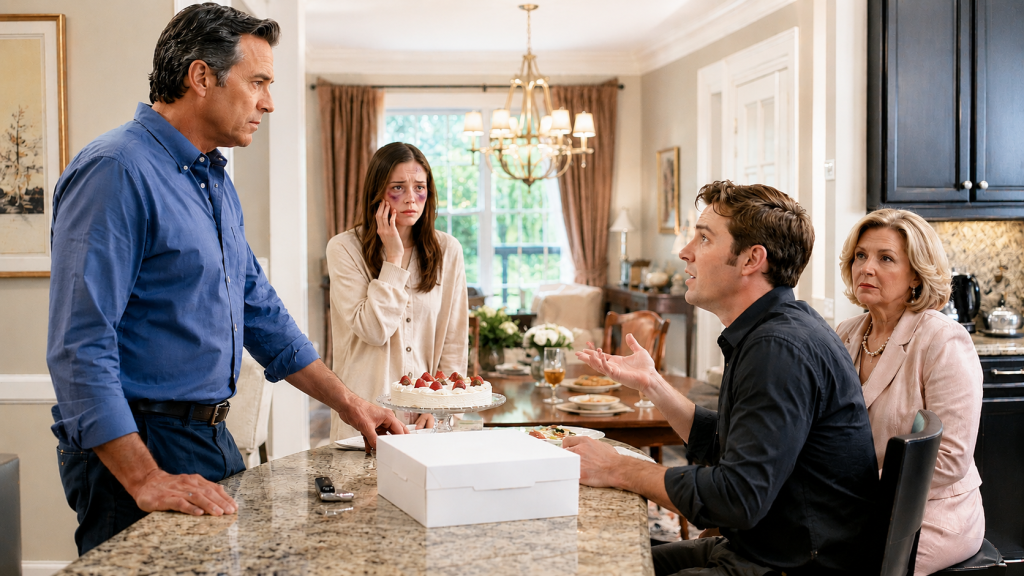
Behind me, my mother-in-law, Linda, arranged paper plates beside a pie she had brought from the grocery store.
She did not ask whether I was all right.
She did not even look surprised.
“You should use more powder,” she said. “Richard notices everything.”
Richard was my father.
“He wasn’t supposed to come until noon,” I whispered.
Linda glanced at the clock above the refrigerator.
“It’s almost eleven.”
At the dining table, my husband, Derek, leaned back in his chair, scrolling through his phone while drinking coffee from the mug I had bought him for our fifth anniversary.
He had not wished me a happy birthday.
He had not apologized for hitting me.
Instead, he had spent the morning complaining that I had embarrassed him by refusing to sign the papers Linda had placed in front of me the previous evening.
The papers would have transferred nearly all the money in my personal savings account into a business account controlled by Derek.
He claimed it was temporary.
He said his contracting company needed emergency funds to finish a development project.
But the account information did not match the name of his company.
When I asked questions, Linda called me selfish.
When I refused to sign, Derek followed me upstairs.
The argument lasted less than five minutes.
The bruises would last much longer.
Derek looked up from his phone and caught me watching him.
“What?” he asked.
“Nothing.”
“Then stop staring.”
I lowered my eyes.
That had become my habit.
Lower my eyes.
Lower my voice.
Lower my expectations.
Make myself smaller until there was nothing left for him to attack.
Linda sliced the pie and placed a piece in front of her son.
“Emily,” she said, “bring him a fork.”
The forks were less than three feet from her hand.
Still, I walked across the kitchen and brought one to Derek.
He took it without thanking me.
“You’re going to sign those papers after your father leaves,” he said.
“I told you I need to read them.”
“You read them.”
“I need someone else to look at them.”
His face changed.
It happened quickly, but I had learned to recognize it.
His mouth tightened.
His shoulders shifted.
The room seemed to become smaller.
Linda sighed dramatically.
“Must we do this again?”
Derek set down his mug.
“You think I’m stealing from you?”
“I didn’t say that.”
“You didn’t have to.”
“I only asked why the account belongs to a company I’ve never heard of.”
Linda pressed her lips together.
“It is a holding company.”
“For what?”
“For private investments,” Derek answered.
“What investments?”
His chair scraped against the floor.
I flinched.
The tiny movement made him smile.
He liked knowing that I was afraid.
Before he could stand, the doorbell rang.
All three of us froze.
Then came my father’s familiar knock.
Three firm taps, a pause, and two more.
My chest tightened.
Dad had used that knock since I was a child.
Whenever I heard it, I knew I was safe.
But that morning, I felt only panic.
Linda hurried toward me.
“Go upstairs,” she whispered. “Tell him you have a migraine.”
“He saw my car.”
“Then say you fell.”
Derek remained seated.
“He’s not stupid.”
“No,” Linda said. “But he loves her enough to believe her.”
The words struck harder than she intended.
That was exactly why I had lied to Dad for years.
He loved me.
And I had been ashamed to tell him what my marriage had become.
The knocking came again.
“Emily?” Dad called through the door. “I hope you’re dressed because I brought enough cake to feed the whole neighborhood.”
His voice sounded cheerful.
Normal.
For one terrible second, I imagined opening the door, taking the cake, smiling, and pretending everything was fine.
I had done it before.
I had hidden bruises beneath sleeves.
I had laughed through dinners while my ribs ached.
I had told Dad that Derek was busy when my husband refused to attend family gatherings.
I had said I was clumsy when Dad noticed a mark on my wrist.
But that morning, something inside me had changed.
Maybe it was the documents waiting upstairs.
Maybe it was the bruise across my face.
Maybe it was the fact that Derek had struck me on the night before my birthday and then slept peacefully beside me.
Whatever the reason, I could not lie again.
I opened the door.
Dad stood on the porch wearing a blue button-down shirt and dark jeans. His silver hair was combed neatly to one side, and he held a white bakery box tied with red string.
“Happy birthday, sweetheart.”
Then he saw my face.
The smile disappeared.
His eyes moved slowly from the bruise beneath my eye to my swollen lip and finally to the marks above my collar.
He did not step inside immediately.
He simply stared.
“Sweetheart,” he said, “why is your whole face covered in bruises?”
My throat closed.
Dad entered and placed the cake box on the kitchen counter with both hands.
Very carefully.
As though any sudden movement might cause the room to explode.
“Emily,” he said, “who did this to you?”
I opened my mouth.
No sound came out.
Derek answered for me.
“Oh, that was me.”
He laughed.
The sound was light and casual.
“Instead of congratulations, I gave her a slap.”
Linda made a nervous noise that was supposed to sound like laughter.
Dad turned toward Derek.
For several seconds, neither man spoke.
Derek had met my father many times, but he had never understood him.
Dad was quiet.
He was patient.
He rarely raised his voice.
Derek mistook those qualities for weakness.
Most people did.
Dad had owned Bennett Auto Repair for thirty-four years. He had spent most of his life beneath engines, rebuilding transmissions and teaching apprentices how to solve problems without losing their tempers.
He had also raised me alone after my mother died when I was eight.
He packed my lunches.
He attended school plays.
He learned how to braid my hair by practicing on pieces of rope in the garage.
He worked twelve-hour days and still came home to help with homework.
He was the gentlest person I knew.
But gentleness was not the same as helplessness.
Dad looked at Derek’s coffee mug.
Then at Linda.
Then at me.
“What happened?” he asked.
Derek shrugged.
“She got disrespectful.”
Dad’s jaw moved slightly.
“How?”
“She refused to support her husband.”
“I asked what happened.”
“I disciplined my wife.”
Linda stood quickly.
“Richard, please don’t turn this into something dramatic. Couples argue.”
Dad looked at her.
“Did you see him hit her?”
Linda hesitated.
“That is not what I said.”
“Did you see it?”
“She was being unreasonable.”
Dad’s gaze returned to Derek.
“Did you hit my daughter more than once?”
Derek stood.
He was six feet two and nearly twenty years younger than my father.
He stepped away from the table with the smug confidence of a man who had never faced real consequences.
“What are you going to do about it, old man?”
My heart began pounding.
“Dad,” I whispered.
He raised one hand without looking at me.
Then he slowly unbuckled his watch.
It was an old stainless-steel watch I had given him for his fiftieth birthday.
He placed it beside the cake box.
Next, he rolled up the sleeves of his shirt.
Derek’s smile widened.
“That’s what I thought.”
Dad finally turned toward me.
“Emily,” he said calmly, “step outside.”
I stared at him.
“What?”
“Go to the porch.”
I thought he was going to fight Derek.
The thought terrified me.
Derek was stronger.
He had a temper.
There were knives in the kitchen drawer and a heavy iron pan on the stove.
“Dad, don’t.”
“Please, sweetheart.”
Something in his voice made me obey.
I walked through the back door and stepped onto the porch.
The November air cut through my sweater.
Through the kitchen window, I watched Dad turn back toward Derek.
Derek kicked his chair aside.
Linda glanced toward the front of the house.
Her face went pale.
Then something strange happened.
She dropped to her knees.
At first, I thought she had fainted.
Instead, she crawled behind the kitchen island.
She moved awkwardly on all fours, knocking into a barstool and dragging her purse after her.
Derek looked at her in disgust.
“Mom, what are you doing?”
Linda pointed toward the front window.
Derek turned.
His expression changed.
Two police cars were parked along the curb.
A dark sedan had pulled in behind them.
Dad had not come alone.
The front door opened.
Two uniformed officers entered the house, followed by a woman in a gray suit carrying a leather folder.
I recognized her immediately.
Her name was Angela Porter.
She had handled the sale of Dad’s garage when he retired two years earlier.
She was also a former prosecutor.
Derek looked from the officers to my father.
“What is this?”
Dad reached into his shirt pocket.
He removed a small black recording device and placed it on the table.
“This,” he said, “is you confessing.”
Derek’s face lost all color.
One officer stepped forward.
“Sir, keep your hands where we can see them.”
“You can’t come into my house.”
“The door was open,” the officer said. “And we have probable cause to investigate a reported assault.”
“Reported by who?”
Angela looked toward the porch.
“By Emily Bennett.”
Derek turned toward me.
His eyes filled with fury.
“You called them?”
I wrapped my arms around myself.
“No.”
“I did,” Dad said.
Derek laughed again, but this time the sound was strained.
“You don’t have proof of anything.”
Dad pointed toward my face.
“That looks like proof.”
“She fell.”
“You just said you slapped her.”
“I was joking.”
The second officer walked onto the porch and asked whether I needed medical attention.
I nodded.
The simple movement made my cheek ache.
He guided me away from the window.
As we crossed the yard, an ambulance turned onto the street.
Neighbors began appearing behind curtains.
I wanted to hide.
Then I remembered how often Derek had used my embarrassment to control me.
He told me no one would believe me.
He told me people would think I was weak.
He told me my father would blame me for staying.
So I stopped lowering my head.
I looked directly at the house as the officers placed Derek in handcuffs.
His mother began screaming.
“This is a family matter!”
Angela answered her.
“Identity theft is not a family matter.”
Linda became silent.
The paramedics examined me in the ambulance.
They found bruising on my face, neck, ribs, upper arms, and back.
One of them asked how long it had been happening.
I tried to say three years.
Instead, I began crying.
Dad climbed into the ambulance and sat beside me.
He did not ask why I had stayed.
He did not say he had warned me about Derek.
He simply held my hand.
“I’m sorry,” I whispered.
“For what?”
“For lying to you.”
“You survived the best way you knew how.”
“I should have left.”
“You are leaving now.”
“I should have told you.”
“You are telling me now.”
His voice broke on the last word.
I had seen my father cry only twice before.
Once at my mother’s funeral.
Once when I graduated from college.
He pressed my hand against his forehead.
“I knew something was wrong,” he said. “I just didn’t know how bad it was.”
“How did you know to bring the police?”
Dad glanced toward the house.
“Your cousin Natalie called me last night.”
My stomach tightened.
The night before, after Derek fell asleep, I had locked myself in the bathroom and taken a photograph of my face.
I sent it to Natalie with five words.
I think I need help.
She had called immediately, but I was too afraid to answer.
“She showed me the picture,” Dad continued. “Then she showed me the messages you sent her over the past year.”
I closed my eyes.
I had forgotten how much I had revealed to Natalie in fragments.
Derek took my keys.
Derek emptied my account.
Derek broke my phone.
Derek says I’m useless.
Each message alone sounded like a bad argument.
Together, they formed a pattern.
“Angela told us not to confront him without witnesses,” Dad said. “We arranged for the officers to wait around the corner.”
“You knew he would admit it?”
“No. But arrogant men often do.”
The ambulance took me to the hospital.
Dad rode beside me.
At the emergency department, a nurse photographed every bruise and documented the injuries.
A social worker named Marisol sat with me while Dad spoke to Angela in the hallway.
Marisol asked whether Derek controlled my finances.
“Yes.”
My phone?
“Yes.”
Transportation?
“Yes.”
Friendships?
“Yes.”
Medical care?
Sometimes.
She asked whether he had threatened to kill me.
I hesitated.
Then I remembered the night he held my head beneath the bathwater for several seconds and told me he could make an accident look convincing.
“Yes,” I whispered.
Marisol stopped writing.
“Emily, this is extremely serious.”
Hearing another person say it made the truth feel real.
For years, I had separated every incident.
The first shove happened because Derek had lost a contract.
The broken wrist happened because I pulled away.
The missing money happened because marriage required trust.
The threats happened because he was angry.
I had built excuses around every act until I could no longer see the prison they formed.
Marisol helped me complete a safety plan.
She asked whether I had somewhere secure to stay.
“My father’s house.”
“Does your husband have a key?”
“No.”
“Does he know the alarm code?”
“No.”
“Does he own weapons?”
“There is a handgun in our bedroom.”
She immediately contacted the officers.
They added the weapon to the search.
An hour later, Dad returned with Angela.
Angela placed a folder on the small hospital table.
“There’s more,” she said.
I looked at Dad.
His expression was grim.
“What happened?”
Angela opened the folder.
Inside were copies of bank statements, loan applications, credit reports, and business records.
“Your father asked me to review the papers Natalie photographed,” she said. “The documents Derek wanted you to sign were not simple investment papers.”
“I knew that.”
“They were designed to make you responsible for debts connected to three shell companies.”
“How much debt?”
“Approximately seventy-eight thousand dollars that we know about.”
My hands went cold.
“I don’t have that kind of money.”
“That may not matter. Some of the loans were already issued using your identity.”
I stared at her.
“I never applied for loans.”
“We know.”
She showed me a signature.
It resembled mine.
But the final curve of the letter E was wrong.
Derek always made that mistake when he tried to imitate my handwriting.
“This is forged.”
“Yes.”
Angela showed me another page.
Then another.
Credit cards.
A personal line of credit.
An equipment loan supposedly connected to a consulting business registered in my name.
The business address belonged to Linda.
“She helped him,” I said.
Angela did not answer immediately.
“We believe she knew at least part of what he was doing.”
I thought of Linda sitting beside Derek while he hit the table, demanded signatures, and called me ungrateful.
I remembered the way she told me every wife should sacrifice.
I remembered the time she said a man would not become angry unless his wife pushed him.
“What happens now?”
“The police are searching the house with your written permission. Derek may face assault charges, weapons charges, fraud, forgery, and identity theft. Linda’s involvement is still being investigated.”
“Will I lose everything?”
“No,” Dad said.
I looked at him.
He was pale with exhaustion, but his voice was certain.
“I won’t let that happen.”
Angela nodded.
“We will dispute the fraudulent accounts, freeze your credit, and seek an emergency protective order. But there is something else you need to know.”
She removed one final document.
It was the deed to our house.
Derek had always claimed the house belonged to him.
He said his parents helped with the down payment.
He reminded me of it whenever I threatened to leave.
Where will you go?
You own nothing.
You’ll be homeless by morning.
But the deed contained both our names.
And beside my name was another forged signature.
“What is this?”
“A refinancing application,” Angela said. “He attempted to borrow against the house without your knowledge.”
“Was it approved?”
“Not yet.”
Relief made me dizzy.
Dad leaned closer.
“You still own half the house.”
“I don’t want it.”
“You don’t have to live there again.”
“I never want to see it.”
“Then we sell it.”
I shook my head.
“Derek will never agree.”
Angela closed the folder.
“He may not have much choice.”
That afternoon, a judge granted a temporary protective order.
Derek was prohibited from contacting me or coming within five hundred feet of Dad’s house, my workplace, or the hospital.
He was released the following day after posting bail.
Before he left the jail, the order was served.
Twenty minutes later, he violated it.
He called me from a blocked number.
I answered without thinking.
“Emily,” he said.
My entire body froze.
“Where are you?”
I ended the call.
He called again.
And again.
Then messages appeared from an unfamiliar number.
You ruined my life.
Tell them you lied.
My mother could go to prison.
Fix this.
The messages changed after I refused to answer.
You have nowhere to hide.
Your father can’t protect you forever.
I showed them to Dad.
He contacted the police.
Derek’s bail was revoked that evening.
For the first time since I had met him, a locked door stood between Derek and me.
I moved into my childhood bedroom.
Dad had never changed it.
The walls were still pale yellow.
A faded poster from my college years hung above the desk.
A small wooden jewelry box sat on the dresser.
Inside was the silver bracelet my mother had given me before she died.
I had left it behind when I married Derek because he said it looked childish.
That first night, I held it in my palm and cried until dawn.
The weeks that followed were not peaceful.
People often imagine that leaving an abusive marriage feels like walking into sunlight.
For me, it felt like waking after a disaster and discovering the storm still lived inside my body.
I jumped whenever a door closed.
I hid my phone beneath my pillow.
I apologized for things that were not my fault.
When Dad asked what I wanted for dinner, I panicked because Derek used to become angry if I chose the wrong food.
One evening, Dad found me standing in front of the refrigerator, crying because I could not decide between chicken and soup.
He did not laugh.
He did not tell me to calm down.
He sat at the kitchen table and said, “We can have both.”
That became his answer to many things.
We can leave the lights on.
We can change the locks again.
We can sit in silence.
We can talk.
We can have both.
Marisol referred me to a trauma counselor named Dr. Patel.
During our first session, she asked what I believed marriage was supposed to require.
“Loyalty,” I said.
“Anything else?”
“Patience. Forgiveness. Sacrifice.”
“Did Derek offer those things to you?”
I stared at the carpet.
“No.”
“Then why were they required only from you?”
I had no answer.
The financial investigation expanded.
Angela discovered that Derek’s business was nearly bankrupt.
He had lost contracts, failed to pay subcontractors, and borrowed money from private lenders.
Instead of admitting the truth, he created companies in my name and used my credit.
Linda helped him receive mail at her house.
She also lied to one lender by pretending to be me during a telephone verification call.
When investigators confronted her, she denied everything.
Then they played the recording.
Her voice was unmistakable.
She began cooperating the next day.
Linda claimed Derek manipulated her.
She said she believed the money would be repaid before I noticed.
She insisted she never wanted him to hurt me.
But the officers found messages between them.
Some were about money.
Others were about me.
Emily is asking too many questions.
Take her phone.
She’ll sign eventually.
Remind her she has nowhere else to go.
One message was sent minutes after Derek struck me.
Linda had written, Don’t leave marks where Richard can see them.
When Angela showed me that message, something inside me went still.
Until then, a small part of me had continued searching for excuses.
Maybe Linda had been afraid of her son.
Maybe she did not understand how badly he hurt me.
Maybe she was trapped too.
But she understood.
She simply valued Derek’s comfort more than my safety.
Two months after my birthday, I filed for divorce.
Derek refused to sign the papers.
Through his lawyer, he claimed I was emotionally unstable.
He claimed I injured myself.
He claimed my father had created false evidence to seize the house.
Then prosecutors obtained the recording from our kitchen.
Derek’s own voice filled the courtroom during the preliminary hearing.
“Oh, that was me. Instead of congratulations, I gave her a slap.”
His laughter followed.
The sound changed the atmosphere.
Even Derek’s attorney looked uncomfortable.
The prosecutor then presented photographs from the hospital, threatening messages, financial records, and testimony from two neighbors who had heard arguments over the years.
One neighbor, Mrs. Collins, admitted that she once saw Derek push me against my car.
She apologized for not calling the police.
“I told myself it wasn’t my business,” she said, crying. “I was wrong.”
The judge ordered Derek to remain in custody until trial.
Linda accepted a plea agreement.
In exchange for testifying about the fraud, she received probation, community service, and an order to pay restitution.
Before signing the agreement, she asked to speak to me.
I refused.
A week later, a letter arrived at Dad’s house.
I recognized her handwriting.
Dad offered to throw it away.
Instead, I opened it.
Linda wrote that she was sorry.
She said she had spent her life protecting Derek from consequences.
When he failed school, she blamed teachers.
When he lost jobs, she blamed managers.
When his first fiancée left him, she called the woman disloyal.
When he hurt me, Linda blamed me because admitting the truth would mean admitting what her son had become.
She did not ask forgiveness.
She wrote that she had no right to ask.
At the bottom of the letter, she included one sentence that stayed with me.
I taught him that love meant never making him answer for what he did.
For years, I had also mistaken protection for love.
I protected Derek’s reputation.
I protected our marriage.
I protected Dad from worry.
I protected everyone except myself.
I folded the letter and placed it in a drawer.
Not because I forgave her.
Not because I wanted to remember her.
I kept it as evidence of what silence could create.
Derek’s criminal trial began seven months later.
By then, the bruises had faded.
My hair had grown longer.
I had returned to work at the public library, where I managed community programs.
At first, I was afraid people would stare.
Instead, my coworkers welcomed me back with quiet kindness.
They did not ask invasive questions.
They placed flowers on my desk.
My supervisor changed the staff entrance code and arranged for security to walk me to my car.
Each ordinary act of consideration taught me something important.
Care did not have to hurt.
Love did not have to frighten me.
Safety did not have to be earned.
During the trial, I testified for nearly four hours.
Derek sat across the courtroom wearing a dark suit.
He looked smaller than I remembered.
His attorney asked why I stayed.
The question felt like an accusation.
I looked at the jury.
“I stayed because the violence did not begin on our wedding day,” I said. “It began with criticism. Then isolation. Then money. Then threats. Every time something became worse, I had already adjusted to the thing before it.”
The attorney asked why I never called the police.
“Because Derek told me no one would believe me.”
“Yet you expect this jury to believe you now?”
The prosecutor objected.
The judge sustained it.
But I answered anyway.
“I expect them to look at the evidence.”
The jury did.
They saw the photographs.
They heard the recording.
They read the messages.
They studied the forged applications.
They listened to Linda explain how she helped her son use my identity.
After three days of deliberation, Derek was convicted of aggravated domestic assault, coercive control, identity theft, forgery, and multiple counts of fraud.
The judge sentenced him to prison.
Before sentencing, Derek was permitted to speak.
He stood and turned toward me.
For the first time since his arrest, our eyes met.
“I’m sorry you felt hurt,” he said.
The words were not an apology.
They were another attempt to change reality.
I felt no anger.
Only clarity.
The judge appeared to feel the same.
“She did not merely feel hurt,” he said. “You hurt her. Repeatedly, deliberately, and without remorse.”
The sentence was longer than Derek expected.
Linda began sobbing behind him.
Dad sat beside me, holding the stainless-steel watch he had removed in my kitchen.
He had not worn it since my birthday.
Outside the courthouse, reporters waited near the steps.
Angela guided us toward the parking lot.
Before we reached the car, Linda called my name.
I stopped.
She stood several yards away beside her attorney.
She looked older.
Her hair was thinner.
Her hands trembled around the strap of her purse.
“I am sorry,” she said.
I did not answer.
“I should have protected you.”
“Yes,” I said. “You should have.”
She lowered her head.
“I don’t expect forgiveness.”
“That is good.”
The words sounded colder than I intended, but they were true.
Forgiveness was not a door everyone had the right to enter.
Sometimes healing meant closing it.
The divorce became final ten months after my birthday.
The house was sold under court order.
After the mortgage, legal costs, and fraudulent liens were resolved, I received enough money to begin again.
I rented a small house near the library.
It had blue shutters, a narrow porch, and a maple tree in the front yard.
The first night I slept there, every room felt too quiet.
I checked the locks five times.
Then I sat on the kitchen floor and listened to the refrigerator hum.
No one shouted.
No one demanded my phone.
No one told me what I was allowed to think.
The silence was not empty.
It was mine.
Dad helped me paint the living room.
I chose a warm yellow.
Halfway through the second wall, he got paint in his hair.
I laughed so hard I had to sit down.
He looked offended for exactly three seconds before laughing too.
It was the first time I had heard my own laughter without immediately wondering whether it would annoy someone.
A year after that terrible birthday, Dad arrived at my new house carrying another white bakery box.
He knocked three times, paused, then knocked twice.
I opened the door.
“Happy thirty-third birthday, sweetheart.”
This time, I smiled.
My living room was filled with people.
Natalie was there with her husband.
My coworkers had brought flowers.
Marisol came briefly before her evening shift.
Angela stood near the fireplace talking with Dad.
Even Mrs. Collins had driven across town to attend.
On the dining table sat a strawberry shortcake.
No grocery-store pie.
No financial documents.
No fear.
Dad placed a small wrapped box beside my plate.
“What is this?” I asked.
“Open it.”
Inside was his watch.
The metal had been polished until it shone.
I lifted it carefully.
Something had been engraved inside the band.
Four words.
Your life is yours.
My eyes filled with tears.
“Dad.”
He hugged me.
“I thought I was going to lose you,” he whispered.
“I’m sorry.”
He pulled back.
“No more apologizing for surviving.”
Everyone gathered around the cake.
Thirty-three candles covered the top.
Natalie turned off the lights.
The flames reflected in the windows.
For a moment, I remembered the previous year.
Dad setting down the cake.
Derek laughing.
Linda crawling across the kitchen floor.
The police entering.
The ambulance doors closing.
But the memory no longer felt like the end of my life.
It was the moment the truth finally entered the room.
“What did you wish for?” Natalie asked after I blew out the candles.
I smiled.
“I don’t need to wish for it.”
That night, after everyone left, Dad helped me carry plates into the kitchen.
He paused beside the sink.
“Can I ask you something?”
“Of course.”
“That day, when I told you to step outside, did you think I was going to hit him?”
“Yes.”
Dad sighed.
“I wanted to.”
“I know.”
“I wanted to do things that would have put me in the same police car.”
“What stopped you?”
He looked toward the watch on my wrist.
“You needed a father beside you, not another man in jail.”
I leaned against his shoulder.
“That was why you removed the watch?”
He smiled faintly.
“Partly.”
“What was the other reason?”
“The recording device was clipped behind it. I didn’t want the metal band scraping against the microphone when I reached into my pocket.”
I stared at him.
“You planned everything.”
“I planned what I could.”
“And if Derek had attacked you?”
“The officers were ten seconds away.”
I shook my head.
“All this time, I thought you were preparing for a fight.”
“I was.”
He tapped the side of his head.
“Just not the kind Derek expected.”
Before leaving, Dad stood on the porch and looked back at me.
“Lock the door.”
“I will.”
“And call me tomorrow.”
“I always do.”
He walked toward his truck.
I closed the door and turned the lock.
Then I stood in my quiet hallway, touching the watch around my wrist.
For years, Derek had told me my life belonged to him.
My money belonged to him.
My choices belonged to him.
My silence belonged to him.
But he had been wrong.
My life had always been mine.
I had only needed help taking it back.
THE END! THANK YOU FOR READING!