

Salute Vice Admiral King
The Invitation
Captain Mara Ellison was working late at Naval Station Norfolk when the invitation appeared on her desk.
Cream parchment.
Elegant gold lettering.
A Charleston address embossed beneath a pair of intertwined initials.
Celia Ellison and Daniel King request the honor of your presence at their wedding.
Mara stared at her younger sister’s name for several seconds before opening the envelope fully.
She had not seen Celia in twenty-three years.
She had not been invited home for Christmas, birthdays, graduations, funerals, or family reunions. She had not received a photograph when Celia finished college or a message when their father died.
Yet at the bottom of the invitation, beneath the formal schedule, their mother had added one cold sentence in familiar blue ink.
You are expected to attend.
Helena Ellison had never written “please.”
Not when Mara was a child.
Not when Helena became the first woman in her family to rise to flag rank.
Not when she retired from the Navy and turned her reputation into political influence, charity boards, television interviews, and invitations to the most exclusive homes in South Carolina.
Helena did not request.
She commanded.
Mara placed the invitation on her desk and looked through the rain-streaked window toward the distant lights along the base.
At forty-one, she had built a life that no longer depended on her mother’s approval. She had survived combat deployments, classified operations, political investigations, and the loneliness of command.
But one sentence in blue ink had transported her back to being sixteen years old, standing in the foyer of the Ellison estate while Helena told her she was no longer welcome.
The argument had begun with a campaign event.
Helena, then a rising admiral with powerful connections, had been preparing for a televised speech about military families. She wanted both daughters standing beside her in matching dresses, smiling for cameras while she spoke about sacrifice and unity.
Mara had refused.
She had recently learned that Helena was using a charitable foundation to pressure military spouses into making donations to politicians who supported her ambitions.
Mara had found letters.
She had asked questions.
Helena had responded by calling her ungrateful.
When Mara threatened to expose the documents, Helena told the household staff to place her belongings outside.
“You will not destroy this family because you enjoy feeling righteous,” Helena had said.
“I’m telling the truth.”
“The truth is whatever survives after powerful people finish speaking.”
Mara had walked out carrying one duffel bag.
She finished high school while living in a room above a bakery owned by a retired Navy chief and his wife. She earned scholarships, entered the Naval Academy, and began building a career her family later dismissed as exaggeration.
Whenever her name appeared in military publications, Helena told relatives Mara held an administrative position.
When Mara received the Silver Star, Helena claimed it had been awarded to her unit.
When Mara commanded a destroyer, Helena said Mara merely served on it.
By the time Mara became a captain, most of the Ellison family believed she spent her days filing paperwork at a desk.
Mara had stopped correcting them.
Less than an hour after opening the invitation, her secure computer chimed.
A notification appeared from the Office of the Secretary of Defense.
Mara entered her credentials and read the message twice.
She had been selected for promotion to rear admiral.
The appointment had already cleared the required review process. The official announcement would occur on the morning of Celia’s wedding.
There was also a second instruction.
Mara was to assume a new classified assignment immediately after the ceremony.
The details would be delivered in Charleston by an authorized officer.
Mara leaned back slowly.
The timing did not feel like fate.
It felt like a warning.
She considered declining the invitation.
Instead, she closed the message and placed the wedding card in her briefcase.
She would attend.
She would observe.
Then she would leave.
No confrontation.
No begging for answers.
No attempt to recover the childhood her family had scraped away one insult at a time.
But Mara did not yet know the invitation was only the first trap.
Beyond the erased face in the family portrait, the groom’s name, and an inheritance dossier hidden inside the estate library, she would be dragged into a secret her entire family had spent decades trying to bury.
The Erased Daughter
Mara drove to Charleston two days before the ceremony.
The Ellison estate stood beside the water behind white stone walls and iron gates. Ancient oak trees stretched across the driveway, their branches draped with Spanish moss.
The house looked exactly as she remembered.
White columns.
Blue shutters.
A wide veranda facing the harbor.
Yet the moment Mara stepped from her rental car, she felt like a visitor approaching a museum built around her own absence.
A uniformed attendant hurried toward her.
“Name, ma’am?”
“Mara Ellison.”
The young man checked his tablet, hesitated, and then looked at her again.
“I’m sorry. I don’t see—”
“Try Captain Mara Ellison.”
Before he could search again, the front door opened.
Helena appeared at the top of the steps.
At sixty-nine, the retired admiral still carried herself with rigid precision. Her silver hair was arranged perfectly. Her cream suit was tailored sharply enough to resemble a uniform.
“Mara,” she said.
“Mother.”
Helena descended slowly.
Her eyes moved over Mara’s simple navy dress, low heels, and small suitcase.
“You came without an escort.”
“I wasn’t aware one was required.”
“Most women in your position would bring someone.”
“Most women in my position know how to travel alone.”
Helena’s mouth tightened.
Then she smiled as two guests approached behind her.
“There she is,” Helena announced brightly. “My difficult daughter finally decided to appear.”
The guests laughed politely.
Mara recognized Senator Charles Whitmore and his wife, both longtime friends of Helena.
Helena touched Mara’s arm as though they shared affection.
“Mara chose a modest military career instead of family life,” she explained. “She has always preferred institutions to people.”
Mara looked directly at her.
“I learned early that institutions sometimes have clearer rules.”
Senator Whitmore coughed to hide a smile.
Helena’s fingers tightened around Mara’s arm.
“Your room is in the east wing.”
“That used to be the staff wing.”
“It still is.”
Mara lifted her suitcase.
“Then I should feel at home. The staff were always kinder to me.”
She entered before Helena could answer.
The foyer smelled of lemon polish and lilies.
Above the grand staircase hung the enormous family portrait commissioned when Mara was fifteen.
Her father stood beside Helena in dress uniform. Celia, then nine, sat on a velvet bench in a pale blue dress.
Mara remembered standing behind her sister with one hand resting on Celia’s shoulder.
But in the portrait now hanging above the stairs, Mara’s face had been painted over.
The artist had replaced her figure with a dark curtain.
The alteration was skillful.
Only someone who remembered the original painting would notice the unnatural fold in the fabric.
Mara stopped beneath it.
Helena followed her gaze.
“The portrait was damaged years ago.”
“Only my section?”
“Moisture.”
“Remarkably selective moisture.”
Helena lowered her voice.
“You agreed to come. Do not begin causing scenes.”
“I haven’t raised my voice.”
“You never needed to. You always knew how to make silence accusatory.”
Mara turned away from the portrait.
A woman in a pale green dress appeared at the top of the stairs.
For one suspended moment, Mara saw the nine-year-old sister she remembered.
Then Celia descended.
She was thirty-five now, elegant and nervous, with their father’s brown eyes and Helena’s careful posture.
“Mara.”
“Hello, Celia.”
Celia stopped two steps above her.
“I wasn’t sure you would come.”
“Neither was I.”
They looked at each other, separated by twenty-three years of unanswered questions.
Celia’s eyes filled briefly.
Then Helena spoke.
“The florist is waiting for you, Celia.”
The emotion vanished from Celia’s face.
“Of course.”
She turned to leave, then paused.
“The rehearsal dinner begins at seven. Daniel wants to meet you.”
“Your fiancé?”
“Yes.”
Something in Celia’s expression changed.
Not fear exactly.
Recognition.
“He knows more about you than I expected.”
Before Mara could ask what that meant, Helena guided Celia toward the dining room.
Mara carried her suitcase upstairs alone.
Her assigned room was small but clean. Through the window, she could see the harbor and a row of temporary tents being prepared for the ceremony.
On the bed lay a printed weekend schedule.
Her name appeared only once.
Family photographs, Saturday, 3:15 p.m.
Beside it, someone had written:
Stand in back.
Mara placed the schedule face down.
She unpacked one dress, one pair of shoes, and her formal Navy uniform.
The uniform remained inside its garment bag.
She had not planned to wear it.
But military regulations required her to keep it available because of the official promotion announcement.
At six forty-five, Mara went downstairs.
Guests filled the veranda with champagne glasses and rehearsed laughter. State officials, retired admirals, wealthy donors, business executives, and television personalities moved through the house as though attending a political summit disguised as a wedding.
Mara recognized several people.
Few recognized her.
Helena introduced her selectively.
“This is my older daughter, Mara. She works for the Navy.”
The phrasing was deliberate.
Not commands.
Not serves as a decorated captain.
Works for the Navy.
A man wearing an expensive linen jacket asked Mara whether she handled recruitment brochures.
“Occasionally,” Mara replied.
Helena smiled approvingly, assuming Mara had accepted the humiliation.
Then Mara added, “Usually while commanding guided-missile destroyers.”
The man laughed, uncertain whether she was joking.
Helena immediately redirected the conversation.
Later, while the guests moved toward dinner, Mara slipped into the library.
The room had belonged to her father, Thomas Ellison. He had been a quiet attorney who specialized in military estate law. Unlike Helena, he had never sought public attention.
He had also never defended Mara when Helena threw her out.
That wound remained deeper than Mara liked to admit.
The library appeared unchanged.
Leather chairs.
Tall windows.
Shelves filled with naval history books.
Her father’s walnut desk stood beneath a portrait of an old sailing ship.
Mara approached the filing cabinet behind it.
One drawer was slightly open.
Inside lay a thick folder marked:
ELLISON FAMILY TRUST — CONFIDENTIAL
Mara knew she should leave it untouched.
Instead, she opened it.
The first pages concerned the estate, investment accounts, and charitable foundations.
Then she found her father’s original will.
Both daughters had been named equal beneficiaries.
Mara continued reading.
A later amendment claimed Mara had voluntarily surrendered her inheritance after leaving home.
Her signature appeared at the bottom.
It was a forgery.
Mara knew immediately.
At sixteen, she signed her name with a wide loop in the final letter. The signature on the document used the precise block style she adopted years later at the Naval Academy.
Someone had copied a recent version of her signature onto an old document.
She turned another page.
Several sheets had been replaced with fresh copies.
The paper was brighter.
The staple marks did not align.
Before Mara could examine them further, footsteps sounded in the hallway.
She returned the folder to the drawer and moved toward the balcony doors.
A man entered the library.
He was tall, broad-shouldered, and dressed in a black dinner jacket. His dark hair was touched with gray at the temples.
Mara recognized him from photographs.
Daniel King.
The groom.
He closed the door behind him and looked directly at her.
Neither spoke for a moment.
Then Daniel straightened.
His heels came together almost imperceptibly.
He gave Mara a subtle military nod.
Not the casual greeting of a civilian.
The acknowledgment of an officer who knew exactly who stood before him.
“Captain Ellison,” he said.
“Mr. King.”
“Commander King, retired.”
Mara studied him more closely.
His public biography described him as an international security consultant. It did not mention naval service.
“What unit?” she asked.
“A unit that rarely appeared in biographies.”
“That answer usually means the speaker is either important or dishonest.”
Daniel smiled faintly.
“I was told you were direct.”
“Who told you?”
“Your father.”
Mara’s expression hardened.
“My father died nine years ago.”
“Yes.”
“You knew him?”
“Better than your family realizes.”
Daniel walked to the filing cabinet and pushed the drawer completely closed.
“You should be careful where you search.”
“I wasn’t searching.”
“Then you are unusually fortunate at finding dangerous things.”
Mara folded her arms.
“Why did my father speak to you about me?”
“Because he believed one day you would come back.”
“He had twenty-three years to call.”
Daniel’s face changed.
“He tried.”
Mara felt a sharp pressure behind her ribs.
“No, he didn’t.”
“He wrote to you dozens of times.”
“I received nothing.”
“Because the letters never left this house.”
The library suddenly felt smaller.
Daniel continued quietly.
“Your father discovered the truth too late. By then, Helena controlled the household accounts, staff, and correspondence. He became ill before he could repair the damage.”
“What truth?”
Daniel glanced toward the door.
“That your mother did not throw you out merely because of a campaign disagreement. You found evidence connected to something much larger.”
“The foundation donations?”
“That was only one piece.”
Mara stepped closer.
“What is this wedding really about?”
Before Daniel could answer, the door opened.
Celia stood there.
She looked from Daniel to Mara.
“Dinner is starting.”
Daniel’s expression became neutral.
“Of course.”
Celia’s hands trembled around the folds of her dress.
“Mara, Mother wants you seated near the service entrance.”
Mara looked at her sister.
“And what do you want?”
Celia opened her mouth.
Nothing came out.
Daniel answered for her.
“I want Captain Ellison seated with the family.”
Celia looked at him sharply.
Helena’s voice carried from the hallway.
“Daniel?”
He stepped toward the door.
“We’ll continue later,” he told Mara.
It was not a suggestion.
As Mara followed them toward dinner, she understood one thing clearly.
Daniel King had not entered the Ellison family by accident.
And whatever he intended to reveal, he believed Mara’s presence was necessary.
The Rehearsal
The rehearsal dinner took place beneath a glass pavilion overlooking the harbor.
Crystal chandeliers glowed above white roses and silver table settings. A string quartet played near the terrace while servers poured wine costing more than some sailors earned in a week.
Mara’s seat was exactly where Celia had said it would be.
Near the service entrance.
Between an empty chair and a decorative palm.
Across the room, Helena sat beside a governor, two senators, and a retired four-star admiral.
Celia and Daniel occupied the center table.
Daniel noticed Mara’s location immediately.
His jaw tightened.
Mara gave him a small shake of the head.
Not here.
Not yet.
She had endured worse than an insulting seating arrangement.
During the first course, Helena stood to deliver a welcome speech.
She praised Celia’s grace, loyalty, and devotion to family.
She praised Daniel’s success and described him as “a man who understood the importance of honorable traditions.”
Then Helena raised her glass toward Mara.
“And, of course, we welcome my older daughter, who has taken time away from her administrative responsibilities in Virginia.”
Several guests turned.
Mara remained seated.
Helena smiled.
“Mara always wanted adventure. Even as a child, she preferred uniforms, rules, and dramatic gestures. We are pleased she found a suitable little place for herself.”
A few people laughed.
Daniel did not.
Celia stared at her plate.
Helena continued.
“Families do not always understand every path their children choose. But tonight is about forgiveness.”
Mara almost admired the performance.
Helena had transformed abandonment into maternal generosity and Mara’s survival into childish rebellion.
When the applause ended, Daniel rose.
“I would also like to welcome Captain Ellison.”
He emphasized the rank.
“She has served this country with distinction.”
Helena’s smile weakened.
Daniel lifted his glass.
“To those whose sacrifices are made quietly.”
Mara met his eyes.
“To quiet sacrifices,” the guests repeated.
After dinner, Celia found Mara alone near the water.
The music from the pavilion drifted across the lawn.
“You embarrassed Mother,” Celia said.
“I barely spoke.”
“Daniel’s toast embarrassed her.”
“Then you should discuss it with Daniel.”
Celia wrapped her arms around herself.
“You always do that.”
“Do what?”
“Stand there calmly while everyone else falls apart.”
Mara looked at her sister.
“You were nine when I left.”
“I woke up and you were gone.”
“I was thrown out.”
“Mother said you ran away.”
“Mother lied.”
Celia’s eyes flashed.
“She said you hated us.”
“I called for six months.”
“No, you didn’t.”
“I called every Sunday. The staff were told never to connect me.”
Celia stepped back.
“That isn’t true.”
“I sent birthday cards. Christmas gifts. Letters.”
“I never received anything.”
“Neither did I.”
The anger drained from Celia’s face.
For a moment, both sisters stood in the darkness, realizing the same invisible hand had controlled the silence between them.
Celia shook her head.
“Why would she do that?”
“To make each of us believe the other chose the separation.”
Celia looked toward the pavilion, where Helena laughed beside powerful friends.
“You don’t understand what it was like after you left. Mother watched everything. My friends. My classes. My relationships. She said I had to repair the damage you caused.”
“What damage?”
“To the family name.”
Mara’s voice softened.
“Celia, what does Daniel know?”
Her sister’s face closed immediately.
“Nothing.”
“He knew Father.”
“Daniel has worked with many people.”
“He knew Father wrote to me.”
Celia went pale.
“You should leave.”
“Is that what you want?”
“It would be safer.”
“For whom?”
Celia looked toward the house.
Before she could answer, a camera flashed from the terrace.
Helena stood there with a photographer.
“Celia,” she called. “The family portrait.”
The next afternoon, the wedding photographer arranged the Ellisons beneath the restored family portrait.
Helena stood in the center.
Celia took her place beside her.
Mara was directed to the far edge.
“Perhaps slightly farther back,” Helena said.
The photographer looked uncomfortable.
“There’s plenty of room in front.”
“Mara prefers the background.”
Mara stepped backward.
Then Daniel entered wearing a dark suit.
He crossed the room, took Mara gently by the elbow, and guided her to the center.
“Daniel,” Helena warned.
“The bride’s sister belongs beside the bride.”
Celia looked between them.
Slowly, she reached for Mara’s hand.
It was the first time they had touched since childhood.
The photographer raised the camera.
Just before the flash, Mara saw Helena’s expression.
Not anger.
Fear.
Afterward, Daniel slipped a key into Mara’s palm.
“Your father’s private office,” he whispered. “Midnight.”
“Why should I trust you?”
“You shouldn’t. Trust the evidence.”
At midnight, Mara entered the library and unlocked a narrow door hidden behind the shelves.
A staircase led downward into a small basement office.
Dust covered most surfaces, but a metal cabinet near the wall had been recently opened.
Inside, Mara found financial records from Helena’s military charity.
The documents showed donations routed through shell organizations, consulting firms, and political committees.
Many contributions came from military families who had been pressured into giving.
Others came from defense contractors seeking access to Helena’s influence.
But the most disturbing file carried the name of Mara’s first commanding officer, Admiral Stephen Vance.
Vance had died in an alleged boating accident seventeen years earlier.
According to the file, he had been investigating Helena.
Mara heard the door close behind her.
Daniel descended the stairs.
“You knew Vance,” he said.
“He mentored me.”
“He also worked with your father.”
Mara held up the file.
“Did Helena have him killed?”
“I don’t know.”
“That is not a useful answer.”
“It is the honest one. Vance collected evidence. Your father preserved it. Helena discovered part of the investigation and used her connections to destroy Vance’s reputation after his death.”
“Why did Father stay silent?”
“He was trying to protect you and Celia.”
“He failed.”
“Yes.”
Daniel did not defend him.
Mara respected that more than excuses.
She opened another folder.
Inside were photographs of a much younger Daniel wearing Navy camouflage beside Admiral Vance.
“You served under him.”
“He saved my life.”
“And this marriage?”
Daniel looked toward the ceiling, where wedding preparations continued above them.
“I met Celia while investigating the Ellison Foundation.”
“So you used her.”
“At first, I intended to get close to Helena.”
“At first?”
“I fell in love with Celia.”
“Does she know?”
“She knows some of it.”
“Not all.”
“No.”
Mara set the photograph down.
“That makes you dangerous.”
“I know.”
“What happens tomorrow?”
“Helena plans to transfer control of the family trust and foundation to herself using Celia’s marriage as justification. Once signed, several original records will be destroyed.”
“And my forged inheritance surrender?”
“It allowed Helena to remove you as a beneficiary and claim full authority after your father died.”
“Why invite me?”
“Because the transfer documents require acknowledgment that all living beneficiaries were notified.”
“She needs my presence.”
“She needs a photograph proving you attended. Your signature can be forged later.”
Mara thought of the scheduled family portrait.
Stand in back.
Proof of attendance.
Not reconciliation.
Evidence.
Daniel reached into the cabinet and removed a sealed leather dossier.
“Your father prepared this for you.”
Mara opened it.
On top lay a handwritten letter.
My dear Mara,
If you are reading this, then I failed to reach you while I was alive. There is no apology large enough for my cowardice. I allowed your mother’s power to become more important than your safety. I told myself silence protected you. In truth, silence protected me.
Mara stopped reading.
Her vision blurred.
She had faced missile fire without shaking.
Yet her father’s confession made her hands unsteady.
Daniel looked away, allowing her privacy.
Mara continued.
You were right at sixteen. The foundation was corrupt. Helena believed her career justified every compromise. When you found the donation records, she feared you would expose her. I should have stood beside you. Instead, I let her send you away.
I later learned she intercepted my letters and yours. I preserved copies, hoping one day you would know that I never forgot you, although remembering is not the same as having courage.
The trust remains legally yours and Celia’s. Helena’s amendment is fraudulent. The enclosed documents will prove it.
Do not seek revenge for me. Seek truth for yourself.
Mara lowered the letter.
“What does Helena know you have?” she asked.
“Very little.”
“And what does she think I know?”
“Nothing.”
Mara closed the dossier.
“Then let her continue believing that.”
The Wedding Morning
At seven the next morning, church bells echoed across Charleston.
Mara stood alone in her room wearing her formal Navy dress uniform.
Her new insignia had arrived before dawn by secure courier.
Rear admiral.
Two silver stars.
She studied them on the table.
The promotion announcement had become official at six.
Messages from senior officers, former sailors, and government leaders filled her secure phone.
One message came from the Chief of Naval Operations.
Congratulations, Admiral Ellison. Your record speaks for itself.
Another came from the commanding officer assigned to deliver her classified briefing.
Command detail will be present at 1600 hours.
Mara attached the insignia carefully.
She had not intended to reveal the promotion at the wedding.
But the transfer papers Helena planned to execute made silence impossible.
A knock sounded.
Celia entered wearing a silk robe, her hair partially styled.
She stopped when she saw the uniform.
“You’re an admiral.”
“As of this morning.”
Celia touched the doorframe.
“Mother said you never advanced beyond captain because you lacked political support.”
“Mother has never had access to my personnel records.”
“Why didn’t you tell anyone?”
“Who would I have told?”
The question struck harder than Mara intended.
Celia looked down.
“I’m sorry.”
“For what?”
“For believing her.”
“You were a child.”
“I’m not a child now.”
Mara waited.
Celia entered and closed the door.
“Daniel told me the truth last night.”
“All of it?”
“He told me why he first approached our family. He told me about Father’s files and Mother’s foundation.”
“How do you feel?”
“Like my entire life was designed by someone else.”
Mara understood that feeling.
Celia sat on the edge of the bed.
“I found letters this morning. In Mother’s locked cabinet.”
She handed Mara a bundle tied with faded ribbon.
The envelopes carried Mara’s handwriting.
Celia’s birthdays.
Christmas.
Her high school graduation.
One envelope included a photograph of Mara in her Naval Academy uniform.
Every letter had been opened.
None had been delivered.
Celia began to cry.
“You didn’t abandon me.”
“No.”
“All these years, I hated you because she told me you didn’t care.”
Mara sat beside her.
“I thought you had forgotten me.”
“I tried to. It hurt less.”
For the first time in twenty-three years, the sisters embraced.
Celia held on as though recovering every lost birthday at once.
After several minutes, she pulled away.
“I can’t go through with the wedding.”
“Do you love Daniel?”
“Yes.”
“Then the marriage is not the lie. The circumstances surrounding it are.”
“He used me.”
“He did.”
Celia flinched at Mara’s bluntness.
“But he also told you before the wedding, knowing you might leave him. That matters.”
“What should I do?”
Mara looked at her sister carefully.
“You should decide what you want without Mother, Daniel, or me deciding for you.”
Celia gave a weak laugh.
“No one has ever said that to me.”
“Then hear it now.”
A sharp knock interrupted them.
Helena entered without waiting.
Her gaze moved immediately to Mara’s uniform.
“What is this?”
“My uniform.”
“Do not be childish. Why are you dressed like that?”
“I have official duties after the ceremony.”
Helena stared at the stars on Mara’s shoulders.
Understanding spread slowly across her face.
“No.”
Mara said nothing.
“You are not a rear admiral.”
“The Department of Defense appears to disagree.”
Helena stepped closer, examining the insignia as if expecting to find them made of plastic.
“This is some ceremonial promotion.”
“It is permanent.”
“You did this today deliberately.”
“I did not choose the announcement date.”
“You will change before the ceremony.”
“No.”
“This is Celia’s day. You will not arrive displaying borrowed authority to attract attention.”
Celia stood.
“They aren’t borrowed.”
Helena looked at her.
“What did you say?”
“My sister earned them.”
The room fell silent.
Helena’s expression hardened.
“Mara, leave us.”
“No,” Celia said.
Helena turned slowly.
“You are about to enter one of the most important marriages in this family’s history. Do not become emotional because your sister has staged another performance.”
Celia held up the bundle of letters.
“Why did you hide these?”
For the first time, Helena lost control of her face.
Only for a second.
But Mara saw it.
“Where did you find them?”
“In your cabinet.”
“You invaded my private room?”
“You stole twenty-three years from us.”
Helena moved toward her.
“I protected you.”
“From birthday cards?”
“From manipulation.”
“Mara was sixteen!”
“She was dangerous.”
Mara’s voice became very quiet.
“Because I knew what you were doing with the foundation.”
Helena turned.
The color drained from her face.
Then she laughed.
“You found a few accounting sheets you did not understand.”
“I understand them now.”
Helena studied Mara.
“You have Father’s dossier.”
Neither sister answered.
Helena’s calm returned, but it looked manufactured.
“You have no idea what you are interfering with.”
“Then explain it.”
“I built everything this family possesses. The estate. The foundation. The connections that protected your father’s career and gave Celia opportunities. I turned a weak family name into power.”
“By stealing donations and forging documents?”
“By doing what men in authority have always done.”
Mara stepped closer.
“You taught me duty meant accepting responsibility.”
“Duty is a word used to control people who lack ambition.”
Celia stared at her mother.
“Do you even want me to marry Daniel?”
“Of course.”
“Because I love him?”
“Because the King family’s international contacts will strengthen the foundation.”
Daniel appeared in the doorway.
“My family has no intention of strengthening your foundation.”
Helena spun around.
He entered wearing his wedding suit.
“You planned this,” she said.
“I planned to expose financial crimes. I did not plan to love your daughter.”
“Spare me the romance.”
Daniel looked at Celia.
“The decision is yours. I will stand at the altar. If you choose not to come, I will accept it.”
Celia wiped her tears.
“Leave us, Daniel.”
He nodded.
Before departing, he looked at Mara.
“The federal investigators are in position.”
Helena heard him.
“What investigators?”
Daniel left without answering.
Helena turned toward Mara.
“You will regret humiliating me.”
Mara met her gaze.
“I spent twenty-three years surviving your punishment. Your threats are no longer new.”
Trash in a Uniform
By four in the afternoon, more than three hundred guests had gathered beneath the waterfront pavilion.
The ceremony space glowed with sunlight reflected from the harbor. White flowers lined the aisle. A Navy string ensemble played near the entrance, arranged as a tribute to Helena’s career.
Mara stood near the back.
She had considered changing into a civilian dress.
She kept the uniform on.
Not as a challenge.
Not for attention.
Because it represented the life she had built after her mother tried to erase her.
Guests noticed the two stars.
Several active-duty officers recognized her and quietly straightened.
Others whispered.
Helena moved through the crowd, smiling, greeting donors, and pretending nothing had changed.
Celia had not yet decided whether she would walk down the aisle.
Daniel waited at the front.
At four fifteen, the musicians stopped.
The guests turned toward the entrance.
But Celia did not appear.
Minutes passed.
Whispers spread.
Helena checked her watch.
Then she walked toward Mara.
Her smile remained fixed because cameras were nearby.
“What did you say to her?”
“The truth.”
“You have always confused destruction with honesty.”
“Celia is making her own choice.”
“She has never known how.”
“That is because you never allowed her to learn.”
Helena’s smile vanished.
A nearby guest turned to listen.
Then another.
Helena noticed the attention and raised her voice deliberately.
“My eldest daughter has always needed to make important occasions about herself.”
The pavilion quieted.
Mara did not respond.
Helena continued.
“She arrives after twenty-three years dressed for a parade, wearing decorations none of us can verify, and poisons her sister against the family on her wedding day.”
Several guests exchanged uneasy glances.
Mara saw Senator Whitmore watching closely.
“Mother,” Mara said, “this is not the place.”
Helena laughed.
“Now you care about propriety?”
She reached out and touched one of Mara’s ribbons.
“You were always obsessed with costumes.”
Mara stepped back.
“Do not touch my uniform.”
The warning in her voice should have ended the exchange.
Instead, Helena looked around at the wealthy guests and retired officers who had spent years praising her.
She needed their laughter.
She needed the room to confirm that she remained powerful.
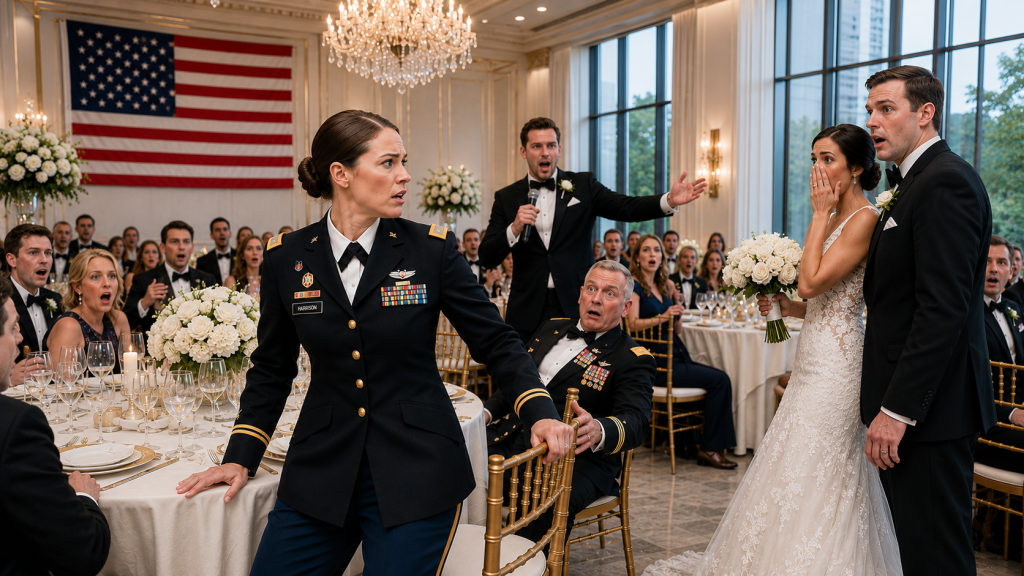
“Look at her,” Helena said. “Standing there as though she commands fleets. She is nothing more than trash in a uniform.”
A burst of laughter came from one table.
Then another.
Some guests laughed because they believed Helena was joking.
Others laughed because powerful people trained them to recognize which person had been selected for humiliation.
Mara stood still.
For one terrible second, she was sixteen again.
A duffel bag on the lawn.
Her father staring at the floor.
Her mother telling her that no one would believe her.
Mara turned away.
She walked toward a quiet corner near the side entrance, where the pavilion opened onto the lawn.
She would not argue.
She would not give Helena the spectacle she wanted.
The laughter continued behind her.
Then a sharp electronic sound cut through the room.
Daniel had taken the microphone.
“Enough.”
The laughter faded.
Helena turned toward him.
Daniel stood at the front of the pavilion, his face hard.
“What are you doing?” she asked.
He ignored her.
His eyes found Mara across the room.
Then he looked beyond her, toward the main entrance.
A group of uniformed officers had arrived.
At their center stood the Chief of Naval Operations, accompanied by senior admirals, ceremonial personnel, and members of Mara’s new command staff.
The guests began rising in confusion.
Daniel lifted the microphone again.
His voice boomed through the pavilion.
“Command detail.”
The officers came to attention.
Daniel locked eyes with Mara.
“Salute Vice Admiral King.”
For a heartbeat, no one moved.
Mara’s brow furrowed at the name.
King?
Then Celia appeared at the entrance wearing her wedding gown.
She held an old legal document in one hand.
Daniel corrected himself, emotion breaking through his formal tone.
“Vice Admiral Mara Ellison King.”
The Chief of Naval Operations stepped forward.
“By authorization of the President and the United States Senate, Rear Admiral Mara Ellison has been selected for immediate appointment to vice admiral in connection with her new command.”
A stunned silence covered the pavilion.
Mara had known about promotion to rear admiral.
She had not known the classified assignment carried a three-star appointment.
The commanding officer approached her with a small case.
“Admiral Ellison, your appointment was finalized forty minutes ago. Your command detail is prepared to receive you.”
The uniformed officers saluted.
Every active-duty service member in the pavilion followed.
Then the retired officers rose.
One by one, hands lifted.
The same guests who had laughed now stood in rigid silence.
Helena stared at Mara’s newly presented third star.
Her face had become gray.
Daniel spoke into the microphone.
“The name King appears in the appointment because Thomas Ellison’s sealed estate instructions identified Mara as the legal heir to the King family trust, established under her grandmother’s original surname. Helena concealed that inheritance and forged Mara’s surrender.”
Murmurs swept through the crowd.
Celia began walking down the aisle alone.
Not toward Daniel.
Toward Mara.
When she reached her sister, she handed her the document.
“Our grandmother’s trust,” Celia said. “Father left control to both of us. Mother changed the records.”
Helena pushed through the guests.
“This is absurd. Stop this ceremony immediately.”
Celia faced her.
“The ceremony hasn’t started.”
“You will walk back to that entrance, compose yourself, and marry Daniel.”
“I will marry Daniel.”
Relief flashed across Helena’s face.
“But not as part of your arrangement.”
Celia turned toward the guests.
“My mother invited my sister here because she needed proof Mara had attended before forging her signature on new trust documents. She did not invite her to reconcile.”
Helena reached for the microphone.
Daniel stepped away.
Federal agents entered through both sides of the pavilion.
The lead investigator displayed her credentials.
“Helena Ellison, we have warrants concerning fraud, obstruction, witness intimidation, theft of charitable funds, and falsification of federal documents.”
The high-society guests moved backward as though shame were contagious.
Helena looked at Senator Whitmore.
“Charles, call someone.”
The senator lowered his eyes.
She looked toward the retired admirals.
None stepped forward.
For decades, Helena had believed influence meant loyalty.
Now she discovered that influence survived only while people considered it useful.
She turned to Mara.
“You did this.”
Mara stood beneath the salutes of her command detail.
“No. You did.”
“I gave you everything necessary to become strong.”
“You gave me wounds. Other people taught me strength.”
Helena’s eyes filled with fury.
“You think three stars make you better than me?”
“No.”
Mara’s voice remained calm.
“They remind me that I became myself without becoming you.”
The agents approached.
Helena resisted when they asked her to turn around.
“This family will collapse without me.”
Celia stepped beside Mara.
“No. It may finally begin.”
As Helena was escorted from the pavilion, not one guest laughed.
The Choice
The ceremony was delayed for nearly an hour.
Many guests left.
The governor’s staff quietly removed him through a side entrance. Several donors avoided reporters waiting outside the estate gates.
The grand wedding Helena had designed as a display of power began shrinking into something more honest.
Celia sat inside the house with Mara.
Her veil had been removed. Her eyes were swollen from crying.
“I don’t know how to stand in front of everyone after this,” she said.
“You don’t have to.”
“I want to marry Daniel.”
“Then marry him.”
“But the flowers, the cameras, all those people—”
“Forget them.”
Celia looked at her.
“How?”
Mara smiled gently.
“Start by asking what you would choose if no one were watching.”
Celia considered the question.
“A small ceremony.”
“Where?”
“Near the water.”
“Who should attend?”
“You.”
Mara’s throat tightened.
“Daniel’s sister. A few friends. The staff who have worked here for years.”
“No politicians?”
“Not one.”
“Then that is your wedding.”
Daniel entered cautiously.
Celia stood.
“I’m still angry with you.”
“You should be.”
“You approached me because of Mother.”
“Yes.”
“You hid things.”
“Yes.”
“Do you love me?”
“Yes.”
The answer came without hesitation.
Celia looked at him for a long time.
“Then we begin again. No investigations. No family strategies. No secret missions inside our marriage.”
Daniel nodded.
“If you ask me to leave, I will.”
“I’m asking you to meet me by the water in twenty minutes.”
His eyes filled.
“I’ll be there.”
The wedding took place beside the harbor as the sun began to set.
The expensive pavilion remained behind them, half empty.
Celia walked across the lawn without music.
Mara stood beside her.
Daniel waited beneath an oak tree with twelve guests, including several household employees Helena had treated as invisible.
The Navy chaplain who had accompanied Mara’s command detail agreed to perform the ceremony.
Celia and Daniel exchanged simple vows.
No political promises.
No speeches about family legacy.
Only truth, forgiveness, and the difficult work of rebuilding trust.
When the chaplain pronounced them married, Mara applauded first.
The others followed.
Afterward, Celia embraced her.
“You stayed.”
“You asked me to.”
“I should have asked years ago.”
“You didn’t know you could.”
Daniel approached Mara.
“Admiral.”
“Daniel.”
“I owe you an apology.”
“You owe my sister honesty.”
“I intend to give it.”
“Then we’re finished.”
He smiled.
“I understand why sailors followed you.”
“Most followed orders.”
“The good ones followed you.”
Before Mara could respond, the Chief of Naval Operations approached.
“Admiral Ellison, we need to leave within the hour.”
Celia heard him.
“You’re leaving tonight?”
“I have a new command.”
“For how long?”
“I don’t know.”
The old fear appeared in Celia’s eyes.
Another departure.
Another silence.
Mara took her sister’s hands.
“This time, I will write.”
Celia laughed through tears.
“This time, I’ll receive the letters.”
The Reckoning
The investigation into Helena Ellison’s foundation lasted fourteen months.
The evidence spread far beyond the forged inheritance documents.
Auditors found millions of dollars diverted through consulting contracts and shell organizations. Military spouses had been pressured to contribute to political committees. Defense contractors had received access to private events in exchange for donations.
Several influential people claimed they had known nothing.
Some were telling the truth.
Others were protecting themselves.
Helena was convicted on multiple counts of fraud, obstruction, and document falsification.
The court did not find enough evidence to charge her in connection with Admiral Vance’s death, though investigators reopened the case.
During sentencing, Helena asked to address the court.
She spoke for twenty minutes about her service, accomplishments, and sacrifices.
She described herself as a pioneer punished for behaving the way powerful men had behaved for generations.
When the judge asked whether she regretted harming her daughters, Helena remained silent.
That silence answered more clearly than any speech.
Mara did not attend the sentencing.
She was overseas commanding a joint maritime security operation.
Celia attended with Daniel.
Afterward, she sent Mara one message.
It is finished.
Mara replied:
No. It is beginning.
The family trust was restored.
Mara and Celia became equal beneficiaries, but neither wanted the estate maintained as a monument to the Ellison name.
They sold the waterfront property.
A portion of the proceeds repaid victims of Helena’s foundation.
The remainder established a scholarship program for teenagers forced from unstable homes, particularly children from military families.
Celia chose the name.
The Open Door Fund.
The altered family portrait was removed from the estate before the sale.
A restoration expert uncovered Mara’s original image beneath the painted curtain.
Celia asked whether she wanted to keep it.
Mara studied the restored face of her sixteen-year-old self.
The girl in the portrait looked serious and uncertain, one hand resting protectively on her little sister’s shoulder.
“No,” Mara said.
“Why not?”
“Because that girl deserves more than to remain trapped in that house.”
They donated the portrait to a museum exhibit about military families and public image.
The description beneath it did not mention Helena’s rank.
It read:
A family may edit its portrait, but it cannot permanently erase the truth.
Two years later, Mara returned to Charleston for the opening of the first Open Door residence.
The building offered temporary housing, education assistance, legal support, and counseling for young people abandoned by their families.
Celia stood at the entrance holding a pair of ceremonial scissors.
Daniel was beside her.
They had a baby daughter named Thomasina, after the grandfather whose confession had finally opened the buried truth.
Mara arrived in civilian clothes.
No stars.
No command detail.
Only a dark blue dress and a small gift for her niece.
Celia hugged her before she reached the steps.
“You came early.”
“I was ordered to attend.”
Celia laughed.
“I learned from Mother.”
“Let us hope not too much.”
Inside, young residents had placed photographs along one wall.
Not formal portraits.
Ordinary moments.
A teenager receiving a diploma.
A young sailor returning from deployment.
Two sisters cooking together.
A family created through choice rather than blood.
During the opening ceremony, Celia invited Mara to speak.
Mara approached the microphone.
For a moment, she remembered another microphone at another ceremony.
Laughter.
Humiliation.
Daniel’s voice calling a command detail to attention.
But this room felt different.
No one had gathered to worship status.
They had come to build something.
“When I was sixteen,” Mara began, “I believed being thrown out of my home meant I had lost my family. For many years, I measured survival by how little I needed from anyone.”
She looked at Celia.
“I was wrong.”
The room remained quiet.
“Strength is not needing nothing. Strength is learning whom you can trust. It is opening a door after someone else has closed one. It is refusing to let the cruelty you suffered become the cruelty you pass forward.”
Celia wiped her eyes.
Mara continued.
“Uniforms, titles, houses, and family names can all be used as costumes. Character is what remains when those things are removed.”
After the applause, a sixteen-year-old girl approached Mara.
She had arrived at the residence only three days earlier after being forced from her home.
“Admiral Ellison?”
“Mara is fine.”
“Is it true your mother said you would never become anything?”
“Yes.”
“What did you say?”
“At the time? Nothing useful.”
The girl smiled faintly.
“What would you say now?”
Mara considered the question.
“I would tell her she did not have the authority to decide my future.”
The girl looked toward the open doorway.
“I don’t know what my future is.”
“Neither did I.”
“Were you afraid?”
“Every day.”
“But you still did everything.”
“No. I made mistakes. I trusted the wrong people. I spent years pretending I wasn’t hurt.”
Mara placed a hand gently on the girl’s shoulder.
“Courage does not mean you stop being afraid. It means fear does not receive the final vote.”
Outside, the harbor shone beneath the afternoon sun.
Celia came to stand beside Mara.
“Do you ever think about what would have happened if you hadn’t attended the wedding?”
“Yes.”
“And?”
“I would still have my career.”
“But not the truth.”
“Not you.”
Celia leaned her head briefly against Mara’s shoulder.
Across the room, Daniel lifted his daughter and made the baby wave.
Mara waved back.
She had once believed justice would feel like watching Helena lose everything.
It had not.
Justice was not the arrest.
It was not the courtroom.
It was not the moment powerful guests stopped laughing and raised their hands in salute.
Justice was this building.
Her sister’s trust.
A child who would grow up without being taught that love must be earned through obedience.
A doorway standing open for someone who had nowhere else to go.
That evening, Mara and Celia walked beside the water.
“Mother wrote to me,” Celia said.
Mara stopped.
“From prison?”
“Yes.”
“What did she say?”
“She blamed Daniel. Then Father. Then the investigators. Then you.”
“Of course.”
“She asked me to visit.”
“Will you?”
“I don’t know.”
Mara nodded.
“You don’t have to decide today.”
“Would you visit her?”
“No.”
The answer was immediate.
Celia looked surprised.
Mara continued gently.
“Forgiveness does not require access. I no longer carry her voice inside my decisions. That is enough for me.”
Celia looked toward the sunset.
“I’m still trying to stop hearing it.”
“You will.”
“How?”
“One choice at a time.”
They continued walking.
Behind them, laughter floated from the Open Door residence.
Not cruel laughter.
Not the nervous laughter of people seeking approval from someone powerful.
It was the sound of young people eating dinner, arguing over music, and discovering that safety could feel ordinary.
Celia slipped her arm through Mara’s.
“You know what I remember most clearly about the wedding?”
“The federal agents?”
“No.”
“Daniel getting my name wrong?”
Celia smiled.
“The moment everyone saluted you.”
Mara looked uncomfortable.
“I remember wishing they hadn’t.”
“Why?”
“Because their respect should not have required three stars.”
Celia’s smile faded.
“You’re right.”
Mara watched the water.
“But I also remember you walking toward me.”
“I should have done it sooner.”
“You walked when it mattered.”
They reached the end of the pier.
For years, Helena had insisted that family honor was something fragile, something maintained through silence, appearances, and obedience.
Mara finally understood the opposite was true.
Honor did not live in portraits, estates, titles, or carefully managed reputations.
Honor lived in truth spoken when silence was easier.
In responsibility accepted without excuses.
In doors reopened.
In sisters choosing each other after decades of separation.
Mara had once been called trash in a uniform before a room filled with powerful people.
The insult had been intended to reduce her.
Instead, it revealed the emptiness of the person who spoke it.
The uniform had never made Mara worthy.
The stars had never made her whole.
She had been worthy at sixteen, standing beside a duffel bag on the lawn.
She had been worthy while studying alone, serving far from home, and writing letters that never arrived.
She had been worthy in the corner of the wedding pavilion, even before anyone raised a hand to salute.
This time, Mara did not need a command detail to prove it.
She had her sister beside her.
She had the truth behind her.
And ahead of them, every door was open.
THE END! THANK YOU FOR READING!