

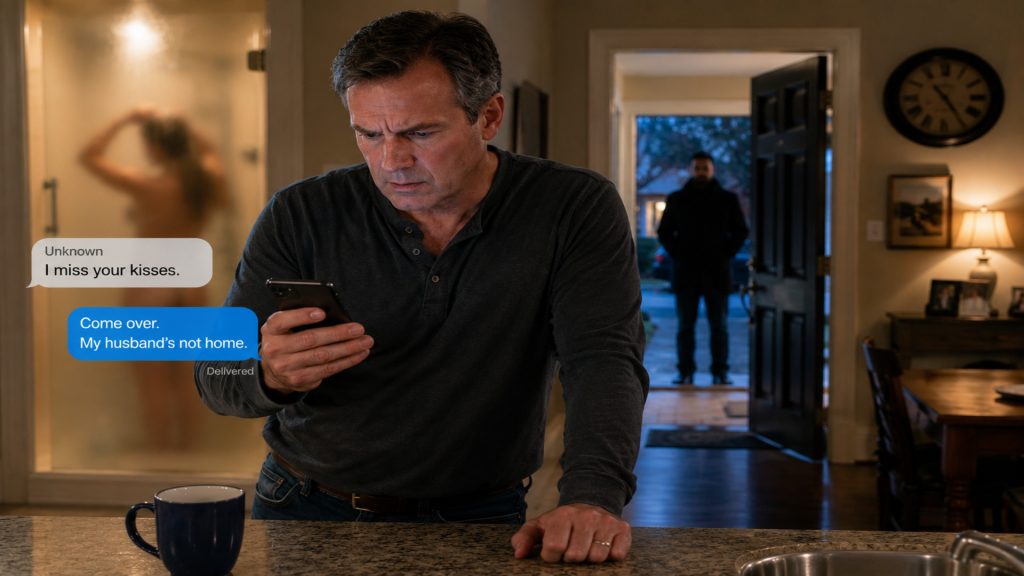
The person standing on my porch wasn’t a stranger at all.
My breath caught in my throat as recognition hit me like a freight train.
It was someone I had trusted for years, someone who had shared holidays, birthdays, hospital waiting rooms, and family dinners with us.
My younger brother, Daniel.
He stood beneath the yellow porch light wearing a dark wool coat, his thinning hair damp from the November drizzle. In one hand, he held a small paper bag from the bakery near his apartment. In the other, he carried a bouquet of white tulips—the same flowers Sarah had carried on our wedding day.
For a moment, neither of us spoke.
Daniel’s nervous smile disappeared.
His eyes moved from my face to the hallway behind me.
“Mark,” he whispered.
I gripped the edge of the door so hard that the metal latch pressed into my palm.
“What are you doing here?”
He swallowed.
“I thought you were working late.”
The words landed harder than a confession.
Not because of what they said.
Because of how quickly they came.
There was no confusion in his face. No question about why I was standing inside my own home. No innocent explanation prepared. He had expected me to be gone, and he had expected Sarah to be waiting.
Behind me, the old wall clock continued ticking.
Upstairs, a floorboard creaked.
Daniel looked toward the staircase.
Then he looked back at me.
“Mark, I can explain.”
“Can you?”
My voice sounded strangely calm.
That scared me more than shouting would have.
He glanced toward the driveway as though considering whether he could simply walk away and pretend this moment had never happened.
I opened the door wider.
“Come inside.”
He didn’t move.
“Mark—”
“Come inside, Daniel.”
The authority in my voice surprised both of us.
He stepped across the threshold.
I closed the door behind him.
The tulips trembled slightly in his hand.
Sarah appeared at the top of the stairs wearing gray sweatpants and a burgundy sweater, her damp hair falling over one shoulder. She had been rubbing it with a towel, but the towel slipped from her hands the second she saw Daniel.
Her face went completely blank.
Not shocked.
Not confused.
Blank.
It was the expression of someone whose mind had slammed shut because reality had become too dangerous to process.
Daniel stared up at her.
Sarah stared down at him.
And I stood between them, feeling like the only person in the room who had not been given the script.
“What is he doing here?” Sarah asked.
Her voice cracked on the last word.
Daniel looked at me.
I reached into my pocket and held up her phone.
“I invited him.”
The color drained from her cheeks.
For several seconds, the only sound was rain tapping against the front windows.
Sarah descended the stairs slowly, one hand gripping the banister. She kept her eyes on the phone, as though it were a weapon I had stolen from her.
“Mark, let me see that.”
“No.”
“Give me my phone.”
“No.”
She stopped on the final step.
Daniel placed the flowers on the small entry table. He did it carefully, almost respectfully, which somehow made everything worse.
I looked at the tulips.
“How thoughtful.”
“Mark,” Daniel said, “please don’t do this.”
I laughed once, but there was no humor in it.
“Don’t do what? Open my own front door? Answer my wife’s messages? Interrupt whatever the two of you planned for tonight?”
Sarah crossed her arms tightly over her chest.
“You’re misunderstanding this.”
I turned toward her.
“Then help me understand.”
She looked at Daniel.
That glance told me more than any confession could have.
It was fast, instinctive, desperate.
A silent question between two people accustomed to hiding together.
What should we tell him?
I felt something inside me collapse.
Not explode.
Collapse.
Like a house that had been rotting quietly behind freshly painted walls.
Daniel cleared his throat.
“The message wasn’t what you think.”
“I miss your kisses?”
I read the words aloud from the screen.
Daniel closed his eyes.
Sarah flinched.
I continued.
“Come over. My husband’s not home.”
“That was you?” she asked.
“Yes.”
“You had no right to impersonate me.”
The accusation was so absurd that I stared at her.
For twenty-five years, Sarah had known every version of me. She had seen me exhausted, grieving, angry, frightened, and proud. She knew the sound of my breathing when I slept. She knew I hated mushrooms and loved old detective movies. She knew I still kept our daughter’s first hospital bracelet in the locked drawer of my desk.
Yet at that moment, she looked at me as if I were the one who had crossed an unforgivable line.
“No right?” I said quietly. “That’s the part you want to discuss?”
Her expression changed.
The anger drained away, replaced by fear.
“Mark, please lower your voice.”
“Our children aren’t here.”
“I know.”
“So who are you protecting?”
She didn’t answer.
Daniel removed his coat and folded it over his arm, an old habit he had learned from our father. For one strange second, that familiar movement transported me back thirty years.
Daniel had always been the younger one.
The charming one.
The one who could break a window and somehow convince our mother to apologize for putting the glass in his way. I had spent half my childhood protecting him and the other half cleaning up after him.
When he wrecked Dad’s Buick at nineteen, I told our parents I had borrowed it.
When his first marriage ended, Sarah and I let him sleep in our basement for six months.
When he lost his contracting business after making bad investments, I gave him $18,000 from the college account we had started for our son.
When his second wife left him, he spent Thanksgiving at our table.
He had carved the turkey that year.
He had raised a glass and said there was no family he trusted more than ours.
Now he stood in my hallway holding flowers meant for my wife.
“How long?” I asked.
Neither of them responded.
I looked at Sarah.
“How long?”
She lowered her eyes.
Daniel shifted his weight.
“Mark, maybe we should sit down.”
“I don’t want to sit down.”
“Your back—”
“Don’t talk about my back.”
He stopped.
I took one step toward him.
“You don’t get to stand in my house and pretend you’re concerned about me.”
“I am concerned about you.”
“Then answer the question.”
Daniel looked at Sarah again.
There it was.
That silent consultation.
That private language.
I had seen it at barbecues, Christmas mornings, and birthday parties without ever understanding what it meant. How many times had their eyes met across a room while I was telling a story? How many smiles had passed between them when I turned away? How many moments had I mistaken for ordinary affection between in-laws?
Sarah sat on the bottom stair.
“Three years,” she whispered.
The room seemed to tilt.
I placed one hand against the wall.
“What?”
“It started three years ago.”
Daniel stepped forward.
“Mark—”
I raised my hand.
He stopped immediately.
Three years.
I tried to calculate what three years meant.
Three wedding anniversaries.
Three Christmases.
Our daughter Emily’s college graduation.
Our son Jason’s engagement party.
The summer we rented a lake house and Daniel arrived two days early because he said he wanted to help prepare.
Three years of Sunday dinners.
Three years of hugs at the front door.
Three years of Sarah kissing me goodnight and rolling onto her side while I believed the distance between us was caused by exhaustion, menopause, stress, or the ordinary erosion of time.
Three years of my brother calling me to ask how work was going.
Three years of lies layered so carefully over the truth that I had walked across them every day without feeling the ground move.
I looked at Sarah.
“Where?”
She shook her head.
“Please don’t ask me that.”
“Where?”
“Mark.”
“In my house?”
Her silence answered.
My stomach twisted.
“In our bedroom?”
“No,” she said quickly.
Daniel looked away.
Sarah saw his expression and turned toward him.
“No,” she repeated. “Never in our bedroom.”
“But in this house.”
She pressed her lips together.
“The guest room,” Daniel said.
I stared at him.
He seemed ashamed, but shame was a weak word for what appeared in his face. It was discomfort. Regret about being caught. Fear of consequences. Perhaps even sorrow.
But shame would have stopped him.
Shame would have kept him from walking through my front door with tulips.
I moved toward the living room and lowered myself into the armchair beside the cold fireplace. My knees had begun to shake.
Sarah remained on the stairs.
Daniel stood in the center of the hallway.
None of us seemed to know how to occupy the same space anymore.
I looked around the room.
The framed wedding photograph above the mantel.
The quilt Sarah’s mother had made us.
The cabinet Daniel had helped me install.
Every object looked contaminated by memory.
Sarah spoke first.
“It wasn’t supposed to happen.”
I stared at her.
“No one accidentally carries on an affair for three years.”
“We didn’t plan it.”
“That makes it better?”
“No.”
“Did you try to stop?”
Her eyes filled with tears.
“Several times.”
Daniel nodded.
“We did.”
I looked at him.
“Did you?”
“Yes.”
“When?”
“Last year. After Emily’s graduation.”
I remembered that weekend.
Daniel had stayed at our house.
He and Sarah had disappeared for nearly an hour on the morning of the ceremony. She told me they had gone to pick up extra ice. Daniel said he needed gasoline.
I had stood in the driveway polishing my shoes, proud of my daughter and grateful that my family had shown up for her.
“Was that when you tried to stop?” I asked.
Neither answered.
I knew.
The pain was no longer sharp. It had become something colder and heavier, spreading through my chest like wet cement.
Sarah wiped her face.
“You were never home.”
I looked at her in disbelief.
She continued quickly.
“I’m not blaming you. I know how this sounds. But you worked constantly. You stopped talking to me. You stopped seeing me.”
“I worked because the mortgage increased. Because Jason needed help with school. Because your mother’s assisted-living facility cost more than her pension covered.”
“I know.”
“Do you?”
“Yes.”
“Then why are you using it as an excuse?”
“I’m not. I’m trying to explain how lonely I was.”
I looked toward Daniel.
“And you?”
He rubbed his forehead.
“I was lonely too.”
The answer was so pathetic that I almost laughed again.
“You had every woman in northeastern Pennsylvania available to you, and you chose my wife because you were lonely?”
“It wasn’t like that.”
“What was it like?”
He hesitated.
“We understood each other.”
The sentence cut deeper than I expected.
We understood each other.
As though I had failed to understand my own wife, and Daniel had discovered some hidden language that made him more deserving of her.
I leaned forward.
“Did you love her?”
Daniel’s eyes moved toward Sarah.
She stared at the floor.
I repeated the question.
“Do you love my wife?”
“Yes,” he said.
Sarah looked up.
The surprise on her face told me he had never said it so plainly before.
Daniel breathed deeply.
“I love her.”
I turned to Sarah.
“And you?”
She began crying harder.
“Mark, please.”
“Do you love him?”
“I don’t know.”
Daniel’s face tightened.
Sarah covered her mouth with one hand.
I watched the two of them absorb the damage of that answer.
Even then, even while my marriage was being dismantled in front of me, I could see that their betrayal had never been the grand love story they had probably imagined.
Daniel loved her, or believed he did.
Sarah loved the secrecy, the attention, or the escape.
Perhaps she had loved him once.
Perhaps she still did.
But what existed between them was no longer protected by hidden messages and locked doors. In the open air, it looked small and ugly.
I stood.
“Get out.”
Daniel remained still.
“Mark, I’m sorry.”
“Get out of my house.”
“We need to talk about this.”
“No. You need to leave before I forget that our mother is still alive and would have to bury one of us.”
Daniel’s face went pale.
I had never threatened anyone in my life.
I didn’t intend to touch him.
But he understood the boundary.
He picked up his coat.
Sarah rose from the stair.
“Daniel—”
I looked at her.
She stopped.
He reached for the tulips, then thought better of it and left them on the table.
At the door, he turned toward me.
“I know you’ll never believe this, but I never wanted to hurt you.”
I opened the door.
“You came here because you believed I wasn’t home.”
Rain blew across the porch.
Daniel lowered his head and stepped outside.
I shut the door behind him.
The lock clicked.
Sarah and I stood in silence.
Her phone remained in my hand.
It buzzed again.
A message from Daniel appeared.
I’m sorry.
I turned the screen toward her.
“Is that for you or me?”
She closed her eyes.
I placed the phone on the entry table beside the flowers.
“I’m going to a hotel,” she said.
“No.”
She looked at me hopefully, misunderstanding.
“No?”
“This is your house too. You can stay.”
“Mark—”
“But I’m leaving.”
Her hope vanished.
I walked toward the coat closet.
She followed.
“Where will you go?”
“I don’t know.”
“Please don’t drive like this.”
“You don’t get to worry about me now.”
“I have always worried about you.”
I turned sharply.
“No. You worried about getting caught.”
“That isn’t fair.”
“Fair?”
My voice rose for the first time.
“You had three years to decide what was fair. Three years to tell me you were unhappy. Three years to ask for counseling, separation, divorce, anything. Instead, you invited my brother into our guest room.”
“I never invited him tonight.”
“I did. But he arrived because he believed you had.”
She flinched.
I pulled on my coat.
“What about the children?” she asked.
The question stopped me.
Emily was twenty-three and working in Philadelphia. Jason was twenty-one and finishing his last year at Penn State. They were adults, but adulthood does not protect children from the collapse of their parents’ marriage. It only gives them a larger vocabulary for the pain.
“We tell them the truth,” I said.
“Not tonight.”
“No. Not tonight.”
“Can we decide together what to say?”
I studied her face.
Sarah looked older than she had an hour earlier. Fine lines had appeared around her mouth, and her wet hair clung to her cheeks.
For a moment, I saw the nineteen-year-old woman I had met at a diner after a high school football game. She had been laughing with two friends, wearing a green sweater and silver earrings. I had spilled iced tea on the table because I was nervous when she looked at me.
That girl had become the mother of my children.
She had slept beside me through layoffs, illnesses, and funerals.
She had held my father’s hand when he died.
She had packed my lunches for fifteen years until I asked her to stop because the younger men at work teased me.
She had betrayed me.
Both truths existed at once, and I hated her for making me carry them together.
“We’ll talk tomorrow,” I said.
I left before she could answer.
The rain had strengthened.
I sat in my truck for nearly twenty minutes without starting the engine. The dashboard clock glowed 8:42.
Across the windshield, the house blurred behind the water.
The upstairs bedroom light turned on.
Then off.
The kitchen light remained glowing.
I wondered whether Sarah was standing where I had stood when the message arrived.
I wondered whether she was calling Daniel.
I wondered whether she was crying.
Then I hated myself for wondering.
I drove to a roadside motel near Interstate 81, checked into a room that smelled of industrial cleaner, and sat on the edge of the bed with my coat still on.
At 10:13, Emily called.
“Dad?”
Her voice was cautious.
My heart sank.
“What happened?”
“Mom called me.”
Of course she had.
“What did she say?”
“She said you two had a terrible fight and that you left.”
I rubbed my eyes.
“Did she say why?”
“No.”
I heard traffic in the background and imagined Emily standing outside her apartment building, hugging her coat around herself.
“Dad, are you okay?”
The kindness in her voice nearly broke me.
“I’m safe.”
“That’s not what I asked.”
I looked around the motel room.
A cheap painting of a sailboat hung above the bed. The heater rattled beneath the window. Someone laughed loudly in the room next door.
“No,” I said. “I’m not okay.”
She went quiet.
“Did Mom do something?”
“Yes.”
“Is there someone else?”
My daughter had always been perceptive.
I closed my eyes.
“Yes.”
She inhaled sharply.
“Who?”
I could not say it.
Not yet.
“Your mother and I need to speak to you and Jason together.”
“Dad, who is it?”
“Tomorrow.”
“Tell me.”
“Emily.”
“Is it someone I know?”
The question hung between us.
I should have lied.
I should have protected her for one more night.
But lies were what had brought us here.
“Yes.”
Her breathing changed.
“Dad, please.”
“It’s Uncle Daniel.”
Silence.
Then a small sound escaped her, somewhere between a sob and a gasp.
“No.”
“I’m sorry.”
“No. That’s not possible.”
“I wish it weren’t.”
She began crying.
I held the phone tightly, unable to comfort my own child because the people who had hurt me had wounded her too.
“How long?” she whispered.
“Three years.”
Another silence.
Then Emily said, “Graduation.”
My stomach tightened.
“What?”
“At my graduation, Mom disappeared with Uncle Daniel.”
“I remember.”
“I asked where she was. She said she went for ice.”
“I remember.”
Emily cried harder.
“I hugged him that day. I thanked him for coming.”
“This is not your shame.”
“I feel stupid.”
“You are not stupid.”
“Did everyone know?”
“No.”
“How do you know?”
“Because I didn’t know.”
She took a shaking breath.
“Where are you?”
I told her.
“I’m coming home.”
“No. It’s late.”
“I don’t care.”
“Emily, stay in Philadelphia tonight. We’ll talk tomorrow.”
“I don’t want you alone.”
That sentence undid me.
I pressed my fist against my mouth.
“I’ll be all right.”
“You always say that.”
“I know.”
“Please call Jason before Mom does.”
I promised I would.
Calling my son was worse.
Jason listened without interrupting. When I told him Daniel’s name, he became completely silent.
Then he said, “I’m going to kill him.”
“No.”
“He came to my games. He helped me move into school. He sat beside me at Grandpa’s funeral.”
“I know.”
“He looked you in the face.”
“I know.”
“You gave him money when his business failed.”
“I know.”
Jason began breathing fast.
“Where is he?”
“I don’t know, and you are not going to find him.”
“He deserves—”
“He deserves consequences. He does not deserve your future.”
Jason swore and slammed something nearby.
“Promise me you won’t go to his house,” I said.
“I can’t promise that.”
“Then listen to me carefully. The worst thing Daniel could take from me would not be my marriage. It would be my son’s freedom. Do not give him that.”
Jason said nothing.
“Promise me.”
Finally, he whispered, “I promise.”
I barely slept.
Every time I closed my eyes, I saw Daniel on the porch holding white tulips.
At six in the morning, Sarah sent a message.
Please come home. We need to talk.
I stared at it until the screen went dark.
Then another message arrived.
I told Daniel never to contact me again.
I didn’t answer.
At seven, I drove back to the house.
Sarah was sitting at the kitchen table with untouched coffee in front of her. The flowers were gone. The paper bag remained on the counter.
She had changed clothes but still looked as though she had not slept.
I removed my coat and sat across from her.
“Where are the tulips?”
“I threw them away.”
“Why?”
She looked at me.
“Because I couldn’t stand looking at them.”
“I couldn’t stand looking at them either, but they were evidence.”
“Evidence?”
“For my memory. For the day you both start rewriting what happened.”
“I won’t do that.”
“You already started last night.”
She lowered her eyes.
“I called Emily.”
“I know.”
“I didn’t tell her everything.”
“I did.”
Her head snapped up.
“You told her?”
“And Jason.”
“Mark, we should have done that together.”
“You called Emily first to control the story.”
“I called because I was terrified.”
“Of what?”
“Losing my children.”
I leaned back.
“You didn’t worry about losing them while sleeping with their uncle?”
Her face crumpled.
“No. I didn’t think.”
“For three years?”
“I told myself they would never know.”
“That’s the problem, Sarah. You believed betrayal only mattered if someone discovered it.”
She wiped her eyes.
“I know what I did was wrong.”
“Do you?”
“Yes.”
“Then tell me why.”
She stared at the coffee.
For a long time, she said nothing.
Finally, she spoke.
“It started after my mother moved into assisted living.”
I remembered that period.
Her mother’s dementia had progressed rapidly. Sarah visited her nearly every day, often returning home exhausted and heartbroken. I had tried to support her financially and practically, but I could not fix the grief of watching a parent disappear while still breathing.
“Daniel was helping with repairs at her house,” she continued. “We were cleaning it out so we could sell it. You were working overtime. He was there.”
“So you kissed him.”
“Not at first.”
“What happened?”
“We talked.”
“You and I talked.”
“No, Mark. We discussed bills, appointments, schedules, groceries. We stopped talking about ourselves.”
“I asked how you were.”
“You asked while checking your email.”
The accusation had truth in it.
That made it hurt differently.
She continued.
“Daniel listened. He let me cry. He told me stories about your mother getting confused near the end, and he understood what it felt like.”
“He is my brother. I understood too.”
“You didn’t show it.”
I stared at her.
She immediately shook her head.
“That does not excuse what I did. I know that. I am not saying it does.”
“Then stop explaining it as though there was a path that led naturally from loneliness to betrayal.”
She nodded slowly.
“You’re right.”
“What happened the first time?”
Sarah pressed her hands together.
“We were at Mom’s house. We had packed the last boxes. I was crying in the kitchen. He hugged me.”
“And?”
“And I kissed him.”
“You kissed him first?”
“Yes.”
Daniel had betrayed me, but Sarah’s answer shattered a private defense I had not realized I was building. Some part of me had imagined my brother pursuing her, manipulating her, exploiting her grief.
But she had crossed the first boundary.
“What did he do?”
“He stepped back.”
A bitter smile touched my mouth.
“How honorable.”
“He said it was wrong. I apologized. We went home separately.”
“And then?”
“Two weeks later, he called me.”
“The unknown number?”
“No. He had another phone later.”
I looked toward her phone on the table.
“A secret phone?”
“He used a prepaid number.”
The planning behind it made my skin crawl.
“How often?”
“At first, only occasionally.”
“That is not an answer.”
“Once every few weeks. Then more.”
“Hotels?”
“Yes.”
“His apartment?”
“Yes.”
“Our guest room?”
Her voice dropped.
“Twice.”
I stood and walked to the window.
The backyard was gray with morning frost. A rusted swing set remained near the fence, even though our children had outgrown it more than a decade earlier. I had always meant to take it down.
“What did you tell yourself afterward?” I asked.
“That it would be the last time.”
“Every time?”
“Yes.”
“And when you came home to me?”
She began crying again.
“Sometimes I hated myself.”
“Only sometimes?”
“Mark, please.”
I turned.
“Did you ever laugh at me together?”
Her face hardened with pain.
“No.”
“Did you discuss me?”
“Yes.”
“What did you say?”
“I won’t repeat private conversations.”
I stared at her.
“Private?”
She realized what she had said.
“I didn’t mean—”
“You protected those conversations from me while discussing my life with him.”
“I’m sorry.”
“Did you tell him about our marriage?”
“Yes.”
“Our finances?”
“Sometimes.”
“Our bedroom?”
She looked away.
That was enough.
I gripped the back of a chair.
“There are things I told you because you were my wife. Fears. Failures. Things I have never told another person.”
“I didn’t tell him everything.”
“But you told him enough.”
She nodded.
I returned to the table.
“What happened last night? Why did he send that message?”
“We hadn’t seen each other in six weeks.”
“Because you stopped?”
“Because I tried to.”
“And he wanted to continue.”
“Yes.”
“Did you?”
“I didn’t know.”
“Would you have let him inside if I had actually been at work?”
Sarah began to answer, stopped, and looked down.
That silence was the most honest thing she had given me.
“Yes,” she whispered.
I felt the final piece of hope leave.
Not hope that the affair had been unreal.
Hope that it had already ended.
I stood.
“I’m filing for divorce.”
Sarah covered her face.
“No.”
“Yes.”
“Please don’t decide today.”
“I decided last night.”
“We can get counseling.”
“You should have suggested counseling before Daniel knew more about our marriage than I did.”
“I’ll do anything.”
“There is nothing you can do that gives me back the last three years.”
“We have twenty-five years.”
“No. We had twenty-two years and then three years when only I believed we were married.”
She reached across the table.
I moved my hand away.
“Please,” she said. “I love you.”
I looked at her for a long time.
“I believe you.”
She seemed startled.
“I think part of you loves me. I think part of you loved our home, our history, and the safety of knowing I would keep showing up. But love without loyalty is only appetite wearing a respectable name.”
She began sobbing.
I picked up my coat.
“Emily and Jason will be here this afternoon. We will speak together. After that, I’m meeting a lawyer.”
“Are you going to leave me with nothing?”
The question surprised me.
“I’m not Daniel.”
She looked ashamed.
“I didn’t mean it that way.”
“We’ll divide what we built fairly. I will not punish you financially. But I will not protect you from the truth.”
That afternoon, our children arrived separately.
Emily entered first and hugged me so tightly that my back protested. I did not care.
She walked past Sarah without speaking.
Jason arrived twenty minutes later. His jaw was clenched, and his knuckles were scraped.
I looked at his hands.
“I punched a wall,” he said.
“Better than a person.”
He nodded.
We sat in the living room.
Sarah took the sofa. I sat in the armchair. Emily chose the rug near my feet, the same way she had when she was a child. Jason stood near the fireplace until I asked him to sit.
No one knew how to begin.
Finally, Sarah spoke.
“I am sorry.”
Jason laughed bitterly.
“That’s it?”
“No.”
“Because that’s not enough.”
“I know.”
Emily stared at her mother.
“Did you love him?”
Sarah swallowed.
“I cared about him.”
“That isn’t what I asked.”
“I don’t know what I felt.”
Jason leaned forward.
“You destroyed Dad for something you don’t even understand?”
“Jason,” I said.
“No, Dad. She needs to answer.”
Sarah looked at our son.
“I was selfish. I was lonely, and instead of confronting what was wrong in my life, I chose something secret that made me feel wanted.”
Emily’s voice was quiet.
“Was Dad not enough?”
“This was not about him being enough.”
“It feels like it was.”
“I know.”
“Did Uncle Daniel love you?”
“He said he did.”
“Did you tell him you loved him?”
Sarah closed her eyes.
“Sometimes.”
Daniel had confessed his love the previous night as though it were new.
Now I understood that even their declarations had become unreliable.
Jason stood suddenly.
“I can’t listen to this.”
He walked into the kitchen.
I followed.
He braced both hands against the counter where Sarah’s phone had first lit up.
“I want to hate her,” he whispered.
“You will feel many things.”
“She’s my mother.”
“Yes.”
“How am I supposed to look at her?”
“One day at a time.”
He turned toward me.
“How are you this calm?”
“I’m not.”
“You look calm.”
“That is what shock looks like on some people.”
He hugged me.
My son had not hugged me like that since he was fifteen.
I held him while he cried.
In the living room, Emily’s voice rose.
“You brought him into this house?”
Jason pulled away.
“What?”
I closed my eyes.
Sarah had told her.
Jason stormed back into the room.
“The guest room?”
“Twice,” Sarah whispered.
“That’s where I slept during Christmas.”
“Jason—”
“That’s where Grandma slept before she died.”
Sarah stood.
“I know.”
“No, you don’t know anything.”
He moved toward the door.
“Where are you going?” I asked.
“Anywhere else.”
“Not Daniel’s house.”
He looked at me.
“I promised.”
“Keep it.”
He left.
Emily followed fifteen minutes later after telling Sarah she did not know when she would speak to her again.
When the door closed, the house felt emptier than it ever had.
Sarah sat with her hands folded in her lap.
“They hate me.”
“They are hurt.”
“Will they forgive me?”
“I don’t know.”
“Will you?”
I considered the question.
“Maybe.”
Hope flickered in her eyes.
“But forgiveness does not mean reconciliation.”
It disappeared.
I moved into a furnished apartment near the logistics center the following week.
The divorce process began quietly.
Sarah hired an attorney recommended by a friend. I hired a woman named Helen Morris, who had practiced family law for thirty years and possessed the calm precision of a surgeon.
She reviewed our finances and told me the house would likely need to be sold unless one of us could buy out the other.
I had assumed that possibility would devastate me.
Instead, I felt relief.
The house had become a museum of lies.
Daniel called me repeatedly.
I blocked his number.
He emailed me.
I deleted the messages without reading them.
Then, two weeks after the confrontation, he appeared outside my workplace.
I saw him leaning against his car near the employee entrance.
For one dangerous moment, anger surged through me so strongly that my vision blurred.
I remembered my promise to Jason.
I remembered my mother.
I walked toward Daniel but stopped several feet away.
“You need to leave.”
“I just want five minutes.”
“You had three years.”
“I need to explain.”
“No explanation changes what you did.”
He looked exhausted. His beard had grown unevenly, and his eyes were red.
“Sarah ended it.”
“I know.”
“She won’t speak to me.”
“That is not my problem.”
“She says she wants to save the marriage.”
I stared at him.
“Why are you telling me?”
“Because I want you to know she chose you.”
I almost pitied him.
Almost.
“She did not choose me. She chose consequences after being caught.”
Daniel’s eyes filled.
“I love her.”
“You keep saying that as though love makes betrayal noble.”
“I never wanted your life.”
“You walked into my house carrying flowers for my wife.”
“I wanted her.”
“My wife was part of my life.”
He lowered his head.
“I know.”
“No, you knew before you did it.”
He took a step closer.
“I have spent my whole life being second to you.”
The confession surprised me.
“What?”
“You were always the responsible one. Dad trusted you. Mom called you first. You had the stable marriage, the good children, the house, the career. Everything you touched lasted.”
I stared at him.
“And you believed sleeping with Sarah would make you first?”
“No.”
“That’s exactly what you did.”
“I didn’t plan it.”
“Stop saying that. You planned every call, every hotel, every lie.”
He wiped his face.
“I was jealous of you.”
For the first time, I understood that Daniel’s betrayal had not begun with Sarah.
It had begun much earlier, in childhood comparisons I had barely noticed.
I had spent years protecting him while he quietly resented the life I built.
“You could have built your own life,” I said.
“I tried.”
“No. You wanted the appearance of stability without the discipline that creates it.”
He flinched.
“I deserve that.”
“You deserve worse, but I’m finished giving you my energy.”
“Will you ever speak to me again?”
I thought of Christmas mornings, fishing trips, our father’s funeral, and the day Daniel stood beside me at my wedding.
Then I thought of the tulips.
“I don’t know.”
He nodded.
“Tell Mom I’m sorry.”
“You tell her.”
“I can’t.”
“That has always been your problem.”
I walked into work and did not look back.
Our mother learned the truth before Christmas.
Daniel told her.
She called me that evening, crying so hard I could barely understand her.
“I raised you to take care of each other,” she said.
“I tried.”
“I know.”
“Don’t ask me to forgive him.”
“I won’t.”
“Don’t ask me to protect him.”
“I won’t.”
She paused.
“Are you eating?”
The question nearly made me smile.
“I’m eating.”
“Are you sleeping?”
“Sometimes.”
“Your father would have been heartbroken.”
“I know.”
“He would also have stood beside you.”
That mattered more than I expected.
Christmas was divided.
Emily spent Christmas Eve with me and Christmas morning with Sarah.
Jason refused to see his mother and came to my apartment carrying two grocery bags and a bottle of bourbon.
We ate overcooked ham at my small kitchen table.
At midnight, he admitted he had driven past Daniel’s house several times.
“But I didn’t stop,” he said.
“I’m proud of you.”
“I’m not.”
“You should be.”
In January, Sarah began therapy.
She emailed me once a week.
The messages were not romantic. They were carefully written accounts of what she was learning about herself: her fear of aging, her habit of avoiding conflict, the resentment she had never expressed, and the way secrecy had allowed her to feel powerful while remaining emotionally passive.
At first, I deleted them.
Then I began reading.
Not because I wanted her back.
Because understanding the truth helped me stop blaming myself for all of it.
I had failed in parts of our marriage.
I had worked too much.
I had assumed stability meant happiness.
I had listened poorly.
I had become practical where tenderness was needed.
But those failures were mine.
The affair was hers.
Learning to separate the two saved me.
The house sold in March.
On the final day, Sarah and I met there to divide the last boxes.
The rooms echoed.
The swing set was still in the yard.
I found our wedding album in the hall closet.
Sarah stood beside me as I opened it.
There we were at twenty-one and nineteen, smiling beneath an arch of white flowers. Daniel stood behind me as my best man, one hand resting on my shoulder.
Sarah began crying.
“Do you regret marrying me?” she asked.
I closed the album.
“No.”
She looked surprised.
“You gave me Emily and Jason. We had years that were real. I won’t let what happened erase everything.”
“Do you regret staying as long as you did?”
“I regret that you didn’t trust me enough to tell me you were unhappy.”
She nodded.
“I was afraid you would leave.”
“So you did the one thing that guaranteed it.”
“I know.”
She touched the edge of the album.
“Can I keep this?”
“Yes.”
“What will you keep?”
I looked around the empty house.
“The truth.”
The divorce became final fourteen months after the night of the message.
We divided the equity from the house. Sarah kept her retirement account. I kept mine. Neither of us fought over furniture.
Daniel moved to Florida.
Our mother spoke to him occasionally but never invited him to family gatherings when I was present.
Emily eventually resumed contact with Sarah after several months of therapy. Their relationship remained cautious but sincere.
Jason took longer.
Nearly two years passed before he agreed to meet his mother for coffee.
I drove him there but waited in the truck.
When he returned, his eyes were red.
“How was it?” I asked.
“Hard.”
“Do you want to see her again?”
“Maybe.”
That was enough.
As for me, I learned that healing did not arrive as one dramatic moment.
It came through ordinary days.
The first night I slept without dreaming about the porch.
The first family dinner where Daniel’s absence did not feel like an open wound.
The first time I heard Sarah’s name and did not feel my chest tighten.
The first time I laughed with a woman named Claire at a community fundraiser and realized I was not pretending.
Claire was a widow, a retired school librarian with silver-streaked hair and a direct way of speaking. We became friends slowly.
I told her everything before our third date.
She listened without interrupting.
When I finished, she said, “What they did says something about them. The fact that you survived it says something about you.”
I married her three years later in a small ceremony beside Lake Wallenpaupack.
Emily stood beside Claire.
Jason served as my best man.
My mother sat in the front row.
There were no white tulips.
After the ceremony, Sarah sent a brief message.
I heard you got married today. I hope you are happy. You deserve to be.
I read it twice.
Then I replied.
Thank you. I hope you find peace too.
And I meant it.
Forgiveness had not restored our marriage.
It had restored me.
Years later, I still remembered the exact sound of Sarah’s phone buzzing on the kitchen counter. I remembered the cold coffee, the November rain, and the words glowing on the screen.
I miss your kisses.
At the time, I believed that message had destroyed my life.
But it had only destroyed the version of my life built on a lie.
The truth was brutal.
It took my marriage, my brother, my home, and my confidence in the people I trusted most.
Yet the truth also gave something back.
It gave me the chance to stop living inside a story everyone else understood except me.
It gave my children permission to see that betrayal did not have to turn into revenge.
It taught me that forgiveness and reunion were not the same thing.
Most importantly, it taught me that losing someone who deceived you is not the same as losing yourself.
Sometimes the door opens, and the person standing there changes everything.
Sometimes you freeze because your heart knows your old life has ended before your mind can accept it.
But eventually, you close that door.
You walk away from the lies.
And somewhere beyond the worst night of your life, another door opens—one you enter with your eyes open, your dignity intact, and no need to wonder who is waiting on the other side.
THE END! THANK YOU FOR READING!