

The six naval officers crossed the ballroom in perfect formation.
Their polished shoes struck the marble floor with a quiet rhythm that seemed louder than the orchestra had been.
Every conversation stopped.
Crystal glasses paused halfway to painted lips. Servers froze beside tables. The string quartet lowered their bows. Even the children near the cake turned to watch.
My father’s face remained composed, but the hand holding his champagne tightened.
Damian stepped away from my table.
For the first time that evening, his smile disappeared.
The officers stopped several feet in front of me.
The tallest among them was Vice Admiral James Rowan, a broad-shouldered man with close-cropped gray hair and enough ribbons on his uniform to make even the wealthiest guests understand they were looking at someone important.
He brought his heels together.
The five officers beside him did the same.
Then all six raised their right hands in a precise salute.
“Admiral Voss,” Rowan said. “It is an honor to see you again.”
A sound moved through the ballroom.
Not applause.
Not yet.
It was the collective breath of hundreds of people realizing they had misunderstood everything.
My father’s champagne glass slipped slightly in his hand.
Damian stared at me.
I rose slowly from my chair.
My navy dress suddenly seemed less plain.
The silver bracelet beneath my sleeve felt heavier than before.
I returned the salute.
“At ease,” I said.
The officers lowered their hands.
Vice Admiral Rowan smiled warmly.
“You said this was a family occasion,” he said, “but Captain Mercer insisted we not let you attend without proper representation.”
A younger woman beside him stepped forward. Captain Lillian Mercer had served under my command during one of the most difficult years of my career. Her expression was disciplined, but her eyes held affection.
“With respect, Admiral,” she said, “you should have known we would ignore that order.”
A few guests laughed nervously.
Julian laughed with relief.
Charlotte, still standing beside the microphone, covered her smile with one hand.
My father looked from the officers to me.
“Admiral?” he repeated.
It was barely a word.
I turned toward him.
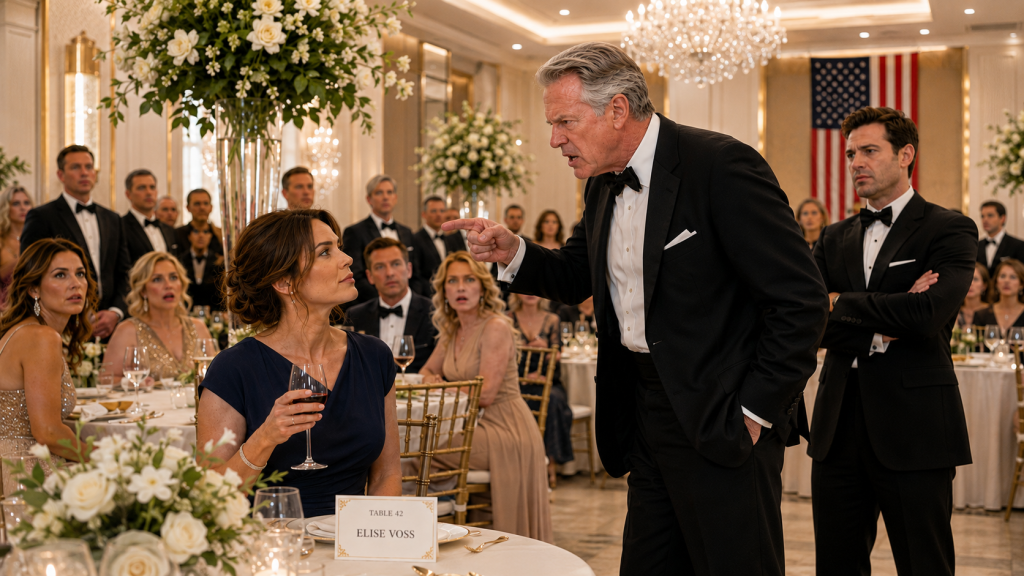
“Yes, Conrad.”
His face changed again.
This time, he could not hide it.
Confusion came first. Then disbelief. Then the slow, painful understanding that the daughter he had thrown into the rain had not disappeared.
She had simply built a life where he could no longer see her.
Damian found his voice before my father did.
“This is ridiculous,” he said. “Elise, what exactly is this supposed to be?”
Vice Admiral Rowan’s expression hardened.
Captain Mercer looked at Damian as if he were something unpleasant she had discovered on her shoe.
I remained calm.
“It is not supposed to be anything,” I said. “They are colleagues.”
“Colleagues?” Damian repeated. “You expect us to believe you’re some kind of admiral?”
“I don’t expect anything from you.”
That answer unsettled him more than anger would have.
My father took one slow step toward me.
“You joined the Navy?”
“Yes.”
“When?”
“Twenty-one years ago.”
His jaw tightened.
“You never told us.”
I looked directly into his eyes.
“You made it clear that I was no longer part of this family.”
A hush settled over the people nearest us.
Conrad Voss had spent his life carefully managing appearances. He donated to museums, hospitals, political campaigns, and prestigious universities. His family appeared in magazines beside headlines about legacy, discipline, and American success.
He could endure private cruelty.
Public truth was another matter.
Before he could answer, Charlotte tapped the microphone.
A soft thump rolled through the ballroom speakers.
“Ladies and gentlemen,” she said, her voice steady despite the emotion in her face, “may I have your attention?”
Every head turned.
Charlotte stood beside Julian beneath the flowered arch. She was still wearing her wedding gown, ivory silk with small pearls stitched along the sleeves, but her posture had changed.
She was no longer simply a bride welcoming guests.
She stood like an officer.
Because that was what she had once been.
Very few members of the Voss family knew that Charlotte Hale had served eight years as a naval intelligence officer before leaving active duty. They knew she had attended Georgetown. They knew her father owned several construction companies. They knew she spoke French and had connections in Washington.
They did not know the real reason Julian had met her.
Three years earlier, Charlotte had been working with a veterans’ housing foundation I had helped establish. Julian, searching for an organization to support through his company, had attended one of our private fundraising meetings.
He had recognized my name on a plaque.
He had asked questions.
And eventually, after two decades of silence, my nephew had found me.
Charlotte lifted her glass.
“A wedding toast is normally about the bride and groom,” she said. “Tonight, however, Julian and I would like to honor the person who made this marriage possible.”
Julian joined her.
My brother’s face went pale.
My father turned sharply toward his grandson.
Charlotte continued.
“Three years ago, Julian and I met at the Harbor Light Foundation, an organization that provides housing, legal support, and medical assistance to veterans and military families.”
A screen behind the orchestra came to life.
The wedding monogram vanished.
In its place appeared a photograph of a renovated apartment building overlooking a quiet park. A brass sign near the entrance read:
HARBOR LIGHT RESIDENCE.
Charlotte looked toward me.
“The foundation was created by Admiral Elise Voss.”
Applause began near the front of the ballroom.
The naval officers joined first.
Then others followed.
Within seconds, the sound filled the room.
I had stood on aircraft carriers beneath roaring engines. I had addressed thousands of sailors. I had received medals in halls filled with generals, ambassadors, and members of Congress.
Yet standing in that ballroom while strangers applauded, I felt more exposed than I ever had in uniform.
Because my father was watching.
And somewhere behind his shock, I could see the nineteen-year-old version of me reflected in his eyes.
The girl with rain-soaked hair.
The girl he had called worthless.
Charlotte raised her hand, and the applause faded.
“Admiral Voss has served our country for more than two decades,” she continued. “Her operational record cannot be discussed in detail tonight, but her leadership has protected thousands of service members and civilians. She has commanded at sea, negotiated during international crises, and led rescue efforts during disasters most of us only saw on television.”
Another image appeared.
It showed me in uniform beside sailors unloading medical supplies after a hurricane.
Then another.
I was standing aboard a carrier, speaking to a row of young officers.
Then a photograph of me kneeling beside a child at a flooded evacuation center.
I had never seen some of those pictures.
Julian must have collected them from public archives.
My throat tightened.
Charlotte’s voice softened.
“More importantly to us, she taught us what family can mean when it is built on loyalty instead of control.”
My father flinched.
Charlotte looked directly at him.
The room noticed.
“Julian contacted his aunt after learning about the Harbor Light Foundation. She had every reason to ignore him. Instead, she welcomed him. When he struggled with the expectations placed upon him, she listened. When he doubted his own judgment, she reminded him that integrity mattered more than approval.”
Julian took the microphone from her.
His eyes were shining.
“Aunt Elise never asked me to choose sides,” he said. “She never insulted my father or grandfather. She never tried to turn me against anyone. She simply showed me that love should not require surrendering your dignity.”
Damian moved toward the stage.
“Julian,” he warned.
His son looked at him.
It was the first time I had ever seen Julian face his father without shrinking.
“No, Dad,” he said. “You’ve spoken for me long enough.”
Damian stopped.
The room became completely silent.
Julian’s hand trembled around the microphone, but his voice did not.
“When I told the family I wanted to marry Charlotte, Grandfather objected because her family was not connected to the right people. Dad told me to delay the wedding until a business agreement could be arranged between our families.”
A murmur traveled through the guests.
My father’s expression turned cold.
“This is not the place,” he said.
Julian looked at him.
“That is what you always say whenever the truth appears in public.”
Conrad’s eyes flashed.
Julian continued.
“I was expected to treat my marriage like a corporate merger. Aunt Elise told me something I will never forget. She said, ‘A family name should be a shelter, not a prison.’”
He raised his glass.
“So tonight, Charlotte and I would like everyone to join us in honoring Admiral Elise Voss—not because she shares our name, but because she taught us how to live without being owned by it.”
Charlotte came to attention.
Then, in front of the entire ballroom, she snapped a sharp salute toward me.
“Ladies and gentlemen,” she announced, “please raise your glass to Admiral Elise Voss.”
Hundreds of glasses lifted.
“To Admiral Voss,” the room answered.
The words struck me harder than any insult ever had.
For twenty-one years, I had imagined returning to my family in a hundred different ways.
Sometimes I pictured myself arriving in full dress uniform, medals bright beneath the chandeliers, while my father finally understood his mistake.
Sometimes I imagined telling him every accomplishment, every promotion, every command.
Sometimes I pictured him apologizing.
But life had slowly taught me that revenge fantasies were often only another form of captivity.
I had not come to the wedding to humiliate Conrad.
I had come because Julian had asked me.
I had come because a young man from my family had chosen love over duty, and I refused to let him stand alone as I once had.
I lifted my glass.
“To Julian and Charlotte,” I said.
The guests repeated the toast.
The orchestra began playing again, but the atmosphere had changed.
People approached me almost immediately.
Some introduced themselves with genuine respect. Others were clearly embarrassed because they had overheard my father’s insult. Several guests who had ignored me earlier now seemed desperate to explain that they had not recognized me.
I accepted their words politely.
Recognition was familiar.
Sincerity was rarer.
Vice Admiral Rowan stood beside me, watching Conrad from across the room.
“Would you like us to remain?” he asked quietly.
“You traveled all this way,” I said. “At least stay for cake.”
He smiled.
“I meant for protection.”
I glanced toward my father.
Conrad had moved to the side of the ballroom, where Damian was speaking urgently into his ear. My mother stood behind them, pale and motionless.
“No,” I said. “I can handle my family.”
Rowan’s expression softened.
“I never doubted that.”
The officers dispersed among the guests.
Captain Mercer stayed near me.
She looked toward my mother.
“Is that her?”
“Yes.”
“Have you spoken?”
“Not yet.”
Mercer nodded slowly.
She knew enough of my history not to press.
My mother had been the shadow in every memory of my childhood.
Vivian Voss had never been cruel in the same sharp way as my father. She did not shout. She did not threaten. She did not throw luggage into the rain.
She simply stood nearby and allowed it.
As a child, I believed silence meant kindness.
As an adult, I learned that silence could be one of cruelty’s most useful tools.
I was speaking with an elderly senator and his wife when my mother approached.
She wore a pale silver gown and a diamond necklace I remembered from childhood. Her hair was softer now, almost entirely white, and her shoulders had begun to curve inward.
For years, I had pictured her exactly as she looked on the night I left.
Time had altered her.
It had not erased what happened.
“Elise,” she said.
The senator’s wife sensed the tension and gently guided her husband away.
My mother looked at my uniformed colleagues, then at me.
“You look well.”
It was such a small sentence.
After twenty-one years, it felt almost insulting.
“So do you,” I replied.
Her hands twisted together.
“I didn’t know.”
“No.”
“Your father told us you were working overseas.”
“I was.”
“He said you had changed your name.”
“I used my middle name for several years.”
“He said you didn’t want contact.”
I studied her face.
“Did you ever check?”
She looked down.
There was my answer.
My mother had resources most people could only imagine. Private investigators. Lawyers. Assistants. Friends in government and business.
If she had wanted to find me, she could have done so.
“I wrote letters,” she whispered.
“To where?”
“The address you gave your grandmother.”
“I moved six months after leaving.”
“I didn’t know.”
“You could have asked her.”
“Your father forbade us from discussing you.”
I felt something cold settle inside me.
“And you obeyed.”
Her eyes filled with tears.
“I was afraid.”
“So was I.”
The difference was that I had been nineteen, homeless, and alone.
She had been a wealthy woman protected by servants, lawyers, and a powerful family name.
My mother reached for my hand.
I stepped back.
Her fingers closed around empty air.
“I thought you would come home,” she said.
“I did.”
She stared at me.
“What?”
“Grandmother’s memorial. I stood outside the chapel in the rain.”
Her face lost all color.
“You were there?”
“I called the house three days before. Damian answered.”
Across the ballroom, my brother turned as though he had heard his name.
“He told me the memorial was private,” I continued. “He said Father would have security remove me if I came inside.”
My mother’s eyes moved toward Damian.
“He told us you refused to attend.”
“Of course he did.”
Her mouth trembled.
The silence between us carried twenty-one years of choices.
“I’m sorry,” she whispered.
I had imagined hearing those words.
They did not heal me.
They did not return birthdays or holidays. They did not erase lonely nights in cheap apartments or the humiliation of asking strangers for help. They did not change the fact that I had once needed my mother and she had chosen obedience over love.
But they were still words she had never said before.
“I believe you regret it,” I told her.
She began crying quietly.
“That is not the same as forgiveness.”
“I know.”
It surprised me that she did.
Before either of us could say more, Damian appeared.
“Mother, Father wants you.”
She wiped her face quickly.
“I’m speaking with Elise.”
Damian looked at me.
His expression was furious, but his anger was mixed with something else now.
Fear.
“You’ve made your point,” he said.
“I wasn’t aware I had one.”
“You arrive unannounced with military officers, hijack my son’s wedding, and embarrass the family.”
“I was invited.”
“Not by the family.”
Julian appeared beside us.
“By me,” he said. “I am the groom.”
Damian turned toward his son.
“You have no idea what you’ve done.”
Julian’s face tightened.
“I invited my aunt to my wedding.”
“You brought a private family dispute into a room filled with clients and partners.”
“That seems to be all you care about.”
Damian lowered his voice.
“Do you understand how this looks?”
“Yes,” Julian replied. “It looks like Grandfather disowned a daughter who became an admiral, and now everyone knows.”
Damian raised his hand.
It happened quickly.
Not a strike.
But the old gesture was there—the instinct to silence his son through fear.
I caught his wrist before he could touch Julian.
The movement was so fast that Damian gasped.
Captain Mercer stepped forward instantly.
Two nearby officers turned.
I released my brother’s wrist.
“Do not raise your hand to him,” I said.
Damian rubbed his arm.
“You think your rank gives you authority here?”
“No. Being the only person willing to stop you does.”
His face reddened.
“You don’t know anything about this family.”
“I know exactly what it costs to remain in it.”
My father’s voice came from behind us.
“That is enough.”
Conrad stood several feet away.
The powerful certainty he had carried when first approaching me was gone. In its place was a rigid determination to recover control.
“Julian,” he said, “you will apologize to your father.”
Julian stared at him.
“No.”
The word was quiet.
But it changed everything.
My father stepped closer.
“What did you say?”
“I said no.”
Damian looked stunned.
Charlotte joined her husband and took his hand.
Conrad’s gaze shifted to her.
“This is your influence.”
Charlotte remained calm.
“No, sir. This is your grandson making his own decision.”
“You have filled his head with ideas about independence.”
“I married a grown man. I expect him to have ideas.”
Several guests nearby tried not to smile.
My father noticed.
His humiliation deepened.
He turned back to Julian.
“If you walk away from this family, you walk away from everything attached to it.”
There it was.
The same weapon.
The same threat.
Money, access, inheritance, belonging.
Twenty-one years earlier, it had been aimed at me.
Now it was aimed at Julian.
My nephew looked toward me.
Not for permission.
For courage.
I gave him a small nod.
He faced his grandfather.
“Then I walk away.”
My mother closed her eyes.
Damian stared at his son as if he had become a stranger.
Conrad’s expression emptied.
“You will receive nothing.”
“I have Charlotte.”
Julian squeezed her hand.
“I have my work. I have friends. I have people who love me without asking me to surrender myself first.”
His eyes moved to me.
“And I have family.”
My father followed his gaze.
For a moment, neither of us spoke.
The ballroom seemed to vanish around us.
We were standing in another doorway.
Another storm.
Another choice.
Conrad had believed I would return because life without his money would be unbearable.
He had never understood that the life he offered was unbearable in a different way.
“Come with me,” my father said.
It was directed at me.
“No.”
His jaw tightened.
“We need to speak privately.”
“Anything you need to say can be said here.”
“I will not discuss family matters in front of strangers.”
I glanced around the ballroom.
“These strangers know more about my life than you do.”
His eyes darkened.
“Five minutes.”
I should have refused.
But part of me knew this moment had waited twenty-one years.
Not for revenge.
For completion.
I looked at Julian.
“Enjoy your wedding,” I said. “This will not become the center of your night.”
Julian hesitated.
“I’ll be fine,” I assured him.
Captain Mercer leaned close.
“Call if you need us.”
“I won’t.”
“I know,” she said. “Call anyway.”
My father led me through a side door into a private sitting room decorated with antique mirrors, velvet chairs, and paintings of ships crossing stormy seas.
The irony almost made me laugh.
He closed the door.
For several seconds, he said nothing.
Then he poured himself a drink from a crystal decanter.
His hand was shaking.
I had never seen Conrad Voss tremble.
He noticed me watching and set the decanter down.
“How?” he asked.
“How what?”
“How did this happen?”
I understood what he meant.
How had the daughter he rejected become someone important without his permission?
“I took a bus to Norfolk,” I said. “I had one hundred and eighty dollars in my wallet. I rented a room from a widow named Mrs. Caldwell and worked mornings at a bakery.”
He turned slowly.
“I don’t need every detail.”
“I think you do.”
His mouth tightened.
“I saw a Navy recruiting office three blocks from the bakery. I walked in because the poster promised education, housing, and a future based on performance.”
I looked toward the painting of the stormy sea.
“That sounded better than marriage to Bennett Vale.”
My father lowered his glass.
“You enlisted?”
“Yes.”
“You could have attended any university in the country.”
“Not after you froze my accounts and withdrew the tuition payment.”
He looked away.
I continued.
“I enlisted. I studied at night. I earned a commission. I discovered I was good at making decisions under pressure. Better than I had ever been at sitting quietly during dinner parties.”
“You should have contacted me.”
“You told me not to come back.”
“People say things in anger.”
“You had twenty-one years to say something else.”
He stared into his drink.
I had spent much of my childhood afraid of his silence.
Now it seemed small.
“When were you promoted?” he asked.
“Several times.”
“To admiral.”
“Two years ago.”
“And no one told me?”
I nearly smiled.
“Who was supposed to tell you?”
His face hardened.
“Do not mock me.”
“I’m not. I’m trying to understand why you believe you were entitled to information about a daughter you erased.”
He walked toward the window.
Beyond the glass, the city lights glittered against the night.
“I did what I believed was necessary,” he said.
“For whom?”
“For this family.”
“There was no danger to the family.”
“You refused a commitment that had been arranged for years.”
“I refused to marry a man I did not love.”
“You embarrassed Bennett’s family.”
“Bennett was sleeping with Damian’s girlfriend.”
My father turned.
For the first time that night, he looked genuinely shocked.
“What?”
“You didn’t know?”
His silence answered me.
“I discovered them together two weeks before the engagement announcement,” I said. “Bennett told me it did not matter because our marriage was about business. Damian told me to keep quiet.”
My father’s eyes narrowed.
“Damian denied any involvement.”
“You asked him?”
“He said you invented the story because you were infatuated with someone else.”
I let out a breath.
Of course.
Damian had always understood our father’s weaknesses. Conrad believed men who sounded confident. He distrusted women who contradicted them.
“Did you ask me?” I said.
“You were emotional.”
“I was telling the truth.”
“Why didn’t you explain?”
“I tried. You called me hysterical and ordered me to apologize to Bennett.”
My father closed his eyes briefly.
A crack appeared in his certainty.
Small.
But real.
“What happened to Bennett?” I asked.
Conrad’s gaze shifted toward the door.
“You truly don’t know?”
“No.”
“He married someone from Boston. Divorced after four years. There were allegations of fraud. His company collapsed.”
I nodded.
“That sounds like Bennett.”
My father sat in one of the velvet chairs.
For the first time, he looked old.
Not distinguished.
Not powerful.
Simply old.
“Damian said you were jealous of him,” he murmured.
“Damian said many things.”
My father stared at the floor.
I could almost see the memories rearranging themselves inside him.
Every lie he had accepted because it was convenient.
Every act of cruelty he had justified because he believed himself correct.
“I made decisions based on the information I had,” he said.
“You made decisions based on the information you preferred.”
He looked up sharply.
“I provided for you.”
“You controlled me.”
“I gave you every advantage.”
“You gave me everything except the right to choose my own life.”
His face tightened.
“You sound like Julian.”
“Perhaps Julian sounds like me because the problem never changed.”
He rose again, anger briefly restoring his strength.
“You return after two decades and turn my grandson against me.”
“I did not turn him against you.”
“You encouraged him to abandon his obligations.”
“I encouraged him to examine them.”
“You believe discipline is oppression.”
“No. I have spent my adult life in the military. I understand discipline better than anyone in that ballroom.”
My voice remained level.
“Discipline is accepting responsibility for a purpose larger than yourself. Control is demanding someone else sacrifice their life to protect your pride. You confused the two.”
My father stared at me.
No one had spoken to him that way in years.
Perhaps no one ever had.
“You think rank makes you wise?” he said.
“No. Pain made me observant.”
He flinched.
I walked toward the door.
“Elise.”
I stopped but did not turn.
“What do you want?” he asked.
The question surprised me.
For twenty-one years, he had assumed he knew what I wanted.
Money.
Approval.
Restoration to the family.
Now, at last, he asked.
“I wanted a father,” I said.
The words came more softly than I intended.
Behind me, I heard his breath catch.
“I wanted you to believe me. I wanted you to ask whether I was afraid. I wanted you to come after me before the rain soaked through my clothes.”
I turned.
“I wanted Mother to step between us. I wanted Damian to tell the truth. I wanted one person in that house to love me more than they loved keeping you comfortable.”
My father looked as though I had struck him.
“But I stopped wanting those things a long time ago,” I continued. “Because wanting them kept me standing outside that door.”
His eyes were wet.
Conrad Voss did not cry.
At least, I had never seen it.
“You could come back,” he said.
I almost pitied him.
He still believed home was a place he controlled.
“I have a home.”
“I mean to the family.”
“I have a family.”
His mouth tightened.
“You mean those officers?”
“Some of them. And sailors I commanded. Veterans I work beside. Mrs. Caldwell, who rented me a room when I had nowhere to sleep. People who showed up when they had no obligation to do so.”
I opened the door.
“Family is not the group that shares your blood and demands your obedience. It is the people who protect your dignity when obedience would be easier.”
I returned to the ballroom.
Music had resumed.
Charlotte and Julian were dancing beneath the chandeliers, smiling as guests formed a wide circle around them.
The evening belonged to them again.
That mattered.
Captain Mercer approached.
“How did it go?”
“He listened.”
Her eyebrows rose.
“That bad?”
I laughed.
It was the first genuine laugh I had given all night.
A server offered us champagne.
Mercer took two glasses and handed one to me.
My mother stood alone near the head table.
Damian was nowhere in sight.
I crossed the room.
She looked frightened when I approached, as though expecting judgment.
“Where is Damian?” I asked.
“He left.”
“Of course.”
“He said Julian had humiliated him.”
“Julian told the truth.”
She nodded.
“I know.”
We watched the newlyweds dance.
My mother’s voice trembled.
“I should have protected you.”
“Yes.”
She looked at me, perhaps expecting comfort.
I did not offer it.
But I did not walk away either.
“I told myself your father would calm down,” she said. “Then days became weeks. After that, contacting you felt like admitting I had failed.”
“So you let years pass.”
“Yes.”
There was no excuse in her answer.
Only shame.
It was more honest than anything she had ever given me.
“I cannot become your daughter again because you are sorry tonight,” I said.
“I understand.”
“I don’t think you do.”
“Then help me understand.”
I studied her face.
“Start by not asking me to make your guilt easier.”
She nodded slowly.
“All right.”
“Do not send gifts. Do not arrange some public reconciliation. Do not tell people we repaired everything because we spoke for five minutes at a wedding.”
“I won’t.”
“If you want contact, write to me. Tell the truth. No excuses. No blame placed on Father.”
Her eyes widened.
“You would read it?”
“I didn’t say that.”
Hope and pain crossed her face together.
But she nodded.
“That is more than I deserve.”
Perhaps it was.
Julian and Charlotte finished their dance to applause.
Then Charlotte waved me forward.
“No,” I said.
She continued waving.
The guests began clapping in rhythm.
Julian grinned.
I shook my head, but Captain Mercer took my glass.
“Go,” she said.
“I command fleets.”
“Tonight you dance.”
Charlotte met me halfway and pulled me into the center.
The orchestra began a lively song.
Julian took my hand.
“I’m not doing anything formal,” I warned him.
“Neither am I.”
He spun me badly.
I laughed again.
The room blurred into light, music, white flowers, and faces.
For a few minutes, I was not Admiral Elise Voss.
I was not the disowned daughter.
I was simply an aunt dancing at her nephew’s wedding.
Later, after the cake was cut and the guests had begun leaving, Julian found me on the terrace.
The city stretched below us.
“You’re not angry?” he asked.
“For what?”
“The tribute. I know you hate public attention.”
“I command press conferences.”
“You hate personal attention.”
That was true.
“I survived.”
He leaned against the railing.
“I wanted him to know.”
“Your grandfather?”
“All of them.”
I looked at him.
“Why?”
“Because they spent years acting as if you were a warning. Whenever I disagreed with Dad, he would say, ‘Do you want to end up like Elise?’”
I felt the old pain, but it no longer controlled my breathing.
“What did you think that meant?”
“I thought you were reckless. Ungrateful. Maybe unstable.”
He looked ashamed.
“Then I found the Harbor Light website. I saw your name. At first, I thought it was someone else. When Charlotte confirmed it was you, I realized the family had lied about everything.”
“Not everything,” I said. “I was reckless occasionally.”
He smiled.
“You know what I mean.”
“I do.”
He turned serious.
“Thank you for coming.”
“You invited me.”
“I wasn’t sure you would.”
“Neither was I.”
The terrace doors opened.
My father stepped outside.
Julian stiffened.
Conrad stopped several feet away.
His tuxedo jacket was unbuttoned. His tie had loosened. He no longer looked like the powerful patriarch who had entered the ballroom.
He looked like a man who had lost control of the story others told about him.
“Julian,” he said.
My nephew faced him.
“I meant what I said.”
“I know.”
Conrad looked toward me.
“Your aunt and I spoke.”
Julian waited.
My father struggled with the next words.
“I was wrong about certain things.”
It was not an apology.
Not yet.
But it was closer than I expected.
Julian remained cautious.
“Which things?”
Conrad almost smiled.
“You truly are her nephew.”
“Yes,” Julian said. “I am.”
My father looked toward the city.
“I will not withdraw your inheritance.”
Julian’s expression hardened.
“That isn’t what I need from you.”
“I know.”
This time, Conrad sounded as though he might actually understand.
“I will also not interfere with your marriage or your work.”
Julian glanced at me.
I stayed silent.
This was his conversation.
My father continued.
“I cannot promise to agree with every decision.”
“I don’t need agreement.”
“No,” Conrad said. “Apparently none of you do.”
There was a trace of bitterness, but also something like reluctant respect.
Julian stepped closer to Charlotte, who had quietly joined us near the door.
“I need you to treat my wife with respect.”
Conrad nodded.
“And I need you never to threaten me with exile again.”
A long silence followed.
Then my father said, “Agreed.”
Julian did not embrace him.
Forgiveness did not suddenly appear beneath the terrace lights.
But a boundary had been drawn, and for once Conrad had not crossed it.
My father turned to me.
“Elise, may I have your telephone number?”
“No.”
Pain moved across his face.
I continued before he could respond.
“You may write through Mother.”
He looked toward the ballroom, where Vivian stood watching from inside.
“You trust her?”
“Not yet.”
“Then why?”
“Because she asked how to begin.”
My father absorbed that.
“What must I do?”
I looked at him for a long moment.
“Learn the difference between regret and accountability.”
Then I kissed Julian’s cheek, hugged Charlotte, and returned Captain Mercer’s salute with exaggerated formality.
At the entrance, Vice Admiral Rowan offered me his arm.
“Ready, Admiral?”
“Yes.”
We walked through the hotel lobby together.
Outside, a line of black cars waited beneath the lights.
The night air was cool.
As I reached the steps, my father called my name.
I turned.
He stood alone in the doorway.
For one strange second, the years folded together.
I saw another doorway.
Rain.
Two suitcases.
A frightened girl pretending not to cry.
Conrad took one step forward.
“I should have come after you,” he said.
Nothing moved.
Not the officers.
Not the hotel staff.
Not even the cars along the curb.
The apology was incomplete.
It did not contain every truth.
But it reached across twenty-one years and touched the exact wound he had created.
“Yes,” I said. “You should have.”
He lowered his head.
I entered the car.
As we drove away, I did not look back.
Six months later, a letter arrived at my office.
The envelope was cream-colored, the handwriting stiff and formal.
My father had written twelve pages.
There were no excuses.
No accusations.
He described the lies Damian had told, but he did not blame Damian for his own choices. He admitted he had believed my brother because the story protected his pride. He admitted that arranging my marriage had been about preserving business relationships, not protecting my future.
He wrote about the night I left.
He remembered the rain.
He remembered my mother crying.
He remembered watching from the upstairs window as I walked toward the bus stop.
That detail nearly broke me.
For twenty-one years, I had believed he turned away the moment the door closed.
Instead, he had watched.
And still had not followed.
At the end, he wrote:
I spent my life believing authority meant never reversing a decision. You taught me, without intending to, that refusing to correct a wrong is not strength. It is cowardice protected by time.
I do not ask you to forgive me.
I ask permission to continue writing.
I placed the letter in my desk drawer.
For three weeks, I did not answer.
Then I wrote one sentence.
You may continue.
My mother wrote too.
Her letters were less polished and more painful. She described moments I had forgotten: the night before my arranged engagement announcement, when she found me crying in the kitchen; the morning I left, when she packed my blue sweater but was too afraid to carry it outside; the birthdays when she bought gifts and hid them in a locked closet.
At first, those details angered me.
Secret love had not helped the girl standing in the rain.
But as the months passed, my mother stopped writing about what she had felt and began writing about what she had done.
That mattered.
Damian sent nothing.
He blamed Julian for damaging his reputation. Several business partners had withdrawn from projects after hearing about the confrontation. Not because I encouraged them, but because powerful people dislike discovering that someone’s public morality is only decoration.
A year after the wedding, investigators uncovered financial irregularities in one of Damian’s companies.
My father could have hidden them.
Instead, he ordered an independent audit.
Damian resigned.
For the first time in his life, my brother faced consequences that no family name could erase.
Julian and Charlotte moved into a modest house near Annapolis.
Their first child was born two years later.
They named her Elise.
When Julian called to tell me, I sat silently in my office until Captain Mercer asked whether I needed medical attention.
“No,” I said.
I was crying too hard to explain.
My parents met their great-granddaughter at a small family gathering.
I attended.
There were no chandeliers.
No champagne tower.
No orchestras or photographers.
Just a sunlit living room, a sleeping baby, and several people learning how to be in the same space without pretending the past had vanished.
My father stood when I entered.
He did not try to hug me.
“Admiral,” he said.
“Conrad.”
Then he smiled.
Not the cold, superior smile from the wedding.
Something uncertain.
Something human.
During dinner, he asked about my work.
He listened to the answer.
My mother asked whether I wanted coffee.
When I declined, she did not take it personally.
Small things.
Ordinary things.
But sometimes ordinary respect is what damaged families must learn before they can attempt love.
I never moved back into the Voss family.
I never needed to.
I kept my own home near the water, where mornings smelled of salt and coffee. I continued working with Harbor Light. I mentored young officers who reminded me of the girl I had once been—capable, frightened, and waiting for someone to say that obedience was not the price of worth.
My silver bracelet remained beneath my sleeve at formal events.
Mrs. Caldwell had given it to me on the day I received my commission.
Inside, she had engraved five words:
YOU WERE NEVER NOTHING, ELISE.
She died before I became an admiral.
But I wore the bracelet at every promotion ceremony.
And at one wedding where a wealthy old man looked at his daughter and believed she had returned in shame.
He was wrong.
I had not returned because I needed his name.
I returned because my nephew needed to see that exile was survivable.
That dignity could outlast rejection.
That a closed door was not the end of a life.
Sometimes it was only the beginning.
Years later, when my father died, I stood beside his hospital bed.
He was eighty-six.
His voice had weakened, and the hands that once controlled companies and households lay still against the blanket.
“I wasted so much time,” he whispered.
“Yes,” I said.
He gave a faint smile.
“You always tell the truth.”
“I learned it was expensive.”
His eyes filled with tears.
“Did you ever forgive me?”
I considered the question.
Forgiveness had not arrived as a single moment.
It had come in fragments.
A truthful letter.
A boundary respected.
A question asked without demand.
A proud man admitting he had been wrong.
“I stopped carrying you as an enemy,” I told him.
He nodded slowly.
“That is more than I deserved.”
“Yes.”
His weak laugh filled the quiet room.
Then he reached for my hand.
This time, I allowed it.
Not because the past was repaired.
Some things cannot be repaired.
But because I was no longer the girl outside the door.
I was Admiral Elise Voss.
I had crossed oceans, commanded ships, survived storms, and built a family from loyalty freely given.
My father’s final lesson arrived too late for him and just in time for me.
A person’s worth is not granted by those who welcome them into a room.
It is not removed by those who throw them out.
And sometimes the ghost at the wedding is not a forgotten woman returning to haunt her family.
Sometimes she is the living proof that they never had the power to erase her at all.
THE END! THANK YOU FOR READING!