

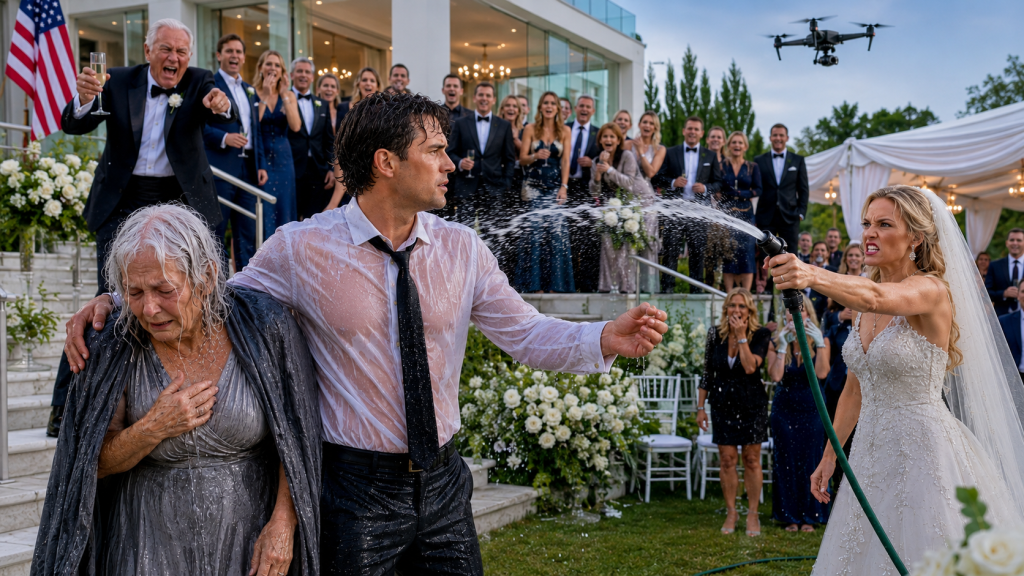
The first blast of water hit my mother before I fully understood what was happening.
By the time I reached her, her worn gray dress was soaked through. Her white hair clung to her face, and she was trembling beneath the freezing spray.
Vanessa—the woman who was supposed to become my wife—still had one hand wrapped around the garden hose nozzle.
On the terrace, her father, Charles Whitmore, lifted his champagne glass and laughed.
“Would you look at her?” he called out. “She looks like she wandered in from a bus terminal.”
Several guests laughed with him.
Not because the joke was funny.
Because Charles Whitmore was powerful, and people who wanted something from him had learned to laugh whenever he did.
Vanessa smiled beneath her long cathedral veil.
“Calm down, Daniel,” she said. “It’s only a joke. I’m trying to rinse away the smell of poverty.”
Then she aimed the hose again.
The water struck my mother’s shoulder and forced her backward.
I moved in front of her without hesitation.
The next stream hit me across the chest.
Water ran down my shirt and trousers as I stared at Vanessa. For the first time since meeting her three years earlier, I saw her without the beauty, the charm, or the polished manners she wore in public.
I saw a cruel woman enjoying the humiliation of someone who had never harmed her.
“Drop the hose,” I said.
Vanessa rolled her eyes.
“Don’t be so dramatic. You’re ruining the fun.”
Behind me, my mother gently touched my arm.
“Danny, please,” she whispered. “Not today.”
Those words hurt more than the humiliation itself.
She was the one standing there drenched and shivering, yet she was still worried about destroying my wedding.
Nearly two hundred guests stood beneath white silk canopies across the lawn of the Whitmore estate. Some looked horrified. Others kept smiling nervously because Charles was still laughing.
The string quartet had fallen silent.
Above the ceremony, a drone camera hovered in the air, capturing every second.
I slowly removed my wedding ring.
Vanessa’s expression changed immediately.
“The wedding is over,” I said. “And before the sun rises tomorrow, your family’s empire will be gone.”
For one long moment, the entire lawn became silent.
Then Charles laughed even harder.
“Our empire?” he mocked. “You’re nothing more than a consultant with a salary and an old car.”
Vanessa threw the hose onto the grass.
“Put that ring back on,” she demanded. “You’re embarrassing yourself.”
“No,” I replied. “You already handled that.”
I removed my jacket and placed it around my mother’s shoulders. Then I guided her away from the stunned guests and toward my car.
Charles followed us down the terrace steps.
His voice had lost some of its amusement.
“If you leave now, you lose everything,” he warned. “Your apartment, your position, your connections. Everything you have came from me.”
I stopped walking.
That was what Charles had always believed.
During my two-year engagement to Vanessa, I had allowed the Whitmore family to see me as useful but insignificant.
I attended their private meetings.
I reviewed their contracts.
I quietly corrected their financial mistakes.
And I listened while they boasted about acquisitions and investments funded by money they did not truly control.
Charles had never questioned why three major banks had approved emergency financing for his failing company within forty-eight hours.
He had never investigated who actually owned Northbridge Capital, the private investment firm concealed behind six holding companies.
Most importantly, he had never wondered why my mother continued wearing an old gray dress when she had enough wealth to purchase the Whitmore estate without taking out a loan.
They believed modesty meant poverty.
They believed silence meant weakness.
And they believed I needed their family more than they needed me.
I helped my mother into the passenger seat and carefully closed the door.
Across the lawn, Vanessa ripped the veil from her head while Charles continued shouting threats.
I removed my phone and called my attorney.
Rebecca answered immediately.
“Rebecca,” I said, keeping my eyes on the Whitmore family, “release the files.”
There was a brief silence.
“All of them?”
“Every contract, every credit guarantee, and every ownership document.”
Vanessa stopped moving.
Perhaps it was something in my voice.
Perhaps she finally remembered the confidential papers I had spent months reviewing.
Charles remained convinced he had created me.
He had no idea that Northbridge Capital belonged to my mother.
He did not know that nearly every loan keeping the Whitmore companies alive depended on guarantees she controlled.
And he certainly did not understand that humiliating her in front of two hundred witnesses had just cost his family everything.
Rebecca did not ask another question.
“Understood,” she said.
I ended the call and climbed behind the wheel.
My mother sat quietly beside me, clutching my jacket around her shoulders. Drops of water fell from the ends of her hair onto the leather seat.
She never asked what I had done.
She simply looked out the window as the Whitmore estate disappeared behind us.
For several miles, neither of us spoke.
The wedding flowers, white tents, and luxury cars vanished in the rearview mirror. We passed through the iron gates and followed the long road toward the city.
My hands were tight around the steering wheel.
“I’m sorry, Mom,” I finally said.
She turned toward me.
“What are you sorry for?”
“For bringing you there. For not seeing what they were capable of. For letting them believe they could treat you that way.”
She reached across the console and placed her cold hand over mine.
“You did not pour the water.”
“I gave them the opportunity.”
“No,” she replied. “You gave them trust. What they did with it belongs to them.”
That was the kind of woman my mother had always been.
Eleanor Mercer never confused kindness with weakness, though many people had made that mistake.
When I was a child, she worked in a small neighborhood bakery and wore the same two dresses through most of my elementary school years. My father died when I was nine, leaving behind medical bills and a workshop full of unfinished furniture.
I remembered helping her count coins at the kitchen table.
I remembered the nights she pretended she had already eaten so I could finish the last piece of chicken.
What I had not understood then was that my mother was building something quietly.
She had studied bookkeeping at night.
She had invested tiny amounts in struggling local businesses.
She had taken ownership stakes instead of immediate repayment when shop owners could not afford her consulting fees.
Over three decades, those small holdings became a network of manufacturing companies, transportation firms, warehouses, and real-estate investments.
By the time I graduated from college, she was wealthier than nearly everyone in the city.
Yet she continued living in the same modest house.
She still clipped coupons.
She still repaired her clothes rather than replacing them.
And she still introduced herself simply as Eleanor.
Northbridge Capital had been created to manage her investments privately. Only a handful of attorneys and executives knew she was the owner.
She had never wanted her wealth to become her identity.
“You should have told them,” I said.
“Told them what?”
“That you owned Northbridge. That you could buy their company.”
She gave me a tired smile.
“If someone respects a poor woman only after discovering she is rich, then the respect is worthless.”
I had heard her say similar things before.
That afternoon, the lesson felt sharper.
My phone began vibrating in the cup holder.
Charles.
I ignored it.
Then Vanessa called.
Then Charles again.
Within ten minutes, there were calls from Whitmore board members, bank executives, attorneys, private investors, and journalists.
Rebecca had moved quickly.
Northbridge Capital had formally notified every lender that it was withdrawing its discretionary guarantees from Whitmore Holdings and its subsidiaries.
The guarantees had not been gifts. They were contractual protections linked to strict conditions, including truthful financial reporting, ethical conduct by senior leadership, and compliance with lending requirements.
For months, Rebecca and I had documented violations.
The wedding had not created the Whitmores’ problems.
It had merely removed the last reason my mother had for protecting them.
I drove directly to her house.
The old brick home stood at the end of a quiet street beneath two enormous maple trees. It was worth less than one of the flower arrangements at the wedding.
Yet stepping inside felt like breathing again.
I turned up the heat while my mother changed into dry clothes.
When she returned, she wore a blue cardigan and soft cotton trousers. She had wrapped a towel around her hair.
I made tea.
She sat at the kitchen table while I checked my phone.
Thirty-seven missed calls.
Twelve voicemails.
Eighty-four text messages.
Vanessa’s first messages were angry.
You made your point. Come back now.
My father is furious.
People are still waiting.
Stop behaving like a child.
Then the tone changed.
Daniel, call me.
Something is happening with the banks.
Dad says Northbridge canceled the guarantees.
Please answer.
The final message had arrived two minutes earlier.
I’m sorry about your mother. It was a stupid joke. Please don’t destroy my family over one mistake.
I placed the phone facedown.
My mother watched me.
“Do you still love her?” she asked.
I wanted to answer immediately.
Instead, I stared at the steam rising from my tea.
“I loved the person I believed she was.”
“That is not the same thing.”
“No.”
“Then you are grieving someone who never existed.”
Her words settled heavily in the room.
At six-thirty that evening, Rebecca arrived carrying two legal cases and a laptop.
She had been my family’s attorney for nearly fifteen years. She was calm under pressure, careful with language, and almost impossible to intimidate.
She took one look at my damp formal clothes and shook her head.
“I saw the video,” she said.
“What video?”
“Apparently, one of the guests posted the drone footage online. It has already been copied thousands of times.”
My mother closed her eyes.
Rebecca sat across from us and opened her laptop.
“The public humiliation is becoming the least of the Whitmores’ problems.”
She turned the screen toward me.
Whitmore Holdings’ after-hours share price had fallen twenty-eight percent. Two lenders had frozen new credit. A major supplier had suspended shipments until the company’s financial position could be reviewed.
“The board is holding an emergency meeting at nine,” Rebecca explained. “Charles is trying to convince them that Northbridge acted because of a private family dispute.”
“It didn’t,” I said.
“No. The withdrawal notices cite documented breaches going back eighteen months.”
My mother looked at Rebecca.
“Did you release everything?”
“Not everything.”
Rebecca opened another folder.
Inside were records I had hoped never to use.
The Whitmore empire had been presented to the public as a triumph of hard work and family leadership. Charles often told reporters that he had transformed a small construction firm into an international development company through discipline and vision.
The truth was less impressive.
Whitmore Holdings had grown through reckless borrowing, falsified valuations, hidden liabilities, and political favors.
I had discovered the first irregularity eight months earlier while reviewing a warehouse acquisition.
An environmental cleanup estimate had been removed from the final report. The missing liability was nearly $40 million.
When I questioned Charles, he claimed it was an administrative error.
Then I found three more.
A pension obligation had been shifted to an inactive subsidiary.
Two executives had received secret payments through a consulting firm owned by Vanessa’s uncle.
A luxury resort project had used restricted loan funds to cover losses elsewhere in the company.
I began copying documents.
Rebecca began building a legal file.
My mother kept the guarantees in place because an immediate collapse would have harmed thousands of employees, contractors, and retirees.
We had been preparing a controlled restructuring that would remove Charles while protecting the healthy parts of the company.
That plan was supposed to begin after the wedding.
Vanessa knew none of it.
Or so I had believed.
Rebecca opened a video recording.
“I received this an hour ago,” she said. “It came from someone inside Whitmore Holdings.”
A security camera showed Charles and Vanessa standing in his office three nights before the wedding.
There was no sound at first.
Then the audio began.
Vanessa’s voice was unmistakable.
“Once Daniel signs the marital agreement, we gain access to whatever he controls.”
Charles leaned against his desk.
“He doesn’t control anything important.”
“He has access to Northbridge files.”
“Access is not ownership.”
“But he knows who makes the decisions. After the wedding, he’ll tell me.”
Charles poured himself a drink.
“And if he doesn’t?”
Vanessa laughed.
“He will. Daniel has spent his entire life trying to prove he belongs in rooms like ours. Men like him will tolerate almost anything once they believe they’ve been accepted.”
I felt something inside me turn cold.
My mother reached for my hand.
On the recording, Charles moved closer to his daughter.
“Do not underestimate him.”
“I don’t,” Vanessa replied. “I understand him. That’s better.”
The video ended.
For a long time, the three of us sat without speaking.
The hose had ended the wedding.
The recording destroyed whatever grief I still carried for the relationship.
“She planned to use me,” I said.
Rebecca nodded.
“It appears so.”
“Who sent this?”
“She refused to identify herself. She said she would speak to you in person at midnight.”
“Where?”
“The old Whitmore textile mill.”
That building had been closed for years.
It was also where Charles had started his first company.
Rebecca continued, “She claims to have evidence of criminal activity. She says the material could send several members of the Whitmore family to prison.”
My mother’s expression tightened.
“It could be a trap.”
“It could,” Rebecca agreed.
“I’m going,” I said.
My mother looked at me.
“Then we are not going alone.”
At nine o’clock, the Whitmore board meeting began.
I knew because Charles called me from the conference room.
This time, I answered.
His voice came through the speaker.
“Daniel, you will reverse those notices immediately.”
“No.”
“You have no idea what you’ve done.”
“I know exactly what I’ve done.”
Around him, I could hear people arguing.
Charles lowered his voice.
“Your mother will face consequences.”
I looked across the table at her.
She remained perfectly still.
“Is that a threat?”
“It is advice. Northbridge interfered with contractual relationships because of an incident at a private event. Every judge in the state will see this as retaliation.”
“The guarantees were withdrawn because your company violated their conditions.”
“Those violations were addressed.”
“No, Charles. They were hidden.”
The room behind him became quieter.
He had put the call on speaker.
Good.
I continued.
“Northbridge has evidence of false valuations, undisclosed liabilities, diverted project funds, and payments to shell companies connected to your relatives. Would you like me to read the transaction numbers aloud?”
Charles said nothing.
A woman in the conference room spoke.
“Mr. Whitmore, is that true?”
I recognized the voice of board member Helen Grant.
Charles covered the phone, but I could still hear shouting.
Then Vanessa took over the call.
“Daniel, please.”
Her tone was softer now.
“Come back to the estate. We can talk privately.”
“There is nothing left to discuss.”
“I apologized.”
“You apologized after the banks called.”
“I made a terrible mistake.”
“You picked up a hose and attacked my mother while your friends applauded.”
“It was supposed to be funny.”
“Explain the joke.”
She became silent.
I waited.
“What part was funny, Vanessa? Was it her shaking? Her wet clothes? Or the belief that she was too poor to defend herself?”
“I wasn’t thinking.”
“That is the first honest thing you’ve said.”
Her voice cracked.
“Do you really intend to ruin thousands of people because you hate me?”
“No. I intend to protect those people from your father.”
Charles grabbed the phone again.
“You ungrateful little fraud,” he snarled. “I brought you into this company.”
“You brought me in because Northbridge required independent financial supervision before extending your credit.”
Another silence.
It was the first time Charles understood that my employment had never been a favor.
“You work for Northbridge,” he said slowly.
“I represent its controlling owner.”
“Who?”
I looked at my mother.
She gave the smallest nod.
“The woman your daughter sprayed with a garden hose.”
Someone in the boardroom gasped.
Charles did not speak for several seconds.
Then he laughed once, but there was no confidence in it.
“That is impossible.”
“You’ll receive the ownership documents before midnight.”
I ended the call.
At ten-fifteen, the board voted to suspend Charles as chief executive pending an investigation.
At ten-thirty, security escorted him from the Whitmore headquarters.
At eleven, Vanessa arrived at my mother’s house.
She came alone.
Her wedding gown was gone. She wore a cream coat over casual clothes, and her makeup had been washed away. Without the diamonds and veil, she looked smaller.
She stood on the porch beneath the yellow light.
I stepped outside and closed the door behind me.
“Daniel,” she whispered.
“You shouldn’t be here.”
“I had nowhere else to go.”
“You own three houses.”
“My father changed the security codes at the estate. He says this is my fault.”
“It is partly your fault.”
Tears filled her eyes.
“I didn’t know your mother owned Northbridge.”
“That is the problem, Vanessa. You believe knowing would have changed what you did.”
“It would have.”
“I know.”
She stared at me.
For a moment, neither of us spoke.
Then she removed the engagement ring from her finger.
It was a large diamond chosen by her mother. Vanessa had complained that my original ring was too simple, so Charles arranged for a jeweler to replace it.
She held it toward me.
I did not take it.
“Keep it,” I said.
“I don’t want it.”
“Then sell it and give the money to a shelter.”
Her hand fell to her side.
“Did you ever love me?”
“Yes.”
The answer seemed to hurt her more than anger would have.
“Then how can you be so cold?”
“Because love does not require me to remain available for abuse.”
“I wasn’t going to hurt your mother.”
“You did hurt her.”
“I mean seriously.”
“She does not have to be hospitalized for your behavior to matter.”
Vanessa wiped her face.
“My father taught me that people either control the room or become invisible inside it. I was trying to make everyone laugh. I wanted them looking at me.”
“They were already looking at you. You were the bride.”
“That was not enough.”
There it was.
Not an excuse.
But perhaps a fragment of truth.
Vanessa had spent her life performing for Charles. Every achievement had to be bigger, brighter, and more expensive than the one before. Kindness gained no attention in that family.
Cruelty did.
“I hope you learn from what happened,” I said.
“Can we ever fix this?”
“No.”
She closed her eyes.
When she opened them again, something in her expression had changed.
“My father has been hiding money,” she said.
I said nothing.
“He keeps records at the old textile mill. There is a private office beneath the loading floor.”
“You sent the video to Rebecca.”
She nodded.
“I knew he was using me. I just didn’t know how to escape him without losing everything.”
“So you planned to use me instead.”
Her face twisted with shame.
“At first.”
The honesty surprised me.
“And later?”
“I thought I loved you.”
“Thought?”
“I don’t know whether someone like me understands what love is.”
Behind us, the front door opened.
My mother stepped onto the porch.
Vanessa looked at her and began crying harder.
Mrs. Mercer’s hair was dry now. She wore her old blue cardigan and held herself with the quiet dignity Vanessa had mistaken for weakness.
“I am sorry,” Vanessa said.
My mother studied her.
“Are you sorry because you hurt me or because your life is collapsing?”
Vanessa looked down.
“Both.”
“That is at least honest.”
“I don’t expect forgiveness.”
“You should not.”
Vanessa nodded.
Then she reached into her coat and removed a key card.
“This opens the lower office at the mill. My father is going there tonight. He intends to destroy the records before investigators find them.”
“What time?” I asked.
“He left twenty minutes ago.”
Rebecca arrived as Vanessa was speaking.
Within minutes, we contacted federal investigators already reviewing the financial documents. They instructed us not to approach the mill.
I intended to obey.
Then Vanessa’s phone rang.
She glanced at the screen.
“My brother,” she said.
She answered.
A frightened male voice came through.
“Vanessa, Dad knows you took the key. He has Mom at the mill. He says she helped you copy the files.”
Vanessa went pale.
“Is she hurt?”
“I don’t know. He locked me outside. He has two security men with him.”
The call ended.
Vanessa looked at me.
“I have to go.”
“No,” Rebecca said. “The investigators are on their way.”
“My mother is inside.”
“So let trained officers handle it.”
But Vanessa was already running toward her car.
I followed.
My mother called my name.
I turned.
She held my gaze for a long second.
“Bring everyone home safely,” she said.
The old textile mill stood beside the river in the industrial district, surrounded by broken fencing and abandoned warehouses.
Rain had begun falling.
Vanessa’s car stopped near the main entrance. I pulled in behind her as unmarked vehicles approached from the opposite street.
She ran toward the building before anyone could stop her.
I followed her through a rusted side door.
Inside, the air smelled of damp wood, oil, and dust.
“Mom!” Vanessa shouted.
Her voice echoed through the empty mill.
A light appeared at the far end of the loading floor.
Charles stepped from behind a support column.
He was still wearing his wedding tuxedo, though the jacket was gone and his shirt sleeves were rolled up. His face looked gray beneath the industrial lights.
Two security guards stood behind him.
Vanessa’s mother, Margaret, sat in a chair with her hands free but her face wet with tears.
“You betrayed me,” Charles said.
Vanessa stopped.
“You betrayed all of us.”
“I built everything you have.”
“You borrowed everything we have.”
His eyes moved toward me.
“And you,” he said. “The charity case who thought he could become king.”
“I never wanted your empire.”
“You destroyed it anyway.”
“No. I stopped hiding the damage you caused.”
Charles took a metal fuel container from the floor.
The sharp smell of gasoline reached us.
Stacks of paper covered a table behind him.
“If I cannot keep the company,” he said, “Northbridge will not have the records.”
“Dad, stop,” Vanessa pleaded.
“You humiliated me.”
“You attacked Daniel’s mother.”
“It was a joke.”
Even then, he could not admit what he had done.
Red and blue lights flashed through the broken windows.
Charles looked toward them.
His security guards immediately stepped away from him.
They had been willing to intimidate.
They were not willing to go to prison.
Charles shouted at them, but both men raised their hands and walked toward the entrance.
Margaret stood from the chair and moved toward Vanessa.
Charles grabbed her wrist.
“You stay with me.”
She looked at him with a tiredness that appeared decades old.
“No.”
He stared at her.
Margaret pulled her arm free.
“For forty-one years, I stayed quiet while you insulted people, cheated partners, and taught our children that compassion was weakness. I told myself I was protecting the family.”
She stepped away from him.
“I was protecting you from consequences.”
Charles lifted the fuel container.
I moved between him and the table.
“You think losing the company makes you nothing,” I said.
“You know nothing about me.”
“I know you built your identity around making other people feel small.”
He gripped the container tighter.
“Move.”
“No.”
Behind me, Vanessa guided her mother toward the exit.
Charles looked at his wife, then his daughter, then the approaching officers.
His shoulders sagged.
For a moment, I thought he would surrender.
Instead, he threw the container toward the papers and reached for a lighter.
I struck his hand before he could ignite it.
The lighter skidded across the floor.
Charles swung at me.
His fist caught my jaw, and I stumbled backward against the table.
He reached for the lighter again.
Before he could touch it, Vanessa kicked it beneath a heavy machine.
Officers rushed into the building.
Charles was forced to the ground and handcuffed.
As they lifted him, he looked at Vanessa.
“You did this.”
She shook her head.
“No, Dad. You did.”
The files survived.
They revealed years of fraud, bribery, tax evasion, and the diversion of employee pension funds.
Charles Whitmore was charged with multiple financial crimes. Several executives and relatives were charged alongside him.
The collapse of the Whitmore empire did not happen by sunrise exactly.
Empires rarely disappear in a single night.
They unravel contract by contract, lie by lie, and account by account.
But by sunrise, Charles had lost control of the company.
The board had removed him.
The banks had frozen his access to credit.
Investigators had secured the evidence.
And every major newspaper carried a photograph from the wedding.
In the image, my mother stood drenched in her gray dress while I shielded her from the water.
The headline beneath it read:
THE WOMAN THEY MOCKED OWNED THE COMPANY THAT KEPT THEM ALIVE.
My mother hated the attention.
For three days, reporters gathered outside her home.
She refused every interview.
Finally, she released a short statement.
“Wealth does not make a person worthy of dignity. Poverty does not remove that dignity. What happened to me was wrong before anyone knew my bank balance.”
The statement was printed across the country.
Northbridge Capital took temporary control of Whitmore Holdings through the debt agreements.
We did not destroy the healthy businesses.
We saved them.
Rebecca and I created a restructuring plan that protected employees, pensions, suppliers, and unfinished projects. Wasteful divisions were closed. Fraudulent contracts were canceled. Independent executives replaced Charles and his inner circle.
Thousands of workers kept their jobs.
My mother insisted that a portion of her recovered investment fund scholarships, housing assistance, and meal programs for low-income families.
She refused to name the program after herself.
Instead, she called it the Gray Dress Foundation.
When I asked why, she smiled.
“So people remember that clothes tell you very little about the person wearing them.”
Vanessa cooperated with investigators.
Her testimony helped prove several of the charges against her father.
She sold the engagement ring and donated the money to a women’s shelter, just as I had suggested. Months later, I received a receipt in the mail without a note.
We did not reconcile.
Some actions change the shape of a relationship permanently.
Forgiveness may release anger, but it does not always restore access.
Vanessa moved to another state and began working for a nonprofit organization that provided legal assistance to families facing eviction.
Whether she changed because she truly understood her cruelty or because she had lost the life that rewarded it, I could not say.
Perhaps, in time, the difference would matter less than what she chose to do next.
Margaret filed for divorce after Charles’s arrest.
She testified against him and surrendered several properties purchased with illegal funds.
For the first time in decades, she lived in a small apartment under her own name.
My mother visited her once.
I never asked what they discussed.
A year after the failed wedding, Charles was convicted.
The judge sentenced him to prison and ordered the seizure of his remaining personal assets.
As officers led him from the courtroom, he looked toward me.
The old anger was still present, but it had weakened.
He had spent his entire life believing that fear was respect and money was character.
In the end, neither belief could save him.
Outside the courthouse, reporters gathered around my mother.
One journalist asked how it felt to defeat the man who had humiliated her.
She paused before answering.
“I did not defeat him,” she said. “He defeated himself every time he chose pride over decency.”
Then she took my arm, and we walked away.
Two years later, I stood beneath the maple trees in my mother’s backyard.
There were no white silk canopies.
No champagne towers.
No drone cameras.
Only folding chairs, wildflowers in glass jars, and thirty people we genuinely loved.
Beside me stood Rebecca.
During the Whitmore investigation, our professional friendship had become something deeper. She never cared what car I drove, what company my mother owned, or which rooms I could enter.
She cared whether I was honest.
She cared whether I listened.
And she treated my mother with respect long before she knew the full extent of her wealth.
My mother wore the same gray dress.
I had offered to buy her something new.
She refused.
“This dress has survived worse than a wedding,” she said. “It deserves a happier memory.”
When Rebecca walked toward me, my mother was sitting in the front row.
Her white hair shone in the afternoon sunlight.
There was no laughter at her expense.
No one looked at her with pity.
The people around her knew that she was wealthy, but that was not why they loved her.
They loved her because she remembered birthdays, delivered soup when someone was sick, and treated frightened interns with the same patience she gave powerful executives.
When it was time to exchange rings, I looked at Rebecca.
For a brief moment, I remembered the cold water, Vanessa’s laughter, and the ring lying in my wet palm.
Then Rebecca took my hand.
“No empires,” she whispered.
I smiled.
“No empires.”
“Just a life?”
“Just a good one.”
We exchanged our vows beneath the trees.
After the ceremony, my mother found me near the kitchen door.
“You look happy,” she said.
“I am.”
She adjusted my tie as she had done when I was a boy.
“Your father would have been proud.”
I swallowed.
“I hope so.”
“He would.”
We stood quietly together while laughter drifted from the garden.
Not cruel laughter.
Not the kind that demanded someone else’s humiliation.
It was warm and ordinary, the sound of people who felt safe with one another.
My mother looked down at her gray dress.
“Do you think the stains are gone?”
I glanced at the faint water marks near the hem.
“No.”
“Good.”
“Good?”
She smiled.
“Some stains should remain. Not to preserve the pain, but to remember what it revealed.”
I understood.
That terrible wedding had revealed Vanessa’s cruelty, Charles’s corruption, and the weakness hidden beneath the Whitmore family’s confidence.
But it had also revealed something else.
It showed me that dignity did not come from wealth.
Power did not come from humiliating others.
And family was not defined by impressive names, estates, or invitations.
Real strength had been sitting quietly beside me all along, wearing an old gray dress and asking for nothing.
As the sun lowered behind the maple trees, I watched my mother join the other guests.
Rebecca slipped her hand into mine.
Northbridge continued to grow, but we changed how it operated.
Every company seeking our investment was evaluated not only on profits but on how it treated workers, customers, and communities.
Some executives called the policy sentimental.
My mother called it common sense.
“Character is a financial risk,” she told the board. “Ignore it, and eventually you pay.”
No one argued with her.
The Gray Dress Foundation expanded into twelve cities. It funded emergency housing, job training, food programs, and legal support for elderly people facing financial abuse.
At the opening of its first community center, someone asked my mother why she had waited so long to make her identity public.
She looked toward me before answering.
“Because privacy allowed me to see how people behave when they believe I have nothing to offer them.”
The room became silent.
Then she added, “It was often disappointing. But sometimes it was beautiful.”
Years later, the Whitmore estate was sold.
Northbridge purchased the property through an open auction, not because we wanted the mansion but because my mother had a plan for the land.
The ballroom became a public library.
The guesthouses became transitional housing for women and children.
The wide lawn where Vanessa had sprayed my mother with freezing water became a community garden.
The marble terrace remained.
My mother insisted on keeping the old outdoor faucet.
Above it, workers placed a small brass plaque.
It did not mention Charles, Vanessa, or the wedding.
It simply read:
KINDNESS COSTS NOTHING. CRUELTY MAY COST EVERYTHING.
On the morning the new center opened, my mother and I stood near that faucet.
Children ran across the lawn where wedding guests had once laughed.
Families carried boxes into the renovated cottages.
Volunteers planted flowers beneath the white canopies.
My mother touched the brass plaque.
“Do you think this is too dramatic?” she asked.
“Not dramatic enough.”
She laughed.
Then she linked her arm through mine.
The woman they had mistaken for a beggar had not merely survived their contempt.
She had transformed the place built to display their wealth into something that served people they would once have ignored.
The Whitmore empire was gone.
In its place stood a library, a garden, safe homes, and a lesson no one who entered the grounds could miss.
Money had given Charles power for a time.
But it was my mother’s dignity, patience, and compassion that created something worth leaving behind.
And whenever I saw her walking across that lawn in her old gray dress, I remembered the moment the freezing water struck her.
I remembered stepping between her and the hose.
I remembered removing the ring and ending the life I had nearly chosen.
Most of all, I remembered that sunrise.
The Whitmore family woke believing their empire had been stolen from them.
The truth was simpler.
Their empire had been supported by trust.
And the moment they proved themselves unworthy of that trust, it disappeared.
THE END! THANK YOU FOR READING!