

Gloria stood in the kitchen doorway holding a clean towel in both hands, staring at the untouched tables as though she were trying to understand where the celebration had gone.
For forty years, I had watched my wife endure hardship without allowing it to harden her.
She had survived overdue bills, broken appliances, an emergency surgery we could barely afford, and the slow years when our restaurant earned just enough to remain open. She had comforted Kevin through childhood fevers, school disappointments, and the collapse of his first marriage. She had welcomed Tiffany into our family even when Tiffany treated kindness like a service she had purchased.
But that afternoon, something inside Gloria seemed to go quiet.
She did not cry.
That frightened me more than tears would have.
I stepped into the backyard and looked at the tables.
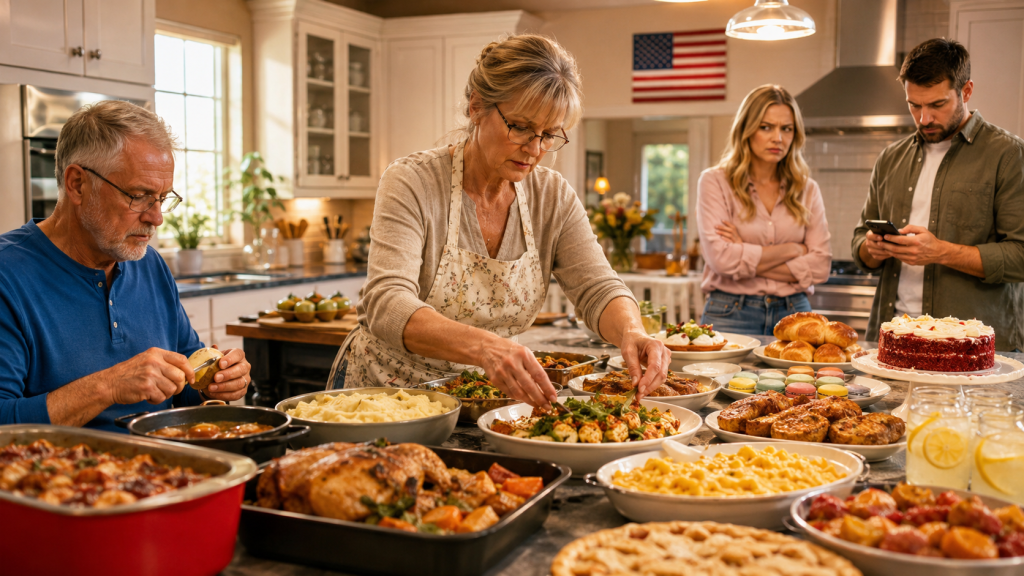
The roast chickens were still warm. Butter glistened over the carrots. The macarons were arranged by color on silver trays Gloria had polished the previous evening. Each dish had a handwritten label because Tiffany had warned us that her friends expected “professional presentation.”
Seventy-five chairs faced nothing.
I pulled out my phone.
“What are you doing?” Gloria asked.
“Remembering.”
I took one photograph.
It captured the tables, the untouched food, the empty chairs, and Gloria standing in the doorway with a bandage around her fingers.
Then I opened the social media page for Gloria’s Corner.
Our restaurant had never been famous. It was the sort of place where firefighters ate breakfast after overnight shifts and retired schoolteachers shared one slice of pie with two forks. We had fewer than three thousand followers, most of them people from the neighborhood.
I posted the photograph with a short message.
“After two sleepless nights, my wife prepared this meal with love for our granddaughter’s eighteenth birthday. The family chose another restaurant instead. Anyone hungry is welcome before sunset. No charge. Bring a container if you know someone who needs dinner.”
I pressed the button before Gloria could stop me.
“Hank,” she whispered.
I put the phone in my pocket.
“I should have defended you years ago.”
“This will embarrass Kevin.”
“He watched his mother work herself sick and then walked away from her. Maybe embarrassment is the first honest thing he needs to feel.”
Gloria lowered her eyes.
“He is still our son.”
“I know.”
That was the problem.
For too long, we had confused loving our son with protecting him from the consequences of his choices.
The first car arrived nineteen minutes later.
It belonged to Mrs. Alvarez, a widow who lived four houses down. She stepped through the gate carrying three plastic containers and wearing bedroom slippers beneath her coat.
“I saw your post,” she said breathlessly. “My sister is recovering from surgery. May I take her some soup?”
Gloria immediately moved toward the table.
“Of course. The tomato soup is still hot.”
I noticed her voice change when she lifted the lid.
That soup had been made for Kevin.
Mrs. Alvarez filled one container, then hesitated.
“Is everything all right?”
Gloria smiled the way she always smiled when she wanted to protect someone else from discomfort.
“Everything is fine.”
Mrs. Alvarez looked at the empty chairs and knew better.
She hugged Gloria before leaving.
A few minutes later, two firefighters from the station near our restaurant arrived. Then a nurse from the neighborhood clinic came with a young mother whose husband had recently lost his job. A church van pulled up beside our garage. People began entering through the gate carrying containers, paper bags, and quiet expressions of concern.
No one rushed.
No one treated the food as free leftovers.
They complimented the careful labels. They asked Gloria which dishes had taken the longest. They thanked her before accepting anything.
A little boy tasted one of the croissants and closed his eyes.
“This is better than the bakery,” he announced.
For the first time since the guests had left, Gloria laughed.
By five o’clock, our backyard was full again.
But these people were not dressed for an elegant birthday dinner.
They wore work uniforms, winter coats, medical scrubs, and paint-stained boots. Some came directly from jobs. Others arrived after hearing that food was being shared with anyone who needed it.
A teacher from the elementary school helped serve macaroni and cheese.
Two teenagers carried plates to an elderly couple waiting in their car.
A delivery driver called a shelter and asked how many meals they could accept.
Someone brought paper plates.
Someone else brought coffee.
Mrs. Patel from the pharmacy appeared with a roll of bandages and insisted on examining Gloria’s fingers.
“You should not have been working with this burn,” she said.
Gloria glanced at me.
“I had food to finish.”
Mrs. Patel shook her head and wrapped the fingers properly.
“You always take care of everyone. Sometimes you must allow people to take care of you.”
That sentence reached a place inside my wife that my own words had failed to touch.
Her eyes filled.
She turned away quickly, pretending to check the peach cobbler.
At five-thirty, my phone began vibrating.
Kevin.
I did not answer.
It rang again.
Then Tiffany called.
Then Kevin again.
I switched the phone to silent and placed it facedown on the patio table.
Gloria noticed.
“You should answer.”
“No.”
“What if something happened?”
“Something did happen. It happened here.”
The restaurant where Tiffany had taken everyone was only fifteen minutes away, but from the number of calls, I suspected the photograph had reached them before dessert.
One of Kayla’s friends had apparently shared the post.
Then another relative shared it.
Within two hours, the photograph had been passed around thousands of times.
Comments appeared beneath it faster than I could read.
Some people praised Gloria’s cooking.
Others criticized the family who had abandoned the food.
Several local business owners offered to donate containers or help deliver meals.
A reporter from a neighborhood news page sent a message asking whether she could come by.
I ignored that one.
I had not posted the photograph to make Gloria a public spectacle.
I had posted it because I wanted the truth to exist somewhere outside our kitchen.
For years, Tiffany had rewritten every family story until she appeared generous and we appeared grateful for whatever scraps of attention she gave us.
When we paid for Kevin and Tiffany’s honeymoon, she told people her parents had covered it.
When Gloria cooked for Tiffany’s baby shower, Tiffany claimed the food came from an expensive caterer.
When we watched Kayla every weekday for four years without payment, Tiffany described us as lonely grandparents who begged for time with the baby.
The photograph could not be rewritten.
It showed exactly what had happened.
As the sun lowered behind the neighboring houses, nearly every dish disappeared into grateful hands.
A shelter received forty-two meals.
The clinic took soup and bread for patients who had nowhere to go after discharge.
The firefighters carried two trays back to the station.
A young father took peach cobbler to his children and tried to pay us.
Gloria refused the money.
He left a twenty-dollar bill beneath a serving spoon anyway.
When the final family departed, only one small bowl of tomato soup remained.
Gloria covered it and placed it in the refrigerator.
I knew she was still saving it for Kevin.
We were folding the last table when three vehicles stopped outside our house.
Kevin emerged from the first one.
Tiffany climbed out beside him, gripping her phone so tightly that her knuckles appeared white.
Kayla and several relatives followed from the other cars.
They entered through the gate without knocking.
Tiffany looked around the nearly empty backyard.
“Where is everything?”
I continued folding the table.
“People ate it.”
“You gave it away?”
“That was the invitation.”
Her voice rose.
“You had no right to post that photograph.”
I locked the table legs into place.
“It was taken in my backyard.”
“You made us look terrible.”
I finally faced her.
“I did not make you look like anything.”
Kevin stepped between us.
“Dad, take the post down.”
“No.”
His face tightened.
“Everyone at the restaurant saw it. Kayla’s friends were reading the comments. Tiffany’s parents were humiliated.”
I looked toward Gloria.
She stood beside the kitchen door, the bandage still wrapped around her hand.
“Your mother was humiliated in front of seventy-five people.”
Kevin’s gaze moved toward the bandage, then away.
“That wasn’t our intention.”
“Your intention stopped mattering when you walked past her without speaking.”
Tiffany gave a short, angry laugh.
“This is unbelievable. We moved the party because the restaurant was more appropriate. No one forced Gloria to make all that food.”
I reached into my pocket and pulled out the folded list.
The paper was stained with butter and coffee.
“You handed her thirty-eight instructions less than a day before the party.”
“She could have said no.”
Gloria flinched.
Tiffany noticed and continued.
“She runs a restaurant. Cooking is what she does.”
“No,” I said. “Cooking is her profession. Sacrifice is what you demanded.”
One of the relatives, my sister Elaine, stepped forward.
“Hank, maybe everyone should calm down.”
I looked at her.
“You were sitting beside Gloria when Tiffany announced the restaurant.”
Elaine lowered her head.
“You left too.”
“We didn’t know what to do.”
“You could have stayed.”
No one answered.
The backyard became quiet again, but this silence felt different from the one earlier.
The first silence had belonged to cruelty.
This one belonged to recognition.
Kayla stood behind her parents with her arms folded across her chest. Her birthday dress was pale blue, and a silver necklace rested against her collarbone. Gloria had given her that necklace the previous year.
“Grandpa,” she said, “can you please remove the picture? People at school are calling my party the empty-table birthday.”
I studied my granddaughter’s face.
I had driven her to dance lessons, attended every school performance, and built a wooden dollhouse for her when she was seven. I loved her. But love did not mean lying to protect her from discomfort.
“Did you see your grandmother’s hands before you left?”
Kayla glanced toward Gloria.
“No.”
“Did you thank her for the food?”
“I didn’t ask her to make it.”
The words came quickly, almost automatically.
I saw Kevin close his eyes.
Perhaps he heard himself in his daughter.
Gloria stepped forward.
“She is right. Kayla did not make the list.”
Tiffany lifted her chin as if Gloria’s defense had proven her point.
But Gloria was not finished.
“You did not make the list,” she told Kayla, “but you saw the tables. You saw me standing beside them. You knew I had cooked for your birthday, and you left without saying goodbye.”
Kayla’s expression changed.
Her arms slowly fell to her sides.
Gloria’s voice remained calm.
“I would have understood if you wanted the restaurant. Eighteen is an important birthday. I would have packed the food and wished you a lovely evening. But none of you told us beforehand. You let us arrange the chairs. You let us welcome the guests. Then you announced that my work was not special enough.”
Tiffany opened her mouth.
Gloria raised one bandaged hand.
“No. You have spoken enough today.”
I had never heard my wife speak to her that way.
Neither had anyone else.
Tiffany’s face reddened.
“I was trying to give my daughter a sophisticated celebration.”
“And I was trying to give my granddaughter love,” Gloria replied. “Perhaps love seemed too simple.”
Kevin moved toward his mother.
“Mom, I’m sorry.”
She looked at him for a long moment.
“You are sorry because people saw what happened.”
“That’s not fair.”
“Isn’t it?”
His mouth opened, then closed.
Gloria continued.
“When you were nine, you were hospitalized with pneumonia. I slept in a chair beside your bed for six nights. When you were nineteen, you crashed your father’s car, and we used our savings to pay the repairs because we did not want you to begin adulthood in debt. When your first business failed, we paid your mortgage for eight months.”
“Mom—”
“I am not listing those things because you owe me obedience. Parents help their children because they love them. But somewhere along the way, you began believing our help had no cost.”
Kevin’s eyes moved toward the ground.
“You stopped seeing the hours behind the meals, the tiredness behind the favors, and the money behind the gifts. You began accepting everything as though it appeared by itself.”
Tiffany crossed her arms.
“This is becoming dramatic.”
I turned toward her.
“No. It has been dramatic for years. We were simply the only people expected to remain quiet.”
My phone vibrated again.
This time, it was not a call.
An email notification appeared from our bank.
I had been expecting it.
Kevin saw my expression.
“What is it?”
I placed the folded table against the garage wall.
“The decision I made after taking the photograph.”
Tiffany narrowed her eyes.
“What decision?”
For nearly twelve years, Gloria and I had been contributing to an education account for Kayla. We had opened it when she was six. Every birthday, every Christmas, and every profitable month at the restaurant, we added something.
The balance had grown to nearly $96,000.
Kevin and Tiffany knew about the account. They had already included it in their plans for Kayla’s private university tuition.
But the account belonged to Gloria and me.
We controlled the funds.
That afternoon, before the first neighbor arrived, I had submitted paperwork to change the beneficiary.
The money would now support a culinary scholarship through the community college, awarded each year to students who had worked in food service or cared for relatives while attending school.
Gloria did not know.
Neither did our son.
“The education account has been reassigned,” I said.
Kevin stared at me.
“What do you mean, reassigned?”
“The money will fund scholarships.”
Tiffany’s face lost its color.
“You can’t do that.”
“I already did.”
“That money belongs to Kayla.”
“No. It was intended for Kayla.”
Kayla looked at her father.
“What account?”
Tiffany ignored her.
“You promised to pay for college.”
“We promised to help,” I said. “We did not promise to finance entitlement.”
Kevin stepped closer.
“Dad, you’re angry. Don’t make a permanent decision because of one bad afternoon.”
“One afternoon did not create this decision. It revealed why it was necessary.”
Tiffany’s voice sharpened.
“Undo it.”
“No.”
“You will destroy Kayla’s future.”
“Kayla’s future is not destroyed because her grandparents are no longer paying for it.”
“She has already applied to schools based on that money.”
“Then you and Kevin can adjust your plans.”
Tiffany stared at us as though we had taken something from her personal bank account.
“What about the house?” she demanded.
Gloria looked at me.
“The house?”
Tiffany realized she had spoken too quickly.
Kevin rubbed his forehead.
“What is she talking about?” I asked.
No one answered.
Then Kayla spoke.
“Mom said Grandma and Grandpa would probably leave us this house, so we shouldn’t worry about buying a bigger one.”
The words settled over the yard.
Gloria’s face changed.
Not anger.
Pain.
Our modest brick house had been purchased thirty-seven years earlier. We had raised Kevin there. Gloria had planted every flower along the fence. I had repaired the porch twice and replaced the kitchen cabinets myself.
Tiffany had already planned its future without asking whether ours was finished.
I looked at my son.
“Is that true?”
Kevin’s silence answered.
Gloria slowly sat in one of the remaining chairs.
Tiffany began talking quickly.
“It was just a practical conversation. You’re both getting older. We assumed—”
“You assumed we were nearly finished using our own life,” I said.
“That isn’t what I meant.”
“It is exactly what you meant.”
Kevin knelt beside his mother.
“Mom, please. We never wanted you to feel that way.”
Gloria looked at him.
“Then why does your wife know the value of our house but not the condition of my hands?”
He had no answer.
I told everyone to leave.
Tiffany protested.
Kevin begged us to talk privately.
Elaine offered to help clean.
But I opened the gate and stood beside it until they understood.
One by one, the relatives walked out.
Kayla remained near the kitchen.
“Grandma,” she said quietly.
Gloria did not look up.
Kayla hesitated, then followed her parents.
When the gate closed, Gloria and I sat beneath the string lights.
The night air smelled faintly of sugar and roasted herbs.
“I wish you had told me about the scholarship,” she said.
“You’re angry.”
“A little.”
“I’m sorry.”
She studied the empty tables.
“Would you have changed your mind if I had asked?”
“Yes.”
“That is why you didn’t ask.”
I smiled sadly.
“That is why I didn’t ask.”
She leaned back in the chair.
“Kayla is still young.”
“She is eighteen.”
“That is young to me.”
“She can still learn. But not if we erase every consequence before it reaches her.”
Gloria was quiet.
After a while, she took my hand.
“What will the scholarship be called?”
I had already considered that.
“The Gloria Bennett Community Culinary Scholarship.”
She turned toward me.
“You used my name?”
“You spent your life feeding people who could not always afford to pay. Your name belongs on something that continues that work.”
Her mouth trembled.
Then she cried.
Not loudly.
She lowered her forehead against my shoulder and released the grief she had contained since the chairs began scraping across the concrete.
I held her beneath the fading birthday lights until the yard was completely dark.
The next morning, our phones began ringing before seven.
Tiffany called eleven times.
Kevin called eight.
Several relatives sent messages asking us to reconsider the education account.
Not one message asked whether Gloria’s burned fingers were healing.
At nine, I turned off both phones.
We opened the restaurant at ten.
A line already extended along the sidewalk.
People had seen the photograph and wanted to support Gloria’s Corner. Some ordered breakfast. Others bought gift cards. A local teacher brought flowers. Two firefighters returned the serving trays and stayed for lunch.
By noon, every table was full.
Gloria moved through the dining room with her bandaged hand held carefully against her apron.
Customers applauded when she emerged from the kitchen.
She looked embarrassed.
Then an elderly man stood and said, “You fed my wife every Tuesday while she was receiving chemotherapy. You never charged us for dessert.”
A nurse added, “You delivered soup to our clinic during the winter storm.”
Mrs. Alvarez raised her coffee cup.
“You remembered my sister’s surgery when my own relatives forgot.”
One by one, people spoke.
They described small acts Gloria had never mentioned to me.
A free meal after a funeral.
A birthday cake for a child whose mother had no money.
Coffee delivered to road workers during freezing mornings.
Sandwiches prepared for a family sleeping in their car.
Gloria stood in the center of the dining room with tears running down her face.
For years, Tiffany had made her feel simple.
That day, an entire neighborhood reminded her that simple kindness could become a legacy.
The restaurant remained crowded until closing.
Our earnings for that single day exceeded an average week.
By the end of the month, donations to the scholarship had reached $41,000.
A local foundation offered to match part of the fund.
The community college agreed to establish the program permanently.
The photograph continued spreading, but I stopped reading the comments.
Public approval was not the purpose.
The real change happened quietly.
For the first time in decades, Gloria began saying no.
When Elaine asked her to prepare Thanksgiving dinner for twenty-six people, Gloria replied that she would bring one pie.
When Kevin requested help paying Kayla’s application fees, Gloria told him to review his household budget.
When Tiffany asked whether we could host Christmas because their home was being renovated, Gloria said the restaurant would be closed and we would be traveling.
We had not planned a trip.
We booked one that afternoon.
Three weeks before Christmas, Gloria and I flew to Savannah.
We walked beneath oak trees draped with Spanish moss. We ate breakfast prepared by someone else. We sat beside the river and watched boats move through the gray morning.
On the second evening, Gloria lifted her hands toward the sunset.
The burn had healed, leaving only a faint pink line across two fingers.
“I had forgotten what it feels like to do nothing,” she said.
“You’re very talented at it.”
She laughed and nudged my shoulder.
Then her expression softened.
“Do you miss them?”
“Yes.”
“So do I.”
Boundaries did not erase love.
They simply prevented love from becoming permission.
Kevin sent messages throughout the trip.
Most were apologies.
At first, they sounded rehearsed.
He wrote that the situation had become “misunderstood” and that Tiffany had been under pressure to create a special birthday.
I did not reply.
Then his messages changed.
He described finding Gloria’s coffee can beneath the restaurant register.
He had gone to the restaurant while we were away because a pipe had frozen in the storage room. Inside the can, he found only three dollars and several old receipts.
He realized the $587 for Kayla’s food had been taken from the oven-repair savings.
For the first time, he asked what the new oven would cost.
I told him.
He did not respond for two days.
When we returned to Chicago, a new commercial oven had been delivered to Gloria’s Corner.
Kevin had paid the deposit and arranged a financing plan in his own name.
A note was taped to the handle.
“I cannot repay forty years. I can begin with one thing I should have noticed.”
Gloria read the note three times.
She did not call him immediately.
Neither did I.
An oven was not forgiveness.
But it was the first apology he had offered without asking for anything in return.
Two weeks later, Kevin came to the restaurant alone.
He arrived after closing and stood near the counter with both hands in his coat pockets.
Gloria continued wiping the tables.
“I’m not here to ask about the account,” he said.
I remained near the register.
He looked at his mother.
“I came to apologize properly.”
Gloria placed the cloth in a bucket.
Kevin’s voice shook.
“I knew Tiffany planned the restaurant. She told me the night before the party. I knew she had already asked you to cook.”
Gloria closed her eyes.
“Why didn’t you warn us?”
“Because I didn’t want an argument with her.”
“So you chose to let us be humiliated instead.”
“Yes.”
The honesty hurt, but it was necessary.
Kevin continued.
“I kept telling myself you wouldn’t mind. I told myself Dad would pack the food for the restaurant and everything would be fine. But really, I knew you would be hurt. I just decided your hurt would be easier for me than Tiffany’s anger.”
Gloria gripped the back of a chair.
I wanted to interrupt.
She looked at me and shook her head.
Kevin needed to finish.
“I have done that for years,” he said. “Every time Tiffany demanded something, I let you carry the cost because I knew you would forgive me.”
Tears filled his eyes.
“I turned your love into the easiest place to hide my cowardice.”
Gloria sat down.
Kevin remained standing.
“I don’t expect you to forgive me tonight.”
“Good,” she said softly. “Because I cannot.”
He nodded.
“But I am listening.”
For the next hour, our son spoke more honestly than he had in years.
He admitted that he and Tiffany were deeply in debt.
Their home renovations, luxury vacations, private-school fees, and expensive celebrations had been funded largely through credit cards.
They had counted on the education account to remove the largest future expense.
They had also expected to inherit our house and restaurant property one day.
Tiffany’s parents had encouraged them to view family assets as part of their financial plan.
“We kept living like your sacrifices were guaranteed,” he said.
“What happens now?” I asked.
“I moved out.”
Gloria looked up sharply.
“You left Tiffany?”
“I am staying in an apartment. We are seeing a counselor. She says I betrayed her by agreeing that the party was wrong.”
“You did agree with her at the party,” I reminded him.
“I know.”
He rubbed his face.
“I don’t know whether our marriage will survive. But I know it cannot continue the way it has.”
“What about Kayla?”
“She barely speaks to either of us.”
That hurt Gloria most.
Kevin said Kayla had stopped attending school for several days after the photograph spread. Some classmates mocked her, while others confronted her about leaving the party.
“She blames you,” he said.
Gloria lowered her eyes.
“She is embarrassed.”
“She is more than embarrassed. She is angry.”
“At us?”
“At everyone.”
We did not hear from Kayla for nearly two months.
Then, one snowy afternoon, she entered the restaurant while Gloria was preparing dough.
She wore jeans, a heavy coat, and no makeup. She looked younger than eighteen.
I was repairing a loose cabinet hinge when she approached the counter.
“Is Grandma here?”
Gloria emerged from the kitchen.
For several seconds, neither of them moved.
Then Kayla noticed the faint scar on Gloria’s fingers.
Her eyes filled immediately.
“I didn’t know you were burned.”
“You did not look.”
The words were gentle, but they landed heavily.
Kayla nodded.
“I know.”
She removed her coat and sat at the nearest table.
“I came to say I’m sorry.”
Gloria waited.
Kayla had inherited Kevin’s habit of hoping a few words could close a deep wound.
This time, she seemed to understand that more was required.
“I saw Mom give you the list,” she said. “I knew she asked for too much. I heard Dad say it was ridiculous.”
My hands stopped moving beneath the cabinet.
“Kevin said that?”
Kayla nodded.
“He said it after you went to the kitchen. Mom told him you liked cooking for people.”
Gloria sat across from her.
“Why didn’t you say anything?”
“Because I wanted the party.”
Her voice broke.
“I wanted my friends to think my family was impressive. Mom showed me pictures of the restaurant, and I wanted to go there. But she said we should still let you cook because some relatives might come early, and we could use the food later.”
Gloria stared at her.
The restaurant reservation had not been a last-minute decision.
They had known from the beginning.
Kayla wiped her cheeks.
“When I saw all the tables, I felt guilty. Then Mom made the announcement, and everyone started leaving. I looked at you, Grandma.”
“I did not see you look.”
“I looked when you turned away.”
That sentence contained the entire failure.
She had looked only when she believed she would not be seen.
“I wanted to hug you,” Kayla continued. “But my friends were filming, and I was afraid they would think the party was cheap.”
Gloria’s expression tightened.
“And now?”
“Now I know they weren’t my friends.”
Two of the girls had shared mocking videos of the backyard and later posted cruel messages about Kayla when the story became public.
The elegant restaurant celebration had lasted less than an hour.
Several guests left early after seeing the photograph. Tiffany argued with the manager when the restaurant refused to reduce the bill. Kayla cried in the restroom while her friends recorded themselves laughing about the situation.
“What do you want from me?” Gloria asked.
Kayla looked confused.
“I want you to forgive me.”
“That is what you want for yourself. What do you want for me?”
Kayla had no answer.
Gloria leaned forward.
“An apology is not a key you put into someone’s heart to unlock forgiveness. You hurt me. If you are sorry, you must care about what helps me heal, not only what removes your guilt.”
Kayla began crying harder.
“I don’t know how.”
“Then learn.”
The following Saturday, Kayla returned at six in the morning.
She wore old clothes and tied her hair behind her head.
Gloria was already in the kitchen.
“What are you doing here?” she asked.
“I want to help.”
“With what?”
“Everything.”
Gloria handed her an apron.
For the next eight hours, Kayla washed dishes, peeled vegetables, cleaned counters, and carried sacks of flour from the storeroom.
By noon, her feet hurt.
By two, her fingers were red from hot water.
She complained once.
Gloria looked at her.
Kayla apologized and continued working.
She returned the next Saturday.
And the next.
No one required her to come.
She began learning recipes.
Gloria taught her how to measure dough by touch, how to season soup slowly, and how to tell when a cake was finished without opening the oven.
One morning, Kayla attempted croissants.
The first batch collapsed.
The second burned.
The third emerged uneven but edible.
She stared at the tray.
“You made three perfect trays for my party.”
“Four,” Gloria corrected. “One was dairy-free.”
Kayla sat down and covered her face.
“I’m so sorry.”
This time, the apology was not intended to end the conversation.
It came from understanding.
Gloria placed one imperfect croissant on a plate and sat beside her.
“I forgive you,” she said.
Kayla looked up.
“Really?”
“Yes. But forgiveness does not return us to the day before the party. We build something new from here.”
Kayla nodded.
“I want that.”
By spring, Kayla had made another decision.
She withdrew her applications from the private universities Tiffany had selected.
Instead, she applied to the local community college and accepted a part-time job at a bakery.
Tiffany was furious.
She accused us of manipulating her daughter and destroying Kayla’s ambitions.
Kayla responded that the ambitions had never been hers.
“I don’t know what I want to do yet,” she told us, “but I want to find out without pretending someone else owes me the answer.”
She refused money from the scholarship fund.
That mattered to me.
The scholarship had received more than three hundred applications. Gloria spent weeks reading personal essays from students who worked night shifts, cared for siblings, or cooked for families while attending school.
The first recipient was a thirty-six-year-old single father named Marcus Reed.
Marcus had spent years working as a hospital dishwasher while raising two daughters. He dreamed of becoming a pastry chef but could not afford tuition.
At the award ceremony, Gloria stood at a podium in the community college auditorium.
Her hands trembled as she unfolded her speech.
I sat in the front row beside Kayla.
Kevin sat three seats away.
Tiffany did not attend.
Gloria spoke about food.
Not the expensive kind served beneath chandeliers.
She spoke about tomato soup for a sick child, bread shared after a funeral, and pie offered to someone who had nowhere else to celebrate.
“Food is not simple when it carries love,” she said. “Nothing made with care is ever simple.”
Marcus wiped his eyes.
So did I.
After the ceremony, Kevin approached us.
He looked healthier than he had in months.
He and Tiffany had separated permanently.
Their divorce was not friendly. Tiffany blamed him, us, and the photograph for the collapse of their family.
But the photograph had not destroyed their marriage.
It had only removed the curtain.
Kevin had sold the renovated house, paid most of the debt, and moved into a modest apartment near the restaurant. Twice a week, he helped close the dining room.
He never asked about the education account again.
“I’m proud of you, Mom,” he said.
Gloria hugged him.
It was not the automatic embrace she had given him throughout his life.
It was slower.
Careful.
But it was real.
Tiffany appeared at the restaurant one final time several weeks later.
She arrived during the lunch rush wearing a cream coat and dark sunglasses.
I recognized the controlled expression she used when she wanted to appear powerful.
She waited until the last customer left.
Then she placed a thick envelope on the counter.
“What is this?” I asked.
“A legal notice.”
She had consulted an attorney about the education account.
The attorney had apparently explained that she had no claim to the funds, but Tiffany still wanted us to reimburse expenses she claimed she had incurred based on our “verbal promise.”
The envelope demanded $50,000.
Gloria read the first page and pushed it back.
“No.”
Tiffany stared at her.
“You promised Kayla an education.”
“I promised to support her future. That is what I am doing.”
“You humiliated her.”
“You taught her to be ashamed of kindness.”
Tiffany removed her sunglasses.
Her eyes were tired.
“You think you won.”
Gloria shook her head.
“There was never anything to win.”
“My marriage is gone. My daughter lives with Kevin half the time and spends every weekend here. Everyone thinks I am some kind of monster.”
“What do you think you are?”
Tiffany looked toward the kitchen.
For the first time since I had known her, she appeared uncertain.
“I wanted better for Kayla.”
“So did we.”
“I didn’t want her eighteenth birthday in a backyard with folding chairs.”
“Why?”
“Because people judge.”
Gloria looked around the restaurant.
The walls held framed photographs of customers, community events, and children eating pancakes. None of it was elegant.
All of it was loved.
“People will always judge,” Gloria said. “The tragedy is building your entire life around impressing those who would abandon you the moment you stop performing.”
Tiffany’s eyes filled, but she quickly looked away.
“My parents expected certain things.”
“And you passed those expectations to your daughter.”
Tiffany picked up the envelope.
“I still think you overreacted.”
“Perhaps,” Gloria replied. “But I will never again apologize for refusing to be used.”
Tiffany left without ordering food.
We never received another legal notice.
Months passed.
The restaurant’s success continued, but Gloria refused offers to expand into multiple locations.
“One is enough,” she said. “I spent too many years believing more was always better.”
We repaired the roof, replaced the old refrigerator, and hired two additional employees so Gloria could rest.
Every Wednesday, she left the kitchen by three.
Sometimes we went to the lake.
Sometimes we sat at home and watched old movies.
Sometimes she did absolutely nothing.
She became very talented at it.
On the first anniversary of the abandoned birthday party, Kayla asked whether she could organize a dinner in our backyard.
Gloria looked cautious.
“For what?”
“No reason. Just family.”
“How many dishes?”
“One.”
Gloria smiled.
Kayla made tomato soup.
Kevin brought bread from the bakery where Kayla worked.
I arranged one long table beneath the same string lights.
There were no balloons.
No photographers.
No expensive dresses.
Only twelve people attended: a few relatives who had sincerely apologized, Marcus and his daughters, Mrs. Alvarez, and two firefighters from the station.
Before dinner, Kayla stood beside Gloria.
“I want to say something.”
Everyone became quiet.
Kayla held up her hands.
A small burn marked one finger from a recent baking mistake.
“Last year, my grandmother cooked thirty-eight dishes for my birthday, and I left without tasting one. I thought her food was too simple for the life I wanted.”
She looked at Gloria.
“I didn’t understand that she had already given me something more valuable than the party. She showed me what love looks like when it works, sacrifices, forgives, and finally learns to say no.”
Gloria’s eyes filled.
Kayla continued.
“I used to believe being loved meant people should give me everything. Now I know being loved means I should notice what it costs them to give.”
She lifted her bowl.
“This soup is made from Grandma’s recipe. It isn’t perfect.”
Marcus tasted it.
“It needs salt.”
Everyone laughed.
Kayla laughed too.
Then she crossed the yard and hugged her grandmother.
This time, she did not look around to see who was watching.
After dinner, Kevin helped me fold the table.
The same way I had folded it one year earlier.
“I hated you for changing that account,” he said.
“I know.”
“I thought you were punishing Kayla.”
“Perhaps part of me was angry enough to want punishment.”
He nodded.
“But you were right.”
“Do not say that too loudly. Your mother will expect me to admit the same thing someday.”
Kevin smiled.
Then his expression became serious.
“Thank you for making me see it.”
“I wish you had seen it without the photograph.”
“So do I.”
Across the yard, Gloria and Kayla carried bowls into the kitchen.
The string lights reflected in the window.
For years, I believed protecting my family meant keeping the peace.
I avoided difficult conversations. I paid bills that were not mine. I watched Gloria exhaust herself and told myself that generosity was simply her nature.
But peace built on one person’s silence is not peace.
It is permission.
The photograph changed our family, but not because strangers saw empty chairs.
It changed us because we finally saw them ourselves.
Every chair represented a moment when someone could have stayed.
Kevin could have stayed beside his mother.
Kayla could have stayed and thanked her grandmother.
Our relatives could have stayed instead of following the most expensive invitation.
And I could have stopped the entire thing before Gloria tied on her apron.
I could not change that afternoon.
But I could change what happened afterward.
The scholarship continued growing.
Each year, another student received the opportunity once intended for Kayla.
She attended every ceremony.
Sometimes people asked whether she resented losing the money.
She always answered the same way.
“I didn’t lose it. I learned what it was worth.”
Three years later, Kayla completed her associate degree in business management. She continued working at the bakery while taking evening courses.
On graduation day, Tiffany attended.
She sat alone near the back of the auditorium.
After the ceremony, she approached Gloria and held out her hand.
“Congratulations,” she said.
Gloria accepted it.
“Thank you.”
There was no dramatic reconciliation.
Some relationships do not return to closeness.
But there was civility.
Sometimes that is the healthiest form peace can take.
Kayla eventually opened a small catering company.
She named it Thirty-Eight Tables.
When I asked why she chose that name, she corrected me.
“Not thirty-eight tables, Grandpa. Thirty-Eight Tables.”
“That is what I said.”
“No, you said it like a number.”
“It is a number.”
She laughed.
The company specialized in affordable meals for family events, shelters, and community organizations.
On the first page of every menu, Kayla printed one sentence.
“Nothing prepared with care is ever simple.”
Gloria pretended not to cry when she saw it.
I did not pretend.
On the fifth anniversary of the photograph, Gloria’s Corner hosted a dinner for all the scholarship recipients.
Marcus had become the pastry chef at a downtown hotel.
Another recipient operated a food truck.
One young woman managed nutrition services at a senior center.
They gathered in our dining room, bringing spouses, children, and dishes of their own.
Kayla prepared croissants.
They were perfect.
She placed one beside Gloria.
“For Kevin?” I asked.
Kayla smiled.
“For Grandma.”
Kevin arrived carrying a large pot of tomato soup.
He had learned the recipe himself.
We filled every chair.
Not because anyone had been commanded to come.
Not because the setting was elegant.
Not because a photograph might impress strangers.
They came because they wanted to be there.
Late that evening, after the guests had gone, Gloria and I sat together near the front window.
The restaurant was quiet.
Her hair had become almost completely silver. My back was stiffer. We moved more slowly than we had five years earlier.
But her hands rested peacefully in her lap.
No burns.
No endless list.
No demand waiting beneath them.
“Do you ever regret posting the photograph?” she asked.
I considered the question.
“I regret that you were hurt.”
“That isn’t what I asked.”
“No,” I said. “I do not regret it.”
She nodded.
“Neither do I.”
Outside, Kayla and Kevin were loading empty trays into her catering van.
They laughed about something I could not hear.
Gloria leaned her head against my shoulder.
That small gesture reminded me of the moment before the party, when she had stood beside thirty-eight dishes and told me everything looked beautiful.
It had been beautiful.
The food.
The tables.
Her devotion.
The mistake was believing beauty required everyone else to recognize it.
Some people may never value what is placed before them until the table is empty.
Some may never understand sacrifice until the giving stops.
And some families do not begin healing until one person finally decides that love must include dignity.
I took one photograph that afternoon.
But the most important decision was not posting it.
The most important decision was refusing to erase it.
The empty chairs remained part of our family’s history.
Not as proof of shame.
As proof that people can leave one table and still choose to return differently.
Gloria rose and switched off the dining-room lights.
I locked the front door.
Together, we walked through the kitchen, where the scent of tomato soup and fresh bread still lingered.
Before leaving, Gloria paused beside the new oven.
The note Kevin had written years earlier remained folded inside a small frame on the wall.
“I cannot repay forty years. I can begin with one thing I should have noticed.”
Gloria touched the frame gently.
Then she took my hand.
We stepped into the cool evening and found Kayla waiting beside the car.
“Dinner next Sunday?” she asked.
“At whose house?” I replied.
“Mine.”
“How many dishes?”
“Three.”
Gloria narrowed her eyes playfully.
“Who is cooking?”
“I am.”
“Then we’ll be there.”
Kayla hugged us both.
As she drove away, I looked through the restaurant window at the rows of chairs resting upside down on the tables.
Empty chairs no longer frightened me.
They no longer represented rejection.
They were simply waiting for morning.
And when morning came, they would be filled again—not by people chasing appearances, but by neighbors, friends, students, workers, and family members who had learned to recognize the difference between a simple meal and a priceless one.
Gloria squeezed my hand.
“Ready to go home, Hank?”
I looked at the woman who had fed everyone for forty years and had finally learned she deserved a place at her own table.
“Always.”
We walked to the car together, leaving the restaurant dark behind us and carrying no anger into the night.
Only gratitude.
Only peace.
And the quiet certainty that love, when joined with self-respect, never goes to waste.
THE END! THANK YOU FOR READING!