

“Ask Daniel whose blood was found in the delivery room.”
The nurse’s words silenced everyone.
Daniel stared at her as though she had just fired a gun. My daughter-in-law, Rachel, pressed both hands over her mouth. The woman restrained by the officers stopped struggling and turned toward the nurse.
“What blood?” I asked.
The nurse stepped inside and closed the door behind her. Her name badge read ELENA RAMIREZ. She looked barely thirty, but the fear in her eyes made her appear much older.
“Not here,” she whispered. “There are people in this hospital who cannot know I spoke to you.”
One of the officers moved toward her. “Ma’am, I need you to tell us exactly what you witnessed.”
Elena glanced at Daniel.
“At three o’clock this morning, I saw him leaving an unused delivery suite with Dr. Sloane and a man named Oliver Crane. Mr. Crane is not a doctor. He runs a private adoption agency called Bright Haven.”
I looked at the contract in my hand. Bright Haven Family Placement Services was printed across the top.
Elena pointed at the evidence bag she was carrying.
“I found this under a cabinet after they left.”
Inside was a torn hospital bracelet stained dark red. The name printed on it was not Rachel’s or the screaming woman’s.
It read LEAH NAVARRO.
“Who is Leah?” I asked.
The woman in the hallway released a terrible sound.
“My sister,” she said.
The officers slowly released her.
She staggered into the room, tears streaming down her face. “My name is Marissa Navarro. Leah disappeared six weeks ago. She was eight months pregnant.”
My knees weakened.
I looked at the newborn sleeping in the hospital cot.
“No,” Daniel whispered. “That is not what they told us.”
Marissa lunged toward him again.
“What did they tell you?” she screamed. “That you could buy a baby and nobody would ask questions?”
“I didn’t know about your sister!”
“You knew enough to hide him!”
Rachel began rocking in the chair.
“We thought it was legal,” she said repeatedly. “They promised us it was legal.”
I slapped the contract against Daniel’s chest.
“This document says you paid two hundred and fifty thousand dollars for a ‘confidential infant transfer.’ It says the biological mother’s identity must never be disclosed. It says you agreed not to contact law enforcement under any circumstances. What part of that sounded legal?”
Daniel’s face crumpled.
“You don’t understand what happened to us.”
“Then make me understand.”
Before he could answer, the newborn began crying.
The sound changed the room immediately.
Every argument stopped.
Marissa rushed toward the cot, but an officer blocked her path. Rachel stood as well, reaching instinctively for the baby.
“No one touches the child,” the officer ordered. “Not until we know who his legal guardian is.”
Rachel let out a broken sob.
“He needs to be held.”
A hospital security supervisor entered with two more nurses. They wheeled the cot toward the door.
Rachel clung to its side.
“Please don’t take him.”
The charge nurse gently removed her hand.
“The infant will be placed in the neonatal unit under protective supervision. You may not leave the hospital until the police have completed their interviews.”
Daniel stepped forward.
“He’s my son.”
Marissa turned on him.
“He is not yours.”
Daniel looked at the floor.
“I don’t know anymore.”
The baby was carried away while all of us watched helplessly.
I had held him less than an hour earlier. I had whispered that Grandma was finally there. Now I did not even know his real name.
The officers separated us for questioning.
I was placed in a small consultation room with Detective Marcus Bell, a calm man with silver beginning to show in his beard. I handed him the contract, the certificate, and the note Elena had given me.
He read the certificate first.
“This is a fetal death certificate,” he said.
My throat tightened.
It listed Rachel Morgan as the mother and Daniel Morgan as the father. Their baby, a boy, had died three weeks earlier.
Cause of death: placental abruption.
I stared at Daniel’s signature at the bottom.
“They never told me.”
Detective Bell turned another page.
“There is also a cremation authorization.”
A memory struck me.
Three weeks earlier, Daniel had called and said Rachel was tired and did not want visitors. I had heard strain in his voice, but he blamed it on the final weeks of pregnancy.
Their child had already died.
While I had been knitting a blue blanket and telling friends I would soon become a grandmother, my grandson’s ashes had been sitting somewhere in a container.
I covered my face.
Detective Bell gave me a moment before asking, “Did your son ever mention Bright Haven?”
“No.”
“Oliver Crane?”
“No.”
“Dr. Adrian Sloane?”
“No.”
“Did Rachel appear pregnant today?”
The question felt cruel, but I forced myself to answer.
“She was under blankets when I arrived. She looked exhausted. I assumed she had given birth.”
“Did you see any medical equipment connected to her?”
I searched my memory.
There had been an intravenous line beside the bed, but I could not remember whether it was attached to her arm. The room had contained flowers, balloons, and a bassinet. Everything I expected to see had been there.
Everything except proof that Rachel had actually delivered a child.
“She had no reason to be in a maternity room,” I whispered.
“Someone arranged it to make the situation appear legitimate.”
Detective Bell photographed the documents.
“Mrs. Morgan, I need to ask something difficult. Do you believe your son knowingly participated in a kidnapping?”
My first instinct was to defend him.
Daniel had been a gentle child. He rescued insects from the bathtub and cried when our elderly dog died. He became an accountant, paid his taxes early, and called me every Sunday.
But the man crying in the stairwell had known the police could become involved. He had known there was a secret serious enough to destroy them.
“I believe he knew he was doing something wrong,” I said. “I don’t know how much he knew.”
Detective Bell nodded.
“That distinction may matter.”
After nearly two hours, I was allowed into the corridor.
Marissa sat against the wall holding a photograph of a young woman with long dark hair and a shy smile. The woman was visibly pregnant.
I sat beside her.
“That’s Leah?” I asked.
Marissa nodded.
“She was twenty-two. She worked at a diner outside Phoenix. The baby’s father disappeared when she told him she was pregnant.”
“What happened six weeks ago?”
“A woman came into the diner and heard Leah talking about overdue rent. She said she worked for a charity that helped expectant mothers. She offered Leah free housing, medical care, and help finding work after the baby was born.”
“Bright Haven?”
“She called it Second Start House, but I found documents with the Bright Haven name after Leah vanished.”
Marissa wiped her eyes.
“I told her not to trust them. She said I was always suspicious of everyone. We argued. The next morning, she sent me a message saying she was going to tour the house. That was the last time I heard from her.”
“Why did you accuse Daniel?”
“Two days ago, someone called me from a blocked number. A woman said Leah had delivered a baby at this hospital and that a couple named Morgan planned to leave with him. She told me the room number.”
“Elena?”
“No. The voice was older.”
I thought of the charge nurse who had shouted Elena’s name.
“Did the caller tell you where Leah was?”
“She said Leah was alive but in danger. Then the call ended.”
A door opened farther down the corridor. Daniel emerged between two officers.
His eyes found mine immediately.
“Mom.”
I stood but did not go to him.
“I need to talk to you.”
The officers allowed us into an interview room while they waited outside.
Daniel looked smaller than I had ever seen him. He dropped into a chair and pressed his palms against his eyes.
“Our baby died three weeks ago,” he said.
“I know.”
“Rachel woke up bleeding in the middle of the night. By the time we reached the hospital, there was nothing they could do.”
His voice cracked.
“He was perfect, Mom. He had ten fingers, ten toes, and Rachel’s mouth. We held him for twelve minutes.”
I sat across from him.
“Why didn’t you call me?”
“Rachel made me promise not to tell anyone. She said if she said the words aloud, it would become real.”
“So you lied to me for three weeks.”
“I was trying to keep her alive.”
The sentence stopped me.
Daniel looked toward the one-way glass.
“After we came home, Rachel locked herself in the nursery. She sat in the rocking chair for two days. She wouldn’t eat. She wouldn’t sleep. I found her holding a bottle of pills.”
I closed my eyes.
“I took her back to the hospital. That’s when Dr. Sloane approached me. He said he knew someone who helped families in desperate situations.”
“Oliver Crane.”
Daniel nodded.
“Crane told us a young mother had chosen adoption but wanted privacy. He said everything had to happen quickly because she feared the father would interfere. He showed us documents with signatures. He showed us a medical report. He said the payment covered her housing, hospital bills, legal representation, and future education.”
“Did he say her name?”
“No. He said confidentiality protected everyone.”
“You paid a quarter of a million dollars without meeting the mother?”
“I knew it was unusual.”
“Unusual?”
“I knew it might violate adoption regulations, but I thought it was still a voluntary placement. I thought we were bypassing waiting periods, not stealing someone’s child.”
I leaned toward him.
“What happened at three o’clock?”
Daniel began to cry.
“Crane called me at two fifteen. He said the mother had gone into labor early and was panicking. He told us to come to the hospital immediately. When we arrived, Dr. Sloane took us through a staff entrance.”
“And Rachel pretended to be a patient.”
“She was sedated. They put her in the room and attached an empty intravenous line so anyone walking past would assume she had delivered.”
My stomach twisted.
“What did you see in the unused delivery room?”
Daniel hesitated.
“Tell me.”
“A woman was lying on the floor.”
“Leah?”
“I don’t know. She had dark hair. There was blood beneath her head.”
I could barely breathe.
“Was she alive?”
“She moved.”
“And you left her there?”
“Dr. Sloane said she had attacked a nurse and fallen. He said security was coming. Crane pushed the baby into my arms and told me to take him to Rachel.”
“You walked away carrying her child.”
“I was terrified.”
“You were holding a newborn while his injured mother lay bleeding.”
“Crane said she had already surrendered him.”
“Then why were they hiding her?”
“I asked that. He told me the birth mother had become violent after using drugs.”
“Did you believe him?”
Daniel looked down.
“I wanted to.”
Those three words hurt more than any excuse he could have given.
“You wanted a baby so badly that you chose not to see what was in front of you.”
He nodded, sobbing.
“I’m sorry.”
“Who were you speaking to in the stairwell?”
“Crane. He called and said Marissa was coming. He told me to discharge the baby and meet him in the parking garage. He said if the police became involved, Rachel and I would be charged with kidnapping.”
“And you told him he couldn’t take the baby.”
“I had begun to understand that he was trying to move evidence. I told him I wouldn’t hand the baby over.”
“You also said if I found out, you were all finished.”
“I was ashamed.”
I stood.
Daniel reached for me.
“Mom, please.”
I pulled my arm away.
“I love you. That is why I am going to tell the police everything you just told me.”
His expression collapsed.
“I could go to prison.”
“A woman may be dying because you looked away.”
“I didn’t hurt her.”
“No. You simply stepped over her.”
I left him crying in the interview room.
Detective Bell listened without interrupting as I repeated Daniel’s confession.
Within minutes, officers began moving through the hospital. Dr. Sloane’s photograph was distributed to security. Oliver Crane’s office and home were placed under surveillance.
But Leah Navarro was not found in any registered patient room.
Elena was brought into the consultation room under police protection.
She explained that she had been assigned to the maternity wing shortly before midnight. At two forty-five, she saw Dr. Sloane pushing a covered hospital bed toward an unused surgical suite.
“The patient was conscious,” Elena said. “She kept saying, ‘I changed my mind. I want my sister.’”
Marissa began crying.
“I followed them because the suite had been closed for renovations. Dr. Sloane ordered me to leave. A few minutes later, I heard shouting and something hit the floor.”
“What did you see when you entered?” Detective Bell asked.
“Leah was on the ground. Mr. Crane was holding the baby. Dr. Sloane told me she had fallen, but there was a metal instrument beside her with blood on it.”
“Why didn’t you call security?”
“I tried. The charge nurse, Patricia Wynn, took my phone. She said Leah was a drug addict who had surrendered the child and that involving police would destroy an adoption. Then Dr. Sloane told me he knew where my daughter went to school.”
Marissa clenched her fists.
“What happened to Leah?”
“They placed her on the bed and took her through the service elevator. I don’t know where.”
“Why did you leave the note for me?” I asked.
“Because I saw you holding the baby. You looked happy, and I realized you had no idea. I thought you might be the only person Daniel would listen to.”
Detective Bell asked about the bloodied bracelet.
“Dr. Sloane tore it from Leah’s wrist because it contained her real name. They had registered her as Jane Lewis.”
A police radio crackled.
An officer had located surveillance footage showing Dr. Sloane’s vehicle leaving the hospital at 3:26 AM. A covered figure was visible in the rear passenger area.
The vehicle had returned forty minutes later without the passenger.
Detective Bell stood immediately.
“We need the location of every property associated with Sloane, Crane, Bright Haven, and Second Start House.”
Marissa suddenly lifted her head.
“Second Start had a place outside the city.”
She opened her phone and found an old message from Leah.
It contained a photograph of a white farmhouse with green shutters. In the distance stood a water tower painted with the name BELLWETHER.
An officer searched the map.
“There’s a Bellwether Water Cooperative forty-three miles north.”
Detective Bell began issuing orders.
Marissa tried to follow him.
“I’m coming.”
“No.”
“She is my sister.”
“And whoever has her may be armed.”
“I have already spent six weeks wondering whether she was alive.”
He softened slightly.
“You can help by staying here in case she calls.”
Marissa looked ready to argue, but her phone rang.
Unknown caller.
Everyone froze.
Detective Bell signaled for silence and activated a recording device.
Marissa answered.
“Hello?”
A weak breath sounded through the speaker.
“Rissa?”
Marissa nearly dropped the phone.
“Leah? Leah, where are you?”
“I don’t know.”
Her voice was barely audible.
“Are you hurt?”
“My head. They took him.”
“We know. The police are here. Tell me what you can see.”
“Wood walls. A little window. I hear water dripping.”
“Are you in the farmhouse?”
“I tried to leave. Oliver said I signed the papers.”
“You didn’t sign anything willingly.”
“They gave me medicine. I woke up and my baby was gone.”
Marissa pressed a fist to her mouth to keep from screaming.
“Stay with me. What else do you hear?”
Leah became silent.
Then a floorboard creaked through the phone.
A man’s voice shouted in the distance.
“She has a phone!”
The call ended.
Detective Bell was already moving.
Police vehicles raced toward Bellwether.
The rest of us were ordered to remain at the hospital.
Those forty minutes were the longest of my life.
Marissa paced until her legs seemed ready to give out. Elena sat with her arms wrapped around herself. Rachel remained in another room under guard. Daniel had been formally detained.
I went to the neonatal unit.
The baby lay beneath soft lights, wrapped in the blue blanket I had brought. A police officer stood outside the glass.
He looked peaceful, unaware that adults had turned his birth into a battlefield.
I placed my hand against the window.
“You have a mother,” I whispered. “We are going to bring her back to you.”
I no longer called myself his grandmother.
The truth mattered more than what I wanted.
A nurse entered the unit and adjusted his blanket. He opened his eyes briefly, then closed them again.
I wondered what Leah had planned to name him.
At last, Detective Bell called.
The farmhouse had been located.
Leah was alive.
Officers found her locked inside a storage room behind the kitchen. She had suffered a head wound, severe blood loss, dehydration, and complications from childbirth. Paramedics were transporting her to the hospital.
Dr. Sloane had been arrested while attempting to escape through a field.
Oliver Crane was not at the property.
Neither was Patricia Wynn.
Police found six empty bedrooms, each containing prenatal vitamins, restraints hidden beneath mattresses, and locked cabinets filled with identification documents belonging to pregnant women.
Bright Haven had not stolen only one baby.
It had been operating for years.
Leah arrived by ambulance shortly before sunset.
Marissa waited near the emergency entrance. When the doors opened, she ran beside the stretcher.
“I’m here,” she told her sister. “I’m right here.”
Leah’s face was pale and bruised, but her eyes were open.
“My baby?”
“He’s safe.”
“Did they give him away?”
“No. We found him.”
Leah began sobbing.
The doctors rushed her into surgery.
While she was being treated, officers searched Dr. Sloane’s office. Hidden behind a false cabinet were files documenting twenty-three infant transfers over seven years.
The scheme followed the same pattern.
Bright Haven employees approached pregnant women facing homelessness, addiction, abusive relationships, or financial hardship. They offered shelter and medical assistance. Once the women entered Second Start House, their phones and identification were taken “for safekeeping.”
They were pressured to sign adoption documents they did not understand.
Some were drugged.
Others were threatened with arrest, deportation, or loss of their older children.
Affluent couples were told they were participating in confidential private adoptions. Most paid enormous fees. Some asked few questions. Others suspected the truth but chose silence.
Birth records were altered by hospital employees.
Infants were moved before mothers could withdraw consent.
Leah had resisted from the beginning.
She accepted housing but repeatedly stated that she intended to keep her son. Oliver Crane told her the program also supported mothers who chose parenting.
That was a lie.
Three days before labor, Leah overheard staff discussing the Morgans. She realized her baby had already been promised to Daniel and Rachel.
She tried to escape.
Patricia Wynn caught her at a bus station and convinced her to return by claiming Marissa had been injured.
During labor, Leah demanded her phone and threatened to call police. Dr. Sloane sedated her without consent.
At 2:53 AM, she delivered a healthy boy.
At 2:58, she woke enough to see Crane carrying him away.
At exactly 3:00, she climbed from the bed and tried to follow.
Dr. Sloane struck her.
The entire conspiracy had nearly succeeded because everyone involved believed a frightened, poor young woman could disappear without anyone important noticing.
They were wrong.
Marissa had noticed.
Elena had noticed.
And eventually, I had been forced to notice what my own son had chosen to ignore.
Rachel asked to speak with me that evening.
She sat in a wheelchair under police guard. Without the blankets and staged hospital equipment, she looked painfully thin.
“I didn’t know about Leah,” she said.
“Daniel said the same thing.”
“I believed the baby had been surrendered.”
“Did you read the contract?”
Her silence answered me.
“You knew the birth mother’s identity was being hidden.”
“Private adoptions can be confidential.”
“You knew there was no waiting period.”
“Crane said it had been waived.”
“You knew they created a false hospital admission for you.”
Rachel began crying.
“I knew that part was wrong.”
“But you did it anyway.”
“I had buried my son three weeks earlier.”
“So had Daniel. Grief did not give either of you permission to take someone else’s child.”
She pressed a hand to her abdomen.
“I could still feel him moving after he died. Do you understand that? I would wake up and think he had kicked me. Then I remembered there was nothing inside me.”
My anger softened, but it did not disappear.
“I am sorry for what you suffered.”
“I wanted to die.”
“I am sorry for that too.”
“When Crane called, it felt like our son was being returned to us.”
“No. Someone offered you another woman’s baby while you were too broken to question the price.”
Rachel looked toward the neonatal unit.
“Can I say goodbye?”
“He was never yours.”
“I held him for four hours.”
“Leah carried him for nine months.”
Rachel closed her eyes.
A police officer entered and informed her that she was under arrest for falsifying medical records and conspiracy to interfere with child custody.
Rachel did not resist.
As she was wheeled away, she looked at me.
“Will you tell Daniel I’m sorry?”
“You will have the opportunity to tell him yourself.”
That night, Leah survived surgery.
The doctors said she would recover physically, although the head injury required careful monitoring. The baby was brought to her room the following morning.
Marissa allowed me to stand near the doorway.
Leah was propped against pillows when a nurse placed the child in her arms.
The moment she saw him, she released a sound somewhere between laughter and grief.
“My Mateo,” she whispered.
So that was his name.
Mateo.
He opened his eyes at the sound of her voice.
Leah kissed his forehead again and again.
“They told me you were gone.”
Marissa climbed onto the edge of the bed and wrapped both arms around her sister and nephew.
I turned away because the moment belonged to them.
Before I could leave, Leah called out.
“Are you Daniel’s mother?”
I stopped.
“Yes.”
Marissa stiffened protectively.
Leah studied my face.
“Did you know?”
“No.”
“Would you have stopped him?”
“I wish I could promise that I would have understood immediately. I loved the idea of that baby before I knew anything about him. But once I learned the truth, I gave the police every document I found.”
Leah looked down at Mateo.
“Daniel carried him out of the room.”
“Yes.”
“He saw me on the floor.”
“Yes.”
Her eyes filled with tears.
“Then he knew enough.”
I could not defend him.
“You’re right.”
Leah was silent for a long time.
Finally, she said, “Thank you for not lying for him.”
It was not forgiveness.
I did not deserve forgiveness.
But it was more mercy than I expected.
Oliver Crane was arrested two days later at a private airport while attempting to board a chartered plane. Patricia Wynn was captured at her sister’s home with sixty thousand dollars in cash and a suitcase containing falsified birth certificates.
As the investigation widened, more women came forward.
One mother had spent four years believing her daughter died after birth. Police discovered that the child was alive, living with a couple who had been told the mother abandoned her.
Another woman recognized Dr. Sloane from news coverage and reported that he had threatened to declare her mentally incompetent unless she signed adoption papers.
Several adoptive families cooperated fully.
Others hired expensive attorneys and insisted they had done nothing wrong.
The case became national news.
Reporters gathered outside the hospital. They shouted questions about stolen babies, corrupt doctors, and wealthy couples buying children.
I left through service exits whenever possible.
Daniel remained in county custody.
His attorney advised him not to speak to me, but he sent a letter.
Mom,
I keep replaying the moment I saw Leah on the floor. I knew something was wrong. I knew a good man would put the baby down and call for help.
I did not.
I told myself Dr. Sloane was a doctor and that Crane had legal papers. The truth is that I was afraid if I asked one honest question, they would take away the thing I wanted most.
I thought grief had already taken everything from me. I did not understand that I was passing that grief to someone else.
I do not expect you to forgive me.
Please tell Leah I am sorry.
I read the letter three times.
Then I placed it in a drawer.
An apology was not a key that opened every locked door.
Daniel eventually agreed to cooperate with prosecutors. He gave them access to bank records, messages, recordings, and emails from Crane. His evidence helped identify three other couples scheduled to receive infants through Bright Haven.
One message from Crane was especially damning.
The mother is resisting. Do not worry. Sloane will handle consent.
Daniel had received it two days before Mateo’s birth.
His reply contained only four words.
Make sure this is legal.
Crane responded with a thumbs-up symbol.
Daniel never asked again.
The prosecutor showed me that exchange before the trial.
“He will argue that he sought reassurance,” she explained.
“But a symbol is not legal reassurance.”
“No.”
“He accepted it because it was the answer he wanted.”
“Yes.”
Daniel pleaded guilty to conspiracy, obstruction, and unlawful custody transfer. Because he cooperated and had not planned the assault, prosecutors recommended a reduced sentence.
At his sentencing, the courtroom was packed.
Leah sat in the front row with Marissa. Mateo, now six months old, remained with a trusted friend outside.
Rachel had already pleaded guilty. She entered a residential psychiatric program while awaiting sentencing.
Daniel stood before the judge in a gray jail uniform.
The judge asked whether he wished to speak.
He turned toward Leah.
“I saw you injured,” he said. “I was holding your son. I could have saved you sooner, but I walked away because I was afraid of losing him.”
Leah did not look away.
“I told myself I had been deceived. I was deceived, but that does not excuse what I chose after I saw you. I am sorry.”
Then he looked at me.
“I also lied to my mother and used her love as part of the disguise. I knew people would believe the baby was ours if she believed it too.”
That confession struck me harder than I expected.
He had not merely hidden the truth from me.
He had used my joy as evidence.
The judge sentenced Daniel to five years in prison, with eligibility for supervised release after three.
Some people said the punishment was too harsh.
Others said it was not harsh enough.
I stopped trying to measure grief in years.
Dr. Sloane received twenty-eight years after being convicted of kidnapping, assault, falsifying medical records, and criminal conspiracy.
Oliver Crane received thirty-five.
Patricia Wynn accepted a plea agreement and testified against them. She was sentenced to twelve years.
Bright Haven and Second Start House were permanently closed.
A state investigation exposed failures in hospital oversight, private adoption regulation, and the handling of vulnerable pregnant patients.
Elena testified before lawmakers.
Because of her courage, new rules required independent advocates for mothers involved in emergency adoption placements. Hospitals also strengthened infant security procedures and whistleblower protections.
Elena never called herself brave.
“I was afraid every second,” she told me.
“Bravery is not the absence of fear,” I replied. “It is what you do while you are afraid.”
Leah and Mateo moved in with Marissa after leaving the hospital.
I did not contact them for several months.
I wanted to help, but I understood that my presence might feel like another claim on Mateo.
Instead, I gave Detective Bell the blue blanket I had knitted. I asked him to offer it to Leah only if she wanted it.
A week later, I received a photograph.
Mateo was sleeping beneath the blanket.
On the back, Leah had written:
He should not lose warmth because adults made terrible choices.
I placed the photograph beside the first picture Daniel had sent me from the hospital.
In that original image, he was holding Mateo and smiling through tears. At the time, I had seen a proud father.
Now I saw a frightened man standing inside a lie.
Rachel and Daniel divorced while he was in prison.
Rachel wrote to me once from treatment.
She said she was learning to grieve the son she had lost instead of trying to replace him. She had finally named him Samuel, the name she and Daniel had chosen before fear made them hide his death.
She asked whether I would visit Samuel’s grave.
I did.
The cemetery had placed his ashes beneath a small stone.
SAMUEL JAMES MORGAN.
BELOVED SON.
I knelt in the grass and told him I was sorry I had never held him.
He was my grandson.
Not the baby I had carried in the hospital room, but the tiny boy whose existence Daniel and Rachel had buried beneath shame.
For the first time, I allowed myself to mourn him.
I mourned Mateo too, not because he was gone, but because the future I imagined with him had never belonged to me.
Three years passed.
Daniel was released under strict supervision after serving most of his sentence. Prison changed him. His hair had begun to gray at the temples, and he carried himself cautiously, as though every step required permission.
I met him at a small diner near the halfway house.
For several minutes, neither of us knew what to say.
Finally, he asked, “Do you still love me?”
“Yes.”
He closed his eyes.
“Do you forgive me?”
“Not completely.”
He nodded as though he expected that answer.
“I thought love meant I had to choose between you and the truth,” I said. “It doesn’t. I can love you and still believe you deserved consequences.”
“I understand.”
“Do you?”
“I’m trying to.”
He had found work keeping books for a small repair company whose owner believed people could rebuild their lives. He attended therapy twice a week and spoke at legal adoption seminars about warning signs prospective parents should never ignore.
He did not describe himself as a victim.
That mattered to me.
One afternoon, nearly four years after Mateo’s birth, Leah called.
Her voice sounded stronger than I remembered.
“Mateo has started asking about the day he was born.”
My heart tightened.
“What have you told him?”
“That bad people tried to take him, but many good people helped bring him home.”
“That sounds right.”
“He saw the blanket in an old photograph. I told him Daniel’s mother made it.”
I waited.
“He wants to meet you.”
I could not speak for several seconds.
“Only if you are comfortable.”
“I wouldn’t call otherwise.”
We met at a public park.
Mateo ran across the grass wearing a red jacket and carrying a toy airplane. He had Leah’s dark eyes and Marissa’s wide smile.
He stopped several feet away and studied me.
“Are you the blanket grandma?”
Leah looked embarrassed.
I laughed through my tears.
“I suppose I am.”
He handed me the airplane.
“It’s broken.”
One wing hung loose.
I sat on a bench and helped him snap it back into place.
He immediately launched it into the air and ran after it.
Leah sat beside me.
“He knows you are not his grandmother,” she said gently.
“I know.”
“But children create their own names for people.”
We watched him chase the plane.
“How are you?” I asked.
“Better. I finished nursing school.”
“That’s wonderful.”
“Marissa says I work too much.”
“She is probably right.”
Leah smiled.
For a while, we sat in comfortable silence.
Then she asked about Daniel.
“He is rebuilding,” I said. “Slowly.”
“Does he ask about Mateo?”
“Never directly. He knows he has no right.”
Leah considered this.
“I don’t want him near my son.”
“I understand.”
“But someday, when Mateo is old enough, he may want answers.”
“Daniel will tell him the truth.”
“He had better.”
“He will.”
Mateo returned and placed a dandelion in my hand.
“For you, Blanket Grandma.”
I kept that dandelion pressed inside my Bible.
Daniel never met Mateo again.
He accepted that boundary.
Years later, he remarried a woman named Claire, a social worker who knew everything about his past before their first date. They decided not to pursue adoption or fertility treatment. Instead, they became licensed respite caregivers for teenagers aging out of foster care.
The first young man who stayed with them was seventeen and furious at the world.
Daniel did not try to replace anyone with him.
He simply gave him a room, clear rules, and a place at the dinner table.
Perhaps that was the beginning of redemption.
Not erasing the harm.
Not demanding forgiveness.
Just choosing differently when another vulnerable person was placed in front of him.
Mateo grew into a lively, curious child who loved airplanes, dinosaurs, and asking questions no adult could answer quickly.
I saw him a few times each year, always at Leah’s invitation.
He called me Evelyn when he became older, but sometimes, when he was tired or excited, Blanket Grandma slipped out.
I never corrected him.
On his tenth birthday, Leah allowed me to give him a small wooden box.
Inside was the blue hospital blanket, carefully folded.
“I was wrapped in this?” he asked.
“For a little while.”
“Did you think I was your grandson?”
“Yes.”
“Were you sad when you found out I wasn’t?”
I looked at Leah. She nodded, allowing me to answer honestly.
“I was sad because I had imagined a life that wasn’t mine. But I was much happier that you were returned to your mother.”
Mateo ran his fingers across the faded yarn.
“My mom says you helped the police.”
“I told them what I knew.”
“Even though Daniel was your son?”
“Yes.”
He thought for a moment.
“That must have hurt.”
“It did.”
“Was it still right?”
“Yes.”
He folded the blanket carefully.
“Mom says doing the right thing can hurt.”
“Your mother is wise.”
He grinned.
“She says that too.”
That evening, after everyone left, I sat alone on Leah’s porch.
The sun disappeared behind the trees while Mateo laughed inside with his friends.
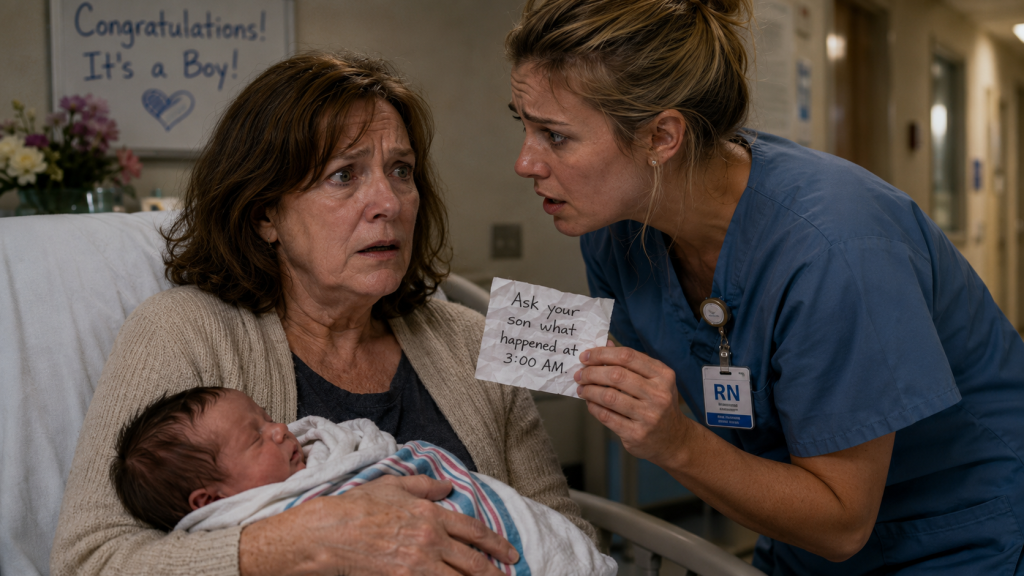
I thought back to the hospital corridor, the crumpled note, and the words that had changed all our lives.
Ask your son what happened at 3:00 AM.
For years, I believed that question was about one terrible hour.
It was not.
It was about every small decision that had led to that hour.
Daniel deciding not to tell me Samuel had died.
Rachel agreeing to pretend she had given birth.
Crane deciding desperate parents were easy to exploit.
Dr. Sloane deciding poor women would not be believed.
Patricia deciding money mattered more than her patients.
Daniel seeing blood on the floor and deciding not to ask whose it was.
And then there were the decisions that brought Mateo home.
Elena deciding to leave a note.
Marissa deciding not to stop searching.
Detective Bell deciding to believe frightened women.
Leah deciding to survive.
Me deciding that loving my son did not require protecting his lie.
Lives rarely change because of one grand heroic act.
They change because, in the most frightening moment, someone chooses not to look away.
Mateo came outside carrying the wooden box.
“Evelyn?”
“Yes?”
“Mom says you’re staying for cake.”
I smiled.
“Then I suppose I’m staying for cake.”
He took my hand and pulled me toward the door.
Inside, Leah stood beside a birthday cake covered in blue icing. Marissa was lighting candles. Photographs lined the walls: Leah graduating from nursing school, Mateo’s first day of kindergarten, family trips, missing teeth, scraped knees, Halloween costumes, ordinary mornings.
A life that almost had been stolen now filled the entire house.
Mateo closed his eyes and made a wish.
When he blew out the candles, everyone cheered.
I did not know what he wished for.
I only knew that he was free to make wishes for himself.
That was enough.
THE END! THANK YOU FOR READING!