

My parents died on a rain-soaked Tuesday afternoon.
At 3:17 p.m., a police officer called and asked whether I was the daughter of Robert and Helen Mercer. By 3:20, I was sitting on the floor of the break room at work, unable to feel my hands.
Their car had been struck by a delivery truck that crossed the center line.
They were killed instantly.
My five-year-old twin brothers, Noah and Liam, had been strapped into the back seat. They survived, but Noah had a fractured arm and three broken ribs, while Liam suffered a concussion and a deep cut above his right eye.
The officer kept talking, explaining hospitals, reports, and emergency contacts, but one sentence swallowed all the others.
“Your brothers are asking for you.”
I left work without my purse and drove through the rain with my supervisor’s coat still draped over my shoulders.
When I reached the hospital, I found Noah curled beneath a white blanket, his small face pale with pain. Liam sat beside him with dried blood in his hair, clutching the stuffed blue rabbit our mother had given him when he was a baby.
They both began crying when they saw me.
“Where’s Mommy?” Liam asked.
I had no answer that a five-year-old could survive hearing.
So I climbed between their beds, wrapped my arms around them, and promised the only thing I could promise.
“I’m here. I’m not leaving.”
A social worker named Denise arrived an hour later. She spoke gently, but there was no gentleness in the decision facing us.
My parents had no surviving siblings. Our grandparents were gone. There were distant cousins in other states, but none of them knew the twins well enough to take emergency responsibility.
“If you cannot assume temporary guardianship,” Denise explained, “the boys will need to enter emergency foster placement when they are discharged.”
I signed the paperwork before she finished speaking.
I was twenty-two years old.
I had a small apartment, an entry-level accounting job, student loans, and a wedding scheduled for the following spring.
I also had two little brothers who had just lost everything.
There was never a choice.
Elliot arrived at the hospital shortly before midnight.
We had been together since high school. He had taken me to senior prom, helped me move into my college dormitory, and proposed beside the lake where we had shared our first kiss.
For seven years, I believed I knew him better than anyone.
When he walked into the hospital room carrying coffee and wearing the worried expression I had seen a hundred times before, I almost collapsed into his arms.
He hugged me stiffly.
“I’m so sorry,” he whispered.
Then his gaze shifted to the twins.
Noah was asleep. Liam was watching cartoons without sound.
Elliot’s expression changed for only a second, but I saw it.
Not grief.
Not concern.
Calculation.
At the time, I convinced myself I had imagined it.
The following morning, while the boys underwent more tests, I met with a hospital administrator, Denise, and a police liaison. By noon, my head was full of forms, funeral arrangements, medical decisions, and questions about my parents’ estate.
Elliot barely spoke.
He kept checking his phone.
When I asked whether he could call the wedding venue and explain that we might need to postpone our next payment, he sighed.
“We already postponed the menu tasting.”
“My parents just died.”
“I know,” he said quickly. “I’m just saying the venue has policies.”
I stared at him.
He leaned down, kissed my forehead, and murmured that stress was making both of us emotional.
That evening, I went looking for him because I needed a clean shirt from the overnight bag in his car.
I found him in a quiet hallway near the vending machines, speaking on the phone.
His back was turned.
His voice was low, but the corridor carried every word.
“No, Mom, I don’t know how much the policies are worth yet.”
I stopped walking.
There was a pause.
Then Elliot said, “Obviously the house has equity. Robert refinanced years ago, but it’s still probably worth at least six hundred thousand.”
My throat tightened.
Another pause.
“If she keeps the kids, everything gets complicated. She’ll burn through the money raising them, and we’ll be stuck living in that old house like some instant family.”
I pressed one hand against the wall.
Elliot laughed quietly at something his mother said.
“Exactly. If she puts them in the system, she gets the estate and the life insurance. We could sell the house, pay off the wedding, clear my debt, and finally have the life we planned instead of raising her parents’ mistakes.”
For a moment, the entire hallway seemed to tilt.
I thought I might faint.
Then his mother’s voice became loud enough to hear through the phone.
“Do not let those children ruin your future.”
Elliot replied, “I won’t.”
I stepped backward before he could see me.
I locked myself in a bathroom stall and pressed both hands over my mouth to keep from making a sound.
The man I loved had just referred to my brothers as mistakes.
My parents had been dead for less than thirty-six hours, and he was already dividing their property.
I wanted to confront him immediately.
I wanted to slap him, scream at him, and throw the engagement ring into the nearest trash can.
But beneath the grief and fury, another instinct surfaced.
My father had taught me never to make a financial decision while frightened or angry.
“People reveal themselves when they think you are weak,” he used to say. “Listen carefully before you show them what you know.”
So I washed my face, returned to the hospital room, and pretended I had heard nothing.
Elliot looked up from his phone.
“Everything okay?”
“I’m tired,” I said.
He smiled with visible relief.
Over the next four days, he became attentive again.
He brought meals, spoke kindly to the nurses, and held my hand during the funeral-planning meeting. Anyone watching would have believed he was the devoted fiancé helping me through unbearable grief.
But whenever he thought I was not looking, I saw impatience beneath the performance.
He asked whether the twins truly needed to stay in the hospital another night.
He complained that my parents’ house was too far from his office.
He wondered aloud whether children that young would even remember us after a few months with a “good foster family.”
Each sentence confirmed what I had heard.
After the boys were discharged, I took them to our childhood home.
The house still smelled like my mother’s cinnamon candles and my father’s coffee. Their shoes remained beside the back door. A grocery list in my mother’s handwriting was still attached to the refrigerator with a sunflower magnet.
Noah ran toward their bedroom before I could stop him.
“Mommy?” he called.
The silence that followed nearly broke me.
I found both boys sitting on the floor beside my parents’ bed. Liam held one of my mother’s scarves against his face. Noah kept asking when they were coming back.
I sat with them until all three of us were crying.
Elliot remained downstairs.
Later that night, after the twins finally fell asleep in my old bedroom, he cornered me in the kitchen.
“We need to talk about reality,” he said.
I closed the refrigerator and looked at him.
“Our apartment has one bedroom. This place needs repairs. You work full-time. We are supposed to be getting married in seven months.”
“I know.”
“You cannot become a parent overnight because you feel guilty.”
“They are my brothers.”
“That does not make you their mother.”
“No,” I said. “It makes me their sister, and right now I am all they have.”
His jaw tightened.
“You are not thinking clearly.”
“I signed temporary guardianship.”
“Temporary,” he emphasized. “Which means it can be changed.”
I stared at him, forcing myself to remain calm.
Elliot walked closer and placed both hands on the kitchen counter.
“I did some research. Foster care is not what people make it sound like. They would be placed with trained adults. People who chose to raise children.”
“They are traumatized. They wake up screaming.”
“Exactly. They need professional help.”
“They need family.”
“They need more than you can provide.”
The cruelty in his voice was no longer hidden.
I folded my arms.
“What are you asking me to do?”
His eyes flickered.
He had been waiting for that question.
“I am asking you to consider our future. Your parents had life insurance. There is the house, their retirement accounts, probably other assets. If you take on the boys permanently, most of that money will be tied up in their care.”
“So?”
“So we have already paid deposits for the venue, photographer, caterer, and honeymoon. My business loan is due in three months. Your student debt is not disappearing. We could sell this house, pay everything off, and start our marriage without pressure.”
“And Noah and Liam?”
“They would adapt.”
“To foster care?”
He exhaled sharply.
“Do not say it like I am suggesting we leave them on the street.”
“That is exactly what you are suggesting.”
“No. I am suggesting that we stop destroying our lives over a tragedy we did not cause.”
For several seconds, I could not speak.
This was the moment when I finally understood that the compassionate boy I thought I had loved might never have existed.
Perhaps Elliot had always been selfish, and I had mistaken charm for kindness because I wanted our history to mean something.
He reached for my hand.
I stepped back.
His expression hardened.
“I am not ruining my future because of children who are not mine,” he said. “Put them in foster care so we can sell the house, or the wedding is cancelled.”
My heart pounded so violently that I could hear it.
I imagined my father walking into the kitchen, setting down his coffee, and ordering Elliot out.
I imagined my mother kneeling beside the twins and promising no one would ever take them away.
Then I remembered my father’s advice.
Listen carefully before you show them what you know.
I lowered my gaze.
When I looked up again, I forced my face to soften.
“Of course,” I said quietly. “You’re right. I’ll do exactly what you asked.”
Elliot blinked.
He had expected resistance.
Relief spread across his face so quickly that I nearly lost control of myself.
“I knew you would eventually be reasonable.”
“But I have one condition.”
His smile weakened.
“What condition?”
I removed the engagement ring from my finger and rolled it between my fingertips.
“If I give up my brothers for our future, I need to know you are completely committed to me.”
“I am.”
“Then you will explain the decision in front of everyone at the estate meeting.”
His face went still.
“What?”
“My parents’ attorney is meeting us here Friday evening. Denise will be present because of the guardianship review. Your mother has been asking about the wedding, so invite her too.”
Elliot stared at me as if I had suggested something absurd.
“Why would my mother need to attend?”
“Because she is going to be my family. I do not want anyone claiming later that this was only my decision. I want everyone to hear that we agreed the twins should enter foster care so we can sell the house and use the money for our marriage.”
His skin lost color.
“That is private.”
“Then the wedding is cancelled.”
The words affected him instantly.
He stepped closer.
“Mara, do not be dramatic.”
“I am giving up two children who depend on me. The least you can do is stand beside me while I explain why.”
He searched my face.
I let my lower lip tremble.
“You said this was the only reasonable choice. Prove that you believe it.”
For a long moment, he said nothing.
Then he nodded.
“Fine.”
“And I want the financial plan in writing.”
His eyes narrowed.
“What financial plan?”
“The house sale. The insurance. Your business debt. The wedding expenses. If I am making this sacrifice, I need to understand exactly how the money will be used.”
He hesitated.
I touched his arm.
“You are right, Elliot. I have been emotional. Help me think practically.”
His confidence returned.
By the following afternoon, he had emailed me a three-page document titled “Mercer Estate Allocation Proposal.”
Reading it made me physically ill.
He estimated the house’s value at $640,000.
He listed my parents’ life insurance at $500,000, although no one had told him the actual amount.
He proposed paying $132,000 toward his business obligations, $78,000 for the wedding and honeymoon, $40,000 for a new vehicle, and $220,000 as a down payment on a luxury house near his mother.
At the bottom, he had written, “Remaining funds to be invested jointly after placement of minor dependents.”
Minor dependents.
He could not even write their names.
I forwarded the document to my parents’ attorney, Rachel Avery.
Then I called her.
Rachel had known my family for more than fifteen years. She had handled the purchase of my parents’ house, prepared their wills, and helped my father establish his small construction company.
She listened without interrupting as I told her everything.
When I finished, there was a long silence.
“Mara,” she said carefully, “do not sign anything Elliot gives you.”
“I won’t.”
“Has he accessed your parents’ financial records?”
“I don’t know.”
“Has he been inside Robert’s office?”
“He searched the desk yesterday. He said he was looking for the insurance information.”
Rachel’s voice sharpened.
“Change the locks.”
“He has a key.”
“Change them tomorrow.”
I looked toward the hallway where the twins were sleeping.
“What is in the estate?”
“I cannot discuss every detail before the formal meeting, but Elliot’s assumptions are wrong. Very wrong.”
“Can you still come Friday?”
“I would not miss it.”
Rachel instructed me to preserve every message, email, and recording. She also asked whether I felt physically safe.
The question startled me.
Elliot had never hit me.
But the man in my kitchen was not the man I thought I knew.
“I think so,” I said.
“That is not an answer.”
After we ended the call, I contacted Denise and explained that there might be a conflict at the estate meeting. She offered to arrange for a county child-welfare supervisor to attend.
I also called my father’s closest friend, Detective Samuel Grant.
Sam had known me since I was eight years old. He had taught me to ride a bicycle and had attended every Mercer family barbecue for nearly two decades.
When I told him what Elliot had said, his voice became cold.
“Your father did not trust that boy.”
I sat down slowly.
“What?”
“Robert asked me about him two months ago. He said money was disappearing from a business account Elliot had access to.”
“Elliot never worked for Dad.”
“He helped install accounting software last year, remember?”
I did remember.
Elliot had spent three weekends “modernizing” my father’s office systems. My father had thanked him with a new laptop and a generous check.
Sam continued, “Robert noticed login attempts on accounts Elliot should never have been able to reach. He did not have proof, so he changed passwords and contacted Rachel.”
“Why didn’t Dad tell me?”
“He did not want to hurt you without evidence.”
My stomach twisted.
Sam asked me to send him Elliot’s proposal and any messages mentioning the estate.
“Do not confront him about the accounts,” he warned. “Let him believe you know nothing.”
The next two days felt like living beside a stranger wearing my fiancé’s face.
Elliot was cheerful.
He spoke about selling the house as if the decision were complete. He measured rooms, photographed the kitchen, and contacted a real estate agent without my permission.
His mother, Judith, arrived Thursday morning carrying champagne.
She stepped into my parents’ living room wearing a white designer coat and looked around with open appraisal.
“The place is dated,” she said. “But the lot should sell well.”
My mother’s funeral flowers were still on the mantel.
I watched Judith run one finger across the wood and examine it for dust.
“Where are the boys?” she asked.
“Upstairs.”
“Good. This conversation is not appropriate for children.”
She placed the champagne in the refrigerator.
“I told Elliot you would come to your senses. You are young, Mara. You should not sacrifice your entire life because your parents failed to make better arrangements.”
“They expected me to care for my brothers.”
Judith gave me a thin smile.
“Parents expect many unreasonable things from daughters.”
She wandered toward my father’s office.
I blocked the doorway.
“That room is private.”
Her smile vanished.
“I was only looking.”
“There is nothing in there for you.”
The words hung between us.
Judith tilted her head.
“You are making the right decision,” she said at last. “Do not spoil it with hostility.”
That night, I overheard her and Elliot whispering in the kitchen.
“The attorney cannot prevent the sale if Mara owns the house,” Judith said.
“She will sign whatever I put in front of her.”
“You had better be certain.”
“I have handled her since we were seventeen.”
The casual arrogance in his voice cut deeper than I expected.
Handled me.
Seven years of birthdays, promises, and shared dreams reduced to manipulation.
I quietly activated the recorder on my phone.
Judith asked, “What about the twins’ portion?”
“They are five. They cannot control anything.”
“And the guardianship?”
“Once they are placed, Mara will be too embarrassed to fight. We will say she had a breakdown after the accident.”
Judith laughed softly.
“Then sell quickly.”
I saved the recording in three separate locations.
Friday arrived with gray clouds and bitter wind.
The estate meeting was scheduled for six in the evening.
At five, I helped Noah and Liam dress in clean sweaters. Noah’s cast was covered with signatures from nurses. Liam still had stitches above his eyebrow.
“Are we leaving?” Noah asked.
“Not tonight.”
“Are we staying with you?”
I knelt in front of them.
“Yes.”
“Forever?” Liam whispered.
I looked into their frightened faces and made a promise I would spend the rest of my life keeping.
“Forever.”
At 5:30, Sam arrived and parked across the street. He wore plain clothes and entered through the side door so Elliot would not see him.
Rachel arrived fifteen minutes later carrying two leather folders and a sealed envelope.
Denise came with her supervisor, Mr. Coleman.
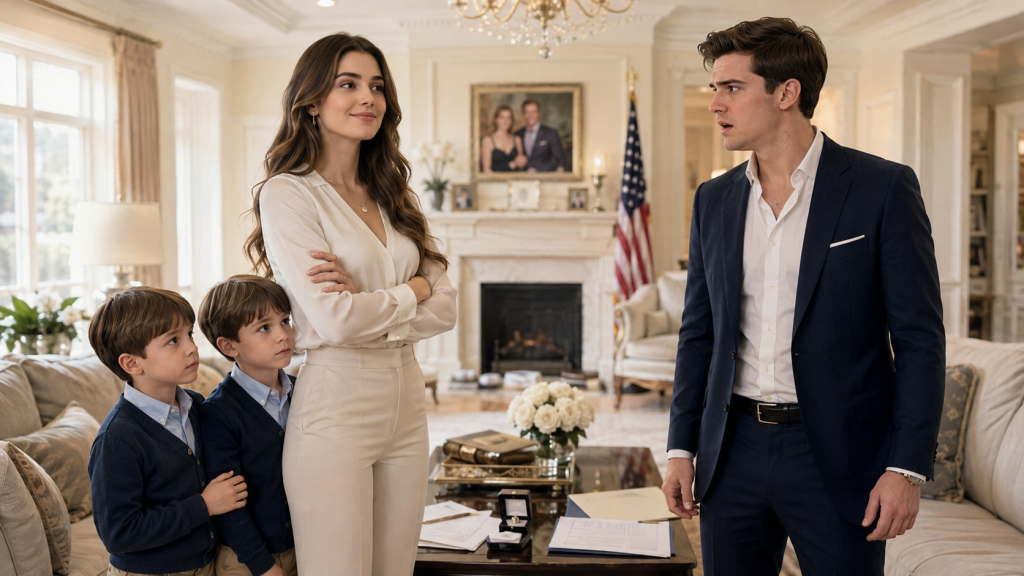
Elliot entered the living room at exactly six, dressed in a navy suit.
Judith followed him in wearing pearls and the satisfied expression of someone attending a celebration.
Elliot glanced around.
“Why are there so many people here?”
“Because this concerns the boys,” I said.
He lowered his voice.
“We agreed.”
“We did.”
That answer relaxed him.
Everyone sat around my parents’ dining table.
I took the chair between Noah and Liam.
Elliot sat across from me, with Judith beside him.
Rachel opened one of her folders.
“Before we discuss the estate,” she began, “Mara has indicated that there may be a change regarding guardianship.”
Elliot looked at me expectantly.
I folded my hands on the table.
“I have decided to follow Elliot’s recommendation.”
Denise’s expression remained neutral, but I saw concern in her eyes.
Rachel asked, “What recommendation is that?”
I turned toward Elliot.
“This was my condition. You explain it.”
He shifted in his chair.
“Mara—”
“You said it was the only reasonable choice.”
Judith interrupted.
“Surely we do not need to dramatize a private family decision.”
Rachel looked at her.
“Any decision affecting two orphaned children is not private from their legal representatives.”
Elliot’s jaw tightened.
I reached into my pocket and placed my engagement ring on the table.
His eyes locked on it.
“Explain,” I said, “or there will be no wedding.”
Judith touched his arm.
He inhaled slowly.
“Mara and I have discussed whether she is realistically equipped to raise two children at her age.”
“That was not what you said,” I replied.
“Mara is grieving.”
“Repeat your words.”
His cheeks reddened.
Noah reached beneath the table and held my hand.
Elliot glanced at the twins and looked away.
“I said foster placement might offer them more stability.”
“And why did you want them placed?”
“To protect our future.”
“What does that mean?”
Judith pushed back her chair.
“This is outrageous.”
Rachel’s voice remained calm.
“Sit down, Mrs. Vale.”
Judith stared at her.
Rachel did not blink.
Slowly, Judith sat.
I looked at Elliot.
“You told me to put Noah and Liam in foster care so we could sell this house, use my parents’ life insurance for our wedding, and pay your debts. Did you say that?”
Silence filled the room.
Elliot’s eyes moved toward the front door.
Sam stepped out of the hallway.
The moment Elliot saw him, fear flashed across his face.
“I think this meeting is over,” Elliot said.
“No,” Rachel replied. “It has just begun.”
I placed my phone on the table and pressed play.
Elliot’s recorded voice filled the dining room.
“If she puts the kids in the system, she gets the estate and the life insurance. We could use that equity. We could actually afford the life we talked about, instead of raising her parents’ mistakes.”
Noah’s fingers tightened around mine.
Liam stared at Elliot with wide, wounded eyes.
Judith lunged for the phone.
Sam stepped between us.
“Do not touch it.”
She froze.
I played the second recording.
“The attorney cannot prevent the sale if Mara owns the house,” Judith’s voice said.
Then Elliot’s answer followed.
“She will sign whatever I put in front of her. I have handled her since we were seventeen.”
By the time the recording ended, Elliot’s face had turned gray.
He pointed at me.
“You recorded private conversations.”
“You planned to abandon my brothers and take their inheritance.”
“There is no inheritance yet.”
Rachel opened the sealed envelope.
“That is where you are mistaken.”
She removed my parents’ wills and placed them on the table.
“Robert and Helen updated their estate plan three months ago.”
Elliot glanced at Judith.
Rachel continued.
“The life insurance proceeds do not pass directly to Mara. They are held in an irrevocable trust for Noah and Liam’s housing, education, medical needs, and long-term care.”
Judith’s mouth fell open.
“The childhood home is also owned by that trust,” Rachel said. “Mara receives the right to reside here as long as she serves as the boys’ guardian. She cannot sell the property for personal gain.”
Elliot stared at the papers.
“That is impossible.”
“It is legally documented.”
“What does Mara inherit?”
Rachel looked directly at him.
“A separate account and a minority interest in Mercer Construction. Neither can be transferred to a spouse for five years.”
His expression collapsed.
Every number in his proposal had been imaginary.
Every plan he had made depended on money he could never control.
Judith recovered first.
“This changes nothing. Mara agreed to marry my son before this accident.”
“I am not marrying him,” I said.
Elliot turned toward me.
“You cannot end seven years over one argument.”
“One argument?”
“You are emotional. Your parents died, and you are looking for someone to punish.”
“My parents’ deaths did not make you cruel. They revealed that you already were.”
He reached for my hand.
I pulled it away.
His voice softened into the tone he had used whenever he wanted me to doubt myself.
“Think about everything we have been through. High school. College. Our first apartment. You know me.”
“I thought I did.”
“Mara, please.”
“You called my brothers mistakes.”
“I was under pressure.”
“You demanded that I abandon them.”
“I was scared.”
“You made a written plan to spend their money.”
He looked toward the document lying beside Rachel’s folder.
“That was only a proposal.”
“It was evidence,” Sam said.
Elliot’s head snapped toward him.
“Evidence of what?”
Sam removed a printed bank statement from his jacket.
“Unauthorized access to Mercer Construction accounts.”
Judith went completely still.
Sam laid several pages on the table.
“Robert reported suspicious logins before his death. We traced one of the devices this afternoon.”
Elliot said nothing.
“The device was registered to you,” Sam continued.
“That does not prove anything.”
Rachel opened the second folder.
“Robert also discovered three transfers totaling forty-eight thousand dollars from a company reserve account to a consulting business registered in Judith Vale’s name.”
Judith stood so quickly that her chair struck the wall.
“This is a setup.”
Sam faced her.
“Sit down.”
“You have no right to detain me.”
“I have not detained anyone. Yet.”
Elliot’s breathing became shallow.
I stared at him, struggling to understand the depth of the betrayal.
“You stole from my father?”
“No.”
“The account records say otherwise.”
“I was repaying myself.”
“For what?”
“Technical work. Consulting. Your father promised compensation.”
“He paid you.”
“Not enough.”
The words escaped before he could stop them.
Sam’s expression hardened.
“So you admit making the transfers?”
Elliot looked trapped.
Judith grabbed his sleeve.
“Do not say another word.”
Rachel turned to me.
“There is more.”
I did not know how there could possibly be more.
She removed a handwritten letter from the folder.
My father’s writing covered two pages.
Rachel explained that he had delivered it to her office one week before the accident, with instructions to give it to me if anything happened to him.
My hands shook as I unfolded it.
Mara,
I hope you never have to read this.
Your mother and I are proud of the woman you have become. You are loyal, compassionate, and far stronger than you realize. Those qualities are gifts, but they can also make you vulnerable to people who mistake kindness for weakness.
I have concerns about Elliot.
I found financial activity connected to him that I cannot explain. I also heard him speak about your future as though your choices, earnings, and inheritance already belonged to him.
I did not tell you because I wanted proof, not suspicion.
If I am wrong, forgive an overprotective father.
If I am right, remember this: history is not the same as love. Time invested is not a reason to surrender the rest of your life.
Protect yourself.
Protect your brothers.
Choose the people who choose you without calculating what you are worth.
Love always,
Dad
The room blurred through my tears.
For the first time since the accident, I felt my father beside me.
Not as a memory.
As guidance.
Noah leaned against my arm.
Liam whispered, “Is that Daddy’s writing?”
“Yes.”
“What did he say?”
I folded the letter carefully.
“He said he loved us.”
Elliot pushed back from the table.
“I am leaving.”
Sam moved toward the doorway.
“Before you do, I need your phone and laptop.”
“You need a warrant.”
“I have one.”
Sam produced the document.
Judith began shouting.
She accused my parents of manipulating me, Rachel of conspiring against them, and Denise of destroying a family.
No one answered.
Two uniformed officers entered through the front door.
Elliot’s arrogance vanished.
He looked at me as they approached.
“Mara, tell them this is a misunderstanding.”
I held my father’s letter against my chest.
“No.”
“You know I would never hurt you.”
“You already did.”
His face twisted.
“You will regret this. You cannot raise two children alone. You will lose your job. You will lose the house. Those boys will destroy every chance you have at a normal life.”
Liam began crying.
I stood.
“Do not speak to them again.”
Elliot stared at me with hatred.
Then the officers escorted him out.
Judith followed after surrendering her phone, still screaming that we would all hear from her attorney.
The front door closed.
The house became silent.
For several seconds, no one moved.
Then Noah asked the question that mattered more than the estate, the theft, or the broken engagement.
“Are they taking us away?”
I knelt beside him.
“No.”
“Elliot said we had to go.”
“Elliot does not make decisions for this family.”
Liam wiped his eyes.
“Are we bad?”
The question broke something inside me.
I pulled both boys into my arms.
“You are not bad. None of this is your fault. You did not cause the accident. You did not ruin anyone’s future. You are loved, and you are staying with me.”
Noah buried his face in my shoulder.
“Forever?”
“Forever.”
Denise knelt beside us.
She explained, in words the boys could understand, that the court wanted them to remain with family and that no one would move them without making sure they were safe.
Rachel placed one hand on my back.
“You are not alone, Mara.”
For the first time, I believed her.
The months that followed were not easy.
Grief did not disappear because Elliot had been exposed.
It came in waves.
Sometimes it arrived when I found my mother’s handwriting on an old birthday card. Sometimes it came when my father’s favorite song played in the grocery store.
For the twins, grief arrived at night.
Noah dreamed about the crash and woke screaming that he could not breathe.
Liam became terrified of cars. For weeks, he refused to sit near a window and cried whenever we stopped at a traffic light.
We began family therapy with a counselor who specialized in childhood trauma.
She taught me that children often ask the same painful questions repeatedly because their minds are trying to build a reality they can understand.
So every time Liam asked whether our parents were coming back, I answered gently.
Every time Noah asked whether I might die too, I promised that many adults were helping keep us safe.
I reduced my hours at work temporarily.
My supervisor arranged remote days, and the trust covered a licensed caregiver named Mrs. Flores, who quickly became part of our family.
She was sixty-one, patient, warm, and completely unimpressed by tantrums.
When Liam threw cereal across the kitchen because his blue bowl was dirty, she calmly handed him a cloth and said, “Strong feelings still clean up their own messes.”
He adored her.
I learned to pack lunches, schedule medical appointments, sign school forms, and survive on five hours of sleep.
I also learned that love was not the same as perfection.
Some nights, I burned dinner.
Once, I forgot Noah’s therapy appointment.
I cried in the laundry room after both boys caught the flu on the same day.
But each morning, we kept going.
The house slowly changed.
My parents’ bedroom became a quiet space where we kept photo albums and memory boxes. I moved into the room across the hall so the twins could reach me easily at night.
We planted a small tree in the backyard for Mom and Dad.
Noah chose an apple tree because Dad loved apple pie.
Liam insisted we hang two wind chimes because Mom always said music made a house feel alive.
Elliot sent letters from jail while awaiting trial.
The first was apologetic.
He claimed grief and financial pressure had distorted his judgment.
The second blamed his mother.
The third blamed me.
By the fourth letter, he was promising that we could repair everything if I withdrew my statement.
I stopped opening them.
Rachel kept them for the case.
Investigators eventually discovered that Elliot had been stealing from my father for nearly eight months.
He used old login credentials to access the company system and created fake invoices through Judith’s consulting business.
Most of the money had gone toward gambling debts, luxury purchases, and deposits for our wedding.
The wedding I thought we had been building together had partly been paid for with money stolen from my parents.
That truth made me physically sick.
When I contacted the venue to cancel, the manager told me Elliot had attempted to change the refund destination to an account in his own name.
Rachel recovered most of the deposits before he could take them.
The photographer returned our payment after hearing what happened.
The caterer sent meals to the twins for a week.
Kindness began appearing from unexpected places.
My coworkers donated vacation time.
Neighbors repaired the broken fence without charging us.
Parents from the twins’ kindergarten class organized a schedule for school pickups.
Sam visited every Sunday and taught Noah how to throw a baseball with his uninjured arm.
Rachel helped me apply for permanent guardianship.
At the hearing, Elliot attempted to submit a letter claiming I was emotionally unstable.
His attorney argued that my decision to care for the twins had been made under extreme grief and that I lacked the resources to raise them.
Then Denise testified.
She described the hospital, the boys’ attachment to me, our therapy progress, and the stable home we had created.
Mrs. Flores testified too.
So did my supervisor, Sam, the twins’ counselor, and their teacher.
The judge reviewed Elliot’s recordings, messages, and financial proposal.
Then she looked directly at me.
“Ms. Mercer, guardianship is not a temporary act of heroism,” she said. “It is a lifelong responsibility. Do you understand that?”
“Yes, Your Honor.”
“There will be difficult years.”
“I know.”
“You are very young.”
“I know that too.”
“Why do you believe you are the right person?”
I looked at Noah and Liam sitting beside Rachel.
“Because they are not an obligation left behind by my parents. They are my family. I cannot promise I will never make mistakes, but I can promise they will never have to question whether they are wanted.”
The judge granted permanent guardianship.
Noah clapped before anyone could stop him.
Liam shouted, “Forever!”
Even the judge smiled.
Elliot’s criminal case concluded almost a year after the accident.
He accepted a plea agreement for fraud, theft, unauthorized computer access, and conspiracy.
Judith received probation and restitution requirements because investigators determined Elliot had controlled most of the financial scheme, though she had knowingly allowed her company to receive stolen funds.
Before sentencing, Elliot asked to address the court.
He stood in a gray suit, looking older than the man I had planned to marry.
He apologized to my family.
Then he turned toward me.
“Mara, I loved you,” he said. “I made terrible choices because I was afraid of losing the future we planned.”
I felt no anger.
Only clarity.
“You were not afraid of losing our future,” I replied when the judge permitted me to speak. “You were afraid of losing access to what you believed I owned.”
He lowered his eyes.
I continued.
“You saw two injured children and calculated their value. You heard that my parents were dead and thought about property. Whatever you felt for me, it was not love.”
The judge sentenced him to prison and ordered restitution to my father’s company.
When the hearing ended, I walked out without looking back.
Two years later, the apple tree in our backyard produced its first fruit.
Noah and Liam were seven.
Noah had become fearless on a bicycle. Liam still disliked highways but could ride in the car without crying.
They remembered our parents in fragments.
Mom singing while cooking.
Dad making pancakes shaped like animals.
The smell of his workshop.
The sound of her bracelets.
I wrote those memories down whenever they shared them because I wanted the boys to have more than photographs.
On the anniversary of the accident, we baked an apple pie and placed two candles in it.
We each told one story.
Noah remembered Dad carrying both twins at once and pretending they were too heavy.
Liam remembered Mom dancing barefoot in the kitchen.
I told them about the day they were born.
I had been seventeen, and Dad picked me up from school so quickly that he wore two different shoes.
The boys laughed until they cried.
Then we cried until we could laugh again.
That became our way of grieving.
Not forgetting.
Not pretending the pain had vanished.
Remembering with enough love that the memories no longer belonged only to the worst day of our lives.
I eventually returned to work full-time and completed additional accounting certifications at night.
Mercer Construction had struggled after my father’s death and the theft, but Rachel helped appoint an experienced manager.
I attended quarterly meetings and slowly learned the business Dad had spent his life building.
Five years after the accident, I purchased the majority interest from the trust at a court-approved valuation.
I renamed the company Mercer Family Construction.
The first project under my leadership was a transitional housing center for young adults leaving foster care.
At the opening ceremony, Denise stood beside me.
“You kept your promise,” she said.
I watched Noah and Liam race across the lawn.
“We all did.”
The childhood home was never sold.
We repaired the roof, remodeled the kitchen, and kept the marks on the pantry doorway where Dad had measured our heights.
Noah eventually grew past my mark.
Liam claimed that was only because Noah’s hair stood up.
Every year, we added new lines.
The wall became proof that life had continued.
I did not date for a long time.
Trust returned slowly.
When I finally met someone, his name was Daniel, a civil engineer working on the housing center.
On our third date, I told him everything.
He did not call me heroic.
He did not say the twins were lucky I had saved them.
He simply asked, “What are their favorite pizza toppings?”
Daniel understood something Elliot never had.
Loving me meant loving the life I had, not calculating the life he could extract from me.
He attended school plays, helped with science projects, and never entered the house without shouting a greeting so the boys knew who was there.
When he proposed, he did it in the backyard beneath the apple tree.
Noah and Liam held a crooked sign that said, “PLEASE SAY YES, WE ALREADY LIKE HIM.”
I laughed so hard that I could barely answer.
Our wedding was small.
We held it at the house.
The twins walked me down the garden path, one on each side.
My mother’s wind chimes rang above us.
Dad’s letter rested inside my bouquet.
There were no crystal chandeliers, imported flowers, or luxury cars.
There was apple pie instead of an expensive wedding cake.
There were children running through the yard.
There were people who had supported us when our lives fell apart.
There was love without calculation.
Before the ceremony, Noah asked whether I ever wished I had chosen the first wedding.
I knelt and straightened his tie.
“No.”
“Not even a little?”
“Not for one second.”
Liam grinned.
“Because Elliot was terrible?”
“Because that future was built on people being disposable.”
I looked at both of them.
“You taught me that family is not something you sacrifice to make your life easier. Family is who stays when life becomes difficult.”
Daniel and I had a daughter two years later.
We named her Helen after my mother.
Noah and Liam became fiercely protective older brothers.
Sometimes I watched the three of them playing beneath the apple tree and thought about the night Elliot delivered his ultimatum.
He believed he had placed me in an impossible position.
He believed grief had made me weak.
He believed years of history guaranteed my obedience.
Most of all, he believed money mattered more than two frightened children.
He was wrong about everything.
My parents’ greatest legacy was never the house, the company, or the insurance trust.
It was the love they had planted in us long before they died.
It was Noah reaching for Liam’s hand in the hospital.
It was my father’s warning arriving when I needed it most.
It was my mother’s voice in my memory, reminding me that kindness without boundaries becomes permission for cruelty.
Elliot expected me to cry and beg.
Instead, I smiled and agreed to his demand because I knew the truth would destroy him more completely than any argument.
My one condition forced him to stand before witnesses and reveal exactly who he was.
He thought I was sacrificing my brothers for him.
In reality, I was giving him one final opportunity to expose the monster behind his charming smile.
He took it willingly.
And when his carefully imagined fortune disappeared, so did every false promise he had ever made.
I lost my parents that terrible afternoon.
I lost the man I thought I would marry.
I lost the future I had planned since I was seventeen.
But I did not lose my brothers.
I did not lose my home.
I did not lose myself.
Years later, whenever the wind moves through the apple tree and the chimes begin to sing, I remember the promise I made beside two hospital beds.
I’m here.
I’m not leaving.
It became the foundation of everything that followed.
And I kept it.
THE END! THANK YOU FOR READING!