

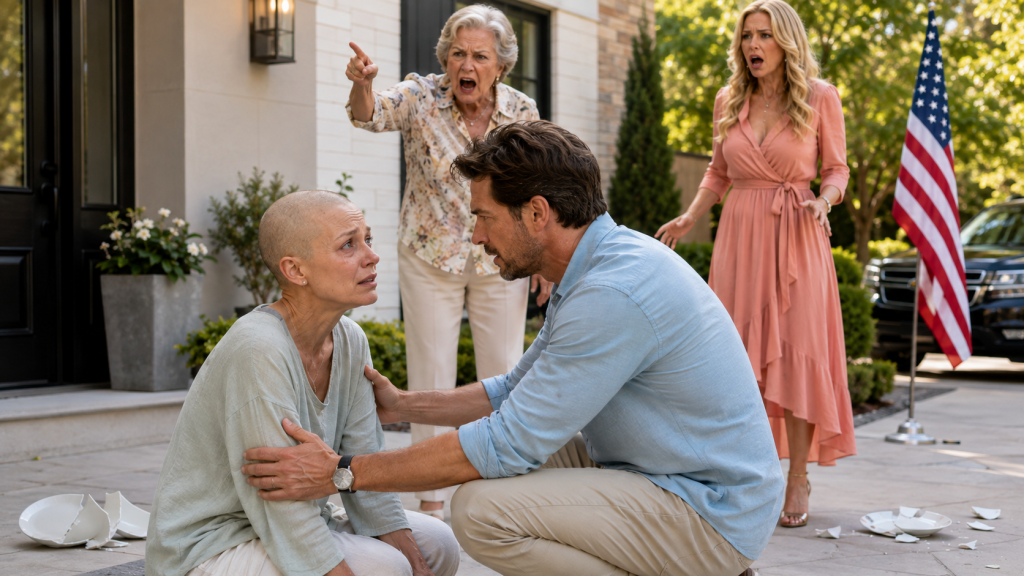
I returned without warning after four years in Canada and found my wife with a shaved head, skin and bones, eating scraps in the backyard.
My mother said she had brought that punishment upon herself.
I didn’t yell.
I announced that I had just received a million-dollar settlement… and let my family’s greed trigger the trap.
The change was immediate.
My mother moved away from the door.
Brianna opened her mouth.
Even Lucy looked up, though her eyes showed confusion, not interest.
“Two million eight hundred thousand?” Theresa repeated.
I nodded.
“The email arrived while I was driving from the airport. Plus, the company wants to hire me as a supervisor when the plant reopens.”
My sister put her phone down on the table.
“That is a whole lot of money.”
“That’s why I didn’t want to come in yelling.”
I held Lucy tighter.
“First, I’m taking her to the hospital. Then we’ll all sit down and decide what to do.”
Theresa approached with a smile I hadn’t seen when she found my wife picking up scraps.
“Of course, son. Lucy’s health comes first.”
My wife stiffened.
I felt her fingers grip my jacket.
“I don’t want to stay here,” she whispered.
“You won’t.”
My mother pretended not to hear.
“We can use a part of it for her treatment,” she added. “Whatever is necessary.”
I looked at her.
“A minute ago you said she brought this illness on herself.”
“I was angry. We all say ugly things when we’re tired.”
“I don’t.”
Theresa looked down.
Brianna stepped closer to Lucy and tried to touch her shoulder.
My wife pulled back.
“Forgive me, sister-in-law,” my sister said. “These past few months have been difficult for everyone.”
“Not for you,” Lucy replied. “You were showing off new clothes while I threw up alone.”
Brianna pressed her lips together.
I didn’t let the argument continue.
I grabbed my suitcase with one hand and supported Lucy with the other.
“I’ll be back tonight.”
“What hospital are you going to?” Theresa asked.
“I’ll let you know later.”
“I can go with you.”
“No.”
That one word changed her expression.
Only for a second.
Then the loving-mother mask returned.
“Of course. You two need privacy.”
I walked Lucy toward the rental car.
She moved slowly, almost shuffling.
Four years earlier, when I had left for Canada, Lucy had been strong enough to carry two grocery bags in each hand while complaining that I bought too much cereal.
She used to dance in the kitchen when she cooked.
She used to sing badly on purpose just to make me laugh.
She had thick black hair that reached halfway down her back.
Now her scalp was covered with uneven stubble.
Her cheeks were hollow.
Her wrists looked frighteningly thin beneath the sleeves of the faded sweater she wore.
When I opened the passenger door, she hesitated.
“What is it?”
She looked back toward the house.
Theresa was standing behind the kitchen curtain.
Watching.
Lucy lowered her voice.
“She’ll be angry.”
I stared at my wife.
“Because you’re leaving?”
Lucy nodded.
Something inside me cracked.
Not loudly.
Not dramatically.
It was quieter than that.
A final thread breaking.
I closed the car door gently after helping her inside.
Then I walked around the vehicle, got behind the wheel, and drove away without looking back.
For the first ten minutes, neither of us spoke.
Lucy kept both hands folded in her lap.
She stared through the window as familiar streets passed.
Finally, she whispered, “You really came back.”
“I should have come back sooner.”
“You didn’t know.”
“I should have known something was wrong.”
Her eyes filled.
“She told me you didn’t want me anymore.”
My hands tightened around the steering wheel.
“Who?”
“Your mother.”
I turned toward her briefly.
“What exactly did she tell you?”
Lucy swallowed.
“That you had met someone else in Canada.”
I nearly missed the red light.
I stopped hard enough for the seat belts to tighten.
“She said what?”
“She said you were embarrassed because I kept getting sick. She said you wanted a clean beginning.”
“Lucy, I spoke to you.”
“Not for the last eight months.”
The light turned green, but I didn’t move until the driver behind us honked.
I pulled forward.
“What do you mean?”
“Our calls stopped.”
“I called every Sunday.”
She stared at me.
“I never received them.”
I felt ice spread through my chest.
Every Sunday.
For eight months.
I had called the same number.
Sometimes it rang without an answer.
Sometimes Theresa answered and said Lucy was sleeping.
Sometimes Brianna told me Lucy was at an appointment.
Three times my mother claimed Lucy was too angry with me to speak.
She said distance was destroying my marriage.
I had started believing Lucy hated me.
But I kept sending money.
I kept working.
I kept telling myself I would fix everything when my contract ended.
“Did you have your phone?” I asked.
Lucy shook her head.
“Your mother took it after I fainted.”
“Why?”
“She said screens were making me worse.”
“And you believed her?”
“At first.”
Her voice became smaller.
“Later I asked for it back.”
“What happened?”
“She told me you had canceled the service.”
I pulled into the hospital parking lot.
Before getting out, I looked at Lucy.
“Listen to me carefully.”
She turned toward me.
“I never stopped loving you.”
Her face crumpled.
“I never met anyone else. I never asked my mother to control your phone. I never told her to punish you. I never told her to withhold money from you.”
Lucy covered her mouth.
Tears spilled over her fingers.
“I thought…”
“I know.”
“You stopped writing.”
“I sent emails.”
“I didn’t have access to my email.”
“I sent money every month.”
She stared at me.
“How much?”
“Almost three thousand dollars.”
Her hand fell.
“Every month?”
“Yes.”
“For four years?”
“Yes.”
Her lips parted.
I watched horror replace confusion.
“Daniel…”
“What?”
“I never saw it.”
The hospital doctor’s face hardened when he examined her.
They ran blood tests.
They started fluids.
They took her for scans.
A nurse brought warm blankets and helped Lucy change into a hospital gown.
I stayed beside her until the doctor asked to speak with me privately.
He shut the consultation-room door.
“Your wife is severely malnourished.”
I had expected the words.
They still hit like a fist.
“She’s dehydrated. She has anemia, electrolyte imbalance, and an untreated gastrointestinal condition that appears to have worsened significantly over time.”
“Can she recover?”
“Yes, but it needs to be done carefully. She cannot simply eat large meals immediately. Her body has been deprived for too long.”
I sat down.
The doctor continued.
“Her medical history also suggests she was previously receiving treatment.”
“She was.”
“For Crohn’s disease?”
I nodded.
“She was diagnosed shortly before I left for Canada. It was manageable then.”
“According to your wife, her medication stopped several months ago.”
My head snapped up.
“Why?”
“She says the family member responsible for obtaining it told her the prescriptions became too expensive.”
I stood.
“They had money.”
The doctor watched me carefully.
“A lot of money.”
“Mr. Mercer—”
“I sent money specifically for her treatment.”
He let silence fill the room.
Then he asked the question I had been avoiding.
“Do you believe your wife was intentionally neglected?”
I thought of Lucy crouched beside the garbage bins.
I thought of Theresa calling it punishment.
I thought of my sister’s new clothes.
I thought of the renovated kitchen I had noticed when I entered the house.
New marble counters.
New refrigerator.
New television.
My wife had been eating scraps twenty feet away.
“Yes,” I said.
The doctor nodded.
“Then I strongly recommend documenting everything.”
“I will.”
When I returned to Lucy’s room, she was awake.
Her eyes followed me.
“Am I dying?”
“No.”
“Don’t lie.”
“I’m not.”
I sat beside her and held her hand.
“You’re sick. But you’re going to get treatment.”
She nodded.
Then she whispered, “They shaved my hair.”
I went still.
“I thought it fell out.”
“Some did.”
She touched the uneven stubble.
“But your mother said long hair wasted nutrients.”
My throat tightened.
“Did a doctor tell her that?”
Lucy shook her head.
“She said sick people shouldn’t care about vanity.”
I looked away because I didn’t trust what my face was doing.
“She used kitchen scissors first,” Lucy continued. “Brianna filmed it.”
My eyes returned to hers.
“She filmed it?”
“She laughed.”
For several seconds, I heard nothing except the soft electronic beeping beside Lucy’s bed.
“Why?”
“They said they wanted to show you what I had become.”
“Did they send it?”
“No. Your mother said it would distract you from working.”
I bent forward and pressed Lucy’s hand against my forehead.
“I’m sorry.”
She started crying.
“I tried to leave.”
My heart stopped.
“What happened?”
“They told me the house belonged to your mother because you were gone.”
“It doesn’t.”
“I know that now.”
“What else?”
“She said I had no money.”
“You had our joint account.”
“They changed the password.”
My breath slowed.
Not because I was calm.
Because I finally understood the scale of what had happened.
This wasn’t cruelty in moments.
This was a system.
My family had isolated Lucy.
Controlled her communication.
Controlled her medication.
Controlled her access to money.
Then convinced her that I had abandoned her.
And while they did it, they were spending the money I sent.
I kissed Lucy’s hand.
“I need you to do something difficult.”
She looked afraid.
“What?”
“Tell me everything.”
Over the next two hours, she did.
It began eight months earlier.
Theresa told Lucy that my Canadian contract had been extended indefinitely.
Then she claimed I was angry about Lucy’s medical expenses.
Brianna started intercepting mail.
Theresa removed Lucy’s phone.
When Lucy’s symptoms worsened, my mother insisted she was exaggerating.
Eventually, Lucy became too weak to argue.
She stopped receiving medication regularly.
Food became another weapon.
Theresa said certain groceries were “too expensive.”
Brianna complained that Lucy contributed nothing to the household.
They began giving her smaller portions.
Then leftovers.
Then whatever remained after everyone else ate.
When Lucy vomited, Theresa called her wasteful.
When she fainted, Brianna accused her of seeking attention.
A neighbor once offered to call an ambulance.
My mother told the neighbor Lucy was mentally unstable.
“Why didn’t you tell someone?” I asked softly.
Lucy looked at me.
“I tried.”
She told me about a letter she wrote to my old friend Marcus.
Theresa found it.
She told me about trying to walk to the pharmacy.
Brianna followed her in the car and brought her home.
She told me about hiding a note inside a grocery delivery box.
She never knew whether anyone found it.
Then, two months ago, Theresa moved Lucy’s mattress out of our bedroom and into a small storage room near the laundry area.
“My room?”
Lucy nodded.
I thought of the bedroom upstairs.
My bedroom.
The one I had paid the mortgage on.
“What’s in there now?”
“Your mother sleeps there.”
I almost laughed.
Not because it was funny.
Because the audacity was beyond anything I could process.
At seven that evening, I called my lawyer in Toronto.
His name was Michael Grant.
He had handled the injury claim resulting from an accident at the industrial facility where I worked.
There really was a settlement.
But it wasn’t $2.8 million.
Not yet.
Negotiations were ongoing.
The latest offer was $410,000.
I had invented the larger number on instinct after seeing the way Theresa treated Lucy.
Now that lie was about to become useful.
“Daniel,” Michael said, “you sound terrible.”
“I need help.”
“Tell me.”
I gave him the short version.
He stopped me twice to make sure he had heard correctly.
When I finished, he said, “Do you have evidence?”
“Not enough.”
“What do you need?”
“The truth.”
“That’s not what I meant.”
“I know.”
I looked through the glass wall toward Lucy’s hospital bed.
“I told them I was receiving $2.8 million.”
Michael was silent.
Then he said, “You didn’t.”
“I did.”
“Why?”
“Because thirty seconds before I said it, my mother was treating my starving wife like an animal. Thirty seconds after I said it, she wanted to pay for Lucy’s treatment.”
Another silence.
Then Michael understood.
“You want them to expose themselves.”
“Yes.”
“Daniel, do not do anything illegal.”
“I won’t.”
“Do not record conversations in violation of local law.”
“I won’t.”
“Do not promise them money in exchange for confessions.”
“I won’t.”
“What exactly are you thinking?”
“I’m going home tonight.”
He sighed.
“That sentence rarely ends well.”
“I’m going to tell them the settlement requires me to choose how the money will be distributed.”
“And?”
“And I’m going to watch.”
Michael paused.
“Call a local attorney too.”
“I already asked the hospital social worker for recommendations.”
“Good.”
“And Michael?”
“Yes?”
“Remember those settlement documents?”
“The draft packet?”
“Yes.”
“I need something that looks official but contains no false signatures and makes no legal promises.”
“You want a prop.”
“I want paper.”
He exhaled.
“I can send you a generic financial-planning worksheet. It will say clearly that it is a planning document, not a contract.”
“That’s enough.”
“Daniel?”
“Yeah?”
“Protect your wife first. Trap second.”
“I know.”
When I told Lucy I was returning to the house, she panicked.
“Don’t leave me.”
“I’m not leaving you like before.”
“You don’t know them anymore.”
“I know.”
“They’ll lie.”
“I expect them to.”
“They’ll cry.”
“I expect that too.”
“They’ll make you feel guilty.”
I smiled sadly.
“That used to work.”
She studied my face.
“What changed?”
I squeezed her hand.
“I saw my wife eating garbage while my mother wore a gold bracelet I bought without knowing it.”
Lucy closed her eyes.
“I bought that bracelet.”
“What?”
“She ordered it using your card.”
Something cold settled deeper inside me.
I kissed Lucy’s forehead.
“I’ll be back.”
That evening, when I entered the house alone, the smell of roast beef greeted me.
My favorite meal.
The dining table had been set with candles.
Brianna wore a blue dress.
Theresa had changed into the pearl earrings I sent her for her birthday two years earlier.
My uncle Robert was sitting near the window.
So was Brianna’s boyfriend, Kyle.
Interesting.
I placed my suitcase near the stairs.
“Daniel!”
Theresa rushed toward me.
“How is Lucy?”
“Stable.”
She pressed her hand dramatically to her chest.
“Thank God.”
Brianna nodded solemnly.
“We were terrified.”
I looked at her.
“You didn’t come to the hospital.”
She blinked.
“You said you wanted privacy.”
“Right.”
I sat down.
Theresa immediately filled my plate.
“You need to eat. You’ve been traveling.”
“I’m not hungry.”
“Just try.”
“No.”
She stopped.
Then smiled again.
“Of course.”
Robert cleared his throat.
“So your mother tells me you had some good news.”
There it was.
Less than ten minutes.
I leaned back.
“The settlement.”
“Two point eight?”
“That’s the current number.”
Brianna tried to act casual.
“Is that after tax?”
I looked at her.
She lifted her glass.
“I’m just curious.”
“Not all of it is taxable.”
Kyle leaned forward.
“What are you thinking of doing with it?”
I smiled.
“That’s why I came back tonight.”
Every face sharpened.
I opened the folder Michael had emailed me.
I had printed the pages at the hospital business center.
“Because of the accident and the settlement structure, I have to make decisions quickly.”
That wasn’t true.
But the document itself simply contained columns for assets, gifts, medical costs, property, debts, and future planning.
Theresa leaned closer.
“What kind of decisions?”
“Beneficiaries. Property. Family support. Investments.”
Robert nodded knowingly.
“You need people you trust around you.”
“I agree.”
I almost admired how easily he said it.
I placed a blank page on the table.
“There’s something I want from everyone before I decide anything.”
Brianna frowned.
“What?”
“Transparency.”
Theresa laughed nervously.
“We are your family.”
“Exactly.”
I looked at my mother.
“For four years, I sent money here.”
Her smile weakened.
“To support the household.”
“Yes.”
“I want to understand how it was spent.”
The room changed.
Not dramatically.
Just enough.
Kyle looked down.
Brianna’s shoulders tightened.
Theresa folded her hands.
“I kept everything running while you were away.”
“I’m sure.”
“Taxes. Utilities. Groceries.”
“And Lucy’s medical bills?”
“Yes.”
“All of them?”
“As much as possible.”
I nodded.
“How much did her medication cost last month?”
Theresa hesitated.
“I don’t remember.”
“Approximately.”
“Six hundred.”
I smiled.
“Interesting.”
Her eyes narrowed.
“Why?”
“Nothing.”
Lucy’s prescription, according to the hospital pharmacy review, should have cost less than one hundred dollars after assistance.
I continued.
“What about the mortgage?”
“Paid every month.”
“That’s strange.”
Theresa’s smile disappeared.
“What?”
“I paid it directly.”
Brianna looked at her mother.
Theresa recovered.
“You mean the property tax.”
“You said mortgage.”
“I misspoke.”
“Okay.”
I wrote something down.
“What are you writing?” Brianna asked.
“Notes.”
“Why?”
“Because if I’m going to give family members part of the settlement, I need to know who is financially responsible.”
That did it.
Greed overpowered caution.
Brianna leaned forward.
“What kind of amount are we talking about?”
I shrugged.
“Maybe $300,000 each.”
Her eyes widened.
Theresa’s lips parted.
Robert sat straighter.
Kyle actually smiled.
I continued casually.
“Maybe more.”
My mother reached across the table.
“Daniel, you don’t owe us anything.”
A beautiful performance.
She even squeezed my hand.
“We cared for your home. We cared for your wife.”
I looked into her eyes.
“Did you?”
“Yes.”
“Even when she became difficult?”
Theresa glanced at Brianna.
“Lucy wasn’t herself.”
“How bad was it?”
My mother sighed.
“She became irrational.”
I nodded sympathetically.
“Tell me.”
That was all she needed.
The story began pouring out.
Lucy refused food.
Lucy refused medication.
Lucy insulted them.
Lucy threw away meals.
Lucy was ungrateful.
Lucy was manipulative.
Lucy pretended to faint.
Lucy accused them of stealing.
Lucy wanted attention.
Brianna joined in.
“She was impossible, Daniel.”
I turned toward her.
“Really?”
“She would just lie there all day.”
“She was sick.”
“We all have problems.”
“Sure.”
“She didn’t help with cleaning.”
My fingers tightened around the pen.
“But you kept supporting her?”
“Obviously.”
“Even after she stopped contributing?”
Brianna glanced toward the planning sheet.
“We’re family.”
I smiled.
“That’s good to hear.”
Then Robert spoke.
“Sometimes tough love is necessary.”
I looked at him.
“What kind?”
“You know. Boundaries.”
“Like limiting food?”
Nobody spoke.
I waited.
Theresa’s face changed.
“Who told you that?”
“Did you?”
“She wouldn’t eat.”
“That wasn’t my question.”
“She wasted food!”
There.
A crack.
“She would throw up expensive groceries,” Theresa snapped. “Do you know how frustrating that becomes?”
“She was ill.”
“She could have tried harder.”
I nodded slowly.
“Did you ever stop giving her meals?”
“No.”
“Did Brianna?”
“No.”
“Did anyone?”
“No.”
I placed the pen down.
Then I pulled my phone from my pocket.
“I spoke to Lucy.”
The room went silent.
My mother’s face became pale.
“She’s confused.”
“She told me you shaved her head.”
Brianna stood.
“I’m going home.”
“Sit down.”
She froze.
I didn’t raise my voice.
I didn’t need to.
“If you want to be considered for $300,000, sit down.”
She slowly returned to her chair.
Greed.
It was almost embarrassing how effective it was.
“I didn’t shave her,” Brianna said.
“Mom did.”
Theresa turned on her.
“Brianna!”
“What? He already knows!”
“You filmed it,” I said.
My sister’s mouth closed.
“Do you still have the video?”
“No.”
“Are you sure?”
“Yes.”
I leaned back.
“Too bad.”
Brianna looked at the folder.
“Does this affect the money?”
I stared at her.
She actually asked that.
Not whether Lucy was okay.
Not whether I hated her.
Not whether she had done something monstrous.
The money.
I softened my expression.
“Depends.”
“On what?”
“Whether you’re honest.”
Her eyes moved toward Theresa.
Then back to me.
“It was Mom’s idea.”
Theresa slapped the table.
“Enough!”
I didn’t move.
Brianna did.
She flinched.
Interesting.
My sister was afraid of our mother too.
Not in the same way Lucy had been.
But enough.
I looked at Brianna.
“What else was Mom’s idea?”
“Daniel,” Theresa warned.
I ignored her.
Brianna whispered, “The phone.”
“What about it?”
“She told me to take Lucy’s phone.”
My mother stood.
“This conversation is over.”
I looked at her.
“Sit down.”
“I will not be interrogated in my own home.”
“It’s my home.”
Silence.
Theresa stared at me.
I continued.
“The deed is in my name and Lucy’s.”
“No.”
“Yes.”
“You transferred it.”
“I signed a temporary management authorization while I was abroad.”
Her face changed.
“You told me—”
“I told you to manage the property.”
“You said I could treat it as mine.”
“No.”
Robert shifted uncomfortably.
I looked at him.
“Did she tell you she owned this house?”
He didn’t answer.
“Robert?”
“She said you were transferring it.”
“I didn’t.”
Theresa pointed at me.
“You left us here for four years!”
“I worked for four years.”
“You abandoned your responsibilities!”
“I sent $2,850 every month.”
Brianna’s eyes dropped.
“For forty-seven months.”
My mother’s jaw tightened.
“That money supported everyone.”
“It was supposed to support Lucy.”
“She was part of the household.”
“Where is it?”
Theresa crossed her arms.
“Spent.”
“All $133,950?”
Nobody spoke.
I had calculated it while sitting beside Lucy’s hospital bed.
One hundred thirty-three thousand nine hundred fifty dollars.
Not including separate payments for medical emergencies.
Not including birthday gifts.
Not including repairs.
Not including the $18,000 I sent after Theresa claimed the roof needed replacement.
The roof had never been replaced.
I knew because moss still grew on the same damaged shingles.
I looked at Brianna.
“New car?”
Her face went pale.
I looked at Theresa.
“Kitchen?”
No answer.
I looked at Robert.
“The loan for your shop?”
He stood.
“I have nothing to do with this.”
“Sit down, Robert.”
“I’m leaving.”
“That’s fine.”
He headed toward the door.
Then I said, “But my attorney will be asking about the $14,000 transfer from my account to Theresa’s, then from Theresa to you three days later.”
He stopped.
Slowly.
He turned around.
“Your mother said it was her money.”
“I’m sure she did.”
His face darkened toward Theresa.
“What did you tell him?”
She ignored him.
“Daniel, this is absurd. After everything I did for you—”
“For me?”
“I raised you!”
“And that gave you permission to starve my wife?”
“I did not starve her!”
The scream echoed through the room.
Nobody moved.
Theresa breathed hard.
Then she realized what she had done and lowered her voice.
“I did not.”
I nodded.
“Okay.”
“You believe me?”
“No.”
Her nostrils flared.
I picked up the folder.
“But I’m finished for tonight.”
Brianna stared at it.
“What about the money?”
I almost smiled.
“There’s one more thing.”
Everyone became still.
“I may need someone local to manage part of the settlement temporarily.”
Theresa’s expression softened instantly.
“I can do that.”
“I thought you might say so.”
“I have managed everything for years.”
“Apparently.”
She ignored the sarcasm.
“What would I need to do?”
“Tomorrow morning, I’ll speak to the attorney.”
“I can come.”
“No.”
Her smile twitched.
“But afterward, I’ll need financial statements from everyone who expects anything from me.”
Brianna frowned.
“Statements?”
“Bank accounts. Debts. Major purchases. Transfers.”
“Why?”
“Tax planning.”
That was partially plausible.
Theresa answered first.
“Of course.”
Brianna hesitated.
“How far back?”
“Four years.”
Her face changed.
I saw it.
Then she smiled too quickly.
“Fine.”
That night, I did not sleep at the house.
I stayed in a hotel across from the hospital.
At six in the morning, Theresa called.
At 6:03, Brianna called.
At 6:11, Robert texted.
At 6:20, Theresa called again.
I ignored all of them.
At seven, I sat beside Lucy while she ate four spoonfuls of oatmeal under a dietitian’s supervision.
She looked embarrassed.
I pretended not to notice.
Afterward, she whispered, “Was I wrong?”
“About what?”
“Your family.”
“No.”
“Did they admit it?”
“Enough.”
I showed her none of the satisfaction I felt.
Because there was nothing satisfying about discovering your mother was exactly as cruel as your wife had said.
Lucy studied my face.
“You believed me before you went, right?”
The question hurt more than anything Theresa had said.
I took Lucy’s hand.
“Yes.”
“Completely?”
“Yes.”
She nodded.
“That’s all I needed.”
Later that morning, a local attorney named Sarah Kim met me at the hospital.
She listened carefully.
She reviewed the bank records I could access.
Then she said, “There are potentially several separate issues here.”
“Criminal?”
“Possibly. Financial exploitation, fraud, unlawful access to accounts, abuse or neglect of a vulnerable adult depending on the evidence and jurisdiction. But law enforcement decides what charges are appropriate.”
“What should I do?”
“Preserve everything.”
We downloaded statements.
We saved emails.
We documented transfers.
We obtained records showing my regular payments.
Lucy gave permission for her medical team to preserve relevant documentation.
Sarah recommended contacting adult protective services and the police.
This time, I didn’t hesitate.
By afternoon, the trap no longer depended on a lie about money.
Greed had already done its job.
Theresa sent me six years of selective bank statements.
Brianna sent three.
Both had deleted obvious information.
But they missed things.
People who lie often think details disappear just because they stop looking at them.
There were transfers from my support payments into Brianna’s account.
Payments to luxury clothing stores.
A $7,600 vacation package.
A $9,200 down payment on Brianna’s vehicle.
Monthly payments for Theresa’s cosmetic treatments.
Money sent to Robert.
And then something worse.
Withdrawals from Lucy’s small inheritance account.
Her father had left her $42,000 years earlier.
I knew about the account.
What I didn’t know was that nearly all of it was gone.
“Lucy,” I said quietly that evening, “did you ever authorize my mother to use your inheritance?”
Her eyes widened.
“No.”
“Did you give her your bank password?”
“No.”
“Did you sign anything?”
She thought.
“Once.”
My stomach turned.
“What?”
“She told me the bank needed permission to pay my hospital bill.”
“When?”
“Last year.”
“Were you allowed to read it?”
“She said I was wasting time.”
Sarah’s expression went cold.
“What did you sign?”
“I don’t know.”
Sarah immediately requested copies through the proper process.
Two days later, we learned Theresa had used a broad financial authorization form.
The signature was Lucy’s.
But Lucy insisted whole pages had been covered when she signed.
Whether that could be legally challenged would take time.
But morally, I already had my answer.
Theresa had not simply spent the money I sent.
She had taken Lucy’s too.
By the third day, Lucy was stronger.
She could walk the corridor with assistance.
She ate small meals.
Color slowly returned to her face.
The nurses treated each tiny improvement like a victory.
Lucy cried when one of them brought her a soft knitted cap.
Not because she was ashamed of her shaved head.
Because someone had given her something without asking what she could provide in return.
That afternoon, my phone rang.
Theresa.
I answered.
“Daniel! Finally.”
“What do you need?”
“Need?”
She laughed nervously.
“I’m your mother. I’m calling because I’m worried.”
“About Lucy?”
“Obviously.”
“What hospital is she in?”
Theresa hesitated.
I smiled.
“You’ve been worried for three days but never asked again where she is.”
“That’s not fair.”
“Probably not.”
She changed tactics.
“Brianna says you asked for all those financial records.”
“I did.”
“Is everything okay with the settlement?”
There it was.
“The settlement is fine.”
Her voice brightened.
“So when will it arrive?”
“Soon.”
“How soon?”
“I’m meeting the attorney tomorrow.”
“Good. Then perhaps afterward we can put all this ugliness behind us.”
I looked at Lucy asleep beside me.
“No.”
Silence.
“What?”
“We are never putting this behind us.”
Her breathing changed.
“Daniel, families fight.”
“This wasn’t a fight.”
“Lucy is poisoning you against us.”
“This conversation is over.”
“Wait.”
I almost hung up.
Then she said, “I found something that might interest you.”
“What?”
“A video.”
My heartbeat changed.
“What video?”
“The one Brianna made.”
I stood.
“Send it.”
“I don’t think that’s wise.”
“Why?”
“You’re emotional.”
“Send it.”
“Maybe we should discuss the settlement first.”
There it was.
Greed making people stupid.
“What does the video have to do with my settlement?”
“Nothing. I’m saying we should sit together as a family.”
“Send it.”
She lowered her voice.
“I could lose your sister over this.”
“You already did.”
“Daniel—”
“Send the video.”
She hung up.
Five minutes later, it arrived.
I watched only once.
I have never watched it again.
Lucy sat on a kitchen chair.
She looked sick, but healthier than when I found her.
Theresa stood behind her with scissors.
Lucy kept saying, “Please don’t.”
Brianna laughed from behind the camera.
Theresa said, “You live under my roof, you follow my rules.”
Lucy tried to stand.
My mother pushed her back into the chair.
Then she cut.
Thick sections of Lucy’s hair fell to the floor.
Brianna laughed again.
Lucy cried silently.
At the end of the clip, Theresa looked directly at the camera.
“Maybe now she’ll stop thinking she’s some princess waiting for Daniel to rescue her.”
The video ended.
My hands were shaking.
Lucy woke.
“Daniel?”
I turned the screen off.
“What happened?”
“Nothing.”
She saw my face.
“You watched it.”
I sat down.
“I’m sorry.”
“For what?”
“For not being here.”
She reached for me.
I leaned into her.
For four years, I had believed sacrifice meant staying away and earning money.
I thought love meant enduring loneliness so we could have security later.
I thought responsibility was measured in transfers, overtime hours, and future plans.
I had been wrong.
Money could support a marriage.
It could not replace presence.
And my absence had created a space that people I trusted filled with lies.
“I’m not leaving again,” I whispered.
Lucy pulled back.
“Don’t promise something impossible.”
“I mean like that.”
She nodded.
“Then I believe you.”
The next morning, I met Sarah and two investigators.
I handed over copies of everything.
The video.
Bank records.
Transfer records.
Hospital documentation.
Messages.
Emails.
The false claims Theresa had sent me about Lucy’s health.
There was also one detail I hadn’t noticed.
Every few months, Theresa emailed me asking for extra money.
Dental treatment.
Emergency plumbing.
Roof repairs.
Property taxes.
Lucy’s medication.
But several of those emergencies had never happened.
One email claimed Lucy needed a $4,800 infusion.
The hospital had no record of it.
Another claimed $6,000 for a specialist.
No appointment existed.
Another asked for $12,000 after a supposed emergency admission.
Lucy had never been admitted that month.
The case was no longer my word against my mother’s.
It was numbers.
And numbers don’t care who raised you.
That afternoon, Theresa called again.
I answered on speaker with Sarah present.
“Daniel, are you coming home tonight?”
“Yes.”
Theresa sounded relieved.
“Good. We need to settle this.”
“I agree.”
“And the money?”
“Everything gets settled tonight.”
Sarah looked at me.
I nodded.
That part was true.
When I arrived at the house, everyone was there again.
Theresa.
Brianna.
Robert.
Kyle.
Two cousins I hadn’t seen in years.
Even my mother’s church friend, Margaret.
Apparently, news of my imaginary fortune had spread.
Food covered the dining table.
Champagne chilled in a silver bucket.
There was even a cake.
WELCOME HOME, DANIEL.
I stared at it.
Theresa rushed over.
“Where is Lucy?”
“Safe.”
“That’s good.”
Her eyes moved toward the folder in my hand.
“Did you see the attorney?”
“Yes.”
“And?”
“Sit down.”
They gathered around the table.
I remained standing.
“I owe everyone an apology.”
Theresa’s eyes glistened instantly.
“Oh, sweetheart.”
“I wasn’t honest.”
The room froze.
Brianna’s smile faded.
“What do you mean?”
“About the settlement.”
Theresa stared.
My uncle frowned.
“How much is it?”
I placed the folder on the table.
“The final settlement hasn’t happened.”
Nobody spoke.
Theresa blinked.
“What?”
“There is no $2.8 million.”
Her entire face changed.
Not slowly.
The warmth vanished.
The concern vanished.
The motherly softness vanished.
“What did you say?”
“I said the settlement isn’t final.”
Brianna stood.
“You lied?”
“Yes.”
“You lied to us?”
“Yes.”
Robert swore.
Kyle looked at Brianna.
The cousins suddenly found their phones fascinating.
Theresa’s hands trembled.
“How much are you getting?”
“I don’t know.”
“You said two point eight!”
“I wanted to see something.”
“What?”
I looked around the table.
“How quickly all of you would stop treating Lucy like garbage if you thought I was rich.”
Theresa’s face turned dark red.
“You manipulated us.”
“Yes.”
“You tricked your own mother!”
“Yes.”
“After everything I’ve done?”
I almost laughed.
“There it is again.”
“What?”
“Everything you’ve done.”
I pulled out copies of bank statements.
“Would you like to discuss it?”
Her face drained.
I placed the first page down.
“$9,200 to Brianna’s car.”
Brianna sat down.
“$7,600 vacation.”
Theresa said nothing.
“$14,000 to Robert.”
Robert stood.
“That was a loan.”
“Using money I sent for my wife.”
“No one told me that!”
He turned toward Theresa.
“You said it was investment income.”
She snapped, “Sit down!”
I laid down another page.
“$18,000 for a roof repair that never happened.”
Theresa’s lips moved.
No sound came out.
“$4,800 for Lucy’s infusion that never happened.”
Brianna looked at her mother.
“Mom?”
“$12,000 for Lucy’s hospitalization that never happened.”
“Daniel,” Theresa whispered.
Then I placed Lucy’s inheritance statement on the table.
“And thirty-six thousand dollars removed from Lucy’s account.”
Theresa went still.
Brianna stared.
Even she looked shocked.
“You took Lucy’s money?” she asked.
“Be quiet.”
“You told me Daniel paid for everything!”
“Be quiet!”
Theresa screamed it.
The room fell silent.
I looked at my sister.
“You didn’t know?”
“Not that.”
Her voice trembled.
“I swear.”
I believed her.
For once.
That didn’t erase what she had done.
But it mattered.
Theresa looked around the table as if searching for allies.
Then she pointed at me.
“You abandoned us!”
“I worked.”
“For yourself!”
“For Lucy.”
“You sent money and thought that made you some hero!”
“No.”
I stepped closer.
“I thought it made you trustworthy.”
Her mouth snapped shut.
“I trusted my mother.”
The anger in my voice surprised even me.
“I trusted my sister.”
Brianna looked down.
“I trusted you with the woman I loved.”
Theresa’s eyes filled with tears.
“You don’t understand what it was like.”
“Tell me.”
“She became sick!”
“Yes.”
“She complained constantly.”
“She was sick.”
“She stopped helping.”
“She was sick.”
“She made the house miserable!”
“She was sick!”
My voice finally rose.
The room shook with it.
Then I lowered it again.
“You shaved her head.”
Theresa went pale.
“Daniel—”
“You took her phone.”
“She needed rest.”
“You intercepted my calls.”
“No.”
“I have records.”
“You controlled her medication.”
“She refused it.”
“The pharmacy records say otherwise.”
Theresa stared at me.
“You withheld food.”
“She wouldn’t eat.”
“I found her eating scraps.”
Nobody moved.
I looked at Brianna.
“You filmed my wife begging you to stop.”
My sister began crying.
“I’m sorry.”
“Not to me.”
“I didn’t know it would get that bad.”
“You laughed.”
“I was stupid.”
“You were cruel.”
She covered her face.
Theresa pointed toward the door.
“Get out.”
I looked at her.
“What?”
“This is my house.”
“No.”
I almost smiled.
“It never was.”
She stared.
“This house belongs to Lucy and me.”
“I have paperwork!”
“You have temporary management authority that has already been revoked.”
Her mouth opened.
“And effective immediately, you are no longer authorized to access any of our accounts.”
“You cannot do this.”
“I already did.”
She stepped toward me.
“You ungrateful little—”
A knock sounded at the front door.
Everyone froze.
I looked at Theresa.
“Who is that?”
She whispered it.
“I think you know.”
Her face collapsed.
Two investigators stood outside.
Along with an adult protective services representative.
Sarah was behind them.
My mother backed away.
“No.”
I opened the door.
Theresa looked at me as though I had become a stranger.
Maybe I had.
Or maybe, for the first time, I wasn’t the obedient son she knew how to control.
The investigators didn’t drag anyone away dramatically.
Real consequences are usually quieter than people imagine.
Questions were asked.
Documents were collected.
Devices were requested through proper procedures.
Statements were scheduled.
My mother cried.
Brianna cried harder.
Robert left as soon as he was permitted.
Kyle disappeared before midnight.
Margaret kept whispering prayers.
The cake remained untouched.
At one point, Theresa caught my arm.
“Daniel.”
I looked down at her hand.
She let go.
“I’m your mother.”
“I know.”
“You would destroy your mother for her?”
The question stunned me.
“For Lucy?”
“Yes.”
I stared at the woman who raised me.
“You still don’t understand.”
Her eyes narrowed.
“What?”
“This isn’t me choosing Lucy over you.”
I stepped closer.
“This is me choosing right over wrong.”
She began crying.
I felt something.
But it wasn’t enough to stop me.
“I fed you when you couldn’t feed yourself,” she whispered.
“You were my mother.”
“I sacrificed everything.”
“And I loved you for it.”
“Then prove it.”
“No.”
She stared.
“You don’t get to turn motherhood into a debt that buys permission to hurt my wife.”
Theresa covered her mouth.
I walked away.
Lucy stayed in the hospital for eleven days.
When she was discharged, she weighed six pounds more than when she entered.
It wasn’t much.
But we celebrated every ounce.
I didn’t take her back to the house.
We rented a small furnished apartment near the hospital.
The first night there, Lucy stood in front of the refrigerator for nearly a minute.
“What’s wrong?” I asked.
She opened the door.
Inside were yogurt, eggs, soup, vegetables, juice, medication drinks, and the carefully selected foods recommended by her medical team.
She stared at them.
Then she looked at me.
“Can I eat whenever I want?”
I felt my chest tighten.
“Yes.”
“Without asking?”
“Yes.”
She started crying.
I crossed the kitchen.
“You never need permission to eat in your own home.”
She pressed her face against my shirt.
For months afterward, healing came in strange forms.
Lucy hid crackers under her pillow.
She apologized when she dropped food.
She panicked whenever my phone rang and I left the room.
She asked repeatedly whether our bills were paid.
Sometimes she woke at night convinced Theresa was in the apartment.
We found a therapist.
Then another specialist for trauma.
We learned recovery was not a straight line.
Some days Lucy laughed.
Some days she barely spoke.
Some days she was furious at me.
I let her be.
One evening she said, “You left me.”
I didn’t defend myself.
“I did.”
“You didn’t mean to.”
“I know.”
“But you still did.”
“Yes.”
She cried.
So did I.
“I hate that I missed you while hating you.”
“I hate that you had to.”
She wiped her face.
“Do you blame me?”
“For what?”
“For believing them.”
“No.”
“Why?”
“Because they built your whole world around the lie.”
She looked out the window.
“Do you blame yourself?”
“Yes.”
She turned back.
“Maybe someday we both stop.”
I nodded.
“Maybe.”
The investigation took months.
Theresa hired an attorney.
She denied everything at first.
Then she claimed Lucy had voluntarily given her money.
Then she claimed all spending was for household expenses.
Then Brianna gave investigators her phone.
That changed everything.
Deleted files were recovered.
Messages between her and Theresa.
Jokes about Lucy.
Arguments about money.
Photos of expensive purchases.
A message from Theresa that read:
DON’T LET HER TALK TO DANIEL. IF HE FINDS OUT HOW BAD SHE LOOKS, HE’LL COME HOME.
Another said:
TELL HIM SHE’S AT THE DOCTOR.
Another:
WE NEED ANOTHER 5K. SAY HER MEDICATION CHANGED.
Brianna had responded:
WHAT IF HE ASKS FOR RECEIPTS?
Theresa replied:
HE NEVER DOES.
That message hurt almost as much as the video.
Because she was right.
I hadn’t asked.
Trust had made me careless.
Guilt made me obsessive afterward.
For weeks, I reviewed every decision I had made over four years.
Lucy eventually stopped me.
“You trusted your mother,” she said.
“I should have checked.”
“Yes.”
I stared at her.
She continued.
“Both can be true.”
That became something we learned together.
Two truths can exist at once.
My family betrayed us.
And I had been absent too long.
Lucy had been victimized.
And she was still capable of rebuilding.
Brianna had participated.
And she had also eventually cooperated.
Theresa was my mother.
And loving her did not require protecting her from consequences.
The case ended without the dramatic courtroom scene people imagine.
There were hearings.
Negotiations.
Evidence.
Lawyers.
Restitution orders.
Restrictions.
Financial penalties.
Theresa ultimately entered a plea related to financial misconduct and neglect.
Other allegations were handled separately.
She was ordered to repay significant funds.
Whether we would ever see all of it was another question.
Brianna faced consequences too.
Her cooperation reduced some of them.
Our relationship did not magically recover because she apologized.
For nearly a year, I refused to see her.
Then one day, Lucy surprised me.
“She wrote again.”
I looked up from breakfast.
“Throw it away.”
Lucy shook her head.
“I read it.”
“Why?”
“Because I wanted to.”
I waited.
“She didn’t ask for forgiveness.”
That got my attention.
“What did she say?”
Lucy handed me the letter.
It was short.
Brianna wrote that she had started therapy.
She wrote that she had replayed the video in her mind until she hated the sound of her own laughter.
She admitted she had enjoyed feeling powerful because she had spent most of her life feeling powerless around Theresa.
She said that explained nothing.
Excused nothing.
She wrote:
I was cruel because cruelty made me feel safe beside Mom.
You paid for my cowardice.
I don’t expect forgiveness.
I only want you to know I finally understand that saying “Mom made me” is another way of refusing responsibility.
I folded the letter.
“What do you think?” Lucy asked.
“I think she learned how to write a good apology.”
Lucy almost smiled.
“Daniel.”
“What?”
“She’s trying.”
“That doesn’t mean we owe her access to our lives.”
“I know.”
“Do you want to see her?”
Lucy thought for a long time.
“Someday.”
“Then someday.”
Not today.
Not because guilt demanded it.
Not because family required it.
Someday, if Lucy chose.
The real settlement from Canada finally arrived seven months after I returned home.
After legal fees and taxes, it was nowhere near $2.8 million.
It was $356,000.
When the deposit cleared, I sat in our apartment staring at the number.
Lucy walked over.
“What?”
“It happened.”
“The settlement?”
I nodded.
“How much?”
I turned the laptop toward her.
She stared.
Then she laughed.
Actually laughed.
A full, warm laugh I had not heard since before I left Canada.
“What?”
I asked.
She wiped her eyes.
“Your mother nearly confessed to everything over fake millions.”
I smiled.
“Apparently $356,000 wasn’t dramatic enough.”
Lucy sat beside me.
“What do you want to do with it?”
I closed the laptop.
“Half goes into long-term savings.”
“Okay.”
“Some goes toward your medical care.”
“Our medical care.”
I smiled.
“Fine.”
“And the rest?”
I thought about it.
“Something useful.”
Three months later, Lucy showed me a brochure for a nonprofit that helped adults experiencing medical neglect and financial abuse.
“They need funding for emergency housing,” she said.
I read the brochure.
“You want to donate?”
“Some.”
“How much?”
She hesitated.
“Ten thousand?”
I stared at her.
“What?”
“You’re asking permission.”
She realized it too.
Her eyes filled.
I took her hand.
“It’s our money.”
She nodded.
“Then ten thousand.”
We donated fifteen.
Not because it erased anything.
Nothing could.
But because Lucy said she wanted one person somewhere to have a door they could lock, food they could reach, and a phone nobody could take away.
A year after my return, we moved back into our house.
Not immediately.
Lucy wasn’t ready.
We changed almost everything first.
The locks.
The furniture.
The bedroom.
The kitchen table.
The backyard.
Especially the backyard.
The place where I had found Lucy searching through scraps had become unbearable to her.
So we tore out the old shed.
Removed the bins.
Built a small garden.
Lucy planted tomatoes.
Basil.
Mint.
Sunflowers.
One morning, I came outside and found her kneeling in the soil.
For one horrible second, the image of that first day flashed through my mind.
Then she turned around.
Her hair had grown to her shoulders.
Her cheeks were fuller.
Sunlight warmed her face.
She held up a tomato.
“Look.”
I stared.
She laughed.
“It’s a tomato, Daniel.”
“I know.”
“You look like you’re going to cry.”
“I might.”
She stood and walked toward me.
“What are you thinking?”
I wrapped my arms around her.
“The first time I saw you in this yard after Canada.”
Her smile disappeared.
“Oh.”
“I thought I had lost you.”
“You almost did.”
“I know.”
She touched my face.
“But you didn’t.”
A car slowed near the house.
Lucy stiffened automatically.
Then relaxed when it continued.
Healing.
Never straight.
Always moving.
“Do you regret coming home that day?” she asked.
I stared at her.
“What kind of question is that?”
“If you had waited another month…”
I couldn’t answer.
She didn’t make me.
Months later, Theresa sent me a letter.
It was the first one I read.
Most previous letters had gone through attorneys.
This one was handwritten.
She said she was sorry.
Then she explained why.
Then she blamed stress.
Then loneliness.
Then money problems.
Then Lucy’s illness.
Then me.
By the end, the apology had become an argument.
I folded it.
Lucy watched me from across the room.
“Bad?”
“Predictable.”
“Do you want to answer?”
I thought about it.
Then I picked up a pen.
My response was six sentences.
Mom,
I believe you are sorry that your life changed.
I hope someday you become sorry for what you did, not only for what it cost you.
I loved you before this happened, and part of me still does.
But love does not require access.
Lucy and I are building a peaceful life.
Please respect that peace.
Daniel.
I mailed it the next morning.
Theresa never received any settlement money.
Neither did Brianna.
Neither did Robert.
The fake fortune had revealed something the real money never could.
It showed me exactly how quickly affection appeared when greed entered the room.
It showed me who asked about Lucy only after hearing a dollar amount.
It showed me who would confess to cruelty if they believed honesty might earn them a reward.
Most of all, it showed me how badly I had confused blood with loyalty.
Two years after I returned from Canada, Lucy and I renewed our vows.
Nothing extravagant.
Thirty people.
A small garden venue.
White flowers.
String lights.
No luxury cars.
No giant cake.
No photographers chasing perfect shots.
Lucy wore a simple cream dress.
Her hair reached the middle of her back again.
Before the ceremony, I found her alone near a window.
She was staring at herself in the reflection.
“You okay?”
She nodded.
Then touched her hair.
“I used to think I would never look like myself again.”
I stood behind her.
“You always looked like yourself.”
“No.”
She met my eyes in the glass.
“For a while, I looked like someone who had disappeared.”
I didn’t know what to say.
She turned.
“But I’m back.”
I smiled.
“Yes.”
“So are you.”
That surprised me.
“I came back two years ago.”
She shook her head.
“Not from Canada.”
I understood.
We walked outside together.
There was no aisle tradition.
No one gave Lucy away.
No one gave me away.
We entered side by side.
When it was my turn to speak, I had prepared vows.
I didn’t use them.
I looked at Lucy and said what I needed to say.
“I used to think providing for someone meant giving them everything they needed.”
My voice shook.
“Money. A house. Security. Plans.”
Lucy’s eyes filled.
“But love is not only what you send from far away.”
I squeezed her hands.
“It is what you notice.”
Her lips trembled.
“It is what you protect.”
A tear slid down her cheek.
“It is showing up before someone has to beg you to.”
The garden was silent.
“I cannot change the years I missed.”
I swallowed.
“But I can promise that I will never again mistake absence for sacrifice when the person I love needs my presence.”
Lucy whispered, “Good.”
People laughed softly.
Then she gave her vows.
Hers were shorter.
“You came home.”
That was how she began.
“And when you saw the truth, you believed me.”
My throat closed.
“That saved more than my life.”
She smiled through tears.
“It saved the part of me that thought nobody ever would.”
We kissed beneath the lights as our friends applauded.
Later that night, after everyone left, we sat barefoot on the edge of the empty dance floor.
Lucy rested her head on my shoulder.
“Do you know what’s funny?” she asked.
“What?”
“You thought the trap was the fake settlement.”
“It was.”
“No.”
I looked at her.
She smiled.
“The money didn’t trap them.”
“What did?”
“The belief that everyone else wanted money as badly as they did.”
I thought about it.
She was right.
Greedy people often believe everyone has a price.
Theresa thought I could be guilted because she could be bought.
Brianna thought honesty was something to trade for a share.
Robert thought loyalty meant standing beside whoever controlled the account.
They never understood that the moment I found Lucy in that backyard, money stopped being the most important thing in the room.
A few weeks after our vow renewal, we received a letter from the nonprofit we had supported.
Our donation had helped fund temporary housing for a woman recovering after family members misused her disability payments.
Lucy read the letter twice.
Then she sat silently at the kitchen table.
“You okay?”
She nodded.
“This is what I wanted.”
I sat across from her.
“What?”
“For something good to exist because of what happened.”
I reached across the table.
She took my hand.
Outside, our backyard garden was bright with late-summer flowers.
The sunflowers had grown taller than the fence.
Sometimes life does not give you a clean ending.
There is no moment when every wound disappears.
No perfect apology.
No magical amount of money that restores stolen years.
Lucy still had bad days.
So did I.
Certain phone calls made her anxious.
Certain bank statements made me angry.
Sometimes she hid food without realizing it.
Sometimes I checked the locks twice.
Sometimes we talked about Theresa.
Sometimes we didn’t.
Brianna eventually met Lucy for coffee.
Once.
Then again six months later.
Their relationship remained careful and distant.
Lucy set every boundary.
Brianna respected them.
That was the only reason a small door stayed open.
As for my mother, I saw her three years after that night.
It happened unexpectedly outside a courthouse after a final restitution hearing.
She looked older.
Smaller.
For a moment, neither of us spoke.
Then she said my name.
“Daniel.”
“Mom.”
Her eyes filled.
“How is Lucy?”
The old version of me would have heard that question and rushed to comfort her.
The new version listened carefully.
“She’s doing well.”
Theresa nodded.
“I’m glad.”
I believed she meant it.
Maybe only a little.
Maybe completely.
I didn’t know.
“I think about her,” she said.
I waited.
“And you.”
“I know.”
“I wish I could change it.”
“So do I.”
She wiped her cheek.
“Do you hate me?”
I considered lying.
Instead, I told the truth.
“No.”
Her face softened.
“But I don’t trust you.”
The softness disappeared.
I continued.
“And I won’t pretend trust can be repaired just because enough time passes.”
She lowered her eyes.
“I understand.”
For the first time, I thought maybe she actually did.
She looked toward the parking lot.
“Did you ever get the money?”
I stared at her.
Then, unexpectedly, she laughed.
Not greedily.
Sadly.
“I shouldn’t have asked that.”
“No.”
She shook her head.
“I suppose some habits take longer to die.”
I almost smiled.
“The settlement came through.”
“Was it really millions?”
“No.”
“How much?”
I looked at her.
She immediately raised a hand.
“Never mind.”
That made me laugh.
Just once.
A tiny laugh.
Theresa smiled.
For one second, she looked like my mother from childhood.
The woman who packed my lunches.
Who sat beside my bed when I had a fever.
Who once worked two jobs to buy me school shoes.
People are complicated.
That may be the hardest truth.
Someone can love you and still become dangerous.
Someone can sacrifice for you and later believe those sacrifices entitle them to control you.
Someone can be part of your happiest memories and still lose the right to participate in your future.
I didn’t hug Theresa.
I didn’t invite her home.
I simply said goodbye.
Then I drove back to Lucy.
When I pulled into our driveway, she was in the backyard.
Not searching for scraps.
Picking tomatoes.
She waved.
I stood for a moment beside the car, looking at her.
She had gained back the weight the doctors wanted.
Her hair moved in the wind.
A basket rested beside her feet.
Our kitchen window was open.
Music played inside.
The same terrible old song Lucy used to sing off-key years ago.
I laughed.
She heard me.
“What?”
“Nothing.”
“Then come help.”
I walked toward her.
She handed me the basket.
“You’re late.”
“Traffic.”
“Excuse.”
“Probably.”
She pointed toward the vegetable beds.
“Pick the ripe ones.”
“Yes, boss.”
“And don’t crush them.”
“I know how tomatoes work.”
“You didn’t last week.”
“One tomato.”
“Three.”
“Two.”
She smiled.
“Three.”
I shook my head and started picking.
After a while, Lucy said, “Daniel?”
“Yeah?”
“Are you happy?”
I looked around.
At the garden.
At the house.
At the woman I almost lost.
At the ordinary evening we had fought so hard to reach.
“Yes.”
She smiled.
“Me too.”
And that was when I understood something I wish I had known four years earlier.
The greatest fortune I brought home from Canada wasn’t the settlement.
It wasn’t the new job.
It wasn’t the bank account.
It wasn’t the property Theresa tried to control.
It was the truth.
The truth about my family.
The truth about my marriage.
The truth about what neglect can hide behind polite phone calls and reassuring messages.
And the truth about Lucy.
They had tried to convince her she was weak.
She wasn’t.
They tried to make her believe she was unwanted.
She wasn’t.
They treated her dignity like something they could remove piece by piece—her phone, her medication, her money, her food, her hair.
They failed.
Because dignity is not something another person can permanently take.
It can be buried.
Bruised.
Forgotten.
But given enough safety, enough truth, and enough time, it can return.
Just like Lucy did.
I had come home expecting to surprise my wife.
Instead, I found a nightmare waiting in my backyard.
And when my mother told me Lucy deserved what had happened to her, I could have screamed.
I could have thrown things.
I could have warned everyone exactly what I planned to do.
Instead, I mentioned money.
Millions.
A fortune large enough to make every greedy person in that room forget to keep pretending.
They thought I was offering them a future.
What I really gave them was enough rope to expose the past.
They smiled.
They confessed.
They blamed one another.
They handed me records.
They asked about their shares.
And by the time they realized there was no $2.8 million waiting for them, the truth was already somewhere they couldn’t reach.
With doctors.
With lawyers.
With investigators.
With Lucy.
With me.
The trap was never about revenge.
Revenge would have meant becoming consumed by ruining them.
I didn’t want my life to revolve around Theresa forever.
I wanted freedom.
For Lucy.
For me.
For whatever years we still had ahead.
And we got it.
Not all at once.
Not without scars.
But we got it.
That evening in the garden, Lucy suddenly tossed a tomato at me.
I barely caught it.
“What was that for?”
“You were staring again.”
“I was thinking.”
“That’s dangerous.”
“I was thinking about Canada.”
Her smile softened.
“The good parts or the bad parts?”
“Both.”
She walked toward me.
Then she rested her head against my chest.
“Do you ever wish you hadn’t gone?”
Every time she asked something difficult now, we answered honestly.
“Yes.”
She nodded.
“Me too.”
I wrapped my arms around her.
“But if I spend the rest of my life wishing I could change those four years, I’ll miss the years we have now.”
Lucy looked up.
“That sounded suspiciously wise.”
“I’ve been practicing.”
“With who?”
“The tomatoes.”
She laughed.
There it was again.
That sound.
The sound I thought my family had stolen.
The sound I would never again take for granted.
I kissed the top of her head.
Then we carried the basket inside together.
The kitchen smelled like basil.
Dinner was already cooking.
Lucy reached for a piece of bread from the counter.
She ate it before the meal was ready.
Without asking.
Without apologizing.
Without looking toward the doorway to see whether anyone was watching.
I noticed.
Of course I noticed.
But I didn’t say anything.
I simply reached for another piece and ate beside her.
Because sometimes healing looks dramatic.
Sometimes it looks like justice.
Sometimes it looks like court papers, hospital records, recovered bank statements, and locked doors.
And sometimes healing looks like a woman standing safely in her own kitchen, eating whenever she is hungry.
That was the victory I cared about most.
Not the settlement.
Not the house.
Not seeing my mother face consequences.
Lucy eating freely.
Lucy laughing loudly.
Lucy sleeping without fear.
Lucy owning her phone, her bank account, her choices, her body, her life.
And me finally understanding that loving someone is not simply promising you would save them if the worst ever happened.
It is building a life where they never have to wonder whether you will believe them when it does.
I came home four years late.
But when I finally arrived, I stayed.
And this time, we rebuilt our life together.
💬THE END! THANK YOU FOR READING!