

Roy’s face went pale.
For the first time since we had entered Mr. Katz’s office, he was no longer looking at me like I was an inconvenience.
He was looking at the envelope.
Sandra stopped tapping her foot.
Even she seemed to understand that whatever Arthur had placed inside the envelope marked IF THEY LIE had been prepared for exactly this moment.
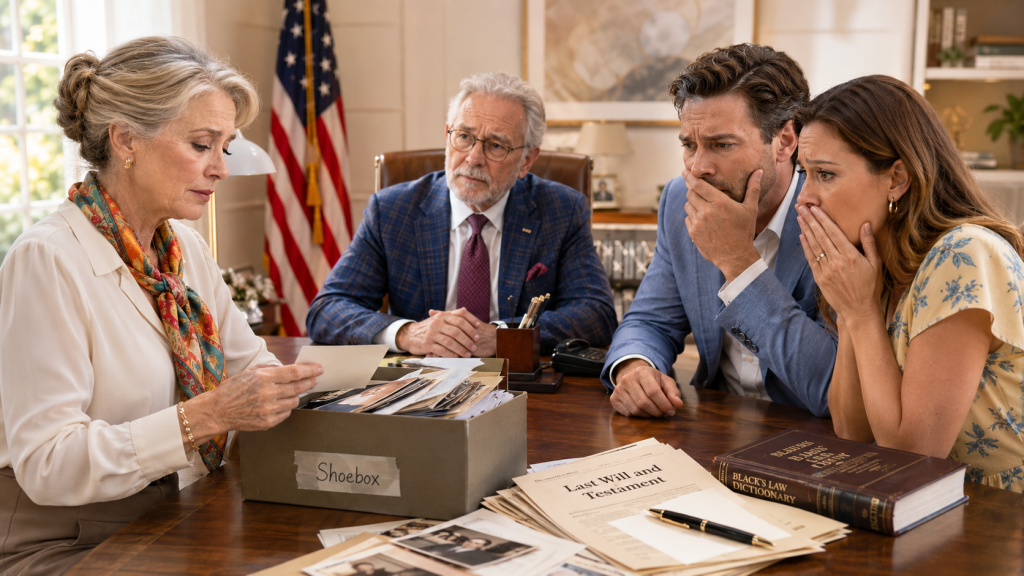
Mr. Katz folded his hands on the table.
“Arthur was very specific,” he said. “If either of you claimed that conversations concerning his property, business, or competency never happened, Helen was to open that envelope.”
Roy recovered first.
He always did.
“That proves nothing. Dad could have written anything.”
I nodded.
“You’re right.”
I reached inside.
“But he didn’t write this.”
I removed a small flash drive.
Roy stared at it.
Sandra whispered, “What is that?”
Mr. Katz answered.
“Recordings.”
The room became so quiet that I could hear the air conditioner humming.
Roy looked from the flash drive to me.
“You recorded us?”
“No.”
I slid it toward Mr. Katz.
“Arthur did.”
Roy’s chair scraped backward.
“That’s insane.”
“No,” Mr. Katz said calmly. “It was cautious.”
Roy pointed at him.
“You knew?”
“I advised your father to preserve evidence after he told me he felt pressured.”
Sandra suddenly leaned forward.
“Pressured? We were trying to help him!”
I looked at her.
“By telling him he was too sick to control his own company?”
“That wasn’t what I meant.”
“By bringing documents to his house and telling him they were routine?”
“We were worried about him.”
“By asking his doctor whether cancer medication could make him legally incompetent?”
Her mouth opened.
Then closed.
I had never told her I knew about that.
Arthur had.
The third envelope contained a copy of an email Sandra had sent to Dr. Warren’s office.
She had asked whether Arthur’s chemotherapy, pain medication, and age might support an argument that he lacked the mental capacity to manage “significant financial affairs.”
Dr. Warren had refused to discuss Arthur’s condition without his permission.
Sandra had written again.
She had claimed she was Arthur’s “primary family representative.”
Arthur had discovered the exchange two weeks later.
That night, he had sat at the kitchen table with me long after dinner.
He didn’t look angry.
That would have been easier.
He looked tired.
“I raised two children who think becoming old means becoming available,” he had said.
I had taken his hand.
“They’re scared.”
He had looked at me for a long time.
“You always find the kindest explanation.”
“I spent thirty-four years as a nurse. Sometimes fear makes people ugly.”
Arthur had squeezed my fingers.
“And sometimes greed does.”
I hadn’t argued.
By then, I had seen enough to know he was right.
I had met Arthur six years earlier.
Not in a hospital.
That was the story Roy and Sandra preferred because it made me sound like an employee who had crossed a line.
We actually met in a grocery store.
Arthur had been arguing with a self-checkout machine.
I was standing behind him with a carton of eggs, coffee, and a loaf of bread.
The machine kept announcing that there was an unexpected item in the bagging area.
Arthur finally looked at me and said, “At my age, I’m beginning to suspect the unexpected item is me.”
I laughed so hard I nearly dropped the eggs.
He smiled.
That was the beginning.
At the time, I had been retired for almost a year.
My first husband, Paul, had died eleven years earlier.
My daughter lived in Oregon with her own family.
I had spent decades taking care of people, first professionally and then personally, and I had reached the point where I wanted quiet mornings, gardening, mystery novels, and absolutely no responsibility for another grown man.
Then Arthur asked if he could buy me coffee.
I said no.
He asked again the following week when we ran into each other at the same store.
I said no again.
The third time, he held up both hands and said, “Helen, either fate is becoming embarrassingly obvious, or you shop for bread far too often.”
I accepted.
Coffee became lunch.
Lunch became weekend drives.
Weekend drives became evenings sitting on his back porch while he told me stories about building Whitmore Manufacturing from one rented warehouse and four employees into a company that supported hundreds of families.
He talked about his late wife, Margaret.
I talked about Paul.
Neither of us tried to erase the people we had loved before.
Maybe that was why loving Arthur eventually felt possible.
We understood that the heart was not a room that needed to be emptied before someone new could enter.
Two years after we met, Arthur asked me to marry him.
We were married quietly at a small chapel.
My daughter came.
Two of Arthur’s oldest friends attended.
Mr. Katz served as a witness.
Roy and Sandra were invited.
Neither came.
Roy called Arthur the morning of the ceremony.
I happened to be standing nearby when Arthur answered.
“You’re actually doing this?” Roy asked.
“Yes.”
“She’s a nurse, Dad.”
“Retired nurse.”
“You barely know her.”
Arthur looked at me and smiled sadly.
“I know her better than you’ve bothered to know me for the last ten years.”
Roy hung up.
Sandra sent a text.
Hope you know what you’re doing.
That was all.
For the first year of our marriage, they rarely visited.
When they did, they treated me politely enough.
Coldly, but politely.
Then Arthur became sick.
It started with fatigue.
Then came the pain.
Then tests.
Then a room with a doctor speaking gently while Arthur held my hand.
Pancreatic cancer.
Advanced.
We walked out of the hospital knowing our future had suddenly become smaller.
I remember sitting beside him in the car.
Neither of us spoke for several minutes.
Finally Arthur said, “Well.”
I looked at him.
“Well what?”
“I suppose this means I’m going to become very annoying.”
I started crying.
He pulled me against him.
“I’m sorry,” he whispered.
“You have nothing to apologize for.”
“I’m going to make you a nurse again.”
I held his face between my hands.
“No.”
He looked confused.
“You’re going to be my husband. If I happen to know how to take care of you, that’s just good luck.”
He kissed my forehead.
For the next fourteen months, that was how we lived.
Not patient and nurse.
Husband and wife.
There were medications, appointments, nausea, weight loss, bad nights, and eventually a hospital bed in our downstairs bedroom.
But there were also movies.
Pancakes.
Arguments over crossword clues.
Slow walks through the garden.
Music playing while I cooked.
His hand reaching for mine under the blankets.
We still laughed.
We still loved.
And somewhere during those fourteen months, Roy and Sandra suddenly rediscovered their father.
At first I was grateful.
I truly was.
I thought illness had reminded them that time was limited.
Roy began coming every Sunday.
Sandra called twice a week.
They brought groceries Arthur hadn’t requested.
They asked about appointments.
They offered to help.
I encouraged it.
“Your children miss you,” I told Arthur.
He gave me a look.
“They miss something.”
I didn’t want to believe him.
Then the questions started.
How much was the house worth?
Had Arthur reviewed the company’s shareholder agreement?
Was he still keeping investment accounts at the same bank?
Where was the deed to the lake property?
Had he changed his estate plan after marrying me?
Did I have access to his accounts?
At first they asked casually.
Then more directly.
One afternoon, while Arthur was sleeping, Sandra cornered me in the kitchen.
“You understand that most of this belongs to the family.”
I dried my hands on a towel.
“I’m part of Arthur’s family.”
She gave me a thin smile.
“You know what I mean.”
“Yes,” I said.
“I’m afraid I do.”
She looked around the kitchen as if taking inventory.
“The company existed before you.”
“I know.”
“The houses existed before you.”
“I know.”
“Our inheritance existed before you.”
That sentence told me everything.
Not our father’s property.
Not Dad’s savings.
Our inheritance.
As though Arthur had already died and simply forgotten to leave.
I put the towel down.
“Your father is still alive.”
Sandra’s expression hardened.
“Nobody said he wasn’t.”
“You just spoke about everything he owns as if it already belongs to you.”
She crossed her arms.
“I’m protecting my children.”
“From what?”
Her eyes moved over me.
“People who arrive late.”
After that, I stopped making excuses for them.
Arthur never asked me to fight his battles.
He didn’t need me to.
He began meeting privately with Mr. Katz.
He asked Dr. Warren to evaluate and document his mental competency.
More than once.
He created records.
Dates.
Letters.
Copies of emails.
Financial statements.
He recorded meetings in which Roy and Sandra pressured him.
And every month, he asked me to write down what I personally witnessed.
I hated doing it.
It made our home feel like evidence.
Arthur insisted.
“Not because I expect you to need it,” he told me, “but because I’ve lived long enough to know that people remember differently when money is involved.”
The fourth envelope was dated May 20th.
Inside was a signed statement from Arthur’s physician.
Mr. Katz read it aloud.
At the time of the examination, Arthur Whitmore showed no evidence of dementia, delirium, significant cognitive impairment, or inability to understand financial and legal decisions.
Roy stared at the table.
Sandra’s face tightened.
The fifth envelope documented a meeting Roy had arranged with a financial adviser Arthur had never hired.
The sixth contained a copy of paperwork Sandra had left on Arthur’s desk.
A power of attorney naming Sandra.
Arthur had never requested it.
He had never signed it.
The seventh contained photographs.
That was the first moment Roy truly lost control.
He saw the photographs and jumped up.
“Where did those come from?”
I knew immediately which ones he meant.
Arthur’s study.
His desk drawers open.
Roy standing in front of the filing cabinet.
Roy holding a folder.
The pictures had been captured by the security camera Arthur installed after tax documents went missing.
Roy pointed at me.
“You installed cameras?”
“Arthur did.”
“This was his son’s house too!”
“No,” I said.
“It was your father’s home.”
The distinction enraged him.
“My mother lived there!”
“Yes.”
“I grew up there!”
“Yes.”
“That house is part of my family!”
“And yet when your father was dying inside it, you spent more time searching his desk than sitting beside him.”
The words came out before I could soften them.
Roy froze.
I regretted the cruelty immediately.
Not because it was false.
Because Arthur would not have wanted me to become cruel to defend him.
Roy sank back into his chair.
For just a second, I saw something beneath his anger.
Shame.
Then it disappeared.
Sandra turned to Mr. Katz.
“This is character assassination.”
“No,” he replied.
“This is documentation.”
“Why are we even here? Read the will.”
Mr. Katz looked at me.
I knew what came next.
I had known for three months.
And I had dreaded it every day.
Arthur’s children believed I had spent his final months persuading him to leave everything to me.
The truth was almost the opposite.
When Arthur told me what he intended to do, we had our worst argument.
“No.”
He had been sitting in his recliner by the bedroom window.
By then he needed oxygen several hours a day.
His face had become thin.
His wedding ring slipped loosely around his finger.
He looked at me.
“Helen.”
“No.”
“You haven’t heard—”
“I heard enough.”
He sighed.
“You’re going to let me finish because I’m dying and I should receive at least one advantage from it.”
“Arthur.”
His eyes softened.
“Sit down.”
I sat.
He reached for my hand.
“I’m not leaving the company to Roy.”
I swallowed.
“That’s between you and Roy.”
“I’m not leaving it to Sandra either.”
“Arthur—”
“I’m leaving controlling ownership to the employee trust.”
I stared at him.
Whitmore Manufacturing employed just over six hundred people.
Arthur had always considered those employees part of the reason the company existed.
Many had been there twenty or thirty years.
He continued.
“Forty-nine percent will remain divided among family trusts. Fifty-one percent goes permanently to the employee trust. The company can’t be sold without employee approval.”
I couldn’t speak.
Roy had been quietly talking with a private equity group for months.
Arthur knew.
If Roy gained control after Arthur’s death, he intended to sell.
The likely result would have been layoffs, consolidation, and the possible closure of the original plant.
“Arthur,” I whispered.
He smiled.
“I built that company with people, Helen. Not with children who visited twice a year and suddenly became experts when cancer showed up.”
“What about Roy?”
“He’ll receive income from his portion if the company succeeds. So will Sandra. So will their children. They will be comfortable.”
“Then why do you think they’ll fight?”
“Because comfortable isn’t the same as powerful.”
He was right.
In Mr. Katz’s office, Roy listened as the terms were read.
His inheritance was substantial.
More money than most people would earn in several lifetimes.
Sandra’s was equally substantial.
Trusts had been created for all four grandchildren.
Arthur had paid off the mortgages on Roy and Sandra’s homes years earlier.
He had already funded investment accounts for them.
Neither child was being abandoned.
Neither was being disinherited.
But neither would control Whitmore Manufacturing.
Roy looked stunned.
“You gave our company to employees?”
“Fifty-one percent,” Mr. Katz corrected.
“My father built that for me.”
I shook my head.
“Your father built it before you were born.”
“He promised I would run it.”
Mr. Katz opened another envelope.
“Actually, Arthur anticipated that claim.”
Roy looked as if he might break something.
The letter was dated August 3rd.
Mr. Katz handed it to Roy.
Roy read silently.
His face changed.
“What does it say?” Sandra asked.
He didn’t answer.
She snatched the letter from him.
Arthur had written:
Roy,
I once hoped you would run Whitmore Manufacturing.
I told you so when you were twenty-six.
I also told you that leadership was earned every day.
You chose another path.
There is no shame in that.
The shame came later, when you returned not because you cared about the work, but because you discovered what the company might sell for.
You asked me to dismiss people who gave thirty years of their lives to this business so a buyer could improve margins.
You called their pensions “legacy costs.”
Those people are not costs.
They are the reason there is a legacy.
I love you.
But I will not allow loving you to become a weapon you use against everything I built.
Sandra stopped reading.
Her fingers trembled.
Roy looked toward the window.
For a while, nobody spoke.
Then Sandra asked the question I had known was coming.
“And Helen?”
Her voice was almost a whisper.
“What does she get?”
Roy turned back.
“Yes.”
There it was.
The question underneath every visit.
Every accusation.
Every suspicious glance.
What does the nurse get?
Mr. Katz opened Arthur’s final will.
“Helen Whitmore retains the marital residence.”
Roy laughed bitterly.
“Of course.”
I said nothing.
“The residence,” Mr. Katz continued, “was transferred into joint ownership with right of survivorship three years ago. It therefore does not pass through the estate.”
Sandra stared at me.
“You already owned half?”
“Yes.”
“Before Dad got sick?”
“Yes.”
She looked genuinely confused.
Arthur had transferred half the house to me six months after our wedding.
Long before cancer.
Long before any dispute.
Mr. Katz continued.
“Helen also receives Arthur’s personal vehicles, household possessions except those specifically designated, and the investment account established for her care.”
Roy gave a sarcastic laugh.
“How much?”
Mr. Katz named the amount.
It was generous.
More than I had ever expected.
But it was nowhere near what they had imagined.
Roy frowned.
“That’s it?”
I looked at him.
The surprise in his voice almost made me laugh.
For fourteen months, he had treated me like a thief waiting for his father to die.
Now he seemed disappointed by the size of my theft.
“That’s it,” I said.
Sandra looked at Mr. Katz.
“What about the lake house?”
“To the grandchildren jointly.”
“The art collection?”
“Several pieces go to museums. The remaining pieces are divided according to the memorandum attached to the will.”
“Dad’s vintage cars?”
“One to Roy. One to Sandra. One to a longtime employee named Marcus Hill.”
Roy frowned.
“Marcus?”
“Your father’s first employee.”
Roy shook his head in disbelief.
Sandra leaned back.
“So she doesn’t get the company.”
“No.”
“She doesn’t get the lake house.”
“No.”
“She doesn’t get the majority of his investments.”
“No.”
Her eyes slowly moved to me.
For the first time, I saw uncertainty.
Maybe even embarrassment.
Because the story she had told herself no longer worked.
I had not married Arthur for his company.
I had not manipulated him into cutting out his children.
I had not taken everything.
Arthur had given his children millions.
He had protected his employees.
He had provided for me.
That should have ended it.
It didn’t.
Roy said, “Then what’s the secret?”
Mr. Katz glanced at me.
Roy continued.
“Dad told me three weeks before he died that there was something I didn’t know. He said I’d understand after the will was read.”
My heart tightened.
I knew what Arthur meant.
It was the one thing he had asked Mr. Katz not to disclose unless Roy and Sandra forced the issue.
Mr. Katz removed the last unopened envelope.
January 7th.
Arthur had died January 11th.
Four days later.
Sandra noticed the date.
Her face lost color.
“What is that?”
I didn’t answer.
Mr. Katz placed it between them.
“Your father’s final statement.”
Roy reached for it.
Mr. Katz stopped him.
“Helen opens this one.”
I took the envelope.
My hands shook.
Not because I didn’t know what it contained.
Because the last time I had seen Arthur write those words, he had been lying in bed barely strong enough to hold a pen.
I broke the seal.
Inside was a letter.
And another document.
I unfolded the letter first.
My Helen,
If they are reading this, I suppose they pushed until you finally had to let them see the thing I wished they would discover without evidence.
I am sorry for that.
You spent your life caring for people and somehow still found enough tenderness left to care for me.
They called you my nurse because it was easier than calling you my wife.
A nurse can be dismissed.
A wife cannot.
A nurse can be accused of overstepping.
A wife belongs beside her husband.
But there is something even Roy and Sandra never understood.
You were not the person who came into my life because of Whitmore Manufacturing.
Whitmore Manufacturing survived because of you.
Roy frowned.
Sandra looked at me.
I kept reading.
They did not know.
Almost nobody knew.
Twenty-eight years earlier, long before Arthur and I ever met in that grocery store, our lives had crossed without either of us realizing how important it would become.
At the time, I was married to Paul.
Paul worked for a regional bank.
I was a hospital nurse working nights.
Whitmore Manufacturing was still small enough that one lost contract nearly destroyed it.
A major customer filed bankruptcy owing Arthur hundreds of thousands of dollars.
Arthur missed payroll.
The bank prepared to call his business loan.
He had personally guaranteed nearly everything.
House.
Equipment.
Warehouse.
Arthur spent years telling people that Whitmore survived because he persuaded his bank to give him ninety days.
That was true.
What Roy and Sandra never knew was why the bank agreed.
Paul had been the senior loan officer reviewing the account.
Arthur’s numbers were terrible.
On paper, the safest decision was foreclosure.
But Paul came home one night and told me about a manufacturing owner who refused to shut his doors because more than forty families depended on the plant.
Paul never gave me Arthur’s name.
He wasn’t allowed to.
He simply said, “I think the man deserves time, but the committee won’t approve the risk without additional collateral.”
A few years earlier, my parents had left me a small parcel of commercial land.
It wasn’t worth a fortune then.
But it was paid for.
Paul and I talked until two in the morning.
The next day, through the bank, we temporarily pledged that property as supplementary collateral for a restructuring fund used to save several local businesses.
One of those businesses was Arthur’s.
I never knew.
Arthur never knew who had backed the program.
Years later, the loan was repaid.
The lien was removed.
Life continued.
Paul died.
I retired.
Then I met Arthur beside a malfunctioning grocery scanner.
It was only after we had been married for nearly a year that Arthur found old refinancing papers while organizing company archives.
He saw Paul’s name.
He asked me whether my husband had worked at that bank.
I said yes.
He kept digging.
Eventually Mr. Katz helped locate the old records.
Arthur discovered the truth.
The collateral Paul and I had provided had been part of the reason Whitmore Manufacturing survived its most dangerous year.
Roy stared at me.
“That’s not possible.”
Mr. Katz slid the second document across the table.
It was a certified copy of the old agreement.
My name was there.
Helen Mercer.
My name before I married Arthur.
Sandra read it twice.
“You invested in Dad’s company?”
“No.”
I shook my head.
“I helped secure a bank program. I didn’t know his company was involved.”
“How much was the land worth?”
“Back then? Enough to make me terrified.”
“What is it worth now?”
I almost smiled.
“That’s irrelevant.”
Arthur had asked the same question when he discovered the story.
Then he had cried.
It was one of only three times I ever saw him cry.
“You saved my company before you knew me,” he had said.
“No, Arthur. Paul and I helped a lending program.”
“My company was one of the companies.”
“We didn’t know that.”
“That makes it better.”
“How?”
“Because you didn’t do it for me.”
He had taken my hands.
“You did it because people might lose their jobs.”
That was the moment he decided to create the employee trust.
Not because I suggested it.
I didn’t.
But because learning how close his company had once come to disappearing reminded him that Whitmore had never survived because of one person.
It survived because people took risks for one another.
Paul.
Me.
The bank.
Employees who accepted delayed paychecks.
Suppliers who extended terms.
Customers who stayed.
Arthur wanted the company’s future to honor that.
Roy stared at the old document.
“So this whole employee trust thing was Helen’s idea.”
“No,” Mr. Katz said.
“It was your father’s.”
“But because of her.”
“Because of what he learned.”
“That’s the same thing.”
I looked at Roy.
“No. It isn’t.”
He turned on me.
“You expect me to believe you never reminded him about this?”
“I asked him not to tell anyone.”
“Why?”
“Because it wasn’t mine to use.”
His expression sharpened.
“You could have used it.”
“Yes.”
“And you didn’t?”
“No.”
“Why?”
I thought about Arthur.
Then I answered honestly.
“Because I loved your father.”
Roy laughed once.
Not because it was funny.
Because he didn’t know what to do with the sentence.
Sandra was still staring at the document.
Suddenly she whispered, “I called you just the nurse.”
I looked at her.
She swallowed.
“At Thanksgiving.”
I remembered.
Arthur had been too sick to come downstairs.
Sandra and Roy had brought their families.
I cooked almost everything.
Halfway through dinner, one of the grandchildren asked why I got to decide whether Grandpa was resting.
Sandra had said, loudly enough for everyone to hear:
“She’s basically just the nurse now.”
I had pretended not to notice.
Later, upstairs, Arthur asked why I was quiet.
I lied.
He knew.
He always knew.
Sandra’s eyes filled with tears.
“I said it in your house.”
“Yes.”
“And you still made dinner.”
“Yes.”
“Why didn’t you throw us out?”
“Because Arthur wanted his grandchildren there.”
She covered her mouth.
Roy stood.
“I need air.”
Mr. Katz said, “We’re not finished.”
Roy turned.
“What else could there possibly be?”
“One final instruction.”
Mr. Katz placed two smaller envelopes on the table.
One said ROY.
One said SANDRA.
“These are personal letters from your father.”
Roy didn’t move.
Sandra took hers immediately.
Her hands trembled as she opened it.
Roy finally sat and tore his envelope open.
I looked away.
Those letters were not for me.
For several minutes, there was only the sound of paper moving.
Then Sandra began to cry.
Not the angry tears I had seen at the hospital when she argued with doctors.
Not the frustrated tears from the funeral home when she complained that the obituary mentioned me as Arthur’s wife.
These were quiet.
Childlike.
She pressed the page against her chest.
Roy remained motionless.
Then he folded his letter.
Unfolded it.
Read it again.
Finally he asked Mr. Katz, “Did he really write this?”
“Yes.”
“When?”
“December.”
Roy looked at me.
“Did you read it?”
“No.”
He nodded slowly.
His face seemed older.
“What did he say?” Sandra asked.
Roy shook his head.
She didn’t press.
Later, months later, Roy told me.
Arthur had written about the day Roy was born.
About teaching him to ride a bicycle.
About the first time Roy came to the factory and announced that someday he wanted Dad’s office.
Arthur had written:
I should have corrected you then.
You should never want someone’s chair more than you want their responsibility.
I confused providing for you with preparing you.
That failure belongs partly to me.
Money made too many things easy, and I allowed it because I remembered how hard my own childhood had been.
But when hardship disappears completely, gratitude sometimes disappears with it.
I do not want your last memory of me to be a will.
I want it to be a choice.
You can spend the rest of your life angry that I did not give you control, or you can finally become the man I kept hoping you would decide to be.
I love you either way.
But only one of those choices will make you happy.
Roy never showed me the rest.
He didn’t need to.
Sandra’s letter said something similar.
She told me herself.
Arthur reminded her of the summer she was nine and spent three weeks collecting injured birds in cardboard boxes.
“You once cared about helpless things without asking what they could give you,” he had written.
“I hope you find that girl again.”
When the meeting ended, Roy walked out without saying goodbye.
Sandra remained in her chair.
Mr. Katz gathered the papers.
I began returning Arthur’s envelopes to the shoebox.
Sandra watched me.
Finally she said, “Why did Dad make you keep all of this?”
“Because he thought you might challenge his decisions.”
“I mean why you?”
I looked at her.
“Because I was there.”
That answer hurt her.
I could see it.
But it was the truth.
I was there when Arthur woke at three in the morning afraid he would stop breathing.
I was there when he vomited after chemotherapy.
I was there when he insisted on walking outside even though he could barely reach the garden gate.
I was there when he laughed.
When he cried.
When he slept.
When he made impossible plans for a future he knew he would never see.
Roy and Sandra could have been there too.
Arthur wanted them there.
That was the saddest part.
He wasn’t trying to punish them for being absent.
He kept hoping they would stop being absent.
Sandra stared at her father’s letters.
“I thought there would be more time.”
I nodded.
“Everyone does.”
She wiped her face.
“I hated you.”
“I know.”
“I thought you replaced Mom.”
“I never tried.”
“He loved her.”
“I know.”
“He loved you too.”
“Yes.”
Sandra’s voice broke.
“I didn’t understand how both could be true.”
I reached across the table.
For a moment, I expected her to pull away.
She didn’t.
I covered her hand with mine.
“Neither did I at first.”
She cried harder.
That did not fix everything.
Real life rarely changes because of one conversation.
Roy hired another lawyer.
For six weeks, he explored challenging parts of Arthur’s estate plan.
Nothing came of it.
The competency evaluations were clear.
The documents were properly executed.
The timeline stretched back years.
Most importantly, Arthur had not acted impulsively.
He had planned carefully.
Roy eventually dropped the challenge.
Sandra called me three months after the will reading.
It was a Sunday afternoon.
I almost didn’t answer.
“Can I come over?” she asked.
I looked around the kitchen.
Arthur’s coffee mug was still in the cabinet.
I couldn’t bring myself to move it.
“For what?”
She hesitated.
“To see you.”
When she arrived, she brought no lawyer.
No paperwork.
No questions about accounts.
She brought a pie.
A terrible one.
The crust was nearly burned.
Arthur would have teased her for weeks.
We sat at the kitchen table.
For the first twenty minutes, neither of us knew what to say.
Finally Sandra looked toward the staircase.
“I keep expecting Dad to come down.”
“So do I.”
She looked at me.
“Does it get quieter?”
“The house?”
“No.”
She touched her chest.
“This.”
I understood.
“Some days.”
She nodded.
Then she started asking questions.
Not about money.
About Arthur.
What was his favorite television show at the end?
Did he still listen to jazz at night?
Was he scared?
Did he talk about her?
That question almost broke me.
“Yes.”
“What did he say?”
“He worried about you.”
Her eyes filled.
“He was angry with me.”
“Sometimes.”
She smiled through tears.
“That sounds like Dad.”
“He was also proud of you.”
“For what?”
“Your children. The volunteer program you started at their school. The way you took care of your friend during her divorce.”
Sandra stared at me.
“He knew about that?”
“He knew everything you told him.”
“I barely called.”
“He remembered every call.”
She covered her eyes.
I reached across the table.
For the first time, Sandra let me comfort her without stiffening.
Roy took longer.
Almost a year.
The employee trust officially assumed majority voting control of Whitmore Manufacturing that spring.
Roy retained his shares.
To everyone’s surprise, he did not sell them.
He also began attending board meetings.
At first, I heard, he was combative.
Then something changed.
Maybe Arthur’s letter worked slowly.
Maybe losing control forced him to learn what leadership actually meant.
Maybe grief finally reached the place pride had occupied.
I don’t know.
But in November, Roy asked Marcus Hill—the employee Arthur had given one of his vintage cars—to take him through the original factory.
Marcus had worked there forty-one years.
He showed Roy the old loading dock.
The tool room.
The wall where Arthur once kept handwritten production targets.
He introduced him to machinists whose parents had worked for Arthur.
According to Marcus, Roy listened.
Really listened.
A few weeks before Christmas, there was a knock at my door.
Roy stood outside.
Alone.
He held no gift.
No folder.
No lawyer.
“Helen.”
“Roy.”
“Can I come in?”
I opened the door.
He walked into the same living room where he had once accused me of controlling access to his father.
His eyes moved toward Arthur’s chair.
I had kept it beside the window.
“Do you still sit there?” he asked.
“No.”
“Why?”
“It’s his.”
Roy nodded.
He stood beside it for several seconds.
Then he said, “Marcus told me about the payroll crisis.”
I waited.
“He said Dad sold his own car during that year.”
“I didn’t know that.”
“He said Dad came to work on the bus for four months so employees could be paid.”
I smiled faintly.
“That sounds like Arthur.”
Roy sat on the couch.
“I thought the company was something Dad owned.”
“It was.”
“No.”
He shook his head.
“I mean I thought that was all it was.”
He looked toward the chair.
“I thought ownership was the important part.”
I sat opposite him.
“And now?”
“I don’t know.”
That was the first truly humble sentence I had ever heard Roy speak.
He rubbed his hands together.
“I spent my whole life assuming Dad would leave me something big enough to prove I mattered.”
My heart softened despite everything.
“You mattered before the will.”
“I know that now.”
He looked at me.
“I’m not sure I knew it then.”
We sat quietly.
Then Roy reached into his coat.
My body tensed before I could stop it.
He noticed.
His face fell.
He pulled out a photograph.
Not paperwork.
A photograph.
Arthur, Margaret, Roy, and Sandra at a beach.
Roy looked about twelve.
Sandra maybe eight.
Arthur was young and sunburned, holding both children.
“My daughter found this.”
I took it carefully.
“Your mother was beautiful.”
Roy smiled.
“She was.”
He studied me.
“I thought liking you meant betraying her.”
The confession surprised me.
“I never asked you to like me.”
“I know.”
“I never asked Arthur to forget her.”
“I know that too.”
Roy swallowed.
“I called you the nurse.”
“Yes.”
“You were his wife.”
“Yes.”
“You took care of him when I should have been helping.”
“You were his son. You didn’t have to do what I did.”
“But I should have done something.”
I didn’t disagree.
He looked down.
“I’m sorry.”
Two words.
Not enough to erase everything.
Enough to begin something.
I accepted his apology.
Not because Arthur had asked me to.
Because I was tired of carrying anger into rooms where Arthur no longer existed.
The following January, exactly one year after Arthur wrote his final letter, the Whitmore Employee Foundation announced its first scholarship.
It would provide tuition assistance for employees’ children entering nursing, engineering, or skilled trades.
Marcus called me.
“You need to come to the ceremony.”
“I don’t need to do anything.”
“Arthur made me promise I’d annoy you.”
“That sounds suspiciously believable.”
I went.
The event was held at the original factory.
More than four hundred people attended.
I sat near the back.
I preferred it that way.
Then Roy walked to the microphone.
I almost left.
Public speeches made me nervous.
Especially Roy’s.
He looked across the room.
“For most of my life,” he began, “I misunderstood what my father meant when he used the word legacy.”
The room quieted.
“I thought legacy was what someone leaves to you.”
He paused.
“My father believed legacy was what you leave inside people.”
I looked down.
My eyes were already burning.
Roy continued.
“Years ago, when this company almost failed, people outside Whitmore helped keep its doors open. One of those people had no idea whose company she was helping.”
His eyes found me.
My stomach dropped.
“Oh, Roy,” I whispered.
Too late.
He smiled slightly.
“My father discovered that the woman he married decades later had once risked her own property as part of the lending program that helped this factory survive.”
People turned toward me.
I wanted to disappear.
“But if you ask Helen Whitmore about it,” Roy said, “she’ll spend fifteen minutes explaining why she deserves no credit.”
A few people laughed.
He continued.
“She’s probably right. Many people saved this company. That’s the point.”
He looked toward the employees.
“My father didn’t leave control of Whitmore to me.”
A year earlier, he could not have said those words without bitterness.
Now he smiled.
“For a while, I thought that meant he didn’t trust me.”
He paused.
“Eventually I realized it meant he trusted all of you.”
Marcus lowered his head.
Someone near the front began clapping.
Roy raised a hand.
“There’s one more thing.”
He looked at me again.
“I spent the last year deciding how to honor my father.”
My heart tightened.
“So today, I’m transferring half of my personal voting shares into the employee trust.”
The room erupted.
I stood without realizing it.
Roy’s eyes filled with tears.
Sandra, sitting across the aisle, covered her mouth.
Roy continued when the applause faded.
“My children will still be provided for. So will I. But my father was right about something I wish I’d learned while he was alive.”
He looked around the factory.
“If you have enough, taking more isn’t success.”
He glanced toward Arthur’s old office above the production floor.
“Sometimes knowing when something belongs to everyone is the hardest form of inheritance.”
I cried openly then.
Not because Roy had given away shares.
Because I could hear Arthur in him.
Not perfectly.
Not completely.
But enough.
After the ceremony, people surrounded Roy.
I tried to slip out.
Sandra caught me near the door.
“Where are you going?”
“Home.”
“No, you’re not.”
“I’m tired.”
“You’re always tired when someone tries to applaud you.”
“I dislike applause.”
She linked her arm through mine.
“Too bad.”
The grandchildren joined us.
Then Roy.
For the first time since Arthur’s funeral, all of us stood together without suspicion in the room.
Roy handed me a small box.
I frowned.
“What is this?”
“Dad left instructions.”
My breath caught.
“What instructions?”
“Marcus had it.”
I looked toward Marcus.
He grinned.
“Don’t blame me. Boss’s orders.”
Inside the box was a key.
A tiny brass key attached to a wooden tag.
On the tag Arthur had written two words.
Blue cabinet.
I knew exactly what he meant.
Arthur kept a narrow blue cabinet in the back corner of his study.
After his death, I had never opened it.
Not once.
That evening, I went home alone.
The house was quiet.
I climbed the stairs to Arthur’s study.
For months, I had avoided spending too much time there.
His reading glasses were still on the desk.
A fountain pen rested beside an unfinished crossword.
His favorite jacket hung behind the door.
Grief is strange.
You can survive funerals, lawyers, wills, arguments, anniversaries.
Then a jacket can destroy you.
I crossed the room to the blue cabinet.
The key fit.
Inside was another shoebox.
I laughed through my tears.
“Arthur, honestly.”
Inside were photographs.
Ticket stubs.
Restaurant receipts.
The little note on which I had written my phone number after our third grocery-store meeting.
He had saved it.
Underneath those things was one final envelope.
HELEN.
I sat on the floor.
For several minutes, I could not open it.
Finally I did.
My dearest Helen,
If you’re reading this, Roy has either become a better man or Marcus has become impatient.
I’m hoping for Roy.
I smiled.
Then cried.
Arthur continued.
You are going to make the mistake of thinking my last year was tragic.
Please don’t.
Dying was terrible.
Being sick was exhausting.
Leaving you was the cruelest thing I have ever been forced to do.
But loving you was not tragic.
Those years were bonus years.
Every morning beside you was something I had no right to expect and every ordinary evening became extraordinary because you were there.
My children called you my nurse.
They were wrong.
Nurses helped me at the hospital.
You were the woman who knew I hated green gelatin.
You were the woman who warmed my socks in the dryer.
You were the woman who argued with me when I became impossible.
You were the woman who let me speak about Margaret without jealousy and made room for every version of me that existed before you.
You were my wife.
My friend.
My last great surprise.
But even that is not the final secret.
I stopped breathing for a moment.
Arthur had underlined the next sentence.
The final secret is that you did not save me at the end of my life.
You gave me a life worth reaching the end of.
I pressed the letter to my chest.
For months I had wondered whether I should have done more.
Found another specialist.
Pushed harder for another trial.
Seen some symptom earlier.
Insisted he eat more.
Made him walk more.
Made him rest more.
Anyone who has cared for someone dying knows that terrible arithmetic.
You keep trying to calculate which choice might have bought another day.
Arthur knew.
Of course he knew.
His letter continued.
So I am leaving you one final instruction.
Stop nursing a dead man.
Live.
Travel.
Plant those ridiculous yellow roses you like.
Visit your daughter.
Spend money without apologizing.
Stay in our house or sell it.
Fall in love again if life is outrageous enough to offer you the chance.
And when my children become annoying—and they will—remember that beneath all their worst qualities are two frightened children who loved their father badly for a while.
If they deserve forgiveness, give it.
If they don’t, keep your distance.
You do not owe anyone access to your peace.
I love you.
Not because you cared for me.
Because you made me feel cared about.
There is a difference.
Arthur
I sat on the study floor until the room went dark.
Then I laughed.
Then I cried again.
Then, for the first time since Arthur died, I opened the curtains.
A year later, I planted yellow roses along the entire south side of the house.
Sandra complained that they were too bright.
Then she planted three at her own home.
Roy remained on Whitmore’s board.
He never became his father.
That was a good thing.
He became himself.
A better version.
Not perfect.
Still proud.
Still occasionally impossible.
But he learned to ask questions before issuing instructions.
He began visiting the factory floor without photographers.
He learned employees’ names.
When Marcus retired, Roy organized the celebration himself.
Sandra started volunteering with the Whitmore Foundation.
Her oldest daughter entered nursing school.
The day she received her acceptance letter, Sandra called me before she called Roy.
“Dad would have loved this,” she said.
“Yes.”
Then she added, “You know she says you’re the reason.”
“For what?”
“For nursing.”
I smiled.
“I told her to become an accountant.”
Sandra laughed.
The sound surprised both of us.
Some wounds close in unusual ways.
Not because the past changes.
It doesn’t.
Sandra still said those things.
Roy still searched Arthur’s office.
They still spent part of their father’s final year counting assets instead of hours.
Forgiveness did not erase those facts.
It simply stopped those facts from controlling every day afterward.
I never forgot the twenty-two envelopes.
I kept them for years.
Not as weapons.
As reminders.
Arthur had understood something I had learned slowly.
Truth rarely needs to shout.
Roy shouted.
Sandra accused.
Lawyers threatened.
Relatives whispered.
People wondered whether the retired nurse had manipulated the wealthy dying businessman.
Arthur didn’t fight every rumor.
He documented reality.
Then he placed it quietly in a shoebox.
Eventually, reality spoke for itself.
Five years after Arthur’s death, the employee trust still controlled Whitmore Manufacturing.
The original factory was still open.
Employment had grown.
The scholarship foundation had funded more than eighty students.
One spring afternoon, I attended a graduation ceremony for twelve scholarship recipients.
Among them was Sandra’s daughter, Emily.
She graduated with honors in nursing.
After the ceremony, she found me outside the auditorium.
She wore her graduation gown and held a ridiculous number of flowers.
“Grandma Helen!”
That was what she called me now.
Not Helen.
Not Dad’s wife.
Not the nurse.
Grandma Helen.
She ran toward me and wrapped both arms around my shoulders.
“I did it.”
“You did.”
She pulled back.
“I wish Grandpa were here.”
I looked toward the blue sky.
“So do I.”
Roy approached with Sandra.
His hair had gone mostly gray.
He handed me a small program.
“Look at page six.”
I opened it.
The nursing scholarship had been renamed.
The Arthur and Helen Whitmore Care Scholarship.
I looked at Roy.
“No.”
He smiled.
“Yes.”
“I told you not to put my name on things.”
“You also told Dad not to leave you money. Apparently ignoring you is a family tradition.”
Sandra laughed.
I swatted Roy’s arm with the program.
Then I looked down at the printed name.
Arthur and Helen.
Side by side.
I thought about the grocery store.
The broken self-checkout.
Coffee.
The chapel.
Cancer.
The hospital bed.
The envelopes.
The arguments.
The final letter.
All the ordinary mornings I once assumed we had more of.
People often think inheritance means money.
Homes.
Stocks.
Companies.
Jewelry.
Land.
Arthur left those things.
But none of them became the part of him I carried most closely.
His real inheritance was quieter.
Roy inherited a lesson about leadership.
Sandra inherited a second chance to love without keeping score.
His grandchildren inherited opportunity.
Hundreds of employees inherited a voice in the company they had helped build.
And I inherited permission.
Permission to stop measuring my love by how much suffering I could prevent.
Permission to stop proving I belonged beside my husband.
Permission to live after him.
That summer, I finally took the trip Arthur and I had postponed when he became sick.
Italy.
I went alone.
Sandra insisted I would hate traveling by myself.
Roy worried I would lose my passport.
I informed them both that I had managed hospital night shifts, two marriages, cancer treatments, estate lawyers, and their personalities.
Rome would not defeat me.
At a little café in Florence, I ordered coffee and sat outside beneath a striped awning.
At the next table, an older man spent several minutes arguing with the electronic payment machine.
It kept rejecting his card.
Finally he looked at me helplessly.
“These machines are designed by young people who hate us.”
I laughed.
For one second, the years disappeared.
I could almost hear Arthur.
Unexpected item in the bagging area.
The man smiled.
“May I buy you another coffee?”
I looked at the empty chair across from me.
For a long time after Arthur died, I would have said no.
Not because I believed loving someone else would betray him.
Because grief had convinced me every new beginning came with an ending hidden inside it.
But Arthur’s letter was folded inside my purse.
I carried a copy when I traveled.
Stop nursing a dead man.
Live.
So I looked back at the stranger.
“One coffee,” I said.
“Don’t get ambitious.”
He laughed.
And somewhere deep inside me, where grief had once occupied every available space, something opened.
Not replacement.
Never replacement.
Room.
There is always room.
That may have been Arthur’s greatest secret of all.
Love is not an estate.
It does not become smaller when divided.
It cannot be protected by locking doors around it.
It cannot be inherited by demanding your share.
Love survives in what it teaches us to give away.
Roy had spent years believing his father’s legacy would arrive in a document telling him what he owned.
Sandra believed belonging meant protecting what was “family” from outsiders.
And for a while, I believed my worth came from how well I could care for everyone else.
Arthur proved all of us wrong.
His final gift was not the house.
Not the investment account.
Not the company.
Not even the truth hidden inside twenty-two envelopes.
It was the chance to become better after him.
Years later, when people asked me about Arthur, they sometimes said the same thing.
“You must have been such a wonderful nurse to him.”
I no longer felt insulted.
I simply smiled.
“I was his nurse sometimes.”
Then I would think of warm socks.
Crossword puzzles.
Burned pancakes.
Yellow roses.
A broken grocery scanner.
His hand finding mine in the dark.
“And the rest of the time,” I would say, “I was his wife.”
That was enough.
It had always been enough.
And somewhere in the home office, inside a shoebox tied with string, twenty-two envelopes remained as proof that the loudest people in the room do not always own the truth.
Sometimes truth waits quietly.
Sometimes love does too.
And when the right moment comes, both have a way of opening themselves.
💬THE END! THANK YOU FOR READING!