

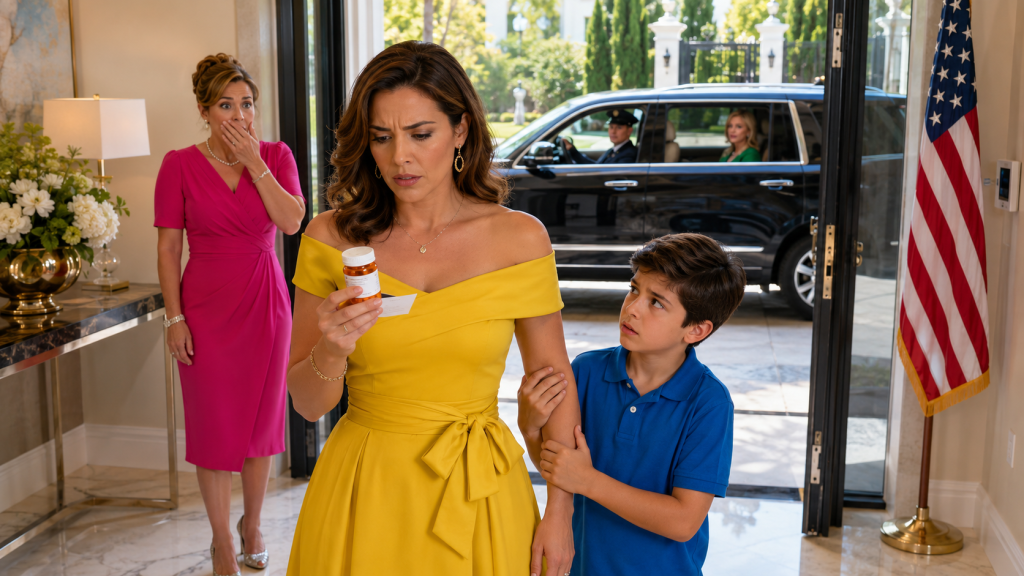
“Mom, don’t take those capsules… Dad said they’re supposed to make you sleep forever.”
For seven years, my son Mateo had never spoken a single word.
Not “Mom.”
Not “water.”
Not “I’m scared.”
Nothing.
So when his small, trembling voice suddenly echoed through the marble foyer of our Paradise Valley home, I felt as though the entire world had shifted beneath my feet.
In my hand was an amber glass bottle filled with white capsules.
There was no label.
No pharmacy information.
No doctor’s name.
My husband, Richard, had given it to me only minutes earlier before climbing into his SUV with his mother, Evelyn.
They claimed they were heading to Aspen for a weekend business trip, where Richard supposedly planned to meet investors interested in expanding the construction company my late father had left me.
The company belonged to me.
The house belonged to me.
Most of our land and investments had come from my family.
Yet somehow, over the years, Richard had slowly convinced me that I couldn’t manage any of it without him.
“You’ve been exhausted lately, sweetheart,” he had said that morning, gently brushing a strand of hair away from my face. “A doctor friend prepared these special vitamins for you. Take one every night.”
I had turned the bottle in my hand.
“Why doesn’t it have a prescription label?”
Richard smiled.
“They’re custom made. Not everything comes from a regular pharmacy, Claire.”
Evelyn hugged me before getting into the SUV, her perfume filling the entryway.
“Take care of yourself, dear. We certainly don’t want to come home and find you looking completely worn out.”
She laughed softly.
At the time, I dismissed it as another one of her insensitive comments.
Later, I would understand those words very differently.
The SUV disappeared beyond the iron gates while I remained in the foyer holding the bottle.
That was when Mateo tugged gently on my sweater.
“Mom…”
My heart stopped.
I dropped to my knees.
“What did you say, sweetheart?”
Mateo’s dark eyes were wide and wet with tears.
He pointed toward the bottle.
“Don’t take those. Last night I heard Dad and Grandma talking. They said when you went to sleep forever, the house would finally be theirs.”
The bottle slipped from my fingers.
Before it reached the marble floor, another hand caught it.
Maria.
She had worked for my family for almost twenty years, first for my father and then for me after I married Richard.
She stood beside us holding the bottle, her face drained of color.
“Please forgive me, Miss Claire,” she whispered. “I knew Mateo could speak.”
I stared at her.
“What?”
“I taught him quietly. Letters, words, reading. Everything I could. But Mr. Richard frightened him. He told Mateo that if you ever discovered he could talk, he would send him far away to a boarding school where you would never find him.”
Mateo pressed himself against me.
“Dad told me if I talked, something bad would happen to you because of me.”
I pulled back the sleeve of his pajamas and noticed faint marks around his upper arm.
My stomach turned.
For seven years, doctors and specialists had repeatedly told me Mateo was physically capable of speaking.
They believed his silence came from a deep emotional barrier.
For seven years, I blamed myself.
I thought I worked too much.
I thought I had failed him.
I never imagined the real reason for his silence had been living under the same roof.
Maria reached into her apron pocket and removed a memory card.
“I found this yesterday beneath the passenger seat in Mr. Richard’s SUV. He was searching everywhere for it afterward.”
“What’s on it?”
“I don’t know. But the vehicle has an interior camera.”
Before I could answer, a phone began ringing on the foyer table.
Richard’s phone.
He had forgotten it.
I walked toward the screen just as a message appeared from someone named Pamela.
Did you give her the capsules yet? Your mom says it can’t fail this time.
I photographed the screen.
I didn’t call Richard.
I didn’t send Pamela a message.
And I didn’t throw away the bottle.
Instead, I called my attorney, Daniel Mercer.
He had been my father’s attorney before becoming mine, and when I told him I needed him at the house immediately, he didn’t ask questions.
Forty minutes later, Daniel arrived with a private investigator named Lena Ortiz.
I showed them everything.
The bottle.
The message.
Mateo’s bruises.
The memory card.
Lena’s expression changed when I told her Richard believed I still knew nothing.
“Then we keep it that way,” she said.
She made copies of the digital evidence while Daniel carefully photographed the bottle without opening it.
The first video on the memory card had been recorded three nights earlier.
Richard sat inside his SUV outside a restaurant.
Evelyn was beside him.
“Once Claire starts taking them,” Evelyn said, “she’ll look confused first.”
Richard looked toward the windshield.
“And Vale documents it?”
“He already agreed.”
“What if she refuses?”
Evelyn’s voice became colder.
“Then Pamela said we increase the pressure another way. Stop being sentimental. You’ve wasted years waiting for her to hand you control voluntarily.”
My fingertips went numb.
Lena opened another recording.
This time Richard was speaking with Dr. Stephen Vale, the specialist who had treated me for exhaustion six months earlier.
Vale handed him an envelope.
“If she’s declared incompetent, the trust becomes easier to challenge.”
Richard asked, “And the board?”
“Once you control her voting rights, the board follows.”
Daniel paused the video.
“Claire, what trust is he talking about?”
“My father’s.”
I swallowed.
“My shares in Harrington Development are held through a family trust. If I die, most of them transfer to Mateo. But if I’m declared legally incapacitated…”
I stopped.
Daniel finished the sentence.
“Your designated financial agent temporarily assumes control.”
Richard.
I had signed the document four years earlier after a minor surgery.
He had told me it was only for emergencies.
Daniel looked sick.
Then Mateo screamed upstairs.
All four of us froze.
Maria came running down the hallway.
“Someone’s at the back door.”
Lena moved first.
“Do not open it.”
The door handle turned slowly.
Once.
Twice.
Then someone knocked.
Three measured taps.
I stood behind the kitchen wall as Lena checked the security monitor.
A man wearing a gray polo shirt stood outside holding a medical bag.
I recognized him.
Dr. Vale.
Daniel whispered, “Why would your doctor come here unannounced?”
Vale knocked again.
“Claire? It’s Stephen. Richard asked me to check on you before he left town.”
I looked at Daniel.
Richard had been gone less than two hours.
How had Vale known I was home?
My phone buzzed.
A message from Richard.
Forgot my phone. Stephen might stop by with something I need for the trip. Let him in if he comes.
Lena shook her head.
“Don’t answer.”
But I suddenly understood something.
Richard still believed the plan was working.
If I disappeared from view now, he would become suspicious.
So I looked at Daniel.
“I’m letting him in.”
Daniel’s eyes widened.
“Claire—”
“You and Lena stay in my father’s study. The cameras record the kitchen and foyer.”
Lena considered it for a moment.
Then nodded.
“Keep distance between you. Don’t eat or drink anything he gives you.”
I opened the door.
Dr. Vale smiled as though this were an ordinary house call.
“Claire. Sorry to bother you.”
“No problem.”
He stepped inside.
His gaze traveled immediately toward the foyer table where Richard’s phone had been.
I had already moved it.
Vale noticed.
“Richard said he left something.”
“He did?”
“Yes. His phone, I think.”
I smiled.
“I haven’t seen it.”
For half a second, something sharpened behind his eyes.
Then the friendly doctor returned.
“Well, while I’m here, how have you been feeling?”
“Tired.”
“Headaches?”
“Sometimes.”
“Memory trouble?”
I knew exactly what he was doing.
Creating symptoms.
Building a narrative.
“Actually,” I said, “I’ve been feeling better.”
Vale’s smile weakened.
He opened his medical bag.
“I brought something that may help you sleep.”
My stomach tightened.
“I already have vitamins.”
His hand stopped.
“Vitamins?”
“The ones Richard gave me.”
Vale recovered almost instantly.
“Yes. Of course.”
That answer told me more than anything else could have.
I leaned against the counter.
“Would you like coffee?”
“No, thank you.”
He glanced toward the staircase.
“Where’s Mateo?”
“Upstairs.”
“Still not speaking?”
I looked straight at him.
“Still quiet.”
Something about the way he exhaled told me he was relieved.
Vale removed a small sealed package.
“Take this tonight along with the supplement Richard gave you.”
“What is it?”
“Something mild.”
“Prescription?”
“Not exactly.”
I smiled.
“Then leave it here.”
He placed it on the counter.
Before leaving, Vale turned toward me.
“Claire, you know Richard worries about you.”
“I know.”
“He’s under a lot of pressure.”
“So am I.”
His smile disappeared.
“Sometimes stress can make people imagine things.”
The warning was subtle.
But it was a warning.
After he left, Lena emerged from the study.
“He walked straight into it.”
Daniel called law enforcement.
Not the local officer Richard played golf with.
Not anyone connected to his social circle.
Daniel contacted a state investigator he trusted, and after hearing what we had, the investigator instructed us not to alter anything.
The capsules and Vale’s package were collected for testing.
Richard’s phone was preserved.
The recordings were copied.
And then we waited.
Waiting was the hardest part.
By Saturday morning, Richard had called my phone seventeen times.
I answered only once.
“Where’s my phone?” he asked immediately.
“Hello to you too.”
“Claire, this isn’t funny.”
“I haven’t seen it.”
There was silence.
Then his voice softened.
“You took your vitamin last night, right?”
I looked through the kitchen window at Daniel’s car parked beyond the guesthouse.
“Yes.”
Richard exhaled.
“Good.”
The sound of relief in his voice made my skin crawl.
“Did you sleep well?”
“Very well.”
“Any dizziness this morning?”
“A little.”
Another pause.
“Just rest.”
I closed my eyes.
The man I had loved for twelve years was listening for signs that whatever he had given me was working.
“Richard?”
“Yes?”
“I love you.”
Silence.
Then he said, “I love you too.”
I hung up before he could hear my breathing change.
That afternoon, the laboratory called the investigator.
I wasn’t told every technical detail immediately, only that the capsules contained substances that absolutely should not have been given to me without medical supervision and that the combination could cause profound sedation, confusion, and serious medical danger.
Daniel sat beside me when I received the news.
The room seemed to tilt.
Until that moment, some small part of me had hoped there was another explanation.
A cruel misunderstanding.
A reckless supplement.
Anything.
But there wasn’t.
My husband had handed me something dangerous, kissed my forehead, and driven away.
Mateo climbed onto the sofa beside me.
“Mom?”
Hearing that word still made my heart ache.
I pulled him close.
“I’m here.”
“Are you going to die?”
“No.”
I said it firmly.
“I’m not going anywhere.”
He studied my face.
“Promise?”
“Promise.”
He wrapped his arms around my neck.
Then he whispered something that changed the entire investigation.
“Dad has more bottles.”
I pulled back.
“Where?”
“In his office. Behind Grandpa’s picture.”
Richard’s office had once belonged to my father.
After Dad died, Richard moved into it, saying the company president needed a proper place to work at home.
I had barely entered the room in years.
Behind my father’s framed photograph was a wall safe.
I didn’t know the combination.
Mateo did.
“Dad says the numbers when he opens it.”
The investigator obtained the proper authorization before anything was touched.
Inside the safe were documents.
Dozens of them.
Copies of my signature.
Medical reports I had never seen.
A draft petition seeking temporary guardianship over me.
A power-of-attorney package.
Transfer documents for several parcels of land.
And life insurance paperwork.
One policy was especially disturbing.
It had been increased nine months earlier.
Richard was the beneficiary.
But that wasn’t the worst discovery.
Inside a blue folder was a document concerning Mateo.
A residential behavioral facility in Utah.
A deposit had already been paid.
The proposed admission date was the following month.
I couldn’t breathe.
Richard had told my son he would send him away if he spoke.
He hadn’t been bluffing.
He was already preparing to do it.
Maria cried when she saw the paperwork.
Mateo simply stared at the floor.
“He showed me pictures,” he whispered.
“What pictures?”
“Of the school. He said children who cause trouble stay there until their moms forget them.”
I turned away so Mateo wouldn’t see my face collapse.
For years I had believed Richard’s greatest cruelty toward me was making me doubt myself.
I had been wrong.
His greatest cruelty was making our child believe love could be taken away as punishment.
Sunday morning brought another message.
This time from Evelyn.
Hope you’re resting. Richard says the supplements are already helping. We may stay one extra night.
I sent back two words.
Feeling sleepy.
Within one minute, she called.
I didn’t answer.
Then Pamela texted Richard’s forgotten phone.
How much did she take?
Lena photographed it.
A second message followed.
If she’s already confused, Vale needs to see her Monday morning. We need documentation before she realizes what’s happening.
Daniel looked at me.
“There’s your timeline.”
Monday morning.
Whatever they were planning was supposed to accelerate within forty-eight hours.
The investigators decided not to arrest Richard in Aspen.
They wanted to know what he would do when he returned believing I was impaired.
I hated the idea.
But I agreed.
Monday afternoon, Richard’s SUV came through the gates.
Evelyn sat beside him.
I was upstairs with Mateo when I heard the front door open.
“Claire?”
Richard sounded cheerful.
Almost too cheerful.
I descended slowly, gripping the railing and deliberately pretending to be groggy.
Evelyn’s face lit up.
Not with concern.
With satisfaction.
“Oh, sweetheart.”
She hurried toward me.
“You look exhausted.”
Richard studied my eyes.
“How many capsules did you take?”
“I don’t remember.”
His gaze met Evelyn’s.
There it was.
A tiny exchange.
Victory.
He wrapped an arm around my waist.
“That’s okay. I’ll handle everything.”
Behind him stood two people I hadn’t expected.
Dr. Vale.
And Pamela.
I recognized her from charity events.
Pamela Reeves was a financial consultant who had worked with Richard for years.
She smiled warmly.
“Claire, we thought it might help to organize a few things while you’re recovering.”
“What things?”
“Business matters.”
Richard guided me toward the living room.
“You don’t need to worry about that.”
On the coffee table, Pamela opened a leather folder.
Several documents were waiting inside.
Richard placed a pen in front of me.
“We just need your signature.”
I stared at the first page as though I couldn’t focus.
“What is it?”
“A temporary management authorization.”
“For what?”
“The company.”
I looked at him.
“Why?”
His patience thinned.
“Because you’re obviously not well.”
Dr. Vale stepped closer.
“Claire, I’m concerned about your cognition.”
“You examined me?”
“I’m observing you now.”
I almost laughed.
Instead, I let my hand tremble.
Richard crouched in front of me.
“Sweetheart, trust me.”
Those words broke something inside me.
Because for twelve years, I had.
I trusted him when he told me my father’s executives didn’t respect me.
I trusted him when he said business decisions overwhelmed me.
I trusted him when he discouraged old friends from visiting because they were “using” me.
I trusted him when he selected doctors.
Managed accounts.
Reviewed contracts.
Spoke for me at meetings.
Bit by bit, he had taken a capable woman and convinced her she was fragile.
Now he wanted my signature to complete the process.
I picked up the pen.
Pamela smiled.
“Right there.”
I lowered the pen toward the page.
Then stopped.
“What happens if I don’t sign?”
Nobody answered.
I looked at Richard.
His expression changed first.
“You will.”
The room became very quiet.
I set down the pen.
“No.”
Evelyn stepped forward.
“Claire, stop behaving like a child.”
My eyes moved to her.
For the first time in our entire marriage, I saw surprise on her face when I didn’t look away.
“No.”
Richard stood.
“Maybe we should do this privately.”
“We are.”
He reached for my arm.
I stepped away.
That was the signal.
Daniel entered from my father’s study.
Behind him came Lena and two investigators.
Richard froze.
Pamela’s face went white.
Vale took one step backward.
Evelyn whispered, “What is this?”
I stood upright.
No trembling.
No confusion.
No weakness.
“Actually,” I said, “I feel much better now.”
Richard stared at me.
His eyes moved toward Daniel.
Then Lena.
Then the investigators.
Finally, he looked at the documents on the table.
“Claire, whatever you think—”
“I think you gave me capsules containing dangerous drugs and expected me to take them.”
Evelyn gasped theatrically.
“That is outrageous.”
I looked at her.
“We have the recordings.”
Her mouth closed.
Richard recovered faster.
“What recordings?”
“The ones from your SUV.”
His face changed.
Not dramatically.
Just enough.
The slightest tightening around his mouth.
The smallest movement of his eyes.
He knew.
Pamela grabbed her purse.
One investigator stopped her.
“Ma’am, please remain where you are.”
“This is insane.”
Lena held up Richard’s phone.
Pamela stopped speaking.
I turned toward Vale.
“You came here Saturday and gave me another unmarked package while asking whether I had memory problems.”
He shook his head.
“That’s not what happened.”
“The kitchen camera recorded everything.”
His shoulders sagged.
Richard turned on him.
“Don’t say anything.”
That sentence destroyed whatever unity remained between them.
Vale looked at Richard with pure panic.
“You said nobody would be investigating.”
Evelyn snapped, “Stephen, shut your mouth.”
One investigator almost smiled.
Richard stepped toward me.
“Claire, listen to me.”
“No.”
“You don’t understand the context.”
“I understand enough.”
“I was trying to protect the company.”
“By making me sick?”
“No one was trying to hurt you.”
Mateo’s voice came from the staircase.
“Yes, you were.”
Every person in the room turned.
Mateo stood halfway down the stairs holding Maria’s hand.
Richard looked as if he had seen a ghost.
“Mateo?”
My son’s fingers tightened around Maria’s.
Then, slowly, he walked down the remaining stairs.
Richard stared at him.
“You can talk?”
Mateo stopped beside me.
“Yes.”
For seven years, Richard had controlled my son with fear.
Now Mateo looked directly at his father.
“You said Mom would sleep forever.”
Richard’s face emptied.
“Buddy, you misunderstood.”
“No.”
“You were little. You heard adults talking about—”
“I heard Grandma too.”
Evelyn stepped forward.
“Mateo, darling—”
He moved behind me.
“Don’t call me darling.”
I will never forget the expression on Evelyn’s face.
The child she considered powerless had become the witness she feared most.
Richard looked at me.
“How long?”
“Long enough.”
His jaw clenched.
“You used our son against me.”
Something cold settled inside me.
“No, Richard. You used him against me for seven years.”
The investigators separated everyone.
Pamela asked for an attorney.
Vale began talking almost immediately.
Evelyn denied everything.
Richard said almost nothing.
Before he was escorted out, he looked back at me.
“This family will never recover from what you’ve done.”
I stood beside Mateo.
“You’re right about one thing.”
He waited.
“This family will never be what it was before.”
Then the door closed behind him.
The silence afterward felt enormous.
For years, that house had been filled with Richard’s voice.
His instructions.
His opinions.
His corrections.
His footsteps.
His rules.
Now he was gone.
Mateo stood in the center of the foyer.
Then he whispered, “Are they coming back?”
“No.”
“Ever?”
I knelt in front of him.
“Not unless it is safe.”
He looked toward the door.
Then he began to cry.
Not loudly.
Just seven years of fear leaving his body one tear at a time.
I held him on the marble floor until my legs went numb.
The investigation lasted months.
Every week seemed to uncover another layer.
Pamela had helped Richard restructure financial records to create the appearance that he had contributed far more money to the company than he actually had.
Vale had created misleading medical notes describing me as forgetful, anxious, and emotionally unstable after appointments where I had complained only of fatigue.
Evelyn had contacted attorneys about challenging my father’s trust.
Richard had secretly transferred small amounts of money from joint accounts into shell businesses, apparently assuming I would never notice.
But the most painful discovery had nothing to do with money.
Investigators recovered messages between Richard and Evelyn discussing Mateo.
When he was three, doctors told us his vocal cords were normal.
One specialist suggested his silence might be related to fear.
I remembered that appointment.
Richard had been furious afterward.
At the time, he told me the doctor was incompetent.
The recovered messages revealed why.
Evelyn had written:
If the boy starts talking, he may repeat things he hears at home.
Richard responded:
I’ll keep him under control.
That sentence stayed with me for weeks.
Not because it surprised me anymore.
Because it explained everything.
Mateo’s silence had never been emptiness.
It had been survival.
Maria eventually told me the entire truth.
She first heard Mateo speak when he was four.
She had dropped a glass in the pantry, cutting her hand.
Mateo ran toward her and whispered, “Are you hurt?”
Maria was stunned.
When she asked why he never spoke around me, he covered his mouth and began crying.
Over time, she earned his trust.
They spoke quietly when Richard wasn’t home.
She taught him to read aloud in whispers.
She made games out of vocabulary.
She encouraged him.
But every time she suggested telling me, Mateo panicked.
“I should have told you anyway,” Maria said one evening.
We were sitting in the kitchen after Mateo went to bed.
“You were protecting him the best way you knew how.”
“I was afraid of Mr. Richard too.”
That confession hurt.
Maria had worked in our house nearly twenty years.
Richard had managed to frighten everyone around me while persuading me he was the person keeping everything together.
“How did my father feel about him?” I asked.
Maria hesitated.
“Your father never trusted him completely.”
I looked up.
“What?”
She disappeared into the pantry and returned with an old envelope.
“Your father gave me this shortly before he died. He told me only to give it to you if I ever believed you had become completely isolated.”
My hands shook as I opened it.
Inside was a handwritten letter.
Claire,
If you are reading this, then I was right to worry.
Love should never make your world smaller.
A good husband may disagree with you, challenge you, even annoy you, but he should never convince you that you cannot stand without him.
You were making decisions beside me when you were twenty-two years old. Do not let anyone convince you that the woman I trusted with everything suddenly became incapable.
Trust yourself.
Dad.
I read it three times.
Then I cried harder than I had at his funeral.
Because somewhere during my marriage, I had forgotten the woman my father remembered.
The next morning I carried the letter into the garden.
Mateo was sitting beneath the lemon tree with a book.
He had begun speaking more every day.
At first only to me and Maria.
Then to Daniel.
Then to his therapist.
His voice was soft, but beautiful.
Not because of the sound.
Because every sentence represented a choice not to be afraid.
“What are you reading?” I asked.
He held up the book.
“Charlotte’s Web.”
“You like it?”
He nodded.
Then smiled.
“I like reading the voices.”
I sat beside him.
“For all the characters?”
“Yeah.”
“Can I hear one?”
He narrowed his eyes dramatically.
“No.”
I laughed.
It was the first completely normal moment we had shared in years.
Then Mateo laughed too.
I realized I had never heard that sound before.
Not really.
He had giggled silently as a toddler.
Smiled without sound.
Covered his mouth when something amused him.
But now laughter burst out of him.
Bright.
Uncontrolled.
Free.
I turned my face away and wiped my eyes.
“Mom?”
“Yes?”
“Why are you crying?”
“Because I like your laugh.”
He looked embarrassed.
“You’re weird.”
I laughed again.
“I’ve been called worse.”
Three months later, I returned to Harrington Development headquarters.
Richard had occupied the president’s office for years even though, technically, he had never owned the company.
I had allowed it because he told me clients wanted a “strong executive presence.”
I believed that meant him.
The board assembled in the conference room expecting Daniel to represent me.
Instead, I walked in.
Conversation stopped.
Several people stood.
Some looked embarrassed.
A few looked relieved.
I took my father’s old seat at the head of the table.
“Our company has spent years operating under one man’s personality,” I said. “That ends today.”
Nobody interrupted.
“We’re ordering a complete forensic audit. Any executive who assisted Richard in hiding transactions will be removed. Any employee who reported concerns and was ignored will be protected.”
One board member cleared his throat.
“Claire, are you planning to assume the chief executive role personally?”
Six months earlier, that question would have terrified me.
Richard had told me I couldn’t understand quarterly reports.
He told me negotiations triggered my anxiety.
He told me investors didn’t trust me.
I smiled.
“Yes.”
The room remained silent.
Then Margaret Chen, our longest-serving director, began to clap.
Slowly at first.
Then others joined.
I raised my hand.
“Please. Don’t applaud yet. Let me earn it.”
For the next year, I did.
I arrived before eight most mornings.
I learned every project.
Visited job sites.
Met department heads.
Reviewed contracts.
Made mistakes.
Corrected them.
Asked questions when I didn’t know something.
And discovered that competence did not mean knowing everything.
It meant refusing to surrender responsibility for your own life.
Harrington Development had its strongest year in nearly a decade.
That fact eventually appeared in a business article.
Richard saw it from jail while awaiting trial.
I know because he mentioned it in a letter.
Claire,
I’m glad the company is doing well. Despite what you think, everything I did was because I was terrified of losing the life we built. Your father never respected me. Your family never saw me as an equal. I spent years feeling like a guest in a world that belonged to you.
I made terrible choices.
But I loved you.
I hope someday you understand that.
Richard.
I folded the letter.
Then put it through the shredder.
His insecurity explained his behavior.
It did not excuse it.
There is a difference.
The criminal proceedings were long and exhausting.
Deals were made.
Charges were argued.
Attorneys used words like conspiracy, fraud, coercion, endangerment, and attempted financial exploitation.
Vale cooperated extensively with prosecutors.
Pamela eventually did too.
Evelyn blamed Richard.
Richard blamed Pamela.
Pamela blamed Evelyn.
Watching them turn on one another was strangely anticlimactic.
For years, I imagined powerful people as people who could control every room.
But once consequences arrived, the people who had seemed terrifying became ordinary.
Small.
Desperate.
Afraid.
The most difficult day was when Mateo had to give a recorded statement.
His therapist prepared him for weeks.
I sat outside the interview room because investigators didn’t want me influencing his recollection.
When he emerged, he looked exhausted.
I opened my arms.
He walked into them.
“Was I brave?” he asked.
I kissed his hair.
“You were honest.”
“Is that the same thing?”
“Sometimes honesty is the bravest thing you can do.”
He thought about that.
Then nodded.
Richard eventually accepted a plea agreement involving several serious offenses.
Dr. Vale lost his medical license and faced criminal consequences of his own.
Pamela surrendered her professional credentials and cooperated with the financial investigation.
Evelyn’s role resulted in charges and civil actions that stripped away much of the social status she had spent her life protecting.
But I learned something important during that year.
Punishment did not heal me.
It provided accountability.
It provided safety.
It protected Mateo.
Those things mattered.
But healing came from quieter places.
It came from breakfast.
From hearing Mateo ask for pancakes.
From hearing him complain that Maria put too many tomatoes in his sandwich.
From arguments about bedtime.
From school mornings when he shouted from upstairs that he couldn’t find his sneakers.
For most parents, those sounds might have been ordinary.
To me, they were miracles.
One afternoon his new speech therapist called me into her office.
“I want to tell you something,” she said.
I immediately became nervous.
“What’s wrong?”
“Nothing.”
She smiled.
“Mateo wants to participate in the school reading ceremony next month.”
I stared at her.
“He wants to read aloud?”
“He chose the passage himself.”
That evening I tried not to make a big deal about it.
“So I heard you’re doing the reading ceremony.”
Mateo shrugged.
“Maybe.”
“You don’t have to.”
“I know.”
“If you change your mind—”
“Mom.”
“What?”
“You’re making it weird again.”
I laughed.
“Sorry.”
On the night of the ceremony, I sat in the second row of the school auditorium.
Maria sat beside me.
Daniel came too.
There were dozens of families around us.
Children walked onto the stage one by one to read poems and short passages.
Then the teacher approached the microphone.
“Our next reader is Mateo Harrington.”
My heart stopped exactly the way it had the first time he said Mom.
Mateo walked onto the stage.
He wore a blue shirt and sneakers he had insisted were lucky.
He reached the microphone.
For several seconds, he said nothing.
The auditorium waited.
I could see his hands trembling.
Then his eyes found mine.
I didn’t smile too broadly.
I didn’t nod.
I just looked at him.
You choose, I thought.
You are safe enough to choose.
Mateo took a breath.
And began reading.
His voice was quiet at first.
Then stronger.
Sentence by sentence, it filled the auditorium.
Nobody else knew what they were witnessing.
To the other parents, he was simply a seven-year-old boy reading a page from a book.
They didn’t know he had spent most of his life believing every spoken word might cost him his mother.
They didn’t know silence had been his prison.
They didn’t know the first sentence he had ever spoken to me was a warning that saved my life.
But I knew.
Maria knew.
And when Mateo finished, the room erupted in applause.
He looked startled.
Then he smiled.
I was already crying.
Afterward, he ran toward me.
“You cried.”
“I absolutely did not.”
“You did.”
“Someone was cutting onions.”
“In the auditorium?”
“Very aggressive onions.”
He laughed.
Then hugged me.
A year after Richard left our home, I renovated his old office.
I considered turning it into a guest room.
Instead, I removed the heavy desk, the dark shelves, and the locked safe.
I painted the room brighter.
Added two desks.
One for me.
One small one for Mateo.
Sometimes I worked there while he did homework.
The room that once represented everything Richard controlled became the place where my son and I built our new life.
On the wall, I hung my father’s letter.
Framed beneath glass.
Love should never make your world smaller.
Those words became my rule.
Not just for marriage.
For everything.
Fear makes your world smaller.
Control makes it smaller.
Shame makes it smaller.
Secrets make it smaller.
But truth, even painful truth, opens doors.
Three years passed.
Mateo turned ten.
By then, strangers meeting him would never have guessed he had once been silent.
In fact, getting him to stop talking had become the challenge.
He loved science.
Hated mushrooms.
Wanted a dog.
Then wanted two dogs because, according to him, one dog might get lonely.
We compromised on one golden retriever named Captain.
Maria continued living in the guesthouse, although I stopped calling her an employee years ago.
She was family.
One Saturday morning, I found Mateo sitting on the kitchen counter while Maria cooked eggs.
“Mom,” he announced, “Captain needs a sister.”
“No.”
“You didn’t hear the evidence.”
“No.”
“I made a presentation.”
“Absolutely no.”
“It has charts.”
I looked at Maria.
She was trying not to laugh.
“Did you help him?”
“I know nothing.”
Mateo jumped down.
“You always say good decisions need evidence.”
“I regret teaching you that.”
He grinned.
For a moment, as sunlight streamed through the kitchen windows, I thought about the woman I had been on that morning years earlier.
Standing in the foyer.
Holding an amber bottle.
Believing she had a tired but ordinary marriage.
She had no idea her son had a voice.
No idea her husband wanted her fortune.
No idea her father had left a warning with Maria.
No idea she was capable of running a company.
No idea how close she had come to losing everything.
Sometimes people ask when I first realized Richard was dangerous.
They expect me to say it was the bottle.
It wasn’t.
The bottle was simply the moment the truth became impossible to ignore.
Looking back, there had been warnings everywhere.
The friends he slowly pushed away.
The meetings he insisted on attending for me.
The passwords he changed.
The doctors he chose.
The constant little jokes about my forgetfulness.
The way Evelyn called me “sensitive” whenever I objected to something cruel.
The way Richard made every independent decision feel like betrayal.
The way I started asking permission in a house my father had built.
Abuse does not always arrive shouting.
Sometimes it arrives smiling.
Sometimes it brings coffee.
Sometimes it says, “Let me handle that for you.”
Sometimes it kisses your forehead before handing you a bottle.
The last time I saw Richard was four years after his arrest.
It wasn’t planned.
There was a hearing related to the final financial restitution.
He had changed.
His hair was grayer.
His shoulders seemed smaller.
Afterward, while officers prepared to escort him out, he asked whether he could say something to me.
Daniel looked at me.
“You don’t have to.”
“I know.”
I stayed.
Richard stopped several feet away.
For a moment neither of us spoke.
Then he asked, “How’s Mateo?”
“Good.”
“Does he remember me?”
“Yes.”
His eyes lowered.
“Does he hate me?”
“That’s his feeling to define.”
Richard swallowed.
“I think about him every day.”
I said nothing.
“And you.”
Still nothing.
“I really did love you, Claire.”
For years I had wondered what I would say if he ever repeated those words.
When the moment finally came, the answer was simple.
“Maybe you believed you did.”
He looked up.
“But love without respect becomes possession. And you wanted to possess everything that belonged to me.”
His eyes filled.
“I was afraid.”
“So was Mateo.”
That ended the conversation.
I walked away.
Outside the courthouse, Mateo was waiting in Daniel’s car with Maria.
He was fourteen now.
Long legs.
Messy hair.
Headphones hanging around his neck.
When I climbed in, he looked at my face.
“You okay?”
“Yes.”
“Did you talk to him?”
“Yes.”
He waited.
I smiled.
“It’s finished.”
Mateo studied me for a second.
Then held out one earbud.
“Want to hear this song?”
I took it.
And just like that, Richard disappeared from the center of the story.
That may have been the greatest victory of all.
For years, everything revolved around him.
His moods.
His plans.
His anger.
His manipulation.
Even after his arrest, I spent months thinking about what he had done.
Eventually, survival became something else.
Living.
Real living.
The ordinary kind.
Birthdays.
Homework.
Company deadlines.
Burned dinners.
Vacations.
Dog hair on expensive furniture.
Mateo learning to drive and nearly sending me into cardiac arrest every time he approached a roundabout.
Maria yelling at both of us from the porch because we forgot sunscreen.
Life grew larger again.
The amber bottle remained in evidence for years.
When the case was finally closed and authorities asked whether I wanted certain personal items returned, I declined almost everything.
Except the bottle.
Daniel was surprised.
“Why would you want that?”
“I’m not sure.”
For months it stayed sealed inside an evidence bag in a locked drawer.
Then, on Mateo’s eighteenth birthday, I finally understood.
He had been accepted into college.
He wanted to study psychology.
When I asked why, he said he wanted to work with children who had trouble speaking about frightening things.
That evening, after his friends left and Maria went to bed, Mateo and I sat outside beneath the stars.
“I have something for you,” I said.
“If it’s another photo album—”
“It’s not.”
I brought out the sealed bottle.
His expression changed immediately.
He recognized it.
“I haven’t seen that in years.”
“Neither have I.”
He stared at it.
“Why did you keep it?”
“Because this almost ended our lives.”
He looked at me.
I continued.
“But it also exposed the truth.”
Mateo turned the evidence bag slowly in his hands.
“I hated that bottle.”
“So did I.”
He was silent.
Then he said, “Can we get rid of it?”
I smiled.
“That’s why I brought it.”
We arranged for it to be surrendered for proper destruction rather than keeping it as some kind of monument to the past.
I didn’t need it anymore.
Neither did he.
On the drive home, Mateo looked out the window.
“Mom?”
“Yes?”
“Do you ever wish I had talked sooner?”
The question hurt.
I thought carefully before answering.
“No.”
He turned toward me.
“I wish you had never been afraid. I wish none of it happened. But I would never blame the scared little boy you were for surviving the only way he knew how.”
His eyes became shiny.
“I thought if I told you, Dad would make you disappear.”
“I know.”
“I practiced talking to you sometimes.”
My hands tightened around the steering wheel.
“What did you practice saying?”
He smiled faintly.
“Mostly ‘Mom.’”
I had to pull the car over.
He laughed.
“Oh no.”
“What?”
“You’re doing the crying thing.”
“I am not.”
“You definitely are.”
I reached across the console and pulled him toward me.
“You have no idea how long I waited to hear you call me that.”
He hugged me back.
“Yes, I do.”
Years earlier, Richard believed my inheritance was the most valuable thing in our home.
He was wrong.
It wasn’t the company.
It wasn’t the trust.
It wasn’t the house behind the iron gates.
It wasn’t the investments or the land.
It was the voice of a frightened seven-year-old boy who loved his mother enough to break through years of fear and say six words that changed everything.
Mom, don’t take those.
Those words saved my life.
But more than that, they gave both of us our lives back.
Today, Harrington Development still bears my father’s name.
Mateo is grown.
Maria complains that I work too much.
Captain is old and gray around the muzzle.
And my father’s letter still hangs on the wall of my office.
Sometimes young women at the company ask how I became so confident.
I never know quite how to answer.
Because confidence wasn’t something I suddenly discovered.
It was something I rebuilt after realizing how much of it I had surrendered.
Piece by piece.
Decision by decision.
No longer asking permission.
No longer apologizing for taking up space.
No longer mistaking control for protection.
And whenever I doubt myself, I remember the foyer.
The unlabeled bottle.
The disappearing SUV.
Maria’s frightened face.
And Mateo’s tiny hand clutching my sweater.
Most of all, I remember his voice.
Soft.
Shaking.
Terrified.
But there.
For seven years, Richard believed silence meant he had won.
He never understood that silence can hold the truth for a very long time.
But eventually, when someone finally feels brave enough to speak, the truth can become louder than every lie built around it.
And when it does, everything changes.
Our house is different now.
The doors are rarely locked during the day.
Friends come and go.
Music plays in the kitchen.
People argue without being afraid.
People laugh loudly.
People say what they mean.
Nobody disappears because someone disagrees.
Nobody is punished for speaking.
And nobody in my home will ever again be taught that love requires silence.
Sometimes, late at night, I walk through the foyer where it all began.
The marble floor is the same.
The staircase is the same.
The iron gates are still visible through the windows.
But the house no longer feels like Richard’s house.
Or my father’s house.
Or even mine.
It feels like ours.
A home.
And every now and then, when Mateo visits and calls from the kitchen—
“Mom, where did you put the coffee?”
—I stop whatever I’m doing just to listen.
He always complains when he catches me smiling.
But I can’t help it.
Because some parents hear their child’s first word when they are one year old.
I waited seven years.
And when it finally came, it didn’t just call me Mom.
It saved us both.
💬THE END! THANK YOU FOR READING!