

“My name is Emily.”
Her voice was so quiet that I almost didn’t hear it over the hum of my refrigerator.
I slid the coffee mug toward her and waited.
For several seconds, she didn’t touch it.
She just stood there in the middle of my kitchen, holding that little baby against her chest and staring at my front door as though she expected someone to kick it open at any moment.
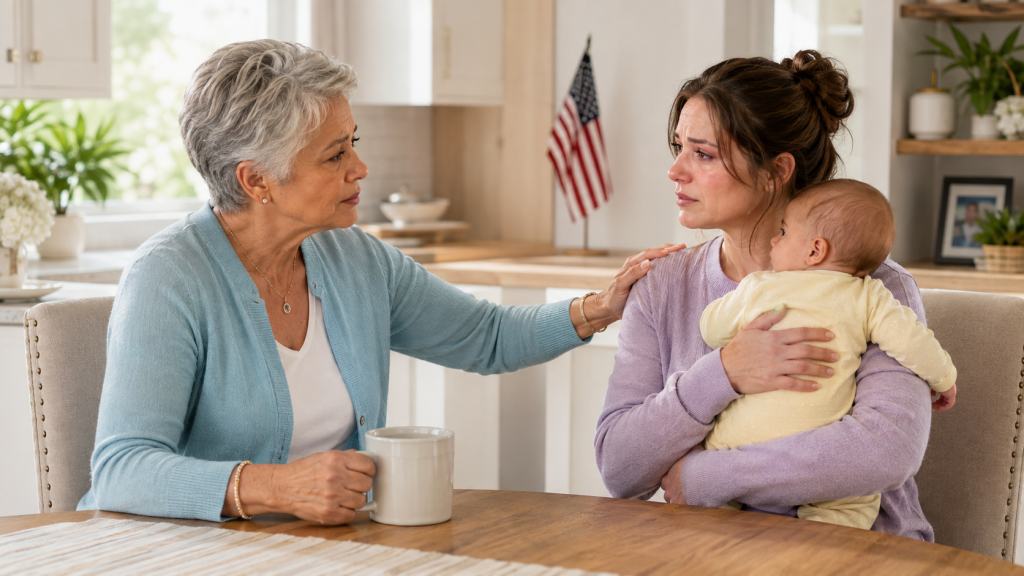
The baby stirred beneath his yellow blanket.
Emily immediately covered one of his ears with her palm and began rocking him.
Not soothing him.
Silencing him.
That was the first thing that made my stomach truly turn.
“Does your husband hurt you?” I asked.
Her whole face changed.
Not dramatically.
That would have been easier.
Instead, every muscle seemed to shut down at once.
Her lips parted.
Her shoulders lowered.
And the terrified young woman who had been pretending to borrow sugar every morning simply disappeared behind a blank expression she had clearly practiced many times.
“No.”
I leaned back in my chair.
“I didn’t ask if you two argue.”
She swallowed.
“I said no.”
“And I heard you.”
I took a sip of coffee.
“But I’ve also been alive seventy-two years, sweetheart.”
Her eyes filled.
She turned her face away.
I didn’t rush her.
I had learned long ago that when someone has spent months being told what to say, when to speak, what to feel, and what version of reality they are allowed to believe, sometimes the kindest thing you can give them is silence.
A place where they can choose their own words.
Finally, Emily whispered, “I’m not really coming for the sugar, Mrs. Higgins.”
“I know.”
Her eyes snapped back toward mine.
“You know?”
“I know you don’t need this much sugar.”
For one tiny second, the corner of her mouth almost moved.
Then it vanished again.
She looked toward the door.
“I come here because it’s the only way he lets me out of the apartment alive.”
The coffee suddenly tasted bitter.
I set my mug down.
“What do you mean?”
Emily squeezed her eyes shut.
“Ryan doesn’t let me go anywhere alone anymore.”
Ryan.
At last, the husband had a name.
I had seen him dozens of times.
Tall.
Broad shoulders.
Always wearing work boots and dark baseball caps.
He drove a black pickup truck that he washed every Sunday afternoon whether it needed washing or not.
Whenever we passed in the hallway, he called me “ma’am.”
Held doors open.
Carried grocery bags for elderly residents.
Once helped Mr. Keller downstairs when the elevator stopped working.
Everybody in the building thought Ryan Cooper was polite.
Helpful.
A little quiet, maybe.
But polite.
I felt suddenly ashamed of how easily politeness could fool people.
“He takes my phone when he leaves,” Emily continued.
“He keeps both apartment keys. He controls the bank account. He has cameras inside.”
My skin prickled.
“Cameras?”
“In the living room. Kitchen. Bedroom.”
“Bathroom?”
She shook her head.
“I don’t think so.”
The fact that she had to say I don’t think so made me sick.
“He checks them from his phone,” she whispered. “He says it’s because of the baby.”
“What’s your baby’s name?”
“Caleb.”
I looked down at the little boy.
“How old?”
“Four months.”
Four months.
And his mother looked like she had aged ten years.
“Does Ryan hit Caleb?”
“No.”
The answer came quickly.
Then she added, “Not yet.”
Those two words told me everything.
Emily finally picked up the coffee.
Her hands trembled so badly that some spilled onto the table.
She immediately stood.
“I’m sorry.”
“For what?”
“I spilled—”
“It’s coffee.”
“I’ll clean it.”
“Sit down.”
She froze.
The firmness in my voice frightened her.
I softened it.
“Emily, honey, sit down. You spilled coffee. Nobody is angry.”
Nobody is angry.
Those words broke something inside her.
She covered her mouth and started crying without making a sound.
No sobs.
No wailing.
Just tears streaming down her cheeks while she fought desperately to remain quiet.
I got up and put my arms around her.
She stiffened at first.
Then she leaned into me.
Caleb was pressed gently between us.
I could feel his tiny breathing through the blanket.
“What does he do to you?” I whispered.
Emily pulled away.
“Everything except what leaves marks people can easily see.”
I didn’t say anything.
“He grabs me.”
Her eyes dropped.
“Shoves me. Keeps me awake all night if he thinks I’ve disrespected him. Makes me stand against the wall while he questions me. Sometimes he locks food away.”
I looked at her thin arms.
“He tells me I’m stupid. Says nobody would believe me because he has a job and I don’t. Says my parents already chose him.”
“What does that mean?”
“My parents love Ryan.”
She gave a hollow little laugh.
“They think he saved me.”
“From what?”
“Being irresponsible.”
I almost laughed at the cruel absurdity of it.
Emily looked twenty-three at most.
“How old are you?”
“Twenty-six.”
“And how long have you been married?”
“Two years.”
“Were things always like this?”
She shook her head.
“No. At first he was wonderful.”
Of course he was.
Nobody walks into a first date carrying a sign announcing what they may become behind closed doors.
“He wanted to know where I was all the time because he said he worried about me. He wanted us to share passwords because married couples shouldn’t have secrets. He said my friends were immature. Then he said my sister was jealous. Then my parents kept telling me marriage requires compromise.”
“And then?”
“When I got pregnant, he convinced me to leave my job.”
Her voice grew smaller.
“After Caleb was born, everything changed.”
She looked down at her son.
“Ryan said I was useless because the house wasn’t clean enough. Said Caleb cried because I was a bad mother. Said I spent too much money on diapers.”
I clenched my jaw.
“And the sugar?”
Emily hesitated.
“He lets me knock on your door because he doesn’t want me texting neighbors or going downstairs. The first time I really did run out of sugar. You gave me some. Ryan saw me return from your apartment, and after that…”
She stopped.
“You realized this was one door you were allowed to knock on.”
She nodded.
“And every morning at 8:17?”
“He leaves around 8:15.”
She stared at the clock on my microwave.
“But sometimes he circles the block.”
My chest tightened.
“What?”
“He drives away, then comes back through the side entrance to see whether I leave.”
I glanced automatically toward my kitchen window.
Our apartment building formed an L around the parking lot.
From Emily’s kitchen, she could see my front door if she leaned far enough toward her living-room window.
From my kitchen, I could see part of the garage exit.
“How long do you have?”
“Usually ten minutes.”
“Usually?”
“Sometimes twenty.”
“And sometimes?”
“Three.”
I stood so quickly my chair scraped across the floor.
Emily flinched.
I stopped.
“Sorry.”
“No, it’s okay.”
“No. It isn’t. You shouldn’t have to jump because a chair moves.”
That nearly made her cry again.
I took a breath.
“Do you want to leave him?”
Her expression changed.
Fear.
Hope.
Then fear again.
“Yes.”
It was barely audible.
“But he’ll find me.”
“Do you have somewhere to go?”
“No.”
“Family?”
“He’ll go there first.”
“Friends?”
“He made me stop talking to them.”
I nodded.
“All right.”
She stared at me.
“All right?”
“Yes.”
“What does that mean?”
“It means we stop asking the wrong question.”
“What wrong question?”
“Whether you have somewhere to go.”
I looked directly into her eyes.
“The real question is how we get you somewhere safe.”
Her mouth trembled.
“You believe me?”
That hurt more than anything she had told me.
“Emily, I believe you.”
She looked down at Caleb.
“Even without proof?”
“You’re standing in my kitchen terrified of footsteps.”
That was enough for me.
But I also knew belief and protection were two different things.
Ryan could charm neighbors.
He could lie.
Emily had no phone, no money, no keys, and apparently no easy access to her identification.
A badly planned escape might make things more dangerous.
We needed help from people who knew what they were doing.
“Have you ever contacted a domestic violence service?”
“No.”
“Police?”
Her face drained.
“No police.”
“Why?”
“He said if I ever called them, he’d tell them I was unstable.”
“Is there any history he could use?”
“I had postpartum depression.”
There it was.
“He took me to a doctor,” she continued. “I was exhausted. I cried all the time. The doctor gave me medication. Ryan keeps the paperwork.”
“And he tells you that means they’ll take Caleb.”
She nodded.
I wanted to march upstairs and throw Ryan through his own front door.
Instead, I reminded myself that anger might feel satisfying, but satisfaction wasn’t the goal.
Getting Emily and Caleb out alive was.
“You said he keeps cameras inside.”
“Yes.”
“Does he record sound?”
“I don’t know.”
“Then assume he does.”
She stared at me.
“From now on, when you go home, you behave exactly the same.”
Her breathing sped up.
“I can’t.”
“Yes, you can.”
“I’m terrible at pretending.”
“No, Emily.”
I reached across the table.
“You have been pretending everything is fine for months. You are already very good at surviving.”
She looked at me for a long moment.
Then she slowly nodded.
Caleb began fussing.
Emily checked the microwave clock.
8:26.
She shot to her feet.
“I have to go.”
“Wait.”
I opened the cupboard.
She watched as I filled the little container she always brought with her.
Sugar.
An ordinary half cup.
Evidence for anyone watching that nothing unusual had happened.
She tucked it beneath the baby’s blanket.
Then her hand slipped deeper under the blanket.
She pulled out a folded piece of paper.
“I need you to hide this before he finds it.”
“What is it?”
“My information.”
I unfolded it.
Her full name.
Date of birth.
Social Security number.
Her parents’ address.
Caleb’s birth date.
Ryan’s workplace.
The truck’s license plate.
And three names with phone numbers.
“My sister,” she said, pointing to the first one. “My old boss. And a friend from college.”
At the bottom, she had written two words.
BLUEBIRD ACCOUNT.
“What’s that?”
“A savings account my grandmother opened for me when I was little. Ryan doesn’t know about it.”
“How much?”
“I don’t know. Maybe a few thousand.”
“That might matter.”
She nodded.
Then we both heard it.
A truck engine.
Emily went white.
She hurried toward the window.
The black pickup was turning into the parking lot.
“Oh God.”
“Stay calm.”
“He came back.”
“Emily.”
“He knows.”
“He doesn’t know anything yet.”
“What if he comes up?”
“Then you borrowed sugar.”
Her breathing became frantic.
“What if he asks why I was here so long?”
“You spilled coffee.”
“He’ll ask why you gave me coffee.”
“I’m a lonely old woman who talks too much.”
Despite everything, she stared at me.
“You’re not lonely.”
“He doesn’t know that.”
The truck stopped.
Ryan climbed out.
Emily clutched Caleb.
I handed her the sugar.
“Walk home.”
“I can’t.”
“Yes, you can.”
“He’ll see my face.”
“Then complain about me.”
“What?”
“Tell him Mrs. Higgins wouldn’t stop talking.”
She almost smiled.
“Go.”
Emily opened my door.
Then she looked back.
“If I don’t come tomorrow—”
“Don’t finish that sentence.”
Her eyes filled again.
“If I don’t come tomorrow, please don’t forget me.”
“I won’t.”
She stepped into the hall.
I stood behind the door and listened.
Her footsteps moved quickly toward the stairs.
Thirty seconds later, heavier footsteps came up from below.
Ryan.
I opened my door just enough to see him reach the third-floor landing.
“Well, morning, Mrs. Higgins.”
Polite smile.
Baseball cap.
Perfect neighbor.
“Morning.”
He looked down the hall.
Emily was unlocking apartment 302.
Apparently he had given her the key for her sugar trip.
“Borrowing groceries again?” he called.
Emily gave a weak laugh.
“Mrs. Higgins talks a lot.”
Ryan looked at me.
I placed a hand dramatically over my chest.
“When you get to my age, young man, conversation is all we’ve got.”
He smiled.
“Have a good one, ma’am.”
Then he followed his wife inside.
The door closed.
My legs nearly gave out.
I went straight to my bedroom, pulled an old metal lockbox from beneath my bed, and placed Emily’s paper inside.
Then I sat down.
For precisely one minute.
That was all the fear I allowed myself.
After that, I got to work.
I used my landline rather than my cell phone.
I contacted a local domestic violence support organization and explained the situation without giving Emily’s exact apartment number at first.
The woman who answered did not sound shocked.
That somehow made it worse.
She asked careful questions.
Did Emily want to leave?
Yes.
Did the husband have weapons?
I didn’t know.
Had he threatened homicide or suicide?
Unknown.
Did he strangle her?
Unknown.
Did he monitor her?
Yes.
Control money?
Yes.
Restrict transportation?
Yes.
Isolate her?
Yes.
Was there an infant involved?
Yes.
The woman told me not to confront Ryan.
Not to warn him.
Not to pressure Emily to leave before she was ready.
She explained that leaving could be a dangerous period and that safety planning mattered.
We arranged a way for Emily to speak with an advocate from my apartment if she returned.
The rest of that day moved more slowly than any day I could remember.
At 5:43, Ryan’s truck returned.
Through my curtains, I watched him walk into the building carrying takeout.
He looked perfectly ordinary.
That was the frightening part.
The next morning, I sat at my kitchen table at 8:00.
Coffee untouched.
At 8:15, the truck left.
8:16.
Nothing.
8:17.
Nothing.
8:18.
Nothing.
My stomach tightened.
8:19.
I nearly picked up the phone.
Then came three soft knocks.
I opened the door.
Emily stood there holding Caleb.
Her left cheek looked slightly swollen.
She saw me notice it.
“I walked into the cabinet.”
“No, you didn’t.”
“No.”
I pulled her inside.
The advocate was waiting on speakerphone in my bedroom with the volume low.
For the next twelve minutes, Emily spoke faster than I had ever heard anyone speak.
She answered questions.
Yes, Ryan owned a handgun.
Yes, it was kept in a locked box in the closet.
No, she didn’t know the code.
Yes, he had threatened her.
Not directly, she said.
Then the advocate asked her to explain.
Emily stared at the floor.
“He says things like, ‘Some women disappear and nobody looks for them.’”
My blood went cold.
The advocate remained calm.
She asked if Ryan had ever put his hands around Emily’s neck.
Emily went silent.
Then nodded.
I closed my eyes.
Twice.
Once while she was pregnant.
Once three weeks earlier.
He had released her before she lost consciousness.
The advocate’s tone changed.
Not panic.
Urgency.
A strangulation history dramatically increased the danger.
We needed a plan.
Not next month.
Not when life became convenient.
Soon.
The advocate helped Emily identify documents she needed.
Birth certificates.
Identification.
Medical records if possible.
Caleb’s pediatric information.
Medication.
A few clothes.
Nothing that would create an obvious missing gap in the apartment.
Emily could not pack a suitcase.
Ryan would notice.
So we created another use for the sugar visits.
Each morning, she brought something small beneath Caleb’s blanket.
One day, her birth certificate.
The next, Caleb’s vaccination record.
Then two photographs.
Medication.
A spare pacifier.
Three onesies.
A tiny blue sweater.
I kept everything in a laundry basket beneath old towels in my hall closet.
Every visit still ended with half a cup of sugar.
After ten days, I had enough sugar in apartment 302 to bake cakes for the entire state.
Yet Ryan never seemed to notice.
Or perhaps he did.
On the eleventh morning, Emily didn’t come.
I watched the parking lot.
Ryan’s truck never left.
At noon, he came downstairs and stood beside it smoking.
At 2:00, he carried something to the dumpster.
At 4:30, he left.
Emily still didn’t knock.
I wanted to run upstairs.
The advocate had warned me against improvising.
Unless I heard violence or believed someone faced immediate danger, showing Ryan that I knew could destroy Emily’s carefully built exit route.
So I waited.
That night, at 11:12, someone knocked on my door.
I looked through the peephole.
Ryan.
My heart slammed against my ribs.
I opened the door only as far as the chain allowed.
“Yes?”
“Sorry it’s late.”
He smiled.
That same pleasant neighbor smile.
“I wanted to ask you something.”
“What?”
“Emily comes over here a lot.”
I shrugged.
“She borrows sugar.”
“Every day?”
“She must have a sweet tooth.”
His smile remained.
His eyes did not.
“She ever talk about me?”
I forced a laugh.
“Young man, your wife barely talks at all.”
His jaw shifted.
“Exactly.”
I waited.
He leaned slightly closer to the opening.
“She’s been having some mental health problems since the baby.”
There it was.
The story he had prepared.
“She gets confused.”
“I’m sorry to hear that.”
“She might say strange things.”
“Strange how?”
He watched my face.
“You know. Paranoid stuff.”
“I’m seventy-two. Everybody under fifty sounds strange to me.”
That made him laugh.
But he continued staring.
“If she ever says something concerning, you tell me.”
“I’ll keep it in mind.”
“You have my number?”
“No.”
“I’ll write it down.”
“No need.”
His eyes narrowed slightly.
“I’m terrible with phones.”
Not completely true.
But tonight, I intended to be the most technologically incompetent woman alive.
He finally stepped back.
“Good night, Mrs. Higgins.”
“Good night, Ryan.”
I closed the door.
Locked it.
Then locked the deadbolt.
My hands were trembling.
The next morning, Emily arrived at 8:17.
“He knows.”
“Not everything.”
“He questioned me last night.”
“What did you tell him?”
“That you complain about your knees for ten minutes every morning.”
I stared at her.
“My knees are excellent.”
“I panicked.”
I laughed despite myself.
Emily laughed too.
It was the first real laugh I had ever heard from her.
It lasted maybe three seconds.
Then she covered her mouth.
But those three seconds mattered.
They reminded both of us there was still a person inside the frightened shell Ryan had built around her.
The advocate had arranged space at a confidential shelter.
The opening would be available Friday.
Three days away.
Emily would leave after Ryan went to work.
A volunteer driver would wait two blocks away rather than pulling directly into our parking lot.
I would walk Emily and Caleb through the rear service exit because there were no cameras in that hallway.
At least none we knew of.
Everything depended on Ryan following his routine.
Thursday night, a storm rolled in.
Rain hammered the windows.
Thunder shook the building.
At 9:30, I heard something crash upstairs.
Then Caleb crying.
Then silence.
I stood beneath my ceiling listening.
Another thud.
A man shouting.
I couldn’t make out the words.
Then Emily screamed.
Just once.
I called emergency services.
I gave the address.
Apartment 302.
Possible domestic violence.
Infant inside.
Weapon potentially present.
Two officers arrived within minutes.
Ryan answered the door.
By then, everything was quiet.
I watched through my peephole as he spoke calmly.
I could hear pieces of the conversation.
Baby dropped a bottle.
Wife emotional.
Postpartum issues.
Everything fine.
Then Emily appeared behind him.
She looked directly toward my door.
Even through the peephole, I saw terror in her eyes.
An officer spoke with her separately in the hallway.
Ryan remained only a few feet away.
She denied being hurt.
The officers eventually left.
I understood why she lied.
But it terrified me.
At 10:17, my phone rang.
Unknown number.
I answered.
No voice.
Then a whisper.
“Martha?”
Emily.
“Where are you?”
“Bathroom.”
“How do you have a phone?”
“Ryan’s old one. It only works on Wi-Fi.”
Her breath shook.
“He knows someone called.”
“He can’t know who.”
“He thinks it was you.”
“Did he hurt you?”
“No.”
A pause.
“Not after the police came.”
“What happened before?”
Silence.
“Emily?”
“He found the drawer empty.”
“What drawer?”
“My documents.”
My stomach dropped.
“What did you tell him?”
“That I moved them because I was organizing.”
“Did he believe you?”
“No.”
I closed my eyes.
Friday was too far away.
“Listen to me carefully. If you are in immediate danger, you call emergency services.”
“I can’t leave tonight.”
“Why?”
“He’s sitting by the front door.”
“What about the fire stairs?”
“Alarmed.”
“Bedroom window?”
“Third floor.”
I thought.
“Tomorrow morning?”
“He says he’s staying home.”
That was bad.
Then Emily whispered, “But he has a dentist appointment at ten.”
A small opening.
“What time does he leave?”
“Usually twenty minutes before.”
“Then tomorrow is the day.”
“The shelter said Friday.”
“They’ll adapt.”
I called the advocate immediately after Emily disconnected.
By midnight, the plan had changed.
Thursday morning at 9:35, I was dressed in plain slacks, walking shoes, and a raincoat.
Emily’s belongings were packed inside two grocery bags.
Not suitcases.
Nothing noticeable.
At 9:39, Ryan stepped into the hallway.
I heard his door shut.
Footsteps descended.
I moved to the window.
His truck pulled away at 9:43.
I waited.
9:45.
9:47.
9:50.
He did not return.
At 9:51, there were three knocks.
Emily stood outside with Caleb.
No diaper bag.
No coat.
Barely anything.
“Come.”
She entered.
I handed her one grocery bag.
“I can’t carry much.”
“I’ll carry the other.”
Her hands were shaking.
“What if he comes back?”
“Then we keep moving.”
We took the rear stairs.
Third floor.
Second.
First.
At the service door, Emily stopped.
“I can’t.”
“Yes, you can.”
“What if I’m making a mistake?”
I turned toward her.
Behind us was an apartment where she had learned to whisper.
Ahead of us was uncertainty.
Of course uncertainty was frightening.
“Emily, I can’t tell you what the rest of your life will look like.”
She started crying.
“But I can tell you this: fear of the unknown is not the same as safety in what you already know.”
Caleb made a little squeaking sound.
Emily looked down at him.
Then she pushed open the door.
Cold morning air rushed in.
We walked.
One block.
Halfway through the second, my knees reminded me that perhaps Emily’s excuse hadn’t been entirely unreasonable.
A blue sedan waited beside a church.
The driver stepped out.
A woman in her fifties.
She gave Emily a name I suspected was not her real one.
She opened the back door.
Emily turned toward me.
“I don’t know how to thank you.”
“You don’t.”
“I might never be able to come back here.”
“I know.”
“What if he comes after you?”
“I’ll deal with Ryan.”
“Martha—”
“I have survived a husband, two teenagers, breast cancer, and forty-one years teaching seventh grade.”
I squeezed her hand.
“A bully in a baseball cap does not impress me.”
She laughed through her tears.
Then she hugged me.
Caleb was between us again, just like that first morning.
Only this time, Emily wasn’t shaking.
Not as much.
She climbed into the car.
I watched until it disappeared around the corner.
Then I went home.
At 11:26, Ryan returned.
I knew because I heard him running up the stairs.
Apartment 302 opened.
Then silence.
A minute later, footsteps thundered downward.
He hit my door with his fist so hard my framed wedding photograph rattled.
“MRS. HIGGINS!”
I did not open it.
He pounded again.
“WHERE IS SHE?”
I called the police.
Then I stood behind the locked door.
“Martha!”
First-name basis now.
Interesting.
“I KNOW SHE WAS HERE!”
I said nothing.
He kicked the lower part of the door.
That was a mistake.
Other doors opened.
Mr. Keller looked out from 305.
Mrs. Alvarez from 304.
The Nelsons downstairs stepped into the stairwell.
Ryan suddenly had witnesses.
“What’s going on?” Mr. Keller called.
Ryan stepped away from my door.
“My wife is missing.”
“You mean Emily?” Mrs. Alvarez asked.
“Yes.”
“She leave you?”
His face changed.
It was only one second.
But everyone saw it.
Police arrived before he could continue.
Ryan told them Emily was mentally unstable.
Said she had taken their child.
Claimed she might hurt herself.
I stepped into the hallway.
He pointed at me.
“She knows where they are.”
An officer looked at me.
“Ma’am?”
“I know Emily left because she was afraid of him.”
Ryan exploded.
“You lying old—”
He stopped himself.
Too late.
Everyone heard the beginning.
I looked at the officer.
“He came to my apartment last night asking what Emily told me. He just kicked my door.”
The officer examined the mark near the bottom.
Ryan began talking quickly.
Misunderstanding.
Stress.
Worried husband.
Missing baby.
But charm works best when nobody has seen the mask slip.
Mrs. Alvarez spoke next.
“I hear fighting upstairs.”
Mr. Keller nodded.
“So do I.”
The Nelsons had heard it too.
Suddenly, the quiet building was not so quiet.
People began remembering.
Doors slamming.
Crying.
Arguments.
A baby wailing late at night.
Emily never using the laundry room.
Emily never collecting mail alone.
Ryan controlling every grocery bag.
The signs had been scattered all around us.
We had simply never assembled them.
The police did not tell Ryan where Emily was.
Neither did I.
He left the building that afternoon.
For two days, his truck disappeared.
Then I learned that Emily had given a full statement from a safe location.
Photographs were taken.
Medical documentation obtained.
Old messages recovered through one of her cloud accounts.
Her sister provided recordings of disturbing voicemails Ryan had left months earlier.
The harmless, polite husband had not been nearly as careful as he believed.
A protective order followed.
Then legal proceedings.
None of it was quick.
None of it was simple.
And Emily’s escape did not magically become a happy ending the moment the blue sedan drove away.
That is something people misunderstand about leaving.
They imagine the door closing behind you and freedom beginning instantly.
But sometimes freedom arrives shaking.
Sometimes it wakes at two in the morning convinced it heard footsteps.
Sometimes it feels guilty.
Sometimes it misses the person who hurt it because human hearts do not switch emotions off like lamps.
Emily called me from the shelter three days later.
“I almost went back.”
My heart tightened.
“But you didn’t.”
“No.”
“Good.”
“I miss him.”
I sat quietly.
“I know that sounds stupid.”
“No.”
“How can I miss someone I’m terrified of?”
“Because he wasn’t terrible every minute.”
She started crying.
“There were good days.”
“I believe you.”
“He made pancakes on Sundays.”
“I believe that too.”
“He used to sing to Caleb.”
“That doesn’t erase what he did.”
“I know.”
“And missing a memory does not mean you have to return to the danger.”
She was silent.
Then she whispered, “Thank you.”
Over the next several months, we talked whenever it was safe.
Emily found an attorney.
She worked with advocates.
She reconnected with her sister, Claire.
Her parents were harder.
At first, her mother insisted Ryan had always been respectful.
Her father said marriage problems should remain private.
Then Emily sent them photographs of the bruising around her neck.
After that, they stopped telling her to reconcile.
I wish I could say they immediately became everything she needed.
They didn’t.
People sometimes struggle when the truth makes them question their own judgment.
Emily’s mother cried because she had defended Ryan.
Her father became angry at everyone except himself.
But eventually, they began listening.
Really listening.
And that was a start.
Ryan was ordered to have no contact with Emily outside permitted legal channels.
Investigators recovered evidence from devices in the apartment that supported parts of her account.
The indoor cameras he had used to control her turned out to be a mistake.
Some footage had been deleted.
Not all of it.
Months later, Emily told me that hearing that made her laugh for almost five minutes.
“He installed his own witnesses,” she said.
Life in our building changed too.
People started knocking on my door.
Not for sugar.
To apologize.
Mrs. Alvarez cried because she had once heard Emily sobbing in the hallway and assumed she was overwhelmed by motherhood.
Mr. Keller admitted he had watched Ryan grab Emily’s arm near the mailboxes and told himself couples sometimes argue.
I didn’t shame them.
What good would that do?
Instead, I said, “Next time your stomach tells you something is wrong, pay attention.”
I told myself the same thing.
Because I had been irritated by those first cups of sugar.
I had judged Emily.
I had seen a young mother borrowing groceries day after day and decided she was disorganized.
If she had not kept coming, I might have remembered her only as the neighbor who couldn’t manage a shopping list.
That truth humbled me.
About six months after Emily left, I received a letter.
Not a phone call.
An actual handwritten letter.
The envelope had no return address.
Inside was a photograph.
Emily sat on a park bench.
Her hair was longer.
Her cheeks were fuller.
Caleb sat on her lap wearing a blue jacket and laughing at something outside the frame.
On the back, Emily had written:
WE BUY OUR OWN SUGAR NOW.
I cried so hard I had to take off my glasses.
Beneath the photograph was a letter.
She had found a small apartment in another part of the state.
She had started working remotely for her old employer.
Claire helped with childcare.
Caleb had learned to crawl.
Then stand.
Then throw food from his high chair with remarkable accuracy.
Emily was attending counseling.
Some days were still difficult.
She still checked locks twice.
Still hated the sound of heavy boots in hallways.
Still sometimes woke convinced Ryan was standing beside the bed.
Healing, she wrote, was not a straight road.
But she was moving.
At the bottom, she wrote one sentence that I read at least twenty times.
You were the first person who believed me before I had to prove it.
I folded the letter and placed it in my metal lockbox.
Right beside the paper she had once hidden beneath Caleb’s yellow blanket.
Nearly a year after the morning Emily left, there was another knock on my door.
8:17.
I froze.
Some times stay inside the body.
I looked at the microwave clock.
Exactly 8:17.
Three knocks.
My heart started pounding.
I opened the door.
Emily stood there.
For one second, I didn’t recognize her.
Not because her face was different.
Because her posture was.
She stood upright.
Her shoulders weren’t curled inward.
Her eyes weren’t checking the stairwell.
Her hands weren’t trembling.
And beside her stood a little boy with brown curls holding a plastic dinosaur.
“Mrs. Higgins,” she said.
I stared.
Then I started crying.
“Oh, for heaven’s sake.”
Emily laughed.
“Martha?”
“You’re supposed to warn old people before surprising them.”
She threw her arms around me.
Caleb looked deeply confused.
When we separated, I knelt as far as my supposedly excellent knees permitted.
“Is this him?”
Emily smiled.
“This is Caleb.”
He held up the dinosaur.
“Rawr.”
I gasped.
“Well, that is terrifying.”
He grinned.
Emily lifted a paper grocery bag.
“I brought something.”
“You didn’t have to.”
She handed it to me.
Inside was a five-pound bag of sugar.
I looked at her.
“You’re a smart aleck.”
“I learned from you.”
We sat in my kitchen for nearly three hours.
This time, Emily drank her coffee without watching the clock.
That small detail nearly broke my heart.
She told me the legal case had finally reached a resolution.
Ryan faced consequences.
Custody arrangements protected Caleb.
Emily no longer needed the confidential shelter.
Her new address remained private from Ryan.
She had started speaking occasionally at support groups.
Not because she considered herself brave.
“I still don’t feel brave,” she said.
“Good.”
She frowned.
“Good?”
“Brave people rarely feel brave while they’re doing the thing.”
She thought about that.
“I used to think leaving would be the hardest part.”
“And now?”
“Staying gone was harder.”
I nodded.
“That makes sense.”
“There were nights when I remembered only the good things.”
She looked down at her hands.
“Ryan apologizing. Bringing flowers. Holding Caleb. Telling me nobody would ever love me as much as he did.”
She paused.
“Then I realized he was right about one thing.”
“What?”
“Nobody should love me the way he did.”
I reached across the table and squeezed her hand.
“No.”
She looked toward Caleb, who was stacking my coasters on the floor.
“I want him to grow up knowing that love shouldn’t make you afraid.”
“That sounds like a fine education.”
Emily smiled.
Before she left that afternoon, she walked to my pantry.
She opened the cupboard.
“You still have sugar?”
“Enough to survive winter.”
She laughed.
Then her expression softened.
“Do you remember the first day?”
“Of course.”
“You looked so annoyed.”
“I was annoyed.”
“I know.”
“I thought you were terrible at grocery shopping.”
“I was.”
“No, you weren’t.”
She smiled.
“Actually, I really was.”
We laughed until Caleb started laughing too without knowing why.
Then Emily hugged me one last time.
At the door, she stopped.
“Martha?”
“Yes?”
“I need you to know something.”
“What?”
“If you hadn’t opened your door…”
I shook my head.
“Don’t.”
“But—”
“You knocked.”
She went quiet.
“You kept knocking, Emily.”
Her eyes filled.
“I just gave you sugar.”
“You gave me a place where he wasn’t the loudest voice.”
That stayed with me.
After they left, I sat alone at my kitchen table.
The apartment was quiet again.
The same kind of quiet I had treasured before Emily first appeared outside my door.
But it felt different now.
I used to think quiet meant peace.
I know better.
Sometimes quiet is peace.
Sometimes quiet is fear trying not to be heard.
Sometimes the person who keeps borrowing something they don’t really need isn’t asking for sugar.
Or flour.
Or a phone charger.
Or directions.
Sometimes people ask tiny questions because the real question feels too dangerous to say aloud.
Do you see me?
Do you believe me?
Can I stand here for five minutes without being afraid?
Will you remember me if I disappear?
A few weeks after Emily’s visit, our apartment management held a residents’ safety meeting.
I expected perhaps fifteen people.
More than fifty came.
A counselor spoke about domestic abuse, coercive control, isolation, financial restrictions, and how difficult leaving can be.
People asked questions.
Real questions.
Not the comfortable kind.
Mrs. Alvarez volunteered to help organize a confidential resource board in the laundry room.
Mr. Keller offered transportation for residents who needed rides to appointments.
The building manager changed policies around locks and security access.
Nobody pretended that a meeting could solve everything.
But we stopped pretending that what happened behind a closed apartment door was automatically nobody else’s concern.
For my part, I kept a new rule.
Whenever someone knocked, I opened the door without deciding who they were before they spoke.
Two years passed.
Caleb turned three.
Emily mailed me photographs.
First day of preschool.
Halloween costume.
Christmas pajamas.
A birthday cake shaped like a dinosaur.
In one picture, Emily stood behind him with her arm around another woman.
Claire.
Her sister.
Both were laughing.
Nothing dramatic.
No grand mansion.
No miraculous transformation.
Just ordinary happiness.
The kind people underestimate until they nearly lose the right to have it.
Then, one spring morning, a large envelope arrived.
Inside was an invitation.
Emily was graduating from a professional certification program connected to her new job.
At the bottom, beneath the ceremony details, she had handwritten:
Reserved seat for the woman who always had sugar.
I attended.
Of course I attended.
I sat beside Claire and Emily’s parents.
Her mother held my hand before the ceremony.
“I should have listened to her.”
There was nothing useful I could say to make that less painful.
So I simply nodded.
“Yes.”
Tears appeared in her eyes.
“I kept telling her Ryan loved her.”
“You know differently now.”
“I do.”
“Then make sure she never has to convince you again.”
She squeezed my hand.
When Emily walked across that stage, Caleb shouted, “MOMMY!”
The entire row laughed.
Emily looked toward us.
She saw me.
And for one second, the twenty-six-year-old woman disappeared.
I saw the frightened girl standing in my kitchen with a four-month-old baby against her chest.
Then she smiled.
Not the forced smile she used in the hallway.
Not the tiny smile she was afraid Ryan might notice.
A full smile.
Her own smile.
I stood and applauded until my hands hurt.
Years later, people in the building still occasionally tell the story about the young mother who borrowed sugar every morning.
They usually focus on the dramatic parts.
The secret plan.
The hidden documents.
Ryan pounding on my door.
The police.
The escape through the service stairs.
But those aren’t the moments I remember most.
I remember spilled coffee.
I remember telling Emily nobody was angry.
I remember the way she looked at me when I said I believed her.
And I remember three soft knocks at exactly 8:17 every morning.
Because sometimes rescue does not arrive with sirens.
Sometimes it arrives as an ordinary neighbor opening an ordinary door.
Sometimes courage doesn’t look like fighting.
Sometimes it looks like a terrified young woman carrying her baby down a hallway and asking the safest question she knows how to ask.
“Do you have some sugar?”
And sometimes the most important answer in the world is simply:
“Come on in.”
Several years after everything happened, on my seventy-eighth birthday, Emily and Caleb visited again.
Caleb was old enough now to understand pieces of the story.
Not everything.
Emily had decided the rest could wait.
He knew only that when he was a baby, his mother had lived somewhere she wasn’t happy, and an old lady downstairs had helped them.
I objected strongly to the phrase old lady.
Caleb found this hilarious.
“You’re ancient,” he told me.
“I can still remove you from my will.”
“What’s a will?”
“Exactly. Be respectful.”
Emily laughed so hard she nearly spilled her coffee.
She still drank coffee at my table.
She still sat in the same chair.
But now she left her phone lying casually beside the mug.
The first time I noticed that, I nearly cried.
A phone.
Such a simple thing.
Ryan had once used possession of one as a form of control.
Now Emily’s phone buzzed every few minutes with messages from friends, coworkers, her sister, school parents, people from a life she had rebuilt piece by piece.
She picked it up when she wanted.
Ignored it when she wanted.
Turned it off when she wanted.
Freedom often hides in ordinary choices.
She could buy groceries without explaining a receipt.
Change plans without asking permission.
Wear her hair short or long.
Spend twenty dollars.
Spend nothing.
Call her sister.
Drive somewhere alone.
Lock her own door.
Own her own keys.
Those were the victories nobody puts in movies.
There was no dramatic music.
No crowd cheering every time she walked into a supermarket.
But I knew what each choice meant.
So did she.
Before they left that birthday afternoon, Caleb ran back into my kitchen.
He returned holding my sugar bowl.
“Mom says this is famous.”
“It is not famous.”
“It saved us.”
Emily’s smile faded into something more tender.
“No, buddy.”
She looked at me.
“The sugar didn’t save us.”
Caleb frowned.
“What did?”
Emily walked over and placed one hand on his shoulder.
“A door that opened.”
I looked away because I knew I was about to cry.
Caleb considered this with the intense seriousness only children can manage.
Then he hugged me around the waist.
“Thank you for opening it.”
I rested my hand on his hair.
“You’re welcome.”
After they drove away, I went back upstairs.
My apartment was quiet.
I made tea.
Opened the curtains.
Sat beside the same window where I had once watched Ryan’s black truck pull out at 8:15 every morning.
The parking lot looked different now.
New tenants.
Different cars.
Children riding bicycles along the sidewalk.
Mrs. Alvarez watering plants.
Mr. Keller had passed away the year before, but his daughter kept the little bench he had donated near the entrance.
Life had moved on.
That is what it does.
Not because terrible things become unimportant.
But because they do not deserve to own every chapter that follows.
I opened my pantry.
On the top shelf sat an unopened five-pound bag of sugar.
Emily had brought it during that first visit back.
I had never used it.
The expiration date, if sugar can truly be said to have one, had long passed.
Still, I kept it.
Not as a reminder of Ryan.
He didn’t deserve that much space in my home.
I kept it as a reminder of Emily.
Of persistence.
Of the strange disguises courage sometimes wears.
A yellow onesie.
A trembling hand.
A borrowed measuring cup.
A whispered confession.
Three knocks.
I thought about the woman I had been when Emily first came to my door.
Judgmental.
Comfortable.
Certain I understood what I was seeing.
There is humility in discovering how wrong your first impression can be.
I thought she needed better organization.
She needed safety.
I thought she was careless.
She was calculating every second necessary to survive.
I thought she kept forgetting sugar.
She was making sure one person outside apartment 302 saw her alive each morning.
That realization still sends a chill through me.
Every knock had been a message.
I am still here.
I am still here.
I am still here.
Until finally, she was able to say something else.
I am leaving.
There are people who ask why Emily didn’t leave sooner.
I never entertain the question.
The better question is why Ryan worked so hard to make leaving dangerous.
Why he took the keys.
Why he took the phone.
Why he controlled the money.
Why he isolated her.
Why he convinced other people she was unstable before she ever had the chance to tell them what was happening.
Those choices belonged to him.
Leaving belonged to Emily.
And she did it when the opportunity became real.
She carried her son through a service door into a future she could not see.
That is courage enough for a lifetime.
On the anniversary of the day she escaped, Emily still sends me one message.
Every year.
Always at 8:17 in the morning.
Sometimes it is a photograph.
Sometimes a heart.
Sometimes simply two words.
Still free.
I always answer.
Still proud.
Last year she replied:
Still buying my own sugar.
I laughed so loudly Mrs. Alvarez knocked on my wall.
And that, I suppose, is where the story truly ends.
Not with Ryan.
Not with courtrooms.
Not with fear.
Not even with me.
It ends with Emily standing in her own kitchen somewhere far from apartment 302.
Caleb probably leaving cereal bowls in the sink.
Her phone on the counter.
Her keys wherever she chooses to put them.
A grocery list taped to the refrigerator.
Milk.
Eggs.
Bread.
Coffee.
And sugar.
Not borrowed.
Not measured into a container as an excuse.
Not carried through a hallway while watching the clock.
Just sugar.
Ordinary.
Unremarkable.
Free.
And if you had told me all those years ago, when I opened my door in my bathrobe and stared impatiently at that pale young woman holding her sleeping baby, that half a cup of sugar would become the beginning of the most important friendship of my old age, I would have laughed.
Life has a sense of humor about these things.
The people who change us rarely arrive with introductions.
Sometimes they simply knock.
And if we are fortunate enough to recognize that the knock means more than the words being spoken, perhaps we open the door a little wider.
Perhaps we put on the coffee.
Perhaps we listen.
And perhaps, when someone finally gathers enough courage to whisper the truth, we believe them.
That was all Emily needed from me in the beginning.
Not a rescue.
Not a speech.
Not revenge.
A safe chair.
A locked door.
A cup of coffee.
And one person willing to say:
“I believe you.”
Everything else began from there.
💬THE END! THANK YOU FOR READING!