

At three in the morning, I opened the folder again.
I told myself I was looking for something I had missed.
A mistake.
A misunderstanding.
A photograph that could be explained away.
Some tiny flaw in Sarah’s evidence that would allow me to climb back into the life I had destroyed and pretend the last twelve hours had never happened.
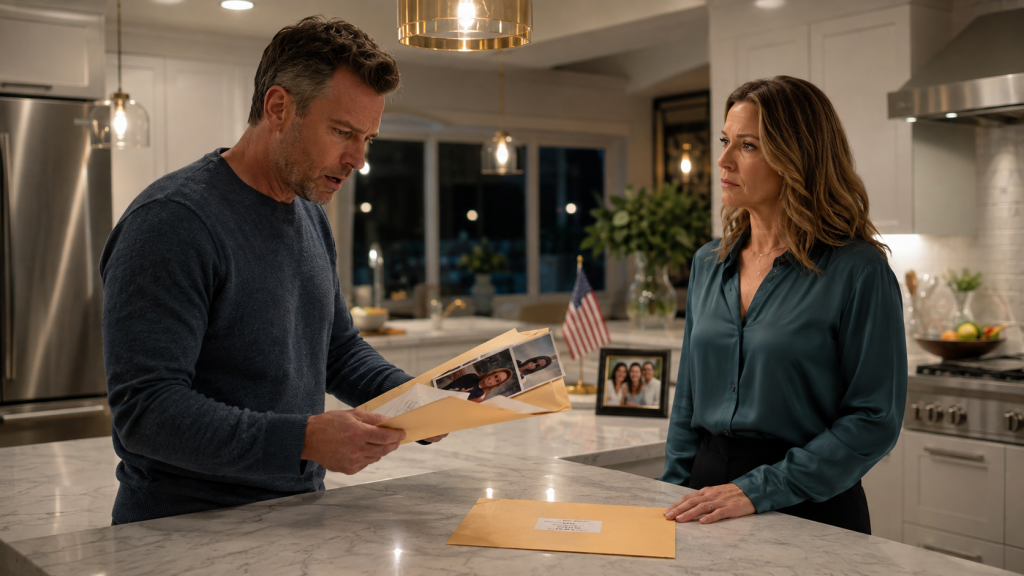
Instead, I found a history of my marriage written in receipts, photographs, screenshots, dates, and Sarah’s painfully neat handwriting.
The first photograph showed me leaving a hotel with Rachel.
Three years earlier.
I remembered that night.
I had told Sarah I was attending a regional sales conference in Denver.
I had even called her from the hotel bathroom while Rachel was asleep in the other room.
Sarah had asked whether I had eaten.
I had told her room service was terrible.
She had laughed and said, “Come home safe. We miss you.”
Beside the photograph, Sarah had written four words.
“Emma had pneumonia here.”
I stared at the sentence.
Then I remembered.
Our daughter had been eight.
Sarah had spent two nights sleeping beside Emma’s bed because her fever kept climbing.
I had known.
Sarah had texted me updates throughout the evening.
At 10:14 p.m., she had written, “Her temperature is 103. I’m scared.”
I had replied forty-three minutes later.
“She’ll be okay. Call the doctor if it gets worse.”
At the time, Rachel and I had been drinking wine in the hotel bar.
I turned the page.
A restaurant receipt.
Two dinners.
Two glasses of champagne.
A chocolate dessert.
The date was our fourteenth wedding anniversary.
I remembered telling Sarah I had been called into an emergency meeting with a client.
I remembered coming home after midnight with grocery-store flowers and apologizing.
She had been sitting at the kitchen table alone.
The dinner she made for us was still covered with foil.
She never asked why I smelled like perfume.
Beside the receipt she had written:
“I waited until 11:30 before throwing away the steak.”
I pressed my palms against my eyes.
The next page contained screenshots of messages between Monica and me.
Nothing explicit.
That somehow made them worse.
Inside jokes.
Compliments.
Plans.
The casual language of two people who had done something terrible so often that it no longer felt dramatic.
One message from me read:
“Same place Thursday?”
Monica had replied with a heart.
Sarah had circled the date.
Underneath, she wrote:
“Noah’s championship game.”
My stomach twisted.
I remembered that game too.
Noah had been eleven.
He had practiced for months.
I had promised I would be there.
At five that afternoon, I called Sarah and said my boss had scheduled a late meeting.
Noah’s team won.
He scored twice.
Sarah sent me a photograph of him holding his trophy.
I replied with three words.
“Proud of you buddy.”
I hadn’t even noticed that I forgot the comma.
Apparently Sarah had.
Because beneath the screenshot of my message to Monica, she had taped the photograph she sent me that night.
Noah stood on the soccer field smiling proudly.
But his eyes were looking somewhere beyond the camera.
Toward the parking lot.
Waiting for me.
I closed the folder.
For several minutes, I couldn’t breathe normally.
I had always thought of cheating as something that happened between Sarah and me.
That was how I justified it.
My private failure.
My private appetite.
My private mistakes.
The children didn’t know.
Therefore, I told myself, the children weren’t affected.
But those pages showed something I had spent years refusing to understand.
Every hour I had given to another woman had been stolen from somewhere.
Every lie had required someone else to wait.
Every hotel room had an empty chair somewhere else.
Every secret dinner meant there was a dinner at home where my place remained untouched.
I opened the folder again.
Near the bottom was another envelope.
Sarah’s handwriting covered the front.
“Read only if you finally understand.”
My hands shook as I opened it.
Inside was a single sheet.
“David,
If you are reading this, maybe you have finally stopped asking what I did and started asking what you did to us.
Tomorrow Andrew will return at ten.
Before then, there is one thing you deserve to know about the man whose hand you saw me holding.
Andrew is not my lover.
He never has been.
He was holding my hand because I had just signed the divorce petition, and my hand was shaking so badly I dropped the pen.
You saw one moment of comfort and immediately felt betrayed.
I hope you remember that feeling.
Not because I want you to suffer.
Because I need you to understand what I felt hundreds of times while standing beside you and pretending not to know.
Yes, David.
Hundreds.
I knew far longer than you think.
Sarah.”
I read the last sentence again.
Hundreds.
I stood so quickly the folder fell from my lap.
Pages scattered across the carpet.
The clock on the microwave showed 3:47.
I walked down the hallway toward our bedroom.
My hand reached for the doorknob.
Then stopped.
For the first time in years, I understood that wanting access to Sarah did not mean I was entitled to it.
I returned to the couch.
At six, Noah came into the living room.
He was fifteen now.
Tall.
Sleepy.
Hair sticking up on one side.
He stopped when he saw me surrounded by papers.
“What happened?”
“Nothing you need to worry about before school.”
He stared at my face.
“You look terrible.”
“I know.”
He looked toward the closed bedroom door.
“Did you and Mom fight?”
I swallowed.
“Your mom and I are dealing with some things.”
His expression changed.
Not surprise.
Recognition.
That scared me more.
“What?”
I asked.
“Nothing.”
“Noah.”
He looked down.
“Just… don’t yell at her.”
The words hit me harder than anything in the folder.
“I don’t yell at your mother.”
He gave me a look children give adults when adults say something technically true but completely dishonest.
“No,” he said quietly. “You just make her sad.”
Then he walked into the kitchen.
I sat frozen.
A few minutes later Emma appeared.
Twelve years old.
She hugged Sarah when Sarah finally came out of the bedroom.
Sarah looked exhausted.
Her eyes passed over me without stopping.
She made breakfast.
Packed lunches.
Reminded Emma about her science project.
Asked Noah whether he needed money for something after school.
The ordinary efficiency of her morning made everything feel more unbearable.
At 7:35, the children left.
The front door closed.
Silence swallowed the house.
Sarah poured herself coffee.
“When did you know?” I asked.
She didn’t pretend not to understand.
“The first time?”
I nodded.
“Six years ago.”
I stared at her.
Six years.
I had expected six months.
Maybe a year.
“You knew for six years?”
“Yes.”
“Why didn’t you say anything?”
Sarah let out a slow breath.
“Because at first I didn’t know what I knew.”
She sat opposite me.
“There was a restaurant receipt in your jacket. Two dinners. You said you’d eaten alone.”
I remembered the restaurant.
I remembered the woman too.
Lisa.
It had lasted four months.
Sarah continued.
“I told myself maybe you ordered food for a client. Then you started showering when you came home. You changed your phone password. You took it into the bathroom. You suddenly cared whether your shirts were wrinkled on days you supposedly had no meetings.”
She stared into her coffee.
“I asked you once.”
I remembered.
Barely.
She had been folding laundry.
“Is there someone else?”
I had laughed.
Actually laughed.
I told her she was being insecure.
Then I kissed her forehead.
“You made me feel ashamed for asking,” Sarah said.
I looked away.
“I’m sorry.”
“I know you’re sorry today.”
Her voice remained calm.
“That’s different from being sorry when you thought you could continue.”
I had no answer.
She continued.
“The second time I found something, I confronted you again. Not directly. I asked why you had been at the Lakeside Hotel when you said you were downtown.”
My heart sank.
“I told you my client moved the meeting.”
“Yes.”
“I lied.”
“Yes.”
“And you knew?”
“I called the client.”
I stared at her.
Sarah gave a sad smile.
“You always thought I was stupid because I didn’t confront you.”
“I never thought you were stupid.”
“Maybe not consciously. But you depended on me being easy to deceive.”
That sentence stayed between us.
Sarah stood and carried her coffee to the sink.
“For a while, I kept waiting for you to stop.”
“Why?”
“Because I loved you.”
Her voice broke on the final word.
It was the first crack I had heard.
She gripped the edge of the counter.
“I thought maybe you were going through something. Maybe if I became more affectionate. More interesting. Thinner. Happier. Less demanding. Maybe you would remember me.”
“Sarah—”
“Do you know I lost eighteen pounds one summer because I thought maybe you weren’t attracted to me?”
I shook my head.
“Of course you don’t.”
She laughed bitterly.
“You complimented me.”
I remembered that.
I had told her she looked fantastic.
I had no idea she was barely eating.
“I bought dresses you liked. I watched videos about repairing marriages. I arranged weekend trips you canceled. I tried not asking where you were because you became irritated whenever I asked.”
Tears filled her eyes.
“And every time you left, I told myself this might be the last time.”
I whispered, “Why didn’t you leave sooner?”
“Because leaving isn’t one decision.”
She turned toward me.
“Especially with children. A mortgage. Fifteen years of memories. Families tied together. Insurance. School districts. Savings. Retirement accounts. Christmas traditions. Friends who know you as a couple.”
She wiped her cheek.
“And because part of me still loved the man you used to be.”
I couldn’t look at her.
“At what point did you stop?”
She knew what I meant.
Loving me.
Her answer came immediately.
“Emma’s birthday.”
My chest tightened.
“Which one?”
“Her tenth.”
I remembered missing it.
A work trip.
Except there had been no work trip.
I had gone away with Monica.
Sarah knew.
“Emma waited by the window,” Sarah said.
“She kept saying you promised to come before cake. Every car that turned onto our street made her stand up.”
I felt sick.
“You called at nine.”
“I remember.”
“You told her your flight had been delayed.”
I nodded.
“She said it was okay.”
Sarah looked directly at me.
“After you hung up, she asked me, ‘Mom, does Dad like work more than us?’”
I covered my mouth.
“That was the night something inside me stopped.”
“I’m sorry.”
“I know.”
“I’m so sorry.”
“You cannot apologize six years backward.”
The doorbell rang at exactly ten.
Andrew stood outside carrying a leather briefcase.
Seeing him again flooded me with the same jealousy I had felt the day before.
But now it came with humiliation.
He was perhaps forty-five.
Gray at his temples.
Wedding ring on his left hand.
He stepped inside.
“David.”
I didn’t shake his hand.
Not because I was angry.
Because I was ashamed.
We sat at the dining table.
The divorce petition lay between us.
Andrew explained everything carefully.
Sarah was seeking shared custody.
She wasn’t trying to take the house.
She wasn’t asking for some impossible financial punishment.
She wanted an equitable division.
Nothing more.
That somehow hurt worse.
“You could take more,” I said.
Sarah frowned.
“This isn’t a negotiation about guilt.”
“I deserve—”
“Stop.”
She leaned forward.
“That’s another way of making this about you.”
I went silent.
“I’m not divorcing you to punish you,” she said. “I’m divorcing you because I no longer want to be married to you.”
There are sentences that destroy hope without raising their voice.
That was one of them.
I signed nothing that morning.
Andrew told me to hire my own lawyer.
Before leaving, he paused beside me.
“For what it’s worth,” he said quietly, “Sarah spent most of our first three meetings asking how to protect your relationship with the children.”
I looked at him.
“She could have approached this differently.”
“What does that mean?”
“It means she had options that would have embarrassed you publicly.”
My stomach tightened.
“She rejected all of them.”
After he left, I asked Sarah, “Why?”
“Because humiliating you wouldn’t heal me.”
She walked upstairs.
Three days later, I moved into a furnished apartment twelve minutes away.
The first night there, I sat on the edge of a bed covered by a gray comforter someone else had chosen.
There were four plates in the kitchen.
Four glasses.
Two towels.
No photographs.
No drawings on the refrigerator.
No shoes beside the front door.
For years I had fantasized about freedom.
Hotel rooms.
Secret evenings.
Nobody asking when I would be home.
Nobody needing anything.
Now I had exactly that.
And I hated every silent inch of it.
The children stayed with me the following weekend.
I bought groceries they liked.
I ordered pizza.
I tried too hard.
Noah noticed.
“Dad, you don’t have to act weird.”
“What do you mean?”
“This.”
He gestured at the table.
“You bought three kinds of soda.”
Emma laughed.
Normally I would have laughed too.
Instead, I realized I didn’t know which soda they preferred.
So I had bought all of them.
That night, Emma stood in the doorway of the spare bedroom holding her stuffed elephant.
“Are you and Mom getting divorced?”
There was no point lying anymore.
“Yes.”
Her eyes filled immediately.
“Because you cheated?”
I stopped breathing.
“Who told you?”
“Nobody.”
She looked offended.
“I’m twelve, Dad. Not four.”
I sat beside her.
“Emma—”
“I heard Mom crying once.”
She hugged the elephant.
“She thought I was asleep.”
I closed my eyes.
“Did you cheat?”
Every selfish instinct told me to soften it.
Explain.
Contextualize.
Say adults make mistakes.
Instead I said, “Yes.”
Her chin trembled.
“Why?”
“I don’t have a good reason.”
“Didn’t you love Mom?”
“I did.”
“That doesn’t make sense.”
“No.”
I stared at the floor.
“It doesn’t.”
She cried quietly.
I reached toward her.
She moved away.
That movement destroyed me.
“I’m sorry.”
“I know.”
Even my daughter had learned Sarah’s answer.
Knowing someone was sorry didn’t erase what happened.
Emma slept with the door closed.
The next morning, Noah barely spoke to me.
After breakfast, I finally asked, “Are you angry?”
“Yes.”
“You can tell me.”
“No, I can’t.”
“Why?”
“Because then you’ll explain.”
I stared at him.
He continued.
“You always explain.”
“What does that mean?”
“You miss something, and there’s a reason. You forget something, and there’s a reason. You don’t answer your phone, and there’s a reason.”
His eyes were wet.
“There’s always a reason why we shouldn’t be mad at you.”
I had built an entire personality out of excuses.
Even my son knew it.
“I’m not going to explain.”
He looked skeptical.
“I hurt your mother. I hurt you and Emma. You have a right to be angry.”
He watched me for several seconds.
Then asked, “Are you going to marry one of those women?”
“No.”
“Do you love them?”
“No.”
His face twisted.
“Then why did you ruin everything for people you don’t even love?”
I had asked myself the same question every night.
I still had no answer.
So I found someone whose job was to help me look for one.
Dr. Patel’s office smelled like peppermint tea.
During my first appointment, I spent twenty minutes describing my father.
How he traveled constantly.
How he cheated on my mother.
How men in my family joked about affairs.
How success meant money, attention, admiration.
Dr. Patel listened.
Then she asked, “Why are you telling me about your father?”
“Because maybe that explains why I did it.”
“It might.”
Relief washed over me.
Then she added, “Explanation and responsibility are different things.”
The relief disappeared.
“You learned certain behaviors. That matters. But you repeated them as an adult, over and over, while understanding your commitments.”
I shifted uncomfortably.
“So what am I supposed to do?”
“Stop searching for a reason that makes you innocent.”
That sentence changed therapy.
For months, I went every Thursday.
I began to see patterns I hated.
I needed admiration.
Sarah knew me too well to worship me.
The women I cheated with saw a carefully edited version of me.
Funny.
Successful.
Generous.
Unburdened.
I never had to discuss leaking faucets or report cards or retirement plans with them.
They never saw me tired, petty, irritated, afraid.
I had mistaken being desired by strangers for being valuable.
And every time real life made me feel ordinary, I escaped somewhere I could perform being extraordinary.
Three months after I moved out, the divorce became final.
Sarah wore a navy dress to court.
I remembered buying it for her years earlier.
When the judge asked whether our marriage was irretrievably broken, Sarah said yes.
I could barely speak when it was my turn.
“Yes.”
Outside the courthouse, Andrew shook Sarah’s hand.
Not held it.
Shook it.
That tiny distinction almost made me laugh at the stupidity of the jealousy that had started everything.
Sarah walked toward her car.
“Sarah.”
She stopped.
“I’m not asking you to reconsider.”
“Good.”
“I just want to say something.”
She waited.
“I used to think losing you would be the punishment.”
Her expression didn’t change.
“But losing you isn’t the punishment. Understanding what I did to you is.”
Sarah looked at me for a long time.
Then she said, “Don’t turn your growth into another gift I have to accept.”
I nodded.
“You’re right.”
She opened her car door.
“Do it because you have children watching you.”
Then she left.
So I tried.
Not dramatically.
There were no grand gestures.
No roses.
No surprise vacations.
No speeches outside Sarah’s house.
I learned that accountability is mostly boring.
Show up at 5:30 when you said 5:30.
Remember the dentist appointment.
Answer the phone.
Pay what you owe on time.
Listen when your child is angry without defending yourself.
Tell the truth even when a lie would be easier.
Six months later, Noah had another championship game.
I arrived forty minutes early.
He noticed me in the stands during warm-ups.
He didn’t wave.
But he saw me.
His team lost by one goal.
Afterward, he walked toward me carrying his bag.
“Want food?” I asked.
“Sure.”
We stopped at a diner.
Halfway through his burger, he said, “I kept looking at the stands.”
My throat tightened.
“I know.”
“I didn’t think you’d leave.”
“I wasn’t going anywhere.”
He nodded.
It wasn’t forgiveness.
But it was something.
Emma took longer.
She refused to sleep at my apartment for nearly eight months.
I didn’t force her.
Every Wednesday, I picked her up for dinner.
Sometimes she barely spoke.
Sometimes she talked nonstop about school.
One Wednesday, she brought a science project into the car.
“Can you help me?”
The question was so ordinary I nearly cried.
We spent four hours building a model of a cell.
At nine-thirty, Sarah called.
“Is she almost done?”
Emma grabbed my phone.
“Mom, can I stay here tonight? We still have to label the mitochondria.”
I looked away because I didn’t want Emma to see my face.
After the call, she said, “Why are you crying?”
“Allergies.”
She rolled her eyes.
“You’re terrible at lying now.”
I laughed.
“That’s the idea.”
A year passed.
Sarah sold the house.
At first, that hurt.
I drove past it one afternoon and saw strangers carrying furniture through the front door.
For nearly twenty years, I had thought of that house as proof of my success.
Beautiful kitchen.
Big backyard.
Two-car garage.
Family photographs along the staircase.
But houses don’t preserve families from the people inside them.
Sarah bought a smaller place two neighborhoods away.
The children liked it.
She painted the kitchen pale yellow.
I helped Noah move a desk into his room.
Sarah stood nearby giving directions.
For half an hour we sounded almost normal.
Then Noah left to meet a friend.
Emma was upstairs.
Sarah and I found ourselves alone.
“You look different,” she said.
“So do you.”
She smiled.
Hers was no longer the exhausted smile from the night everything ended.
She looked lighter.
That hurt.
And I was glad.
Both feelings could exist together.
“Are you seeing anyone?” I asked.
Immediately I regretted it.
Sarah raised an eyebrow.
“Sorry. None of my business.”
“No.”
I nodded.
She studied me.
“You really are learning.”
“Slowly.”
I headed for the door.
“David.”
I turned.
“I am seeing someone.”
The old jealousy came alive instantly.
Hot.
Primitive.
Then I recognized it for what it was.
Not betrayal.
Not injustice.
Grief.
“Okay.”
“His name is Mark.”
I forced myself to breathe.
“Does he treat you well?”
Her eyes softened.
“Yes.”
“Then I’m glad.”
It was partly a lie.
But unlike the lies from my marriage, this was not meant to deceive her.
It was the truth I hoped to grow into.
In the car, I cried for twenty minutes.
Then I called Dr. Patel.
Not Sarah.
That mattered.
Mark entered the children’s lives gradually.
I hated him before meeting him.
Then I met him.
And hated that he was difficult to hate.
He was a history teacher.
Divorced.
One teenage daughter.
Quiet.
Patient.
At Emma’s school concert, he sat two rows behind me.
Afterward, he approached.
“David.”
“Mark.”
Awkward silence.
Then he said, “Emma did great.”
“She did.”
Another silence.
I wanted to establish dominance.
Ridiculous word, but accurate.
Tell him I was her father.
Make sure he understood boundaries.
Instead he said something that disarmed me.
“I know I’m not replacing you.”
I looked at him.
“I would never try.”
I nodded.
“Thank you.”
Over time, I noticed something.
Sarah was different around him.
Not wildly romantic.
Not transformed.
Relaxed.
She didn’t watch his face for signs of irritation.
She didn’t apologize before asking questions.
She didn’t check whether he was telling the truth.
Watching that was painful because it showed me exactly how unsafe I had made honesty feel in our marriage.
Two years after the divorce, my father died.
Heart attack.
Sudden.
At his funeral, people talked about what a charming man he had been.
Successful.
Funny.
Generous.
My mother stood beside the coffin with a strange expression.
Later that evening, after everyone left, she sat with me on her porch.
“Your mother knew,” she said.
I looked at her.
“Knew what?”
She laughed without humor.
“About your father.”
My chest tightened.
“All of it?”
“Enough.”
“Why did you stay?”
She stared into the yard.
“Same reasons Sarah stayed for so long, probably.”
I had never told my mother everything about the divorce.
I didn’t have to.
“Did Dad ever stop?”
“For periods.”
“Did he ever apologize?”
“Oh, constantly.”
I looked at her.
She smiled sadly.
“Your father was excellent at apologies.”
That sentence frightened me.
“What was he bad at?”
“Changing.”
We sat quietly.
Then my mother reached for my hand.
“Don’t spend your life becoming him just because you’re ashamed that you resemble him.”
I thought about that for months.
Three years after the divorce, Sarah married Mark.
When she told me, we were standing beside Noah’s car after helping him pack for college.
My first reaction was grief.
My second was gratitude that grief no longer controlled what I did next.
“When?”
“October.”
“Congratulations.”
She searched my face.
“You mean that?”
“I’m working on meaning it completely.”
Sarah laughed.
A genuine laugh.
It felt like something returning from another lifetime.
“You’re impossible.”
“Historically, yes.”
Her smile faded into something gentler.
“Thank you for making the last few years easier.”
I knew what she meant.
No custody wars.
No manipulation.
No using the children as messengers.
No showing up uninvited.
No comments about Mark.
“I owed you that.”
“No.”
She shook her head.
“You owed the children that.”
She had corrected me again.
And she was right.
In October, Emma asked whether I would attend the wedding.
I hesitated.
“Do you want me there?”
“Yes.”
“Then I’ll be there.”
The ceremony was small.
Outside.
Sarah walked down the aisle alone.
For one terrible second, I saw the twenty-four-year-old woman who had walked toward me decades earlier.
I remembered her wedding vows.
I remembered mine.
Promises I had treated like decorative language instead of obligations.
Sarah reached Mark.
He took her hands.
I looked down.
Noah nudged me.
“You okay?”
“Yes.”
He studied me.
Then squeezed my shoulder.
I had once thought my children would respect me if they saw me as strong.
I eventually learned they respected me more when I stopped pretending strength meant never hurting.
At the reception, Sarah approached me.
“Thank you for coming.”
“Thank Emma.”
She smiled.
“I did.”
Mark joined us.
For a moment, the three of us stood there in impossible peace.
Then Mark said, “I’m stealing her for a dance.”
I almost said, “You already did.”
The old version of me would have.
Instead I stepped aside.
“Go.”
I watched them dance.
And finally understood something.
Sarah had not been stolen.
You cannot steal someone who has been released by years of neglect.
I had let go of her long before she let go of me.
Five years after that night with the folder, I met Claire.
At a bookstore.
Not dramatic.
She asked whether I was finished with a chair.
I said yes.
Ten minutes later, we were discussing the book she was holding.
Our first date was coffee.
Our second was dinner.
On the fourth date, she asked why my marriage ended.
The old David would have crafted an answer.
“We grew apart.”
“We both made mistakes.”
“Things became complicated.”
Instead I said, “I cheated on my wife repeatedly for years.”
Claire blinked.
I continued before fear could make me edit myself.
“She knew. I lied. We divorced. I’ve spent several years trying to understand why I became someone capable of doing that.”
She was quiet.
“I don’t expect you to be comfortable with it.”
“Are you still cheating on people?”
“No.”
“How do I know?”
“You don’t.”
That answer surprised her.
“All I can do is behave honestly long enough for you to decide whether you trust me.”
Claire stayed.
Slowly.
Carefully.
A year later, we moved in together.
The first time an old client flirted with me during a business trip, I felt something I hadn’t expected.
Temptation.
Not because I wanted her.
Because I wanted the feeling.
That tiny electric confirmation that someone found me desirable.
For years I had blamed circumstances.
Loneliness.
Stress.
Alcohol.
Opportunity.
But sitting in that hotel bar, I finally recognized the real danger.
It wasn’t the woman.
It was the part of me that still wanted to be worshiped by strangers.
I stood.
Called Claire.
And told her.
Not because anything happened.
Because secrecy had once been the soil where everything happened.
She was quiet.
Then said, “Thank you for telling me.”
The next week, I told Dr. Patel too.
Growth, it turned out, did not mean temptation disappeared.
It meant I stopped treating temptation like permission.
Years passed.
Noah graduated college.
Emma became a nurse.
Sarah and Mark remained married.
Claire and I eventually married too.
We kept it small.
Before our wedding, I told Claire there was something I needed her to see.
I brought out the old folder.
I had kept it all those years.
Not as punishment.
As evidence.
Of what denial could cost.
Claire sat beside me and read several pages.
When she finished, she closed the folder.
“Why keep this?”
“Because I used to be very good at rewriting my own history.”
She touched my hand.
“You’re not that man anymore.”
I looked at the folder.
“I’m still the man who did those things.”
“There’s a difference.”
“Yes.”
I finally understood that too.
Change did not erase responsibility.
Responsibility did not forbid change.
Both truths had to live together.
Ten years after Sarah handed me that folder, our family gathered for Emma’s wedding.
She married a doctor named Luis.
Before the ceremony, I stood alone in the hallway outside the bridal room.
Emma came out wearing her dress.
I cried immediately.
“Oh, Dad.”
“I know.”
“You’re going to ruin my makeup.”
“Your makeup?”
“You’ll make me cry.”
I laughed.
Then her expression softened.
“Can I ask you something?”
“Anything.”
“Are you happy?”
The question surprised me.
“Yes.”
“Really?”
“Yes.”
She nodded.
“Mom is too.”
“I know.”
She looked toward the room where Sarah was helping with flowers.
“For a long time, I thought divorce meant our family was destroyed.”
I swallowed.
“I’m sorry.”
“No.”
She shook her head.
“I mean, what you did was terrible.”
I laughed through tears.
“Thank you.”
“But the family didn’t disappear.”
She took my arm.
“It changed.”
I looked down at my daughter.
The little girl who had once waited at a window for a father who didn’t come.
“I wish I had known how to be your father sooner.”
“You figured it out.”
“Eventually.”
“Eventually counts.”
Music began inside the venue.
Emma tightened her arm around mine.
“Ready?”
“No.”
She smiled.
“Me neither.”
We walked toward the doors.
Before they opened, I looked across the foyer.
Sarah stood beside Mark.
Her hair had silver in it now.
She caught my eye.
For a moment, we simply looked at each other.
There had been a time when I believed forgiveness meant Sarah would eventually decide what I had done no longer mattered.
I was wrong.
What happened mattered forever.
It shaped us.
Changed where we lived.
Who we married.
What our children understood about trust.
Forgiveness was not erasure.
Sometimes forgiveness was simply being able to stand in the same room years later without wanting the other person to suffer.
Sarah smiled.
I smiled back.
The doors opened.
Emma and I began walking.
Halfway down the aisle, she whispered, “Dad?”
“Yes?”
“Don’t step on my dress.”
I laughed.
Everyone turned.
For once, being watched didn’t matter.
At the reception, Noah made a speech.
He talked about family.
Not the perfect kind.
The real kind.
“The people who disappoint you,” he said, “and sometimes become better. The people who get hurt and still build something good afterward. The people who learn that love isn’t a promise you say once. It’s what you keep choosing when nobody is applauding.”
I looked at Sarah.
She was crying.
So was I.
Later that evening, I stepped outside alone.
The air was warm.
Music drifted through the doors.
Claire came out and stood beside me.
“What are you thinking about?”
“A kitchen table.”
“That sounds exciting.”
I smiled.
“A folder.”
She understood immediately.
“You still think about that night?”
“Sometimes.”
“Do you wish it hadn’t happened?”
I considered the question.
“I wish I had never given Sarah a reason to create that folder.”
“That wasn’t what I asked.”
I looked through the glass doors.
Sarah danced with Mark.
Noah laughed with his girlfriend.
Emma leaned her head against Luis’s shoulder.
My mother sat at a table telling Claire’s sister some probably exaggerated story.
Everything I once feared losing had changed.
And yet life had continued.
“I’m glad she made me look at it,” I said.
Claire took my hand.
“Even though you lost your marriage?”
“I had already destroyed the marriage.”
The truth came easily now.
“That folder just stopped me from pretending otherwise.”
We stood together in silence.
Then my phone vibrated.
A message from Sarah.
I opened it.
Across the room, she was looking at me.
The message contained a photograph.
An old one.
Noah at eleven, holding his soccer trophy.
The photograph from the folder.
Underneath she had written:
“He finally stopped looking toward the parking lot.”
My chest tightened.
I looked at Noah.
Twenty-five now.
Laughing.
Confident.
Happy.
I typed back:
“Thank you for giving me the chance to become someone worth looking for.”
I hesitated.
Then deleted it.
Too much.
Too dramatic.
Still making myself the center.
Instead I wrote:
“I’m glad.”
Sarah read it.
She looked across the room and nodded.
That was enough.
Later, while driving home, Claire fell asleep with her head against the passenger window.
I thought about the man I had been when this story began.
A man convinced he was clever because his wife never confronted him.
I had mistaken silence for ignorance.
Patience for weakness.
Marriage for possession.
Secrecy for freedom.
And love for something that would remain available no matter how carelessly I treated it.
The cruelest irony was that I didn’t understand Sarah’s pain until I saw her holding another man’s hand.
One hand.
One moment.
One completely innocent gesture.
And jealousy tore through me like a blade.
For years, I had driven that same blade into her heart and called the wound invisible because she refused to scream.
I thought I had hidden everything.
In reality, Sarah had been watching my lies pile up one by one.
She had simply reached the point where confronting me mattered less than saving herself.
That night, when I found the divorce papers, I wanted desperately to prove she still belonged to me.
Years later, I understood that she never had.
People are not property.
Marriage is not ownership.
Love is something another person freely places in your hands.
And when someone trusts you with it, you can protect it or destroy it.
I destroyed Sarah’s.
Nothing I did afterward changed that fact.
But the worst thing I could have done was use shame as another excuse to remain exactly the same.
So I learned.
Slowly.
Painfully.
I learned that apologies without changed behavior are merely another kind of manipulation.
I learned that remorse centered on losing consequences is not the same as remorse centered on causing harm.
I learned that being forgiven is not something you can demand from the person you hurt.
I learned that children remember who showed up.
I learned that trust returns in teaspoons and disappears in buckets.
I learned that temptation does not make betrayal inevitable.
I learned to stop asking whether I was a good man and start asking whether my choices were good.
Most importantly, I learned that sometimes the person you hurt will heal without you.
Sarah did.
She built a life I was no longer entitled to share.
For years, that knowledge felt like punishment.
Eventually, it became proof that love can survive betrayal without surviving the relationship where the betrayal occurred.
I had loved Sarah badly.
Later, I learned to care about her well enough to let her happiness belong entirely to her.
When Claire and I reached home that night, she woke as I pulled into the driveway.
“We’re here?”
“We’re here.”
She smiled sleepily.
“Good wedding.”
“The best.”
Inside, she headed upstairs.
I remained in the kitchen.
For reasons I couldn’t explain, I opened the cabinet where I kept old documents.
The folder was there.
Edges worn.
Pages yellowing.
I carried it to the table.
For the first time in years, I opened to the original letter from Andrew.
“Sarah hired me eight months ago, not to destroy you, but to help her save the only things she still could: herself and your children.”
I read that sentence twice.
Then I turned to Sarah’s note.
“You saw one moment of comfort and immediately felt betrayed. I hope you remember that feeling.”
I remembered.
I always would.
But something had changed.
The folder no longer felt like a verdict.
It felt like a map of a place I never wanted to return to.
Claire entered the kitchen wearing pajamas.
“What are you doing?”
“Closing something.”
I shut the folder.
The next morning, I called Sarah.
She answered after two rings.
“Everything okay?”
“Yes.”
“I wanted to ask you something strange.”
“That sounds promising.”
“The folder.”
Silence.
“What about it?”
“I still have it.”
“I assumed you burned it.”
“No.”
I looked at the box sitting beside me.
“I think I’m ready to get rid of it.”
Sarah was quiet for several seconds.
“Then get rid of it.”
“Do you want any of it?”
“No.”
Her answer was immediate.
“I stopped carrying that years ago.”
I closed my eyes.
Of course she had.
“Okay.”
“David?”
“Yes?”
“I’m glad you kept it as long as you needed.”
“Thank you.”
“But you don’t need evidence anymore.”
I understood exactly what she meant.
The evidence was in the life we had lived afterward.
In Noah trusting me again.
In Emma asking me to walk her down the aisle.
In Sarah no longer needing to fear my dishonesty.
In Claire knowing the worst things I had done and still receiving truth from me instead of another carefully polished version of myself.
That afternoon, I placed the folder in the fireplace.
One page at a time.
The hotel photograph.
The restaurant receipt.
The messages.
The handwritten dates.
Emma’s birthday.
Noah’s game.
Our anniversary.
The papers curled at the edges.
Blackened.
Collapsed.
I kept Sarah’s original letter until last.
Before dropping it into the flames, I read the final words again.
“I knew far longer than you think.”
For years, those words had haunted me.
Now they meant something different.
Sarah had known who I was before I had been willing to know myself.
I placed the letter in the fire.
The flame caught slowly at one corner.
Then spread.
Claire stood beside me.
“Feel better?”
I watched the paper disappear.
“No.”
She looked surprised.
I smiled.
“I feel finished.”
There was a difference.
That evening, Noah called.
Then Emma.
Normal conversations.
Work.
Dinner plans.
A broken washing machine.
Nothing dramatic.
And perhaps that was the most beautiful consequence of everything.
Normal life had returned.
Not the old normal.
A better one.
A life without secret hotel rooms.
Without phones turned facedown.
Without invented meetings.
Without children studying my promises to decide whether believing them was safe.
When I told someone I would be there, I was there.
When I was afraid, I said I was afraid.
When I made mistakes, I admitted them before someone else had to discover them.
And when Claire reached across the dinner table and took my hand, I thought again about the day I saw Sarah holding Andrew’s.
Back then, another man touching my wife had felt like the greatest betrayal imaginable.
I know now how absurd that was.
Andrew had held Sarah’s hand for less than a minute.
I had broken her trust for years.
That single moment didn’t destroy my marriage.
It revealed that my marriage had already ended.
I just happened to be the last person who knew.
Sometimes consequences do not arrive with shouting.
Sometimes they walk into your kitchen carrying an envelope.
Sometimes they speak softly.
Sometimes the person you betrayed doesn’t seek revenge.
They simply stop waiting for you to become someone you have repeatedly chosen not to be.
That was what Sarah did.
She stopped waiting.
And losing her taught me something that keeping her never had.
Love does not obligate another person to endure you.
A wedding ring is not permission to be careless.
“I’m sorry” is not a time machine.
And believing someone will never leave is not the same as giving them reasons to stay.
I cheated for years because I thought I could have both lives.
The loyal wife at home.
The excitement elsewhere.
The children who adored me.
The reputation of a devoted husband.
I believed I was protecting everything through secrecy.
In truth, secrecy was the thing slowly poisoning every room I walked into.
Sarah survived it.
The children survived it.
Eventually, I survived facing what I had become.
But survival wasn’t the victory.
Change was.
And change only began when there was nowhere left to hide.
Not from Sarah.
Not from photographs.
Not from my children.
And finally, not from myself.
The man who wrote his name on that divorce envelope felt like a dead man.
In some ways, he was.
But the life that came afterward taught me that endings do not always give you back what you lost.
Sometimes they give you the chance to stop losing everything else.
And that chance, painful as it was, became the greatest mercy I never deserved but finally learned not to waste.
💬THE END! THANK YOU FOR READING!