

At fourteen, I learned that there are moments when childhood does not fade gradually.
Sometimes it ends in a single sentence.
For me, that sentence was spoken by my father beneath the fluorescent lights of an emergency room in Columbus, Ohio.
“Don’t ever come back. We’re done.”
But to understand why he said it, you have to understand what happened in our kitchen two hours earlier.
Vanessa stood near the counter with blood running down her palm.
Broken glass glittered across the tile.
My father had barely stepped through the garage door before she began crying.
Not loud crying.
Vanessa was smarter than that.
She pressed her injured hand against her chest and whispered his name as though she were afraid of me.
“Mark…”
Dad froze.
“What happened?”
I opened my mouth.
Vanessa spoke first.
“She pushed me.”
I stared at her.
“What?”
“She was angry,” Vanessa continued. “I found this letter in her room, and when I tried to talk to her about it, she lost control.”
She held up Rachel’s letter.
My father’s face changed immediately.
Not when he saw Vanessa’s bleeding hand.
When he saw the envelope.
That was the moment I knew something was wrong.
He crossed the kitchen in three steps and snatched the letter away.
“Where did you get this?”
I had never heard that kind of fear in his voice before.
“It was mailed to me.”
“By who?”
“I don’t know. It came inside an old library book.”
Dad looked at Vanessa.
Their eyes met.
And something passed between them.
Recognition.
I saw it.
Even at fourteen, I saw it.
“Dad,” I said, “Rachel wrote that she’s been trying to contact me.”
His jaw tightened.
“She’s lying.”
“How do you know?”
“Because I know her.”
“She says she sent letters.”
“She didn’t.”
“She says she called.”
“She didn’t.”
“She says you—”
“Enough!”
His voice shook the room.
I flinched.
Vanessa immediately moved closer to him, placing herself slightly behind his shoulder.
“She got violent when I told her Rachel was dangerous,” she whispered.
“I did not.”
Dad looked at the broken bowl.
Then at Vanessa’s hand.
Then at me.
“You pushed her?”
“No!”
“She did,” Vanessa said.
“I never touched her!”
“She was screaming at me.”
“You smashed the bowl yourself!”
Vanessa’s face crumpled beautifully.
If she had ever wanted to become an actress, she had missed her calling.
“Mark, please. Don’t make her more upset.”
Dad stepped between us.
“Go upstairs.”
“No.”
It was the first time I had ever openly refused him.
His eyebrows lifted.
“What did you say?”
“I said no. She’s lying.”
“Go upstairs, Emily.”
“Ask her why she knew about the letter.”
“I said upstairs.”
“Ask her why you both looked terrified when you saw Rachel’s name!”
Vanessa suddenly reached for my arm.
“Emily, calm down.”
I jerked away before she touched me.
My heel came down on a shard of glass.
Pain shot through my foot.
I screamed and stumbled backward.
My shoulder hit the edge of the kitchen island.
Then my head struck the floor.
For several seconds, everything went dark.
When I opened my eyes, Dad was kneeling over me.
My foot burned.
Blood had soaked through my sock.
Vanessa stood behind him, clutching her own hand.
“Don’t move,” Dad said.
I remember thinking he sounded like my father again.
For one tiny moment, I thought whatever madness had taken over the kitchen was finished.
I thought he would see what Vanessa had done.
I thought he would protect me.
Instead, as he helped me sit up, Vanessa whispered, “She tried to attack me again.”
Dad’s hands went still.
“I didn’t.”
He wouldn’t look at me.
“Dad.”
Nothing.
“Dad, please look at me.”
Finally, he did.
And what I saw in his face frightened me more than the blood.
He had already decided.
The hospital was only fifteen minutes away, but the drive felt endless.
Dad drove.
Vanessa sat in the passenger seat with a towel wrapped around her hand.
I sat in the back with my injured foot elevated on an old sweatshirt.
Nobody spoke.
Rain hammered the roof.
Every few minutes, headlights swept across Vanessa’s face, and I saw her watching me in the mirror.
She was no longer crying.
The instant Dad looked away, her expression became completely calm.
At one red light, our eyes met.
She smiled.
Just slightly.
That smile told me everything.
She knew she had won.
At the emergency room, nurses separated us.
Vanessa needed stitches.
My foot needed six.
The fall had also given me a mild concussion.
A nurse named Claire sat beside me while a doctor cleaned the cut.
“Did someone hurt you?” she asked quietly.
I shook my head.
“Are you sure?”
“My stepmom lied.”
Claire looked at me.
“About what?”
“She told my dad I pushed her.”
“Did you?”
“No.”
I expected her to give me the adult look I had grown used to—the expression that meant children exaggerated and adults knew better.
She didn’t.
Instead she asked, “Do you feel safe going home tonight?”
I hesitated.
Before I could answer, Dad appeared behind the curtain.
“Yes,” he said.
Claire turned.
“I was asking Emily.”
Dad’s mouth tightened.
“She’s safe.”
I stared at him.
Claire noticed.
“I’ll give you two a minute.”
She left.
Dad remained standing.
He didn’t sit beside me.
He didn’t ask whether my foot hurt.
He simply held Rachel’s letter.
“You went looking for her.”
“No.”
“You contacted her.”
“I didn’t even know where she was.”
“Vanessa says you’ve been hiding things for weeks.”
“I hid the letter because I knew you would take it.”
His face hardened.
“So you admit you’ve been lying.”
I laughed once in disbelief.
“Vanessa just cut her own hand and blamed me, and you’re mad because I hid a letter?”
“Don’t talk about her that way.”
“She lied!”
“She has eight stitches because of you!”
“I never touched her!”
Dad lowered his voice.
“You have been angry ever since Vanessa moved in.”
“That was three years ago.”
“You never accepted her.”
“She hates me.”
“She has tried to be a mother to you.”
“I already have a mother!”
The words echoed between us.
Dad stared at me.
I had never said that before.
Not since Rachel disappeared.
His expression became strangely empty.
“Rachel stopped being your mother when she walked away.”
“What if she didn’t?”
“She did.”
“Then why is she writing to me?”
“To manipulate you.”
“Why would she do that?”
“Because that is who she is.”
I held out my hand.
“Give me the letter.”
“No.”
“It’s mine.”
“You’re fourteen.”
“It was sent to me.”
“I’m your father.”
“And she’s my mother.”
His face turned red.
For a moment, neither of us spoke.
Then he folded the letter once.
Twice.
And pushed it into his coat pocket.
“You are going to apologize to Vanessa.”
“No.”
“You are going to tell her you understand what you did.”
“I didn’t do anything.”
“You could have seriously hurt her.”
“She hurt herself!”
Dad turned toward the curtain.
Something broke inside me.
“Did you keep her letters?”
He stopped.
“What?”
“Rachel’s letters. Did you keep them from me?”
He didn’t answer.
My stomach dropped.
“Dad?”
His silence was louder than any confession.
“You did.”
He looked over his shoulder.
“You don’t understand adult situations.”
“How many?”
“Emily—”
“How many letters did she send?”
His jaw tightened.
I started crying.
Not because I wanted to.
Because suddenly eight years of my life felt uncertain.
Every birthday when I waited for a card that never came.
Every Christmas when I wondered whether Rachel remembered me.
Every school event when other girls arrived with their mothers.
Every night I had silently asked what was wrong with me that my own mother could leave.
“How many?” I whispered.
Dad finally said, “Enough.”
That was all.
Enough.
Enough letters for him to remember.
Enough letters for him to hide.
Enough letters for me to realize my mother had not forgotten me.
I stared at the man I had trusted my entire life.
“You lied to me.”
“I protected you.”
“From my mother?”
“From instability.”
“She said you wouldn’t let her see me.”
“She made choices.”
“What choices?”
“She left.”
“Why?”
“That doesn’t matter.”
“It matters to me!”
Dad slammed his hand against the side rail of the hospital bed.
“Because she was sick!”
I froze.
His breathing was heavy.
“She was sick,” he repeated. “She had problems. She wasn’t capable of raising you.”
“What kind of sick?”
He looked away.
“What kind?”
“Depression.”
I blinked.
“That’s it?”
“You don’t know what it was like.”
“So you told me she abandoned me?”
“She did leave.”
“Because she was depressed?”
“She went into treatment.”
Something inside me went cold.
“How long?”
“What?”
“How long was she in treatment?”
Dad said nothing.
“Was it eight years?”
“No.”
“One year?”
Silence.
“Six months?”
He looked at me.
And I understood.
Rachel had gotten better.
Then she had tried to return.
And my father had kept her away.
“You knew she wanted me.”
“You were better off.”
“That wasn’t your decision!”
“I was your father!”
“And she was my mother!”
A nurse pulled the curtain aside.
“Is everything okay?”
Dad gave her a tight smile.
“Family disagreement.”
She looked at me.
I was sobbing.
“No,” I said. “Everything is not okay.”
Dad’s face hardened.
The nurse stepped closer.
“Emily, do you want me to stay?”
Dad answered for me.
“She’s fine.”
“No.”
My own voice surprised me.
“I want her to stay.”
The nurse moved beside my bed.
Dad stared at me as though I had betrayed him.
Maybe that was the moment he decided what came next.
Or maybe he had already decided years before that anyone who challenged his version of the truth became an enemy.
He reached into his wallet, removed some cash, and placed it on the bedside table.
“Your discharge paperwork should be finished soon.”
I wiped my face.
“What?”
“You want to believe Rachel? Fine.”
“Dad…”
“You think Vanessa is lying? Fine.”
He walked toward the curtain.
I thought he was angry.
I thought he was going to cool off.
I thought he would return in five minutes.
Then he stopped.
He didn’t face me when he spoke.
“Don’t ever come back.”
My breath caught.
“We’re done.”
The nurse said, “Sir—”
But Dad walked away.
I stared after him.
“Dad?”
He kept going.
I pulled the blanket off my legs.
Pain exploded through my stitched foot when I tried to stand.
“Dad!”
The nurse caught me.
“Emily, stop.”
“Dad!”
He never turned around.
I watched his coat disappear through the emergency room doors.
The automatic doors closed.
And my father was gone.
For the next ten minutes, I could not speak.
Claire sat beside me.
She didn’t tell me he hadn’t meant it.
She didn’t offer empty promises.
She just stayed.
Eventually, she asked if there was another family member she could call.
My grandparents were dead.
Dad was an only child.
Rachel’s family had never been part of my life.
Then I remembered the return address on the envelope.
Thomas Mercer.
“I know a name,” I whispered.
“Who?”
“Thomas Mercer.”
“Do you have a phone number?”
“No.”
The original envelope was still inside my backpack.
Vanessa had taken Rachel’s letter but had left the outer package in my room.
Except I had shoved it into my school bag that afternoon without thinking.
My backpack sat beneath the hospital chair.
Claire retrieved it.
My hands trembled as I searched.
There it was.
Thomas Mercer.
A street address in Worthington.
Claire used the hospital phone to search a directory.
There were two Thomas Mercers listed nearby.
She called the first.
No answer.
She called the second.
A man picked up.
Claire explained only that she was calling from the hospital regarding Emily Carter.
The response was immediate.
“What hospital?”
Claire looked at me.
I nodded.
She gave him the name.
He said, “Tell Emily I’m coming.”
Two hours after my father abandoned me, a man I had never met came running into the emergency room wearing mismatched shoes.
That is the first thing I remember about Thomas Mercer.
One black shoe.
One brown.
His gray hair was wet from the rain, and his coat was buttoned incorrectly.
He looked around frantically until he saw me.
Then he stopped.
His face crumpled.
“Oh, Emily.”
I stared at him.
“Who are you?”
He walked closer but didn’t touch me.
“My name is Tom.”
“I know.”
His eyes filled.
“I’m your mother’s brother.”
I forgot how to breathe.
“My uncle?”
“Yes.”
“My mother has a brother?”
He nodded.
Dad had told me Rachel was an only child.
Another lie.
“Where is she?”
Tom looked at Claire, then back at me.
“She’s nearby.”
“Is she alive?”
His expression shattered.
“Of course she’s alive.”
I started crying again.
Not delicate tears.
The kind that make your entire body hurt.
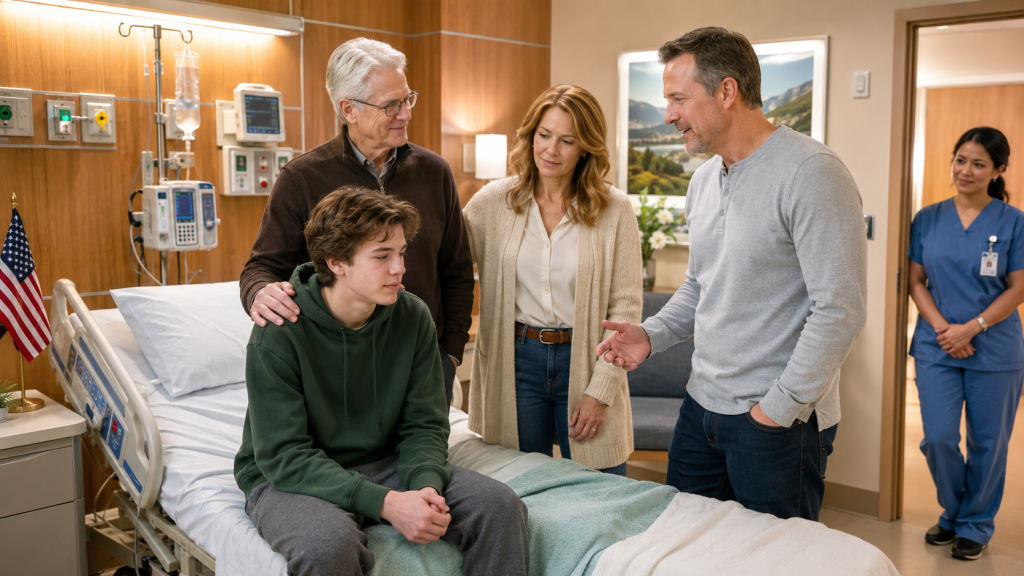
Tom knelt in front of the hospital bed.
“She’s alive, Emily. She loves you. She has never stopped loving you.”
“Then why isn’t she here?”
“Because she was terrified that showing up without permission would make things worse for you.”
“Permission from who?”
He hesitated.
“Your father.”
I covered my face.
Tom stayed where he was.
After a while, I lowered my hands.
“Did she send the letter?”
“Yes.”
“Why through you?”
“Because every letter she mailed from her own address came back.”
“Dad returned them?”
“Most of them. Some disappeared. We never knew if you received them.”
“I never did.”
Tom closed his eyes briefly.
“I’m sorry.”
“Why didn’t she come get me?”
“She tried.”
The words were quiet.
“She went to court.”
“What?”
“Twice.”
I stared at him.
“She tried to change the custody arrangement after she completed treatment.”
“Treatment for depression?”
Tom nodded.
“Your mother had severe postpartum depression after your younger brother died.”
I went still.
“My what?”
Tom’s face changed.
“You don’t know.”
I shook my head.
Dad had never told me I had a younger brother.
Tom sat in the chair beside me.
“His name was Benjamin.”
The room seemed to tilt.
“You were six. Benjamin was nine months old. He developed meningitis. It happened quickly.”
Memories flashed through my mind.
A blue blanket.
My mother crying in a bathroom.
A tiny wooden train on a shelf.
Images I had always assumed were dreams.
“Did he die?”
“Yes.”
I swallowed.
“Is that why Mom left?”
“Rachel didn’t simply leave. After Benjamin died, she became severely depressed. She couldn’t sleep. She blamed herself even though there was nothing she could have done. Eventually, she checked herself into a psychiatric hospital because she was afraid she might hurt herself.”
My eyes burned.
“And Dad told me she wanted a different life.”
Tom’s mouth tightened.
“Your father was angry.”
“At her?”
“At everything. Benjamin’s death destroyed both of them in different ways.”
“Then why keep us apart?”
Tom took a long breath.
“Because by the time Rachel recovered enough to ask for shared custody, your father had convinced himself that letting her back into your life would destabilize you. Then he met Vanessa.”
That name made my stomach twist.
“What does Vanessa have to do with it?”
“A lot.”
Tom reached into his coat and removed his phone.
He opened a folder of photographs.
The first showed Rachel outside a courthouse.
Older than I remembered.
Thin.
Holding a stack of papers.
The next showed her standing beside Tom.
Another showed a pile of returned envelopes.
My name was written on every one.
Emily Carter.
I touched the screen.
“There were so many.”
“Birthdays. Christmases. School years. She wrote even when she thought you would never read them.”
“Where is she now?”
Tom looked toward Claire.
She gave him a small nod.
“She’s at Riverside Hospital.”
My heart stopped.
“Why?”
“She had surgery yesterday.”
“What kind?”
“Heart surgery.”
I sat up too quickly.
Pain shot through my head.
“Is she dying?”
“No. The doctors expect her to recover.”
“Take me to her.”
“Emily…”
“Please.”
Because I was a minor, things were not that simple.
The hospital had already contacted child protective services after Dad left.
A social worker named Monica arrived.
She asked questions.
A lot of questions.
Had my father ever hit me?
No.
Had Vanessa?
No.
Did I have food at home?
Yes.
Was I afraid of them?
Before that night, I would have said no.
Now I didn’t know.
Monica called Dad.
He didn’t answer.
She called again.
Nothing.
Then she called Vanessa.
Vanessa answered.
Monica stepped into the hallway during most of the conversation, but I heard enough.
“She cannot return tonight.”
Pause.
“No, Mrs. Carter, leaving a fourteen-year-old at a hospital does not constitute arranging alternative supervision.”
Pause.
“No, I understand you’re injured.”
Another pause.
Then Monica’s expression changed.
“You are telling me neither you nor Mr. Carter is willing to have Emily return to the residence?”
My stomach dropped.
Tom reached for my hand.
I let him hold it.
Monica listened for nearly a minute.
“Understood.”
She hung up.
I already knew.
“They don’t want me.”
Monica pulled up a chair.
“Emily, what they choose tonight says something about their decisions. It does not determine your value.”
At fourteen, I did not have language for how badly I needed someone to say that.
I looked at Tom.
“Can I stay with him?”
Monica explained there would need to be background checks and emergency placement approval.
Tom immediately gave her everything she requested.
Driver’s license.
Address.
Employment.
References.
“I have a guest room,” he said. “My wife is home. Call her. Call anyone.”
His wife, Marianne, answered on the first ring.
When Monica explained the situation, Marianne started crying.
“Bring her home,” she said.
Not “if you have to.”
Not “we’ll figure something out.”
Bring her home.
By nearly midnight, the emergency placement was approved for forty-eight hours pending further review.
But before we left, Tom made one request.
“Could we stop upstairs?”
Riverside was only ten minutes away, but Rachel’s cardiologist had transferred her earlier that evening to the same hospital where I had been treated because of a complication involving her medication.
She was three floors above me.
My mother had been in the same building while my father abandoned me.
The symmetry of it felt impossible.
A nurse wheeled me upstairs because walking hurt.
Tom pushed the chair.
When we reached room 614, he stopped outside.
“She doesn’t know you’re here.”
My hands began shaking.
“What if she doesn’t want to see me?”
Tom looked genuinely shocked.
“Emily, she has wanted this moment for eight years.”
He opened the door.
Rachel was sleeping.
For a moment, I didn’t recognize her.
My memories belonged to a thirty-year-old woman with long dark hair.
The woman in the hospital bed was nearly forty.
Her hair was shorter.
There were lines beside her eyes.
Tubes ran beneath her gown.
But then she moved.
And I saw the small crescent-shaped scar near her eyebrow.
I had the same scar.
Mine came from falling off a bicycle at seven.
Hers came from childhood.
She opened her eyes.
Tom whispered, “Rachel.”
She looked at him.
Then at me.
Everything in her face stopped.
Her lips parted.
“Emily?”
I started crying before I could answer.
Rachel covered her mouth.
The heart monitor began beeping faster.
A nurse stepped forward.
Rachel held out her hand.
I moved the wheelchair closer.
“Is it really you?”
“Yes.”
She touched my cheek.
Her fingers trembled.
“My baby.”
Those two words destroyed the last wall inside me.
I leaned into her carefully.
She wrapped one arm around me.
We cried so hard neither of us could speak.
For eight years, I had imagined meeting my mother again.
Sometimes I imagined screaming at her.
Sometimes I imagined ignoring her.
Sometimes I imagined asking why I wasn’t enough.
I never imagined that she would be the one apologizing.
“I’m sorry,” she whispered again and again. “I’m so sorry.”
“You wrote to me.”
“Every month.”
“Dad said you didn’t.”
Her body went still.
“He told me you didn’t want to see me.”
Rachel pulled back.
“What?”
“He said you left because you wanted another life.”
Her face drained of color.
“No.”
“He said you stopped calling.”
“No, Emily.”
“He said you stopped caring.”
“No.”
The monitor accelerated.
The nurse warned us to slow down.
Rachel closed her eyes.
When she opened them, tears spilled down her cheeks.
“I need you to hear something, and you never have to believe it tonight. You can take years if you need to. But I did not stop loving you for one single day.”
I believed her.
Not because I wanted to.
Because I had seen the envelopes.
The court photographs.
The returned letters.
Evidence.
Something my father had never offered.
I slept at Tom and Marianne’s house that night.
Technically, I barely slept.
Their guest room had pale yellow walls and a quilt Marianne said had belonged to her mother.
She placed clean pajamas on the bed and asked whether I wanted the door open or closed.
Open.
At 3:12 a.m., I heard footsteps.
Marianne appeared.
“Can’t sleep?”
I shook my head.
She sat on the floor outside my doorway so she wouldn’t crowd me.
“Did you know about me?”
“Yes.”
“Why didn’t you come?”
Pain crossed her face.
“We were told contact could hurt your mother’s custody case.”
“By Dad?”
“By lawyers. Your father accused us of harassment after Rachel tried to see you at school.”
“When?”
“You were nine.”
I remembered that day.
A teacher had kept me inside during recess.
Dad picked me up early.
He told me there had been a dangerous stranger near the school.
My stomach turned.
“It was Mom?”
Marianne nodded.
“She didn’t approach you. She stood across the street because she wanted to see how tall you’d gotten.”
I stared into the dark hallway.
“What else don’t I know?”
Marianne’s answer stayed with me for years.
“Probably a lot. But you don’t have to learn everything tonight.”
The next morning, Dad finally called the social worker.
He wanted me placed in foster care rather than with Tom.
That shocked even Monica.
His argument was that Rachel’s relatives were “emotionally manipulative.”
Monica asked whether he planned to reclaim custody himself.
Dad said he needed time.
Time.
He wanted time away from his fourteen-year-old daughter because his wife had accused her of shoving her.
Meanwhile, Vanessa filed a police report.
She claimed I intentionally pushed her into the counter, causing the bowl to break.
A police officer interviewed me at Tom’s house.
I told him everything.
The argument.
The letter.
The bowl.
Vanessa cutting her hand.
He listened.
Then he asked whether the kitchen had security cameras.
I laughed.
“No.”
Tom suddenly looked at me.
“Doesn’t Mark have cameras outside?”
“Yes.”
Our house had a doorbell camera and one overlooking the driveway.
That did not help.
But then I remembered something.
“Dad bought a camera for the kitchen.”
The officer looked up.
“Why?”
“Vanessa said somebody was stealing cash from her purse. Dad set up a little camera facing the counter.”
“Is it still there?”
“I don’t know.”
Vanessa had complained that it looked ugly.
Dad said he would remove it eventually.
I had forgotten about it.
The officer obtained permission to inspect the home.
Vanessa initially claimed there was no camera.
Dad said the same.
But police found the device still mounted beneath a cabinet.
The memory card was missing.
That should have been the end of it.
Except Dad automatically backed up the security footage to a home computer.
He had set it up months earlier.
He had forgotten.
The recording showed everything.
Vanessa entering my room.
Vanessa following me into the kitchen.
Me standing several feet away.
Vanessa smashing the bowl.
Vanessa deliberately cutting her own palm.
Then Dad walking inside.
No shove.
No attack.
No ambiguity.
The police officer called Tom three days later.
Vanessa was being investigated for filing a false report.
But that wasn’t what hurt most.
The footage also contained audio.
After I fell and Dad crouched beside me, there was a moment when I was barely conscious.
Vanessa whispered something.
“Make her choose.”
Dad said, “Not now.”
Vanessa replied, “It’s us or Rachel. You promised.”
You promised.
My father had not been fooled.
Not completely.
He had known there was more happening than Vanessa admitted.
Maybe he had not seen her cut herself.
But he knew the real issue was Rachel.
He chose Vanessa anyway.
The emergency custody hearing took place nine days later.
Rachel attended in a wheelchair.
Dad arrived with an attorney.
Vanessa did not come.
The judge reviewed the hospital records, police footage, old custody documents, returned letters, and Dad’s refusal to allow me back home.
Then he asked me where I wanted to live.
“With my mother.”
Dad finally looked at me.
His expression held something between anger and disbelief.
The judge asked whether I understood Rachel was recovering from major surgery and might need assistance.
“Yes.”
“Do you have a relationship with her?”
“I’m trying to.”
“Would you feel safe living temporarily with your uncle and aunt while that relationship is rebuilt?”
“Yes.”
Dad’s attorney stood.
“Your Honor, Mr. Carter believes Emily is being heavily influenced.”
I turned toward him.
Influenced.
That word almost made me laugh.
For eight years, Dad had told me what to believe.
Who abandoned me.
Who loved me.
Who was dangerous.
And the moment I learned the truth, suddenly I was being influenced.
The judge asked Dad directly, “Mr. Carter, do you want your daughter returned to your care?”
Dad hesitated.
That hesitation changed everything.
A parent who truly wanted his child would have answered immediately.
Yes.
Instead he looked toward his attorney.
Then said, “Under certain conditions.”
The judge’s expression hardened.
“What conditions?”
“That she stop communicating with Rachel until a therapist determines it is appropriate.”
Rachel closed her eyes.
I stared at Dad.
The judge asked, “Anything else?”
“She needs to apologize to my wife.”
The courtroom became completely silent.
The judge leaned forward.
“For an assault contradicted by video evidence?”
Dad’s face reddened.
“There was still aggressive behavior.”
“She was fourteen years old, injured, and subsequently abandoned at an emergency room.”
“I did not abandon her.”
The judge raised an eyebrow.
“What would you call leaving a minor without arranging supervision and informing her she should never return to your residence?”
Dad had no answer.
Temporary custody went to Tom and Marianne.
Rachel received unrestricted contact.
Dad received supervised visitation after completing family counseling.
I thought that meant he would fight for me.
He didn’t.
He missed the first scheduled visit.
Then the second.
At the third, he arrived twenty minutes late.
I sat across from him in a counseling center.
A therapist named Dr. Patel stayed in the room.
Dad looked older.
Tired.
For several minutes, he said nothing.
Finally, I asked, “Why?”
He rubbed his hands together.
“I made mistakes.”
“That isn’t an answer.”
“I was angry.”
“For eight years?”
He looked away.
“Your mother hurt me.”
“She got sick.”
“She left me alone when Benjamin died.”
“She was suicidal.”
“I was grieving too.”
I understood that.
For the first time, I saw something I had not considered.
Dad had lost a child too.
Rachel had gone into treatment.
He had remained home with me.
He had been grieving, terrified, furious and alone.
That explained his pain.
But explanations are not excuses.
“So you punished her by taking me?”
His eyes snapped toward mine.
“No.”
“You told me she abandoned me.”
“I believed keeping distance was best.”
“Then why hide her letters?”
“Because every time one arrived, everything came back.”
“What came back?”
“Benjamin. The hospital. Your mother screaming. The funeral.”
His voice cracked.
I had never seen my father cry.
Not once.
He covered his face.
“I hated her for surviving it differently than I did.”
The room went quiet.
That was probably the most truthful thing he ever said to me.
I asked, “Did Vanessa know?”
Dad lowered his hands.
“Yes.”
“How much?”
“Everything.”
“And she encouraged you?”
He hesitated.
“Yes.”
“Why?”
“She was afraid Rachel would come back and destroy our family.”
I almost laughed.
“She destroyed it herself.”
Dad didn’t argue.
“What happened after the hospital?”
I asked.
He frowned.
“What do you mean?”
“When you left me. Where did you go?”
“Home.”
“And what did Vanessa say?”
His eyes dropped.
“She said we had finally done what needed to be done.”
My throat tightened.
“And you believed her?”
“For about twenty minutes.”
“What happened?”
“I watched the camera footage.”
My entire body went still.
“You saw it that night?”
“Yes.”
The words hit harder than anything I had learned so far.
“You knew.”
He nodded.
“You knew she lied.”
“Yes.”
“You knew I never pushed her.”
“Yes.”
“And you didn’t come back.”
Dad started crying.
I didn’t.
I had no tears left for him.
“Why?”
“I was ashamed.”
“That’s it?”
“I didn’t know how to face you.”
“So you left me there because you were embarrassed?”
“No.”
“That’s what you just said.”
“I panicked.”
“You were the adult.”
“I know.”
“I was fourteen.”
“I know.”
“You told me we were done.”
“I know.”
“And after you watched a video proving I was innocent, you let me believe my father hated me enough to abandon me.”
He whispered, “I’m sorry.”
Dr. Patel glanced at me, probably worried about what I would do.
I didn’t scream.
I simply stood.
My stitched foot had healed enough that I could walk normally.
“I don’t want another visit.”
Dad looked up.
“Emily.”
“Not right now.”
“I’m your father.”
That sentence once would have controlled me.
Now it sounded empty.
I looked directly at him.
“And I’m your daughter.”
Then I walked out.
Vanessa’s lies unraveled quickly after that.
Police charged her for filing a false report.
The charge was eventually reduced after she accepted a plea agreement, completed community service, and underwent counseling.
But the criminal case revealed something far more important.
Investigators found old emails between Vanessa and Dad.
Years of them.
Some discussed Rachel.
Vanessa had repeatedly encouraged Dad to return letters unopened.
She had searched Rachel’s social media accounts.
She had even created a fake email address and sent Rachel messages pretending to be Dad, threatening legal action if Rachel contacted me.
Rachel had saved those emails.
Dad claimed he did not know Vanessa had impersonated him.
I believed him about that.
Mostly.
But he knew enough.
That was the problem.
Vanessa had not invented the wall between Rachel and me.
Dad built it.
Vanessa simply added bricks.
Their marriage lasted another four months.
Dad filed for divorce after learning Vanessa had secretly contacted his employer and accused him of hiding money from her.
Apparently, once trust disappears from one corner of a house, it rarely stays contained.
Rachel recovered slowly.
For the first six months, I continued living with Tom and Marianne.
Every afternoon after school, I visited her.
At first, we did not talk about the past much.
We built something new.
She learned that I hated mushrooms.
I learned that she loved terrible detective shows.
She learned I played clarinet.
I learned she still had every elementary-school photograph she had managed to obtain through relatives and old friends.
One afternoon, she brought out a wooden box.
Inside were birthday cards.
Eight of them.
One for every birthday she had missed.
“Why didn’t you send these?”
“I did.”
She smiled sadly.
“These are copies.”
I opened the card from my seventh birthday.
There was a drawing of a giraffe because when I was little, giraffes had been my favorite animal.
The card from my tenth birthday contained a ten-dollar bill.
The twelfth had a pressed flower.
The fourteenth had been written two months before the hospital night.
I read it silently.
My dearest Emily,
If this reaches you, please know I have never expected you to forgive me simply because I am your mother.
I only hope that someday you are allowed to know the truth and decide for yourself what relationship you want with me.
You deserve the right to choose.
Love always,
Mom.
I read the last sentence again.
You deserve the right to choose.
That was the difference between Rachel and Dad.
Rachel wanted me to choose.
Dad wanted to choose for me.
When I was fifteen, Rachel moved into a small townhouse five minutes from my school.
The court approved me living with her.
I remember standing in the doorway of my new bedroom.
The walls were blank.
There was no furniture except a bed and a desk.
Rachel apologized.
“I didn’t know what you liked.”
I looked around.
“Good.”
She seemed confused.
“Good?”
“We can figure it out.”
So we did.
We painted one wall dark green.
We bought posters.
We argued about whether I needed a rug.
We burned our first attempt at homemade pizza.
We had disagreements.
Real ones.
Sometimes Rachel became overprotective because she was terrified of losing me again.
Sometimes I became cruel because part of me was still angry she had not fought harder.
Therapy helped.
It taught me something I wish more adults understood.
Reconciliation is not pretending nothing happened.
It is learning how to discuss what happened without using the past as a weapon.
At sixteen, I saw Dad again.
Not because the court required it.
Because I asked.
We met at a coffee shop.
He looked nervous when I entered.
“Hi.”
“Hi.”
We sat.
He had brought a folder.
I almost laughed.
“What’s that?”
“Things I should have given you years ago.”
Inside were photographs of Benjamin.
My little brother.
There he was in Dad’s arms.
There I was beside him, six years old, holding a stuffed rabbit over his crib.
In another photograph, Rachel was kissing his forehead.
Dad pointed at one.
“That was his first Christmas.”
I touched Benjamin’s tiny hand in the photograph.
“Why did you erase him?”
Dad’s eyes filled.
“I couldn’t say his name.”
“So nobody could?”
“I thought forgetting would hurt less.”
“Did it?”
“No.”
We sat quietly.
Then Dad slid another envelope toward me.
It contained copies of Rachel’s letters.
Dozens.
He had kept them.
Not all of them.
But many.
“I read some,” he admitted.
“Why?”
“I don’t know.”
“Yes, you do.”
He looked through the café window.
“Because part of me wanted to know she still cared.”
The cruelty of that stunned me.
“You wanted proof she cared while telling me she didn’t?”
His face crumpled.
“Yes.”
I stood.
Dad looked alarmed.
“Are you leaving?”
“No.”
I walked outside for air.
Five minutes later, I returned.
I sat across from him.
“I don’t forgive you.”
He nodded.
“I understand.”
“Maybe someday I will.”
Another nod.
“But even if I forgive you, it doesn’t mean we go back.”
“I know.”
“You don’t get to be the dad you were before.”
“I know.”
“You have to become someone different.”
He looked at me.
“I’m trying.”
For once, that was enough.
Not enough to fix everything.
Enough for one cup of coffee.
Then another six months later.
Then dinner.
Then a graduation ceremony.
Dad and Rachel never became friends.
That would have been unrealistic.
But they eventually learned to stand in the same room.
When I graduated from high school, Rachel sat on one side of Tom.
Dad sat on the other.
Nobody fought.
Nobody competed.
Nobody asked me to choose.
After the ceremony, Dad approached Rachel.
I watched from several feet away.
He said something.
She stared at him for a long time.
Then nodded.
Years later, I finally asked what he had said.
Rachel told me.
“He apologized for making your grief belong only to him.”
That sentence mattered more to her than an apology about the letters.
Because after Benjamin died, everyone had been grieving.
Rachel.
Dad.
Me.
But Dad had decided his pain justified controlling everyone else’s.
Pain can explain terrible decisions.
It does not automatically excuse them.
Vanessa disappeared from my life completely.
The last time I saw her, I was seventeen.
I was leaving a bookstore when someone called my name.
I turned.
She stood near the entrance.
For a second, neither of us moved.
She looked different.
Shorter hair.
No makeup.
She approached cautiously.
“Emily.”
I said nothing.
“I heard you’re doing well.”
Still nothing.
She swallowed.
“I owe you an apology.”
“Yes.”
That answer seemed to surprise her.
She had probably expected me to make it easier.
To say she didn’t owe me anything.
She did.
“I was jealous of Rachel,” Vanessa admitted. “Even before she came back.”
“She never left.”
Vanessa flinched.
“You’re right.”
I waited.
“I thought if your father felt guilty about Rachel, he would eventually regret marrying me.”
“So you made him hate her.”
“I encouraged feelings that were already there.”
“That sounds nicer than what you did.”
She looked down.
“Yes.”
“Why did you cut yourself?”
Her face became pale.
“I don’t have a good answer.”
“Try the bad one.”
Vanessa almost smiled, then thought better of it.
“I wanted your father to choose me.”
“And you needed me to be the enemy.”
“Yes.”
I studied her.
For years, I had imagined what I would say if I ever saw her again.
I imagined humiliating her.
Making her cry.
Telling everyone nearby what she had done.
Instead I felt tired.
“You won.”
She looked confused.
“That night. Dad chose you.”
Her eyes filled.
“It didn’t feel like winning.”
“That’s because you didn’t actually want love. You wanted proof you could take it away from someone else.”
Vanessa stared at me.
I walked past her.
She called my name.
I stopped.
“I really am sorry,” she said.
I turned around.
“I believe you.”
Hope appeared on her face.
Then I added, “But believing you’re sorry doesn’t mean I need you in my life.”
And I left.
I was twenty-two when Dad suffered a minor heart attack.
Rachel called me.
That alone showed how far things had come.
“Your father is at Grant Medical Center.”
I drove there.
Dad looked embarrassed when I walked into his room.
“Apparently I’m dramatic now.”
“You always were.”
He laughed, then winced.
I sat beside him.
For a while, we talked about normal things.
Work.
My apartment.
Rachel’s garden.
Then Dad became quiet.
“Do you remember the hospital?”
I knew immediately what he meant.
“Yes.”
“I think about it every time I’m in one.”
I looked at him.
“The doors closing behind me,” he said. “You calling after me.”
I said nothing.
“I heard you.”
My chest tightened.
“I always wondered.”
“I heard you every time.”
“Then why didn’t you turn around?”
Dad stared at the blanket.
“Because if I turned around, I would have had to admit I was wrong.”
There it was.
The simplest truth.
Pride.
Not Vanessa.
Not Rachel.
Not grief.
Not complicated custody arrangements.
Pride.
He had allowed his fourteen-year-old daughter to sit alone in an emergency room because turning around meant admitting he had made a mistake.
“I hated you for that,” I said.
He nodded.
“You had every right.”
“I don’t anymore.”
His eyes lifted.
“That doesn’t mean I forgot.”
“I know.”
“It means I got tired of carrying it.”
Dad cried.
This time, I reached for his hand.
Forgiveness did not arrive like lightning.
There was no dramatic moment when everything became clean.
It was more like putting down a heavy suitcase after carrying it for miles.
Your arms still ache afterward.
You still remember the weight.
But you are no longer carrying it.
Years passed.
I became a social worker.
People often assume I chose the profession because of what happened when I was fourteen.
They are partly right.
I remember Claire sitting beside me in the emergency room.
I remember Monica refusing to let adults speak over me.
I remember how enormous those small acts felt.
So when frightened children sit across from me today, I try to remember that they notice everything.
They notice who believes them.
Who interrupts them.
Who asks what they want.
Who decides what they are allowed to know.
And sometimes one adult listening carefully can change the direction of a life.
Rachel eventually told me everything about Benjamin.
Not all at once.
I learned that he had gotten sick on a Wednesday.
That by Friday, doctors knew it was serious.
That Rachel sang “You Are My Sunshine” beside his hospital bed because it was the only song that calmed him.
That he died early Sunday morning while Dad held one hand and Rachel held the other.
I learned that I had been staying with neighbors during the worst of it.
That afterward, I kept asking when the baby was coming home.
Rachel could not answer me.
Neither could Dad.
So Dad packed away Benjamin’s things.
Then his photographs.
Then every mention of him.
When Rachel entered treatment, Dad told six-year-old me she had gone away because she needed a different life.
Maybe he meant to explain properly later.
Then days became months.
Months became years.
And lies become harder to confess the longer people build their lives around them.
When I was twenty-eight, Dad, Rachel, Tom, Marianne, and I visited Benjamin’s grave together.
Dad had not gone in twenty-two years.
He stood before the small stone for several minutes.
Then knelt.
“I’m sorry, buddy,” he whispered.
Rachel placed flowers beside the grave.
I stood between them.
For the first time, my family’s history felt whole.
Not happy.
Whole.
There is a difference.
We did not need to pretend tragedy had not broken us.
We only needed to stop pretending the broken pieces had never existed.
Before leaving, Dad touched Benjamin’s name carved into the stone.
Then he looked at me.
“I almost lost both my children.”
I knew he wasn’t talking about death.
“Yes.”
“I’m grateful you came back.”
I shook my head gently.
“I didn’t come back, Dad.”
He looked confused.
“You came toward me.”
He stood very still.
Then he nodded.
“You’re right.”
That was our relationship from then on.
He came toward me.
He called.
He showed up.
He remembered birthdays.
He apologized when he was wrong.
He never demanded forgiveness.
And slowly, over years, he became my father again.
Not the father from before.
A new one.
One built with truth instead of authority.
Rachel never asked me to hate him.
That may have been the greatest gift she gave me.
She told me once, “Your father did things I may never fully forgive, but he loved you badly. That isn’t the same as not loving you.”
I understood what she meant.
Love without honesty can still cause enormous damage.
Love mixed with fear can become control.
Love mixed with pride can become cruelty.
Saying “I love you” does not erase what you do to someone.
But people can change if they are willing to look directly at the damage they caused.
When I was thirty-one, I had my first child.
A daughter.
We named her Claire Rachel Mercer.
Claire for the nurse who refused to leave a frightened fourteen-year-old alone.
Rachel for my mother.
Mercer because by then I had married a man who happened, unbelievably, to share no relation to Uncle Tom despite the surname.
Life has a sense of humor.
Dad came to the hospital the morning after Claire was born.
He stood outside the room until my husband invited him inside.
He approached the bassinet slowly.
“She’s beautiful.”
“Do you want to hold her?”
His eyes widened.
“Can I?”
I nodded.
Dad picked up his granddaughter.
His hands shook.
For several minutes, he simply stared at her.
Then he began crying.
“What?” I asked.
He looked at me.
“I was thinking about the last time you and I were in a hospital together.”
The memory appeared instantly.
Rain.
Stitches.
Rachel’s letter.
Automatic doors closing.
Don’t ever come back.
We’re done.
Dad looked down at Claire.
“I wish I could go back.”
“I know.”
“I would turn around.”
“I know.”
“I would come back into that room.”
My eyes filled.
“I know.”
“But I can’t.”
“No.”
He swallowed.
“So I’m going to keep showing up now.”
I reached over and touched his arm.
“That’s all you can do.”
Rachel entered a few minutes later carrying flowers.
Dad looked nervous for half a second.
Then Rachel smiled.
“Grandpa already stealing my time?”
Dad laughed.
“Your grandmother is apparently territorial.”
They stood beside each other over Claire.
Once, those two people had been at the center of a war that shaped my entire childhood.
Now they were simply two grandparents arguing about whose nose the baby had.
I watched them and thought about fourteen-year-old me.
That girl sitting beneath hospital lights.
Convinced she had lost everything.
If I could sit beside her now, I would not tell her everything would be perfect.
That would be another lie.
I would tell her the truth.
I would tell her that the next few years would hurt.
That she would wake from nightmares hearing her father’s voice.
That she would become suspicious whenever people whispered in another room.
That she would struggle to trust apologies.
That she would spend years learning that someone else’s rejection did not automatically mean she had done something wrong.
I would tell her that meeting Rachel would not magically repair eight missing years.
They would have to build a relationship slowly.
There would be awkward dinners.
Arguments.
Tears.
Questions without satisfying answers.
I would tell her Dad would disappoint her again before he changed.
That Vanessa would eventually apologize, but apologies do not always restore relationships.
I would tell her forgiveness is optional.
Boundaries are not cruelty.
Truth sometimes arrives late, but late truth can still free you.
Most importantly, I would tell that fourteen-year-old girl to remember what happened two hours after her father left.
Because that is the part of the story people sometimes overlook.
My father said, “Don’t ever come back.”
And two hours later, someone came for me.
Not because I had earned it.
Not because I proved I was innocent first.
Not because I begged.
Tom came running into that hospital wearing two different shoes because the moment someone told him I needed help, helping me mattered more than looking prepared.
Then Rachel reached for me from a hospital bed.
Marianne opened her home.
Claire stayed beside me.
Monica listened.
One person walked away.
Five others stepped forward.
For years, I defined that night by the person who left.
Eventually, I learned to define it by the people who came.
That changed everything.
Dad died when I was forty-two.
A stroke.
Sudden.
By then we had repaired enough of our relationship that I could sit beside his bed without wishing our past had been different every second.
Rachel sat with me.
Near the end, Dad opened his eyes.
He could barely speak.
“Emily.”
“I’m here.”
His fingers moved against mine.
“Hospital.”
I knew.
“You didn’t leave me this time,” I whispered.
A tear rolled down his cheek.
“No.”
“No.”
He squeezed my fingers.
“I’m sorry.”
I leaned closer.
“I know.”
Then I said the words I had spent years deciding whether I truly meant.
“I forgive you.”
His eyes closed.
He died several hours later.
At his funeral, I did not tell the story people expected.
I did not describe him as perfect.
I did not erase Vanessa.
I did not erase Rachel.
I did not erase the hospital.
Instead, I said my father taught me two important lessons.
The first was how deeply people can hurt the ones they love when they allow fear, pride, and grief to make their decisions.
The second was that people are more than the worst thing they have ever done if they take responsibility for changing afterward.
Dad had spent eight years keeping me from my mother.
He could never give those years back.
He abandoned me in a hospital.
He could never erase those words.
But for the rest of his life, he tried to become someone who would never make that choice again.
That mattered.
After the funeral, Rachel and I walked outside together.
She was seventy by then.
Her hair completely silver.
She slipped her arm through mine.
“You okay?”
“I think so.”
She nodded.
We stood beneath an October sky.
It had rained that morning.
The pavement shone beneath the parking lot lights.
For a second, I was fourteen again.
Then Rachel squeezed my arm.
And I came back to the present.
“Funny,” I said.
“What?”
“The rain.”
She looked upward.
“Does it bother you?”
“Not anymore.”
That surprised me as I said it.
For years, heavy rain had brought me back to that night.
Now it was just rain.
Water against pavement.
Clouds moving overhead.
A memory without power.
Rachel smiled.
“Ready to go home?”
Home.
Such a small word.
For most of my childhood, I thought home was an address.
Then I thought it was whoever legally had custody of me.
Later, I understood.
Home is where the truth does not have to hide beneath a mattress.
Home is where love does not require choosing sides.
Home is where someone notices when you are frightened.
Home is where apologies come with changed behavior.
Home is where people come back.
I looked at my mother.
“Yeah.”
We walked toward the car together.
And sometimes, when I think about that fourteen-year-old girl sitting alone in the hospital, I imagine those automatic doors opening again.
I imagine her expecting to see the father who abandoned her.
But instead, in walks an uncle wearing mismatched shoes.
Upstairs waits a mother who never stopped writing.
Outside waits an aunt preparing a bedroom.
Nearby stands a nurse who believes her.
And somewhere beyond that terrible night waits an entire life she cannot yet imagine.
A life with graduations.
A marriage.
Children.
Forgiveness.
Boundaries.
Truth.
A mother rediscovered.
A father changed.
A little brother finally remembered.
And a lesson I have carried into every room where a frightened child has ever sat across from me:
Being rejected by someone who should have protected you does not mean you are impossible to love.
Sometimes the person who walks away is simply revealing the limit of who they are in that moment.
And sometimes, two hours later, the door opens.
Someone else walks in.
And that is where your real story begins.
💬THE END! THANK YOU FOR READING!