

I never believed she would actually strike me.
Not Brittany.
Not the woman whose nursing school tuition at UT Austin I had helped cover when she was twenty-four, overwhelmed, and working weekend shifts at a rehabilitation center just to keep gas in her car.
Not the young woman I had welcomed into the backyard casita behind my Austin home when she and Tyler were first married and couldn’t afford an apartment.
Not the daughter-in-law who once hugged me at Christmas and whispered, “I don’t know what we’d do without you.”
But she did.
The blow came so quickly that for several seconds I couldn’t understand what had happened.
One moment Brittany was standing across from me in the kitchen, furious because I had questioned why Tyler was planning to drain his retirement account for their new house.
The next, her hand struck the side of my face.
I stumbled backward.
My hip hit the granite island first.
Then my wrist slammed against the sharp edge.
Pain exploded from my fingertips to my elbow, bright and immediate enough to make my knees buckle.
I landed hard on the hardwood floor.
For a few seconds all I could hear was my own breathing.
Brittany stood over me.
Her chest rose and fell quickly.
Her eyes were cold.
She didn’t gasp.
She didn’t reach for me.
She didn’t say, “Oh my God, I’m sorry.”
She simply stared.
“You’re not welcome here anymore,” she said.
Her voice was barely above a whisper.
That somehow made it worse.
I looked toward the staircase.
Tyler was upstairs.
I knew he was.
His truck was in the driveway.
His laptop bag was beside the front door.
He had been working from home all afternoon.
There was no possibility that he hadn’t heard the argument.
And almost certainly no possibility that he hadn’t heard me fall.
“Tyler?” I called.
Nothing.
I hated the weakness in my voice.
“Tyler?”
Still nothing.
Brittany folded her arms.
“He doesn’t want to deal with you.”
Those words hurt more than my wrist.
I pushed myself upright with my good hand.
My lip tasted metallic.
When I touched it, my fingertips came away red.
Brittany watched me grab my purse.
She didn’t move.
I walked toward the front door slowly because the room still tilted when I turned my head.
Before leaving, I looked toward the stairs one final time.
No footsteps.
No voice.
No son.
So I left.
Outside, the Texas sun was merciless.
The kind of late-afternoon brightness that bleaches everything pale and makes even ordinary sidewalks shimmer.
Neighbors were watering lawns.
A delivery truck rolled past.
Somebody’s sprinkler ticked rhythmically across the grass.
The world had the nerve to look completely normal.
I sat inside my SUV for several minutes before starting the engine.
My wrist was already swelling.
I had to use my left hand to turn the key.
That was when my phone buzzed.
Tyler.
For one ridiculous second, relief washed through me.
I thought he was calling to apologize.
Instead, it was a text.
Please don’t come back. It’s better this way. Stay away from us.
I read it three times.
Us.
That word stayed with me.
Not, “Mom, everyone needs time.”
Not, “What happened?”
Not even, “Brittany says you upset her.”
Stay away from us.
The boy I had raised alone had chosen a side without asking whether I was bleeding.
I typed one word.
Okay.
Then I drove away.
I went straight to an urgent care clinic off South Congress.
A nurse named Felicia helped remove my watch because my wrist had swollen too badly for me to slide it off.
“You fell?” she asked carefully.
I hesitated.
“Someone pushed me off balance.”
Felicia looked at the bruise forming across my cheek.
“Someone?”
“My daughter-in-law.”
Her expression changed.
Not dramatically.
Just enough.
She lowered her voice.
“Do you feel safe going home?”
“Yes.”
“Does she live with you?”
“No.”
“Do you want us to contact law enforcement?”
I stared at the floor.
My entire adult life had been about solving problems quietly.
When Tyler’s father, Matthew, disappeared with another woman when Tyler was seven, I didn’t scream at his workplace or destroy his belongings.
I found a lawyer.
I sold the house we couldn’t afford.
I worked.
When Tyler struggled in high school, I hired tutors.
When he crashed his first car, I drove to the hospital.
When college tuition came due, I took extra consulting projects.
When he married Brittany, I tried to treat her like family.
Quiet solutions.
That was how I survived.
“Not today,” I told Felicia.
The X-ray showed a fracture.
Not catastrophic.
But real.
They fitted me with a temporary cast and told me to see an orthopedic specialist within forty-eight hours.
As I waited for the discharge paperwork, I looked at Tyler’s message again.
Stay away from us.
Something settled inside me.
It wasn’t anger.
Anger is hot.
This was cold.
Clear.
Almost peaceful.
For years, I had mistaken helping Tyler for loving him.
I had solved every financial emergency.
Every late bill.
Every unexpected repair.
Every shortage.
And because I could help, I did.
Again.
And again.
And again.
Maybe I had made it too easy for him to believe my support was permanent.
Maybe I had accidentally taught my son that no matter how he treated me, I would still be standing behind him holding the ladder.
That evening, I returned home.
My house felt unusually quiet.
I made tea I never drank and sat at the kitchen table beneath the pendant light.
My wrist throbbed.
My cheek was beginning to discolor.
I opened my laptop.
Then I pulled a thick manila folder from my desk.
Mortgage Documents.
A month earlier, Tyler and Brittany had found what they called their dream home.
It was a new construction property in Round Rock.
Four bedrooms.
Three and a half bathrooms.
A media room.
An outdoor kitchen.
Nearly thirty-three hundred square feet.
The asking price was far beyond what I believed they could reasonably afford.
I told Tyler that.
He laughed.
“Mom, houses appreciate.”
“So do bills.”
“We’ll grow into the payment.”
I had heard phrases like that from clients for years.
I worked in commercial risk management before retiring.
My entire career had been built around one principle:
Hope is not a financial strategy.
Tyler earned decent money as a project manager.
Brittany worked as a nurse practitioner.
Together, they should have been comfortable.
But comfortable wasn’t enough for them anymore.
They wanted impressive.
Their current house was eleven years old and perfectly respectable.
But Brittany had begun following luxury home accounts online.
Suddenly their kitchen was “dated.”
Their neighborhood was “starter-home energy.”
Their backyard was “too small for entertaining.”
When they discovered the Round Rock development, Brittany became obsessed.
The problem was their debt.
Two vehicles.
Credit cards.
A personal loan.
Brittany’s remaining student loans.
And, unknown to me until the mortgage process began, almost forty thousand dollars in revolving balances.
They couldn’t qualify for the mortgage alone.
So Tyler called.
“Mom, we need a favor.”
I should have known.
He came to my house that Saturday carrying breakfast tacos from my favorite place.
Brittany brought flowers.
They were charming.
Attentive.
Grateful.
Tyler explained that the lender would approve the mortgage if I co-signed and provided additional asset verification.
“It’s temporary,” he said.
“We’ll refinance in a year or two.”
Brittany reached across the table.
“You’d basically just be helping us get through underwriting.”
Basically.
That word cost people fortunes.
I said I wanted to review the paperwork.
Tyler smiled.
“Of course.”
The purchase contract required a substantial down payment.
They had some money saved, but not enough.
So I agreed to gift them sixty-five thousand dollars.
Then the lender requested additional financial backing.
I agreed to guarantee part of the loan.
At the time, I told myself it was an investment in my son’s future.
Now I sat at the same table with a fractured wrist because his wife had struck me and he had told me to disappear.
I opened my email.
There was the latest message from the loan officer, Patricia Monroe.
Final underwriting documentation required by Friday.
My signatures had not yet been completed.
The gift funds were still sitting in my account.
My guarantee had not been finalized.
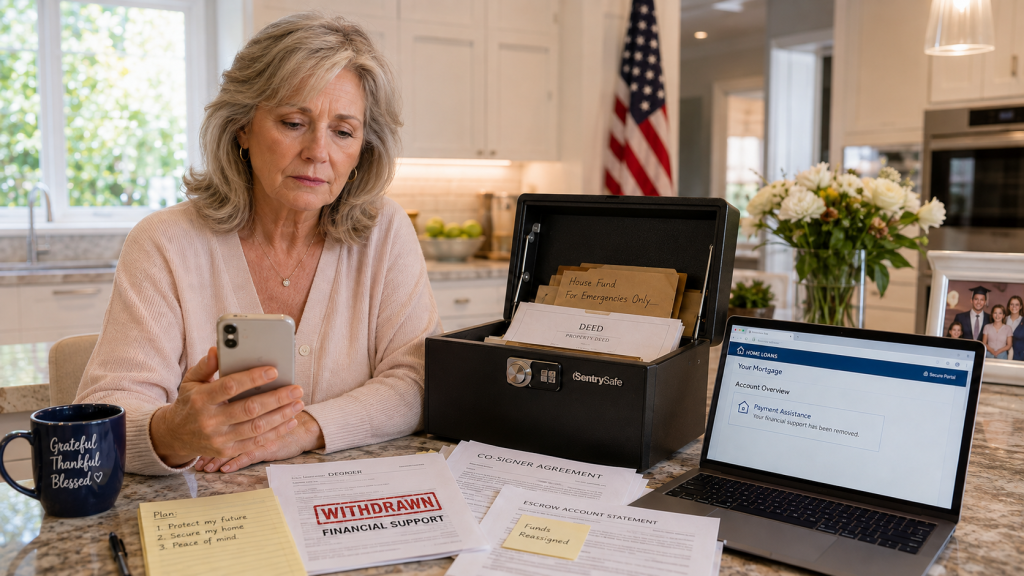
I called Patricia the next morning at 8:15.
“Mrs. Whitaker,” she said warmly. “I was actually planning to contact you today.”
“I’m withdrawing.”
There was a pause.
“From the guarantee?”
“Everything.”
Another pause.
“I want to be certain I understand. You’re withdrawing your intended gift contribution and declining to proceed as co-signer?”
“Yes.”
“Has something changed financially?”
“No.”
That was important.
I wasn’t lying.
My finances were exactly the same.
Something had changed personally.
Patricia chose her next words carefully.
“I should tell you that without your involvement, their debt-to-income ratio may put the loan outside the approval guidelines.”
“I understand.”
“They may lose the property.”
“I understand.”
“You’re absolutely certain?”
I looked down at the cast on my wrist.
“Yes.”
She explained the documentation I needed to complete.
I signed it electronically.
At 9:02, I received confirmation.
Withdrawal accepted.
I closed the laptop.
Then I made scrambled eggs.
That was it.
No dramatic speech.
No revenge announcement.
No social media post.
I had simply stopped financing people who wanted me out of their lives.
My phone began ringing shortly after two.
Tyler.
I watched his name flash across the screen.
I didn’t answer.
He called again.
Then Brittany.
Then Tyler.
Then Brittany.
At 2:31, the first text arrived.
What did you do?
I ignored it.
Another followed.
The lender says you withdrew.
Then:
Mom, call me NOW.
I continued folding laundry.
By three, there were nine missed calls.
At 3:14, Tyler sent another message.
They denied the mortgage.
I sat on the edge of my bed and stared at that sentence.
Yesterday, I was dangerous enough to be ordered away.
Today, apparently, I was necessary again.
My phone rang.
This time I answered.
“Hello?”
“Mom, what the hell?”
No greeting.
No question about my wrist.
“What do you mean?”
“The mortgage!”
His voice cracked with panic.
“Patricia says you withdrew your guarantee and the gift.”
“That’s correct.”
“Why?”
I almost laughed.
Instead, I said, “You asked me to stay away from you.”
“That doesn’t mean you sabotage our house.”
“I didn’t sabotage anything.”
“Are you serious?”
“Yes.”
“You knew we needed that money.”
“And you knew Brittany hit me.”
Silence.
Not shock.
Not confusion.
Just silence.
That told me everything.
“You knew,” I said.
“Mom—”
“You knew before you sent that message.”
He exhaled.
“Brittany told me there was an argument.”
“She struck me hard enough to fracture my wrist.”
“She said you fell.”
I stared at the wall.
“Do you want a photo of the cast?”
“That’s not the point.”
My son actually said that.
“That’s not the point?”
“You came into our house criticizing our financial decisions.”
“I asked why you planned to empty your retirement account.”
“It’s our money.”
“Then buy the house with your money.”
Another silence.
That one lasted longer.
Finally Tyler said, “You promised.”
“I promised to help my son and his wife buy a home. Then his wife hit me, and my son told me to stay away.”
“You’re punishing us.”
“No, Tyler. I’m obeying you.”
He lowered his voice.
“You can’t do this.”
“I already did.”
Brittany shouted something in the background.
Then Tyler said, “She says you’re trying to destroy our marriage.”
“I’m not responsible for your marriage.”
“You know what she’s been through.”
That sentence nearly made me lose my composure.
I had heard it for years.
Brittany’s childhood had been difficult.
Her father drank.
Her mother bounced between unstable relationships.
Money was scarce.
I had sympathy for that.
I still did.
But pain does not give someone permission to create more pain.
“I know exactly what she’s been through,” I said. “That’s why I helped pay her tuition. That’s why I let you live in my casita. That’s why I helped with your wedding. That’s why I’ve covered things for both of you for years.”
“Don’t throw that in our faces.”
“I didn’t. You called me.”
Another muffled argument happened in the background.
Then Brittany grabbed the phone.
“You vindictive old woman.”
Her voice was shaking.
“Brittany.”
“You planned this.”
“No.”
“You never wanted us to have that house.”
“I told you it was expensive.”
“You always look down on me.”
“I paid twenty-eight thousand dollars toward your education.”
“I knew you’d bring that up.”
“I’m bringing it up because you’re pretending I spent years trying to hurt you.”
“You’ve always controlled Tyler with money.”
That stopped me.
Because there was enough truth in it to hurt.
Not the way she meant it.
I never demanded obedience in exchange for money.
But I had absolutely used money to fix situations Tyler should have learned to fix himself.
Maybe control and rescuing were closer relatives than I wanted to admit.
So I answered carefully.
“You may be right about one thing.”
She went quiet.
“I should have stopped financing Tyler’s life years ago.”
“That’s not what I meant.”
“I know.”
“You’re insane.”
“No. I’m finished.”
She hung up.
An hour later, somebody pounded on my front door.
I was in the kitchen.
My body went rigid.
More pounding.
Then the bell.
I checked the security camera.
Brittany.
She stood on my porch in blue scrubs with her hair pulled into a messy bun.
Tyler was behind her.
I didn’t open the door.
Brittany hit the bell again.
“Open up!”
I activated the speaker through my security system.
“You need to leave.”
Tyler looked directly into the camera.
“Mom, please.”
“Yesterday you told me to stay away.”
“We need to talk.”
“We can talk by phone.”
Brittany stepped closer.
“You’re hiding?”
“I’m protecting myself.”
“Oh my God.”
She laughed.
The sound was ugly.
“You pushed me first.”
Tyler looked at her.
That was interesting.
“What?” he said.
She turned.
“She pushed me.”
“No, I didn’t.”
I spoke through the speaker.
Brittany looked toward the camera.
“Yes, you did.”
Tyler stared at his wife.
“You told me she grabbed your arm.”
“She did.”
“You just said she pushed you.”
Brittany’s face changed.
Very slightly.
But I saw it.
So did Tyler.
“Leave my property,” I said.
Tyler rubbed his forehead.
“Mom, can we please come inside?”
“No.”
“Five minutes.”
“No.”
“Please.”
I looked at my son standing on the porch.
He suddenly seemed younger.
Not because he looked young.
Because he looked like the confused teenager who used to call me whenever his choices finally produced consequences.
For decades, that expression had activated something automatic in me.
Fix it.
Protect him.
Make it easier.
Not this time.
“You made your position clear yesterday,” I said.
“I was angry.”
“You weren’t the one who got hit.”
“I didn’t know your wrist was broken.”
“You didn’t ask.”
He looked down.
Brittany muttered, “This is ridiculous.”
Then she turned and walked toward their car.
Tyler stayed another moment.
“I’m sorry you got hurt.”
Not “I’m sorry Brittany hurt you.”
Just sorry you got hurt.
There’s a difference.
“Goodbye, Tyler.”
I turned off the speaker.
He eventually left.
That night, I slept poorly.
Every sound outside woke me.
By morning, I made a decision I probably should have made at urgent care.
I went to the police station.
I brought photos.
The medical report.
The security footage from my porch.
And the text Tyler sent less than an hour after the incident.
I told the officer exactly what happened.
I did not exaggerate.
I did not call Brittany evil.
I did not say I wanted her arrested.
I simply documented it.
The officer asked whether there had been previous incidents.
“Not physical.”
“What does that mean?”
I thought about it.
“She has screamed at me before.”
“Threatened you?”
“Not directly.”
“Destroyed property?”
“No.”
“Blocked you from leaving?”
I hesitated.
“Once.”
His pen stopped.
“When?”
“Christmas two years ago.”
“What happened?”
Brittany had been furious because I refused to loan them twenty thousand dollars for a backyard renovation.
She stood in front of my car in their driveway for almost ten minutes, demanding I come back inside and “finish the conversation.”
At the time, I dismissed it as emotional behavior.
Now it sounded different when repeated aloud.
I gave the officer the details.
When I left the station, my stomach felt sick.
But I also felt lighter.
Over the following week, I began reviewing everything I was financially covering.
It was more than I realized.
Tyler’s family phone plan.
Gone.
Their vehicle insurance reimbursement.
Gone.
The storage unit where they kept furniture for the new house.
Gone.
A subscription service Brittany had added to my credit card years earlier.
Canceled.
The automatic transfer of eight hundred dollars each month into an education account I had created for their future children.
Paused.
That one hurt.
But there were no children yet.
And I could restart it someday if circumstances changed.
I wasn’t trying to make them suffer.
I simply stopped paying expenses that belonged to two employed adults who had told me to leave them alone.
The consequences were immediate.
Tyler called repeatedly.
I answered once.
“Mom, the insurance payment bounced.”
“I removed my account.”
“You could have warned me.”
“You told me to stay away.”
“Stop saying that!”
“But you did.”
“I said it because Brittany was upset.”
“Was Brittany upset when she hit me?”
He groaned.
“You’re acting like she attacked you with a weapon.”
“My wrist is fractured.”
“It was one mistake.”
“No, Tyler.”
My voice remained calm.
“The hit was one action. Your silence was another. Your message was another. Showing up at my home after I told you to leave was another. Lying about what happened was another.”
“She’s under stress.”
“So am I.”
“She could lose her job if you push this legally.”
“I didn’t strike a patient or coworker. She made her choice.”
“She’s terrified.”
“So was I when I was sitting on your floor bleeding.”
That ended the conversation.
Three weeks passed.
My cast was replaced with a brace.
The bruising faded from my face.
Something else faded too.
The constant nervous habit of checking my phone to see whether Tyler needed something.
I began noticing how much of my life had revolved around anticipating his emergencies.
I had retired two years earlier, imagining dinners with family, travel, gardening, perhaps volunteering.
Instead, I had somehow become the unofficial financial department for two adults.
Without that responsibility, my days opened.
I joined an early morning walking group once my wrist allowed it.
I started attending pottery classes with my neighbor Denise.
I booked a trip to Santa Fe with two women I had worked with for almost twenty years.
When I told Denise the story, she stared at me across her patio table.
“You paid their phone bill?”
“Yes.”
“And their insurance?”
“Partly.”
“And gave them housing?”
“For eighteen months.”
“And paid Brittany’s tuition?”
“Some of it.”
Denise raised one eyebrow.
“What exactly did they pay for?”
I almost defended them.
The words formed automatically.
Tyler works hard.
Brittany had a difficult start.
Austin is expensive.
Then I stopped.
“They paid for plenty,” I said.
“But I paid for too much.”
Denise nodded.
“That sounds different.”
It was.
Taking responsibility for my own choices felt better than blaming them for everything.
I had trained Tyler to expect rescue because rescue made me feel useful.
I could admit that.
But admitting my mistake didn’t require continuing it.
About a month after the incident, Tyler came to my house alone.
He didn’t knock aggressively.
He simply rang once and waited.
I opened the door but left the security chain attached.
His face fell when he saw it.
“Can we talk?”
“From there.”
He looked exhausted.
His shirt was wrinkled.
There were dark shadows beneath his eyes.
“Brittany moved out.”
I didn’t respond.
“She’s staying with her sister.”
“I’m sorry.”
“She says I betrayed her.”
“Did you?”
“I told her she needed to apologize to you.”
That surprised me.
“When?”
“Last week.”
“Why last week?”
His eyes lowered.
Because that was the question.
Why not immediately?
“I didn’t understand how bad things had gotten.”
“You watched them get bad.”
“I kept thinking if I didn’t interfere, things would calm down.”
“That’s not neutrality, Tyler.”
“I know.”
His voice cracked.
That reached me.
But I didn’t open the door.
He continued.
“She’s been angry for a long time.”
“I know.”
“She screams at me too.”
I went still.
“Has she hit you?”
He looked away.
There was the answer.
“How long?”
“Mom.”
“How long?”
“Maybe a year.”
My heart dropped.
He quickly added, “Not like punching me.”
There it was.
The language people use when they’re trying to make something unacceptable sound manageable.
“She throws things sometimes.”
“At you?”
“Near me.”
“Tyler.”
“Sometimes at me.”
I closed my eyes.
Suddenly I understood some of the changes I had noticed over the previous year.
His canceled plans.
His nervousness when Brittany called.
The way he always checked his phone during dinners.
I had assumed he was becoming inconsiderate.
Maybe sometimes he was scared.
“Why didn’t you tell me?”
He gave a broken laugh.
“Because I’m thirty-six years old.”
“So?”
“Because I’m six feet tall and she’s five-four.”
I understood.
Shame doesn’t care about physics.
“Abuse is abuse.”
“I know that now.”
“No, you’re beginning to know.”
He nodded.
We stood quietly.
Finally he said, “I was wrong.”
I waited.
“About what?”
“Everything.”
It would have been easier for him if I accepted that.
But vague apologies allow vague accountability.
“What specifically?”
He swallowed.
“I was wrong not to come downstairs.”
My eyes burned.
“I heard you fall.”
There it was.
“I know.”
“I stood at the top of the stairs.”
I gripped the doorframe with my good hand.
He continued.
“Brittany came up a minute later and told me you were being dramatic.”
“Did you see the blood?”
“Yes.”
“Did you see my wrist?”
“Yes.”
“Then why didn’t you help me?”
Tears filled his eyes.
“Because I was afraid of what would happen after you left.”
The answer was horrible.
And honest.
He had chosen my danger because he feared his own.
I could understand it without excusing it.
“That hurt me more than anything Brittany did.”
“I know.”
“No, Tyler. I need you to hear me.”
He nodded.
“When she hit me, I was shocked. But when you stayed upstairs, I realized I was alone in your house.”
His face crumpled.
“I’m sorry.”
This time the apology sounded different.
Not defensive.
Not strategic.
Just ashamed.
“I’m sorry, Mom.”
I opened the door.
Not all the way.
Just enough to step onto the porch.
I hugged him.
Briefly.
Then I stepped back.
He looked surprised.
“You’re not coming in?”
“Not yet.”
His expression tightened.
“Okay.”
That single word made me proud of him.
Because he didn’t argue.
Over the next several months, Tyler began therapy.
He moved into a small apartment after selling their old house.
The dream house disappeared from their lives completely.
The builder kept part of their earnest money.
They lost several thousand dollars.
A year earlier, I would have written a check to soften that loss.
I didn’t.
Tyler picked up freelance project work.
He sold his expensive truck and bought a used Honda.
The first time he told me, I expected him to sound resentful.
Instead, he laughed.
“Do you know how much cheaper the insurance is?”
“I have some idea.”
“I should’ve done this years ago.”
“Yes.”
“Mom.”
“What?”
“You’re supposed to say you’re proud of my financial maturity.”
“I’ll wait another six months.”
He laughed again.
It felt good.
Brittany’s situation was more complicated.
The police report led to an investigation.
Because I had medical documentation, officers interviewed both of them.
I declined to pursue the matter aggressively beyond what was required.
That decision was mine.
Not Tyler’s.
Not Brittany’s.
Mine.
I wanted documentation and boundaries more than punishment.
Brittany eventually admitted during mediation that she struck me.
She blamed stress.
Then trauma.
Then fear about money.
The mediator asked a simple question.
“Do any of those things make striking Mrs. Whitaker acceptable?”
Brittany cried.
“No.”
It was the first time I heard her say it.
She later sent me a handwritten letter.
I left it unopened for two weeks.
Then one Sunday afternoon, I sat on the porch and read it.
She apologized.
Not perfectly.
There were still sentences that shifted responsibility.
She wrote about feeling judged.
About growing up poor.
About believing I saw her as someone who needed saving.
Some of that was fair.
She also admitted she had resented every check I wrote even while accepting them.
That sentence stayed with me.
She wrote:
Every time you helped us, I felt grateful and ashamed at the same time. Instead of dealing with that shame, I turned it into anger at you.
That was probably the most honest thing she had ever told me.
At the bottom she wrote:
You did not deserve what I did.
I folded the letter.
I did not call her.
Forgiveness and reconciliation are not the same thing.
I could release hatred without reopening my home.
Tyler and Brittany remained separated.
Eventually, they divorced.
I was sad for my son.
I was also relieved.
Those two emotions can live in the same house.
About eighteen months after the day Brittany hit me, Tyler invited me to dinner.
Not at my house.
Not someplace expensive.
A little Mexican restaurant in North Austin where we used to eat when he was in high school.
He paid.
When the check arrived, I instinctively reached for my purse.
He slapped his hand over the receipt.
“No.”
I smiled.
“Excuse me?”
“I invited you.”
“I can pay for my own enchiladas.”
“I know.”
That was the difference.
He knew.
He paid anyway.
Afterward, we sat outside beneath string lights.
Tyler looked healthier.
Calmer.
“I figured something out in therapy,” he said.
“That sounds expensive.”
He laughed.
“I’m serious.”
“I’m listening.”
“I thought love meant preventing people from being disappointed in me.”
I let him continue.
“So with Brittany, I avoided conflict. With you, I depended on you. With Dad…”
He paused.
His father had reappeared sporadically over the years.
Birthdays.
Graduation.
A Christmas card when he remembered.
“With Dad, I spent years trying to prove I didn’t care that he left.”
“You cared.”
“Yeah.”
He looked at me.
“And you spent years trying to make sure I never felt abandoned again.”
That one landed.
“I probably did.”
“You rescued me every time I got scared.”
“I thought that was my job.”
“It was when I was eight.”
He smiled gently.
“Not when I was thirty-five.”
I looked toward the parking lot.
“I’m sorry.”
He shook his head.
“No. You loved me. I took advantage of it.”
“We both contributed.”
“Maybe.”
He leaned back.
“But you didn’t make me choose Brittany over you.”
“No.”
“And you didn’t make me stay upstairs.”
“No.”
“I need to own that.”
I nodded.
“That’s all I ever wanted.”
That wasn’t entirely true.
For months, I had wanted the version of my son who existed before Brittany.
But eventually I understood that version never existed.
People aren’t frozen in their best moments.
Tyler had failed me.
Badly.
And then he had faced what he did.
That mattered.
Trust returned slowly.
Not through speeches.
Through behavior.
When he said he would call, he called.
When he borrowed something, he returned it.
When he needed money, he did something new.
He didn’t ask me.
Once, his car needed a transmission repair.
I found out three months later.
“You didn’t tell me?”
“What would you have done?”
I hesitated.
“Probably offered to help.”
“Exactly.”
“So what did you do?”
“Put it on a payment plan.”
“You paid interest?”
“A little.”
I tried not to wince.
He grinned.
“It didn’t kill me.”
No.
It didn’t.
In fact, consequences were teaching him lessons my money had delayed.
Two years after the incident, Tyler bought another house.
Not a sprawling new build.
A modest three-bedroom place in Pflugerville with an old oak tree in front and cabinets that definitely needed updating.
He qualified alone.
The day he closed, he sent me a picture of himself holding the keys.
No request.
No loan.
No guarantee.
Just:
Did it myself.
I cried when I read that.
I wrote back:
I know. I’m proud of you.
He invited me over that weekend.
The house smelled like fresh paint and cardboard boxes.
We ate pizza sitting on the floor because his furniture had not arrived.
At one point he walked toward the kitchen and stopped beside the island.
His expression changed.
I knew what he was remembering.
So did he.
“Mom.”
“Yes?”
“I still think about that day.”
“So do I.”
“I wish I had come downstairs.”
“I know.”
“I wish I could change it.”
“You can’t.”
His eyes lowered.
Then I added, “But you changed what happened afterward.”
He looked at me.
“That matters.”
He nodded.
Later that evening, while we unpacked dishes, he handed me an envelope.
“What’s this?”
“Open it.”
Inside was a check.
Twenty-eight thousand dollars.
I stared at him.
“Tyler.”
“It’s not everything.”
“What are you talking about?”
“The money you gave Brittany for school.”
“That was a gift.”
“I know.”
“Then why are you giving this to me?”
“Because I want you to use it for something that has nothing to do with saving either of us.”
I tried to hand it back.
He refused.
“I’ve been putting money aside since the divorce.”
“You don’t owe me this.”
“I know.”
“Then keep it.”
“No.”
We argued for five minutes.
Eventually I stopped.
“What am I supposed to do with twenty-eight thousand dollars?”
He smiled.
“Go somewhere.”
So I did.
The following spring, Denise and I spent three weeks traveling through Italy.
Rome.
Florence.
Siena.
Venice.
I stood beneath ceilings painted centuries before Texas existed.
I drank wine overlooking vineyards.
I bought handmade leather gloves even though Austin barely has winters.
One afternoon in Florence, I sat at a café near the Arno and watched people cross the bridge.
My wrist had fully healed.
There was still a small ache during cold weather, but nothing serious.
I thought about that kitchen floor.
About Brittany standing above me.
About Tyler hiding upstairs.
About the text.
Stay away from us.
At the time, those words felt like rejection.
Now I understood they had been an accidental gift.
For years, I had been afraid that if I stopped helping, my son wouldn’t need me.
And if he didn’t need me, maybe he wouldn’t love me.
That fear kept me writing checks.
It kept me solving problems.
It kept me accepting behavior I should have confronted earlier.
When Tyler told me to stay away, I finally learned something every parent eventually has to learn.
Being needed is not the same as being loved.
And rescuing someone is not always kindness.
Sometimes the most loving thing you can do is allow another adult to meet the consequences waiting for them.
I did not withdraw my mortgage support to destroy Tyler.
I withdrew it because support without respect becomes exploitation.
I did not cancel their bills because I wanted them desperate.
I canceled them because adults who reject a relationship cannot reasonably demand its benefits.
And I did not report Brittany because I hated her.
I reported what happened because silence had already protected bad behavior for too long.
Three years after the incident, I saw Brittany again.
It happened unexpectedly at a charity fundraiser for a domestic violence shelter.
I almost laughed at the irony.
She was across the room.
Her hair was shorter.
She looked older.
So did I.
For several minutes we pretended not to notice each other.
Then she walked toward me.
“Mrs. Whitaker.”
“Brittany.”
She looked nervous.
“I heard Tyler bought a house.”
“He did.”
“He always wanted one.”
“Yes.”
There was an awkward silence.
Then she said, “I’m in therapy.”
“I’m glad.”
“I stopped drinking.”
I hadn’t known drinking had become a problem.
“I’m glad.”
She looked down.
“I’m not asking you to forgive me.”
“I already have.”
Her eyes lifted.
“But that doesn’t mean we go back.”
“I know.”
I believed her.
She took a breath.
“I hated you because you had everything I thought I didn’t.”
“What did I have?”
“Stability.”
That answer surprised me.
“You made life look easy.”
I smiled sadly.
“My husband abandoned me with a seven-year-old.”
“I know.”
“I worked sixty-hour weeks for years.”
“I know.”
“None of it was easy.”
“I know that now.”
She wiped at one eye.
“I’m sorry.”
This time there was no excuse attached.
No mention of stress.
No mention of childhood.
No “but.”
Just sorry.
“Thank you.”
She nodded.
Then she walked away.
That was enough.
I never wanted revenge.
Revenge would have meant wanting Tyler homeless.
Wanting Brittany ruined.
Wanting them to suffer simply because I suffered.
I wanted none of those things.
I wanted something much simpler.
I wanted my dignity back.
I wanted my son to understand that love does not require accepting abuse.
I wanted Brittany to understand that gratitude cannot coexist with entitlement forever.
And most importantly, I wanted myself to understand that saying no did not make me cruel.
The last time Tyler and I talked about the mortgage, we were sitting on my back porch.
He was grilling steaks.
I was trimming basil from a planter.
He said, “You know, losing that house might have saved my life.”
“That’s dramatic.”
“I mean it.”
I looked at him.
“If we’d gotten that mortgage, I would’ve emptied my retirement account.”
“Yes.”
“I would’ve worked every hour possible to keep up with payments.”
“Probably.”
“And Brittany would still have been miserable.”
“Probably.”
He turned one steak.
“I hated you for about forty-eight hours.”
“Only forty-eight?”
“Maybe seventy-two.”
I laughed.
“What changed?”
“The lender sent me the numbers.”
That sounded like Tyler.
“I realized you weren’t taking something away from me.”
He looked around my backyard.
“You had been holding something up that I couldn’t afford to hold myself.”
Exactly.
That was the truth.
Financial help can disguise instability.
Remove the help, and suddenly everyone sees what was actually standing on its own.
Tyler wasn’t poor.
He wasn’t incapable.
He had simply built a lifestyle around the assumption that his mother would cover the gaps.
Once I stopped, he adjusted.
He became stronger.
And strangely, so did our relationship.
He visits now because he wants to see me.
Not because his insurance payment is due.
He calls to tell me about work.
He sends pictures of the tomatoes he grows badly in his backyard.
He asks my advice.
Sometimes he ignores it.
That’s healthy too.
Last Mother’s Day, he arrived carrying breakfast tacos.
For one second, I remembered the day he came asking me to co-sign the mortgage.
Same tacos.
Different man.
He set the bag on my counter.
“No flowers?”
“I bought you something better.”
He handed me a small box.
Inside was a brass key.
I frowned.
“What’s this?”
“My house.”
“I already know where your spare key is.”
“That one was temporary.”
He smiled.
“This one’s yours.”
I ran my thumb over the key.
“Why?”
“Because you’re welcome there.”
The words caught me unexpectedly.
He must have known they would.
His eyes softened.
“I should’ve told you that years ago.”
I hugged him.
This time without fear.
Without obligation.
Without a check waiting to be signed afterward.
Just a mother hugging her son.
If you had told me on the afternoon Brittany hit me that anything good could come from that day, I would have called you insane.
Pain doesn’t feel productive while you’re inside it.
Rejection doesn’t feel freeing while the door is closing.
But sometimes a closed door finally forces you to stop carrying people who are capable of walking.
I had spent nearly thirty years believing that a good mother never lets her child fall.
I was wrong.
A good mother teaches her child how to stand.
And if she realizes too late that she has been holding him upright, she has the courage to let go.
That morning at my kitchen table, when I withdrew my name from the mortgage paperwork, I thought I was ending something.
In reality, I was beginning something.
For Tyler.
For me.
Even, perhaps, for Brittany.
The house they wanted went to another family.
I drove past the neighborhood once about a year later.
Not intentionally.
Traffic had been rerouted after construction on the highway.
I recognized the stone entrance and found myself wondering which house had been theirs.
Then I realized I didn’t remember the lot number.
That made me smile.
Something that once consumed our family had become so unimportant I couldn’t even identify it.
I kept driving.
My hands rested comfortably on the steering wheel.
My wrist no longer hurt.
My phone sat quietly in the cup holder.
And for the first time in many years, nobody needed me to rescue them.
That felt strange.
Then peaceful.
Then wonderful.
A few minutes later my phone buzzed.
At a red light, I checked the screen.
Tyler.
Dinner Sunday? I’m cooking. No financial emergencies. Promise.
I laughed.
Then I typed:
I’ll bring dessert.
His answer came immediately.
Deal. Love you, Mom.
I looked at those words for a moment.
Love you.
No request attached.
No crisis.
No money.
No condition.
Just love.
Sometimes you have to stop paying the price of being needed before you discover who genuinely values your presence.
Sometimes “stay away” is not the end of a family.
Sometimes it is the boundary that finally gives everyone a chance to become one.
And sometimes the most powerful answer you can give someone who tells you they don’t need you is simply:
Okay.
And mean it.
💬THE END! THANK YOU FOR READING!