The seventh evening after David removed me from the family group chat, the silence stopped feeling like punishment.
It began to feel like information.
For years, I had mistaken being needed for being loved.
There is a difference, although it took me seventy-one years to understand it.
When my husband Thomas was alive, he used to say, “Margaret, people will always tell you who they are. Trouble starts when we keep translating.”
I would laugh and tell him he was too suspicious.
Thomas had spent forty-three years reading cattle markets, weather patterns, bank contracts, and people. He believed all four could turn without warning.
I believed family was different.
That was where I had been wrong.
The week after David’s phone call passed quietly.
I watered my tomatoes.
I checked the western pasture fence.
I drove into town for feed.
I had lunch with my friend Eleanor at a little café where the waitress still called everyone honey.
I balanced the ranch accounts on Wednesday morning and met with a contractor Thursday afternoon about replacing the roof on the old equipment barn.
I did all the ordinary things David apparently thought retired people no longer understood.
What he had forgotten was that retirement had never meant I stopped working.
It simply meant I stopped receiving a paycheck from someone else.
Thomas and I had spent the first twenty-eight years of our marriage in Virginia’s Shenandoah Valley, where we bought a struggling little farm with a leaking roof, two stubborn dairy cows, and more debt than sense.
That farm raised our children.
It also nearly broke us.
We survived droughts, surgeries, recessions, bad harvests, and one winter when the pipes froze for six days.
By the time Thomas was sixty-two, the land around us had become too valuable to ignore.
Developers were buying farms.
Property taxes were climbing.
Our children had scattered across three states.
So we sold most of the Virginia acreage, placed a conservation easement on the oldest section, and eventually moved to the Texas Hill Country, where we bought a ranch outside Fredericksburg.
The Texas place was supposed to be our final chapter.
Two hundred and fourteen acres.
Live oaks.
Limestone hills.
A creek that ran clear after spring rains.
A long gravel drive ending at a stone house Thomas designed himself.
And an iron gate at the county road.
Thomas loved that gate.
I hated it at first.
“It makes us look unfriendly,” I told him.
“It makes cows stay where they belong,” he replied.
“And people?”
He smiled.
“That too, if necessary.”
For nearly twelve years, the gate was almost never locked.
Our children knew the code.
The grandchildren knew where we kept spare keys.
When birthdays came, cars filled the driveway.
At Thanksgiving, we unfolded extra tables across the back porch.
At Christmas, sleeping bags covered the den floor.
Nobody needed a formal invitation.
Family came.
That was what the ranch was for.
Or at least, that was what I thought.
After Thomas died three years ago, the visits changed.
At first, everyone came often.
They called every day.
David flew down twice during the first month.
My daughter Melissa stayed nearly two weeks.
My nieces sent casseroles.
My grandson Matthew fixed a broken fence.
Everyone kept saying the same thing.
“Mom, you’re not alone.”
“Aunt Margaret, you’ve got us.”
“Grandma, this place will always be full.”
And for a while, I believed them.
Then grief became less interesting.
People returned to their jobs.
The daily calls became weekly.
The weekly calls became occasional.
That part never offended me.
Adults have lives.
I understood that.
What I did not notice was how the relationship slowly shifted.
They stopped asking how I was and started asking whether the ranch was available.
“Mom, could we use the guesthouse over spring break?”
“Grandma, can Tyler bring some college friends down?”
“Aunt Margaret, would you mind if we parked our RV there for a few nights?”
“Mom, David’s company is doing a retreat. The ranch would be perfect.”
Usually I said yes.
Then I cleaned before they arrived.
I stocked refrigerators.
I washed sheets.
I bought groceries.
I prepared bedrooms.
I watched children.
I fed dogs nobody asked permission to bring.
I paid for broken patio furniture.
I replaced missing towels.
I found beer cans beside the creek.
I cleaned barbecue grease from the stone terrace.
And every time they left, they hugged me and said, “Thanks, Mom. You’re the best.”
I thought that meant love.
Looking back, sometimes it just meant convenience.
The family group chat had been created eight years earlier.
Thomas named it “The Loud Bunch.”
There were fourteen of us originally.
Children.
Spouses.
Older grandchildren.
Thomas and me.
After he died, nobody removed his number.
His name stayed there like a chair no one wanted to move.
Every few days someone posted something.
Pictures.
Memes.
Work complaints.
Birthdays.
Football scores.
Arguments about restaurants.
Sometimes I did not understand the jokes.
Sometimes I asked what abbreviations meant.
Once I thought “LOL” meant “lots of love” and used it after my cousin’s husband had surgery.
They teased me for months.
I laughed too.
I never believed not understanding every joke meant I no longer belonged.
Then, on that Tuesday afternoon, I heard the little notification.
“You were removed from The Loud Bunch.”
I stared at my phone.
I assumed I had pressed something.
So I used an old invitation link.
I got back in.
Within four minutes, I was removed again.
That was when I called David.
His explanation was not angry.
That somehow made it worse.
“Mom, that group is for working adults now.”
Working adults.
“You don’t really understand the things we talk about anyway. It’s easier this way for everybody.”
Everybody.
I remember that word more than any other.
Not easier for him.
Not easier for Melissa.
Easier for everybody.
Which meant, somewhere along the way, the family had apparently discussed me.
Maybe they had agreed.
Maybe nobody objected.
Maybe somebody laughed.
I did not ask.
I simply said, “I see.”
David must have heard something in my voice because he quickly added, “Don’t make this into a big thing.”
I almost smiled.
When someone hurts you and immediately tells you not to make it a big thing, they usually understand perfectly well what they have done.
“I won’t,” I told him.
And I meant it.
I did not make it big.
I made it clear.
On Friday morning, three days before the family arrived, I drove to my attorney’s office.
His name was Samuel Ortiz.
Thomas and I had worked with him for nearly fifteen years.
Samuel handled our estate plan, land contracts, mineral questions, insurance matters, and eventually Thomas’s probate.
He was fifty-two, patient, meticulous, and incapable of wearing a tie that was not slightly crooked.
He looked surprised when I walked in carrying a leather notebook.
“Margaret.”
“Samuel.”
He pointed toward the notebook.
“Thomas’s ledger?”
“Yes.”
Samuel leaned back.
“Something happen?”
“I finally started reading it properly.”
That notebook had lived in Thomas’s desk for decades.
Dark brown leather.
Cracked spine.
Pages covered with his narrow handwriting.
I had always known what was inside.
Loans.
Family expenses.
Land repairs.
Tuition payments.
Business advances.
Insurance details.
Thomas recorded everything.
He never did it because he was stingy.
He did it because he had grown up poor, and poor people who become financially secure sometimes develop almost religious attitudes toward records.
“If money changes hands,” he used to say, “write it down before memory starts editing.”
After his death, I placed the notebook in the bottom drawer of his desk.
I could not bear seeing his handwriting.
But that week I took it out.
On page fourteen was the loan we made David when he started his first business.
Thirty-two thousand dollars.
Repaid: zero.
On page twenty-one was Melissa’s graduate school tuition.
Eighteen thousand four hundred dollars.
Gift.
On page thirty-six was our contribution to David’s first house.
Forty-five thousand.
Gift.
Page fifty-two recorded a loan to my nephew Christopher after his restaurant failed.
Twenty-one thousand.
Never repaid.
Page sixty-seven documented a year of childcare expenses we covered when Melissa returned to work.
Page seventy-four listed the money Thomas and I put toward David’s daughter Emily’s private school.
Page eighty-three showed the repairs we paid for after a storm damaged David’s second house.
Then came cars.
Medical bills.
Wedding deposits.
Airline tickets.
Emergency rent.
Security deposits.
Dental work.
College books.
A failed landscaping company.
A custody attorney.
A furnace.
A transmission.
A honeymoon.
Nobody had forced us to give those things.
Most were gifts.
I did not regret them.
But page after page revealed something I had never allowed myself to calculate.
For thirty years, Thomas and I had been the family’s quiet financial foundation.
And somehow, somewhere, that generosity had been rewritten as obligation.
Samuel opened the notebook.
“You want these amounts added up?”
“No.”
He looked at me.
“I already did that.”
“How much?”
I told him.
He removed his glasses.
“Margaret.”
“I know.”
The total was just over four hundred and eighty thousand dollars.
That did not include holidays hosted at our homes.
It did not include food.
It did not include unpaid childcare.
It did not include family members living with us temporarily.
It did not include cars borrowed and returned with empty tanks.
It did not include labor.
It did not include time.
And it definitely did not include respect.
“I don’t want the money back,” I said.
“I assumed not.”
“I want to change access to the ranch.”
Samuel became very still.
“What kind of change?”
“No one comes without permission anymore.”
“That is easy.”
“I want the gate codes changed.”
“Also easy.”
“The guesthouse locks too.”
“All right.”
“And I want to review the trust.”
That got his attention.
Thomas and I had created the Hill Country Family Trust years earlier.
The ranch sat inside it.
Originally, after my death, the property was supposed to pass equally to David and Melissa, with provisions allowing grandchildren shared use.
At the time, it seemed beautiful.
A place the family would keep forever.
Samuel folded his hands.
“What are you thinking?”
“I’m thinking that people who believe I am too old to understand their conversations should not automatically inherit responsibility for two hundred acres.”
He nodded slowly.
“That is a reasonable concern.”
“I’m not making decisions because I’m angry.”
“Good.”
“I am making them because I was asleep.”
Samuel looked at me for several seconds.
Then he said something I still remember.
“Anger can make people reckless. Clarity usually makes them specific. You sound specific.”
We spent two hours reviewing the trust.
Nothing was changed that day.
I was not ready.
But I learned exactly what I could change.
Everything.
The ranch was mine during my lifetime.
I could sell it.
Lease it.
Place conservation restrictions on it.
Donate part of it.
Change beneficiaries.
Create conditions.
Leave it to a university.
Leave it to a donkey sanctuary.
David’s imagined future ownership gave him no present rights at all.
That sentence alone felt like someone opening a window.
That afternoon, I called a locksmith.
Saturday morning, a ranch security company changed the main gate code.
I had them remove the old keypad access from everyone except me and my ranch manager, Luis.
The spare key under the terracotta planter came inside.
Then I ordered a simple white sign.
PRIVATE PROPERTY.
ENTRY BY INVITATION ONLY.
PLEASE CALL OWNER.
I stood looking at it after Luis bolted it to the iron gate.
“It looks serious,” he said.
“It is.”
Luis had managed the ranch for six years.
He was forty-four, quiet, dependable, and loyal enough not to ask questions until invited.
Finally he said, “Family trouble?”
“No.”
He raised one eyebrow.
I laughed.
“All right. Family education.”
That evening, I made photocopies from Thomas’s notebook.
Not every page.
Just one.
The page dated July 17, nineteen years earlier.
Thomas had written:
DAVID—BUSINESS LOAN: $32,000.
Below that was a note added six years later.
DAVID OFFERED REPAYMENT PLAN. TOLD HIM TO KEEP MONEY FOR CHILDREN. M. AGREED.
Then underneath, in handwriting darker than the rest, Thomas had written one sentence.
GENEROSITY MUST NEVER BE CONFUSED WITH ENTITLEMENT.
I had forgotten that line.
I photocopied it twelve times.
Then I put the copies inside a waterproof document box beside the gate.
On top I placed a small spiral notebook and a pen.
Its first page contained a message in my handwriting.
If you came here because you believed this ranch was automatically available to you, please write down who invited you.
If your answer is no one, please think about why you believed permission was unnecessary.
Love,
Mom.
That was all.
No threats.
No accusations.
No list of money.
No dramatic speech.
I went inside.
Sunday passed.
Monday morning was peaceful.
Around four-thirty that afternoon, my driveway camera sent the first alert.
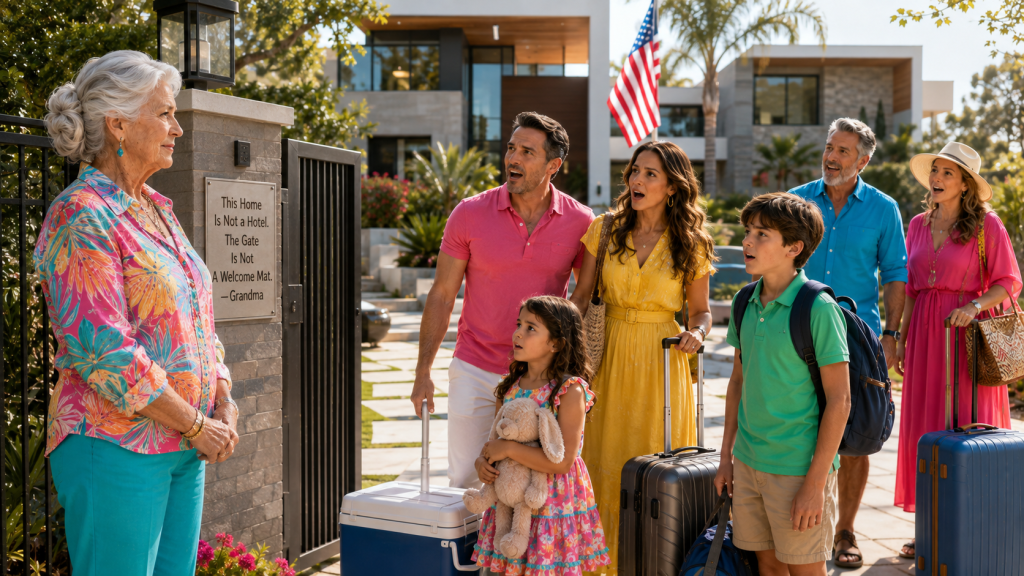
David’s black SUV pulled onto the gravel turnout outside the gate.
Behind him came Melissa’s Suburban.
Then Christopher’s pickup.
Then another SUV.
And another.
Twelve people.
Suitcases strapped to roof racks.
Coolers.
Folding chairs.
Two briskets.
Three dogs.
I sat at my kitchen table watching through the security camera.
For nearly two full minutes, nobody seemed concerned.
David got out.
He walked to the terracotta planter.
Lifted it.
Looked underneath.
Nothing.
He checked again.
Then he looked toward the keypad.
I watched him enter the old code.
The gate remained closed.
He tried again.
Nothing.
Christopher climbed out of his truck.
Melissa followed.
Soon all of them were standing around the gate.
I could not hear them at first.
Then David pressed the call button.
My kitchen intercom rang.
I answered.
“Hello?”
“Mom.”
“Yes?”
“The gate’s broken.”
“No, it isn’t.”
Pause.
“We’re outside.”
“I know.”
“Can you open it?”
“Who invited you?”
The silence on the speaker was extraordinary.
Finally David said, “What?”
“Who invited you?”
“Mom, it’s us.”
“I can see that.”
He laughed once.
Not because anything was funny.
It was the little laugh people use when reality refuses to cooperate.
“We’re here for the weekend.”
“It’s Monday.”
“We took the week off.”
“I see.”
“Melissa organized it.”
Melissa’s voice appeared in the background.
“We all organized it.”
That interested me.
Because apparently the group for working adults had been busy.
David returned to the speaker.
“We figured it would be good for everyone to get together.”
“At my house?”
“It’s the family ranch.”
There it was.
The family ranch.
I stood at my kitchen window and looked across the hills Thomas and I had paid for.
The cedar we cleared.
The fences we repaired.
The mortgage we carried.
The taxes I still paid every January.
“Yes,” I said. “That is what you have been calling it.”
“Mom, come on.”
“There is a notebook beside the gate.”
“I saw it.”
“Read the first page.”
He did not answer.
After perhaps thirty seconds, Melissa picked it up.
Christopher leaned over her shoulder.
Then someone opened the document box.
David found the photocopy.
He stared at it.
Even through the camera, I saw his posture change.
“That’s Dad’s notebook,” he said.
“Yes.”
“You copied his financial records?”
“One page.”
“Why?”
“Because you told me I didn’t understand the conversations of working adults. I thought it might be useful to remind everyone what kind of work funded many of those adults.”
“That’s low.”
“No, David. Low would be posting every page online. I gave you one private page at a locked gate.”
His voice sharpened.
“You’re humiliating me in front of everyone.”
“I didn’t invite everyone.”
That ended the conversation for several seconds.
Then my granddaughter Emily stepped toward the intercom.
She was twenty-six, a physical therapist in Austin.
“Grandma?”
“Yes, sweetheart.”
“Can I ask something?”
“Of course.”
“Are you angry because of the group chat?”
“I was hurt because of the group chat.”
“So this is punishment?”
“No.”
“Then what is it?”
“A locked gate.”
Nobody spoke.
I continued.
“For years, I kept that gate open because I believed everyone understood the difference between welcome and ownership. Apparently, I was mistaken.”
David interrupted.
“Nobody thinks they own this place.”
“Then why are twelve people standing outside my home with luggage without asking whether I was available?”
That was the first moment I saw embarrassment move through the group.
People looked at one another.
One of the younger grandchildren stared at his shoes.
Melissa folded her arms.
David rubbed his forehead.
Christopher walked away from the speaker.
Emily remained there.
“Grandma, did nobody call you?”
“No.”
She turned around.
I watched her ask the others something.
Several mouths moved.
Then she came back.
“I thought Uncle David had.”
That sentence changed the entire mood.
David said quickly, “I assumed Melissa did.”
Melissa snapped, “You said you handled Mom.”
Handled Mom.
Interesting phrase.
I heard it clearly through the speaker.
So did everyone else.
I waited.
Melissa apparently realized what she had said.
“Mom, that isn’t what I meant.”
“It sounded fairly specific.”
She moved closer.
“We wanted to surprise you.”
“No, you wanted to use the ranch.”
“That’s not fair.”
“Did anyone bring food I asked for?”
Silence.
“Did anyone ask whether I had plans?”
Silence.
“Did anyone ask whether the guesthouse was available?”
Nothing.
“Did anyone ask whether I wanted twelve overnight guests?”
Nothing again.
Finally Christopher said from somewhere behind them, “We always come.”
“Yes,” I replied. “And I always allowed it. Those are not the same sentence.”
David’s temper arrived then.
He had always been impatient when embarrassed.
“Fine. You made your point. Open the gate.”
“No.”
“Mom.”
“No.”
“We drove hours.”
“That was your decision.”
“We have perishables.”
“There is a grocery store in town.”
“We have the dogs.”
“Several hotels accept pets.”
“We took time off work.”
That nearly made me laugh.
Instead I said, “I understand work schedules better than you might think.”
His face changed.
He knew exactly what I meant.
“Are you seriously turning your own children away?”
“I am turning away uninvited guests.”
“We’re not guests. We’re family.”
“Family is a relationship, David. It is not a property right.”
He stepped away from the intercom.
For several minutes they argued among themselves.
I made tea.
Chamomile again.
I carried it onto the back porch.
The absurdity of the situation struck me.
Twelve adults stood outside a gate discussing why a seventy-one-year-old widow would not surrender access to her own home.
Three years earlier, I would have opened it immediately.
I would have apologized.
I would have said I was tired.
I would have blamed myself.
I would have hurried to make beds.
Grief changes people.
But sometimes being dismissed changes them more.
My phone began ringing.
David.
Melissa.
Emily.
Christopher.
I answered only Emily.
“Grandma, can I come in alone?”
“Yes.”
I buzzed the pedestrian gate.
She walked nearly half a mile up the drive.
When she reached the house, she was sweating and carrying her overnight bag.
I hugged her.
She hugged me back.
“Am I allowed to stay?”
“You asked.”
A smile appeared.
“So yes.”
“Yes.”
We sat at the kitchen table.
She noticed Thomas’s notebook beside me.
“Can I see it?”
I hesitated.
Then I pushed it across the table.
Emily opened the first page.
She turned slowly through decades of entries.
I watched her expression change.
“I didn’t know any of this.”
“You weren’t supposed to.”
“Dad borrowed thirty-two thousand dollars?”
“Yes.”
“And Grandpa forgave it?”
“Yes.”
“Mom and Dad said Grandpa invested in the company.”
“No. Your father’s company never issued us shares.”
She turned more pages.
“You paid for my school?”
“Your parents paid some. We helped.”
“How much?”
“It doesn’t matter.”
“It matters if I’ve spent ten years hearing that Dad built everything alone.”
That hurt more than I expected.
I looked toward the window.
“Your father did work hard.”
“I know.”
“He has done well.”
“I know that too.”
“Then don’t use this notebook to think less of him.”
Emily stared at me.
“Why are you defending him?”
“Because the truth doesn’t need exaggeration.”
That was something Thomas would have said.
I heard his voice in mine.
Emily closed the notebook.
“Grandma, can I tell you something?”
“Yes.”
“The group chat wasn’t really about work.”
I already suspected that.
“What was it about?”
“Everything.”
She looked ashamed.
“Mostly normal stuff. Trips. Jokes. Politics. Restaurants. Work complaints. Family plans.”
“Plans like this visit?”
She nodded.
“For how long?”
“A couple of weeks.”
I felt my stomach tighten.
“Two weeks?”
“No. I mean they started planning this visit a couple of weeks ago.”
I stared at her.
“Before I was removed?”
Emily nodded again.
That mattered.
“Why remove me?”
She picked at the edge of a napkin.
“Because they were talking about the ranch.”
“What about it?”
Her eyes met mine.
“Dad thinks you should start transferring things.”
The kitchen suddenly felt very quiet.
“Transferring what?”
“The ranch. Investments. Some accounts. He said estate taxes and planning get complicated and that it would be smarter to start while you’re healthy.”
I almost admired the audacity.
“Was that discussed in the group?”
“Yes.”
“With everyone?”
“Mostly Dad and Aunt Melissa. Christopher had opinions too.”
“And nobody thought I should be part of discussions about my estate?”
Emily swallowed.
“Dad said you get emotional when money comes up.”
I looked down at Thomas’s notebook.
Forty years of careful records.
Budgets.
Mortgages.
Land sales.
Retirement accounts.
Insurance policies.
Investments.
College plans.
Trusts.
Apparently I was emotional about money.
“What exactly was supposed to happen during this visit?”
Emily hesitated.
“I don’t know everything.”
“Tell me what you know.”
“Dad invited someone.”
“Who?”
“A financial adviser.”
I actually laughed.
It came out louder than I intended.
Emily flinched.
“My son brought a financial adviser to my ranch without telling me?”
“He was coming Wednesday.”
“Was Samuel invited?”
“Who?”
“My attorney.”
“No.”
“Of course not.”
Emily reached across the table.
“Grandma, I’m sorry.”
“You didn’t do this.”
“I stayed in the group.”
“You’re allowed to talk to your family.”
“I knew you’d been removed.”
“That was their choice.”
“I didn’t say anything.”
“That was yours.”
Her eyes filled.
I did not rescue her from the discomfort.
Love does not require removing every consequence.
After a moment, she nodded.
“You’re right.”
Outside, car engines started.
I checked the camera.
Two vehicles were leaving.
Christopher first.
Then one of the cousins.
David and Melissa remained.
Emily looked at the screen.
“Where will they go?”
“They’re adults.”
That sentence tasted strange.
Then good.
Around seven, I received a text from David.
We’re at the Fredericksburg Inn. I hope you’re happy.
I did not respond.
Another came ten minutes later.
Dad would be ashamed of this.
That one I answered.
Your father wrote the sentence you read today.
No reply followed.
Emily stayed the night.
We cooked eggs and sliced tomatoes for dinner.
We watched an old movie Thomas loved.
Around ten, she went to bed in the guest room.
I sat alone on the porch beneath a sky crowded with stars.
For the first time since Thomas died, the ranch felt entirely mine.
Not lonely.
Mine.
There was a difference.
Tuesday morning, David returned.
Alone.
He called from the gate.
“Can I come in?”
I opened it.
That mattered.
He had asked.
He drove up slowly and parked beside the barn.
When he entered the kitchen, he looked tired.
He did not hug me.
I did not offer.
Thomas’s notebook remained on the table.
David stared at it.
“You showed Emily.”
“She asked.”
“That was between Dad and me.”
“It was also between your father and me.”
He sat.
For several seconds neither of us spoke.
Then he said, “You made me look like a freeloader.”
“No. The numbers made you look like someone whose parents helped him.”
“You know how Dad was. He never wanted that money back.”
“I know.”
“So why keep records?”
“Because grown adults keep records.”
He winced.
Good.
He deserved that one.
David leaned back.
“This is all because of one group chat.”
“No.”
“Then what?”
“Pattern recognition.”
“What does that mean?”
“It means the group chat was one tile in a much larger floor.”
He stared at me.
I continued.
“You removed me because you decided I was too old and irrelevant to understand your conversations. At the same time, you were discussing my property, my accounts, and my estate without me.”
“We were planning.”
“For me.”
“With you.”
“No, David. You planned first. You intended to present it to me here, surrounded by twelve family members and a financial adviser you selected.”
His mouth tightened.
“When you say it like that—”
“There is no other way to say it.”
“We’re worried about you.”
“About my health?”
“Yes.”
“My doctor says I’m healthy.”
“Things can change.”
“They can.”
“You’re alone out here.”
“I employ four people on this property. Luis lives less than a mile away. Eleanor calls me every morning. Emily lives ninety minutes away. I am alone by choice, not abandoned in the wilderness.”
“You shouldn’t be managing all this.”
“Why?”
“Because it’s a lot.”
“For whom?”
“For anyone your age.”
There it was again.
Not concern.
Classification.
I looked at my son and saw something I had resisted seeing.
David did love me.
I believe that.
But he had started loving a version of me that required management.
A widow.
A mother.
An elderly woman.
A future estate.
He had stopped seeing Margaret.
“Do you know what I did last month?” I asked.
“What?”
“I renegotiated the grazing lease on eighty acres.”
He said nothing.
“I moved part of my investment portfolio into municipal bonds after reviewing the tax consequences with Samuel and my CPA.”
Silence.
“I rejected an offer from a developer who wanted the southern ridge.”
His eyebrows rose.
“What developer?”
“Exactly.”
“What offer?”
“Exactly.”
“How much?”
I smiled.
“Working-adult information.”
His face reddened.
“That’s childish.”
“No. Childish was excluding someone because you assumed age made her incompetent.”
“I never said incompetent.”
“You didn’t need to.”
He looked away.
I softened my voice.
“David, I would rather have had you say, ‘Mom, we want a separate chat for some topics.’ That might have hurt, but it would have been honest.”
“It wasn’t meant to hurt you.”
“Intent does not erase impact.”
“I’m sorry.”
The words came quickly.
Too quickly.
I waited.
He knew.
Finally he tried again.
“I’m sorry I removed you from the chat. And I’m sorry I said you didn’t understand.”
“Thank you.”
“Can we move on?”
“No.”
He stared at me.
“Why not?”
“Because apology is not a password.”
That one surprised even me.
Thomas would have loved it.
David almost smiled despite himself.
Then his face became serious.
“What happens now?”
“Now you understand that the ranch is not family property.”
“I know legally it’s yours.”
“No. You know that sentence. I need you to understand it.”
“What’s the difference?”
“The difference is whether you behave accordingly when nobody is quoting a deed.”
He rubbed his hands together.
“So nobody can visit?”
“People can visit when invited.”
“Grandkids can’t use the creek?”
“When invited.”
“Family holidays?”
“When invited.”
“And after you’re gone?”
There it was.
The question beneath everything.
I did not get angry.
I told the truth.
“I am reviewing my estate plan.”
His face went pale.
“Because of this?”
“Because of what this revealed.”
“Are you cutting us out?”
“I have not decided.”
“Mom.”
“This conversation is exactly why I am reviewing it.”
He stood.
“Dad wanted the ranch kept in the family.”
“Your father wanted the family to respect the ranch.”
“He told me—”
“I was married to him for forty-seven years. Do not use your father as a witness against me.”
David stopped.
I had never spoken to him that sharply.
Neither had Thomas.
Not often, anyway.
I stood too.
“Your father also wanted me protected.”
“I’m not trying to hurt you.”
“I know.”
That confused him.
“Then why are you acting like I’m some enemy?”
“I’m not. Enemies are simple. Family requires boundaries precisely because love makes us vulnerable.”
He stared at the floor.
Then he asked quietly, “What do you want from me?”
For the first time, I believed he was really asking.
“Respect before inheritance.”
He looked at me.
“Permission before access.”
He nodded.
“Questions before decisions.”
Another nod.
“And I want you to stop treating age like a disease.”
He swallowed.
“I can do that.”
“We’ll see.”
He left around noon.
This time, when he reached the gate, he closed it behind him.
That evening Melissa called.
She did not apologize.
She began with strategy.
“I think everyone’s emotions got out of hand.”
“Mine are fine.”
“Mom, David said you’re changing the trust.”
“I’m reviewing it.”
“That seems extreme.”
“Why?”
“Because family property should stay in the family.”
“Who told you it was family property?”
“Dad always said—”
“Your father is becoming unusually talkative now that he’s dead.”
Melissa went silent.
I almost felt guilty.
Almost.
She tried another approach.
“What if something happens to you?”
“Something will eventually.”
“That’s not funny.”
“It wasn’t a joke.”
“Who will manage everything?”
“I have a succession plan.”
“With David?”
“No.”
Silence again.
“With me?”
“No.”
“Then who?”
“My trustee.”
“Who is that?”
“Samuel.”
“You made your attorney trustee?”
“Years ago.”
She sounded genuinely shocked.
That told me how little they knew about arrangements they were apparently ready to reorganize.
“Mom, don’t make permanent decisions because we hurt your feelings.”
“I won’t.”
“Promise?”
“I promise.”
She relaxed audibly.
Then I added, “I will make permanent decisions based on behavior.”
She hung up soon afterward.
Wednesday came.
The financial adviser never arrived at my ranch.
Instead, I met Samuel.
This time, I made decisions.
I kept David and Melissa as beneficiaries.
But I changed the structure.
Neither child would automatically receive the ranch outright.
After my death, the property would remain in trust for ten years.
A professional trustee would manage taxes, maintenance, leases, and conservation requirements.
Family members could use designated portions by reservation.
No one could borrow against the ranch.
No one could force a sale during those ten years.
At the end of the period, David and Melissa could jointly choose to continue the trust.
If they disagreed, the property would be offered for conservation purchase before any commercial sale.
I also designated twenty acres near the creek for a small educational foundation in Thomas’s name.
Local agricultural students could attend workshops there.
Young farmers could receive small grants.
Widowed ranch owners could receive free legal and financial-planning seminars twice a year.
Samuel read that provision twice.
“I like this.”
“Thomas would too.”
“What about the children’s cash inheritance?”
“I’m leaving it largely unchanged.”
He smiled.
“So this isn’t revenge.”
“No.”
“It rarely is, once people sit in my office long enough.”
I looked at Thomas’s notebook.
“I’m adding something.”
“What?”
“A letter.”
I wrote it myself.
Not to punish them.
To explain.
My dear family,
If you are reading this, I am gone, and somebody is probably arguing about whether I would have wanted things done differently.
So let me save you time.
I loved you.
I loved you when I paid tuition.
I loved you when I watched children.
I loved you when I gave money.
I loved you when I opened my home.
But none of those gifts were contracts obligating me to keep giving forever.
A family home should be a place where everyone is welcome, but welcome must never become entitlement.
Thomas and I built what we had through work, luck, sacrifice, mistakes, and help from others.
We were never self-made.
Neither are you.
Remember that.
If this ranch survives us, let it teach something better than ownership.
Let it teach stewardship.
Let children run here.
Let tired people rest here.
Let arguments happen and forgiveness follow.
But knock before entering.
Ask before assuming.
Listen before deciding someone is too old, too young, too poor, too educated, too simple, or too different to matter.
The day people stop giving one another dignity is the day a family becomes only a list of relatives.
Do better.
Love,
Mom
I cried after writing it.
Not because I was sad.
Because I could almost hear Thomas saying, “Needs one more sentence.”
So I added one at the bottom.
And for heaven’s sake, close the gate. The cattle still don’t understand inheritance.
Samuel laughed until his glasses fogged.
The weeks afterward were strange.
The family chat remained without me.
I did not ask to return.
Then one afternoon my phone chimed.
A new conversation appeared.
Emily had created it.
She named it “Ask Grandma First.”
There were fourteen members.
Including me.
Including Thomas’s old number.
I stared at the screen.
Then David posted:
Mom, are you free Sunday for lunch at your place? We’ll bring food. Six people. No dogs. We will leave by five. May we come?
I read it twice.
Then I typed:
Yes.
Bring potato salad.
Melissa replied:
Homemade or store-bought?
I wrote:
You are a working adult. Use your judgment.
Emily sent seventeen laughing emojis.
Even I understood those.
Sunday arrived.
David called from the gate.
Not because he needed to.
I had given him a temporary code for that afternoon.
He called because he wanted to ask.
“We’re here.”
“I see you.”
“Can we come in?”
“Yes.”
The gate opened.
They brought brisket.
Potato salad.
Cornbread.
Peach cobbler.
They also brought trash bags, paper towels, and their own sheets.
I noticed.
I said nothing.
After lunch, David repaired a loose board near the tack room.
Melissa helped me clear weeds from the garden beds.
Emily sat on the porch with Thomas’s notebook.
Not reading the financial pages.
Reading his weather notes.
“Grandpa really wrote down every rainfall?”
“Every one.”
“He was weird.”
“Extremely.”
David overheard and smiled.
For a few hours, everything felt almost normal.
But it was a better normal.
Not automatic.
Intentional.
Before leaving, Melissa stood beside the terracotta planter.
“Is the spare key back under there?”
“No.”
“Never again?”
“Probably not.”
She nodded.
“Fair enough.”
Then she hugged me.
Not the quick departure hug she usually gave.
A real one.
“I’m sorry, Mom.”
I held her.
“I know.”
“No, I mean it. I was talking about your life like you weren’t in the room.”
“Yes.”
“I don’t know when I started doing that.”
“Probably gradually.”
She stepped back.
“Will you tell me if I do it again?”
“I certainly will.”
She laughed.
“I believe you.”
David was the last to leave.
He stood by his SUV, hands in his pockets.
“I told the adviser not to contact you.”
“Good.”
“He was embarrassed.”
“He’ll recover.”
David looked toward the hills.
“Can I ask you something?”
“Yes.”
“Are you still mad?”
“No.”
“Hurt?”
“Some.”
He nodded.
“I guess that lasts longer.”
“Sometimes.”
He looked toward the house.
“I always thought this would be mine someday.”
“I know.”
“I think that’s why I started acting like it already was.”
I appreciated that sentence more than any apology.
“Maybe.”
“I don’t like seeing it.”
“What?”
“That part of myself.”
“Seeing it means you can change it.”
He looked at me.
“Dad really wrote that line?”
“About generosity?”
“Yes.”
“He did.”
“Was it about me?”
I considered lying.
“No.”
He blinked.
“Really?”
“It was about me.”
“What?”
I smiled.
“Your father thought I gave too much.”
David laughed.
“That sounds right.”
“He worried that I believed saying no would make people leave.”
David’s smile disappeared.
“Did you?”
“For a long time.”
“And now?”
“Now I know anyone who leaves because I said no was only staying because I kept saying yes.”
He looked down.
“I wouldn’t leave.”
“I know.”
“How?”
“Because you came back and asked permission.”
His eyes filled slightly.
He looked away toward the road.
Men in our family had inherited Thomas’s talent for pretending dust caused emotion.
He hugged me.
Then he drove away.
Months passed.
The gate remained locked.
Strangely, the family visited more often.
Not less.
Perhaps boundaries made visits feel deliberate.
Perhaps people behave better when access is not guaranteed.
Or perhaps we all simply needed the shock.
Christmas came.
Twenty-one people gathered at the ranch.
Every one of them asked beforehand.
They brought sheets.
They brought groceries.
They cleaned the kitchen after dinner.
Christopher replaced the broken latch on the chicken enclosure without being asked.
Melissa organized breakfast.
David took trash to the road.
I barely knew what to do with myself.
On Christmas Eve, Emily brought out a wrapped box.
“For Grandma.”
Inside was a new leather notebook.
Embossed on the cover were four words.
GENEROSITY WITHOUT ENTITLEMENT.
I laughed so hard I cried.
“Open it,” David said.
On the first page, everyone had written something.
Melissa:
Thank you for teaching us that love needs manners.
Christopher:
I owe you more than money.
Emily:
You were never too old for the conversation. We were too immature to have it properly.
David’s entry was last.
Mom,
I thought adulthood meant earning money, having responsibilities, and making decisions.
I forgot that adulthood also means respecting another adult’s right to make her own.
I am sorry.
I love you.
Please never put me in charge of potato salad.
I closed the book.
Nobody spoke.
Then I looked around the room.
Children on the floor.
Adults crowded around the table.
Thomas’s photograph on the mantle.
The old notebook beside the new one.
For forty years, I had thought my greatest legacy would be land.
I was wrong.
Land can be sold.
Money can disappear.
Houses burn.
Markets fall.
Even notebooks eventually crumble.
The real inheritance was learning how to remain a family without consuming one another.
It was understanding that parents are not endless wells.
That grandparents are not free hotels.
That generosity is not weakness.
That retirement is not irrelevance.
That age does not erase intelligence.
And that love without respect eventually starts resembling ownership.
The following spring, the first Thomas Bennett Agricultural Grant was awarded to a twenty-three-year-old woman trying to save her late father’s goat farm.
She cried when I handed her the check.
I nearly cried too.
David attended.
So did Melissa.
Afterward, David walked with me toward the creek.
“You really did all this without us knowing.”
“Yes.”
He shook his head.
“I guess there were a lot of conversations we didn’t understand.”
I smiled.
“Apparently.”
At the gate, the old sign still hung.
PRIVATE PROPERTY.
ENTRY BY INVITATION ONLY.
PLEASE CALL OWNER.
The weather had faded the letters slightly.
David touched the edge.
“You ever going to take this down?”
“No.”
He laughed.
“I figured.”
Beside the gate, under a small covered shelf, I kept the new notebook.
Not Thomas’s financial ledger.
That stayed in my desk.
This new notebook had a different purpose.
Anyone who visited could write something inside.
A memory.
A thank-you.
A joke.
A recipe.
A thought.
Over time, the pages filled.
Grandchildren wrote about catching fireflies.
Melissa wrote her peach cobbler recipe.
Christopher drew a terrible picture of one of my cows.
Emily documented rainfall like her grandfather.
David wrote one sentence almost every time he came.
Thanks for opening the gate.
Sometimes I answered underneath.
Thanks for asking.
Two years after that first locked-gate afternoon, I stood on the porch watching another family gathering.
The ranch was loud.
Children ran toward the creek.
Someone burned the first batch of burgers.
A dog stole half a loaf of bread.
David and Christopher argued about charcoal.
Melissa shouted that nobody was touching her cobbler until dinner.
Perfect disorder.
The kind I used to think required me to make myself endlessly available.
Now I understood something better.
A gate does not destroy a home.
A boundary does not destroy love.
Sometimes the only way to know whether people value you or merely value access to you is to close the gate for a little while.
The people who love you will knock.
The people who respect you will wait.
And the people who belong in your life will eventually understand that being family does not mean having a permanent key.
That evening, as everyone prepared to leave, David walked down the driveway with me.
The Hill Country sunset stretched orange across the limestone ridges.
Cicadas hummed in the grass.
For a moment, I missed Thomas so fiercely that it felt like losing him all over again.
David must have noticed.
“You okay, Mom?”
“Yes.”
“You thinking about Dad?”
“Yes.”
He looked toward the iron gate.
“He would’ve enjoyed all this, wouldn’t he?”
“The arguing?”
“The lesson.”
I smiled.
“He would have charged admission.”
David laughed.
We reached the gate.
Everyone’s cars passed through.
One by one.
Emily waved.
Melissa blew me a kiss.
Christopher shouted something about coming back next month.
Then David remained beside me.
He waited until the last vehicle disappeared around the bend.
“Need help closing it?”
“No.”
“You sure?”
“I’ve got it.”
He nodded.
“Goodnight, Mom.”
“Goodnight, sweetheart.”
He hugged me and walked to his truck.
Before climbing in, he turned.
“Thanks for having us.”
I looked at the iron gate.
At the sign.
At the road beyond it.
At the ranch Thomas and I had built after decades of working, saving, failing, recovering, and beginning again.
Then I looked at my son.
“Thanks for asking.”
David smiled.
His truck rolled through.
I pressed the button.
The iron gate began closing slowly.
Not angrily.
Not dramatically.
Simply because nighttime had come and it was my gate to close.
The latch clicked.
I stood there for another moment with the evening wind moving through the live oaks.
Then I walked back toward the house.
My house.
My life.
My remaining years.
And for once, I did not feel guilty about any of those words.
I had spent decades believing a good mother kept the door open no matter how people entered.
I know better now.
A good mother can love her grown children and still require respect.
A widow can cherish her husband’s legacy without surrendering control of it.
A grandmother can be generous without becoming invisible.
And an older woman does not need permission from her children to remain the author of her own life.
Sometimes dignity returns quietly.
Sometimes it arrives through a difficult conversation.
Sometimes through an attorney’s office.
Sometimes through a handwritten ledger.
And sometimes it begins with something as simple as moving a spare key from beneath a terracotta planter, locking an iron gate, and finally allowing the people you love to learn how to knock.
💬THE END! THANK YOU FOR READING!