

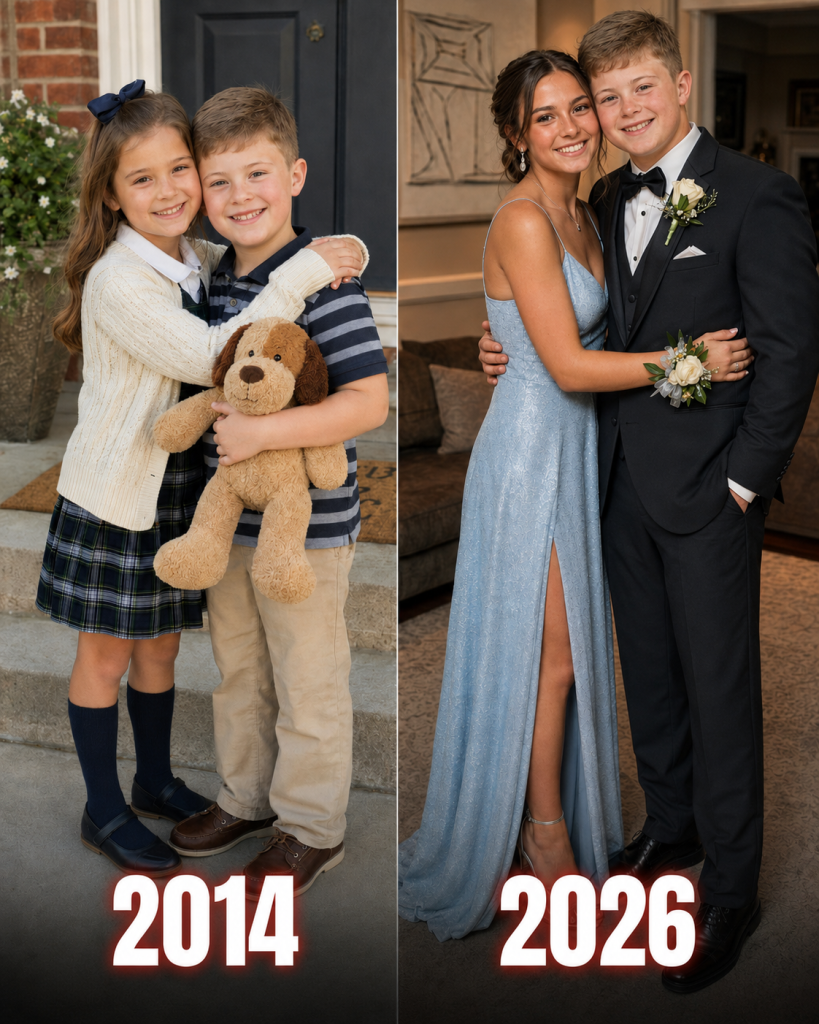
At six years old, I promised my best friend we would go to prom together. Twelve years later, on the night we were finally supposed to keep that promise, my mother locked my bedroom door and told me I could only go with him under one condition.
Then she revealed a secret that changed the way I saw our entire friendship. My name is Christina Bennett, and if you had asked me when I was six years old who my favorite person in the world was, I would have answered without hesitation.
Noah Carter.
Not my mother.
Not my father.
Not even my grandmother, who made cinnamon rolls every Sunday morning.
Noah.
We became best friends in first grade for two very important reasons.
We both hated raisins, and we both loved dinosaurs.
That was enough.
The first time we sat beside each other at lunch, I watched Noah carefully remove every raisin from his oatmeal cookie and arrange them in a neat little pile on his napkin.
I pointed at them.
“You don’t like raisins either?”
He looked at me as though I had just revealed the secret password to an exclusive club.
“They look like dead grapes.”
I laughed so hard milk came out of my nose.
From that moment on, we were inseparable.
Noah had Down syndrome.
I knew that because adults sometimes mentioned it.
His mother had explained it to our teacher, and once, when I asked why Noah went to a different classroom for part of the day, my mother told me that his brain learned some things differently.
That explanation satisfied me completely.
Children have a wonderful ability to accept facts without turning them into judgments.
Noah learned differently.
So what?
I couldn’t tie my shoes properly until second grade, and nobody held a family meeting about that.
To me, Noah was simply Noah.
He was the boy who could remember baseball statistics from seasons that happened before we were born.
He was the boy who insisted a Tyrannosaurus rex would defeat any other dinosaur in battle, even though I strongly supported the Triceratops.
He was the boy who carried three pencils because he was convinced at least one would break.
And he was brutally honest about my artwork.
One afternoon in first grade, I drew what I believed was a magnificent picture of a princess standing beside a castle.
Noah stared at it for several seconds.
I waited proudly for praise.
Finally, he pointed at the princess.
“It looks like a potato with arms.”
I gasped.
“It does not!”
“It does.”
“She’s wearing a dress!”
“Potatoes can wear dresses.”
I was furious.
Noah laughed until he nearly fell out of his chair.
By recess, I was laughing too.
That was our friendship.
We fought.
We teased.
We forgave.
And we always found our way back to each other before the day ended.
The promise happened a few months later.
Our first-grade teacher, Mrs. Patterson, announced one Friday afternoon that she was getting married.
The classroom exploded with questions.
“Are you wearing a princess dress?”
“Will there be cake?”
“Do you get presents?”
“Can we come?”
Mrs. Patterson laughed and tried to answer everyone at once.
Soon the entire class was talking about weddings.
Someone said weddings had dancing.
Someone else said grown-ups cried.
Noah raised his hand as if he were delivering an official statement.
“My wedding will have chocolate cake.”
Mrs. Patterson smiled.
“That sounds delicious.”
“And no slow boring songs.”
The class laughed.
Noah looked pleased with himself.
Then a boy named Tyler, sitting across from us, said something that made the room feel suddenly different.
“Who would marry you?”
Noah’s smile disappeared.
Tyler shrugged.
“Nobody.”
I didn’t fully understand why the words were cruel.
I only knew they were.
I saw Noah’s shoulders drop.
Something angry rose inside me.
“That’s stupid,” I snapped. “Someone will love Noah.”
Tyler rolled his eyes.
Noah turned toward me.
“Would you?”
I froze.
At six years old, I had very little understanding of marriage.
As far as I knew, marriage meant wearing fancy clothes, eating cake, and arguing about who forgot to buy milk.
So I shrugged.
“Maybe.”
Noah waited.
“But first we have to go to prom.”
His forehead wrinkled.
“What’s prom?”
“It’s a big dance when we’re almost grown up.”
“Does it have chocolate cake?”
“I don’t think so.”
He considered this seriously.
Then he held out his pinkie.
“Promise?”
I hooked mine around his.
“Promise.”
The conversation lasted less than a minute.
I forgot about it before summer vacation.
Noah never did.
Over the next twelve years, our friendship survived almost everything childhood could throw at us.
Different classrooms.
Different teachers.
Awkward school pictures.
Puberty.
Family problems.
My terrible haircut in seventh grade.
Noah’s brief obsession with professional wrestling.
My obsession with drawing.
His obsession with baseball.
And eventually, heartbreak.
But before all of that came the year my family nearly fell apart.
I was eight when my parents’ marriage collapsed.
At first, I didn’t understand what was happening.
My father started coming home later.
My mother stopped singing while she cooked dinner.
They whispered after I went to bed.
Then the whispers became arguments.
And the arguments became shouting.
One night, I woke up to the sound of a glass breaking downstairs.
I crawled out of bed and sat halfway down the staircase.
My father was yelling.
My mother was crying.
I didn’t understand the words.
Money.
Someone else.
Lies.
Leaving.
Then Dad walked past me carrying a suitcase.
He stopped when he saw me sitting there.
His expression changed.
“Christina.”
“Where are you going?”
He crouched down.
For a second, I thought he would hug me.
Instead, he kissed my forehead.
“I’ll see you soon.”
He didn’t.
Not really.
He visited sometimes.
Then less often.
Then barely at all.
My mother changed after he left.
She tried to pretend she hadn’t.
Every morning she packed my lunch.
Every night she asked about school.
But something inside her had gone quiet.
She moved through the house like someone underwater.
I learned years later that she had been severely depressed.
At eight, I only knew that my mother cried when she thought I couldn’t hear her.
There were days when she forgot to eat.
Days when she stared at the television without knowing what was playing.
Days when I came home from school and found her still wearing the clothes she had slept in.
I was frightened, but I didn’t know how to say it.
So I stopped talking about my fear.
Children are good at that.
We notice everything.
We understand almost nothing.
And we often blame ourselves for the gaps.
Noah noticed something was wrong before almost anyone else did.
He never asked big questions.
He simply started sitting beside me more often.
At lunch.
On the school bus.
During recess.
If I was quiet, he didn’t demand that I explain myself.
He would talk about baseball until my eyes glazed over.
Sometimes that was exactly what I needed.
One afternoon, when we were eight, something happened that I completely forgot until the night of senior prom.
My mother remembered every detail.
That day, I came home from school and found Mom asleep on the couch.
I tried to wake her.
She opened her eyes briefly.
“Sweetheart, give me ten minutes.”
I waited.
Ten minutes became thirty.
Then an hour.
The house felt too quiet.
I remember standing in the kitchen and feeling something I couldn’t name.
Abandoned.
Scared.
Angry.
I put on my sneakers and walked out the front door.
No coat.
No note.
Nothing.
I walked down our street.
Then another.
Then another.
I don’t remember where I thought I was going.
Maybe to find my father.
Maybe nowhere.
Eventually, I sat beside the road near a small playground three blocks away and cried.
That was where Noah found me.
His mother, Mrs. Carter, had picked him up after school and was driving home when Noah spotted me through the car window.
“Christina!”
Mrs. Carter stopped the car.
Noah jumped out before she could fully park.
He ran toward me.
“What are you doing here?”
I wiped my face.
“Nothing.”
“You’re crying.”
“No, I’m not.”
“You are.”
I started crying harder.
Noah sat down beside me.
He didn’t ask why.
He didn’t tell me to stop.
He simply sat there.
After a while, he said, “Want to hear something?”
I shook my head.
“The Yankees lost.”
Despite myself, I laughed.
He smiled.
“Knew that would work.”
Mrs. Carter drove both of us back to my house.
When we arrived, my mother was standing outside barefoot.
She looked terrified.
She ran toward me and pulled me into her arms.
“Where were you?”
I cried against her.
Noah stood beside his mother watching us.
That moment, my mother later told me, was when she realized how far she had fallen.
She had been asleep for nearly two hours and hadn’t known her eight-year-old daughter had left the house.
After I went inside, Noah remained on the porch with her.
I never knew about the conversation that followed.
Not until senior prom.
According to Mom, Noah looked at her with the serious expression he used whenever he believed something was important.
“Christina is sad.”
Mom wiped her face.
“I know.”
“You should make her happy.”
“I’m trying.”
Noah thought about that.
Then he said, “I can help.”
My mother apparently managed a weak smile.
“That’s very kind.”
“I’ll take care of Christina until she feels happy again.”
He was eight.
My mother tried to tell him that he didn’t have to take care of me.
Noah shook his head.
“I promised.”
Mom didn’t understand what he meant.
Neither did I.
Because Noah had connected that moment to our first-grade promise.
In his mind, going to prom with me someday meant staying my friend until then.
That was how literally he understood loyalty.
Not as something sentimental.
As a responsibility.
That same week, my mother called a doctor.
Then a therapist.
Then my grandmother.
She began climbing slowly out of the darkness she had been living in.
But Noah continued keeping his promise.
He didn’t announce it.
He simply stayed.
When Dad missed my ninth birthday, Noah gave me half of his cupcake because he knew I had barely touched mine.
When I was ten and cried during a school father-daughter event, Noah sat outside the gym with me and made shadow animals on the wall.
When I was eleven and changed schools, he called me every Saturday morning.
When we attended the same middle school again, he found me on the first day and said, “See? You didn’t get rid of me.”
I laughed.
“I wasn’t trying.”
“Good.”
Middle school was harder for Noah than elementary school.
Children became more aware of differences.
And sometimes more cruel.
Some classmates treated him like a baby.
Others talked about him while he was standing directly beside them.
A few mocked the way he spoke.
Noah usually pretended not to care.
But I could tell when something hurt him.
His ears turned red.
He looked at the floor.
He became very quiet.
Once, in seventh grade, three boys in the cafeteria began imitating his voice.
I stood up so quickly my chair fell backward.
“What is wrong with you?”
One boy laughed.
“Relax, Christina.”
“No.”
Noah grabbed my sleeve.
“Sit down.”
“I’m not sitting down.”
He tugged harder.
“You’re embarrassing me.”
That stopped me.
I sat.
Later, outside school, I apologized.
“I was trying to help.”
“I know.”
“They were being jerks.”
“I know.”
“Then why did you stop me?”
He kicked a pebble across the sidewalk.
“Because I can fight my own fights.”
I looked at him.
He glanced at me.
“Sometimes.”
That day taught me something important.
Being Noah’s friend did not mean protecting him from everything.
It meant respecting him enough to let him decide when he needed help.
High school brought new challenges.
Our schedules changed.
I joined the art club.
Noah became manager for the baseball team.
For the first time in our lives, we spent entire school days without seeing each other.
But somehow, every afternoon, one of us found the other.
I would sit in the bleachers while he helped organize baseball equipment.
He would sit in the art room criticizing my paintings.
“You use too much blue.”
“It’s the sky.”
“Still too much.”
“You know nothing about painting.”
“I know that’s too much blue.”
Nothing changed.
Except everything changed.
We grew older.
Our classmates started dating.
Then I started dating.
His name was Eric.
He was funny, confident, and at sixteen, I thought being noticed by a popular boy meant something important.
Noah disliked him immediately.
“You don’t like anybody I date,” I complained.
“I’ve only met one.”
“Exactly.”
“He’s annoying.”
“He’s nice.”
“He talks too much.”
“So do you.”
“That’s different.”
Eric and I dated for nine months.
Then one Thursday night, he called and told me he wanted to “see other people.”
I learned two days later that “other people” meant a girl from his chemistry class.
I was devastated.
I locked myself in my room and cried until my eyes hurt.
Around eight that evening, someone rang the doorbell.
Mom opened it.
Noah stood outside carrying two containers of ice cream.
He came upstairs without asking.
He sat on the floor beside my bed.
I looked terrible.
Mascara streaked across my face.
Hair everywhere.
He handed me a container.
Chocolate.
My favorite.
“I told you that guy was an idiot.”
I laughed through my tears.
“You’re terrible at comforting people.”
“I brought ice cream.”
“That doesn’t make you good at this.”
He opened his own container.
“It helps.”
I sat beside him.
He didn’t give me advice.
He didn’t tell me I deserved better.
He didn’t say I would meet someone else.
He simply stayed.
We watched stupid television.
We ate too much ice cream.
And eventually, the pain stopped feeling like the end of the world.
That was Noah’s gift.
He never had the perfect speech.
He never tried to solve my problems.
He simply remained beside me until whatever hurt became survivable.
Senior year arrived faster than either of us expected.
Suddenly everyone was talking about college.
Jobs.
Graduation.
The future.
And prom.
One afternoon in February, Noah found me at my locker.
He stood there holding something behind his back.
“What?”
“Nothing.”
“You’re smiling weird.”
“I smile normal.”
“No, you don’t.”
He pulled a small plastic dinosaur from behind his back.
A Triceratops.
Around its neck he had tied a piece of paper.
I unfolded it.
PROM?
I stared at him.
He looked nervous.
“Remember first grade?”
I did.
Barely.
Then suddenly the memory returned.
Mrs. Patterson.
Wedding talk.
Chocolate cake.
The pinkie promise.
I laughed.
“Oh my God.”
“You promised.”
“You remembered that?”
“Yes.”
“Twelve years?”
“Yes.”
I looked at the dinosaur.
Then at him.
“Of course I’ll go with you.”
His entire face lit up.
“Really?”
“Really.”
He raised one finger.
“No slow boring songs.”
“Prom will definitely have slow songs.”
“Then I will complain.”
“Deal.”
News traveled through school quickly.
Most people thought it was sweet.
A few assumed I was going with Noah because I felt sorry for him.
That irritated me more than I expected.
One girl from my English class said, “That’s so nice of you.”
I frowned.
“What is?”
“Taking Noah.”
“I’m not taking Noah.”
She looked confused.
“We’re going together.”
“Oh.”
The difference mattered to me.
Noah was not a charity project.
He wasn’t someone I was escorting so people could praise me.
He was my best friend.
There was genuinely nobody else I wanted beside me.
Mom seemed supportive when I told her.
At least, I thought she was.
“That sounds lovely,” she said.
Then she quickly changed the subject.
I noticed something strange in her expression but ignored it.
Over the following weeks, Noah became obsessed with preparation.
He bought his suit nearly two months early.
He practiced tying his bow tie.
He asked the baseball coach which cologne smelled “grown up.”
He even practiced dancing with his mother in their living room.
Mrs. Carter sent me a video.
Noah was counting steps out loud.
“One, two, three, don’t step on toes.”
I laughed until I cried.
I bought a dark green dress.
When Noah saw a picture, he said, “Good.”
“Good?”
“Yes.”
“That’s all?”
“You want a speech?”
“Yes.”
He stared dramatically.
“You look less like a potato than your first-grade drawings.”
I threw a pillow at him.
Prom night arrived in May.
The afternoon was warm and bright.
Our house smelled like hairspray, perfume, and the chicken Mom had cooked because she insisted I needed to eat before leaving.
My aunt Rebecca came over to take pictures.
Grandma called twice.
I spent almost two hours getting ready.
At seven o’clock, the doorbell rang.
My stomach fluttered.
Not romantically.
Emotionally.
Because suddenly I remembered our six-year-old selves sitting in that classroom.
A promise neither of us had truly understood was about to be kept.
I peeked through the upstairs window.
Noah stood on the porch wearing a dark navy suit and a green bow tie that matched my dress.
He held a small box containing my corsage.
And he was smiling like he had just won the World Series.
Mom opened the door.
I could hear Noah greet her.
“Hi, Mrs. Bennett.”
Then silence.
Too much silence.
I looked down from the window.
Mom was staring at him.
Her expression had changed completely.
For a few seconds, she seemed unable to speak.
Then she forced a smile.
“Noah.”
“Do I look okay?”
Mom swallowed.
“You look wonderful.”
“Christina ready?”
“Almost.”
Mom closed the door and hurried upstairs.
I was standing in front of the mirror attaching my earrings when she entered.
Her face was pale.
“What’s wrong?”
“Nothing.”
“Mom.”
She shut the bedroom door.
Then she locked it.
I turned around.
“Why did you lock the door?”
She stood with her back against it.
“You can still go to prom with Noah tonight.”
I laughed nervously.
“Okay…”
“But only under one condition.”
For a second, I thought she was about to give me the traditional parent speech.
“No drinking?”
“No.”
“Home by midnight?”
“No.”
“Then what?”
Her hands were trembling.
That frightened me.
“Mom?”
She walked toward my bed and sat down.
“You need to hear something first.”
“Hear what?”
“The truth.”
My stomach tightened.
“What truth?”
She looked toward the floor.
“Something about Noah.”
I immediately became defensive.
“What about him?”
“And something about me.”
My heartbeat quickened.
“Mom, what happened?”
Her eyes filled with tears.
“There’s something I should have told you years ago.”
Downstairs, I could faintly hear Noah talking with Aunt Rebecca.
He was laughing.
Completely unaware that upstairs my entire understanding of our childhood was about to shift.
Mom reached for my hands.
“After your father left,” she began, “I got very sick.”
“I know.”
“No. You know I was sad. You don’t know how bad it became.”
I said nothing.
She continued.
“There were days when I could barely get out of bed. I stopped eating properly. I wasn’t sleeping. Sometimes I wished I could disappear.”
My throat tightened.
“Mom.”
“I would never have abandoned you intentionally. But emotionally, Christina, I was barely there.”
I looked away.
Old memories stirred.
Dark rooms.
Unwashed dishes.
My mother crying in the bathroom.
“I remember some of it.”
“I know.”
She squeezed my hands.
“Do you remember leaving the house when you were eight?”
I frowned.
“No.”
“You walked three blocks away.”
I stared at her.
“What?”
“You were gone almost two hours before I woke up and realized it.”
The blood drained from my face.
“Two hours?”
She nodded, crying openly now.
“I thought something terrible had happened to you.”
“What does this have to do with Noah?”
“He found you.”
I froze.
Mom told me everything.
The playground.
Mrs. Carter stopping the car.
Noah sitting beside me while I cried.
Bringing me home.
Then the conversation on the porch.
“He looked at me,” Mom whispered, “and said, ‘Christina is sad. I can help.’”
My eyes burned.
“He said that?”
“Yes.”
Mom smiled through tears.
“Then he told me he would take care of you until you felt happy again.”
I stared at her.
“He was eight.”
“I know.”
“That’s ridiculous.”
“It was. And it wasn’t.”
She took a shaky breath.
“That moment saved me, Christina.”
I didn’t understand.
“How?”
“Because an eight-year-old boy could see what I refused to admit. My daughter was hurting. And I wasn’t functioning.”
Mom told me that the next morning she called Grandma.
Then her doctor.
Then a counselor.
Recovery took months.
But that day was the beginning.
I wiped my eyes.
“Why didn’t you tell me?”
“Because I was ashamed.”
I shook my head.
“Mom…”
“And because I started noticing something.”
“What?”
“Noah kept doing it.”
I stared at her.
“Doing what?”
“Keeping his promise.”
She reminded me of things I had forgotten.
The cupcake after Dad missed my birthday.
The father-daughter event.
The Saturday phone calls.
The afternoons when Noah stayed later than planned because he knew I was struggling.
“Every time something happened,” Mom said, “somehow Noah knew.”
I started crying.
“He never told me.”
“Of course he didn’t.”
Mom looked toward the door.
“That’s why I reacted when I saw him tonight.”
I wiped my face carefully, terrified of ruining my makeup.
“What’s your condition?”
She stood.
For a moment, she simply looked at me.
Then she said, “You cannot walk downstairs believing you’re doing him a favor.”
I blinked.
“What?”
“All these years, I thought you were the one protecting Noah.”
“So?”
“I had it backward.”
Her voice broke.
“He protected you too.”
I looked down.
Mom continued.
“I’ve heard people say how kind you are for taking him to prom. I’ve heard them call you generous. I even let myself think that way sometimes.”
She shook her head.
“But Noah deserves better than gratitude disguised as friendship.”
My chest tightened.
“Mom, I’m not going with him because I feel sorry for him.”
“I know.”
“Then why are you saying this?”
“Because I needed you to remember something before tonight.”
“What?”
“That friendship is not one person giving and another receiving.”
I stared at her.
“Noah does not need your pity.”
“I know.”
“And you never needed his.”
That sentence hit me harder than anything else.
Mom unlocked the door.
She placed her hand on the knob.
“That’s the condition.”
I swallowed.
“What is?”
“You walk downstairs as his equal.”
I stood.
For a moment, neither of us moved.
Then I hugged her.
She held me tightly.
“I’m sorry I never told you.”
“I’m glad you did.”
When we separated, she wiped beneath my eyes with a tissue.
“Your mascara survived.”
“Barely.”
She laughed.
Downstairs, Noah called, “Christina! We’re going to be late!”
I laughed through my tears.
“Still impatient.”
Mom opened the door.
“He waited twelve years.”
I smiled.
“Fair point.”
I walked downstairs.
Noah stood near the front door.
When he saw me, his mouth fell open.
For once, the boy who always had something to say became completely silent.
I stopped on the last step.
“Well?”
He blinked.
“You look…”
I waited.
“Not like a potato.”
I burst out laughing.
“That is your compliment?”
“Yes.”
“Terrible.”
He grinned.
Then he held out the corsage.
His hands shook slightly as he put it around my wrist.
Aunt Rebecca took approximately forty photographs.
Mom cried during twenty-seven of them.
Mrs. Carter arrived and cried too.
Noah complained.
“Everybody stop crying. This is prom, not a funeral.”
That made everyone laugh.
Before we left, Mom asked for one final picture.
Noah and I stood on the porch.
He put his arm around my shoulder.
I leaned against him.
Mom raised the camera.
“Ready?”
Noah looked at me.
“Promise kept.”
My throat tightened.
“Not yet.”
He frowned.
“We have to actually go.”
“Right.”
We climbed into the limousine shared with several classmates.
The entire ride, Noah talked about the food.
“You think they’ll have chicken?”
“Probably.”
“Cake?”
“Maybe.”
“Chocolate?”
“I don’t know.”
“This event is badly organized.”
When we arrived, the school gym barely looked like a gym.
Strings of white lights hung from the ceiling.
Tables were decorated with flowers.
Music filled the room.
Teachers stood near the entrance taking pictures.
For the first hour, we danced with friends.
Noah had practiced.
A lot.
He counted under his breath.
“One, two, three, don’t step on toes.”
I laughed.
“You’re doing fine.”
“I know.”
“Then stop counting.”
“No.”
Later, during dinner, someone from our class approached us.
A boy named Ryan.
He nodded toward Noah.
“Man, that suit looks good.”
Noah adjusted his bow tie.
“I know.”
Ryan laughed.
Then he looked at me.
“You two having fun?”
“The best.”
Ryan walked away.
It was such a simple interaction.
But I noticed Noah smiling afterward.
Not because Ryan had been kind.
Because Ryan had spoken to him normally.
No exaggerated friendliness.
No baby voice.
No awkward praise.
Just respect.
Around ten o’clock, the DJ changed the music.
A slow song began.
Noah groaned loudly.
“Oh no.”
I smiled.
“Slow boring song.”
“We agreed there would be none.”
“We agreed nothing.”
“I specifically requested it in first grade.”
“I don’t think the DJ received your memo.”
Couples moved toward the dance floor.
Noah remained seated.
I stood.
“Come on.”
“No.”
“Why?”
“Slow dancing is weird.”
“You practiced.”
“With Mom.”
“Exactly.”
“That was different.”
I held out my hand.
“Noah.”
He looked at it.
Then at me.
“Fine.”
We walked onto the dance floor.
He placed one hand awkwardly on my shoulder.
I corrected him.
“Waist.”
“No.”
I laughed.
“Yes.”
“That seems suspicious.”
“Trust me.”
Eventually, we found a rhythm.
Slow.
Clumsy.
Perfect.
Around us, classmates danced with boyfriends, girlfriends, friends, people they would probably forget within five years.
Noah looked at me.
“Remember Mrs. Patterson?”
“Yes.”
“Remember Tyler?”
I smiled.
“Yes.”
“He said nobody would marry me.”
My chest tightened.
“Noah.”
“I don’t care.”
“You don’t?”
He shook his head.
“I was six.”
“So was he.”
“Exactly.”
He smiled.
“I might get married someday.”
“I hope so.”
“But probably not to you.”
I laughed.
“Good.”
“You’re bossy.”
“You’re annoying.”
“And you hate baseball.”
“I truly hate baseball.”
“Terrible marriage.”
“Disaster.”
We both laughed.
The song continued.
Then Noah became serious.
“You happy?”
The question seemed simple.
But suddenly I understood.
Not just the words.
The history behind them.
The porch.
The promise.
The eight-year-old boy telling my mother he would take care of me until I was happy again.
My eyes filled with tears.
Noah frowned.
“Why are you crying?”
“I’m happy.”
“That makes no sense.”
“I know.”
He waited.
Then I asked, “Were you serious?”
“About what?”
“When we were little. When you told my mom you’d take care of me.”
His eyes widened slightly.
“She told you?”
“Yes.”
He looked embarrassed.
“That was secret.”
“Why?”
He shrugged.
“Because you didn’t need to know.”
My heart hurt.
“Why did you do all that?”
“Do what?”
“Stay.”
He looked confused.
“Because we’re friends.”
“Noah.”
“What?”
“People leave.”
He thought for a moment.
“Then they’re bad at promises.”
I almost laughed.
Instead, I cried harder.
He looked uncomfortable.
“Can we stop crying tonight?”
“I’m trying.”
He sighed dramatically.
Then he reached into his pocket and handed me a tissue.
“You carry tissues?”
“My mom made me.”
Of course she did.
I wiped my eyes.
Noah smiled.
“Better?”
“Yes.”
He looked around the dance floor.
Then back at me.
“Promise kept.”
I shook my head.
“No.”
His eyebrows lifted.
“What now?”
I wrapped my arms around him.
“Promises kept.”
He hugged me back.
And that was the moment I finally understood our friendship.
For years, people had praised me for including Noah.
For defending him.
For treating him like everyone else.
But friendship had never been a favor I gave him.
He had carried me through some of the hardest parts of my childhood without ever asking for recognition.
He made me laugh when my father left.
He sat beside me when I was lonely.
He showed up when my heart broke.
And I had done the same for him.
Not because either of us owed the other something.
Because that was what love looked like when it wasn’t romantic.
Steady.
Ordinary.
Loyal.
Prom ended just before midnight.
Noah complained that the DJ played four slow songs.
I reminded him we survived.
We took pictures beneath the decorations.
We ate terrible cake.
We danced badly.
We laughed constantly.
And when we reached my house, Mom was waiting on the porch.
She looked at us as we walked up the driveway.
“Well?”
Noah raised both arms.
“We did it!”
Mom smiled.
“Was it fun?”
“The chicken was dry.”
I groaned.
“Of course that’s your review.”
“And too many slow songs.”
Mom laughed.
Then Noah hugged her.
Not politely.
Not quickly.
A real hug.
Mom closed her eyes.
“Thank you,” she whispered.
Noah stepped back.
“For what?”
She looked at him for a long moment.
“For being Christina’s friend.”
He shrugged.
“She’s my friend too.”
That answer made Mom cry again.
Noah stared at me.
“Your family cries too much.”
“You’re not wrong.”
Before he left, he turned toward me.
“So.”
“So?”
“We finished the promise.”
“I guess.”
“What promise next?”
I thought about it.
“College graduation?”
“You’ll graduate before me.”
“Then both graduations.”
He held out his pinkie.
I laughed.
“Seriously?”
“Promise?”
I hooked mine around his.
“Promise.”
Life after high school changed things.
It had to.
I attended college two hours away.
Noah enrolled in a vocational program near home and began working part-time at a sporting goods store.
For the first time since we were six, we lived separate daily lives.
But distance did not end our friendship.
Every Sunday evening, Noah called.
Sometimes for ten minutes.
Sometimes for an hour.
He updated me on baseball.
I pretended to care.
I sent him pictures of my artwork.
He continued criticizing it.
“Too much blue.”
“It’s an ocean.”
“Still.”
When I came home for holidays, we met at the same diner near our old high school.
He always ordered pancakes, regardless of the time of day.
I always ordered coffee.
Our lives expanded.
But the friendship remained.
Three years after prom, Mom finally told Noah how much that childhood conversation had meant to her.
We were sitting in our kitchen during Thanksgiving.
Noah was stealing pieces of pie before dinner.
Mom suddenly said, “Do you remember the day you found Christina near the playground?”
Noah froze.
Then nodded.
“I remember.”
“You saved both of us that day.”
He looked uncomfortable.
“I just found her.”
“No.”
Mom reached across the table.
“You made me realize I needed help.”
Noah stared at her hand.
Then at her face.
“You helped yourself.”
Mom smiled.
“Eventually.”
He thought about that.
Then said, “Good.”
Simple.
No drama.
That was Noah.
Years later, people would sometimes ask me why we stayed friends so long.
They expected a beautiful answer.
Something inspirational.
But the truth was ordinary.
We stayed friends because we enjoyed each other.
Because he made me laugh.
Because I trusted him.
Because he remembered important things.
Because he called me out when I was wrong.
Because I did the same.
Because neither of us ever decided the friendship had become inconvenient.
When I was twenty-five, I got engaged.
His name was Daniel.
The first time Noah met him, he interrogated him over dinner.
“What baseball team?”
Daniel smiled.
“Cubs.”
Noah frowned.
“Problem.”
“Sorry.”
“You should be.”
I kicked Noah under the table.
He ignored me.
Then he asked Daniel, “You make Christina cry?”
Daniel glanced at me.
“I hope not.”
“That’s not answer.”
“No.”
Noah studied him.
“Good.”
Later, Daniel whispered, “Was that an interview?”
“Yes.”
“Did I pass?”
“Barely.”
Noah was one of the first people I called after Daniel proposed.
His response was predictable.
“Good.”
“That’s it?”
“You want speech?”
“Yes.”
He paused.
“Daniel is less annoying than Eric.”
High praise.
At my wedding, Noah stood beside my mother in the front row.
During the reception, he complained about the slow songs.
Some things never change.
He also gave a speech.
That surprised everyone.
Especially me.
He stood nervously near the microphone, holding a folded piece of paper.
“Christina and me have been friends since first grade.”
The room became quiet.
“She promised to go to prom with me.”
People smiled.
“She kept promise.”
He looked toward me.
“She keeps promises.”
My eyes filled.
Then he looked at Daniel.
“So you better keep yours.”
The room erupted in laughter and applause.
Daniel stood and hugged him.
Mom cried, naturally.
Years passed.
Noah eventually moved into an apartment with supported living assistance.
He became an assistant equipment manager for a local college baseball program.
It was his dream job.
He memorized every player’s statistics.
He knew every schedule.
He took enormous pride in being needed.
And one afternoon, when we were thirty-one, he called me sounding unusually nervous.
“Christina.”
“What happened?”
“Nothing.”
“You sound weird.”
“I have date.”
I sat up.
“With who?”
“Emily.”
“Who is Emily?”
“She works at library.”
I smiled.
“Do you like her?”
“Yes.”
“Does she like baseball?”
“No.”
“Oh, this is serious.”
“Shut up.”
I laughed.
Emily turned out to be wonderful.
She had a developmental disability and an extraordinary memory for movie dialogue.
The first time I met her, she corrected Noah three times during a conversation.
I immediately liked her.
Two years later, Noah called again.
“Christina.”
“Yes?”
“I bought ring.”
I screamed so loudly Daniel ran into the room thinking something had happened.
Noah pulled the phone away from his ear.
“Stop screaming.”
“You’re proposing?”
“Yes.”
“Oh my God.”
“Need help.”
“With what?”
“Chocolate cake.”
I laughed until I cried.
When Noah married Emily, the reception had chocolate cake.
And absolutely no slow boring songs.
That part he insisted on.
During the ceremony, I sat beside Mom.
She reached for my hand.
We watched Noah standing at the altar.
He looked older.
Confident.
Happy.
The boy Tyler once said nobody would marry had found someone who adored him.
But more importantly, Noah had built a life that belonged entirely to him.
Not a life defined by what other people believed he could or could not do.
A life shaped by work, friendship, love, arguments, mistakes, and ordinary happiness.
As the ceremony ended, Mom leaned toward me.
“Remember prom night?”
I smiled.
“How could I forget?”
“I almost ruined it.”
“No.”
“I was scared.”
“I know.”
She squeezed my hand.
“I thought I was protecting you.”
“From what?”
She sighed.
“From confusing loyalty with responsibility.”
I looked toward Noah and Emily.
“Maybe they’re not always so different.”
Mom nodded.
“No.”
Then she smiled.
“But love should never make someone smaller.”
I understood exactly what she meant.
For years, people had misunderstood my friendship with Noah because they assumed one person had to be the helper and the other the helped.
But real friendship is rarely that simple.
Sometimes I defended Noah.
Sometimes he rescued me.
Sometimes he needed encouragement.
Sometimes I did.
Sometimes we disappointed each other.
Sometimes we argued.
Sometimes months passed when life became too busy.
Then one of us called.
And the friendship continued.
The story people loved telling was that I had taken a boy with Down syndrome to prom.
They thought that was the beautiful part.
They were wrong.
The beautiful part was that two six-year-old children made a promise before they understood the world had opinions about whether their friendship made sense.
And then they grew up without letting those opinions matter.
Noah never needed me to prove he deserved love.
He already knew he did.
I never needed him to save me.
But there were years when his loyalty made surviving easier.
That mattered.
It still matters.
Today, a photograph from prom night sits on my mother’s mantel.
Noah in his navy suit.
Me in my green dress.
His arm around my shoulder.
Both of us laughing.
Every time my children visit Grandma, they ask about it.
My daughter once pointed at the picture.
“Mom, was Uncle Noah your boyfriend?”
I laughed.
“No.”
“Then why did you go to prom together?”
“Because we promised.”
She considered that.
“How old were you?”
“Six.”
Her eyes widened.
“You remembered for twelve years?”
I smiled.
“He remembered.”
She looked at the photograph again.
“Why?”
I thought about the answer.
Because Noah remembered everything important.
Because he believed promises meant something.
Because friendship had never seemed temporary to him.
But eventually, I gave her the simplest answer.
“Because he was my best friend.”
My daughter nodded.
As if that explained everything.
Maybe it did.
Noah and I are older now.
There are gray hairs.
Mortgages.
Jobs.
Families.
Doctor appointments.
Responsibilities our six-year-old selves could never have imagined.
We do not talk every day.
Sometimes not even every week.
But every year on prom anniversary, without fail, my phone rings.
I answer.
And Noah says the same thing.
“Remember?”
I always pretend not to.
“Remember what?”
“Prom.”
“Oh, that.”
“You promised.”
“I know.”
“And I remembered.”
“You always do.”
Then there is usually a pause.
And every year, he says,
“Good promise.”
I used to laugh.
Now I don’t.
Because he’s right.
It was a good promise.
Not because we went to a dance.
Not because we wore fancy clothes.
Not because people thought the story was sweet.
It was a good promise because somewhere inside that childish agreement was something neither of us had language for yet.
I see you.
I choose you.
I will not disappear simply because life becomes difficult.
Years ago, my mother thought Noah needed someone like me.
Then she realized I had needed someone like him too.
Maybe that was the secret she was really trying to tell me on prom night.
Friendship is not measured by who needs more help.
Love is not charity.
Loyalty is not pity.
And the strongest relationships are not built when one person saves another.
They are built when two people keep showing up.
Again.
And again.
And again.
Until one day you look back and realize you have spent a lifetime keeping a promise you made before you were old enough to understand how important it would become.
When Noah and I were six, we thought prom was simply a big dance for almost-grown-ups.
We didn’t understand divorce.
Depression.
Disability.
Heartbreak.
Loneliness.
Marriage.
Grief.
Or the thousand complicated ways people can hurt and heal each other.
We only understood something simple.
We liked being together.
So we promised we still would be when we grew up.
And somehow, against all the ways life tries to separate people, we were.
The night Mom locked my bedroom door, I thought she was about to tell me something that would destroy my friendship with Noah.
Instead, she told me the truth that made me understand it for the first time.
Noah had never been the boy I included.
He was never the friend I rescued.
He was the person who found me when I was lost.
And sometimes, without even realizing it, I had found him too.
That is what we gave each other.
Not rescue.
Not sacrifice.
A place to belong.
And all these years later, when I look at that prom photograph, I no longer see an eighteen-year-old girl standing beside a boy she once promised to take to a dance.
I see two people who had already spent twelve years learning the most important lesson friendship can teach.
You do not have to carry someone every step of the way.
You only have to make sure that when they look beside them during the difficult parts, they are not standing there alone.
That was Noah’s promise to me.
It became mine to him.
And even now, all these years later, we are still keeping it.