

Three hours before my wedding, I found my mother’s wedding dress floating in a bathtub filled with red wine, black coffee, and something that smelled sharply of bleach.
For several seconds, I stood in the doorway of the bridal suite without understanding what I was seeing.
The dress had been ivory when I hung it inside its protective garment bag that morning.
Now it was a ruined mixture of pink, brown, and yellow.
The lace along the sleeves had curled inward where the chemicals had eaten through it. Pearls my mother had sewn back into place by hand floated like tiny moons along the surface of the stained water.
One sleeve had nearly dissolved.
The train was submerged completely.
Pinned to what remained of the bodice was a cream-colored card.
Four words were written across it.
Know your place.
I recognized the handwriting immediately.
Evelyn Harrow.
My future mother-in-law.
Behind me, my maid of honor, Tessa, made a strangled sound.
“Oh my God, Claire.”
I didn’t answer.
I couldn’t.
The dress had belonged to my mother.
She wore it when she married my father in 1989.
When I became engaged to Adrian, Mom had already been sick for almost a year.
She knew there was a chance she wouldn’t live long enough to see me walk down the aisle.
So she spent six months restoring the dress with me.
Even during chemotherapy, when her fingers shook and she needed breaks every twenty minutes, she insisted on doing part of the work herself.
We replaced missing pearls.
We repaired a tear in the train.
We reinforced the seams.
And beneath the hem, where no one else would ever see it, she stitched one tiny blue thread.
“Something borrowed, something blue,” she had whispered.
“But this one is just ours.”
She died four months later.
The dress was the closest thing I had to having her beside me on my wedding day.
And now it was floating in poisoned water.
Tessa stepped past me.
Her face had turned red with fury.
“I’m calling Adrian.”
“No.”
She stared at me.
“Claire.”
“No.”
“She destroyed your mother’s dress.”
“I know.”
“You cannot possibly be thinking about going through with this wedding.”
My voice sounded strangely calm even to me.
“I am.”
Tessa grabbed the cream card from the dress with trembling fingers.
“Then at least confront her.”
“Not yet.”
“Why not?”
Because rage was exactly what Evelyn wanted.
She wanted screaming.
She wanted tears.
She wanted me running through the hotel in a robe while guests whispered behind champagne glasses.
She wanted a scene dramatic enough to become family mythology.
The poor little accountant who realized she could never belong with the Harrows.
That was what Evelyn had always believed about me.
That I was temporary.
Disposable.
Someone who could be humiliated into disappearing.
She had been trying to teach me my “place” from the first day Adrian introduced us.
I met Evelyn Harrow at a charity dinner eighteen months earlier.
She looked me up and down before shaking my hand.
“So you’re Claire.”
Not hello.
Not nice to meet you.
Just confirmation.
Like she had been expecting a package and wanted to inspect it for damage.
“Yes.”
“Adrian tells me you’re an accountant.”
“A forensic accountant.”
She smiled.
“I’m sure there’s a difference.”
“There is.”
She turned to Adrian.
“Your father is waiting.”
That was our introduction.
At dinner, she asked where I grew up.
“Outside Dayton.”
“Ohio?”
“Yes.”
“And your parents?”
“My father taught high school history. My mother was a nurse.”
“How wholesome.”
She said it in exactly the same tone someone might use for handmade soap.
When I mentioned that I had attended college on scholarship, she brightened.
“Oh. How resourceful.”
Adrian kicked my ankle lightly beneath the table.
His silent version of please don’t start.
So I didn’t.
Not that night.
I learned quickly that Evelyn had an entire vocabulary designed to insult without appearing to insult.
My apartment was “efficient.”
My clothes were “practical.”
My job was “responsible.”
My friends were “refreshingly ordinary.”
Once, at a dinner with three of her friends, she asked whether my family “understood formal cutlery.”
Adrian nearly choked on his wine.
I smiled and told her my father had taught me the important rule.
“What rule?”
“That no matter how many forks there are, only one person at the table can be the biggest one.”
Adrian laughed.
Evelyn didn’t.
That was probably the exact moment she decided she hated me.
What she never understood was that I didn’t want her money.
I didn’t want the Harrow name.
I didn’t want the houses in Aspen or Palm Beach or the family table at Manhattan charity galas.
I wanted Adrian.
That was it.
He was thoughtful, stubborn, funny when he forgot to be serious, and far kinder than the family environment that had raised him.
He had spent years trying to earn his mother’s approval and even longer pretending he didn’t care about getting it.
When his father, Charles Harrow, suffered a stroke six months before our wedding, Adrian stepped into temporary leadership of Harrow Hospitality.
That was when things changed.
Harrow Hospitality owned seventeen luxury hotels, three resort properties, and a management company that Evelyn liked to describe as “our family legacy.”
Adrian began noticing irregular payments.
Vendor contracts that didn’t match invoices.
Consulting companies billing hundreds of thousands of dollars for vague services.
Maintenance budgets that appeared to double overnight.
He mentioned it casually one evening while we were eating takeout Thai food at my apartment.
“Probably just old accounting systems,” he said.
I looked at the spreadsheet on his laptop.
“What’s Westbridge Advisory?”
“No idea.”
“They received eight hundred and forty thousand dollars last year.”
His chopsticks stopped halfway to his mouth.
“What?”
I pointed.
“And another three hundred twenty thousand through Harrow Coastal Management.”
He frowned.
“That doesn’t sound right.”
It wasn’t.
I specialized in financial investigations for family-owned corporations.
I spent my career finding the money people assumed nobody would look for.
And once I started looking at Harrow Hospitality, I saw patterns everywhere.
Payments routed through companies formed in Delaware.
Vendor addresses that matched private residences.
Management fees that had no corresponding work product.
Transfers authorized through executive offices during periods when Charles was already medically impaired.
I didn’t accuse anyone.
Not then.
I just helped Adrian organize the records.
Quietly.
Carefully.
We didn’t even tell his father at first.
And we definitely didn’t tell Evelyn.
But somehow she realized we were looking.
Two weeks before the wedding, I came home to find one drawer in my bedroom slightly open.
Nothing obvious was missing.
But I’m trained to notice details.
My jewelry box had been shifted.
A folder containing copies of Harrow Hospitality records had moved from beneath one stack of papers to another.
The zipper on my laptop case was turned the opposite direction from how I always left it.
That night, I bought two battery-powered cameras.
One went in my apartment.
The other went inside the hard-shell dress case containing my mother’s gown.
Tessa had teased me.
“You think somebody is going to steal your dress?”
“No.”
“Then why the camera?”
“I don’t know.”
That was the truth.
I had simply learned that when wealthy families become nervous about money, paranoia stops being paranoia surprisingly fast.
Standing in the bridal suite, staring at my ruined dress, I was suddenly grateful for every suspicious instinct I possessed.
I pulled out my phone.
The app loaded.
Tessa stood beside me.
“Please tell me you have something.”
I tapped the recording.
At 9:14 that morning, the bridal suite door opened.
Evelyn entered.
She wore a pale champagne suit, oversized sunglasses, and the pearl necklace she had planned to wear during the ceremony.
She checked the hallway.
Then she closed the door.
She walked directly to the garment case.
There was no hesitation.
No confusion.
She knew exactly where the dress was.
She pulled it out.
For one second, she actually held it up and studied it.
My stomach twisted.
Then she carried it into the bathroom.
The camera angle didn’t show the bathtub clearly, but it didn’t need to.
We could hear glass bottles opening.
Liquid pouring.
Then Evelyn returned to the frame holding the empty wine bottles.
She looked toward the wall-mounted hotel camera.
Smiled.
And made a phone call.
“Everything is handled,” she said.
A pause.
“No, she won’t stay. Trust me.”
Another pause.
Then she laughed.
“Once she runs, Adrian will finally sign the amended trust papers.”
My breath caught.
Tessa looked at me.
“What amended trust papers?”
I paused the recording.
Outside the suite, somewhere down the hall, a hotel employee hurried past pushing a cart of champagne.
Two hundred guests were downstairs.
The string quartet was probably warming up.
The florist was arranging the last flowers.
Adrian was somewhere in the groom’s suite believing the biggest problem we faced that morning was whether his college roommate would remember the rings.
I looked back at the ruined dress.
“The reason this wedding was never just about me.”
Tessa crossed her arms.
“Explain.”
Three weeks earlier, Adrian had brought home a folder from his father’s attorney.
The Harrow family trust controlled most of the voting shares in Harrow Hospitality.
Under the original terms, Adrian would assume voting control gradually after his father’s retirement or death.
But someone had drafted an amendment.
If Adrian married before his father formally returned to business, certain voting powers could temporarily shift to Evelyn as “family trustee.”
The language was buried beneath pages of estate-planning terminology.
Adrian hadn’t signed it.
He told Evelyn he wanted independent counsel to review it.
She had been furious.
I hadn’t understood why.
Now I did.
If I ran from the wedding, Adrian would be humiliated.
His mother could comfort him.
Pressure him.
Tell him I had proven what she had always said.
Then, while he was angry and embarrassed, she could push those trust papers in front of him.
Tessa stared at me.
“You think this is about the company?”
“I think the dress is about getting rid of me.”
“That’s insane.”
“No.”
I looked at Evelyn frozen on the video.
“It’s desperate.”
The hotel manager arrived five minutes later.
His name was Marcus Bell.
He looked like a man who had been informed that a tornado had formed inside his ballroom.
“Ms. Bennett, I am so sorry.”
“Who accessed this suite?”
He swallowed.
“Only authorized wedding staff.”
“Was the hallway camera recording?”
A long pause.
Then he looked toward the door.
“Mrs. Harrow requested that camera be disabled this morning.”
Tessa actually laughed.
It wasn’t amusement.
It was disbelief.
“Of course she did.”
Marcus continued quickly.
“She said photographers were moving through the hallway and she wanted privacy for the family.”
“Do you have that request documented?”
“Yes.”
“Good.”
He looked toward the bathroom.
“Would you like us to call the police?”
I thought for a moment.
“Not yet.”
Tessa stared at me.
“Claire.”
“I said not yet.”
“Why?”
“Because I want to know what else she thinks she has already won.”
I asked Marcus to preserve all access logs and security records.
Then I emailed the video from my phone to three places.
My personal attorney.
Adrian’s attorney.
And myself.
Tessa watched me.
“You are terrifying when you’re calm.”
“I’m not calm.”
“You look calm.”
“My hands are numb.”
That was when she hugged me.
And for the first time, I nearly cried.
Not because of Evelyn.
Because I could smell my mother’s old perfume in my memory.
Because I remembered the night we repaired the dress together.
Because I remembered Mom saying, “You don’t need a perfect wedding, Claire. You need a marriage where someone stands beside you when things aren’t perfect.”
I closed my eyes.
Then pulled away.
“I need another dress.”
Tessa blinked.
“You’re serious.”
“Yes.”
She stared at me for another second.
Then her expression changed.
“All right.”
That was why she had been my best friend since college.
No speech.
No argument.
Just action.
The hotel had a luxury bridal boutique connected to its spa level.
Marcus called the manager personally.
Thirty minutes later, I stood in a dressing room wearing a simple ivory gown that fit as though someone had tailored it for me.
It was nothing like my mother’s dress.
No lace sleeves.
No pearl detailing.
No long train.
Just clean satin, a square neckline, and a narrow waist.
Tessa stood behind me.
“You look beautiful.”
I stared at myself in the mirror.
“I don’t feel beautiful.”
“You don’t have to.”
She adjusted the veil.
“You only have to walk.”
Before leaving the suite, I went back to the bathroom one last time.
The water had turned a muddy reddish-brown.
My mother’s dress floated beneath the surface.
I reached in carefully and found the hem.
The tiny blue thread was still there.
I cut out that small section of fabric.
Tessa watched silently.
I pinned it beneath the lining of the new dress.
Then I whispered, “You’re still coming with me, Mom.”
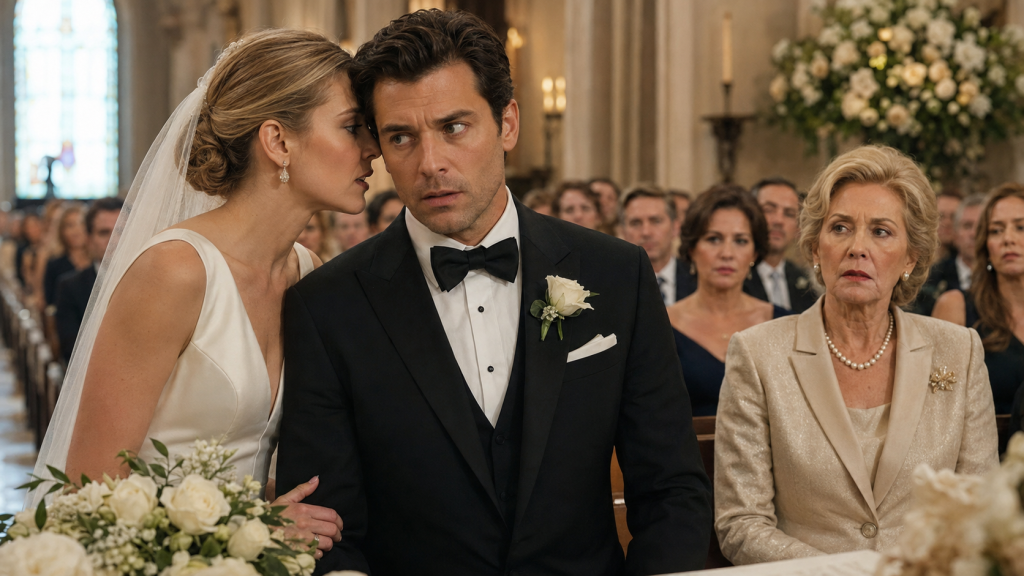
At 12:57 p.m., three minutes before the ceremony, I stood behind the chapel doors.
I could hear music.
Guests shifting in their seats.
Low conversation.
Tessa squeezed my hand.
“You can still stop.”
“I know.”
“And if you want me to tackle Evelyn into the floral arrangement, I’m emotionally prepared.”
I almost laughed.
“Please don’t.”
“No promises.”
The doors opened.
Two hundred people turned.
I saw confusion immediately.
Several guests knew what my original dress looked like because Evelyn had practically turned it into a publicity event.
She had told anyone who would listen that the bride planned to wear a “vintage family gown.”
Her family’s social circle loved sentimental details.
They just preferred them when professionally photographed.
Whispers moved through the chapel.
Then I saw Evelyn.
Front row.
Champagne suit.
Pearls.
Perfect posture.
Her eyes landed on my borrowed dress.
For half a second, surprise flickered across her face.
Then satisfaction.
She believed I had been defeated.
But she had underestimated one thing.
I had never needed the dress to marry her son.
I walked.
One step.
Then another.
At the end of the aisle, Adrian waited.
His face changed the moment he saw me.
Not because the new dress looked bad.
Because he knew.
He knew something had happened.
His brows drew together.
I gave him the smallest possible nod.
Not now.
He understood.
We stood before the officiant.
The ceremony began.
I barely heard the opening words.
My attention remained on Evelyn.
She sat motionless.
Watching.
Waiting.
When the officiant asked us to join hands, Adrian leaned toward me slightly.
“What happened?”
I smiled for the guests.
Then whispered, “Your mother destroyed my dress.”
His fingers tightened around mine.
I continued.
“She did it because she thinks I’ll leave.”
His face went completely still.
“And I have her confession on video.”
His eyes shifted toward Evelyn.
She was still smiling.
I added one final sentence.
“She mentioned the amended trust.”
Adrian stopped breathing for a second.
The officiant cleared his throat softly.
“Mr. Harrow?”
Adrian looked at me.
“Do you still want to do this?”
“Yes.”
“Are you sure?”
“Yes.”
He nodded.
Then he turned back toward the officiant.
“Please continue.”
That was the moment Evelyn’s smile began to disappear.
She knew her son.
She had seen the look on his face.
The ceremony continued.
We exchanged vows.
Adrian’s voice shook slightly during his.
Mine didn’t until the final sentence.
“I choose you,” I said, “not because life with you will always be easy, but because when it becomes difficult, I believe we’ll stand on the same side.”
His eyes filled.
“So do I.”
We exchanged rings.
Then the officiant pronounced us husband and wife.
The chapel erupted in applause.
Evelyn didn’t clap.
At the reception, she found us before we reached the head table.
“Adrian.”
He turned.
“Mother.”
Her eyes moved toward my dress.
“How unfortunate. I heard there was some accident.”
Tessa, standing five feet away, nearly inhaled her champagne.
Adrian looked at Evelyn.
“What kind of accident?”
“I don’t know.”
She gave me a sympathetic smile.
“These things happen.”
I said nothing.
Evelyn reached for Adrian’s arm.
“We should talk privately.”
“No.”
She froze.
“I beg your pardon?”
“You heard me.”
Her smile tightened.
“This is your wedding day.”
“Yes.”
“Then why are you creating unpleasantness?”
Adrian looked toward me.
“Claire showed me the video.”
For the first time since I had known Evelyn Harrow, she had no immediate answer.
The silence lasted less than two seconds.
But it was enough.
“What video?”
“The one of you entering Claire’s suite.”
“That’s absurd.”
“Pouring wine and bleach over her mother’s wedding dress.”
Her face hardened.
People nearby had started paying attention.
Evelyn lowered her voice.
“You are embarrassing yourself.”
“No.”
Adrian’s voice remained quiet.
“You embarrassed yourself.”
She looked at me.
“This is your doing.”
I finally spoke.
“No, Evelyn. The interesting thing about cameras is that they record the person actually doing the thing.”
“You recorded me without permission.”
“In a locked bridal suite where my belongings were stored.”
Her jaw tightened.
“You have no idea what you’re getting involved in.”
“I think I do.”
“No, you don’t.”
She moved closer.
“You think because you look at spreadsheets for a living that you understand our family?”
Adrian stepped between us.
“Stop.”
She stared at him.
“Do you know what she’s doing to you?”
“Yes.”
“She is turning you against your family.”
“No.”
His voice sharpened.
“You did that yourself.”
The nearby conversations had gone almost completely quiet.
Evelyn noticed.
Her public mask returned instantly.
She smiled.
“We’ll discuss this later.”
Adrian shook his head.
“We’ll discuss it now.”
“Not here.”
“Why?”
“Because there are guests.”
“You didn’t seem concerned about guests when you tried to make my bride disappear three hours before the ceremony.”
Her eyes flashed.
“I was protecting you.”
“From what?”
Evelyn looked directly at me.
“From a woman who has spent six months digging through private family finances.”
There it was.
The truth.
Not about my background.
Not about table manners.
Not about dresses.
Money.
Control.
Adrian stared at her.
“You knew.”
“Of course I knew.”
“Then you know what we found.”
“I know you have been manipulated.”
“By Claire?”
“Yes.”
I almost smiled.
Evelyn turned toward me.
“You came into this family and immediately began asking questions.”
“I began asking questions because the company was losing money.”
“You had no right.”
“Adrian asked me.”
“You should have refused.”
“Why?”
“Because Harrow business is family business.”
“Then perhaps Harrow family shouldn’t route company funds through shell corporations.”
Her face changed.
Just slightly.
But I saw it.
So did Adrian.
“What shell corporations?” he asked.
Evelyn said nothing.
I reached into my clutch.
“Westbridge Advisory. Calder Management Partners. Birchway Holdings.”
Adrian stared at her.
“Mother?”
She laughed softly.
“You’re listening to this?”
“I’m listening very carefully.”
“Your father authorized dozens of arrangements.”
“Dad was recovering from a stroke during some of these transfers.”
“He was still chairman.”
“Barely conscious.”
Evelyn’s expression hardened.
“That is enough.”
“No,” Adrian said.
“I think we’ve had enough secrets.”
At that moment, a voice came from behind us.
“I agree.”
Charles Harrow stood near the ballroom entrance.
Adrian’s father had not been expected to attend the entire reception.
His doctors had approved only the ceremony and perhaps thirty minutes afterward.
He walked with a cane now.
His speech was slower than before his stroke.
But his mind was perfectly intact.
Beside him stood Martin Graves, the Harrow family attorney.
Evelyn went pale.
“Charles.”
He looked at her.
“Martin showed me the amendment.”
She stiffened.
“What?”
“The trust amendment.”
“You shouldn’t be dealing with this today.”
“I should have dealt with it months ago.”
She glanced at Martin.
“You had no authority to involve him.”
Martin’s expression remained professional.
“Mr. Harrow is the settlor of the trust. He has every authority.”
Evelyn’s face tightened.
Charles stepped closer.
“Did you destroy Claire’s dress?”
“That has nothing to do with the trust.”
“That wasn’t my question.”
Silence.
Adrian looked at his mother.
“Answer him.”
Evelyn lifted her chin.
“Yes.”
The word landed like glass hitting stone.
Several nearby guests gasped.
Charles closed his eyes.
“Why?”
She looked around the ballroom.
Then something in her broke.
Not emotionally.
Strategically.
She realized there was no version of this moment where denial still worked.
“Because everyone has forgotten what I built.”
Charles stared at her.
“What?”
“You were sick.”
Her voice sharpened.
“Adrian was inexperienced. The board was circling. Investors were nervous. I kept everything together.”
“By stealing from the company?” Adrian asked.
“I did not steal.”
“Then what were the transfers?”
“Protection.”
“For whom?”
“For this family!”
Her voice carried across the ballroom now.
People stopped pretending not to listen.
Evelyn looked at her husband.
“Do you have any idea what would have happened if the company collapsed while you were lying in that hospital?”
Charles said quietly, “It didn’t collapse.”
“Because I made sure it didn’t.”
“By transferring money?”
“By creating reserves.”
“In companies you controlled?”
“For emergencies.”
I spoke.
“Then why weren’t those companies disclosed to the board?”
Her eyes snapped toward me.
“Stay out of this.”
“No.”
The word came easier than I expected.
“You destroyed something my dying mother spent months restoring because you wanted to frighten me away from this family. You don’t get to tell me to stay out of anything anymore.”
The ballroom was silent.
Evelyn stared at me.
Then she said the sentence she had probably wanted to say since the day we met.
“You do not belong here.”
I looked around the ballroom.
At the chandeliers.
The flowers.
The champagne.
The two hundred carefully selected guests.
Then I looked back at her.
“Maybe not.”
Adrian turned toward me.
But I continued.
“I don’t belong in a family where humiliation is considered discipline.”
Evelyn’s face reddened.
“I don’t belong in a family where money matters more than honesty.”
Charles lowered his head.
“And I definitely don’t belong anywhere someone thinks wealth gives them permission to destroy what they cannot buy.”
I took Adrian’s hand.
“But I do belong beside the man I just married.”
Adrian squeezed my fingers.
“That’s the only place I asked to be.”
Nobody spoke.
Then Charles turned to Martin.
“Freeze every discretionary transfer under the trust.”
Evelyn’s head snapped toward him.
“Charles.”
“And notify the board that I’m requesting an independent audit.”
“You cannot do that.”
“I can.”
“You’ll destroy us.”
“No.”
His voice was quiet.
“You nearly did.”
She stared at him.
Then at Adrian.
Finally at me.
For the first time, I saw something beneath the arrogance.
Fear.
Not fear of losing money.
Fear of losing authority.
That was the thing Evelyn loved most.
Being necessary.
Being obeyed.
Being the person everyone had to go through.
She looked at Adrian.
“You would choose her over your own mother?”
Adrian’s expression softened.
But not in the way she wanted.
“This isn’t a competition.”
“It has always been a competition.”
“No.”
“You just never realized you were the only one competing.”
Evelyn looked as though he had struck her.
He hadn’t.
He simply stopped playing the game.
Security did not remove her.
Charles refused to make the scene worse than it already was.
Instead, he asked his driver to take Evelyn home.
She left through the ballroom doors without saying goodbye.
Nobody clapped.
Nobody whispered loudly enough for me to hear.
But everyone watched.
Afterward, the reception continued.
Strangely.
Awkwardly.
Beautifully.
The band played.
People danced.
My father held me during the father-daughter dance and whispered, “Your mother would have loved that.”
“What?”
“The way you handled yourself.”
I swallowed hard.
“I wish she were here.”
He looked toward the tiny piece of blue fabric pinned inside my dress.
“She is.”
That was when I finally cried.
Not when I found the gown.
Not when Evelyn admitted destroying it.
Not when two hundred guests watched our family fracture in public.
I cried on my father’s shoulder while the band played one of my mother’s favorite songs.
And for once, I didn’t care who saw.
Later that night, Adrian and I sat barefoot on the balcony of our hotel suite eating leftover wedding cake with forks straight from the plate.
My veil was on the floor.
His tie was hanging from a chair.
The city glowed below us.
For several minutes, neither of us spoke.
Then Adrian said, “I’m sorry.”
I looked at him.
“For what?”
“My mother.”
“You didn’t destroy the dress.”
“I should have seen how far she would go.”
“How?”
He looked down.
“She’s been controlling my life for years.”
“That doesn’t mean you could predict this.”
“I kept thinking she would eventually accept us.”
“So did I.”
He looked at me.
“Did you ever think about leaving?”
“Today?”
“Yes.”
I thought about it.
“For maybe ten seconds.”
His face fell.
“Not because I didn’t want to marry you.”
“Then why?”
“Because that dress was Mom.”
He nodded.
“And for ten seconds, I felt like the whole wedding had been poisoned.”
I rested my head against the chair.
“Then I remembered something she told me.”
“What?”
“That I didn’t need a perfect wedding.”
He smiled faintly.
“She sounds smart.”
“She was.”
“What did she say you needed?”
I looked at him.
“A marriage where someone stands beside me when things aren’t perfect.”
He reached for my hand.
“Did I pass?”
“Barely.”
He laughed.
It was the first normal sound either of us had made all day.
Then his expression became serious.
“What happens now?”
“With your mother?”
“With everything.”
I looked out across the city.
“Now we follow the money.”
Three days later, the board of Harrow Hospitality hired an external forensic team.
I recused myself from the investigation.
That surprised several people.
Including Evelyn.
She sent me an email accusing me of engineering the entire situation so I could gain access to family assets.
I forwarded it to my attorney and didn’t respond.
The independent investigators found far more than Adrian and I had.
Over four years, approximately $6.8 million had moved through related entities without proper board disclosure.
Some of the money had been used to cover legitimate emergency expenses during Charles’s illness.
But nearly two million dollars had gone toward investments controlled personally by Evelyn.
A beach property.
Private equity placements.
Renovations to a residence she claimed was owned by the company but was titled through a personal trust.
The story wasn’t as simple as “Evelyn stole millions.”
Reality rarely is.
She had convinced herself that company money and family money were the same thing.
And because she believed she had protected the Harrow name for decades, she felt entitled to move both however she wished.
The board disagreed.
So did the auditors.
So did Charles.
The amended trust document became especially important.
Investigators learned that Evelyn had pressured one of the family’s longtime advisers to draft language expanding her control.
Adrian had been expected to sign it the morning after the wedding.
The plan had been presented to him as routine estate planning.
If I had disappeared publicly and dramatically, Evelyn apparently believed he would be emotionally vulnerable enough to sign without reading carefully.
That assumption ended her control over Harrow Hospitality.
Charles removed her as family trustee.
The board revoked her executive authority.
She kept her ownership interests.
She kept her home.
She kept more money than most people could spend in several lifetimes.
But she lost the one thing she valued above all else.
Control.
For two months, Adrian had no contact with her.
Neither did I.
Then one afternoon, a package arrived at our apartment.
Inside was my mother’s wedding dress.
Or what remained of it.
I almost dropped the box.
Adrian came into the room.
“What is it?”
I couldn’t answer.
He looked inside.
His face hardened.
There was a note.
Not from Evelyn.
From Charles.
Claire,
I know this cannot repair what was done.
But I thought the dress belonged with you.
I am sorry.
—Charles
Beneath the damaged fabric was a card for a textile restoration specialist.
I called them.
They told me honestly that the dress could never be restored enough to wear again.
The bleach damage was permanent.
But sections could be saved.
For three months, a conservator worked on it.
She cleaned what remained of the lace.
Recovered several intact pearl sections.
Stabilized the fabric.
And framed the bodice with photographs of my mother wearing it on her wedding day.
When the finished piece arrived, I hung it in our bedroom.
The blue thread remained tucked beneath the hem.
Adrian stood beside me.
“She’d like that.”
“You never met her.”
“No.”
He wrapped his arm around me.
“But I know you.”
Six months after the wedding, Evelyn called.
Not Adrian.
Me.
I almost didn’t answer.
“Hello?”
Silence.
Then her voice.
“Claire.”
“Evelyn.”
Another pause.
“I would like to speak with my son.”
“Then call him.”
“He doesn’t answer.”
“That’s his choice.”
“I know.”
That surprised me.
She sounded different.
Not softer exactly.
Smaller.
“I made mistakes.”
I waited.
“I thought I was protecting my family.”
“You destroyed my mother’s wedding dress.”
“I know.”
“You tried to manipulate Adrian into signing legal documents.”
“I know.”
“You called me a threat because I noticed what you were doing.”
“I know.”
The repetition felt strange.
I walked toward the window.
“Why are you calling me?”
“Because he loves you.”
“That’s not new information.”
“No.”
Her voice trembled slightly.
“And because I think he might listen if you told him I wanted to apologize.”
I closed my eyes.
There it was.
The old strategy.
Go through the person closest to the decision-maker.
I almost laughed.
“You’re doing it again.”
“What?”
“Trying to manage the outcome.”
Silence.
“If you’re sorry, send Adrian an apology.”
“He won’t respond.”
“Then apologize anyway.”
“What good does that do?”
“The apology isn’t supposed to purchase a response.”
She said nothing.
“Send it because he deserves it. What he does afterward is up to him.”
Another long pause.
Then Evelyn asked quietly, “Do you hate me?”
I thought about the dress.
The bathtub.
The note.
Know your place.
“No.”
She seemed surprised.
“I don’t trust you.”
“That’s fair.”
“And I don’t want a relationship with you right now.”
“I understand.”
“But I don’t hate you.”
“Why?”
“Because hating you would make you too important.”
She inhaled sharply.
I almost regretted saying it.
Almost.
Then she whispered, “You really are impossible.”
I smiled.
“So I’ve been told.”
She sent Adrian a letter the following week.
He read it three times.
Then put it in a drawer.
He didn’t call her for another month.
When he finally did, their conversation lasted fourteen minutes.
I didn’t ask what they discussed.
He told me only one thing afterward.
“She apologized without saying ‘but.’”
“That’s progress.”
“I suppose.”
Rebuilding took time.
There were boundaries.
No surprise visits.
No financial discussions outside attorneys and board meetings.
No comments about my background, career, clothes, family, or table manners.
And absolutely no control over holidays.
Evelyn hated the rules.
Which was precisely why they were necessary.
A year after our wedding, Adrian and I hosted dinner at our apartment.
Charles came.
My father came.
Tessa came with her fiancé.
And after considerable debate, Adrian invited Evelyn.
She arrived carrying flowers.
Not roses.
My mother had loved peonies.
I had mentioned that once, years earlier.
Evelyn handed them to me.
“These are for you.”
“Thank you.”
No speech.
No explanation.
During dinner, my father told an embarrassing story about me getting lost on a school field trip at age eight.
Everyone laughed.
Even Evelyn.
At one point, she reached for the wrong fork.
I noticed.
She noticed me noticing.
For one second, we stared at each other.
Then I raised an eyebrow.
She almost smiled.
“Not a word.”
“I wasn’t going to say anything.”
“Your face did.”
Adrian nearly spit out his wine.
It wasn’t forgiveness.
Not completely.
Maybe forgiveness isn’t always a door you walk through once.
Sometimes it’s a hallway.
Sometimes people move one careful step at a time.
Sometimes they stop.
Sometimes they turn back.
But for the first time, Evelyn seemed to understand that being part of our lives was a privilege, not a right.
Two years after the wedding, Harrow Hospitality completed its restructuring.
Adrian became CEO.
Charles remained chairman emeritus.
Evelyn never returned to management.
The money improperly transferred was repaid through asset sales and settlement agreements.
There were legal consequences, although less dramatic than gossip sites predicted.
No courtroom spectacle.
No handcuffs.
No television cameras.
Just lawyers.
Auditors.
Contracts.
Repayment schedules.
And the slow dismantling of authority that had once seemed absolute.
As for me, I never joined Harrow Hospitality.
That disappointed almost everyone who assumed the scandal had been my clever path into the company.
Instead, I opened my own forensic accounting firm.
Tessa helped design the website.
Adrian invested exactly zero dollars because I refused to let him.
Within eighteen months, we had twelve employees.
Our specialty was family-owned businesses dealing with internal financial disputes.
I became especially good at one particular kind of client.
The underestimated woman sitting quietly at the end of the conference table while everyone assumed she understood less than she did.
Those women usually became my favorite clients.
On the third anniversary of our wedding, Adrian and I returned to the hotel.
Not for a party.
Just dinner.
The bridal boutique was still there.
The chapel looked smaller than I remembered.
We walked past the hallway where the bridal suite was located.
Adrian stopped.
“Want to see it?”
“No.”
“Good answer.”
We continued toward the restaurant.
Then he paused.
“You know something?”
“What?”
“My mother really believed you would run.”
“I know.”
“She thought ruining the dress would ruin the wedding.”
“I know.”
He smiled.
“What were you actually thinking when you walked down the aisle?”
I thought about it.
“Mostly that my shoes hurt.”
He laughed.
“I’m serious.”
“So am I.”
“Claire.”
I looked toward the chapel doors.
Then I remembered myself standing there three years earlier.
Borrowed dress.
Blue thread hidden beneath the hem.
Heart pounding.
Two hundred people waiting.
A future mother-in-law certain she had already won.
“I was thinking about place.”
“Place?”
“The note.”
His expression softened.
Know your place.
Four words meant to humiliate me.
For a long time, I had thought Evelyn’s cruelty came from believing I was beneath her.
But eventually I understood something else.
People obsessed with putting others in their place are often terrified of losing their own.
Evelyn had spent decades building her identity around being indispensable.
Then her husband became ill.
Her son grew independent.
The company began changing.
And I arrived at exactly the moment when she felt control slipping through her fingers.
None of that excused what she did.
But it explained why four simple words mattered so much to her.
Know your place.
I smiled at Adrian.
“I realized she was right.”
His eyebrows rose.
“Excuse me?”
“I did need to know my place.”
“And where was that?”
I took his hand.
“Where I chose to stand.”
Not where wealth placed me.
Not where family history placed me.
Not where someone else’s opinion placed me.
My place was beside the people who respected me.
Beside the work I had earned.
Beside the memories I refused to let anyone destroy.
Beside the man who, when the truth arrived at the worst possible moment, had listened instead of doubting me.
That was what I whispered to him at the altar.
Not revenge.
Not a threat.
Not some dramatic demand that he choose between his wife and his mother.
Just the truth.
“Your mother destroyed my dress because she thinks I’ll leave.”
And then the sentence that changed everything.
“I’m not going anywhere.”
Adrian believed me.
That was why the wedding continued.
That was why Evelyn’s plan failed.
She had assumed humiliation would make me disappear because that was how power had always worked in her world.
Make people uncomfortable.
Make them feel inferior.
Make them question whether they belong.
Eventually, they leave on their own.
But my mother had taught me something Evelyn never understood.
Belonging isn’t granted by the person with the biggest house, the oldest money, or the loudest voice.
Sometimes belonging is simply the decision to remain standing when someone expected you to fall.
My mother’s original wedding dress never became wearable again.
The restored sections still hang in our bedroom.
Every morning, sunlight touches the preserved lace through the glass.
Some of the stains remain.
The conservator offered to hide them.
I asked her not to.
They are part of the dress now.
Part of the story.
My mother wore it when she began her marriage.
I carried a piece of it when I began mine.
And someone tried to destroy it because she believed memories could be erased as easily as fabric could be stained.
She was wrong.
On our fifth anniversary, Adrian gave me a small velvet box.
Inside was a pendant.
At first, I thought it was a pearl.
Then I realized what he had done.
One of the pearls recovered from my mother’s dress had been placed into a simple gold setting.
I looked at him.
“How did you get this?”
“Your dad helped.”
I touched the pearl.
“You stole part of the frame?”
“Borrowed.”
“Without asking.”
“Technically.”
“I married a criminal.”
“Apparently.”
I laughed.
Then cried anyway.
He fastened the necklace around my neck.
In the mirror, the pearl rested just above my heart.
Adrian stood behind me.
“Your mother made it to another anniversary.”
“Yes.”
I touched the necklace.
“Yes, she did.”
Downstairs, our guests were arriving.
Tessa.
My father.
Charles.
Several friends.
And Evelyn.
Yes.
Evelyn too.
Our relationship had never become warm in the way people like to imagine difficult family relationships eventually should.
We did not become best friends.
She did not suddenly become the mother I had lost.
I never trusted her completely.
Trust, unlike money, cannot simply be repaid.
But she changed.
Slowly.
She learned to ask before interfering.
She learned that “no” did not mean “convince me.”
She learned that Adrian could disagree with her and still love her.
And she learned something that may have been hardest of all.
She learned that respect could not be demanded through fear.
That evening, she stood near our dining room window looking at an old framed wedding photo.
The picture showed Adrian and me leaving the chapel.
My borrowed dress caught the afternoon light.
My smile looked exhausted.
His looked relieved.
Evelyn noticed me beside her.
“I ruined what should have been a beautiful day.”
I looked at the photograph.
“No.”
She turned.
“I ruined the dress.”
“Yes.”
“And the ceremony.”
“No.”
Her brow furrowed.
“You tried.”
I smiled.
“But the ceremony was still beautiful.”
“How can you say that?”
“Because I learned exactly who I was marrying.”
She looked toward Adrian across the room.
He was arguing with Tessa about music.
“And he learned something too.”
“What?”
“That choosing a wife means actually choosing her.”
Evelyn nodded slowly.
“I suppose I taught him that lesson badly.”
“Very badly.”
She laughed.
A real laugh.
Quiet.
Almost embarrassed.
Then she looked at me.
“I still regret the dress.”
“So do I.”
“If I could undo it—”
“You can’t.”
Her eyes dropped.
“I know.”
For years, I had imagined that if Evelyn ever apologized sincerely, I would feel triumphant.
I didn’t.
I just felt tired of carrying the moment.
So I said something I had not planned to say.
“I forgive you.”
She looked up sharply.
I continued before she could speak.
“That doesn’t mean it didn’t matter.”
“I understand.”
“It doesn’t mean I forgot.”
“I know.”
“And it doesn’t mean I’ll ever trust you the way I might have if none of this happened.”
Her voice was quiet.
“I know.”
“But I forgive you.”
Tears filled her eyes.
She turned toward the window.
“Thank you.”
That was all.
No dramatic embrace.
No applause.
No miraculous transformation.
Just two women standing beside a wedding photograph.
One who had tried to erase the other.
And one who had finally decided she no longer needed the anger.
Later that night, after everyone left, Adrian and I cleaned the kitchen together.
He handed me a plate.
“What did Mom say to you?”
“She apologized again.”
“And?”
“I forgave her.”
He stopped.
“You did?”
“Yes.”
“How do you feel?”
I thought about it.
“Lighter.”
He nodded.
Then he smiled.
“My wife, the terrifying forensic accountant, has developed mercy.”
“Don’t spread that around.”
“It could damage your reputation.”
“Exactly.”
He kissed my forehead.
Then reached for another plate.
On the wall behind him hung the framed piece of my mother’s dress.
The lace was imperfect.
The silk still bore faint traces of pink and brown.
The blue thread remained beneath the hem.
Once, I thought damage made something less valuable.
Now I knew better.
Some things become meaningful because they survived.
So did marriages.
So did families.
So did people.
Evelyn wanted those four words to send me running.
Know your place.
Instead, they became a reminder.
My place was not beneath her.
It was not above her either.
My place was wherever my dignity remained intact.
Where my voice mattered.
Where love did not require submission.
Where family meant loyalty without ownership.
Where no amount of money could convince me to surrender who I was.
Three hours before my wedding, Evelyn Harrow destroyed a dress.
She thought she was destroying my future.
She thought two hundred guests would watch me disappear.
She thought Adrian would sign away his authority.
She thought I would become the frightened scholarship girl she had always imagined me to be.
Instead, I walked down the aisle.
I took Adrian’s hands.
I told him the truth.
And when he asked whether I still wanted to marry him, I said yes.
The dress was ruined.
The wedding wasn’t.
The family changed.
The company survived.
And so did I.
Sometimes the most powerful response to someone who tells you where you belong is not shouting.
It is not revenge.
It is not proving that you are richer, smarter, or stronger.
Sometimes it is simply refusing to move.
Because eventually, the people who try hardest to put you in your place discover something they never expected.
You already know exactly where you stand.
And they no longer have the power to move you.
💬THE END! THANK YOU FOR READING!