

Julian stopped three feet away from me, but for several seconds he seemed incapable of speaking.
The applause around us had faded into the background.
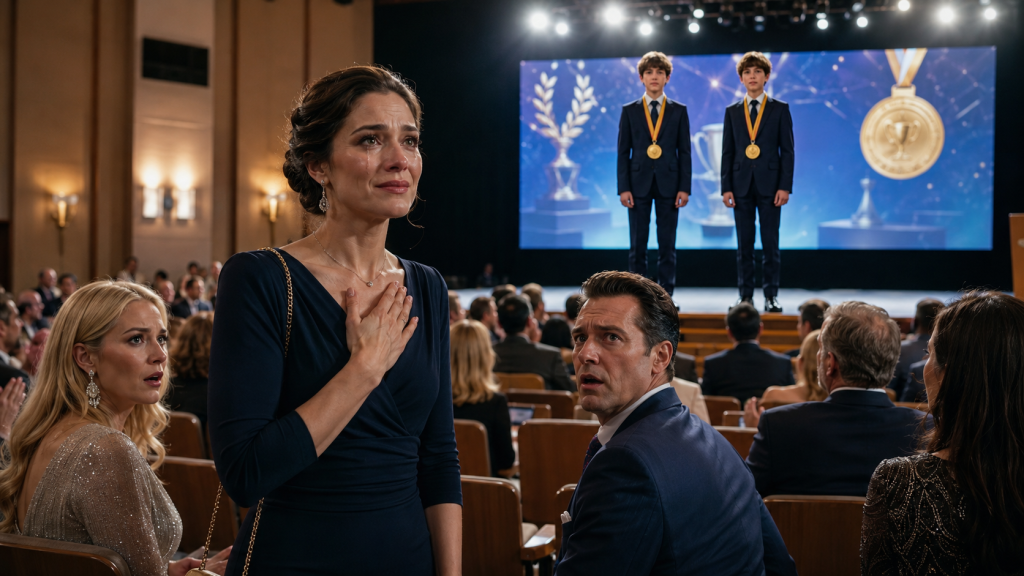
Onstage, photographers were still taking pictures of Leo and Ethan holding their gold medals beneath the enormous tournament banner.
But Julian wasn’t looking at the cameras.
He was looking at my sons.
His sons.
Thirteen years too late.
“Clara,” he finally whispered.
I hadn’t heard him say my name in more than a decade.
Once, hearing it in his voice had made my heart race.
Now it sounded like something pulled from another lifetime.
“Those boys…”
He swallowed.
“Are they mine?”
I looked at him steadily.
“You already know the answer.”
His face changed.
Not dramatically.
Julian had always been good at controlling himself in public.
But I knew him well enough to recognize the small signs.
The tightening around his mouth.
The twitch in his jaw.
The way his fingers curled against the side of his trousers.
He turned toward the stage again.
Leo was laughing at something Ethan had whispered to him.
For an instant, Julian simply stared.
Then Victoria appeared beside him.
“What exactly is happening?”
Her voice was sharp enough to cut through the nearby conversation.
She looked at me as though I were something unpleasant she had discovered beneath an expensive shoe.
Then she looked toward Leo and Ethan.
Her expression twisted.
“No.”
Julian didn’t answer her.
Victoria grabbed his arm.
“I said, what is happening?”
He slowly pulled free.
“Not now.”
“Not now?”
Her voice rose.
“Our son has just been humiliated in front of hundreds of people, two strangers have somehow taken the prize he deserved, and you’re standing here staring at this woman like you’ve seen a ghost.”
I almost corrected her.
Preston had not lost because Leo and Ethan had stolen anything from him.
He had simply scored lower.
Far lower.
But I didn’t need to defend my children.
Their scores were glowing on the enormous screen behind the stage.
Facts rarely need to shout.
Victoria pointed at me.
“This is about her, isn’t it?”
Julian remained silent.
And that silence told her everything.
Her eyes widened.
Slowly, she turned toward the stage again.
She studied Leo.
Then Ethan.
Then Julian.
The resemblance was impossible to ignore once someone knew to look for it.
“No,” she whispered.
Julian closed his eyes briefly.
Victoria stepped backward.
“No.”
I watched understanding spread across her face.
The same woman who had called my sons fatherless nobodies only minutes earlier was discovering precisely who their father was.
She looked at me.
“You had twins?”
“I did.”
“You never told him?”
That almost made me laugh.
“I told Julian I was pregnant before our divorce was finalized.”
Several people nearby had begun pretending not to listen.
They were doing a terrible job.
Victoria turned toward her husband.
“You knew?”
Julian’s face tightened.
“I knew she was pregnant.”
“You knew?”
“I didn’t know there were two.”
I folded my arms.
“That makes a remarkable difference, apparently.”
Julian looked at me.
“Clara, I thought—”
“I remember exactly what you thought.”
I had spent thirteen years trying not to remember.
But some memories never truly leave.
They simply stop controlling you.
The night Julian walked out of our apartment, I had been eight weeks pregnant.
I had stood beside the kitchen table holding an ultrasound photograph in both hands.
He had barely looked at it.
Instead, he had paced the room talking about opportunities.
Connections.
A future.
Victoria Bennett’s family owned Bennett Aerospace, one of the largest engineering firms in the state.
Her father had offered Julian a senior position.
Victoria herself had offered him something more.
A life Julian believed I could never provide.
He had been thirty-one.
Ambitious.
Impatient.
And convinced that success meant standing beside people who already had power.
“What about the baby?” I had asked him that night.
He had stared through the window.
“I’ll send money.”
That had been his answer.
Not I’ll stay.
Not we’ll figure this out.
Not I’m sorry.
I’ll send money.
But even that promise disappeared within months.
Julian moved.
Changed attorneys.
Let every communication pass through other people.
Then Victoria became pregnant.
And suddenly my unborn child became an inconvenience from a previous life.
When I learned I was carrying twins, I sent the medical report through his attorney.
No response came.
When they were born, I sent photographs.
Nothing.
When Leo spent two nights in neonatal care because he had difficulty breathing, I called the number I had for Julian.
Disconnected.
That was when I stopped trying.
I gave my sons my maiden name.
Holloway.
And I built a life without waiting for someone who had already chosen not to be part of it.
Julian stood before me now, surrounded by chandeliers, sponsors, cameras, and wealthy families.
Everything he had wanted.
Yet his eyes looked empty.
“I didn’t know,” he said quietly.
“Yes, you did.”
“I didn’t know they were twins.”
“You knew there was a child.”
He flinched.
“That should have been enough.”
Victoria looked between us.
“This is ridiculous. Julian, tell her we’re leaving.”
He didn’t move.
Victoria’s voice hardened.
“Julian.”
“I’m not leaving.”
She stared at him.
Then something ugly flashed across her face.
She turned toward me.
“You planned this.”
I smiled faintly.
“I planned to attend my sons’ competition.”
“You knew Julian was the primary sponsor.”
“Yes.”
Her eyes narrowed.
“So you came here deliberately.”
“Yes.”
Julian looked at me then.
There was suspicion beneath the regret now.
“What are you saying?”
Before I could answer, Leo and Ethan appeared at the edge of the aisle.
Both still wore their medals.
Ethan noticed Julian first.
His smile disappeared.
Leo followed his gaze.
Neither boy said anything.
I had told them months ago that Julian might be here.
I had also told them that meeting him was their choice.
They owed him nothing.
Not anger.
Not forgiveness.
Not even conversation.
Julian took one uncertain step forward.
“Leo?”
My eldest-by-seven-minutes son looked at him calmly.
Julian turned.
“Ethan?”
Ethan’s expression was harder to read.
Then he looked at me.
“Mom.”
That single word drew an invisible line between us.
I moved toward them.
Julian remained where he was.
Ethan glanced at him again.
“Is this him?”
Julian’s face crumpled slightly.
Maybe he had imagined a different moment.
Maybe somewhere inside his mind he had pictured two boys recognizing him instantly.
Calling him Dad.
Running toward him.
Life rarely rewards abandonment with sentimental reunions.
“Yes,” I said.
“This is Julian.”
Not your father.
Not Dad.
Julian.
Leo nodded once.
“Okay.”
That was all.
Julian looked almost more wounded by their indifference than he would have been by hatred.
“I…”
He stopped.
Leo waited.
Julian tried again.
“I’m your father.”
Ethan’s eyebrows rose slightly.
“Biologically.”
Victoria made a strangled sound.
“Excuse me?”
Ethan didn’t even look at her.
Julian did.
“Victoria, go back to your seat.”
She laughed in disbelief.
“You cannot be serious.”
“I said go.”
“This woman appears after thirteen years with two boys who conveniently look like you, wins the competition sponsored by your company, and suddenly everyone is supposed to believe some dramatic reunion story?”
Leo finally turned toward her.
“There’s nothing convenient about genetics.”
I almost smiled.
That was very Leo.
Precise.
Unemotional.
Devastating without trying.
Victoria’s eyes flashed.
“You think you’re clever?”
“I know my score.”
Ethan coughed to disguise a laugh.
Victoria’s face reddened.
“Preston had tutors from Oxford.”
Leo nodded.
“Then I’d ask for a refund.”
This time Ethan didn’t bother hiding his laugh.
Even a few nearby parents smiled.
Victoria stepped forward.
“You disrespectful little—”
“Stop.”
Julian’s voice cracked across the aisle.
People turned.
Victoria froze.
Julian looked at her with a fury I had never seen before.
“You will not speak to them that way.”
“They’re humiliating our son!”
“No.”
He looked toward the scoreboard.
“Preston lost.”
Victoria stared at him as if he had slapped the air out of her lungs.
Julian continued.
“He performed poorly. They performed exceptionally. That is not humiliation. That is a result.”
“But—”
“And calling them fatherless nobodies?”
His voice lowered.
“That was disgraceful.”
Victoria’s lips parted.
Perhaps she expected Julian to defend her automatically.
He always had.
Thirteen years of marriage had apparently taught her that Julian would choose comfort over confrontation.
I knew that version of him too.
But guilt can make cowards behave unpredictably.
Before anyone could continue, one of the tournament coordinators approached.
She was a woman named Dr. Rebecca Lane, director of the National Young Innovators Challenge.
I had met her twice before.
She carried a cream envelope.
“Ms. Holloway?”
“That’s me.”
“I’m sorry to interrupt.”
She held out the envelope.
“This was delivered to the administrative office earlier today. The sender requested that it be given to you after the award ceremony.”
Leo glanced at it.
“The director said this arrived for you.”
I recognized the law firm’s embossed name instantly.
Hargrove, Miller & Chase.
Julian recognized it too.
His expression changed.
Victoria noticed.
“What is that?”
I took the envelope.
“The reason I knew Julian would be here tonight.”
Julian stared at me.
“What have you done?”
“Nothing yet.”
I opened the envelope carefully.
Inside were three documents.
One was a letter.
One was a copy of an old legal filing.
The third was something Julian had apparently hoped would never surface.
I unfolded the letter first.
Julian’s breathing changed.
“Clara.”
I looked at him.
“You should probably sit down.”
“I’m fine.”
“No,” I said softly.
“You really aren’t.”
Victoria folded her arms.
“This is absurd.”
I handed the first page to Julian.
He took it.
His eyes moved across the paper.
Then stopped.
He read the same paragraph again.
“What is this?”
“You can read.”
“This says…”
His voice trailed off.
Victoria leaned toward him.
“What?”
He moved the document away.
She snatched it anyway.
Her eyes scanned the page.
Then her mouth fell open.
The document had been signed twelve years earlier.
By Julian’s former attorney.
It confirmed that Julian had received notice of the twins’ birth.
Not merely the pregnancy.
Not merely the fact that there was a child.
Both births.
Their names.
Their birth weights.
Their hospital.
Everything.
Attached to it was a signed acknowledgment from Julian himself.
Victoria looked at him.
“You said you didn’t know.”
Julian stared at the document.
“I…”
“You just said you didn’t know there were twins.”
“I didn’t remember this.”
Victoria laughed once.
It was a cold, shocked sound.
“You didn’t remember?”
“I had a lot happening then.”
“You forgot you had two sons?”
“I didn’t say that.”
“That is exactly what you said!”
Nearby conversations had stopped completely.
Julian glanced around.
“Keep your voice down.”
Victoria’s face twisted.
“Oh, now you care about appearances?”
I took the second document from the envelope.
“This isn’t the important one.”
Julian looked at me.
“What could possibly be more important?”
I handed him the second page.
He read.
His face went gray.
It was a petition filed shortly after the boys were born.
My attorney at the time had sought a formal paternity acknowledgment and child-support arrangement.
Julian’s legal team had responded.
Not by denying paternity.
By requesting that the matter be handled privately.
They offered a settlement.
I had refused.
I wanted support to be legally documented, not hidden behind some confidential agreement designed to protect Julian’s new social position.
But before the hearing could occur, something happened.
Julian’s attorney produced a document.
A statement supposedly signed by me.
It claimed I was withdrawing the petition voluntarily and waiving further financial claims.
There was only one problem.
I had never signed it.
At twenty-nine, exhausted with newborn twins and barely enough money to keep our apartment, I had not had the resources to fight a legal battle against Bennett attorneys.
My lawyer had suspected misconduct.
But suspicion wasn’t proof.
So the case disappeared.
And I moved forward.
Years later, after building my own career, I began looking again.
Quietly.
Methodically.
Not because I wanted money.
By then, I had plenty.
I wanted the truth.
Six months before the competition, an archived storage company discovered the original physical records from Julian’s old law firm after a corporate merger.
Among them was correspondence that should never have existed.
Instructions.
Internal notes.
A draft bearing Victoria’s father’s initials.
And proof that someone associated with the Bennett family had pressured Julian’s attorney to make my claim disappear.
Julian read the final page.
His eyes lifted toward Victoria.
“What is this?”
She stared at the paper.
“I don’t know.”
“Your father’s initials are here.”
“That proves nothing.”
“It says Bennett legal affairs authorized the payment.”
Victoria’s expression changed.
Only slightly.
But I saw it.
So did Julian.
His voice became quieter.
“You knew.”
“No.”
“You knew about the twins.”
“I knew Clara claimed she was pregnant.”
“Don’t lie to me.”
“I’m not.”
He held up the paper.
“This memorandum is dated three weeks after they were born.”
Victoria said nothing.
Julian’s face twisted.
“You knew.”
She looked around at the staring crowd.
“Not here.”
“You knew!”
The words echoed.
Preston appeared behind her.
He had removed his competition badge.
Until then, he had looked embarrassed.
Now he looked frightened.
“Mom?”
Victoria turned.
“Go wait with your tutor.”
“What’s happening?”
“Preston.”
Julian looked at the boy he had raised.
The contrast was brutal.
Preston had Julian’s last name.
Julian’s home.
Julian’s attention.
Julian had attended every school ceremony.
Every birthday.
Every parent conference.
Every competition.
Meanwhile Leo and Ethan had grown up without receiving so much as a birthday card.
I saw that realization pass through Julian’s expression.
But Preston was innocent too.
I would not let adults turn children into weapons.
“Julian,” I said.
He looked at me.
“Whatever happens, Preston has nothing to do with this.”
Victoria scoffed.
“How noble.”
I ignored her.
“He is a child.”
“He’s thirteen,” Ethan muttered.
I gave him a look.
He corrected himself immediately.
“A young person.”
Leo smiled.
Even Julian almost did.
Then the moment vanished.
Victoria pointed toward my sons.
“You’ve poisoned them against us.”
I shook my head.
“I barely mentioned you.”
That offended her more than hatred would have.
“You expect me to believe that?”
“They had homework.”
A few people nearby actually laughed.
Victoria’s cheeks burned.
Julian rubbed his forehead.
“Clara, why now?”
I knew exactly what he meant.
Why bring this forward tonight?
Why here?
Why thirteen years later?
I folded the documents carefully.
“Because three months ago Bennett Aerospace submitted an application to become the tournament’s permanent education partner.”
Julian froze.
Victoria’s eyes widened.
The National Young Innovators Challenge wasn’t simply a competition.
It was connected to scholarships, university partnerships, research grants, and a rapidly growing science education foundation.
Becoming its permanent corporate sponsor would give Bennett Aerospace access to enormous prestige.
Julian had personally led the bid.
He had spent months courting the foundation’s board.
What he didn’t know was that I sat on that board.
Not publicly.
I had joined two years earlier under the nonprofit arm of Holloway Technologies.
My company.
The company I had founded from my kitchen table when Leo and Ethan were toddlers.
I had started by designing educational engineering software for small schools.
Then school districts.
Then universities.
Over thirteen years, Holloway Technologies had become one of the fastest-growing STEM education platforms in the country.
Julian had no idea.
Why would he?
He had never looked for me.
Victoria blinked.
“What does that have to do with you?”
I smiled.
“Quite a lot.”
A man approached from behind the stage.
Dr. Samuel Reed.
Chairman of the foundation board.
He greeted me warmly.
“Clara.”
Julian stared.
Samuel looked toward him.
“Mr. Mercer.”
Julian recovered himself.
“Dr. Reed.”
They had clearly met several times.
Samuel turned back toward me.
“The board is assembled in the conference suite whenever you’re ready.”
Victoria laughed.
“You?”
Samuel frowned.
“I’m sorry?”
“She has no reason to attend your board meeting.”
Samuel’s expression remained polite.
“Ms. Holloway has every reason.”
Julian slowly looked at me.
Samuel continued.
“She is one of our largest private benefactors.”
Silence.
Victoria stared.
I said nothing.
Samuel smiled.
“And, of course, the founder of Holloway Technologies has served on our ethics and scholarship committee for nearly two years.”
Julian looked as though the floor had shifted beneath him.
“Holloway Technologies?”
I nodded.
He knew the name.
Everyone in his industry did.
My company’s educational systems were used by thousands of institutions.
We had recently begun collaborating with universities on advanced engineering simulation software.
Three months earlier, Forbes had estimated our valuation at just over nine hundred million dollars.
Money had never been my revenge.
But I would be lying if I said watching Julian discover what I had built without him felt entirely unpleasant.
Victoria’s eyes traveled over my simple navy dress.
My modest earrings.
The leather bag hanging from my shoulder.
She had always measured wealth by visibility.
I never had.
“You own Holloway Technologies?” Julian asked.
“I founded it.”
“When?”
“When the twins were two.”
He looked stunned.
“Why didn’t I know?”
I almost smiled.
“Because knowing things about me would have required interest.”
That silenced him.
Samuel glanced between us.
“I assume there’s history here.”
“You could say that.”
He nodded toward the documents in my hand.
“Is that the Hargrove report?”
“Yes.”
Julian turned sharply.
“You knew about this?”
Samuel answered calmly.
“The foundation received an ethics disclosure from Ms. Holloway regarding a possible conflict involving Bennett Aerospace.”
Victoria stepped forward.
“This is outrageous.”
Samuel’s eyebrows rose.
“Mrs. Mercer.”
“She’s using personal revenge to interfere with our sponsorship.”
“No.”
His tone became firmer.
“The board is reviewing documented allegations that individuals connected to Bennett Aerospace improperly influenced a legal proceeding involving the abandonment of two minor children.”
Julian’s head snapped toward Victoria.
“Individuals?”
Samuel nodded.
“The documentation references your father-in-law, his former general counsel, and two executives.”
Victoria’s face drained.
“That happened thirteen years ago.”
“So?”
Samuel’s expression remained calm.
“Our ethics requirements do not expire when misconduct becomes inconvenient.”
Julian turned back toward me.
“You knew tonight was the board vote.”
“Yes.”
“And you brought this forward today.”
“No.”
I looked directly at him.
“I submitted it three months ago.”
His confusion deepened.
“Then why wasn’t I told?”
“Because the board was conducting an independent investigation.”
Samuel nodded.
“We completed it yesterday.”
Victoria’s confidence disappeared.
Julian stared at him.
“And?”
Samuel glanced around the crowded auditorium.
“This isn’t the appropriate setting.”
“Tell me.”
Samuel hesitated.
Then he said quietly, “The findings were substantiated.”
Julian went completely still.
Victoria shook her head.
“No.”
Samuel continued.
“The board will formally vote tonight, but the ethics committee has unanimously recommended rejecting Bennett Aerospace’s sponsorship agreement.”
Victoria’s hand flew to her mouth.
Julian said nothing.
The permanent sponsorship was worth more than money.
It would have positioned Bennett Aerospace as the face of one of the country’s most influential youth science programs.
They had spent millions preparing their proposal.
Millions more building campaigns around it.
Julian had staked his professional reputation on securing the agreement.
And now it was collapsing.
Not because my sons won.
Not because I manipulated anything.
Because thirteen years earlier, powerful people had believed a young mother without money could be erased.
Julian turned toward Victoria.
“Did your father do this?”
She looked away.
“Victoria.”
“I don’t know.”
“You’re lying.”
Preston stood several feet behind them.
His face had gone pale.
“Dad?”
Julian turned.
Preston looked from him to my sons.
“Are they really your kids?”
No one answered immediately.
Then Julian nodded.
“Yes.”
Preston swallowed.
“Did you leave them?”
Julian closed his eyes.
“Yes.”
The word seemed to hurt him.
Preston stared at the floor.
Then at Leo and Ethan.
“I didn’t know.”
Leo answered before anyone else could.
“We know.”
There was no accusation in his voice.
Only fact.
Preston nodded.
For the first time that night, I felt sorry for him.
He had entered the auditorium expecting to win a competition.
Instead, he had discovered that his family history was a lie.
Victoria reached toward him.
“Preston, come with me.”
He stepped away.
“Did you know?”
Her hand stopped.
“Sweetheart—”
“Did you?”
“It’s complicated.”
“That means yes.”
“Preston.”
He shook his head.
“You told me they were nobodies.”
Victoria’s face tightened.
“You were upset.”
“You said they cheated.”
“I thought—”
“No.”
Preston looked toward the stage.
“They didn’t.”
That surprised me.
He looked at Leo.
“Your final solution was good.”
Leo blinked.
“Thanks.”
Preston shoved his hands into his pockets.
“Better than mine.”
Ethan tilted his head.
“You had the right model initially.”
Preston looked surprised.
“You saw it?”
“I watched your semifinal presentation.”
“I changed it because my coach said the optimization wasn’t aggressive enough.”
Ethan shrugged.
“He was wrong.”
Preston looked at him.
Then gave a tiny, humorless laugh.
“Yeah.”
Victoria stepped between them.
“This is not happening.”
Julian looked exhausted.
“What isn’t happening?”
“You are not going to stand here while my son fraternizes with hers.”
Julian stared at her.
“Hers?”
“You know what I mean.”
“No.”
His expression hardened.
“I don’t think I do.”
Victoria lowered her voice.
“Those boys are going to destroy everything we built.”
I finally spoke.
“No, Victoria.”
She turned toward me.
“They didn’t destroy anything.”
I held up the documents.
“The adults did that.”
For once, she had no response.
Samuel touched my elbow gently.
“The board should begin.”
I nodded.
“I’ll be there.”
Julian stepped forward.
“Can I attend?”
Samuel shook his head.
“Not the closed session.”
“I’m president of Bennett Aerospace.”
“Which is precisely why you cannot attend.”
Victoria immediately reached for Julian.
“We need to call the attorneys.”
He pulled away.
“You call them.”
“What?”
“I’m staying.”
“With her?”
“With my sons.”
Leo’s expression changed slightly.
Julian noticed.
“Unless…”
He looked at both boys.
“Unless you don’t want me to.”
There it was.
The first respectful thing he had done regarding them.
He asked.
Leo looked at Ethan.
Twin communication had always fascinated me.
Sometimes an entire argument passed between them without words.
Finally Ethan shrugged.
“You can stay.”
Julian breathed out.
“But,” Leo added, “we’re not calling you Dad.”
Julian swallowed.
“I understand.”
“And you don’t get to ask Mom for forgiveness because we won something.”
Julian looked at him.
Leo continued.
“You didn’t notice us until strangers applauded.”
That hit exactly where it needed to.
Julian nodded slowly.
“You’re right.”
Victoria scoffed.
“This is unbelievable.”
Julian turned.
“No.”
His voice was tired.
“What’s unbelievable is that I abandoned two children and spent thirteen years pretending it had been handled.”
Victoria stared.
“You chose us.”
“I chose status.”
His eyes moved toward me.
“And I spent years telling myself it had been justified.”
I felt something strange then.
Not satisfaction.
Not love.
Maybe closure.
For years I had imagined Julian eventually realizing what he had done.
In those fantasies, he always apologized perfectly.
He always understood every night I had spent terrified over bills.
Every fever.
Every school pickup.
Every time Leo asked why forms had a blank space labeled Father.
Every time Ethan pretended he didn’t care.
But real regret is less elegant.
It looks like an aging man standing beneath fluorescent lights, realizing no speech can return thirteen years.
I left them there and followed Samuel upstairs.
The board meeting lasted fifty-two minutes.
I recused myself from the final vote.
I wanted no one to claim my personal history had determined the outcome.
It didn’t need to.
The evidence did.
The vote was eleven to zero.
Bennett Aerospace was rejected.
Furthermore, the board referred several documents to outside counsel for review regarding whether additional reporting obligations existed.
When I returned downstairs, most families had left.
The auditorium was nearly empty.
Leo and Ethan sat with Preston near the stage.
The three boys had opened a laptop.
Of course they had.
Apparently family scandal was no match for teenagers arguing about mathematical modeling.
Julian sat several rows behind them.
Alone.
Victoria was nowhere in sight.
He stood when he saw me.
“Well?”
“The board rejected your company’s proposal.”
He nodded.
“I expected that.”
“They’re also forwarding the records to counsel.”
Another nod.
“I expected that too.”
I studied him.
“Where’s Victoria?”
“She left.”
“With Preston?”
“No.”
We both looked toward the boys.
Preston was leaning over Ethan’s shoulder.
“She wanted him to come,” Julian said.
“He refused.”
I sighed.
“This is going to be difficult for him.”
Julian nodded.
“I know.”
I almost reminded him that difficulty was something children survived when adults gave them no choice.
But there was no point.
He knew now.
“I want to ask you something,” he said.
“You can ask.”
“Did you ever try to contact me after the boys were born?”
I stared at him.
“You really want the list?”
His face tightened.
“Yes.”
“I sent photographs.”
He nodded.
“I never saw them.”
“I called your office.”
“I was told there were no calls.”
“I sent letters.”
Nothing.
“Birthday cards with their footprints.”
His eyes closed.
“Medical updates.”
He looked down.
“When Leo was hospitalized.”
Julian’s head lifted.
“He was hospitalized?”
“At six weeks.”
“What happened?”
“Respiratory infection.”
“Was he—”
“He recovered.”
Julian sat slowly.
“I didn’t know.”
I believed him.
That was the hardest part.
Somewhere between me and Julian, other people had indeed intercepted things.
But that did not absolve him.
Because he had chosen not to verify.
He had chosen convenience.
“You could have found us,” I said.
He nodded.
“I know.”
“You had money.”
“Yes.”
“Investigators.”
“Yes.”
“Attorneys.”
“Yes.”
“You could have searched my name online.”
He laughed bitterly.
“Yes.”
“But you didn’t.”
“No.”
I sat two seats away.
For a while neither of us spoke.
Finally he said, “Why Holloway?”
“My name.”
“I know.”
“No.”
I looked at him.
“I don’t think you do.”
He waited.
“Holloway was the name on every paycheck my mother earned raising me after my father died. It was the name on the apartment lease when I brought two babies home. It was the name on my first business registration. It was the name I signed on every permission slip, every doctor form, every tuition payment.”
I looked toward my sons.
“They didn’t need the Mercer name.”
Julian nodded.
“I see that.”
“No.”
I smiled faintly.
“You’re beginning to.”
At that moment Ethan looked up.
“Mom, Preston says his coach told him never to use stochastic sampling in the second stage.”
I blinked.
“I have absolutely no idea what that means.”
Leo grinned.
“It means his coach cost him about eighteen points.”
Preston groaned.
“Can we not calculate exactly how badly I lost?”
“Technically,” Ethan said, “you’re asking mathematicians not to calculate something.”
Preston laughed.
A real laugh this time.
Julian looked at them.
I saw something painful in his expression.
He had missed this.
Not medals.
Not achievements.
This.
Ordinary conversation.
Bad jokes.
Arguments over formulas.
Thirteen years of breakfasts, forgotten backpacks, scraped knees, school projects, and ridiculous sibling disputes.
No amount of money could purchase those memories retroactively.
Julian approached slowly.
“Would you boys mind if I asked something?”
Leo closed the laptop.
“Okay.”
“What are you planning to do with the prize scholarship?”
Ethan looked at Leo.
Then both looked at me.
Leo answered.
“We’re donating part of it.”
Julian seemed surprised.
“To what?”
“A scholarship program Mom started.”
“For students who can’t afford competition fees,” Ethan added.
Preston looked embarrassed.
“I didn’t know people had to pay fees.”
“They do,” Leo said.
“Travel too.”
“Hotels.”
“Equipment.”
“Sometimes families can’t afford any of it.”
Preston stared at his expensive shoes.
“My hotel suite cost more than some of the scholarship.”
No one answered.
He looked at me.
“Can I donate too?”
Victoria would have fainted.
I smiled.
“You can.”
“How much?”
“Whatever is actually yours to give.”
He nodded thoughtfully.
Julian watched him.
Something shifted in his expression.
Maybe he realized that raising a child with every advantage did not guarantee wisdom.
Sometimes children learned despite us.
Sometimes because of people we never intended them to meet.
The next morning, Julian called.
I almost didn’t answer.
But curiosity won.
“Hello?”
“Clara.”
“What is it?”
“I resigned.”
I sat upright.
“From Bennett?”
“Yes.”
“Why?”
There was silence.
“Because the board started reviewing the old records last night.”
I waited.
“My father-in-law knew everything.”
“I know.”
“So did Victoria.”
I closed my eyes.
“How much?”
“All of it.”
Julian sounded hollow.
“She knew you had twins. She knew about the support petition. Her father paid my attorney to make the matter disappear.”
“And you?”
“I signed documents without reading them.”
I said nothing.
“I told myself the legal team was handling everything.”
He laughed bitterly.
“That sentence sounds pathetic now.”
“It sounded pathetic thirteen years ago too.”
“I deserve that.”
“I’m not interested in what you deserve.”
Another silence.
“What do the boys deserve?”
That was a better question.
“Time.”
“Yes.”
“Consistency.”
“Yes.”
“Truth.”
He breathed out.
“Yes.”
“And no promises you can’t keep.”
“I understand.”
“Do you?”
“I want to.”
I looked across my kitchen.
Leo was making pancakes.
Ethan was arguing that pancakes should be measured by weight rather than volume.
Normal Saturday chaos.
“Then start there.”
Julian did.
Not dramatically.
He did not buy them cars.
He did not arrive with expensive watches.
The first gift he offered was an apology.
Leo listened.
Ethan asked questions.
Hard ones.
“Why didn’t you find us?”
“I was selfish.”
“Did you love Preston more?”
“I knew Preston. I allowed myself not to know you.”
“Did you ever think about us?”
“Yes.”
“Then why didn’t you call?”
“Because the longer I waited, the more ashamed I became.”
Ethan looked at him for a long time.
“That’s not a good reason.”
“No.”
Julian nodded.
“It isn’t.”
They did not forgive him that day.
I was proud of that.
Forgiveness should never be demanded because someone finally apologizes.
Trust arrived slowly.
Weeks became months.
Julian attended a robotics exhibition.
Then a school debate.
Then Leo’s orchestra concert.
He arrived early.
Sat in the back.
Asked permission before taking pictures.
The boys began calling him Julian without the edge they once used.
That was progress.
Victoria, meanwhile, entered a far more complicated world.
Bennett Aerospace launched an internal investigation.
Her father retired abruptly.
Two former executives hired attorneys.
News articles appeared.
Most focused on corporate governance, not my personal life.
I preferred it that way.
Victoria filed for separation from Julian two months after the competition.
Julian did not fight it.
Preston split his time between them.
To everyone’s surprise, he also stayed in contact with Leo and Ethan.
The three boys developed a strange friendship built mostly around competition and mutual insults.
Six months later, Preston entered another academic tournament.
He placed fourth.
He was thrilled.
When he called Ethan afterward, I overheard him say, “I did it without my old coach.”
Ethan replied, “Imagine what you could accomplish without your mother choosing your socks.”
Preston yelled something I probably should not repeat.
Leo laughed so hard he fell off the couch.
Julian visited occasionally.
Never uninvited.
That mattered to me.
One evening almost a year after the auditorium confrontation, he stood on my porch after dropping the boys home from dinner.
“They called me something tonight.”
I raised an eyebrow.
“What?”
“Dad.”
His eyes were wet.
“Ethan did it accidentally.”
I smiled.
“Don’t make too much of it.”
“I won’t.”
“You’re making too much of it right now.”
“I know.”
For a moment, the years between us seemed visible.
We were no longer the young couple who had once dreamed about a tiny house and two careers.
We were two older people shaped by choices we could not undo.
“I’m sorry, Clara.”
“You’ve said that.”
“I know.”
He looked toward the window where our sons were visible inside.
“But I don’t think there’ll ever be a point when I stop being sorry.”
“That’s yours to carry.”
He nodded.
“I know.”
He stepped toward his car.
Then stopped.
“For what it’s worth, you built an extraordinary life.”
I looked around.
At the house.
At the company logo reflected on my laptop through the window.
At my sons fighting over the last slice of pizza.
“You mean without you?”
He smiled sadly.
“Yes.”
I smiled too.
“That was the point.”
Two years after that competition, Leo and Ethan returned to the same auditorium.
This time they weren’t contestants.
They were speakers.
The foundation had invited them to present the first results from the Holloway Access Initiative, the scholarship program they had helped expand with their prize money.
More than four hundred students had received grants.
Some had traveled to competitions for the first time.
Others received laptops, lab materials, or tutoring.
Preston volunteered with the program during summers.
Julian funded part of it anonymously.
I knew because anonymous donations are not especially anonymous when you sit on the finance committee.
I never exposed him.
Some acts should be allowed to remain quiet.
Before the presentation, we stood near the same aisle where everything had changed.
Julian appeared beside me.
His hair had more gray now.
His suits were simpler.
After leaving Bennett Aerospace, he had started consulting for smaller engineering companies.
He seemed happier.
Or perhaps simply less impressed with himself.
“You nervous?” he asked.
“For them?”
He nodded.
“No.”
“Of course not.”
Leo walked onto the stage.
Ethan followed.
The audience applauded.
Julian watched them with pride.
This time, there was no shock.
No scandal.
No secret.
Just two young men standing beneath bright lights, confident in who they were.
Leo began.
“Two years ago, my brother and I stood on this stage because we solved a difficult problem.”
Ethan stepped forward.
“But we eventually realized some of the hardest problems aren’t mathematical.”
A photograph appeared behind them.
Students from scholarship programs across the country.
“Talent exists everywhere,” Ethan continued.
“Opportunity doesn’t.”
I felt Julian glance at me.
Leo smiled.
“Our mother taught us that.”
My throat tightened.
The next photograph appeared.
It showed the three of us years earlier.
Leo and Ethan at five.
Missing front teeth.
Holding cardboard rockets.
Me kneeling between them.
I had forgotten that picture existed.
The audience laughed warmly.
Then another image appeared.
Three teenagers working around a table.
Leo.
Ethan.
Preston.
Julian’s breath caught.
The caption read:
BUILD WHAT SHOULD HAVE EXISTED BEFORE YOU.
I looked at my sons.
For thirteen years, I had believed survival was the victory.
Then I believed success was.
Then justice.
But standing there, I realized none of those had been the greatest victory.
The greatest victory was that bitterness had not inherited my children.
They knew what Julian had done.
They knew what Victoria had done.
They knew exactly how easily adults could fail.
And still they chose to build something generous.
After the speech, Julian approached them.
Leo hugged him first.
Not awkwardly.
Not reluctantly.
Simply hugged him.
Ethan followed.
“Good speech,” Julian said.
“It was my speech,” Ethan replied.
Leo rolled his eyes.
“We wrote it together.”
“I improved it.”
“You added two jokes.”
“Exactly.”
Julian laughed.
Preston joined them moments later.
He was taller now.
Still competitive.
Still slightly dramatic.
“I want it officially noted that I edited the final slide.”
Ethan nodded solemnly.
“The font selection was adequate.”
“You’re impossible.”
I stood nearby watching them.
No one looking at the scene would have guessed how it began.
With betrayal.
Silence.
A forged document.
Thirteen missing years.
But families are not always defined by the moment they break.
Sometimes they are defined by what people choose to build from the pieces.
Julian and I never reconciled romantically.
There was no dramatic remarriage.
No fantasy ending where betrayal disappeared because enough years had passed.
I did not need that.
I had loved him once.
Then I learned to live without him.
Eventually, I learned to forgive without inviting the past back into my home.
Those are different things.
Victoria and I rarely spoke.
But years later, she sent me a letter.
It was handwritten.
Three pages.
No excuses.
She admitted that she had known about my pregnancy before marrying Julian.
She admitted her father had convinced her that cutting me off would protect their family.
And she admitted something I had long suspected.
She had been terrified.
Terrified Julian would return to me.
Terrified my children would threaten Preston’s inheritance.
Terrified that everything she possessed could be taken away.
Fear had turned into cruelty.
Cruelty had turned into choices.
Choices had consequences.
At the bottom she wrote:
I thought winning meant making sure you had nothing.
I was wrong.
You built something I could never take.
I read the letter twice.
Then placed it in a drawer.
I did not respond.
Not every apology requires an answer.
Sometimes acknowledging the truth is enough.
Years after the competition, people occasionally asked me whether I had planned the twins’ victory.
That always made me laugh.
No.
I could not have planned a perfect score.
I could not have planned Preston finishing last.
I could not have planned Victoria shouting those terrible words loudly enough for Julian to hear them.
What I planned was much simpler.
I planned to stop protecting powerful people from the consequences of what they had done.
I submitted evidence.
I told the truth.
Then I let truth do what it does.
Julian once asked whether I had wanted to destroy him.
We were sitting outside a university auditorium waiting for Leo to finish an interview.
“No,” I said.
He looked surprised.
“I wanted you to see.”
“See what?”
I smiled.
“What your choice cost.”
His eyes filled with regret.
“I see it.”
I nodded.
“That’s enough.”
Because revenge would have meant wanting him ruined.
I didn’t.
I wanted my sons whole.
I wanted my own name restored.
I wanted the people who believed money could erase responsibility to learn otherwise.
And I wanted Julian to understand that thirteen years earlier, when he walked away from a frightened pregnant woman because he thought wealth was waiting on the other side of the door, he had miscalculated more badly than any contestant in that auditorium ever could.
He thought he was leaving behind a burden.
He was leaving behind Leo.
Ethan.
Thousands of mornings.
Thousands of conversations.
Every first step.
Every birthday.
Every school play.
Every scraped knee.
Every ridiculous joke.
Every quiet moment that becomes a family.
No fortune can purchase those years once they are gone.
That was his consequence.
Not losing a sponsorship.
Not losing his position.
Not losing Victoria.
Those things could be replaced.
Time could not.
One autumn afternoon, many years later, I stood on a university lawn while Leo and Ethan posed for graduation photographs.
They had chosen different fields.
Leo went into computational engineering.
Ethan chose applied mathematics.
Preston studied environmental design at another university but arrived late to the ceremony carrying flowers and complaining about traffic.
Julian stood beside him.
The photographer waved.
“Parents closer together, please.”
Julian looked at me uncertainly.
I laughed.
“It’s a photograph, Julian.”
He stepped closer.
The twins stood between us.
Preston jumped into the edge of the frame.
“You’re not graduating here,” Ethan complained.
“I contributed emotional support.”
“You sent memes.”
“Exactly.”
Everyone laughed.
The camera flashed.
For one second, I thought about the old ultrasound photograph I had held thirteen years before the tournament.
The one Julian barely looked at.
Back then, I had imagined family as something that could only survive if everyone stayed.
I was wrong.
Sometimes people leave.
Sometimes promises fail.
Sometimes you build again.
And sometimes, years later, the picture looks nothing like the one you originally imagined.
But that does not make it lesser.
After photographs, Leo came over and wrapped an arm around me.
“You crying?”
“No.”
“You’re definitely crying.”
“Allergies.”
“It’s October.”
“Very aggressive autumn pollen.”
Ethan joined us.
“She always says that.”
I kissed both their cheeks.
“I’m allowed to cry. I raised two geniuses.”
Leo groaned.
“Please never say that near faculty.”
“Too late.”
Julian approached.
For a moment, he simply looked at the boys.
Then at me.
“Thank you.”
I frowned.
“For what?”
“For raising them.”
I shook my head.
“You don’t thank me for that.”
“Why not?”
“Because they were never a favor.”
His eyes softened.
“I know.”
He paused.
“Then thank you for eventually letting me know them.”
That was different.
I looked toward Leo and Ethan.
They were arguing with Preston again.
I smiled.
“They decided that.”
Julian nodded.
“As they should.”
The boys called us for another photograph.
We walked toward them.
And as the camera lifted, I realized the story that had once begun with abandonment no longer belonged to abandonment.
It belonged to everything that came afterward.
To two children who succeeded without needing revenge.
To a woman who discovered that being discarded did not mean being worthless.
To a man who learned far too late that ambition without character costs more than failure ever could.
And even to another boy who learned that privilege was not the same thing as merit.
The auditorium confrontation became family legend eventually.
Leo told the story dramatically.
Ethan corrected his exaggerations.
Preston insisted everyone remember that he had finished last because of “strategic coaching errors.”
Julian always shook his head.
And I?
I remembered the moment differently.
I remembered standing beneath the lights as two names appeared on a giant screen.
Leo Holloway.
Ethan Holloway.
My sons.
My name.
Their achievement.
No secret could diminish that.
No absent father could claim it.
No wealthy family could purchase it.
Thirteen years earlier, Julian had walked away believing I had lost.
Thirteen years later, he walked toward that stage and finally understood something I had learned long before.
Being left behind and losing are not the same thing.
Sometimes the person who gets abandoned is simply the person forced to discover how strong they can become.
And sometimes the most powerful response is not revenge.
It is building a life so complete that when the past finally turns around to look for you, it discovers you were never waiting there at all.
💬THE END! THANK YOU FOR READING!