

The moment I saw my parents standing beside the ballroom wall while nine members of Daniel’s family lounged at our main table, I knew my wedding was already over.
I just hadn’t told the groom yet.
My mother still wore the pale blue dress she had saved for six months to buy.
She had found it in the window of a small boutique downtown, taken a photograph, and stared at it for weeks before finally deciding she deserved something beautiful for her only daughter’s wedding.
My father had quietly contributed half the money without telling her.
That was the kind of marriage they had.
Small sacrifices.
Quiet kindness.
No announcements.
No applause.
Now my father stood beside her in his dark charcoal suit, holding her purse because her hands were trembling.
His hands were scarred from thirty years of electrical work.
He had repaired factories in freezing winters, crawled through attics in brutal summer heat, and spent countless nights answering emergency calls so I could grow up believing electricity simply existed whenever I flipped a switch.
Those hands had paid for my schoolbooks.
Those hands had taught me how to ride a bicycle.
Those hands had clapped louder than anyone when I graduated from college.
And somehow, according to the family I had nearly married into, those hands were embarrassing.
At the center table, Daniel’s mother, Veronica, looked my parents up and down as if someone had dragged mud across white carpet.
“They look poor,” she said.
She didn’t whisper it.
She said it loudly enough for three nearby tables to hear.
A few guests turned.
My mother lowered her eyes.
Daniel glanced at my parents, then shrugged.
“They’ll be fine. We needed those seats for family.”
Family.
That word landed harder than any insult Veronica could have thrown.
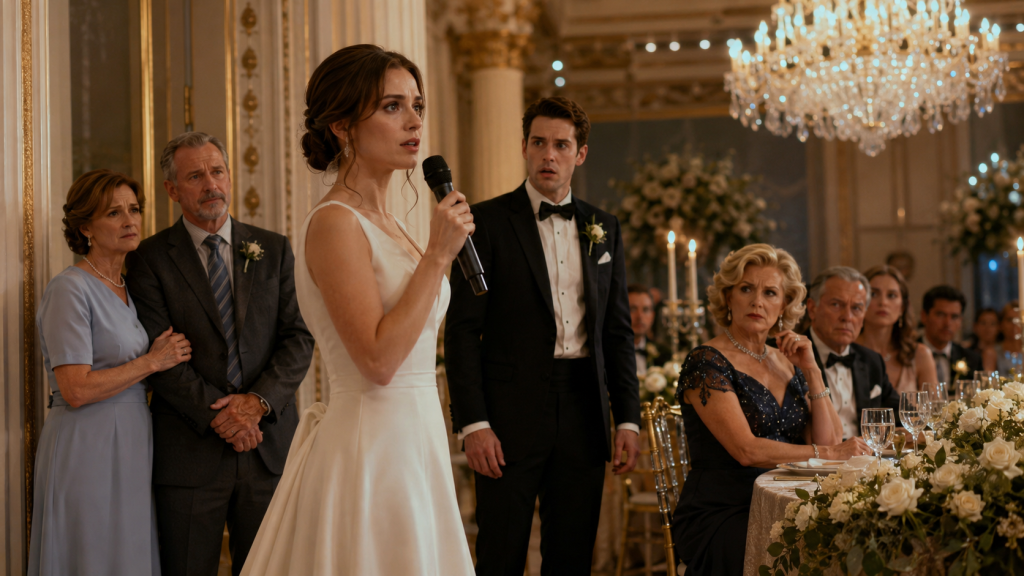
I stood beneath a crystal chandelier that cost more than my parents’ house, wearing a wedding gown Veronica had insisted was “finally appropriate,” and felt something inside me become perfectly still.
Three weeks earlier, the seating chart had been finalized.
My parents’ names were beside mine.
My father had joked that he hoped the chair was strong enough after all the wedding cake he planned to eat.
My mother had cried when she saw the printed card reading:
MOTHER AND FATHER OF THE BRIDE.
That morning, however, my wedding planner had texted me an apology.
Daniel had personally ordered the change.
He had replaced my parents with his aunt, two cousins, an uncle, his older brother, his brother’s wife, Veronica’s sister, Veronica’s sister’s husband, and a family friend who owned several luxury car dealerships.
Nine seats.
Nine people Daniel considered more valuable than the two people who raised me.
I looked at him.
He smiled as though nothing had happened.
“Come on, Claire,” he said. “Don’t make this awkward.”
I smiled back.
That frightened him more than anger would have.
Daniel’s smile slipped.
“Why are you looking at me like that?”
“I’m just thinking.”
“About what?”
“Our future.”
His shoulders relaxed.
He misunderstood completely.
What Daniel and Veronica had never understood was that my quietness was not weakness.
For four years, I had allowed them to believe I was merely a modest marketing consultant who had gotten lucky marrying into a wealthy family.
They never asked who owned the consulting firm.
They never asked why Daniel’s struggling property company suddenly received introductions to private investors.
They never asked why vendors who had previously refused to work with him began offering favorable terms.
They never asked why a regional bank approved a six-million-dollar revolving line of credit after previously declining him twice.
They certainly never asked why every document connected to those deals had passed through my attorney.
Daniel liked believing he was the architect of his own success.
I let him.
At first, because I loved him.
Later, because I wanted to see what he would do with success once he thought it belonged entirely to him.
The answer was standing ten feet away wearing a custom tuxedo and pretending my parents were strangers at my wedding.
I walked toward them.
My father saw me coming and immediately tried to smile.
“Beautiful place,” he said.
His voice was too cheerful.
That hurt more than if he had complained.
My mother reached for my hand.
“Claire, don’t make trouble.”
“Trouble?”
She glanced toward Daniel.
“It’s your wedding day.”
I looked at her.
“No,” I said quietly. “It was supposed to be.”
Her eyes filled.
“Sweetheart—”
“Did anyone explain why your seats were changed?”
My father answered.
“Daniel said there was a misunderstanding.”
I looked toward my groom.
Of course he had.
My father continued, “He said some important investors showed up unexpectedly.”
I almost laughed.
“Those aren’t investors.”
Dad frowned.
“That man in the gray suit?”
“His cousin sells imported kitchen cabinets.”
“The woman beside him?”
“Veronica’s bridge partner.”
My mother closed her eyes.
That was when I knew they had already understood.
They simply hadn’t wanted me to understand too.
“Are you all right?” Dad whispered.
I kissed his cheek.
“I am now.”
My mother searched my face.
“Claire, don’t ruin your day because of us.”
“They already did,” I said softly. “I’m just deciding who gets to keep the pieces.”
Across the ballroom, Veronica snapped her fingers at a waiter.
“Champagne,” she ordered. “For the real family table.”
The waiter glanced uncomfortably toward me.
Daniel raised his glass.
His brother laughed.
And my phone vibrated.
I looked down.
A message from my attorney, Rachel Kim.
FINAL FILES CONFIRMED.
SIGNED GUARANTEES INCLUDED.
YOUR CALL.
I stared at those words.
Rachel and I had been preparing for this possibility for almost three months.
Not this exact humiliation.
Not my parents being removed from my wedding table.
But the possibility that I would discover Daniel was not the man I thought I was marrying.
The warning signs had started shortly after our engagement.
At first, they were small.
Daniel criticizing my father’s truck.
Veronica suggesting my mother should “learn how people dress at proper events.”
Daniel asking if my parents could avoid mentioning that Dad had been an electrician when speaking with some of his business associates.
Once, at a charity dinner, Daniel introduced my father as “retired from the construction industry.”
Dad corrected him.
“Electrical maintenance.”
Daniel laughed as if embarrassed.
That night, I asked why he had lied.
“I didn’t lie.”
“You changed what he did.”
“I simplified it.”
“For whom?”
He had stared at me as though I were being unreasonable.
“Claire, presentation matters.”
That sentence stayed with me.
Presentation matters.
Apparently character did not.
Six months before the wedding, things became worse.
Daniel began treating my professional contacts as though they belonged to him.
He started scheduling lunches with investors I had introduced.
He spoke about “his banking relationships.”
He bragged that his company’s expansion proved he had finally entered “another class.”
Another class.
I asked him what that meant.
He smiled.
“You know exactly what it means.”
I did.
That was when I called Rachel.
Not because I planned to leave.
Because I wanted to know exactly what would happen if I did.
Every guarantee.
Every contract.
Every personal introduction.
Every agreement involving my firm.
We reviewed them one by one.
Rachel discovered something interesting.
Daniel’s company looked successful from the outside.
Inside, it was dangerously dependent on relationships I controlled.
Without my guarantee, the bank could demand additional collateral.
Without my firm’s vendor agreement, his material costs could rise by nearly thirty percent.
Without the investor syndicate I had assembled, his newest development project would lose more than half its committed capital.
Daniel knew none of this.
Because he had never bothered to read the details.
He enjoyed signing documents.
He hated understanding them.
That had become my protection.
Now, standing in my wedding ballroom beside the parents he had humiliated, I typed two words.
Proceed now.
Rachel replied immediately.
CONFIRMED.
My heartbeat slowed.
I handed my bouquet to my mother.
“Hold this for me.”
She stared at me.
“Claire?”
I turned toward the stage.
“Where are you going?”
“To finish my wedding.”
The band had just ended a song.
The emcee was preparing to announce dinner service.
I stepped onto the small stage.
Daniel noticed.
His expression changed.
“What are you doing?” he mouthed.
I reached for the microphone.
The ballroom slowly quieted.
I looked across two hundred guests.
People who had traveled from different states.
Business partners.
Family friends.
Neighbors.
Daniel’s colleagues.
My employees.
My parents’ oldest friends.
People who had known me since childhood.
People who knew only the polished version of Daniel he showed publicly.
I smiled.
“Thank you, everyone, for coming.”
A few guests applauded.
Daniel stood.
“Claire, dinner’s about to start.”
“I know.”
I looked at him.
“That’s why this won’t take long.”
Veronica leaned toward him.
Something about my tone had unsettled her.
Good.
I continued.
“Before we continue, there’s something everyone should know about the man I almost married.”
The ballroom became silent.
Daniel’s face turned white.
Not pale.
White.
“Almost?” someone whispered.
Daniel took one step toward the stage.
“Claire.”
I held up one finger.
“Please don’t interrupt.”
His jaw tightened.
“What exactly are you doing?”
“I’m fixing the seating arrangement.”
A nervous laugh moved through the room.
Veronica stood.
“This is ridiculous.”
I looked directly at her.
“Sit down, Veronica.”
Her mouth opened.
Nobody spoke to Veronica that way.
Apparently everyone had been waiting for someone to try.
She sat.
I turned back toward the guests.
“For four years, Daniel has allowed many of you to believe that his company’s recent success came entirely from his own business skill.”
Daniel shook his head.
“Claire, stop.”
“He has talked publicly about the investors he attracted, the credit facilities he secured, and the favorable supplier agreements that helped his company grow.”
I paused.
“What Daniel has never mentioned is that every major investor was introduced through my firm.”
Murmurs spread through the room.
Daniel stared at me.
I continued.
“The six-million-dollar credit line keeping his operations liquid was approved because I personally guaranteed part of the risk through a holding company he apparently never bothered to research.”
A banker sitting near the front lowered his champagne glass.
Daniel’s brother turned toward him.
Veronica’s face changed.
“And the vendor agreements that reduced his operating costs?” I said. “Negotiated by my company.”
Daniel climbed onto the first stage step.
“Enough.”
I looked down at him.
“No.”
The word echoed through the speakers.
He stopped.
“This morning,” I continued, “I learned that Daniel personally ordered my parents removed from our main table.”
My mother looked down.
My father stared at the floor.
Daniel’s voice sharpened.
“That’s private.”
“You made it public when your mother announced they looked poor in front of half the ballroom.”
People turned toward Veronica.
Her face reddened.
“I never—”
A woman at the next table spoke up.
“Yes, you did.”
Another guest nodded.
“I heard it too.”
Veronica glared at them.
I continued.
“My parents were told their seats were needed for family.”
I pointed gently toward them.
“My parents are my family.”
Applause started somewhere near the back.
One clap.
Then another.
Then dozens.
Daniel looked around furiously.
“Stop clapping!”
That only made it louder.
I waited.
Eventually the room quieted again.
“So,” I said, “fifteen minutes ago, I authorized my attorney to withdraw every guarantee, terminate every discretionary agreement, and notify every partner whose relationship with Daniel’s company existed solely because of me.”
Daniel stared.
He looked as though he had forgotten how to breathe.
“You can’t do that.”
“I already did.”
“You’re bluffing.”
My phone vibrated.
I looked down.
Rachel.
NOTICES DELIVERED.
BANK COUNSEL ACKNOWLEDGED.
INVESTOR GROUP REQUESTING EMERGENCY REVIEW.
I turned the screen toward Daniel.
He read it.
His face collapsed.
Veronica hurried toward him.
“What does that mean?”
Daniel didn’t answer.
She grabbed his arm.
“Daniel?”
He whispered, “The Harbor project.”
His brother frowned.
“What about it?”
Daniel swallowed.
“We could lose financing.”
“How much?”
Daniel said nothing.
I answered.
“Approximately eleven million dollars in committed capital.”
The room erupted with whispers.
Veronica stared at me.
“You did this?”
“No.”
I smiled.
“Daniel did.”
Her expression twisted.
“You vindictive little—”
My father stepped forward.
“Careful.”
His voice was quiet.
But for the first time that day, Veronica looked frightened.
I stepped down from the stage.
I thought it was finished.
Then my phone vibrated again.
Another message from Rachel.
URGENT.
CALL ME.
FOUND SOMETHING IN THE GUARANTEE FILES.
DO NOT SIGN MARRIAGE LICENSE.
I stopped.
Daniel saw my face.
“What?”
I looked at him.
Rachel called before I could answer.
I accepted.
“Rachel?”
Her voice was controlled.
Too controlled.
That meant something serious had happened.
“Claire, are you alone?”
“No.”
“Can you step away?”
I looked around the ballroom.
“No.”
She hesitated.
“Then listen carefully.”
My stomach tightened.
“What did you find?”
“When we prepared the withdrawal notices, my associate reviewed the original collateral package Daniel submitted to Northbridge Bank.”
“Yes?”
“There’s a personal asset schedule attached.”
I remembered it vaguely.
“What about it?”
“Daniel listed an ownership interest in a property he doesn’t own.”
I glanced at him.
“What property?”
Rachel answered.
“Your parents’ house.”
Everything around me disappeared.
The music.
The guests.
The ballroom.
Even Daniel.
For a second, there was only Rachel’s voice.
“What did you say?”
“He represented that he had a future ownership interest based on a family transfer arrangement.”
My hand tightened around the phone.
“There is no arrangement.”
“I know.”
“How did he get the deed information?”
“We’re trying to determine that.”
I stared at Daniel.
He knew.
The moment our eyes met, I knew he knew.
I lowered the phone.
“Rachel, stay on.”
I turned toward him.
“There’s one more thing.”
His expression changed.
Not confusion.
Fear.
Real fear.
“What now?”
I held the microphone again.
“Daniel, why is my parents’ house listed in your bank collateral file?”
The ballroom went absolutely silent.
My father looked up.
“What?”
Daniel’s eyes darted toward the banker near the front.
The banker immediately looked away.
“Claire,” Daniel said. “This is complicated.”
My mother stepped forward.
“Our house?”
Daniel raised both hands.
“Nobody is taking anyone’s house.”
“That wasn’t my question.”
He looked at me.
I repeated it.
“Why is their property listed in your collateral documentation?”
Veronica whispered something to him.
He ignored her.
“It was just projected family equity.”
My father stared.
“What does that mean?”
Daniel sighed, annoyed now.
“It means eventually Claire would inherit the property.”
The way he said it made several guests gasp.
Eventually.
As if my parents’ deaths were a line on his spreadsheet.
My father’s face hardened.
“You used my house to support your loan?”
“No.”
“Yes or no?”
“It wasn’t directly pledged.”
Rachel’s voice came through my phone.
“He’s technically correct.”
I put her on speaker.
Everyone near us heard.
“The house itself was not legally pledged,” Rachel explained. “But Daniel represented an anticipated ownership interest in the property as part of his personal financial statement. That representation appears materially misleading.”
Daniel snapped, “Turn that off!”
I didn’t.
My father looked at him.
“You counted my home as something you would own?”
Daniel ran a hand through his hair.
“This is being exaggerated.”
My mother spoke for the first time.
“You thought we were going to die and leave it to you?”
Nobody moved.
Daniel looked embarrassed rather than ashamed.
“That’s not what I meant.”
She nodded slowly.
“Yes, it is.”
Her voice broke.
And something in me broke with it.
Not painfully.
Cleanly.
Like a rope finally cut.
I took off my wedding ring.
Daniel stared.
“Claire.”
I placed it on the table.
“No.”
He stepped toward me.
“Don’t do something stupid.”
I almost laughed.
“I was about to marry you. I’ve already done something stupid.”
A few guests covered smiles.
Daniel’s eyes hardened.
“You’re humiliating me.”
I looked toward my parents.
“No, Daniel. Humiliation is making two decent people stand against a wall at their daughter’s wedding because their clothes aren’t expensive enough.”
“That was my mother’s decision.”
Veronica gasped.
“Daniel!”
I stared at him.
Interesting.
Ten minutes ago, he had defended it.
Now he was blaming her.
And that told me everything else I needed to know.
“You ordered the seating change.”
He froze.
The wedding planner, Melissa, was standing beside the ballroom entrance.
I looked at her.
“Melissa?”
She hesitated.
Then nodded.
“He did.”
Daniel spun around.
“What the hell?”
She straightened.
“You told me the bride approved.”
He pointed at her.
“You work for us.”
“No,” I said. “She worked for the wedding.”
Melissa’s expression softened.
“Claire, I’m sorry.”
“Not your fault.”
Daniel turned back to me.
“Fine. I changed the seats. It was one table.”
“One table showed me exactly how you see my family.”
He lowered his voice.
“You’re throwing away four years because of chairs?”
“No.”
I stepped closer.
“I’m throwing away four years because today you finally stopped pretending.”
That silenced him.
Veronica pushed through the crowd.
“You ungrateful woman.”
I looked at her.
“Ungrateful?”
“We welcomed you.”
“You tolerated me.”
“We gave you access to a world you never would have seen otherwise.”
Several people visibly winced.
Veronica continued.
“Do you think anyone here would know your name if it weren’t for Daniel?”
A laugh came from the front table.
Not mocking me.
Mocking her.
The man laughing was Arthur Bell, founder of Bell Capital.
One of Daniel’s largest investors.
He stood.
“Actually, Veronica, I know Daniel because of Claire.”
Her face changed.
Arthur looked toward me.
“Claire’s firm handled our West Coast expansion three years ago.”
Another woman stood.
“So did ours.”
Then another man.
“Claire introduced me to Daniel.”
One by one, people spoke.
Not everyone.
They didn’t need to.
Enough.
Veronica slowly turned toward her son.
For the first time, she seemed to understand that the social hierarchy she worshipped had been upside down all along.
Daniel whispered, “Claire, can we talk privately?”
“No.”
“Please.”
The word surprised me.
I had almost never heard him use it.
He lowered his voice.
“We can fix this.”
I looked at him.
“What part?”
“The seating.”
I stared.
He genuinely still didn’t understand.
“The wedding is over.”
His mouth opened.
“Claire—”
“I’m not marrying you.”
My mother covered her mouth.
My father closed his eyes.
Daniel stared at me like I had spoken another language.
“You can’t cancel a wedding after the ceremony.”
“We haven’t signed the license.”
His face changed.
Our officiant stood quietly near the stage.
I looked at him.
“Correct?”
He nodded.
“The license has not been signed.”
Daniel turned toward him.
“You already pronounced us married.”
The officiant answered carefully.
“The legal documentation remains incomplete.”
Daniel looked at me again.
“You planned this.”
“No.”
I shook my head.
“I prepared to protect myself. There’s a difference.”
His voice dropped.
“You never trusted me.”
“I trusted you for years.”
I looked around the ballroom.
“You spent every one of them teaching me not to.”
For the first time, Daniel had nothing to say.
I picked up my bouquet from my mother.
“Mom.”
She looked terrified.
“Yes?”
“Do you still want dinner?”
She blinked.
“What?”
I turned toward the guests.
“There are two hundred meals already paid for.”
A few people laughed nervously.
“So I see no reason good food should go to waste.”
I looked at Daniel’s relatives sitting at the main table.
“But we are fixing the seating chart.”
My father laughed.
A genuine laugh.
It broke the tension.
I pointed toward the center table.
“Mom. Dad. Those seats are yours.”
Daniel’s cousin immediately stood.
Then another relative.
Within seconds, the entire table emptied.
Veronica remained seated.
I looked at her.
She looked at me.
Nobody spoke.
Finally, Arthur Bell cleared his throat.
“Veronica.”
She stared at him.
He nodded toward another table.
“There seems to be space near the service entrance.”
Laughter exploded across the ballroom.
Even my father laughed.
Veronica stood so abruptly her chair nearly tipped.
“This family will hear about this.”
My mother murmured, “Which family?”
I almost choked.
It was the most savage thing I had ever heard her say.
Veronica left the ballroom.
Three of her relatives followed.
Daniel remained.
He looked around as though waiting for someone to stand beside him.
Nobody did.
His brother finally approached.
“What did you do?”
Daniel frowned.
“Not now.”
“No. Now.”
His brother pointed toward me.
“You told us Claire worked for some small agency.”
Daniel looked furious.
“She does.”
I shook my head.
“I own it.”
His brother stared.
“What?”
“Meridian Strategy Group.”
He went still.
Apparently he recognized the name.
Daniel muttered, “It doesn’t matter.”
His brother laughed once.
“You told Dad Meridian was one of your strategic partners.”
Daniel looked away.
His brother stared at him for several seconds.
Then he removed the flower from his lapel and placed it on the table.
“I’m leaving.”
Daniel grabbed his arm.
“Michael.”
Michael pulled away.
“You used Mom’s snobbery because it made you feel important.”
He looked at my parents.
“I’m sorry.”
My father nodded.
Michael left.
Daniel’s shoulders dropped.
I should have felt triumphant.
I didn’t.
I felt tired.
Deeply tired.
Four years.
That was what hurt.
Not the table.
Not the money.
Not even the collateral lie.
Four years of dinners.
Vacations.
Birthdays.
Sunday mornings.
Plans.
Promises.
A thousand memories suddenly requiring reinterpretation.
Had he loved me?
Maybe.
In his way.
But I finally understood that Daniel’s way of loving people depended on what they gave him.
Status.
Access.
Security.
Validation.
And when someone offered nothing he valued, he treated them like my parents.
Disposable.
My father touched my shoulder.
“You don’t have to stay.”
I looked around.
“I think I do.”
“Why?”
“Because running out makes this feel like something happened to me.”
I took a breath.
“I want to remember that I chose what happened next.”
Dad nodded.
We sat.
Dinner was strange.
And wonderful.
The band continued playing because they had been paid.
The catering staff served steak and sea bass.
Guests moved freely between tables.
Some left quietly.
Most stayed.
People came to hug me.
Some apologized for Daniel.
Others told me stories I wished they had mentioned earlier.
A former employee told me Daniel once referred to me as “my best acquisition.”
A vendor admitted Daniel had bragged that marriage would eventually give him access to “Claire’s family assets.”
That one almost made me laugh.
My family assets.
A seventy-year-old house.
Dad’s pickup truck.
Mom’s ceramic Christmas village.
And parents whose value Daniel had never been wealthy enough to recognize.
Around nine that evening, Rachel arrived.
She walked into the ballroom wearing jeans, a black blazer, and the expression of someone who had missed dinner because she had spent hours ruining a dishonest man’s week.
I hugged her.
“You came.”
“You said there was cake.”
“There is.”
“Then obviously.”
She looked toward Daniel.
He was sitting alone near the bar.
“Has he left?”
“No.”
“Interesting.”
“Why?”
“Because his attorney has called me fourteen times.”
I blinked.
“Already?”
“The bank contacted him.”
“That quickly?”
“When six million dollars suddenly becomes less secure, bankers discover impressive speed.”
I glanced toward Daniel.
He was staring into a glass of whiskey.
Rachel handed me a folder.
“What’s this?”
“Copies.”
“Of?”
“The asset schedule.”
I opened it.
There it was.
My parents’ address.
Estimated property value.
Future beneficial interest.
My stomach turned.
“How bad is it?”
“For him?”
“Yes.”
“Potentially very bad.”
“Criminal?”
Rachel chose her words carefully.
“Too early to say. Misrepresentations on financial documents can create serious consequences, but we’re not jumping ahead. The bank will investigate.”
I nodded.
“Did he forge anything?”
“Not that we’ve confirmed.”
“Then how did he get the property details?”
Rachel looked toward my parents.
“I have a theory.”
“What?”
“Did your mother ever give Daniel copies of family documents?”
I thought.
Then remembered.
“Insurance.”
Rachel frowned.
“What?”
“Last year after Dad had surgery, Daniel offered to help organize their emergency documents.”
My stomach dropped.
Mom had been grateful.
Daniel had created a digital folder.
Insurance policies.
Property tax records.
Utility accounts.
A copy of the deed.
I closed my eyes.
“He had everything.”
Rachel nodded.
“That may explain access.”
My father had come close enough to hear.
He looked devastated.
“I gave him those papers.”
I turned.
“Dad.”
“I trusted him.”
“So did I.”
He stared at the document.
“I should’ve known.”
“No.”
I took his hands.
“Daniel should have been trustworthy.”
Dad’s eyes filled.
I had seen my father cry exactly three times.
When his mother died.
When I graduated.
When I got engaged.
The third memory hurt now.
He looked at me.
“I’m sorry your wedding ended like this.”
I hugged him.
“My wedding didn’t end.”
He pulled back.
“What?”
“It just changed.”
I looked around the ballroom.
My mother was dancing with one of my college friends.
The band was playing an old Motown song.
Guests were laughing.
Someone had removed the decorative sign reading MR. & MRS. WHITMORE from behind the cake.
My cousin had replaced it with a handwritten napkin taped to the table.
CLAIRE’S ESCAPE PARTY.
I laughed.
“This is the first honest wedding reception I’ve attended.”
Dad laughed too.
Across the room, Daniel stood.
He walked toward me.
Rachel stepped between us.
“No.”
He stopped.
“I need to talk to Claire.”
“You can speak through counsel.”
“Rachel, this isn’t business.”
She looked at the folder.
“It became business when you listed her parents’ home in a financial disclosure.”
His jaw tightened.
“Claire.”
I stepped beside Rachel.
“What?”
He looked exhausted now.
Less polished.
Less impressive.
Human.
For a second, I remembered the man I had loved.
The Daniel who brought soup when I had the flu.
The Daniel who once drove four hours because my car broke down.
The Daniel who danced barefoot with me in the kitchen during a thunderstorm.
I wanted that man to explain everything.
But perhaps that man had always existed beside this one.
People are rarely monsters every hour of every day.
That’s what makes leaving them difficult.
Daniel lowered his voice.
“I’m sorry.”
I waited.
“For?”
He looked confused.
Everything, apparently, had not occurred to him.
“The table.”
I almost smiled.
“There it is again.”
“What?”
“You keep apologizing for the furniture.”
He rubbed his face.
“I’m sorry about your parents.”
“Why?”
“Because they were embarrassed.”
“That’s an outcome. Why were you willing to embarrass them?”
He looked toward the floor.
I waited.
Finally he said, “I wanted today to look right.”
“What does right look like?”
He said nothing.
“Expensive?”
Silence.
“Connected?”
Still nothing.
“Useful?”
His eyes lifted.
“That’s not fair.”
“No?”
“I’ve worked my entire life to build something.”
“So did my parents.”
“That’s different.”
“Why?”
He opened his mouth.
Closed it.
I nodded.
“Exactly.”
He looked at me desperately.
“I got caught up.”
“For four years?”
“My mother puts pressure on me.”
“You are thirty-seven years old.”
“I know.”
“She didn’t submit my parents’ house as your future asset.”
His expression hardened.
“I already told you. It wasn’t collateral.”
“You represented it as wealth you expected to receive.”
“Eventually it would come to you.”
“Maybe.”
“And we would be married.”
“Maybe.”
His face changed.
“Claire, married people share things.”
“Not dead parents.”
He flinched.
Good.
“You wrote their home into your financial story as if their deaths were already scheduled.”
“That’s not what happened.”
“It is exactly what happened.”
He looked toward Rachel.
“She’s twisting this.”
Rachel laughed.
“I’ve barely spoken.”
Daniel turned back to me.
“Please don’t destroy my company over this.”
There it was.
Not us.
The company.
“What happens if I don’t withdraw my support?”
He answered too quickly.
“We fix everything.”
“How?”
“Counseling.”
“What else?”
“I’ll apologize to your parents.”
“What else?”
He hesitated.
I watched his mind calculating.
“You can choose every holiday.”
I actually laughed.
“You think this is about Thanksgiving?”
His cheeks reddened.
“What do you want from me?”
“The truth.”
“I’m giving you the truth.”
“No. You’re negotiating.”
That stopped him.
I stepped closer.
“You don’t want me back, Daniel. You want your financing back.”
“That’s not true.”
“Then choose.”
His eyes narrowed.
“What?”
“Me or the company.”
Rachel looked at me.
Daniel stared.
I continued.
“If you mean what you’re saying, shut down the Harbor project voluntarily. Sell the assets. Pay every creditor. Walk away from the company.”
His face went blank.
“We can start over.”
“You’re insane.”
I nodded slowly.
“Thank you.”
He realized too late.
“You tricked me.”
“No. I gave you a choice.”
“That company is twelve years of my life.”
“And I was supposed to be the rest of it.”
He looked away.
There was my answer.
I removed the small silver bracelet he had given me on our first anniversary.
I had worn it under my wedding sleeve.
I placed it beside the ring.
“Goodbye, Daniel.”
He didn’t stop me.
Three weeks later, Northbridge Bank suspended Daniel’s line of credit pending review.
Two major investors paused funding.
One withdrew completely.
The Harbor project stalled.
Daniel’s company didn’t collapse overnight.
Real life is rarely that dramatic.
Instead, it shrank.
Slowly.
Painfully.
He sold two properties.
Then office space.
Then his Mercedes.
By winter, half his staff had left.
I took no joy in that.
Many of those employees were good people.
Through Rachel, I helped several find positions with firms I knew.
Daniel never learned that.
Or perhaps he did.
I stopped caring.
The bank ultimately determined that the reference to my parents’ property had been misleading but had not created a valid security interest.
There were penalties.
Legal fees.
A revised lending arrangement.
No one lost a house.
My parents changed every document password Daniel had ever known.
Dad installed a safe.
Mom bought a paper shredder powerful enough to destroy a phone book.
She seemed oddly excited about it.
Veronica sent me three letters.
I returned the first unopened.
The second arrived through certified mail.
I gave it to Rachel.
The third came six months later.
This one was different.
No accusation.
No threat.
Just four sentences.
Claire,
I judged your parents by appearances and encouraged my son to do the same.
What happened that day has forced me to confront things about myself I do not like.
I am sorry.
I read it twice.
Then placed it in a drawer.
I never replied.
Forgiveness and reconciliation are different things.
I eventually forgave her.
From a distance.
A very comfortable distance.
Daniel contacted me exactly once after the lawyers completed everything.
It was nearly a year after the wedding.
I was leaving my office when I found him standing across the street.
He looked thinner.
Older.
Not ruined.
Just humbled.
“Can we talk?”
I considered walking away.
Instead, I nodded.
We went to a coffee shop.
Nothing elegant.
Nothing impressive.
Just chipped wooden tables and mugs that didn’t match.
He smiled sadly.
“You would’ve liked this place.”
“I do.”
“I know.”
We sat.
For a while neither of us spoke.
Finally, he said, “I’m sorry.”
I waited.
He smiled faintly.
“You’re waiting to ask what for.”
“Yes.”
“Everything.”
That answer surprised me.
He looked down at his coffee.
“I spent my whole life terrified of being ordinary.”
I said nothing.
“My father always talked about winners and losers. My mother cared about appearances. I thought success meant entering rooms where nobody could look down on me.”
He laughed quietly.
“Then I became the person looking down.”
“Yes.”
He nodded.
“I know.”
I studied him.
“Why did you remove my parents from the table?”
He took a breath.
“Because Arthur Bell was there.”
I frowned.
“He already knew my parents.”
“I didn’t know that.”
“Why did that matter?”
“I thought if he saw where you came from, he might think differently about me.”
I stared at him.
There it was.
The ugliest truth.
Simple.
Pathetic.
Human.
“And instead?”
Daniel smiled without humor.
“He thought differently about me.”
“Yes.”
He nodded.
“I deserved that.”
I looked out the window.
People hurried along the sidewalk.
Nobody knew the man across from me had once stood beside me beneath a chandelier while I prepared to marry him.
Nobody cared.
That realization felt freeing.
Daniel spoke again.
“I did love you.”
I looked at him.
“I believe you.”
His eyes widened slightly.
“But you loved what being with me did for your life too.”
He looked down.
“Yes.”
“And eventually you couldn’t tell the difference.”
He swallowed.
“No.”
I stood.
He looked up.
“That’s it?”
“That’s it.”
“Will I ever see you again?”
I thought about it.
“Probably not.”
He nodded.
“Are you happy?”
The question surprised me.
I smiled.
“Yes.”
And I was.
Not because I had found someone else.
I hadn’t.
Not yet.
I was happy because my life finally belonged entirely to me.
My business expanded.
My parents traveled.
Dad bought a newer truck but kept the old one because he said “the engine still had plenty of argument left in it.”
Mom wore her pale blue wedding dress again to their fortieth anniversary dinner.
When I saw her in it, I cried.
She laughed.
“Why are you crying?”
“Because it looks better now.”
She understood.
Two years after my wedding that wasn’t, my parents renewed their vows.
Nothing fancy.
A small garden behind a community hall.
Fifty guests.
Folded chairs.
Homemade flowers.
Dad wore the same charcoal suit.
Mom wore pale blue.
Before the ceremony, Dad looked at the seating arrangement.
Then looked at me.
“You got a chair?”
I laughed.
“Front row.”
“Good.”
He pointed toward the empty seat beside mine.
“What’s that one?”
“Reserved.”
“For who?”
I smiled.
“Family.”
Dad rolled his eyes.
During dinner, he stood and tapped his glass.
Everyone turned.
He looked at Mom.
Then at me.
“I’m not much for speeches.”
“That’s a lie,” Mom said.
Everyone laughed.
Dad continued.
“I spent a lot of my life thinking my job was to give my daughter more than I had.”
He paused.
“A better education. Better opportunities. Better everything.”
His voice softened.
“But somewhere along the way, she taught me something.”
He looked at me.
“You don’t measure a good life by what your table costs.”
My eyes filled.
“You measure it by who deserves a seat.”
The entire room applauded.
I looked around.
Neighbors.
Friends.
Coworkers.
People who had known us when we had very little.
People who had stayed when nobody had anything to offer except themselves.
And I thought about that ballroom.
The chandelier.
The champagne.
The imported flowers.
The engraved menus.
All the expensive things that had seemed so important.
None of them mattered now.
What mattered was one sentence.
They look poor.
Veronica had meant it as an insult.
Instead, she had given me the clearest warning of my life.
She showed me exactly what kind of family I was entering.
And Daniel’s answer showed me exactly what kind of husband he would become.
They’ll be fine.
He was right about one thing.
My parents were fine.
Better than fine.
So was I.
As the anniversary dinner continued, my mother came over and squeezed my hand.
“Any regrets?”
I knew what she meant.
I looked toward Dad laughing with old coworkers.
I looked around the modest room.
Then I smiled.
“Only one.”
Her expression softened.
“What?”
“That I almost married him before seeing who he really was.”
Mom kissed my forehead.
“Sometimes people reveal themselves exactly when you need them to.”
I looked at her pale blue dress.
“Apparently sometimes they do it at the seating chart.”
She laughed.
Later that night, after everyone had gone, I helped my parents carry flowers to their car.
Dad opened the passenger door for Mom.
He had been doing it for forty years.
She still smiled every time.
Before climbing in, he looked at me.
“You know something?”
“What?”
“That boy called us poor.”
I smiled.
“Technically his mother did.”
“He agreed.”
“True.”
Dad leaned against the car.
“I’ve been thinking about that.”
“Oh no.”
He ignored me.
“When I was twenty-three, your mother and I had eighty dollars left after rent.”
Mom called from inside the car.
“Sixty-four.”
Dad nodded.
“Apparently sixty-four.”
I laughed.
“We shared one car. Ate a lot of potatoes. Couldn’t afford air conditioning.”
Mom added, “You were too cheap to turn it on when we eventually got it.”
“That is not the point.”
He looked back at me.
“We were poor.”
I waited.
“But I never once felt ashamed of your mother.”
His voice grew quiet.
“That’s the difference.”
I stopped smiling.
Dad continued.
“Money comes and goes. Work comes and goes. Houses, cars, all of it.”
He tapped his chest.
“But if the person beside you makes you ashamed of where you came from, they’ll eventually make you ashamed of who you are.”
I hugged him.
Hard.
He patted my back.
“Also, never marry anyone who dislikes electricians.”
I laughed into his shoulder.
“Very specific advice.”
“Excellent advice.”
They drove away.
I stood beneath the parking-lot lights watching their taillights disappear.
Then I returned to my car.
My phone buzzed.
A message from Arthur Bell.
Dinner next week? Meridian expansion discussion.
I smiled.
Life continued.
That was perhaps the greatest surprise.
When my wedding collapsed, I thought everything would feel permanently marked by that day.
It didn’t.
The humiliation faded.
The anger faded.
Even Daniel faded.
But one thing remained.
Clarity.
I stopped making myself smaller to keep other people comfortable.
I stopped pretending cruel jokes were harmless.
I stopped confusing silence with peace.
At work, I became more direct.
With friends, more honest.
With family, more present.
And when someone showed me contempt disguised as sophistication, I believed them the first time.
Three years later, Meridian opened its third office.
At the celebration, my mother cut the ribbon.
My father complained that the scissors were dull.
There were reporters.
Employees.
Clients.
Investors.
Afterward, one journalist asked me how I had built the company.
I could have talked about strategy.
Capital.
Risk.
Market timing.
Instead, I looked toward my parents.
Dad was explaining something electrical to a young intern who clearly regretted asking.
Mom was rearranging the catering plates because she thought the cookies looked “lonely.”
I smiled.
“I learned early that value isn’t always obvious.”
The journalist looked confused.
I continued.
“Some people walk into expensive rooms and assume wealth tells them who matters.”
I paused.
“It doesn’t.”
She wrote that down.
Years ago, I might have worried how that sounded.
Now I didn’t.
Because I knew exactly what wealth looked like.
It looked like a mother saving six months for a pale blue dress.
It looked like a father carrying her purse because her hands were shaking.
It looked like scarred hands that worked thirty years without demanding applause.
It looked like parents willing to stand against a ballroom wall rather than ruin their daughter’s wedding.
It looked like loyalty.
Dignity.
Love.
And when I remembered Daniel sitting at that glittering table surrounded by nine people he called “family,” I understood something he never did.
He had been seated among the poorest people in the room.
Not because of their bank accounts.
Because they could look at two good people and see only what their clothes cost.
The wedding I lost saved me from the marriage I would have regretted.
And whenever someone asks whether I wish I had discovered the truth earlier, I always give the same answer.
Of course.
But life rarely reveals people on our preferred schedule.
Sometimes truth arrives quietly.
Sometimes it arrives in financial documents.
Sometimes it arrives through the voice of a cruel mother-in-law.
And sometimes it appears at your wedding, where the two people who love you most are left standing while strangers steal their chairs.
When that moment comes, you have a choice.
Ignore it because everyone is watching.
Smile because the flowers are already paid for.
Sign the papers because admitting the truth feels embarrassing.
Or pick up the microphone.
I picked up the microphone.
And it changed my life.
💬THE END! THANK YOU FOR READING!