

Easter dinner was supposed to be the last peaceful meal before I gave my son the answer he didn’t want.
Instead, it became the night my daughter-in-law threw a wine glass at me, my son accused me of overreacting, and two police officers stood beside my hospital bed asking whether I felt safe returning to my own home.
My name is Margaret Lawson.
I’m sixty-two years old, widowed, and until that Easter Sunday, I had spent most of my life believing that keeping peace in a family was worth almost any personal inconvenience.
Almost.
My husband, Richard, died six years ago.
We had been married for thirty-seven years.
He was the sort of man who checked every window twice before bed, sharpened the lawn mower blades every spring, and kept every important document in labeled folders inside a fireproof cabinet.
When he passed, I inherited our four-bedroom house outside Columbus, Ohio, outright.
The mortgage had been paid off years earlier.
There were no liens.
No loans.
No co-owners.
The deed carried one name.
Mine.
That fact should have been simple.
But somehow, over the previous three months, my son Daniel and his wife Vanessa had begun treating my house like a family resource waiting to be redistributed.
It started casually.
Vanessa’s parents, Frank and Linda Mercer, had been renting a townhouse across town.
Their landlord planned to renovate the building when their lease expired.
Daniel mentioned it over coffee one Sunday.
“Frank and Linda might need somewhere to stay for a few weeks,” he said.
I remember looking over the rim of my mug.
“A few weeks?”
“Just while they find another place.”
“I’m sure they’ll find something.”
He nodded.
Conversation over.
Or so I thought.
A week later, Vanessa brought it up.
“You have all that room upstairs.”
I set down the dish towel I was folding.
“I have bedrooms upstairs.”
“Exactly.”
“They’re not available.”
She laughed as though I had made a joke.
“Margaret, nobody uses them.”
“I do.”
“For what?”
“One is my sewing room. One is Richard’s old study. The other is a guest room.”
“You don’t need three extra rooms.”
I remember the way she said need.
As if ownership depended on necessity.
As if unused space became public property.
I told her no.
A few days later, Daniel called.
“Mom, they’d pay utilities.”
“No.”
“They could help around the house.”
“No.”
“You’re alone.”
“That doesn’t mean I’m helpless.”
“They’re family.”
“They’re your wife’s parents, Daniel. I like them well enough, but that does not mean they are moving into my home.”
He sighed.
“You’re making this harder than it needs to be.”
I had heard that sentence before.
Usually from people asking me to surrender something.
Time.
Money.
Privacy.
Boundaries.
By the seventh time the subject came up, temporary had evolved into something much more permanent.
Vanessa suggested Frank could turn my garage into a woodworking shop.
Linda could “take over” the flower beds.
They could use the upstairs bathroom.
Perhaps install a small refrigerator.
Perhaps build shelves.
Perhaps redirect their mail.
Perhaps change the internet package because Frank needed faster service.
That was when I called my attorney.
Rachel Kim had handled Richard’s estate.
She was in her early forties, sharp-eyed, calm, and almost impossible to rattle.
When I explained what was happening, she listened without interrupting.
Then she asked, “Has Daniel ever had access to your paperwork?”
“He has a spare house key.”
“That wasn’t my question.”
I hesitated.
“He knows where Richard kept important things.”
“Have you noticed anything missing?”
“No.”
“Moved?”
That answer took longer.
“A few times.”
Rachel leaned back.
“What kind of things?”
“Property tax statements. Insurance papers. Richard’s old estate documents.”
“Who has been in the house?”
“Daniel and Vanessa.”
She folded her hands.
“Margaret, I’m not telling you they’ve done anything illegal. But I am telling you to secure your documents and stop discussing the house with them.”
That conversation had happened three weeks before Easter.
Rachel helped me obtain a fresh certified copy of my deed.
She reviewed my estate plan.
She updated several documents.
She suggested I move original records to a safe deposit box.
And then she said something I hadn’t forgotten.
“If someone keeps pushing after seven clear refusals, they’re no longer asking. They’re testing how difficult you’ll be to override.”
That sentence changed the way I saw everything afterward.
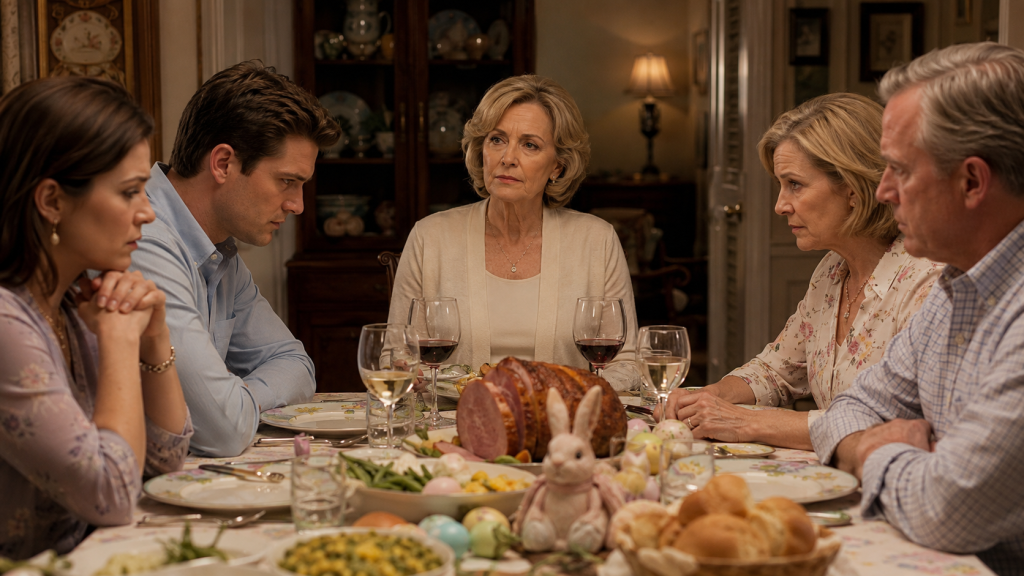
At Easter dinner, I planned to make myself clear one final time.
Frank and Linda were seated at my table.
Linda had brought a lemon pie.
Frank brought a bottle of wine.
Daniel carved the ham.
Vanessa barely spoke through the first half of dinner.
I almost believed we might get through the afternoon peacefully.
Then Daniel cleared his throat.
“Mom.”
I knew that tone immediately.
“Frank’s lease ends next month.”
I put down my fork.
“He needs somewhere affordable.”
“They need to find an apartment.”
Vanessa’s fork struck her plate.
“You have empty bedrooms!”
“They’re my bedrooms.”
Frank stared at his plate.
Linda looked uncomfortable.
Daniel frowned.
“Mom, be reasonable.”
“I am being reasonable.”
“You’re living alone in a four-bedroom house.”
“Yes.”
“Doesn’t that seem wasteful?”
“No.”
Vanessa laughed under her breath.
Something inside me hardened.
“My house is not a community housing project.”
“You’re being selfish,” Daniel snapped.
I looked directly at my son.
“You don’t get to volunteer my house.”
Vanessa shoved her chair backward.
“My parents helped us for years! You sit here alone in this giant house and won’t inconvenience yourself for family?”
“I said no.”
She grabbed her wine glass.
For half a second, I thought she was only gesturing with it.
Then her arm moved.
The glass flew.
Linda screamed.
It struck me before hitting the floor.
Everything stopped.
Not metaphorically.
Stopped.
The room went completely silent except for the faint hum of my refrigerator.
Daniel jumped up.
Vanessa stared at me.
“Oh, come on!” she shouted. “I didn’t mean to hit her!”
I pressed a napkin against the injury.
Daniel moved toward me.
“Mom—”
I stepped away.
“Don’t.”
“It was an accident.”
Vanessa was already crying.
Not because I was hurt.
Because she was frightened by the consequences.
I picked up my purse.
“Don’t clean anything up.”
Daniel stared.
“What?”
“Leave everything exactly where it is.”
“Mom, you’re overreacting.”
And that was the sentence that ended something between us.
Not the glass.
Not Vanessa shouting.
Not even the weeks of pressure.
That sentence.
You’re overreacting.
I looked at the son I had carried, raised, driven to soccer practices, helped through college, sat beside during his first heartbreak, lent money to after his wedding, and defended more times than I could count.
And I realized he was not asking whether I was all right.
He was calculating how inconvenient my reaction might become for him.
I left.
At a red light on the way to the hospital, I took several photographs.
Then I called no one.
I simply kept driving.
At the emergency room, a nurse treated me while I opened my phone.
I texted Rachel.
Phase one is complete.
She replied almost immediately.
Do not discuss the house with them. Save everything. Police should be notified.
Before I could answer, two Columbus police officers walked into the treatment area.
Apparently Linda had called.
One officer introduced himself as Officer Ramirez.
The other, Officer Collins, carried a notebook.
“Mrs. Lawson?”
“Yes.”
“We received a report of an assault at your residence.”
I looked toward the folded napkin on the tray beside me.
For the first time that evening, I smiled.
Not because any of this was funny.
Because Vanessa thought she had thrown a wine glass.
What she had actually thrown was the first domino.
Officer Collins asked me to explain what happened.
So I did.
No embellishment.
No dramatics.
I told them about dinner.
The argument.
My repeated refusal.
The glass.
Daniel’s reaction.
Then Ramirez asked the question that mattered.
“Does Mrs. Lawson—your daughter-in-law—have access to your house?”
“Not directly.”
“What does that mean?”
“My son has a key.”
He wrote something down.
“Does your son live there?”
“No.”
“Does he receive mail there?”
“No.”
“Does he contribute financially?”
“No.”
“Has he been given permission to allow other people to live there?”
“Absolutely not.”
The officers exchanged a glance.
I thought about the paperwork I had noticed moved.
The questions Vanessa had asked.
What was your property tax this year?
Did Richard ever put Daniel on the deed?
Would the house automatically go to Daniel someday?
Wouldn’t it be easier if everybody just lived together?
At the time, each question had seemed irritating.
Together, they formed a pattern.
Rachel texted again.
Change the locks tonight. Do not warn them. Tomorrow morning, come directly to my office. We have enough to move forward.
My phone rang.
Daniel.
I declined the call.
It rang again.
Declined.
Then a voicemail appeared.
I listened with the volume low.
“Mom, don’t involve the police. Vanessa is sorry. We need to talk about the house before you do something you’ll regret.”
I saved it.
Officer Ramirez noticed.
“Your son?”
“Yes.”
“Keep that voicemail.”
“I intend to.”
By the time I left the hospital, it was after nine.
Linda had called twice.
Frank once.
Vanessa eleven times.
Daniel sixteen.
I responded to none of them.
Instead, I called a twenty-four-hour locksmith.
When I pulled into my driveway, a patrol car was waiting.
The officers had arranged for someone to meet me because the people involved might still be present.
They weren’t.
The dining room looked exactly as I had left it.
Chairs crooked.
Dinner abandoned.
Broken glass on the floor.
A stain spreading across the rug Richard and I had bought on our thirtieth anniversary.
The sight of that rug nearly broke me more than the injury had.
Not because it was valuable.
Because I could remember the afternoon we bought it.
Richard insisting the blue one looked better.
Me insisting the green one warmed the room.
Him pretending to surrender dramatically in the middle of the store.
We had laughed all the way home.
Now the rug had become part of a police report.
I stood in the doorway until Officer Collins asked gently, “Are you okay?”
I nodded.
“Yes.”
And I meant it differently than he probably understood.
I was done being afraid of what would happen if I stopped accommodating people.
The locksmith arrived forty minutes later.
Every exterior lock was changed.
The garage keypad reset.
The security system password replaced.
Daniel’s code deleted.
Then I went upstairs and checked Richard’s old study.
The top drawer of the desk was open.
I always closed it.
Always.
Inside were copies of insurance policies, utility statements, old mortgage papers, and estate documents.
Nothing seemed missing.
But several folders were out of order.
I photographed everything.
Then I noticed something on the carpet beside the desk.
A small white corner.
I bent down.
It was a torn piece of printer paper.
Only three words remained.
OWNER OCCUPANCY AFFIDAVIT.
I stared at it.
I didn’t know exactly what it meant.
But Rachel would.
I placed it in an envelope without touching it more than necessary.
At nine the next morning, I was sitting in Rachel’s office.
She read the police report.
Reviewed the hospital paperwork.
Listened to Daniel’s voicemail.
Then I handed her the torn paper.
Her expression changed.
“Where did you find this?”
“Beside Richard’s desk.”
She looked at it again.
“Did you print anything involving an owner occupancy affidavit?”
“No.”
“Did you apply for refinancing?”
“No.”
“A home equity loan?”
“No.”
“Transfer title?”
“Absolutely not.”
Rachel picked up her phone.
She made two calls.
The first was to the county recorder’s office.
The second was to a title company she trusted.
Then she looked at me.
“We’re going to check something.”
“What?”
“Whether anyone has tried to create an interest in your property.”
My stomach tightened.
“What does that mean?”
“It could mean nothing.”
“Rachel.”
She sighed.
“It could mean someone explored refinancing, transfer documents, occupancy claims, or some other transaction involving your address.”
“Without me?”
“Exploring and completing are very different things.”
I sat back.
“Daniel wouldn’t do that.”
Rachel didn’t answer.
That silence hurt.
For twenty minutes, she worked at her computer.
Then she turned the monitor toward me.
“No transfer has been recorded.”
Relief came quickly.
Then disappeared when she continued.
“But someone recently requested multiple certified copies of your deed.”
I stared at her.
“Who?”
“We don’t know yet.”
“Can anybody do that?”
“In many cases, property records are public.”
“Then maybe it means nothing.”
“Maybe.”
The word hung between us.
Rachel reached for a folder.
“There’s something else we need to discuss.”
She slid several papers toward me.
These were documents we had prepared weeks earlier.
A revised will.
A transfer-on-death affidavit.
A durable power of attorney naming someone other than Daniel.
A medical directive.
I had signed some but delayed filing the property document because I kept hoping the family situation would calm down.
Rachel tapped it.
“You told me you wanted the house eventually divided between Daniel and two charities Richard supported.”
“Yes.”
“Do you still want that?”
I thought of the dining room.
Vanessa’s arm moving.
Daniel saying I was overreacting.
His voicemail warning me not to do something I would regret.
“No.”
Rachel waited.
“I don’t want Daniel making decisions about my home while I’m alive.”
“He can’t.”
“I know.”
“And after you’re gone?”
I looked out the window.
“Richard and I always talked about donating part of our estate to the veterans’ housing foundation.”
“Yes.”
“He also loved the community scholarship program.”
Rachel nodded.
“What are you thinking?”
“I’m thinking Daniel already believes the house is his someday.”
“That isn’t uncommon.”
“He’s treating my future death like a pending real-estate transaction.”
Rachel said nothing.
“I want the house placed in a trust.”
“For what purpose?”
“For me to live here as long as I choose. After I’m gone, I want it sold.”
“And the proceeds?”
“Half to the veterans’ housing foundation. Half to the scholarship fund.”
Rachel’s eyebrows rose slightly.
“That is a significant change.”
“Yes.”
“You should not make it solely from anger.”
“I’m not.”
“Think about it.”
“I have.”
“For longer than one night?”
I met her eyes.
“For six years.”
That surprised her.
I told her something I had never told Daniel.
After Richard died, Daniel’s behavior toward money changed.
Not dramatically.
Slowly.
He began asking what accounts I had.
Whether Dad had life insurance.
Whether there were investments.
Whether I planned to stay in the house.
At first I thought he was worried about me.
Then one afternoon, less than three months after the funeral, I heard him tell Vanessa in my kitchen, “Eventually the house will be ours.”
Not mine.
Ours.
I had stood in the hallway holding a laundry basket.
Neither of them knew I heard.
For years, I pretended it didn’t matter.
Rachel listened.
Then she nodded once.
“All right.”
We spent the next two hours restructuring my estate.
At 11:47, my phone began ringing again.
Daniel.
I let it ring.
Rachel glanced toward it.
“You can speak to him if you want.”
“I don’t.”
“You don’t owe anyone immediate access to you.”
That sentence felt almost revolutionary.
Around noon, an email arrived from Vanessa.
Subject line:
I AM SO SORRY.
The message was five paragraphs.
She said she had been stressed.
She said she had consumed too much wine.
She said she felt humiliated by how I had spoken to her parents.
She said throwing the glass was wrong.
Then came the important sentence.
But I hope you can also acknowledge that your repeated refusal to help family contributed to an emotionally intense situation.
I laughed.
Rachel looked up.
“What?”
I handed her my phone.
She read the message.
“Save it.”
“I already did.”
Vanessa had apologized and blamed me in the same paragraph.
By three o’clock, the trust documents were underway.
We also sent Daniel a formal written notice that his permission to enter my property had been revoked.
No unannounced visits.
No use of former keys.
No authorization to act regarding the property.
Everything in writing.
Rachel also advised me to install cameras.
I did.
Two days later, I understood why.
At 7:18 Wednesday morning, my phone alerted me to movement near the front porch.
Daniel stood outside.
Beside him was Frank.
Daniel tried his old key.
Once.
Twice.
Then stared at the lock.
Frank said something I couldn’t hear.
Daniel knocked.
I didn’t answer.
He knocked harder.
“Mom!”
I watched through the camera.
“Mom, open the door.”
I stayed in the kitchen.
“Mom, we need to talk.”
Another knock.
Then he tried the garage keypad.
Denied.
Again.
Denied.
On the third attempt, Frank walked toward a side window.
That was enough.
I called the police non-emergency line.
Before officers arrived, Daniel received the certified notice on his phone.
I saw him reading it.
His face changed.
He looked directly toward the camera above the door.
Then he called me.
This time I answered.
“Hello.”
“What is this?”
“A notice.”
“You changed the locks?”
“Yes.”
“Why?”
“Because you no longer have access to my house.”
“This is insane.”
“No.”
“Frank and I came to fix the dining room.”
“I didn’t ask you to.”
“You called the police on Vanessa!”
“Vanessa threw a glass at me.”
“She made a mistake.”
“She committed an act that injured me.”
“You’re really going to destroy this family over one stupid moment?”
I looked around my kitchen.
The same kitchen where Richard taught Daniel how to make pancakes.
The same kitchen where I packed thousands of school lunches.
The same kitchen where Daniel had apparently come to believe love meant permanent access.
“No,” I said. “I’m protecting myself because of many moments.”
“What does that mean?”
“You’ll understand soon enough.”
Frank called through the door.
“Margaret, we’re trying to make peace.”
I spoke loudly enough for the door camera to capture it.
“Frank, I have never invited you to live in my home, and you do not have permission to enter my property.”
Silence.
Then Daniel said quietly, “You’re going too far.”
A patrol car pulled onto the street.
I replied, “You should leave.”
He did.
That afternoon, Linda came alone.
She stood on my porch holding a casserole dish.
I nearly ignored her.
Then she spoke toward the camera.
“Margaret, please. I came by myself.”
I opened the door but left the storm door locked.
Linda looked ten years older than she had at Easter.
“I’m sorry,” she said.
I believed her.
“I called the police that night.”
“I know.”
“Vanessa was wrong.”
“Yes.”
Linda’s eyes filled.
“I’ve told her that.”
“Thank you.”
She looked down.
“Frank and I never asked to move here.”
That surprised me.
“What?”
“Vanessa told us you had offered.”
I stared at her.
“She said what?”
“She told us you were thinking about letting us use the upstairs for a year while we saved money.”
“I never said that.”
“I know that now.”
“She told me you needed somewhere for a few weeks.”
Linda closed her eyes.
“Oh, Lord.”
Slowly, the shape of the manipulation became visible.
Vanessa told them I had offered.
She told me they were desperate.
She told Daniel his in-laws needed rescuing.
She told everyone a different version until my refusal looked cruel.
“Did Frank believe I offered?”
“At first.”
“And the workshop?”
Linda looked embarrassed.
“Vanessa said you suggested it.”
I almost laughed.
“She told me Frank wanted to convert my garage.”
Linda covered her mouth.
“I’m so sorry.”
“Why?”
“She’s our daughter.”
“That doesn’t make you responsible for every choice she makes.”
“I should have realized.”
“Maybe.”
Linda nodded.
Then she said something I wasn’t expecting.
“There’s something else.”
My hand tightened on the doorframe.
“What?”
“A few weeks ago Vanessa asked Frank to sign some papers.”
“What papers?”
“He didn’t.”
“Why not?”
“She said they were just forms showing that we intended to live here.”
Every sound around me seemed to disappear.
“What kind of forms?”
“I don’t know.”
“Did you see them?”
“Only briefly.”
“Did they have my address?”
“Yes.”
My skin went cold.
“Did they have my name?”
“I think so.”
“What did Frank say?”
“He told her he wouldn’t sign anything unless you were present.”
I opened the storm door.
“Come inside.”
I called Rachel immediately.
Linda repeated everything.
By the next morning, Rachel had identified the likely purpose.
Someone had been exploring an occupancy-based financing arrangement.
Nothing had been completed.
Nothing legally changed my ownership.
But email records Linda later showed us revealed that Vanessa had been communicating with a mortgage broker.
The broker had apparently been told that I planned to transfer a partial interest in the house to Daniel.
I had planned no such thing.
When questioned, the broker cooperated immediately.
The application had stalled because required owner signatures were missing.
There was no completed loan.
No forged closing documents.
No lost property.
But there had been an attempt to build a transaction around a future that existed only in Vanessa’s imagination.
The motive became clearer soon after.
Daniel and Vanessa were in debt.
A lot of debt.
Credit cards.
A personal loan.
Two expensive vehicles.
Home renovation bills.
And money borrowed from Frank and Linda.
Nearly seventy thousand dollars.
Their plan, pieced together from messages and documents, was breathtakingly simple in its entitlement.
Get Frank and Linda into my house.
Establish that we were all living there together.
Push me to give Daniel some ownership “for estate planning.”
Then use the property to help solve their financial problems.
Maybe they believed they would convince me eventually.
Maybe Vanessa thought family pressure would wear me down.
Maybe Daniel assumed I would sign whatever he placed in front of me because I had trusted him my entire life.
What they did not expect was the word no.
And they certainly did not expect me to keep saying it.
A week after Easter, Daniel appeared at Rachel’s office.
Not because I invited him.
Because he wanted answers.
Rachel called me.
“He’s here.”
“What does he want?”
“You.”
“No.”
“He says this is a misunderstanding.”
“Everything becomes a misunderstanding when consequences arrive.”
Rachel was quiet.
Then said, “That is unfortunately accurate.”
I agreed to speak with him by conference call.
Rachel stayed in the room.
Daniel’s voice came through the speaker.
“Mom.”
“Daniel.”
“This has gotten completely out of control.”
“No.”
“Vanessa told me about the trust.”
That caught my attention.
“How?”
“Does it matter?”
“Yes.”
“She heard from someone.”
“Who?”
“Mom, stop.”
“No.”
He exhaled sharply.
“You’re giving away the house?”
“Eventually.”
“That was Dad’s house.”
“And mine.”
“He wanted it kept in the family.”
“Your father wanted me protected.”
“You don’t know what he would want.”
I stared at the framed photograph of Richard on the shelf beside my desk.
“I was married to him thirty-seven years. I know better than you.”
Daniel’s voice softened.
“Mom, please.”
There it was.
The voice he used as a child.
The one that once made me bend every rule.
I felt the old instinct rise.
Then I remembered the hospital.
“What exactly are you asking?”
“Don’t do this.”
“Do what?”
“Cut us out.”
“I haven’t cut you out of my life.”
“You’re leaving the house to charities.”
“Yes.”
“That’s basically the same thing.”
“No, Daniel. And the fact that you think it is tells me more than you realize.”
Silence.
Then he said, “We were under pressure.”
“Financial pressure?”
Another silence.
“You know about that?”
“I know enough.”
“Vanessa was trying to find solutions.”
“With my property.”
“She thought you’d agree eventually.”
That sentence almost made me lose my composure.
“Daniel, listen carefully. Your wife was planning around an agreement I had explicitly refused seven times.”
“She wasn’t stealing the house!”
“I did not say she was.”
“You’re making it sound criminal.”
“She threw a glass at me.”
“That was different.”
“No. It wasn’t.”
Rachel watched me.
I continued.
“The glass happened because Vanessa has stopped recognizing my right to say no. The house situation happened for exactly the same reason.”
Daniel said nothing.
“Did you know she told her parents I had invited them to move in?”
“No.”
“She did.”
“That can’t be right.”
“Ask Linda.”
He went quiet again.
“Did you know she told a mortgage broker I intended to transfer you an interest in the property?”
“I knew she spoke to someone.”
“Did you tell them I agreed?”
“No.”
“Did you correct Vanessa?”
Nothing.
“Daniel?”
“I thought you would eventually understand why we needed help.”
There it was.
Not confusion.
Not ignorance.
Permission assumed in advance.
“You believed I would surrender.”
“I believed you cared about your family.”
I closed my eyes.
“That sentence is exactly why this ends now.”
“What ends?”
“Your ability to use guilt as a substitute for consent.”
He scoffed.
“You sound like your lawyer.”
“No. I sound like myself for the first time in years.”
I ended the call.
Vanessa was charged in connection with the Easter incident.
I won’t pretend the legal process transformed her overnight.
It didn’t.
At first, she blamed stress.
Then alcohol.
Then me.
Then Daniel.
Then her parents.
Eventually, through her attorney, she entered a resolution that required accountability, counseling, and compliance with a no-contact condition for a period of time.
I didn’t celebrate.
I didn’t want revenge.
I wanted boundaries that could no longer be negotiated through pressure.
Frank and Linda found a two-bedroom apartment six miles away.
Frank never converted anyone’s garage.
Linda called me once after they moved.
She sounded almost amused.
“We have one bathroom.”
“You’ll survive.”
“Frank says he’s never sharing a sink again.”
“Tell him marriage builds character.”
She laughed.
It was the first normal conversation either of us had enjoyed in months.
Daniel disappeared from my life for nearly five weeks.
No calls.
No texts.
Nothing.
At first, the silence hurt.
Then it became peaceful.
I planted tomatoes.
Repainted Richard’s study.
Joined a weekly walking group.
Had lunch with women I had neglected while spending too much energy managing family tension.
I replaced the stained dining room rug.
Not with the same design.
That surprised me.
For years I had tried to preserve everything exactly as Richard left it.
One afternoon, standing in the rug store, I saw a warm cream-and-blue pattern I loved.
I almost heard Richard’s voice.
You’re allowed to pick something new, Maggie.
So I did.
The house changed.
Not dramatically.
But enough.
I converted one upstairs bedroom into a reading room.
Another became a proper sewing studio.
I moved Richard’s old desk beside the window instead of keeping it exactly where he had placed it.
And in the garage, I created something Frank would probably have hated.
A pottery corner.
For the first time since Richard died, empty space no longer felt like evidence of absence.
It felt like possibility.
Then, one rainy Thursday afternoon, Daniel called.
I stared at the screen for several rings.
Then answered.
“Hello.”
“Mom.”
He sounded tired.
“Daniel.”
“Can I see you?”
I hesitated.
“Alone?”
“Yes.”
“No Vanessa?”
“No.”
“Why?”
“I need to apologize.”
I nearly refused.
Then I decided an apology could be heard without being accepted.
“Tomorrow. Two o’clock. Rachel’s office.”
He sighed.
“Your lawyer has to be there?”
“Yes.”
“Fine.”
Daniel arrived ten minutes early.
When I entered Rachel’s conference room, I barely recognized him.
His hair was longer.
His face looked thinner.
He wore an old gray jacket I remembered buying him years earlier.
We sat across from each other.
Rachel stayed but said nothing.
Daniel looked at his hands.
“I was wrong.”
I waited.
He swallowed.
“I kept thinking if I could explain everything, you’d understand.”
“Understand what?”
“Why we pushed.”
“I understand why.”
“That’s not what I mean.”
He rubbed his palms together.
“We were drowning.”
“Financially.”
“Yes.”
“How long?”
“Almost two years.”
“And you didn’t tell me.”
“I was embarrassed.”
“So you planned to use my house.”
He flinched.
“When you say it like that…”
“How else should I say it?”
He nodded slowly.
“Fair.”
I had never heard him admit that so quickly.
Daniel continued.
“Vanessa kept saying that once her parents moved in, it would make sense for all of us to combine expenses.”
“All of us?”
“I know.”
“Did you plan to move in too?”
He looked embarrassed.
“Eventually.”
I stared at him.
“So the plan was for you, Vanessa, Frank, Linda, and possibly your children someday to move into my house.”
“We don’t have children.”
“That wasn’t the question.”
“Yes.”
“And where exactly would I fit into this arrangement?”
“Mom…”
“Answer me.”
“You’d still live there.”
“In my own house.”
“Yes.”
“As what? The elderly relative in the downstairs bedroom?”
“No.”
“Then why did Vanessa refer to my living alone as wasteful?”
His eyes dropped.
I knew.
The house had stopped being mine in their imagination.
That realization was strangely freeing.
“I’m sorry,” Daniel said.
“For what?”
He looked up.
“For assuming your things were eventually mine.”
My throat tightened.
“For not defending you.”
I said nothing.
“For telling you that you were overreacting after Vanessa hurt you.”
Still nothing.
“For knowing she was talking to the mortgage broker and pretending I didn’t understand what she was trying to do.”
That mattered.
“You knew?”
“Not everything.”
“But enough.”
“Yes.”
Rachel shifted slightly in her chair.
Daniel’s eyes filled.
“When Dad died, I started thinking about the house like it was this permanent safety net. Like no matter how badly I messed up, there would always be that.”
I thought about Richard.
“We didn’t buy the house to protect you from every adult decision.”
“I know.”
“Your father worked forty-three years.”
“I know.”
“He packed lunches. Took overtime. Fixed his own car. Wore the same winter coat for twelve years because he hated wasting money.”
Daniel smiled weakly.
“That brown coat.”
“Yes.”
“He loved that ugly thing.”
“It was terrible.”
For one brief second, we both laughed.
Then the sadness returned.
Daniel wiped his face.
“I turned him into an inheritance.”
That sentence landed hard.
I reached across the table.
Not to forgive everything.
Not yet.
But I placed my hand over his.
“Yes,” I said quietly. “You did.”
He nodded.
“I’m sorry.”
We sat like that for a while.
Then Daniel asked the question I knew was coming.
“Is the trust final?”
“Yes.”
His face fell.
“The house is really going to charity?”
“After I die, it will be sold. The proceeds will support veterans’ housing and scholarships.”
“Dad would probably like that.”
“He would.”
Daniel looked toward the window.
“I’m not asking you to change it.”
That surprised me.
“I thought I would,” he admitted. “When I drove here, part of me still wanted to ask.”
“And now?”
“Now I think if you changed it because I apologized, the apology wouldn’t mean anything.”
Rachel’s eyebrows rose slightly.
I leaned back.
“That may be the first truly mature thing you’ve said to me in months.”
“Probably years.”
“Possibly.”
He smiled.
Then became serious.
“Vanessa and I separated.”
I hadn’t known.
“When?”
“Two weeks ago.”
“Because of this?”
“Because of a lot of things.”
I remained quiet.
“I’m not blaming everything on her,” he said quickly. “I let it happen. I liked letting her be the aggressive one because then I could pretend I was the reasonable one.”
That was painfully accurate.
“When you said no, she pushed. Then I came in afterward and tried to make you feel guilty.”
“Yes.”
“I see that now.”
“Good.”
“Doesn’t fix it.”
“No.”
He looked at me.
“Will you ever forgive me?”
I thought carefully.
“Probably.”
His eyes closed.
“But forgiveness is not restoration.”
He nodded.
“I know.”
“Trust comes back through behavior.”
“I understand.”
“And you will never again have a key to my house unless I decide to give you one.”
“Okay.”
“You will never discuss my estate unless I bring it up.”
“Okay.”
“You will never pressure me to house anyone.”
“Okay.”
“And if you ever tell me I’m overreacting after someone harms me, I will personally throw you out.”
Daniel almost laughed.
“Understood.”
“Without a wine glass.”
That time, we both laughed.
It felt good.
Not healed.
But real.
Over the next year, Daniel kept his promises.
Not perfectly.
But consistently.
He rented a smaller apartment.
Sold his luxury SUV.
Started meeting with a financial counselor.
Picked up additional contract work.
He repaid part of what he owed Frank and Linda.
Then more.
He never asked me for money.
That mattered.
Vanessa and Daniel eventually divorced.
I only saw Vanessa once after the legal matter ended.
It happened at a grocery store.
We turned into the same aisle.
She stopped.
So did I.
For several seconds, neither of us spoke.
She looked different.
Quieter.
“Margaret.”
“Vanessa.”
Her eyes moved toward the shopping cart.
Then back to me.
“I’m sorry.”
I had heard versions of those words before.
But this time she didn’t explain.
Didn’t blame stress.
Didn’t mention wine.
Didn’t mention her parents.
She simply said it.
“I’m sorry.”
I nodded.
“Thank you.”
“I was awful to you.”
“Yes.”
She looked surprised by my answer.
I wasn’t interested in pretending.
“I thought Daniel’s family owed us something,” she said.
“Why?”
“I don’t know.”
“I think you do.”
She swallowed.
“My whole life, if someone had more than me, I thought fairness meant they should share.”
“That isn’t fairness.”
“I know.”
“Generosity given freely is kindness. Generosity demanded becomes entitlement.”
She nodded.
“I learned that.”
I believed her.
But believing someone has changed does not require reopening every door they once forced.
“I hope you’re doing better,” I said.
“I am.”
“Good.”
Then I pushed my cart away.
That was enough.
Two years after Easter, the veterans’ housing foundation invited me to a groundbreaking ceremony.
A new transitional housing project was being built outside Columbus.
Richard had been a veteran.
He rarely talked about his service.
But helping veterans rebuild their lives had always mattered to him.
I had begun volunteering with the foundation after updating my estate.
Through that work, I met dozens of people whose lives had been changed by something as simple as stable housing.
One afternoon, the director asked whether I would consider creating a small annual scholarship in Richard’s name while I was still alive.
The idea stopped me.
Why wait until death to do something meaningful?
So I funded the first Richard Lawson Community Scholarship.
Not enough to change the world.
Enough to change one student’s semester.
The first recipient was a nineteen-year-old nursing student named Maya.
When she shook my hand, she cried.
Then I cried.
Daniel attended the ceremony.
He stood near the back.
Afterward, he walked over carrying two paper cups of coffee.
“Dad would have hated all the attention.”
“He would have disappeared before the photographs.”
“Absolutely.”
We sat on a bench.
Daniel looked toward the construction site.
“I spent years thinking the house was the valuable thing.”
I sipped my coffee.
“It is valuable.”
“You know what I mean.”
“Yes.”
He watched volunteers moving lumber.
“Dad built security so we could live well. Not so I could wait for him to die.”
I looked at my son.
That was the moment I knew we were going to be all right.
Not because everything had returned to normal.
It hadn’t.
Normal had been the problem.
The old normal was me giving.
Daniel assuming.
Vanessa demanding.
Everyone measuring love by how much Margaret would tolerate.
I didn’t want that normal back.
I wanted something better.
Boundaries.
Respect.
Choice.
A relationship between two adults instead of a mother carrying the emotional consequences of her grown son’s decisions.
Three years after the Easter dinner, I hosted Easter again.
For weeks, Daniel didn’t ask.
Then one evening he called.
“Are you doing anything Sunday?”
“I haven’t decided.”
“No pressure.”
That phrase made me smile.
“What are you doing?”
“Linda invited me to lunch.”
“You still see them?”
“Sometimes. Frank helped me fix my kitchen sink.”
“Did he convert your garage?”
Daniel groaned.
“Please never stop using that against me.”
“I make no promises.”
We laughed.
Then he said, “If you want company, I can come by later. If not, that’s okay.”
No guilt.
No assumptions.
No agenda.
“Come for dinner.”
“Really?”
“Yes.”
“Should I bring something?”
“Pie.”
“What kind?”
“Not lemon.”
“Understandable.”
That Easter, five people sat around my table.
Me.
Daniel.
My friend Carol from the walking group.
Rachel.
And Rachel’s husband, who had become fond of my cooking after attending one too many estate meetings scheduled near lunchtime.
The dining room looked different.
New rug.
New curtains.
Different chairs.
The old family china remained.
I cooked Richard’s favorite glazed ham.
Daniel brought chocolate pie.
Before dinner, he stood beside the window and stared toward the backyard.
“What?” I asked.
“Nothing.”
“Daniel.”
He smiled.
“I was just thinking about that Easter.”
“So was I.”
“I wish it hadn’t happened.”
“I don’t.”
He turned.
“What?”
“I wish Vanessa hadn’t thrown the glass.”
“Obviously.”
“But I don’t wish the truth hadn’t come out.”
Daniel was quiet.
“If that dinner had stayed peaceful,” I continued, “I might have kept saying no while still letting you push. You might have kept believing persistence would eventually earn you my surrender.”
“That’s grim.”
“It’s accurate.”
He nodded.
“So the glass really was the first domino.”
I looked at him.
“You remember me saying that?”
“Linda told me later.”
I smiled.
“Yes. It was.”
But the final domino didn’t fall with a courtroom.
It didn’t fall with Vanessa’s apology.
It didn’t fall when I changed my will.
The final domino fell quietly.
On an ordinary Wednesday morning.
I was sitting on my back porch drinking coffee when Daniel arrived carrying a wooden box.
“You’re early.”
“You said ten.”
“It’s nine forty-two.”
“That’s early?”
“For civilized people.”
He set the box on the table.
“I found this.”
Inside were some of Richard’s old things from Daniel’s garage.
A pocketknife.
A baseball scorecard.
Several photographs.
And an envelope.
My name was written on the front in Richard’s handwriting.
Margaret.
My hands shook.
“Where?”
“Inside one of Dad’s toolboxes.”
I opened it carefully.
The letter wasn’t long.
Richard had apparently written it during a routine hospital stay years before his death.
He hadn’t been seriously ill then.
He was simply Richard.
Always preparing.
Margaret,
If you are reading this, somebody finally cleaned the garage properly.
I laughed immediately.
Daniel smiled.
The letter continued.
I will not reproduce every word.
Some things belong only to the people who loved the person who wrote them.
But one sentence changed me.
Richard wrote that everything we had built together was meant to give me freedom.
Not obligation.
Freedom.
I read the line three times.
Then handed the letter to Daniel.
He read silently.
When he reached that sentence, his face crumpled.
“I’m sorry, Mom.”
I took his hand.
“I know.”
“He really did want you protected.”
“Yes.”
“I made everything about what came after you.”
“For a while.”
Daniel wiped his eyes.
“Do you think he’d forgive me?”
I looked toward the garage.
I could imagine Richard inside, muttering because someone had returned a screwdriver to the wrong drawer.
“Yes.”
“Why?”
“Because you changed.”
We sat in silence.
Birds moved through the maple tree.
A lawn mower started somewhere down the street.
My coffee grew cold.
Nothing dramatic happened.
No police.
No lawyers.
No screaming.
No broken glass.
Just a mother and her son sitting beside a wooden box while the morning passed.
That was when I understood something I wish I had learned decades earlier.
Boundaries do not destroy healthy relationships.
They reveal unhealthy ones.
Sometimes the people who love you adjust.
Sometimes they leave.
Sometimes they become angry because your boundaries interrupt a system that benefited them.
But saying no does not make you selfish.
Owning something does not create an obligation to surrender it.
Being a mother does not mean your adult children inherit authority over your choices.
And forgiveness does not require returning to the version of yourself who allowed the harm.
I still live in the same four-bedroom house.
I am sixty-five now.
The upstairs bedrooms are not empty.
One holds books.
One holds fabric, thread, and a sewing machine.
One remains a guest room.
Daniel sleeps there occasionally when he visits.
But he asks first.
Every time.
The garage has pottery shelves along one wall.
Frank still complains jokingly that it could have been an excellent workshop.
He and Linda are doing well.
They renewed the lease on their apartment and apparently enjoy not maintaining a lawn.
Daniel is financially stable again.
He has fewer things.
Less debt.
And, according to him, much better sleep.
We have dinner twice a month.
Sometimes more.
Sometimes less.
Nobody counts.
Nobody demands.
Nobody keeps score.
The trust remains unchanged.
Daniel knows that.
He has never asked me to reconsider.
Last year, he even made his first donation to the Richard Lawson Scholarship Fund.
It was fifty dollars.
The note attached said:
Dad would probably tell me not to waste it on flowers.
I laughed for ten minutes.
Then I framed the note.
As for the wine glass, I kept one small piece.
Rachel thought that was strange.
Maybe it is.
I placed it inside a tiny wooden frame on my desk.
Not because I enjoy remembering what happened.
Because sometimes one moment separates the life you tolerated from the life you choose.
Whenever I see that piece of glass, I remember the woman I was before Easter dinner.
She believed peace meant keeping everyone comfortable.
She believed being needed was the same as being loved.
She believed family deserved unlimited chances to cross lines because confrontation felt cruel.
I don’t dislike that woman.
She was doing her best.
But I’m grateful I am no longer her.
The woman I am now understands that peace without respect is merely silence.
And silence can become expensive.
It can cost money.
Privacy.
Confidence.
Dignity.
Sometimes even your own home.
So if someone is asking you for something you do not want to give, remember this:
You are allowed to say no before you can justify it beautifully.
You are allowed to say no when they are disappointed.
You are allowed to say no when they call you selfish.
You are allowed to protect what you built.
You are allowed to change the locks.
You are allowed to call the lawyer.
You are allowed to change the will.
You are allowed to forgive someone and still require them to knock.
That Easter, Vanessa thought she threw a wine glass.
Daniel thought I was overreacting.
I thought I was simply going to the emergency room.
None of us understood what had really happened.
A glass crossed a dining room.
A boundary became visible.
A mother finally stopped apologizing for owning her own life.
And the first domino fell.
Three years later, I can tell you where the last one landed.
Right here.
In a quiet house outside Columbus.
In a room I chose.
Beside a window I opened myself.
With my son sitting across from me.
Not because he had a key.
Not because he believed the house belonged to him.
Not because guilt had forced me to let him inside.
But because he knocked.
And I chose to open the door.
💬THE END! THANK YOU FOR READING!