

“I only did it because you were going to leave me,” Victoria whispered.
Julian froze with his hand inches from the envelope.
For a moment, nobody moved.
Even the wind seemed to quiet around Harrison Sterling’s grave.
Julian stared at Victoria.
“Did what?”
Victoria’s eyes flicked toward me, then toward the five children standing beside me.
“She was planning to take everything from you,” she said quickly. “I was protecting you.”
My stomach tightened.
Ten years had passed, and Victoria Hayes still had the same instinct.
When the truth came too close, she changed its shape.
Julian stepped toward her.
“What did you do?”
Victoria shook her head.
“This isn’t the place.”
“Answer me.”
His voice wasn’t loud.
It didn’t need to be.
Every member of the Sterling family had fallen silent.
Aunt Margaret stood beneath a black umbrella.
Julian’s younger brother, Charles, had stopped halfway between the gravesite and the stone path.
Several business associates who had known Harrison for decades were staring openly.
Victoria looked around and seemed to realize there was nowhere left to hide.
“I changed the dates,” she finally said.
Julian blinked.
“What dates?”
I opened the envelope.
“The hotel records,” I answered. “The photographs she gave you. The timeline that supposedly proved I was having an affair.”
Julian slowly looked at me.
I removed a stack of copied documents and held them out.
“You remember the photographs?”
His expression hardened.
Of course he remembered.
They had destroyed our marriage.
Ten years earlier, Victoria had arrived at the Sterling estate carrying photographs of me entering the Ashford Hotel in Savannah with a man Julian didn’t recognize.
The photographs were real.
The story attached to them wasn’t.
The man beside me had been Major Daniel Reese, the physician overseeing a military medical evaluation I had been required to attend before being assigned to an overseas support unit.
The meeting had taken place on March 14.
Victoria altered the hotel registration record to make it appear that it happened on March 28.
The same night Julian had been in Atlanta for a Sterling Holdings board dinner.
The perfect night for an affair.
At least, that was what Victoria wanted everyone to believe.
I handed Julian the original certified records.
His fingers trembled slightly as he read them.
“These came from the hotel’s archives,” I said. “Certified eight years ago when I finally found an attorney willing to help me reconstruct everything.”
Julian looked at the date.
March 14.
Then at another document.
Military orders.
March 14.
Medical evaluation.
Savannah.
Authorized government travel.
His face slowly changed.
“I asked you to look at my orders,” I reminded him.
Julian closed his eyes.
The memory was returning.
I could see it.
Ten years earlier, I had stood in his father’s library crying so hard I could barely speak.
I had told Julian there was an explanation.
I had begged him to call my commanding officer.
I had tried to show him the papers.
He had knocked them from my hands.
“You called them fake,” I said quietly.
Julian opened his eyes again.
His voice barely carried.
“I remember.”
Victoria stepped closer.
“Julian, she’s manipulating this.”
He turned toward her.
“You just admitted changing the dates.”
“I changed one document because I knew what she was doing.”
“What was I doing?” I asked.
Victoria’s gaze snapped toward me.
“Trying to trap him.”
Ethan moved slightly closer to my side.
I rested one hand on his shoulder.
My oldest son had inherited Julian’s habit of going very still when angry.
That resemblance had not escaped anyone.
Victoria continued.
“You found out you were pregnant, and suddenly everything became about securing your place in the Sterling family.”
A small sound escaped Aunt Margaret.
I looked at Victoria.
“You told Julian I wasn’t pregnant.”
That sentence landed differently.
Julian’s head turned sharply.
“What?”
Victoria said nothing.
I reached into the envelope again.
There were moments in life when carrying proof felt humiliating.
As though your own memory were insufficient.
As though your pain needed notarization before anyone would respect it.
For ten years, I had collected documents not because I wanted revenge, but because I had learned what happened when powerful people decided your words were inconvenient.
I removed a copy of my hospital records.
“Four days before our divorce became final, I collapsed at Fort Stewart.”
Julian stared at the pages.
“I was eleven weeks pregnant.”
He stopped breathing for a second.
I continued.
“The ultrasound showed five viable pregnancies.”
Someone behind us whispered, “Five?”
I looked at my children.
Ethan.
Noah.
Luke.
Rose.
Emma.
Five babies who had once appeared on a grainy ultrasound screen while I lay alone in a military hospital, terrified and heartbroken.
Five heartbeats.
Five reasons I had stopped begging Julian Sterling to love me and started fighting to build a life.
Julian looked at Victoria.
“You told me she had made up the pregnancy.”
Victoria’s face turned pale.
He stepped toward her.
“You said the clinic confirmed there was no record.”
Victoria swallowed.
“I was trying to stop you from being manipulated.”
“The clinic confirmed it?”
“She had connections.”
I almost laughed.
Not because anything was funny.
Because after ten years, Victoria still believed confidence could substitute for logic.
“I was a twenty-six-year-old Army administrative specialist,” I said. “What connections did you imagine I had?”
Victoria ignored me.
Julian looked back at the children.
“How old are they?”
Ethan answered before I could.
“Ten.”
His voice was calm.
Julian flinched.
“When is your birthday?”
“October seventh.”
The effect on Julian was immediate.
He knew.
He did the calculation without needing a calendar.
October seventh.
Seven months after our marriage ended.
The children had been born prematurely.
Thirty-two weeks.
Five babies delivered by emergency cesarean section.
Five children who had spent weeks in neonatal intensive care.
Five children Julian had never known existed.
He turned toward me.
“Why didn’t you tell me?”
For the first time since arriving, anger rose through the calm I had spent years building.
“I did.”
Julian stared at me.
I reached deeper into the envelope.
“Certified letters.”
I handed them to him.
“One sent to your apartment in Atlanta.”
Another.
“One sent to Sterling Holdings.”
Another.
“One sent to your father’s estate.”
Another.
“One sent through your attorney.”
Julian looked at the signatures on the delivery confirmations.
His brow furrowed.
“I never received these.”
“No.”
Victoria backed away.
Julian noticed.
He looked from the letters to her.
Then back again.
“Who signed for them?”
I already knew.
For years, I had known.
The first had been signed by an assistant at Sterling Holdings.
The second had been forwarded to Julian’s personal office.
The third had been received at the estate.
The fourth had gone directly to the law firm managing our divorce.
Yet somehow, none reached him.
I pulled out another page.
“This one did.”
Julian took it.
It was a photocopy of an email.
Sent from his personal account.
To me.
Subject: STOP CONTACTING ME.
The message was short.
Genevieve,
Whatever story you are trying to create now will not change what happened between us.
Do not contact me again.
If there is a child, handle it through counsel.
I do not believe the child is mine.
Do not use my family name.
—Julian.
His face went completely still.
“I didn’t write this.”
“I know.”
He looked at me sharply.
“You know?”
“I didn’t know then.”
For years, that email had been the final voice of Julian Sterling in my life.
Cold.
Certain.
Dismissive.
I had read it sitting in a hospital cafeteria with one hand resting over a belly already growing much faster than expected.
I had cried for exactly twelve minutes.
Then I printed it.
Folded it.
Put it in my medical folder.
And decided my children would never grow up begging a man to claim them.
“I believed you wrote it,” I said. “So I stopped contacting you.”
Victoria’s voice came from behind him.
“This proves nothing.”
Julian turned.
His expression frightened her.
Not because he looked violent.
Julian had never been violent.
Because he looked clear.
The fog he had lived inside for ten years was disappearing.
“You had access to my email,” he said.
Victoria shook her head.
“No.”
“You helped manage my schedule after the divorce.”
“That was months later.”
“You knew my password.”
“Everyone knew that password.”
Charles stepped forward.
“No, they didn’t.”
Victoria looked at him.
Charles frowned.
“You changed Julian’s travel bookings. You handled board packets. You were practically running his personal office after Genevieve left.”
“I was helping the family.”
Charles looked sick.
“So you could have intercepted the letters.”
Victoria lifted her chin.
“This is insane.”
Then Noah spoke.
“Is that why Grandpa found us?”
Everyone turned toward him.
Noah was quieter than Ethan.
More observant.
He had Harrison’s habit of asking the one question everyone else avoided.
Julian looked at him.
“What do you mean?”
Noah looked at me for permission.
I nodded.
“Grandpa Harrison said he had been looking for Mom for years.”
Julian’s expression shifted.
Rose pulled something from the small purse she carried.
A folded card.
She held it carefully.
“Mom let us read his letters.”
Julian stared at the handwriting on the front.
His father’s handwriting.
He recognized it instantly.
I explained.
“Harrison contacted me four years after the divorce.”
“How?”
“I never asked.”
That was partly true.
Harrison had simply written that he had finally found an address where a letter might reach me.
Later, he admitted he had hired a retired investigator.
Not to threaten me.
Not to locate assets.
Simply to discover whether I was alive.
His first letter contained an apology.
Not for believing me guilty.
Harrison had never fully believed Victoria’s story.
He apologized because he had lacked the courage to oppose his family when I needed him.
I had not answered for three months.
Then Christmas came.
I was stationed in Germany.
The children were six.
I sent him a photograph.
Nothing more.
Five children standing beneath a Christmas tree.
Harrison wrote back within two weeks.
He did not ask whether they were Julian’s.
He knew.
He had raised Julian.
He recognized his son’s face scattered among five grandchildren.
Julian stared at Rose’s card.
“My father knew?”
“Yes.”
“How long?”
“Six years.”
His face twisted with pain.
“Six years?”
“He respected my decision not to involve you.”
“Why would he do that?”
“Because I showed him the email telling me to stay away.”
Julian looked down at the paper in his hand.
The email he insisted he had never sent.
For the first time, I saw the full weight of what had been stolen from him.
I had spent years thinking I was the only person Victoria had robbed.
I was wrong.
She had robbed Julian too.
That did not absolve him.
Victoria had lied.
Julian had chosen to believe her.
Both things were true.
Harrison understood that.
He never pressured me.
Never demanded access.
Never threatened custody.
He asked whether he could send birthday cards.
Then books.
Then Christmas gifts.
Eventually, when we returned to the United States, he visited us.
Quietly.
Twice a year.
Always alone.
My children knew him as Grandpa Harrison.
They knew Julian existed.
I had never lied about their father.
But I never taught them to hate him either.
Children should not be asked to carry adult bitterness.
Julian looked around.
“My father visited them?”
“Yes.”
“And never told me?”
“He wanted to.”
I paused.
“He told me that many times.”
“Then why didn’t he?”
“Because I asked him not to.”
Julian stared at me.
I met his eyes.
“You were married to Victoria.”
That caused another wave of whispers.
Victoria had married Julian two years after our divorce.
Their marriage lasted seven years.
They had separated the previous spring but still appeared together at family events.
“I would not bring five children into a household with the woman who destroyed mine.”
Victoria’s face flushed.
“You have no proof I destroyed anything.”
I looked toward Julian.
“Turn the statement over.”
He did.
There was one final document beneath the medical records.
A notarized affidavit.
Signed by Melissa Carver.
Victoria’s former assistant.
Julian read the first paragraph.
Then the second.
His face changed.
Victoria lunged forward.
“Give me that.”
Charles blocked her.
“Don’t.”
Victoria stopped.
Julian kept reading.
Melissa Carver had worked for Victoria ten years earlier.
She had watched Victoria alter scanned copies of the Ashford Hotel records.
She had been instructed to deliver an envelope of photographs to Julian.
She had also witnessed Victoria accessing Julian’s email from his office computer several times during the divorce.
The final section was the reason Victoria feared the envelope.
Melissa admitted she had personally taken two certified letters addressed to Julian and given them to Victoria.
One of those letters contained my first ultrasound results.
Melissa had asked what to do with them.
Victoria had told her:
“He never needs to see these.”
Julian stopped reading.
His hands lowered.
His eyes moved toward Victoria.
She looked almost gray.
“Tell me Melissa is lying.”
Victoria’s lips parted.
Nothing came out.
“Tell me.”
“Julian—”
“Tell me she is lying.”
“I was trying to protect you.”
His expression broke.
Not anger.
Something worse.
Grief.
“You knew.”
Victoria began crying.
“You don’t understand.”
“You knew Genevieve was pregnant.”
“She had already ruined everything.”
“No. You knew.”
“She would have trapped you forever!”
“They were my children!”
His voice cracked across the cemetery.
Emma jumped slightly.
I put my arm around her.
Julian noticed.
Immediately, he lowered his voice.
That small instinct hurt more than I expected.
He had no relationship with these children.
Yet something inside him already understood that frightening them was unacceptable.
Victoria wiped at her face.
“You hated her.”
Julian stared at her.
“No.”
“Yes, you did. After the photographs—”
“I was hurt.”
“You said you never wanted to see her again.”
“Because I believed you.”
Victoria shook her head.
“You would have gone back to her.”
There it was.
The real reason.
Not protection.
Not concern.
Not loyalty to the Sterling family.
Fear.
Victoria had always wanted Julian.
And when she realized our marriage was damaged enough to break, she ensured it shattered completely.
Julian looked at her as though seeing a stranger.
“You did all of this because you wanted me?”
Victoria’s voice became desperate.
“I loved you.”
“You stole ten years from me.”
“I gave you ten years.”
“No.”
His answer came immediately.
“You stole them.”
Victoria looked around, searching for support.
She found none.
Even Julian’s mother, Eleanor, who had once been one of my harshest critics, could not look at her.
That surprised me.
Eleanor Sterling had never liked me.
I was not wealthy enough.
Not polished enough.
Not connected enough.
My father had been a mechanic.
My mother had taught elementary school.
I had joined the Army partly because college seemed impossible otherwise.
To Eleanor, I had always been temporary.
A youthful mistake Julian would eventually outgrow.
Ten years ago, when Victoria brought the photographs, Eleanor did not ask whether they could be misleading.
She simply said, “I knew this would happen.”
Now she stood beside her husband’s grave with tears on her cheeks.
She looked at my children.
Then at me.
“Genevieve.”
I didn’t respond.
“I owe you—”
“Not here.”
She stopped.
I looked toward Harrison’s coffin.
“This is still his funeral.”
The words seemed to remind everyone where we were.
Harrison Sterling deserved better than to have his burial turned into a spectacle.
I had not planned any of this.
I had intended to arrive quietly.
Sit in the back.
Let the children place flowers at their grandfather’s grave.
Leave.
Victoria had changed that when she stepped into our path.
The pastor cleared his throat gently.
“We should continue.”
I nodded.
Then I turned toward the children.
“Come on.”
We walked past Julian.
He did not stop us.
The five children stood beside me near the edge of the family gathering.
For the next twenty minutes, Harrison was the only person who mattered.
The pastor spoke about his generosity.
His stubbornness.
His love of Georgia football.
His habit of carrying peppermints for every child he met.
Rose smiled at that.
Harrison always brought peppermints.
Then Charles spoke.
He told a story about Harrison teaching him to drive and pretending not to notice when Charles backed a Mercedes into a hedge.
People laughed softly.
Julian stood last.
For several seconds he could not speak.
He looked toward the coffin.
Then toward my children.
“My father believed family was something you chose every day,” he began.
His voice broke.
“He was better at that than I was.”
I looked down.
Julian continued.
“He believed people should be judged by what they did when nobody was watching. I think… I think he would want all of us to remember that.”
He did not say anything more.
He stepped away.
When the service ended, each family member approached the grave.
My children waited until nearly everyone else had gone.
Ethan placed a small military challenge coin beside the flowers.
Harrison had loved collecting them.
Noah left a handwritten note.
Luke placed a Georgia Bulldogs pin.
Rose left a peppermint.
Emma placed a photograph.
It showed Harrison sitting on our porch two summers earlier surrounded by five laughing children.
Julian was standing only a few feet away.
He saw the photograph.
His face crumpled.
Emma noticed.
She looked at him curiously.
Then back at me.
I gave her the choice with my eyes.
She stepped away from the grave.
Julian didn’t approach her.
He simply whispered, “Thank you.”
Emma nodded.
That was all.
Afterward, I began walking toward the SUV.
Julian followed.
“Genevieve.”
I stopped.
The children kept walking with Ethan.
He was old enough to understand I needed a moment.
Julian stood several feet away.
Victoria was nowhere nearby.
His mother and brother remained by the grave.
“I don’t know what to say.”
“That’s probably wise.”
He almost smiled.
Almost.
Then the grief returned.
“Are they mine?”
I looked at him for a long moment.
“You read the tests.”
“I know.”
“Then why are you asking?”
His eyes moved toward them.
“Because I need to hear you say it.”
I considered refusing.
Part of me wanted him to live with uncertainty.
Just for a minute.
Just long enough to understand what it felt like when someone withheld the one sentence you desperately needed.
But pain was not an inheritance I wanted to pass forward.
“Yes.”
His eyes filled.
“All five?”
“All five.”
“How?”
Despite everything, I laughed softly.
“That was also my question.”
He let out something between a laugh and a sob.
I explained that spontaneous quintuplets were extraordinarily rare.
My doctors believed fertility factors in my family might have contributed.
My grandmother had been a twin.
So had one of my aunts.
But nobody expected five.
Julian looked toward them again.
“Did you know before the divorce?”
“No.”
That mattered.
I could tell.
“I knew I might be pregnant,” I said. “I took a home test two days before you asked me to leave. It was positive. I tried to tell you.”
He closed his eyes.
I remembered the night.
Julian standing in our bedroom.
Photographs spread across the bed.
Victoria downstairs.
Eleanor in the library.
My suitcase open.
I had said, “Julian, please. I think I’m pregnant.”
He had stared at me as though I had just invented the cruelest possible lie.
Then he said, “Don’t.”
One word.
That was all.
I had never forgotten it.
Now he whispered, “I remember.”
“You told me not to use a baby to manipulate you.”
He nodded, tears slipping down his face.
“I remember that too.”
“I believed you meant it.”
“I didn’t know.”
“You didn’t want to know.”
That distinction mattered.
Julian looked at me.
And for once, he didn’t defend himself.
“You’re right.”
The admission surprised me.
Ten years earlier, Julian had been a man who believed certainty was strength.
He had wanted answers immediately.
Cleanly.
Good person.
Bad person.
Truth.
Lie.
He had chosen the version that hurt most because it allowed him to act quickly.
Age had softened that arrogance.
Or perhaps grief had.
“I failed you,” he said.
I studied him.
“Yes.”
“And them.”
“You didn’t know them.”
“I could have.”
“That’s true.”
He looked toward the children again.
“Do they hate me?”
“No.”
That seemed to hurt him even more.
“They should.”
“They’re children, Julian. I didn’t raise them to carry my anger.”
“What did you tell them?”
“The truth appropriate to their age.”
“Which was?”
“That their father and I separated before I knew I was having them. That the adults made serious mistakes. That you did not know them.”
Julian swallowed.
“You protected me.”
“No.”
He looked confused.
“I protected them.”
There was a difference.
I had not preserved Julian’s reputation for his sake.
I simply refused to make my children believe half of themselves came from a monster.
Julian nodded slowly.
“Can I meet them?”
I looked toward the SUV.
Five faces were visible through the windows.
Watching.
Curious.
Guarded.
“They’ve already met you.”
“You know what I mean.”
“Yes.”
“Can I?”
“That isn’t entirely my decision.”
“They’re ten.”
“Exactly. Old enough to have opinions.”
Julian looked surprised.
I continued.
“I will not force them into a relationship because you suddenly discovered biology. And I will not prevent one if they want it.”
He nodded immediately.
“Whatever they need.”
“There will be conditions.”
“Anything.”
“No.”
I stopped him.
“Don’t say anything. Listen first.”
He did.
“You don’t arrive with gifts.”
He nodded.
“You don’t make promises you aren’t certain you can keep.”
Another nod.
“You don’t tell them Victoria stole you from them as though you were helpless. She lied to you. You chose not to investigate.”
His face tightened.
But he nodded.
“You do not ask them to call you Dad.”
“I won’t.”
“You do not confuse guilt with love.”
That one made him look at me.
I continued.
“And you do not disappear if this becomes uncomfortable.”
“I won’t.”
“You don’t know that yet.”
“Yes, I do.”
I held his gaze.
“Then prove it quietly.”
For the first time, Julian seemed to understand what I was asking.
Not dramatic repentance.
Not money.
Not declarations.
Consistency.
Children did not need grand gestures.
They needed people who showed up on ordinary Tuesdays.
People who remembered dentist appointments.
People who attended school performances when nobody was watching.
People who did not disappear because emotions became complicated.
Julian nodded.
“I can do that.”
“We’ll see.”
A car door slammed behind us.
Victoria.
She was walking quickly toward the parking area.
Julian turned.
“Victoria.”
She stopped.
He approached her.
I remained where I was.
This was no longer my confrontation.
Victoria looked exhausted.
Mascara streaked beneath her eyes.
“You humiliated me in front of everyone.”
Julian stared at her.
“You forged evidence.”
“You humiliated me.”
“You intercepted letters telling me I had children.”
“You would have left me.”
“We weren’t together then.”
“I had waited for you for years.”
“That gave you no right.”
Victoria looked toward me.
“She would have ruined your life.”
Julian followed her gaze.
“My life was ruined.”
Victoria flinched.
“You don’t mean that.”
“I missed their first words.”
His voice shook.
“Their first steps. Their first birthdays. Their first day of school.”
“Julian—”
“Did my father confront you?”
Victoria went silent.
I hadn’t known that part.
Julian noticed.
“He did, didn’t he?”
Victoria looked away.
“When?”
She crossed her arms.
“It doesn’t matter.”
“When?”
“Six years ago.”
My heart shifted.
Six years ago.
The year Harrison found me.
Julian stepped closer.
“What did he say?”
Victoria’s voice became bitter.
“He said he knew.”
“Knew what?”
“That the children were yours.”
Julian closed his eyes.
“He told you?”
“He accused me of keeping you from them.”
“And what did you say?”
Victoria laughed without humor.
“I told him you were happy.”
Julian stared.
“You told my father not to tell me?”
“I told him you had moved on.”
“He listened to you?”
“No.”
Victoria looked toward me.
“He listened to her.”
I understood then.
Harrison had confronted Victoria.
Probably hoping she would confess.
When she didn’t, he came to me.
And when I showed him Julian’s email and refused to reopen the wounds, Harrison honored my request.
Perhaps that had been his final mistake.
Or perhaps there had been no correct choice.
Julian looked at Victoria with something like finality.
“Our marriage is over.”
Victoria’s mouth opened.
“We’ve been separated for months.”
“I mean everything is over.”
“You can’t erase ten years.”
“No.”
His gaze moved toward the five children waiting in my SUV.
“I know that better than anyone.”
Victoria began crying again.
“Where am I supposed to go?”
Julian looked genuinely confused.
“Wherever you want.”
“You’re abandoning me?”
“No, Victoria.”
His voice was quiet.
“I’m finally refusing to let your choices become my responsibility.”
She slapped the side of her purse against her leg in frustration.
Then she walked away.
No one stopped her.
I thought watching Victoria lose Julian would feel satisfying.
It didn’t.
Revenge is often disappointing when you have already built a life larger than the people who hurt you.
Victoria had occupied enormous space in my memory.
Standing there beside Harrison’s grave, she suddenly looked small.
Human.
Broken by her own choices.
I didn’t forgive her.
But I no longer needed her punishment to prove that I had survived.
I returned to the SUV.
Ethan looked at me.
“Are we leaving?”
“In a minute.”
He glanced toward Julian.
“He wants to talk to us, doesn’t he?”
“Yes.”
Noah frowned.
“Do we have to?”
“No.”
Rose asked, “Can we?”
Emma looked uncertain.
Luke shrugged.
“I want to know why his ears look exactly like Noah’s.”
Noah shoved him.
I laughed.
The tension broke.
Then Ethan looked at me seriously.
“What do you think?”
That question mattered.
I sat sideways in the open SUV door.
“I think adults sometimes make terrible decisions.”
They listened.
“I think your father believed something that wasn’t true. He should have checked. He didn’t.”
“Was Grandpa mad at him?” Rose asked.
“Sometimes.”
“Are you?”
I thought about it.
“Yes.”
I had promised never to lie.
“But I’m not only angry anymore.”
Ethan studied Julian through the window.
“Do you trust him?”
“No.”
That surprised them.
“Then why would we talk to him?”
“Because trust can be built.”
I looked at each child.
“If you want to give him that chance.”
Luke leaned forward.
“What if he messes up?”
“Then we deal with it.”
“What if he leaves?”
“Then you still have me.”
Ethan smiled slightly.
“And each other.”
“And each other.”
Noah opened the door.
“I’ll talk to him.”
One by one, the others followed.
Julian stood alone near the oak trees when the five children approached.
I stayed several yards away.
This was theirs.
He looked terrified.
Five ten-year-olds had reduced Julian Sterling, a man who had negotiated corporate acquisitions worth hundreds of millions of dollars, to complete uncertainty.
Ethan stopped first.
“I’m Ethan.”
Julian nodded.
“I know.”
“No, you don’t.”
Julian blinked.
Ethan wasn’t being rude.
He was stating a fact.
Julian corrected himself.
“You’re right.”
He offered his hand.
“I’d like to.”
Ethan shook it.
Then Noah.
Luke.
Rose.
Emma.
Julian did not hug them.
I appreciated that.
He did not cry dramatically.
He did not call them his babies.
He simply learned their names.
Ethan liked history.
Noah liked science.
Luke played baseball.
Rose loved horses.
Emma drew constantly.
Julian listened.
Really listened.
Then Emma asked the question everyone had avoided.
“Why didn’t you want us?”
Julian’s face broke.
I almost stepped forward.
But he answered.
“I didn’t know you existed.”
Emma frowned.
“Mom said she told you.”
“She tried.”
Julian crouched so he was closer to their height.
“And I made a terrible mistake. I believed someone who lied to me, and I refused to listen to your mother.”
“So you didn’t want to know?” Ethan asked.
Julian looked at him.
“That’s probably fair.”
Ethan crossed his arms.
Julian continued.
“I was angry. And proud. And I thought admitting I might be wrong would make me weak.”
“Did it?”
“No.”
Julian gave a sad smile.
“It made me stupid.”
Luke laughed.
Even Ethan smiled.
Then Rose said, “Grandpa said people can change.”
Julian’s eyes filled.
“He said that?”
“A lot.”
Julian looked toward his father’s grave.
“I hope he was right.”
The children didn’t answer.
They didn’t need to.
We left twenty minutes later.
Julian did not ask where we were staying.
He asked whether he could give me his number.
That mattered.
He understood boundaries better already.
I accepted the card.
Three days passed before Ethan asked whether we could call him.
We were staying at a hotel outside Savannah before returning to Fort Liberty, where I was assigned.
I called Julian first.
He answered before the second ring.
“Genevieve?”
“They want to talk.”
Silence.
Then a shaky breath.
“Okay.”
That phone call lasted thirty-four minutes.
Mostly baseball.
Luke dominated the conversation.
The next call lasted an hour.
Then came messages.
Not constant.
Not intrusive.
Julian asked first.
Could he text them through my phone?
Could he send birthday photographs from Harrison’s collection?
Could he attend Ethan’s school history competition in November?
I said yes to the photographs.
Maybe to the competition.
Trust was built slowly.
Julian seemed to understand.
Two months after the funeral, a package arrived.
No expensive electronics.
No designer clothes.
Five books.
Each selected based on something the children had mentioned.
Inside was a note.
I didn’t know whether gifts were allowed. Books seemed safer. If this crosses a line, tell me and I won’t repeat it.
—Julian.
I laughed when I read it.
So did Ethan.
“He sounds scared of you.”
“He should be.”
Six months passed.
Julian attended the history competition.
He sat in the third row.
He did not bring flowers.
He did not introduce himself as Ethan’s father.
He simply clapped when Ethan received second place.
Afterward Ethan walked over.
“You came.”
Julian looked confused.
“I said I would.”
Ethan shrugged.
“People say stuff.”
Julian’s expression softened.
“I know.”
That evening Ethan asked whether Julian could come to dinner.
I agreed.
The first dinner was awkward.
Luke asked whether Julian was rich.
I nearly choked.
Julian answered, “Yes.”
“How rich?”
“Luke.”
“What? Everyone knows.”
Julian smiled.
“Rich enough that money stopped being useful as a way of measuring whether I was doing well.”
Ethan looked at him.
“That sounds like something Grandpa would say.”
“It was.”
Slowly, Harrison became the bridge between them.
Julian told stories.
The children shared theirs.
We discovered Harrison had told all of us different versions of the same terrible fishing joke.
We laughed.
For the first time in ten years, Julian and I sat at the same table without anger dominating the room.
That did not mean we reconciled.
People often misunderstand forgiveness.
They think forgiveness means restoration.
It doesn’t.
Sometimes forgiveness simply means the past no longer gets to decide how you feel every morning.
Julian apologized many times.
I accepted once.
After that, I told him to stop apologizing and start being useful.
He did.
He drove four hours for Luke’s baseball tournament.
He learned Rose’s horse’s name.
He helped Noah build a model rocket.
He sat through Emma’s two-hour elementary art showcase and behaved as though every crayon drawing belonged in a museum.
He never missed Ethan’s birthday.
Or any of theirs.
The children eventually started calling him Dad.
Not together.
Not because anyone suggested it.
Rose was first.
She said it accidentally after falling off her bicycle.
“Dad, hold this.”
Julian froze.
Rose didn’t notice.
I did.
He walked into my kitchen afterward and cried silently for almost five minutes.
Noah was last.
Nearly two years later.
Julian never pressured him.
That was probably why Noah eventually chose it.
As for Victoria, the affidavit had consequences.
Julian turned everything over to his attorney.
There were questions about fraud, intercepted correspondence, and unauthorized access to private accounts.
Some claims were too old to pursue.
Others became part of their divorce proceedings.
I refused to participate beyond providing documents.
I had spent enough of my life proving what Victoria had done.
I would not spend another decade watching her be punished.
Eleanor Sterling visited us the following spring.
That was harder than seeing Julian.
She stood on my porch holding nothing but a handbag.
No expensive gifts.
No flowers.
“May I come in?”
I hesitated.
Then stepped aside.
She sat at my kitchen table.
The same woman who had once told me I lacked the breeding to survive in her world now looked older.
Smaller.
“I believed what I wanted to believe,” she said.
I said nothing.
“You frightened me.”
That surprised me.
“Why?”
“Because Julian loved you without asking our permission.”
I almost laughed.
Eleanor looked down.
“I had spent his entire life believing I could guide him toward the correct choices. The correct schools. The correct career. The correct friends.”
“The correct wife.”
“Yes.”
She looked at me.
“You weren’t her.”
“No.”
“Victoria was.”
There it was.
The truth beneath everything.
Victoria had not manipulated the Sterling family from nothing.
She had used the prejudice already waiting for her.
Eleanor had wanted to believe I was unfaithful because it proved her instincts correct.
“You didn’t destroy my marriage,” I told her.
She looked surprised.
“You helped.”
Her eyes filled.
“I’m sorry.”
I believed she meant it.
That did not erase anything.
But I accepted the apology.
She met the children.
Rose immediately asked why her hair was so white.
Eleanor laughed harder than I had ever heard her laugh.
Over time, she became Grandma Eleanor.
Carefully.
Slowly.
On the third anniversary of Harrison’s death, we returned to the cemetery.
All of us.
The children.
Julian.
Eleanor.
Charles.
Me.
The sky was bright that day.
Nothing like the cold gray morning when we had first returned.
The children placed flowers beside Harrison’s headstone.
Luke left another Georgia Bulldogs pin.
Rose left peppermints.
Emma placed a new photograph.
It showed five children standing with Julian at Ethan and Noah’s middle-school graduation.
Harrison would have loved it.
Julian stood beside me.
“I wish he could see them now.”
“I think he knew where this might go.”
Julian smiled.
“He always thought he was smarter than everyone.”
“He usually was.”
We stood quietly.
Then Julian said, “I used to think the worst thing Victoria did was lie to me.”
I looked at him.
“It wasn’t.”
“No.”
He watched the children.
“The worst thing was that I made it so easy.”
That was the sentence I had waited years to hear.
Not because I wanted him tortured by guilt.
Because accountability was the only thing that made forgiveness meaningful.
“I was arrogant,” he continued. “I thought trusting my instincts made me strong.”
“You were twenty-eight.”
“That’s not an excuse.”
“No.”
He nodded.
Then he looked at me.
“Thank you.”
“For what?”
“For not teaching them to hate me.”
I smiled faintly.
“I already told you. That wasn’t for you.”
“I know.”
Behind us, Ethan called out.
“Mom! Dad! Picture.”
Julian and I both turned.
The word still sounded strange sometimes.
Dad.
But it no longer hurt.
We walked toward the children.
Emma positioned everyone.
Eleanor complained about the sun.
Luke made rabbit ears behind Noah’s head.
Rose yelled at him.
Ethan tried to organize everyone.
And Julian laughed.
A real laugh.
The kind I remembered from before wealth, pride, suspicion, and other people’s expectations had complicated everything.
Emma set the camera timer and ran into place.
For one brief second, I looked around.
Ten years earlier, I had walked out of the Sterling estate believing I had lost my family.
I had been wrong.
Family had simply taken a different shape than I expected.
It had begun in a military hospital with five tiny heartbeats.
It had grown through long nights, overseas assignments, scraped knees, school lunches, fevers, birthdays, and all the ordinary moments that make a life.
Then Harrison had quietly found us.
And years later, grief had carried us back to the place where everything had fallen apart.
I used to think justice would arrive as an apology.
Or a confession.
Or watching Victoria exposed before everyone who once believed her.
It didn’t.
Justice was Ethan laughing with his father.
It was Noah trusting slowly and being allowed to take his time.
It was Luke arguing baseball statistics with Julian.
It was Rose keeping Harrison’s peppermint tradition alive.
It was Emma drawing a family tree with branches that bent in unusual directions but still connected.
And it was me standing in the middle of that picture without needing anyone to declare that I had been right all along.
The camera flashed.
Everyone complained that Luke had blinked.
Emma insisted on another.
Before she reset the timer, Julian touched my arm gently.
“Genevieve.”
I looked at him.
There was a time when hearing my name in his voice could undo me.
Not anymore.
“I know we can’t change what happened.”
“No.”
“And I know this isn’t the life we planned.”
“No.”
His eyes moved toward our children.
“But I’m grateful you came to the funeral.”
I looked toward Harrison’s grave.
“So am I.”
Emma shouted, “Stop talking!”
We laughed.
Then she ran back into position.
This time, when the camera flashed, nobody blinked.
Five children stood between us.
Five lives that had once been hidden behind forged records, intercepted letters, pride, fear, and one woman’s obsession.
Five truths no lie had been strong enough to erase.
Ten years earlier, Victoria believed she had buried my marriage.
In some ways, she had.
That marriage never returned.
And I eventually understood that it didn’t need to.
What came after was more honest.
Julian and I did not remarry.
We did not pretend our story was a romance waiting to resume.
We became something quieter.
Co-parents.
Friends, eventually.
Two people connected by five extraordinary children and the hard-earned knowledge that love without trust was fragile, while responsibility practiced every day could build something surprisingly strong.
Years later, when Ethan asked me whether I regretted going to Harrison’s funeral, I told him the truth.
“No.”
“Even after everything that happened?”
“Especially because of everything that happened.”
He thought about that.
Then smiled.
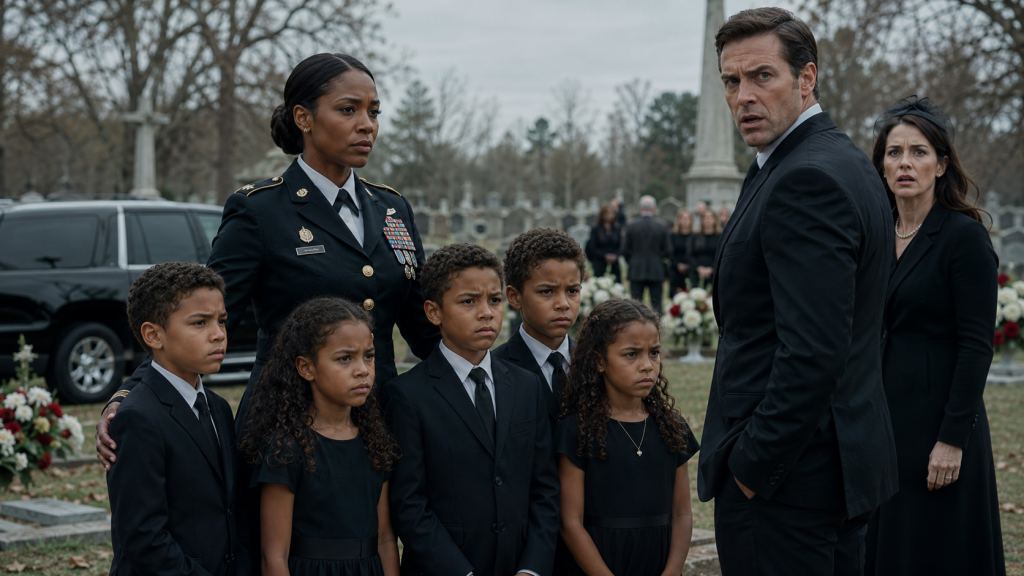
“You looked pretty terrifying in your uniform.”
I laughed.
“That was the intention.”
He grinned.
“You know everybody started whispering before we even got to the grave.”
“I noticed.”
“Dad says he knew the second he saw us.”
That surprised me.
“He told you that?”
“He said his brain kept trying to find another explanation.”
“That sounds like your father.”
Ethan smiled.
“Then he saw Emma make that annoyed face.”
I laughed harder.
Emma’s annoyed expression was almost identical to Julian’s.
“And he knew?”
“Yep.”
Ethan grew quiet.
“He said it was like seeing ten years of his life walk toward him.”
That sentence stayed with me.
Because it was true.
The truth had not arrived as a document.
The documents only confirmed it.
The truth arrived as Ethan, Noah, Luke, Rose, and Emma walking side by side beneath a cold Georgia sky.
It arrived in Julian’s eyes.
In Harrison’s letters.
In Victoria’s fear.
In the choices we made afterward.
People sometimes ask whether I forgave Victoria.
I don’t know.
Maybe forgiveness is too simple a word.
I stopped needing to imagine what should happen to her.
That was enough.
The last I heard, she moved to another state after her divorce from Julian was finalized.
She sent one letter.
I never opened it.
Not because I was afraid of what it contained.
Because there was nothing left inside that envelope that could change my life.
I had already learned the most important lesson.
When people refuse to believe your truth, you have two choices.
You can spend your life screaming louder.
Or you can keep walking until your life becomes the evidence.
I chose the second.
I became an officer.
I raised five children.
I built a home filled with noise, books, muddy shoes, military plaques, science projects, baseball gloves, horse magazines, and Emma’s drawings taped to almost every wall.
I learned that humiliation doesn’t last forever.
Neither does betrayal.
And sometimes the life waiting beyond the thing that broke you is larger than the life you were trying so desperately to save.
Harrison understood that long before I did.
The last card he ever sent me arrived three months before he died.
I still keep it inside my Bible beside the first.
There were only two sentences written inside.
Family finds its way home eventually.
Don’t be afraid when yours does.
For years, I thought he meant the children finding the Sterlings.
Now I think he meant all of us.
Not returning to the past.
Not rebuilding something that should remain broken.
Simply finding our way toward the truth.
Toward accountability.
Toward peace.
And on the days when I remember that cemetery, I no longer remember Victoria’s pale face first.
I remember five children walking beside me.
I remember Julian seeing them.
I remember Harrison’s grave covered in flowers and peppermints.
And I remember the strange certainty that came over me as the truth finally stood where everyone could see it.
I had not come back to prove I belonged to the Sterling family.
I had come because Harrison had belonged to ours.
That was enough.
More than enough.
And for the first time in ten years, nobody could take that truth away from me.
💬THE END! THANK YOU FOR READING!