

The photograph on Daniel’s phone showed a legal document with my name printed across the top.
For several seconds, I couldn’t understand what I was looking at.
My hands were still trembling from everything that had happened.
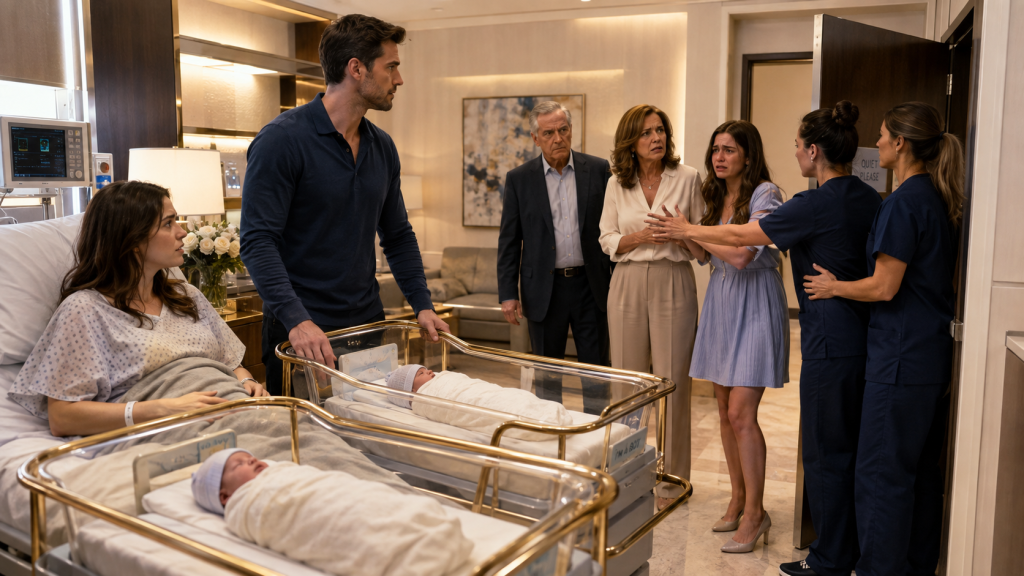
One of my newborn sons slept against my chest, wrapped in a blue hospital blanket, while his brother rested in the bassinet beside Daniel.
Olivia stood near the door, her face wet with tears.
Daniel enlarged the image.
“Sarah,” he said quietly, “look at the signature.”
I did.
My stomach dropped.
It looked exactly like mine.
Not similar.
Not close.
Exactly like mine.
The looping S.
The sharp angle in the M.
Even the small upward stroke I always made at the end.
“What is that?” I whispered.
Daniel scrolled upward.
The title read:
TEMPORARY GUARDIANSHIP AND CONSENT FOR PLACEMENT.
I felt the blood drain from my face.
“No.”
Daniel kept reading.
The document stated that I, Sarah Mitchell, voluntarily agreed to allow one of my newborn children to be placed temporarily with my sister, Olivia Bennett, following delivery.
My breathing became shallow.
“That’s fake.”
Daniel looked at me.
“I know.”
“I never signed anything.”
“I know.”
Olivia stepped closer.
“What are you talking about?”
Daniel turned the screen toward her.
Her expression changed instantly.
She covered her mouth.
“Oh my God.”
I stared at her.
“You’ve never seen this?”
“No.”
She shook her head rapidly.
“Sarah, I swear.”
Daniel looked at the message again.
My mother had written only one sentence beneath the photograph.
You should think carefully before turning this into something ugly.
I read it three times.
Then something inside me went strangely calm.
Maybe it was exhaustion.
Maybe it was shock.
Or maybe there are moments when fear becomes so enormous that your mind simply stops allowing it to grow.
“Call the nurse,” I said.
Daniel looked at me.
“What?”
“Call the nurse.”
He pressed the call button beside my bed.
Within a minute, the same nurse who had ordered my father out stepped into the room.
Her name was Melissa.
She looked from my face to Daniel’s.
“Is everything okay?”
“No,” Daniel said. “We need security again. And probably hospital administration.”
Melissa’s expression sharpened.
“What happened?”
Daniel handed her the phone.
She read the document.
Her face changed.
“Mrs. Mitchell, did you sign this?”
“No.”
“Were you ever asked to sign anything like this?”
“No.”
Melissa looked at Olivia.
“And you?”
Olivia shook her head.
“I didn’t even know this existed.”
Melissa immediately stepped into the hallway.
Within twenty minutes, our room had become the center of an investigation.
A hospital administrator arrived.
Then hospital security.
Then a woman from patient advocacy.
They asked the same questions over and over.
Had I signed any paperwork before surgery?
Yes.
Standard medical consent forms.
Had my parents been present?
My mother had visited earlier in the day while I was still in labor.
Had she helped me with paperwork?
That question stopped me.
I closed my eyes.
The memory came back slowly.
I had been exhausted.
Contractions were coming every few minutes.
Daniel had stepped into the hallway to speak with the doctor.
My mother had been sitting beside me.
A hospital employee brought several forms.
My mother had taken them.
“I’ll help,” she had said.
I remembered signing three or four pages.
Maybe more.
I hadn’t read every line.
I had trusted her.
The realization made me nauseous.
“She handed me forms,” I whispered.
Daniel stared at me.
“What?”
“Before the emergency surgery.”
Melissa immediately asked, “Did your mother ever take any forms out of the room?”
“I don’t know.”
My voice broke.
“I was in labor.”
Olivia sat down slowly.
“This is insane.”
The administrator took photographs of Daniel’s screen.
“We’re contacting our legal department,” she said. “But I want to reassure you of something immediately. No child can simply be removed from a hospital because of a document someone photographed on a phone.”
I nodded, but I was barely listening.
Because suddenly everything my parents had said made horrifying sense.
You have two boys.
Olivia has none.
You should give her one.
You don’t need two.
Family sacrifices for family.
They hadn’t come to ask me.
They had come expecting me to cooperate.
And somewhere along the way, they had apparently prepared for the possibility that I wouldn’t.
Daniel must have realized the same thing.
He walked toward the window and stood there with his hands pressed against the sill.
I had seen him angry before.
But never like that.
His anger was quiet.
Controlled.
Dangerous only in the sense that it was absolute.
“They planned this,” he said.
Olivia began crying again.
“I didn’t know.”
Daniel turned toward her.
“Did they ever talk to you about Sarah’s babies?”
Olivia hesitated.
That hesitation told me everything.
“Olivia.”
She looked at me.
“Not like this.”
“What did they say?”
She wiped her face.
“Mom kept saying that maybe everything happened for a reason.”
“What does that mean?”
“She said maybe you having twins was God balancing things.”
I stared at her.
“And what did you say?”
“I told her not to talk like that.”
“Did Dad say anything?”
Olivia looked down.
“He said two babies would be overwhelming for you.”
Daniel laughed once.
There was no humor in it.
“So they discussed taking one.”
“No.”
Olivia stood.
“At least—I didn’t think they meant literally.”
I wanted to believe her.
She was my sister.
We had grown up sharing bedrooms, clothes, secrets, heartbreaks.
When her fertility treatments failed, I had driven her home.
When she lost her first pregnancy at nine weeks, she had slept in my guest room for four nights because she couldn’t bear to return to the nursery she had already painted.
I had held her while she cried.
I had never once resented her sadness.
Even during my pregnancy, I had tried to be careful around her.
I didn’t flood social media with pictures.
I didn’t complain about morning sickness.
I didn’t talk endlessly about names.
When we learned we were having twins, I delayed telling my family for a week because I was worried about hurting Olivia.
And somehow my parents had transformed that compassion into entitlement.
“Did you know they were coming here today?” I asked.
Olivia nodded slowly.
“Yes.”
My heart tightened.
“They told me they wanted everyone together.”
“To do what?”
She looked toward the bassinets.
“They said they had an idea that could change my life.”
The room went silent.
“You came anyway.”
Olivia started crying harder.
“I thought they were going to offer to pay for another round of IVF.”
I searched her face.
Maybe she was telling the truth.
Maybe not.
At that moment, I didn’t have enough strength left to decide.
Daniel stepped beside me.
“You should go.”
Olivia looked at him.
“Daniel—”
“Sarah needs to recover.”
“I want to stay.”
“She doesn’t need this right now.”
Olivia looked at me.
I could see the question in her eyes.
I hated that I didn’t know the answer.
Finally, I whispered, “Please go.”
Her face crumpled.
But she nodded.
Before leaving, she walked toward the bassinet.
Daniel immediately moved between her and the baby.
Olivia stopped.
The pain on her face was unmistakable.
“I wasn’t going to touch him.”
Daniel didn’t respond.
She looked at me one last time.
“I’m sorry.”
Then she left.
The moment the door closed, I started crying.
Not quietly.
Not gracefully.
I cried until my incision hurt.
I cried until Melissa brought me medication and another nurse dimmed the lights.
Daniel sat beside me with our son against his chest.
Neither of us spoke for almost an hour.
Finally, I whispered, “Do you believe Olivia?”
Daniel looked down at the sleeping baby.
“I don’t know.”
Neither did I.
That was the worst part.
The next morning, a police officer came to the hospital.
Hospital administration had advised us to file a report.
The officer explained that a photograph of a document was not enough to establish exactly what had happened, but forging a signature on a legal document could potentially be serious.
He took statements from both of us.
The hospital also reviewed camera footage.
My mother had indeed been near the admissions desk during my labor.
At one point, footage showed her carrying a folder out of my room.
She disappeared toward the elevators for twenty-three minutes.
When she returned, the folder was gone.
The officer wrote everything down.
Then he asked whether we wanted my parents formally barred from visiting.
“Yes,” Daniel said immediately.
I hesitated only half a second.
“Yes.”
Their names were added to the hospital’s security list.
Olivia’s was not.
I wasn’t ready to decide what she had done.
Or hadn’t done.
That afternoon, my father began calling.
Daniel blocked his number.
Then my mother.
Blocked.
Then my aunt.
Then my cousin.
Then people from our church.
Within hours, I realized my parents had launched their own version of the story.
According to them, I had “misunderstood a family conversation.”
Dad had merely suggested that Olivia could “help raise” one of the twins.
Mom said the legal paperwork was only a “draft.”
They accused Daniel of escalating everything because he had never liked them.
By evening, my phone was full of messages.
Your parents would never steal your baby.
Olivia has suffered enough.
Maybe emotions were high.
Family should solve things privately.
You only get one mother.
That last message made me laugh.
A bitter, exhausted laugh.
Daniel looked over.
“What?”
I showed him.
He read the message.
Then he deleted it.
“You also only get one first day with your children,” he said.
That sentence stayed with me.
Because while my sons had been entering the world, my parents had turned their birth into a negotiation.
While I should have been memorizing their faces, I had been defending their right to remain mine.
I looked down at the baby sleeping in my arms.
We had named him Noah.
His brother was Ethan.
They were tiny.
Perfect.
Completely unaware that grown adults had already tried to decide which one of them was more disposable.
I kissed Noah’s forehead.
“No one is taking you,” I whispered.
Daniel heard me.
He reached over and touched Ethan’s small hand.
“No one.”
We were discharged three days later.
Security escorted us through a private exit.
Daniel had arranged for his brother, Michael, to drive our car home while we rode with the babies in another vehicle.
It felt ridiculous.
Like something from a crime movie.
But after what had happened, neither of us wanted surprises.
When we arrived at our house, there were flowers on the front porch.
For one hopeful second, I thought they might be from friends.
Then I saw the card.
From Mom.
Daniel opened it.
Congratulations on your beautiful boys. We hope when you calm down, you remember who your real family is.
I stared at the card.
Then I tore it in half.
Daniel threw the flowers away.
The first week home passed in a blur.
Feedings.
Diapers.
Pain medication.
Almost no sleep.
And underneath everything, fear.
Every car slowing near the house made me look through the window.
Every phone notification tightened my chest.
Daniel installed new locks.
A camera above the front door.
Another over the garage.
He took two weeks off work.
My friend Rachel came almost every afternoon.
She cooked.
She folded laundry.
She never once asked me to explain what happened.
She simply said, “Tell me what you need.”
That was what support looked like.
Not demanding.
Not controlling.
Just there.
On the sixth day, Olivia texted.
Can I see you?
I didn’t answer.
Two hours later, another message came.
I found something. I think you need to see it.
I showed Daniel.
He frowned.
“What something?”
I typed.
Send it.
A minute later, Olivia sent four screenshots.
They were text messages between her and my mother.
The messages dated back almost three months.
Mom: Sarah is lucky. Two healthy boys after barely trying.
Olivia: Please don’t compare us.
Mom: I’m only saying life isn’t fair.
Olivia: I know. But they’re her babies.
Mom: You would be a better mother.
Olivia: Stop.
Mom: She’ll be overwhelmed. She has no idea.
Olivia: Mom, stop talking like this.
Then another conversation.
Mom: Your father thinks Sarah might eventually understand.
Olivia: Understand what?
Mom: That sometimes one person gets more than she needs while another gets nothing.
Olivia: I don’t like where this is going.
Mom: Don’t be dramatic.
I read the screenshots twice.
Then Daniel pointed at the timestamp of the final message.
It was from two weeks before my delivery.
Mom: We’re handling it. You don’t need to know details yet.
Olivia had replied:
Handling what?
There was no answer.
I called her.
She picked up immediately.
“Sarah?”
“Why didn’t you show me these before?”
She was silent.
“Olivia.”
“Because I was ashamed.”
“Of what?”
“That part of me wanted to know what Mom meant.”
That hurt.
But at least it sounded true.
She continued.
“I never wanted your baby. I swear. But when she kept saying they had a solution, there was a horrible part of me that wondered if maybe you had offered something. I knew that made no sense. I knew you wouldn’t. But grief makes you think awful things sometimes.”
I closed my eyes.
“Did you ever ask them to take one?”
“No.”
“Did you ever say you deserved one?”
“No.”
“Did you know about the document?”
“No.”
Her voice broke.
“I would testify to that.”
The word testify caught me off guard.
“You think this is going that far?”
“Yes.”
That was the first moment I realized Olivia might finally understand what our parents had done.
She wasn’t just apologizing.
She was choosing a side.
Two days later, she came to our house.
Daniel stayed in the room.
So did Rachel.
I wasn’t taking chances.
Olivia sat on the edge of the sofa with her hands clasped tightly in her lap.
For several minutes, no one spoke.
Then she looked at the twins.
“They’re beautiful.”
“Thank you.”
She smiled sadly.
“Which is which?”
I pointed.
“Noah is sleeping. Ethan is pretending he’s asleep so he doesn’t have to burp.”
Olivia laughed softly.
It was the first normal sound I had heard from her since the hospital.
Then she started crying.
“I hate that they did this.”
I didn’t answer.
She wiped her eyes.
“Mom told me growing up that you always got everything first.”
I frowned.
“What?”
“The better grades. The scholarship. Daniel. The house.”
“That’s ridiculous.”
“I know.”
“Olivia, you were the one they protected.”
She looked at me.
“What do you mean?”
“When you crashed Dad’s car at seventeen, he blamed the other driver.”
She looked down.
“When you dropped out of college for a semester, Mom told everyone you were sick.”
“I was struggling.”
“I know. That’s my point. They protected you.”
She sat very still.
I continued.
“When I lost my job at twenty-four, Dad told me failure builds character.”
Olivia swallowed.
“When your first IVF cycle failed, they paid for the second one.”
“I didn’t ask them to.”
“I know.”
The realization spread slowly across her face.
Our parents hadn’t merely loved us differently.
They had created a competition neither of us had fully recognized.
They had taught Olivia that suffering entitled her to compensation.
They had taught me that competence meant I needed less care.
And when I became pregnant with twins while Olivia remained childless, those beliefs collided.
“They thought I could spare one,” I whispered.
Olivia covered her face.
“I’m so sorry.”
This time, I believed her.
Not completely.
Trust didn’t repair itself in one conversation.
But I believed that she hadn’t planned it.
Three weeks later, the investigation uncovered the rest.
My mother had contacted an attorney months earlier.
Not a family attorney.
An adoption attorney.
She had asked hypothetical questions about private family adoption.
She had claimed that her pregnant daughter was “considering placing one twin with a close relative.”
The attorney had sent her sample documents.
My mother had edited one.
Then she had apparently copied my signature from another form.
The document Daniel had received was not legally valid.
But that almost made it worse.
Because my parents hadn’t understood the law well enough to accomplish what they wanted.
They had simply assumed that if they could wave enough paperwork around while I was exhausted and medicated, they could pressure me into surrendering.
The police officer explained all of this in our living room.
Daniel sat beside me.
Olivia sat across from us.
When he finished, no one spoke.
Finally, Olivia asked, “My parents both knew?”
“Yes.”
The officer nodded.
“Based on the messages we recovered, your father was involved.”
He handed us printed copies.
One message from my father to my mother read:
She’ll resist at first. Daniel will be the problem.
Another said:
Once Olivia has the baby home, Sarah won’t take him back. She’s too soft.
I stared at that sentence until the words blurred.
Too soft.
My father had mistaken love for weakness.
He thought because I avoided conflict, I could be controlled.
Because I forgave, I could be manipulated.
Because I loved my family, I would sacrifice myself to preserve it.
He had been wrong.
The case didn’t result in some dramatic courtroom spectacle.
There was no sudden arrest in our driveway.
Real life was slower.
Messier.
Lawyers became involved.
Statements were taken.
The forged document became part of an official investigation.
Hospital administrators changed procedures around family access to maternity patients.
My parents hired an attorney.
And then, finally, they became quiet.
For almost two months, we heard nothing.
I began sleeping again.
Not much.
Twins make sure of that.
But enough.
Noah developed a habit of smiling in his sleep.
Ethan hated socks.
Daniel learned how to carry both babies at once while making coffee.
We began becoming what we should have been from the beginning.
A new family.
Not a battlefield.
Not a negotiation.
Just a mother.
A father.
Two sons.
One rainy afternoon in November, an envelope arrived.
No return address.
Inside was a letter from my father.
Sarah,
Your mother and I have had time to reflect.
Mistakes were made on all sides.
I stopped reading.
Mistakes were made.
As if I had accidentally misunderstood a dinner invitation.
As if he had forgotten my birthday.
As if forging documents to claim a newborn child was simply a disagreement that had become emotional.
Daniel sat beside me.
“Keep going.”
I did.
We were worried about Olivia and allowed that concern to influence our judgment. We should have approached the situation differently.
Differently.
I laughed.
Daniel shook his head.
The letter continued.
However, we believe involving police and attorneys was unnecessary and deeply damaging to this family.
There it was.
The real apology.
Not regret for what they did.
Regret that consequences followed.
I folded the letter.
“I’m done.”
Daniel didn’t ask what I meant.
He knew.
That evening, I wrote my own letter.
Not because they deserved one.
Because I did.
I wrote:
Dad and Mom,
There is nothing to discuss.
You did not make a parenting mistake.
You planned to pressure me into surrendering one of my children.
You created false paperwork.
You entered my hospital room hours after major surgery and told me I did not need both of my sons.
Then you blamed me when I protected them.
You do not currently have a place in our lives.
Do not come to our home.
Do not contact Daniel.
Do not contact me.
Do not attempt to see Noah or Ethan.
If one day I choose to reconsider, I will contact you.
Until then, respect this boundary.
Sarah.
I mailed it the next morning.
My hands shook when I dropped it into the box.
Then I drove home.
And for the first time since giving birth, I felt free.
Olivia’s relationship with our parents collapsed soon afterward.
They blamed her for giving investigators the text messages.
My father told relatives she had “betrayed the family.”
Olivia called me crying.
“They said I chose you over them.”
I was feeding Ethan.
“No.”
“What?”
“You chose yourself.”
She was quiet.
“So did I.”
Olivia began therapy.
So did I.
Not together.
Some wounds need separate rooms before they can ever heal in the same one.
Months passed.
The twins grew.
Their personalities emerged.
Noah was cautious.
Ethan feared absolutely nothing.
At seven months, Ethan crawled toward every dangerous object in the house with the confidence of an explorer.
Noah studied everything before moving.
Daniel joked that one would become an engineer and the other would jump out of airplanes for fun.
Olivia visited once a week.
At first, she always waited for permission before touching them.
Eventually, I stopped noticing.
Trust returned slowly.
Not because we pretended nothing happened.
Because we talked about it.
One afternoon, she was sitting on the carpet with Noah when she said, “Can I tell you something terrible?”
I nodded.
“After your ultrasound showed twins, I hated you for about five minutes.”
I smiled sadly.
“I figured.”
She looked surprised.
“You did?”
“I saw your face.”
She looked down.
“I went home and cried for six hours.”
“I’m sorry.”
“No. Don’t be. That’s what I needed to understand.”
She looked at Noah.
“My grief was mine. Mom and Dad kept teaching me that someone else had to fix it.”
That sentence stayed with me.
Because it explained almost everything.
Pain does not create entitlement.
Loss does not create ownership.
Loving someone does not require surrendering what is sacred to you.
Almost a year after the twins were born, my mother appeared at our front door.
I saw her through the security camera.
My heart started pounding.
Daniel was upstairs bathing the boys.
I spoke through the doorbell.
“You need to leave.”
Her face lifted toward the camera.
“Sarah, please.”
“I said no contact.”
“It’s been a year.”
“That doesn’t change the boundary.”
“I just want to see my grandsons.”
My grandsons.
As though the word itself granted access.
“You need to leave.”
She began crying.
For years, my mother’s tears had been one of the most powerful forces in our family.
If she cried, everyone adjusted.
Apologized.
Compromised.
Surrendered.
That day, I simply watched.
“I’m your mother.”
“Yes.”
“How can you be this cruel?”
I almost laughed.
Cruel.
The word didn’t wound me anymore.
“I’m not discussing this.”
“We made a mistake.”
“You made a plan.”
She stopped crying.
That distinction hit her.
I continued.
“A mistake is saying something thoughtless. A plan is contacting attorneys. Editing documents. Copying my signature. Coming to a hospital expecting to leave with my child.”
Her face tightened.
“Your father pushed things too far.”
I stared at the screen.
There it was.
Blame shifting.
Even now.
“Did he forge the signature?”
Silence.
“Did he contact the attorney?”
Silence.
“Did he bring the paperwork into my hospital room?”
She looked away.
“Leave.”
“Sarah—”
“If you don’t leave, I’m calling the police.”
She stared at the camera for several seconds.
Then she walked away.
I watched her car disappear down the street.
Daniel came downstairs carrying Noah.
“Who was here?”
“My mother.”
His body stiffened.
“Do I need to call someone?”
“No.”
He studied me.
“You okay?”
I looked at Noah.
Then toward the hallway where Ethan was babbling from his playpen.
“Yes.”
And I meant it.
Another year passed.
The legal case ended with consequences that were real but not cinematic.
There were agreements.
Restrictions.
Legal fees.
A formal acknowledgment regarding the forged document.
My parents never went to prison.
For a long time, some relatives thought that meant what they did “wasn’t that serious.”
I stopped trying to convince them.
People who need a judge to explain morality are rarely persuaded by a daughter explaining pain.
Some relatives disappeared from my life.
Others apologized.
A few admitted they had always known my father controlled the family through intimidation.
They simply hadn’t wanted to become his next target.
That hurt too.
But understanding cowardice doesn’t require accepting it.
When Noah and Ethan turned three, we held their birthday party in our backyard.
There were balloons tied to the fence.
A small inflatable pool.
Cupcakes covered in blue icing.
Children everywhere.
Rachel came with her daughter.
Michael grilled hamburgers.
Olivia arrived carrying two enormous wrapped boxes.
Daniel groaned.
“I thought we agreed no giant toys.”
Olivia smiled.
“You agreed.”
She handed one box to Noah.
The other to Ethan.
Inside were matching balance bikes.
The boys screamed with joy.
I laughed until my stomach hurt.
Then I looked around the yard.
This was family.
Not biology.
Not obligation.
Not sacrifice demanded at gunpoint by guilt.
Family was Rachel washing bottles at midnight without being asked.
Family was Michael sitting with Daniel in the hospital hallway while I had surgery.
Family was Olivia admitting the ugliest parts of her grief instead of pretending she had never felt them.
Family was Daniel standing between my newborn sons and anyone who believed they were possessions.
I used to believe losing my parents meant losing my family.
I know better now.
Sometimes you lose people who taught you that love requires obedience.
And in the space they leave behind, you finally discover what love actually looks like.
That night, after everyone went home, Daniel and I carried two exhausted little boys upstairs.
Noah fell asleep before his head touched the pillow.
Ethan tried to convince us he was not tired while yawning every fifteen seconds.
Daniel tucked the blanket around him.
“Happy birthday, troublemaker.”
“I’m not trouble,” Ethan mumbled.
“You climbed the fence this morning.”
“I was exploring.”
Daniel looked at me.
I tried not to laugh.
After they were asleep, we stood in the hallway between their rooms.
Three years earlier, in a hospital bed, I had been terrified someone might take one of them from me.
Now they were here.
Safe.
Loud.
Messy.
Ours.
Daniel put his arm around me.
“You thinking about that day?”
“A little.”
“Do you regret cutting them off?”
I knew who he meant.
“No.”
The answer came easily.
Then I thought about it.
“I regret that it had to happen.”
He nodded.
“That’s different.”
“Yes.”
I looked into Noah’s room.
“Sometimes I wonder what Dad thought would happen.”
“What do you mean?”
“If I had somehow agreed.”
Daniel frowned.
I continued.
“Did he think I would choose one?”
The thought made my stomach turn even years later.
Choose Noah.
Choose Ethan.
Decide which baby went home with me and which one went somewhere else.
Daniel shook his head.
“Don’t do that to yourself.”
“I’m not.”
I looked at him.
“Not anymore.”
That was true.
For a long time, I had obsessed over the impossible questions.
Which child had they wanted?
Had my parents already chosen?
Did they think twins were interchangeable?
Would Olivia have accepted one if I had been bullied into saying yes?
Eventually, therapy helped me understand something important.
There was no useful answer.
The entire premise was broken.
Children are not resources distributed according to fairness.
Motherhood is not something another person earns by suffering more.
And no one gets to solve one woman’s grief by destroying another woman’s family.
The twins were four when my father died.
A heart attack.
Sudden.
Olivia called me.
I was in the kitchen packing lunches.
“Sarah.”
I knew immediately.
There was something in her voice.
“What happened?”
“Dad died.”
I leaned against the counter.
For several seconds, I felt nothing.
Then too many things at once.
Sadness.
Anger.
Memory.
Relief.
Guilt for feeling relief.
Grief for the father I once believed I had.
Not the man who stood beside my hospital bed demanding one of my sons.
The man who taught me to ride a bicycle.
The man who carried me upstairs when I fell asleep in the car at seven.
The man who used to make pancakes shaped like animals on Sundays.
Those memories had not disappeared.
That was one of the hardest things to accept.
Someone can love you in one season of life and still harm you deeply in another.
Good memories do not erase terrible choices.
Terrible choices do not always erase every good memory.
Both things can exist.
“Are you going to the funeral?” Olivia asked.
I looked toward the living room.
Noah and Ethan were building a tower.
Daniel was helping them.
“I don’t know.”
In the end, I went.
Not for reconciliation.
Not because relatives pressured me.
For myself.
Daniel came with me.
The boys stayed with Rachel.
My mother sat in the front row.
She looked ten years older.
When she saw me, her lips parted.
I sat several rows behind her.
We did not speak.
After the service, people gathered outside.
My mother approached slowly.
“Sarah.”
I looked at her.
For once, there was no performance.
No anger.
No demand.
Just exhaustion.
“He loved you.”
I nodded.
“I know.”
That surprised her.
“He made terrible mistakes.”
“He made choices.”
She looked down.
“Yes.”
We stood silently.
Then she said something I never expected.
“I should have stopped him.”
I looked at her.
She was crying quietly.
“And I didn’t.”
No excuses.
No “but.”
No explanation.
Just truth.
“I wanted Olivia to be happy so badly that I convinced myself we were helping.”
I said nothing.
She continued.
“I told myself you were strong. That you could handle anything.”
My throat tightened.
There it was again.
The curse of being the capable child.
“You decided my strength meant I could survive losing something.”
She closed her eyes.
“Yes.”
“And Olivia’s pain meant she deserved to receive it.”
“Yes.”
It was the first honest conversation we had ever had about what happened.
I did not forgive her that day.
Forgiveness is not a door someone opens simply because another person finally knocks correctly.
But something changed.
Years later, my mother would slowly return to my life.
Slowly.
Carefully.
She attended therapy.
She respected boundaries.
She never arrived without permission.
She never demanded access to the boys.
The first time Noah and Ethan met her knowingly, they were six.
She sat across from them at a café.
Her hands shook.
Noah asked, “Are you Mom’s mom?”
She smiled.
“Yes.”
Ethan frowned.
“Then why haven’t we met you?”
Children have no patience for family mythology.
My mother looked at me.
I said nothing.
This answer belonged to her.
“Because I made some very bad choices when you were babies,” she said.
Ethan leaned closer.
“What choices?”
She smiled sadly.
“I hurt your mother.”
Noah looked at me.
“Did she say sorry?”
“Yes.”
He considered this.
“Did you forgive her?”
My mother immediately said, “She doesn’t have to.”
That mattered more than she realized.
I answered honestly.
“I’m working on it.”
Ethan returned to his chocolate milk.
“Okay.”
And somehow that was enough.
Olivia eventually adopted a little girl named Grace.
Not through manipulation.
Not through secret arrangements.
Through a long, lawful, carefully considered process.
When she called to tell me the adoption was final, she could barely speak.
I cried with her.
This time, the joy didn’t hurt either of us.
The first time I held Grace, Olivia watched me nervously.
“She likes you.”
“She has excellent judgment.”
Olivia laughed.
Then she whispered, “Do you ever think about how different everything could have been?”
“Yes.”
“Me too.”
She looked at her daughter.
“I’m glad I never got what Mom and Dad thought I deserved.”
I understood exactly what she meant.
Because Grace did not enter Olivia’s life as compensation.
She entered as herself.
A child.
Not a replacement.
Not a solution.
Not proof that the universe had finally become fair.
Just Grace.
Years passed.
The story of that hospital day became something I rarely told.
Not because I was ashamed.
Because it no longer defined us.
Noah and Ethan grew into entirely different people.
Noah loved science and hated crowds.
Ethan loved soccer and could make friends in grocery-store lines.
They argued constantly.
They defended each other instantly.
When they were ten, Ethan came home from school angry because another child had told Noah he was weird for preferring books to sports.
“What did you do?” I asked.
“I told him Noah’s smarter than all of us.”
Noah rolled his eyes.
“He also pushed my backpack into a bush.”
“That was unrelated.”
Daniel laughed from the kitchen.
I looked at them and sometimes thought about that terrible sentence.
You don’t need two.
How little my father understood.
I didn’t have “two.”
I had Noah.
And Ethan.
Two entire human beings.
Two personalities.
Two futures.
Two voices calling “Mom” from opposite ends of the house.
Two sets of dreams.
There had never been an extra child.
There had only ever been two sons.
On their twelfth birthday, I finally told them a simplified version of what happened.
Not every detail.
Enough.
We sat at the dining table after dinner.
They listened quietly.
When I finished, Ethan looked horrified.
“Grandpa wanted you to give one of us away?”
“Yes.”
“To Aunt Olivia?”
“That was the plan.”
Noah was silent for a long time.
Then he asked the question I had feared for twelve years.
“Which one?”
I reached across the table and took his hand.
“They never got to choose.”
“But did they say?”
“No.”
Ethan looked angry.
“That’s messed up.”
Daniel nodded.
“Yes.”
Noah stared at the table.
“What would you have done?”
I squeezed his hand.
“There was never a choice.”
He looked up.
“Even if everyone got mad?”
“Even then.”
“If Grandma cried?”
“Yes.”
“If they stopped talking to you?”
“Yes.”
“If the whole family hated you?”
I looked at both my sons.
“I would have chosen you.”
Noah frowned.
“Which one?”
I smiled.
“Both.”
Ethan rolled his eyes.
“That was obvious.”
Noah smiled too.
Then he asked, “Did Aunt Olivia want one of us?”
I answered carefully.
“She was hurting very badly because she wanted children and couldn’t have them. But she did not plan what happened.”
“Did you forgive her?”
“Yes.”
“Why?”
“Because she told the truth. She took responsibility for the things she should have done differently. And she changed.”
Noah nodded.
That was the lesson I hoped they remembered.
Not that people never hurt you.
They will.
Not that family always deserves another chance.
Sometimes they don’t.
But accountability matters.
Change matters.
Boundaries matter.
Love without respect is not enough.
That night, after the twins went upstairs, Daniel stood beside me at the sink.
“Twelve years.”
“I know.”
“We survived.”
I smiled.
“We did more than survive.”
He kissed my temple.
Outside, I could hear the boys arguing about whose turn it was to choose a movie.
I listened to them.
And I thought back to that hospital room.
My father’s red face.
My mother’s crossed arms.
Olivia’s tears.
Daniel standing between the bassinets and everyone else.
My own exhausted voice saying one word.
No.
At the time, it had felt tiny.
Weak.
Barely audible.
But that one word changed my entire life.
No.
No, you cannot have my child.
No, your pain does not create a claim to my happiness.
No, being family does not give you ownership of me.
No, love does not require surrender.
No, I will not destroy myself to keep everyone else comfortable.
For most of my life, I thought strength meant enduring.
Enduring criticism.
Enduring pressure.
Enduring guilt.
Enduring people who said cruel things and then reminded you that family forgives.
I know better now.
Sometimes strength is not enduring.
Sometimes strength is ending.
Ending a cycle.
Ending access.
Ending a conversation.
Ending the belief that your boundaries require permission.
My father told me I was selfish.
For years, that word haunted me.
Now I think about the woman lying in that hospital bed.
Exhausted.
Cut open.
Terrified.
Barely able to sit upright.
And still saying no.
She wasn’t selfish.
She was a mother.
And that was the day I finally became something else too.
My own protector.
My sons are sixteen now.
Tall.
Loud.
Forever hungry.
Noah wants to study biomedical engineering.
Ethan says he is going to become either a sports journalist or “someone who gets paid to travel.”
Olivia and Grace visit often.
My mother comes to some holidays.
Not all.
Our relationship is different.
It will always be different.
But it is honest.
And honesty, even imperfect honesty, is better than the family illusion we once maintained.
Sometimes people ask whether I wish I could go back and change that day.
My answer surprises them.
No.
I wish my parents had made different choices.
I wish Olivia had never been placed in that position.
I wish Daniel and I had spent those first hours simply holding our babies.
But I would not erase the day.
Because before it happened, I still believed family loyalty mattered more than personal boundaries.
I still believed saying no made me difficult.
I still believed protecting other people’s feelings was my responsibility.
That day burned those beliefs out of me.
Painfully.
Permanently.
And in their place, something stronger grew.
The knowledge that my children would never have to earn my protection.
The knowledge that I could love people without surrendering to them.
The knowledge that walking away can sometimes save more than staying.
Years ago, my father stood beside my hospital bed and said Olivia deserved one of my babies more than I did.
He thought motherhood could be divided.
He thought love could be redistributed.
He thought I would bend.
Instead, that moment broke the version of our family that had always depended on my silence.
What grew afterward was smaller.
Messier.
More complicated.
But real.
And every time Noah and Ethan walk through the front door arguing, laughing, calling for food, leaving shoes where I have told them a thousand times not to leave them, I remember the impossible demand made on the day they were born.
You don’t need two.
I smile every time.
Because he was wrong.
Not because I needed two.
Because they were never mine to divide in the first place.
They were themselves.
Noah.
Ethan.
My sons.
And on the day everyone expected me to choose between family loyalty and protecting my children, I finally understood something I should have learned years earlier.
Anyone who asks you to prove your love by betraying yourself is not asking for love.
They are asking for control.
I chose my children.
I chose my marriage.
I chose peace.
And eventually, for the first time in my life, I chose myself.
💬THE END! THANK YOU FOR READING!