

My father’s voice shook through the phone.
“Emily,” he said, “who exactly did you marry?”
I stood beside the floor-to-ceiling windows of the hotel suite, watching six black vehicles idle beneath the gray morning sky.
Behind me, Adrian was fastening the cuffs of a charcoal suit.
For a man my family had described as helpless, dependent, and practically imprisoned by his blindness, he moved with startling confidence.
He knew exactly where his watch rested on the nightstand.
Exactly how many steps separated the bedroom from the sitting area.
Exactly where I was standing.
And somehow, even without seeing my face, he seemed to know that for the first time in my life, I was smiling while my father panicked.
“What do you mean?” I asked quietly.
“Those vehicles downstairs belong to Vale Meridian.”
Dad lowered his voice.
“I recognize the security team.”
I said nothing.
“Emily?”
“Yes?”
“Why are they here?”
I glanced at Adrian.
He tilted his head slightly.
“Tell him we’re coming down,” he said.
Dad heard him.
The silence on the line lasted two full seconds.
Then my father whispered, “What did he say?”
“We’re coming down.”
I ended the call.
My hand trembled.
Adrian reached toward me.
I crossed the room and placed my fingers in his.
“You don’t have to be afraid of them anymore,” he said.
“You make that sound easy.”
“It isn’t.”
He squeezed my hand.
“But fear becomes smaller when people lose the power they were using to create it.”
I stared at him.
For twenty-nine years, fear had been the architecture of my life.
My father had never needed to shout very often because the threat behind his calm voice was usually enough.
He controlled the family company.
The houses.
The cars.
The allowances.
The accountants.
Even the trust my grandmother had created specifically for me.
My grandmother, Eleanor Whitmore, had been the only person in the family who ever treated me as though kindness wasn’t a defect.
When I was a child, she would take me to the small greenhouse behind her Connecticut home and teach me the names of flowers.
“People will try to prune you into whatever shape makes them comfortable,” she once told me.
“Don’t confuse being loved with being controlled.”
I had been twelve.
I remembered the sentence.
I just hadn’t understood it.
Not until much later.
After she died, my father became one of the trustees overseeing the assets she had left me.
Technically, portions of the trust became available at twenty-five.
In reality, Dad buried the assets inside Whitmore-controlled entities, management agreements, and corporate structures I barely understood at the time.
Whenever I asked questions, he reminded me that he was “protecting me from mistakes.”
Whenever I considered leaving the company, Mom warned me not to humiliate the family.
Whenever I wanted anything Vanessa wanted too, Vanessa got it.
The larger office.
The better position.
The board appointment.
The townhouse in Manhattan.
She even received the vice presidency Dad once claimed I might earn.
I remained “special projects director,” a title impressive enough for society pages and meaningless enough to keep me away from decisions.
They mistook silence for stupidity.
That was their first mistake.
Their second was assuming I would stay silent forever.
Adrian held out his arm.
“Ready?”
“No.”
“Good.”
I laughed softly.
He smiled.
“People who say they’re ready for family confrontations are usually lying.”
We left the suite.
As the elevator descended, my heartbeat thudded harder with each floor.
Twenty-three.
Twenty-two.
Twenty-one.
My wedding ring caught the light.
Less than twenty-four hours earlier, I had stood beneath chandeliers in front of three hundred guests while my sister whispered insults behind a champagne glass.
She believed I had been sacrificed.
Maybe I had.
But sacrifices only stay powerless when they remain on the altar.
The elevator doors opened.
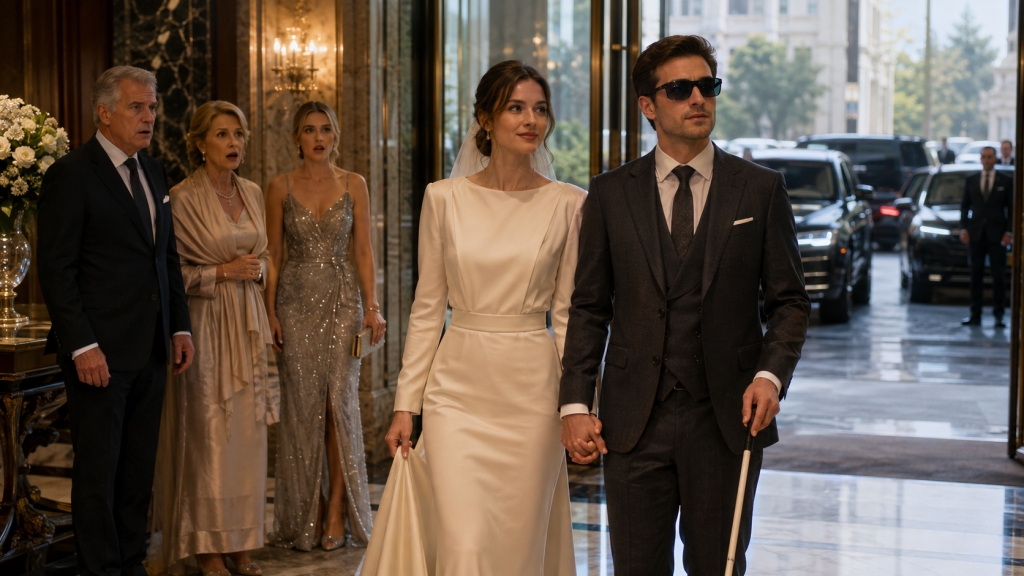
My family was waiting in the lobby.
Dad stood rigidly near the marble fountain.
Mom clutched a designer handbag against her waist.
Vanessa was beside them in yesterday’s wedding clothes, though her makeup had been hastily redone.
Her eyes moved from me to Adrian.
Then to the men in dark suits gathered near the entrance.
Six Vale Meridian executives.
Two attorneys.
A security director.
And one silver-haired man I recognized from financial magazines.
Jonathan Pierce.
Chief operating officer of Vale Meridian.
A company valued in the billions.
He crossed the lobby.
“Good morning, Adrian.”
Adrian held out his hand.
“Jonathan.”
They shook.
Vanessa stared.
Jonathan turned toward me.
“And congratulations, Mrs. Vale.”
Mrs. Vale.
The words made my mother blink.
Dad recovered first.
“There seems to be some confusion.”
Jonathan looked at him.
“No confusion on our side.”
Vanessa gave a sharp laugh.
“Adrian doesn’t run Vale Meridian.”
Every face nearby turned toward her.
She looked around as though expecting someone to agree.
Jonathan’s expression remained polite.
“Mr. Vale owns the controlling interest.”
Vanessa’s smile vanished.
Dad’s face changed more slowly.
I watched disbelief become calculation.
Calculation become dread.
Adrian’s father had been wealthy.
Everyone knew that.
But my father had apparently assumed Adrian lived off inherited assets managed by other people.
That assumption was exactly why he had chosen him.
A blind heir.
A quiet one.
A man who appeared socially withdrawn after the accident that cost him his sight.
Someone Charles Whitmore believed would accept any deal offered in exchange for belonging.
My father stepped forward.
“Adrian, perhaps we should discuss the financing proposal privately.”
Adrian’s hand rested lightly against mine.
“The proposal involving the three hundred million dollars?”
Vanessa looked at Dad.
Mom’s mouth parted.
Apparently even they hadn’t known the full amount.
Dad’s jaw tightened.
“This is not the place.”
“Then where would you prefer?” Adrian asked. “Your office? The same office where you described your younger daughter as a useful bridge between our families?”
The lobby became painfully quiet.
My mother looked at me.
“Emily—”
I raised one hand.
“No.”
One word.
It was amazing how powerful one word could feel after a lifetime of swallowing it.
Dad took another step toward Adrian.
“You misunderstood the nature of that conversation.”
“No,” Adrian said. “I recorded it.”
The color left Dad’s face.
Vanessa stared at him.
“You recorded Dad?”
“My legal counsel records negotiations when appropriate and permitted.”
Jonathan opened a leather case and removed a thick folder.
He handed it to Adrian.
Adrian held it toward me.
“Emily.”
I took it.
Across the front, stamped in dark letters, were the words:
WHITMORE FRAUD REVIEW.
My stomach tightened.
I opened the cover.
The first document was a loan authorization.
Twenty-six million dollars.
The borrower was a subsidiary called WPH Residential Fourteen.
The collateral listed several parcels associated with my grandmother’s trust.
And at the bottom—
Vanessa’s signature.
My sister saw it too.
She stepped backward.
“What is that?”
“You tell me,” I said.
“That could be anything.”
“It’s your signature.”
“I sign hundreds of documents.”
Dad interrupted.
“Emily, give me the folder.”
I closed it.
“No.”
His expression hardened automatically.
The old reflex.
The look that had made me obey since childhood.
For half a second, my fingers weakened around the folder.
Then Adrian touched the back of my hand.
Not possessively.
Not rescuing me.
Just reminding me that I could choose.
I looked directly at my father.
“No.”
Something in his face broke.
Not emotionally.
Strategically.
He finally understood.
The daughter he controlled had stopped responding to the controls.
Mom moved closer.
“Sweetheart, whatever this is, we should discuss it as a family.”
I almost laughed.
“Was it a family discussion when you decided I should marry Adrian?”
She looked wounded.
“We wanted security for you.”
Vanessa recovered enough to scoff.
“You should be thanking us.”
Adrian turned his face toward her voice.
“For what?”
She hesitated.
“For bringing you together.”
“No,” he said. “You believed you were transferring Emily to someone too weak to challenge your family.”
Vanessa flushed.
“That’s ridiculous.”
“Would you like me to play the recording from the dinner where you called me ‘manageable’?”
Her mouth snapped shut.
I looked at her.
She hadn’t known.
Of course she hadn’t.
My father had underestimated Adrian.
Vanessa had underestimated everyone.
Jonathan gestured toward a private conference salon at the side of the hotel lobby.
“We have the room reserved.”
Dad turned to leave.
Adrian spoke.
“Charles.”
My father stopped.
“The financing offer is suspended.”
Dad slowly looked back.
“What?”
“The three-hundred-million-dollar facility.”
“You can’t suspend it.”
“I can.”
“You gave preliminary approval.”
“Subject to due diligence.”
Dad’s forehead tightened.
“And due diligence uncovered the documents your daughter is holding.”
For the first time in my life, I watched my father struggle to find words.
Vanessa tried instead.
“This is absurd. Whitmore Properties has been operating for forty years.”
Jonathan nodded.
“And currently carries significantly more debt than disclosed in the financing materials submitted to Vale Meridian.”
Mom looked at Dad.
“How much debt?”
He ignored her.
Jonathan continued.
“Several loans appear to have been moved through entities connected to Mrs. Vale’s trust assets.”
Mrs. Vale.
Again.
Dad looked at me as if my new surname itself were an act of betrayal.
I opened the folder.
Each page was worse than the one before.
Altered valuations.
Cross-collateral agreements.
Transfers between shell subsidiaries.
Properties my grandmother had intended to belong to me being used to secure debt for projects run by Dad and Vanessa.
Then I found an appraisal I recognized.
A warehouse development outside Boston.
I had copied an earlier version two years ago.
The original appraisal valued it at fourteen million.
The version submitted for financing said thirty-eight million.
My hands went cold.
“I have the original.”
Everyone looked at me.
Dad’s face went still.
“What?”
“I have the original appraisal.”
Vanessa shook her head.
“No, you don’t.”
“Yes.”
“How?”
“Because three years ago I stopped believing what you told me.”
I looked at Dad.
“Every time you refused to explain something, I made a copy.”
Mom whispered my name.
I continued.
“Board minutes. Loan agreements. emails. appraisal drafts. subsidiary statements. Internal memos.”
Dad walked closer.
“You accessed confidential company documents?”
“I worked for the company.”
“That doesn’t give you authority—”
“I had authority to review project files.”
“Not to remove them.”
“I didn’t remove them.”
I smiled faintly.
“I copied them.”
Vanessa stared at me with a mixture of rage and disbelief.
“You sneaky little—”
“Finish that sentence,” I said.
She didn’t.
Maybe it was my expression.
Maybe it was the room full of attorneys.
Maybe it was the realization that I was no longer alone.
Jonathan opened the conference-room door.
“We should continue inside.”
We entered.
There was a long walnut table.
Coffee service.
Water.
Legal pads.
Nothing dramatic.
Which somehow made everything more frightening.
Real disasters rarely happen beneath lightning and thunder.
Sometimes they happen under recessed lighting while someone quietly pours coffee.
Dad sat at one end.
Mom beside him.
Vanessa remained standing.
Adrian and I sat together.
His attorney, Rebecca Sloan, opened a laptop.
Jonathan placed several folders on the table.
Rebecca spoke first.
“Mr. Whitmore, Vale Meridian’s internal review identified discrepancies in the financial representations submitted with your financing request. We are also concerned about possible misuse of assets belonging to the Eleanor Whitmore Trust.”
Dad’s tone became icy.
“You represent Adrian?”
“I represent multiple Vale entities involved in this matter.”
“Then you should know this family arrangement was intended to strengthen business cooperation.”
I felt Adrian’s fingers brush mine beneath the table.
Rebecca didn’t react.
“Marriage does not eliminate disclosure requirements.”
Dad looked at me.
“This is what you wanted?”
There it was.
The pivot.
When intimidation failed, he moved to guilt.
“You wanted to destroy everything your grandfather built?”
“My grandfather didn’t build Whitmore Properties.”
Dad frowned.
“My grandmother did.”
He stiffened.
That was another truth rarely spoken aloud.
Eleanor Whitmore had inherited a small portfolio of rental buildings and transformed them into the company’s first major assets.
My grandfather had expanded the operation.
Dad inherited it.
Yet family history had somehow been rewritten until Charles Whitmore became the visionary patriarch and Eleanor became a photograph over a fireplace.
“I’m protecting what she left me,” I said.
“From your own father?”
“Yes.”
Mom gasped softly.
I looked at her.
“And you knew.”
Her eyes filled with tears.
“I didn’t know details.”
“But you knew he controlled my trust.”
“He was trying to keep everything together.”
“That isn’t an answer.”
“Families make sacrifices.”
“Interesting.”
I glanced toward Vanessa.
“Why was I always the sacrifice?”
Mom said nothing.
Vanessa dropped into a chair.
“Oh, please. You had everything.”
I looked at her.
“What did I have?”
“A house. Money. Trips. Clothes.”
“Things Dad could take away.”
“You sound pathetic.”
“You sound frightened.”
Her eyes flashed.
“I’m not frightened of you.”
“You should be frightened of the documents.”
She looked toward Dad.
“Tell them this is nonsense.”
Dad didn’t.
That was when Vanessa’s confidence truly cracked.
She leaned toward him.
“Dad.”
Nothing.
“Dad, tell them.”
He stared at the table.
Adrian spoke quietly.
“The issue isn’t just the inflated appraisals.”
Dad looked up.
“What else?”
“There were payments.”
I turned toward Adrian.
He had not mentioned payments the previous night.
Rebecca rotated her laptop so everyone could see.
A spreadsheet filled the screen.
“Over the last eighteen months,” she said, “approximately eleven-point-six million dollars moved from Whitmore development subsidiaries into three consulting entities.”
Jonathan added, “Those entities appear to have no employees and no meaningful operations.”
Vanessa’s face went blank.
Dad remained motionless.
Rebecca continued.
“One is controlled through an intermediary linked to Ms. Vanessa Whitmore.”
Mom turned slowly toward my sister.
“Vanessa?”
“That’s a lie.”
Rebecca clicked.
Corporate registration documents appeared.
Vanessa stood.
“I don’t know what that is.”
“Sit down,” Dad said.
She stared at him.
“Excuse me?”
“Sit down.”
Something in his voice made her obey.
I studied his expression.
Not shock.
Recognition.
He knew.
Maybe not everything.
But enough.
I felt something strange then.
Not satisfaction.
Grief.
I had spent years imagining that someday I would uncover evidence proving my family had mistreated me because of some misunderstanding.
A hidden reason.
A mistake.
Something fixable.
But there are truths that don’t repair the past.
They simply remove the lies that made it tolerable.
My father had used my inheritance.
My sister had participated.
My mother had looked away.
And all three had attempted to marry me to someone they viewed as powerless so they could tighten their control.
They hadn’t misunderstood me.
They had understood my fear perfectly.
They had simply believed it would last forever.
Rebecca closed the laptop.
“We are not making criminal accusations in this room. We are notifying you that Vale Meridian will not proceed with financing while these discrepancies remain unresolved.”
Dad leaned back.
Without the three hundred million dollars, Whitmore Properties was in serious trouble.
I knew enough to understand that.
Several projects were overleveraged.
A major construction lender had recently threatened to reduce exposure.
A Manhattan tower was months behind schedule.
The company needed Adrian’s money.
That was why my father had been willing to trade his daughter like collateral.
Dad looked at Adrian.
“What do you want?”
Adrian’s expression didn’t change.
“For the financing?”
“For all of this.”
“I don’t want anything from you.”
Dad laughed bitterly.
“Everyone wants something.”
Adrian turned his face toward me.
“I wanted Emily to know the truth.”
My throat tightened.
Dad noticed.
And because he was Charles Whitmore, because manipulation was as instinctive to him as breathing, he immediately changed targets.
“Emily, think carefully.”
I looked at him.
“You are angry right now.”
“I’m calm.”
“You think this man saved you.”
“No.”
I glanced at Adrian.
“He showed me information. I saved myself.”
Adrian smiled.
Dad hated that answer.
“You barely know him.”
“That’s true.”
“You married a stranger.”
“Because you threatened me.”
“You had choices.”
“You told me you would freeze every distribution from Grandma’s trust.”
“To stop you from making a disastrous decision.”
“My disastrous decision was not marrying the stranger you selected?”
Mom rubbed her forehead.
“Please stop saying it like that.”
“How should I say it?”
No one answered.
Dad softened his voice.
“You’re still my daughter.”
I stared at him.
“Then act like a father.”
His jaw tightened.
“There are complexities here you don’t understand.”
“Then explain them.”
“I can’t discuss sensitive corporate matters in front of outsiders.”
I looked around the table.
“My husband is apparently the man you asked for three hundred million dollars.”
Dad flinched at the word husband.
I continued.
“His attorneys already know more about your finances than I do.”
Silence.
“So explain it.”
He didn’t.
That silence was my answer.
We left the hotel forty minutes later.
Dad followed us into the lobby.
“Emily.”
I stopped.
Mom and Vanessa stood several feet behind him.
For once, Vanessa didn’t look smug.
She looked furious.
Terrified.
Dad lowered his voice.
“If you walk out with them, understand what you’re doing.”
The threat was back.
Familiar.
Almost comforting in its predictability.
“What am I doing?”
“You’re choosing strangers over your family.”
“No.”
I looked directly into his eyes.
“I’m choosing myself over people who never expected me to.”
Then I walked away.
Outside, the morning air felt colder than it had through the glass.
Adrian’s driver opened the rear door of the center vehicle.
I hesitated.
Not because I wanted to go back.
Because I realized I had nowhere else I truly considered home.
Adrian sensed it.
“We don’t need to go to my house.”
I looked at him.
“How did you know?”
“You stopped walking.”
I smiled.
“I’m still learning.”
“So am I.”
“About blindness?”
“About being married.”
I laughed.
“Fair.”
He tilted his head.
“Where do you want to go?”
No one had asked me that in years.
Not where I should go.
Not where the family expected me to go.
Where did I want to go?
“My grandmother’s house.”
He nodded.
“Then that’s where we’ll go.”
The house in Greenwich had been closed for nearly eight years.
Technically, it belonged to the trust.
Practically, my father treated it as storage.
The greenhouse had been neglected.
Dust covered the furniture.
White sheets draped the chairs like ghosts.
But when I stepped into the entrance hall, I smelled cedar and old books, and suddenly I was twelve again.
Grandma’s portrait still hung above the staircase.
I stood beneath it.
Adrian waited beside me.
“She’s looking very judgmental,” I said.
“Is she?”
“Extremely.”
“Of me?”
“Mostly my shoes.”
He laughed.
That was the first moment the day felt normal.
For the next week, my life became a strange mixture of legal meetings and quiet domestic discoveries.
I learned Adrian liked coffee strong enough to frighten reasonable people.
He learned I hated olives.
I learned he had memorized the layout of nearly every building he regularly visited.
He learned I talked in my sleep.
I learned his accident had happened on a mountain road in Switzerland.
A driver lost control during heavy rain.
Adrian survived.
His closest friend didn’t.
The injuries damaged his optic nerves permanently.
He spent almost a year angry at everyone.
Then another year angry at himself.
His company continued operating because, contrary to my family’s assumptions, blindness did not erase his ability to make decisions.
He used screen readers.
Braille displays.
Voice interfaces.
Assistants when needed.
But he also admitted something I hadn’t expected.
“There are things I need help with.”
We were sitting in Grandma’s greenhouse while contractors inspected the broken heating system.
“Of course.”
He turned toward my voice.
“I don’t like when people pretend otherwise.”
I waited.
“Some people are so uncomfortable with disability that they swing between two extremes. Either I’m helpless or I’m inspirational for pouring coffee.”
I laughed.
“That sounds exhausting.”
“It is.”
He smiled.
“I need accommodations. Sometimes I need assistance. That doesn’t mean I need someone controlling my life.”
The words landed harder than he probably intended.
“Neither do I.”
“I know.”
That afternoon, Rebecca arrived with another discovery.
My grandmother’s original trust agreement.
Not the summaries Dad’s lawyers had shown me for years.
The actual document.
She placed it on the kitchen table.
“There’s a provision your father appears to have avoided discussing with you.”
I sat down.
“What provision?”
“At age twenty-eight, you gained the right to remove Whitmore Family Holdings as administrative manager of the trust assets.”
I stared at her.
“I’m twenty-nine.”
“Yes.”
My heartbeat quickened.
“So Dad doesn’t control it?”
“Not if you exercise the provision.”
“Why didn’t anyone tell me?”
Rebecca’s expression remained careful.
“I can’t answer that.”
But I could.
Because my father assumed I would never look.
I read the provision myself.
Then again.
Then a third time.
The language was clear.
The controlling rights over several trust-owned entities could transfer to an independent fiduciary upon my written instruction.
Those entities owned substantial shares in Whitmore Properties.
Not a majority.
But enough to matter.
“How much voting power?”
“Once everything is properly transferred?”
Rebecca turned several pages.
“Twenty-two percent.”
I almost dropped the document.
Adrian sat across from me.
I heard the faintest smile in his voice.
“Your grandmother believed in leverage.”
I looked toward her portrait hanging in the adjoining room.
“Yes.”
She did.
By that evening, I signed the paperwork.
By the next morning, my father knew.
He called eleven times.
I didn’t answer.
Vanessa called seven.
Mom sent four messages.
At noon, an email arrived from Whitmore corporate counsel requesting an “urgent family discussion.”
Rebecca responded on my behalf.
At three, Dad arrived at the Greenwich house.
Without calling.
I watched his sedan come up the drive.
Adrian was upstairs taking a business call.
I considered asking security not to let Dad in.
Then I changed my mind.
For once, I wanted him to enter a room I controlled.
He stepped into the library.
His eyes immediately noticed the trust documents on Grandma’s desk.
“You had no right to do this without speaking to me.”
“Apparently I did.”
“You don’t understand the consequences.”
“That sentence doesn’t work anymore.”
He stared at me.
“Vale is influencing you.”
I shook my head.
“You really can’t imagine me making decisions unless someone else is controlling me.”
“I know you.”
“No.”
My voice stayed quiet.
“You knew how to scare me.”
He looked away.
For a second, he looked older.
Not weaker.
Just older.
“You think I enjoyed any of this?”
“I don’t know.”
“Whitmore Properties supports more than eight hundred employees.”
“I know.”
“Families depend on this company.”
“I know.”
“Banks are tightening. Two projects went over budget. Interest expenses doubled. We had to move assets around.”
“Grandma’s assets.”
“Family assets.”
“Mine.”
His eyes hardened.
“That selfish attitude is exactly why you weren’t ready to control them.”
I nearly smiled.
There it was.
No apology.
No explanation.
Just justification.
“You committed me to a marriage because you needed money.”
“I created an alliance that could have saved this company.”
“By choosing a man you believed was helpless.”
“I chose someone stable.”
“You called him dependent.”
He stopped.
I realized Adrian hadn’t been exaggerating.
Dad truly had said it.
I continued.
“You thought Adrian couldn’t challenge you.”
“That is not what happened.”
“And you thought I wouldn’t challenge you either.”
Silence.
“That’s the part you can’t forgive, isn’t it?”
His eyes narrowed.
“Not the documents.”
I stepped closer.
“Not Vale Meridian.”
“Not even the financing.”
“You can’t forgive me for realizing I don’t need your permission.”
For several seconds, neither of us spoke.
Then Dad said something I will never forget.
“You were easier before.”
There it was.
The truth.
Not daughter.
Not family.
Easy.
I nodded.
“I know.”
He left ten minutes later.
The following Monday, Whitmore Properties held an emergency board meeting.
For the first time in seven years, I attended.
Not as an employee.
As the representative of a twenty-two-percent voting block.
Vanessa arrived fifteen minutes early.
She wore navy.
Perfect hair.
Pearl earrings.
Armor.
She stopped when she saw me seated near the middle of the conference table.
“You don’t belong there.”
I looked at the nameplate.
EMILY WHITMORE VALE – TRUST REPRESENTATIVE.
“Apparently I do.”
She sat across from me.
“You’ve always wanted my life.”
I stared at her.
“Is that what you think?”
“Don’t pretend.”
“You think I wanted to be you?”
“You were jealous of everything.”
I leaned back.
“No, Vanessa. I wanted you to stop enjoying the fact that Dad treated me like less.”
Something flickered in her expression.
“Dad expected things from me.”
“And punished me when you failed.”
She looked away.
“You don’t understand what it was like being the eldest.”
“Then tell me.”
She frowned.
It was probably the first time I had ever asked.
For a moment, she looked almost human.
Then the board members entered.
Dad came last.
The meeting began.
Numbers were presented.
They were worse than expected.
Whitmore Properties wasn’t merely struggling.
It was close to violating major debt covenants.
Without new capital, several lenders could force asset sales.
Dad proposed emergency financing.
A private lender had offered funds at brutal terms.
Then my father made his final move.
He proposed selling three properties owned through entities tied to my trust.
I raised my hand.
“No.”
Dad stared at me.
“They are underperforming assets.”
“They are protected assets.”
“They could stabilize the company.”
“I said no.”
Vanessa interrupted.
“So you’d rather watch eight hundred employees lose their jobs?”
I looked around the table.
“That isn’t the only option.”
Dad’s face changed.
“What did you do?”
I opened a folder.
“I requested an independent restructuring analysis.”
His voice sharpened.
“Through Vale?”
“No.”
That surprised him.
I had deliberately avoided using Adrian’s company.
Instead, I hired a separate advisory firm.
I wanted every choice to be mine.
“They identified six non-core luxury developments that can be sold without touching Grandma’s trust assets.”
Dad laughed.
“At catastrophic losses.”
“Smaller losses than insolvency.”
“They don’t understand our business.”
“Then perhaps the board should decide.”
The directors shifted.
Dad noticed.
For decades, no one challenged him.
Now the room itself felt different.
Uncertain.
Independent.
Dangerous.
The vote happened forty minutes later.
Five directors supported restructuring.
Three supported Dad’s plan.
Two abstained.
Dad lost.
He sat completely still after the result was announced.
Vanessa stormed from the room.
I remained seated.
Not triumphant.
Just steady.
Outside, I found Vanessa alone near the elevators.
She had been crying.
She wiped her face when she saw me.
“Happy?”
“No.”
“Liar.”
“I’m not happy.”
“You destroyed Dad.”
“No.”
“You humiliated him in his own company.”
“He made a proposal.”
“The board rejected it.”
She stepped closer.
“You love this.”
“No.”
I lowered my voice.
“I spent my entire childhood thinking if I became quieter, easier, more agreeable, you might finally stop treating me like a joke.”
Her expression changed.
“I don’t know why I believed that.”
“Emily—”
“You used to lock me in the pool house.”
She went pale.
“We were kids.”
“You were nineteen.”
She looked away.
“You told my friends I had a nervous disorder because I cried at my graduation dinner.”
“That was years ago.”
“You convinced Dad to remove me from the London project because you said clients found me awkward.”
“They did.”
“No.”
I smiled sadly.
“They liked my proposal better than yours.”
She stared at me.
“How do you know that?”
“Because I finally asked them.”
Silence.
Vanessa’s lips trembled.
Then something unexpected happened.
She sat down.
Right there on the bench outside the elevators.
“I hated you.”
The words were barely audible.
I remained standing.
“I know.”
“No, you don’t.”
She looked at her hands.
“Grandma loved you more.”
I blinked.
“She did.”
“She saw you.”
Vanessa’s voice cracked.
“When she looked at me, she saw Dad.”
I didn’t know what to say.
“She always told me I was ambitious like him. Strong like him. Ruthless like him.”
She laughed bitterly.
“I thought those were compliments.”
“Maybe they were meant to be.”
“She left you the independent trust.”
I understood.
“You thought she chose me.”
“She did choose you.”
“No.”
I sat beside her.
“She protected me because she knew I was the easier target.”
Vanessa looked at me.
For the first time in years, I didn’t see my tormentor.
I saw the girl who had grown up beside me in the same cold mansion and learned a different survival strategy.
I became invisible.
She became powerful.
Neither of us had been free.
But understanding someone is not the same as excusing them.
“You still hurt me,” I said.
Her eyes lowered.
“I know.”
“And the shell companies?”
She stiffened.
I waited.
Finally, she whispered, “Dad told me they were consulting structures.”
“Did you receive money?”
“Yes.”
“How much?”
“About three million.”
My stomach dropped.
“Vanessa.”
“I didn’t steal it.”
“Then what was it?”
“He said it was deferred compensation.”
“Through companies with no employees?”
“I didn’t ask.”
“Why?”
Her answer was devastatingly simple.
“Because Dad said not to.”
Two weeks later, she gave a formal statement to the board’s outside investigators.
It did not absolve her.
But it changed everything.
The investigation found that my father had authorized dozens of improper transfers, manipulated valuations, and concealed company liabilities.
Vanessa had signed several documents and benefited financially.
But the pattern led back to Charles.
The board placed him on administrative leave.
He resigned three days later.
Whitmore Properties did not collapse.
That mattered to me.
The restructuring firm sold the speculative Miami development, the unfinished resort in Arizona, and two luxury residential projects Dad had refused to abandon.
The company shrank.
But it survived.
Hundreds of employees kept their jobs.
The family jet disappeared.
So did the Hamptons house.
My mother acted as though civilization itself had ended.
She called me one Sunday afternoon.
“We have to sell the apartment.”
“I heard.”
“You grew up there.”
“I grew up mostly avoiding everyone there.”
“That’s cruel.”
“It’s true.”
She became quiet.
Then she asked, “Do you hate me?”
I considered lying.
“No.”
She exhaled.
“But I don’t trust you.”
That hurt her more.
“I was your mother.”
“You still are.”
“Then how can you say that?”
“Because those are different things.”
She began crying.
A younger version of me would have immediately apologized.
This time, I waited.
“I should have protected you,” she said.
“Yes.”
“I thought keeping your father calm protected everyone.”
“It protected the system.”
She was silent.
“I don’t know how to fix this.”
“Neither do I.”
“So what happens now?”
“We stop pretending nothing happened.”
That was the beginning.
Not forgiveness.
Not reconciliation.
Just truth.
Vanessa faced civil claims related to the money she received.
She repaid most of it by selling her townhouse and several investments.
She also resigned from Whitmore Properties.
Months later, she began working for a much smaller commercial-development company in Boston.
No family name above the door.
No father clearing obstacles.
No guaranteed title.
She hated it.
Then, strangely, she became good at it.
Dad hated everything.
He fought the board.
He fought the investigators.
He blamed me.
Adrian.
Interest rates.
Banks.
Disloyal directors.
His own attorneys.
Everyone except himself.
Eventually, the company negotiated settlements with lenders and regulators after correcting its financial filings.
Dad avoided prison, but he paid millions in penalties and surrendered all executive authority.
For a man who had built his entire identity around control, losing control became its own punishment.
I saw him six months after the wedding.
He looked thinner.
We met at a quiet restaurant.
Just the two of us.
He didn’t apologize immediately.
That would have been too simple.
Instead he complained about the board.
Then the lawyers.
Then Vanessa.
Finally, I put down my fork.
“Why did you ask me here?”
He looked older than I remembered.
“I wanted to see my daughter.”
“Then see me.”
He frowned.
“I am.”
“No.”
I shook my head.
“You’re waiting for the old version of me to come back.”
He looked away.
“She isn’t coming.”
We sat quietly.
Then he said, “I didn’t know how bad things had gotten.”
“With the company?”
“With everything.”
I waited.
“I kept thinking I could fix the next problem.”
His fingers tightened around his water glass.
“Then another appeared.”
“That doesn’t explain me.”
“No.”
He swallowed.
“It doesn’t.”
I had imagined this moment hundreds of times.
In every fantasy, he apologized perfectly.
He understood everything.
He begged forgiveness.
Reality was smaller.
Messier.
More believable.
“I treated obedience like love,” he said.
My eyes burned.
“That’s the closest thing to honesty you’ve ever said to me.”
He nodded.
“I know.”
I did not forgive him that day.
But I stopped waiting for him to become the father I had needed.
And strangely, that freed me almost as much as leaving him had.
My marriage to Adrian changed too.
It had begun as a contract.
A strategy.
An alliance between two people underestimated by the same family.
For the first month, we slept in separate rooms.
For the second, we stopped pretending that was because of politeness.
We were afraid.
He was afraid I would eventually resent the circumstances that brought us together.
I was afraid kindness from him was simply another form of control I hadn’t learned to recognize.
So we talked.
Constantly.
Painfully.
Honestly.
One evening, nearly five months after the wedding, we sat in the restored greenhouse at my grandmother’s house.
The broken glass had been replaced.
The heating system worked again.
New jasmine climbed the trellis.
Adrian sat beside me with one hand resting near a mug of coffee.
I said, “Can I ask you something?”
“Always dangerous.”
“Why did you really agree to marry me?”
“I told you.”
“Business leverage?”
“No.”
“Then what?”
He was silent for a long moment.
“I heard you at a Whitmore board dinner three years ago.”
I stared at him.
“We never met.”
“You spoke during the reception.”
“What did I say?”
“You corrected your father about the affordable-housing allocation in one of the development proposals.”
I remembered.
He had dismissed my concern publicly.
“You were there?”
“Yes.”
“You weren’t blind yet.”
“No.”
My heart stumbled.
“So you saw me.”
“I did.”
Heat rose into my face.
“What did you think?”
“That you looked terrified.”
I laughed.
“Romantic.”
“And that you spoke anyway.”
I went quiet.
“After the accident, I followed industry news. I noticed your name disappeared from major projects.”
“You noticed that?”
“Yes.”
“Why?”
He smiled slightly.
“Because I remembered you.”
I looked down.
“When Charles proposed the marriage, I nearly refused.”
“What changed?”
“He described you.”
My stomach tightened.
“What did he say?”
“That you were compliant.”
I winced.
“Quiet.”
Of course.
“Easy to manage.”
My throat closed.
“And I realized the woman I remembered wasn’t any of those things.”
I couldn’t speak.
“So I agreed to meet you.”
“You never met me before the wedding.”
“I know.”
“That was reckless.”
“Extremely.”
I laughed through tears.
He reached toward the sound.
I placed my hand in his.
“And now?” I asked.
“Now I think your father is a terrible judge of character.”
I leaned closer.
“That’s all?”
“No.”
His thumb moved gently across my knuckles.
“Now I think I’m in love with my wife.”
My breath caught.
There was no orchestra.
No dramatic storm.
Just jasmine.
Coffee.
The faint hum of the greenhouse heater.
And the first declaration of love I had ever received that didn’t sound like ownership.
“I love you too,” I whispered.
He smiled.
“Good.”
“That’s your response?”
“I had a longer speech prepared.”
“Where is it?”
“Gone.”
I laughed.
Then I kissed him.
A year after our wedding, Whitmore Properties held its annual shareholder meeting.
The company had returned to profitability.
Not spectacularly.
Honestly.
The new chief executive presented conservative growth plans.
No hidden leverage.
No fantasy valuations.
No family entitlement.
I remained a major shareholder through the trust but declined an executive role.
Instead, I created a foundation using a portion of my grandmother’s assets to support housing projects for women rebuilding financial independence after coercive family or marital situations.
I understood too well how money could become a cage when someone else controlled the key.
Vanessa attended the shareholder meeting.
She sat three rows behind me.
Afterward, she approached.
“Coffee?”
I raised an eyebrow.
“Are you asking me?”
“No, I’m asking the chandelier.”
I smiled.
Some things never changed completely.
We went to a café.
She told me about her new job.
I told her about the foundation.
We did not pretend we were close.
But we were trying.
Before leaving, she pulled an envelope from her bag.
“What’s this?”
“Grandma’s letter.”
I froze.
“What letter?”
“I found it in one of Dad’s old office boxes.”
My fingers trembled as I opened it.
The envelope had my name on the front.
Emily.
Inside was a single handwritten page.
My grandmother’s handwriting.
I recognized it instantly.
My darling Emily,
If you are reading this, I hope you have already discovered something I fear your family may try to make you forget.
Gentleness is not weakness.
Silence can be wisdom, but never let anyone demand it as the price of belonging.
Money is useful only when it gives you choices.
Love is valuable only when it leaves you free.
And family is not proven by blood, tradition, or obligation.
It is proven by who allows you to become fully yourself.
I have arranged what I can to protect your future.
The rest will require courage from you.
I believe you have more of it than you know.
Love always,
Grandma
I read it twice.
Then a third time.
Vanessa sat quietly across from me.
“Did Dad hide this?”
“I don’t know.”
“You’re lying.”
She looked toward the window.
“I found it in a sealed file labeled trust correspondence.”
I nodded.
Of course.
One final attempt to control which truths reached me.
I folded the letter carefully.
“Thank you for giving it to me.”
Vanessa looked back.
“I almost didn’t.”
“I know.”
“But I’m trying not to be that person anymore.”
I believed her.
Not completely.
Not yet.
But enough.
That evening, Adrian and I returned to the Greenwich house.
The property no longer felt like a museum.
We had restored the greenhouse.
Opened the rooms.
Removed the sheets from the furniture.
Filled the kitchen with things we actually used.
Adrian knew every hallway by heart now.
Sometimes he navigated the house more confidently than I did.
I found him sitting beneath Grandma’s portrait in the library.
“You’re home,” he said.
“How did you know it was me?”
“Your footsteps.”
“You always say that.”
“Because it’s true.”
I sat beside him.
“I got something today.”
I placed Grandma’s letter in his hands.
“I’ll read it.”
So I did.
Slowly.
When I reached the last sentence, my voice broke.
Adrian waited.
Then he said, “She was right.”
“About what?”
“You having more courage than you knew.”
I shook my head.
“I married a stranger because I was too frightened to refuse my family.”
“And what did you do the next morning?”
I thought about the black cars.
The folder.
Dad’s face.
My first no.
“I walked downstairs.”
“You walked downstairs.”
He smiled.
“Courage doesn’t mean you were never afraid, Emily.”
I leaned my head against his shoulder.
Outside, rain touched the windows softly.
For most of my life, I thought revenge would feel like watching the people who hurt me suffer.
I imagined humiliation.
Begging.
Loss.
And yes, there had been consequences.
My father lost his company.
Vanessa lost millions.
My mother lost the illusion that silence made her innocent.
But none of that became the moment I treasured most.
My revenge was smaller.
And bigger.
It was waking up without asking anyone’s permission.
It was controlling the trust my grandmother left me.
It was attending board meetings without lowering my eyes.
It was learning that love could sound like, “What do you want?”
Instead of, “Here is what you’ll do.”
It was watching Adrian navigate the world with a confidence my family had mistaken for dependency simply because they couldn’t imagine strength looking different from theirs.
It was realizing that they had chosen him because they believed blindness made him powerless.
They had chosen me because they believed fear made me obedient.
They had calculated everything.
Except who we actually were.
Two years after the wedding, we hosted a dinner in the greenhouse.
Not a Whitmore gala.
No reporters.
No photographers.
No seating chart designed around status.
Just people we wanted there.
Jonathan came with his wife.
Rebecca came with her partner.
Several colleagues from my foundation attended.
Vanessa arrived alone.
Mom came too.
Dad did not.
He wasn’t ready.
Maybe he never would be.
I had finally learned that someone else’s unfinished growth did not have to become my unfinished life.
After dessert, Vanessa wandered toward the far end of the greenhouse.
I joined her.
She touched one of the jasmine vines.
“Grandma would like this.”
“Yes.”
“She’d probably criticize the furniture.”
“Definitely.”
Vanessa smiled.
Then she looked at me.
“Do you remember what I said at your wedding?”
I did.
Of course I did.
At least now you know your place.
“Yes.”
“I think about it sometimes.”
“So do I.”
She looked ashamed.
“I’m sorry.”
Not dramatic.
Not perfect.
Just real.
I nodded.
“Thank you.”
She hesitated.
“Do you know your place now?”
I looked across the greenhouse.
Adrian was standing near the doors, laughing with Jonathan.
His cane rested lightly against his leg.
Beyond him was the house my grandmother had protected for me.
On the desk inside sat trust documents bearing my signature.
In the city, Whitmore Properties continued without my father controlling every decision.
My foundation had helped fifty-three women establish independent financial accounts that year.
And inside me was something I had spent twenty-nine years waiting for someone else to give me.
Authority over my own life.
“Yes,” I said.
Vanessa followed my gaze.
“Where?”
I smiled.
“Anywhere I choose.”
Later that night, after everyone left, Adrian and I sat on the back steps.
The garden was dark.
Crickets moved through the summer grass.
He loosened his tie.
“Good dinner.”
“You spilled wine.”
“The glass attacked me.”
“You knocked it over.”
“Unproven.”
“There were eight witnesses.”
“Biased witnesses.”
I laughed.
He reached for my hand.
I gave it to him.
“Vanessa apologized,” I said.
“I heard.”
“You hear everything.”
“Occupational hazard.”
I rested my head against him.
For a while, neither of us spoke.
Then Adrian said, “Do you ever regret it?”
“The wedding?”
“Yes.”
I thought carefully.
“I regret why it happened.”
He waited.
“I regret being afraid.”
I traced my thumb over his hand.
“I regret what they intended.”
Then I smiled.
“But I don’t regret you.”
His fingers tightened around mine.
“Good.”
“Do you?”
“Regret you?”
“Yes.”
“Constantly.”
I sat upright.
He was grinning.
“You’re terrible.”
“I married a terrifying woman.”
“My family said I was manageable.”
“They were wildly misinformed.”
I laughed so loudly it echoed across the garden.
And that was the strangest ending to everything.
Not revenge.
Not wealth.
Not winning.
Laughter.
My own laughter.
In my own home.
Beside a man my family had called useless.
Living a life they had never chosen for me.
The convoy of black cars disappeared long ago.
The investigations ended.
The headlines faded.
Whitmore Properties survived.
My father learned to live without controlling it.
My mother slowly learned that peace created through silence was never peace.
Vanessa began rebuilding herself without using me as the person she had to stand above.
And Adrian?
He never became my rescuer.
That mattered.
He was my partner.
The man who told me the truth when everyone else benefited from hiding it.
The man who never once asked me to become smaller so he could feel larger.
The man my family believed could not see.
Yet somehow, from the beginning, he saw me more clearly than they ever had.
And I finally saw myself.
Not as the quiet daughter.
Not as the disappointing sister.
Not as the bargaining chip.
Not as the woman who had been forced into a marriage she was too frightened to refuse.
I was Emily Vale.
Granddaughter of Eleanor Whitmore.
Founder.
Shareholder.
Wife.
Woman.
Free.
And if my family learned one thing from the morning those black cars appeared outside the hotel, I hope it was this:
Never mistake kindness for surrender.
Never mistake disability for helplessness.
Never mistake silence for ignorance.
And never build your power on someone else’s fear.
Because fear can disappear.
People can wake up.
Documents can surface.
Doors can open.
And sometimes the person you thought you had placed exactly where she belonged will finally look you in the eye and realize something that changes everything.
Her place was never beneath you.
Her place was never behind you.
Her place was wherever she decided to stand.
And once I understood that, no one in my family could ever choose my life for me again.
💬THE END! THANK YOU FOR READING!