

Mrs. Henderson’s final words stayed suspended between us.
“And someone has been watching them.”
For several seconds, I didn’t know what to say.
I stood in the middle of her living room holding the plastic-wrapped envelope while the grandfather clock against the wall ticked loudly enough to make the silence uncomfortable.
“What do you mean, watching them?”
Mrs. Henderson glanced toward the front window again.
Then she stepped closer and lowered her voice.
“I mean exactly what I said.”
She reached for the blinds and closed them.
That simple movement made the situation feel suddenly more serious.
I had walked over expecting an explanation about children passing harmless notes between neighbors.
Instead, I was standing in a darkened living room while a seventy-two-year-old widow spoke as though our quiet suburban street had become the setting of something far more complicated.
“Sit down,” she said.
I followed her toward the sofa.
Mrs. Henderson took the plastic package from my hand and slowly opened it.
The twenty-dollar bill was still inside.
So was the folded envelope.
She opened the letter.
I watched her eyes move across the page.
Her expression shifted almost immediately.
First confusion.
Then sadness.
Then something resembling relief.
“What does it say?”
She hesitated.
“It’s from Mrs. Alvarez.”
I knew the name.
She lived at the opposite end of the block in a faded blue house with white shutters.
I had spoken to her only a few times.
She was in her late sixties and rarely left home except to attend church or pick up groceries.
“What is she sending you?”
Mrs. Henderson folded the note.
“Money.”
I looked at the twenty-dollar bill.
“Why?”
“She owes me.”
“For what?”
Mrs. Henderson gave a tired little smile.
“Groceries.”
I still didn’t understand.
She must have noticed.
“About eight months ago, her husband became ill,” she explained. “Medical bills started piling up. Their savings disappeared quickly. She was too embarrassed to ask for help, so several of us started quietly bringing groceries.”
“Several of us?”
She nodded.
“Me. Mr. Carter. Your neighbors across the street. A few others.”
That was the first surprise.
The second came immediately afterward.
“Why involve the children?”
Mrs. Henderson leaned back.
“Because some people on this street don’t want anyone to know they need help.”
She looked at the envelope again.
“Pride can be stronger than hunger.”
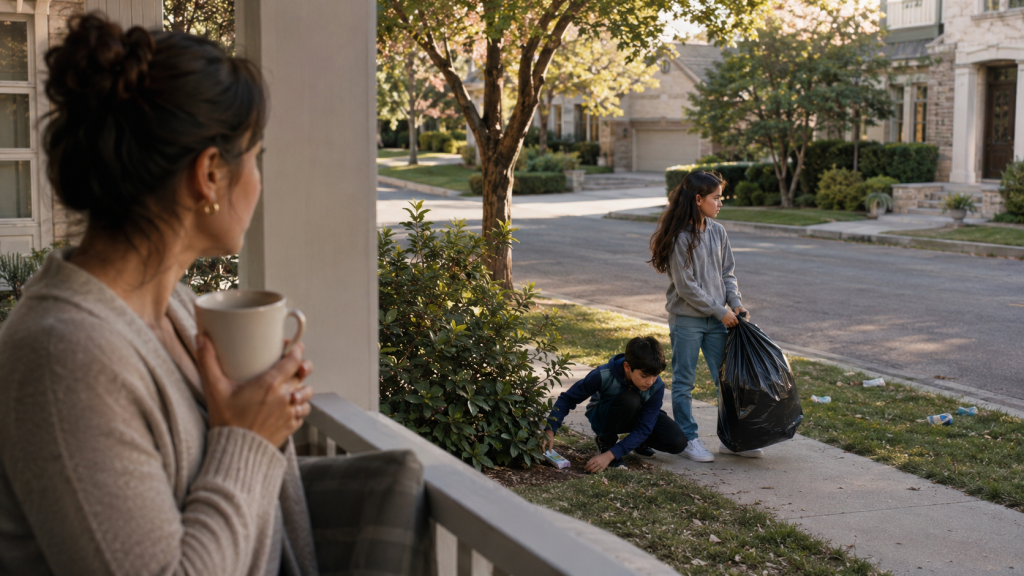
I thought about the children’s enormous black garbage bag.
Their slow walk along the street.
Their stops beside bushes and mailboxes.
Suddenly, the routine looked completely different.
“They’re delivering things to neighbors?”
“Sometimes.”
“And collecting things?”
“Sometimes.”
I stared at her.
“What kinds of things?”
“Money. Notes. Grocery cards. Medicine pickup slips. Small packages. Nothing dangerous.”
“Why hide everything?”
Mrs. Henderson sighed.
“Because it wasn’t supposed to become this complicated.”
She folded her hands.
“It started with their grandmother.”
I waited.
“The children’s grandmother, Ruth, lived in that house before their mother moved in.”
I remembered Ruth.
Barely.
An older woman with silver hair who used to walk a small brown dog every evening.
She had died two years earlier.
“Ruth knew everyone,” Mrs. Henderson continued. “Not casually. Really knew them. She knew who had lost a job. Who had cancer. Who couldn’t afford heating bills. Who was lonely. Who was pretending everything was fine.”
Mrs. Henderson smiled faintly.
“She used to say neighborhoods weren’t made of houses. They were made of people who noticed when someone’s porch light stopped coming on.”
I looked toward the dark window.
“That sounds like her.”
“It was.”
After Ruth died, her daughter Rebecca inherited the house.
Rebecca was the mother of the two children.
The woman I had complimented near the mailbox.
The woman who had looked strangely uncomfortable when I praised her children.
“Rebecca continued some of Ruth’s work,” Mrs. Henderson explained. “Quietly. She helped people without making them feel like charity cases.”
“How?”
“Food. Rides. Small loans. Collecting prescriptions. Watching pets. Things like that.”
“And the kids?”
“They wanted to help.”
I pictured the older girl placing herself between her brother and the street.
“They use the garbage bag as camouflage?”
Mrs. Henderson smiled.
“That was Noah’s idea.”
Noah.
The younger boy.
He looked maybe nine years old.
His sister, Lily, was probably twelve.
“They figured if they walked around collecting litter, nobody would question why they stopped beside different houses.”
I almost laughed.
It was clever.
But Mrs. Henderson wasn’t laughing.
“What about someone watching them?”
Her expression changed again.
“That part is new.”
She rose from the sofa and walked toward a small writing desk.
From the top drawer, she removed another envelope.
This one was sealed inside a sandwich bag.
She handed it to me.
There was no name written on it.
Only three words.
STOP USING THE CHILDREN.
I stared at the message.
“When did you get this?”
“Last Sunday.”
“Where?”
“Under my porch mat.”
A chill moved down my arms.
“Do Rebecca and the children know?”
“I told Rebecca.”
“And?”
“She wanted to stop immediately.”
That made sense.
“Then why were the children out today?”
“Because some of the neighbors insisted there was nothing to worry about.”
I stared at her.
“That seems irresponsible.”
“I said the same thing.”
Mrs. Henderson sat again.
“But there’s more.”
Of course there was.
“There have been other notes.”
She opened the drawer once more.
Three additional pieces of paper appeared.
Each carried a short message.
WE SEE WHAT YOU’RE DOING.
KEEP YOUR BUSINESS TO YOURSELVES.
SOME PEOPLE DON’T WANT YOUR HELP.
My stomach tightened.
“Who’s sending these?”
“We don’t know.”
“Have you contacted the police?”
“Rebecca did.”
“And?”
“They said the notes weren’t specific threats. They recommended cameras and told her to document everything.”
I looked toward the window again.
My house suddenly felt farther away than three doors down.
“Do you think one of the neighbors is angry about this?”
Mrs. Henderson shrugged.
“That’s what we’ve been trying to figure out.”
“Why would anyone care?”
“You’d be surprised.”
She looked tired now.
“Some people resent being helped. Some resent other people receiving help. Some worry about gossip. Some simply don’t like not knowing what’s happening around them.”
I stood.
“I need to talk to Rebecca.”
Mrs. Henderson nodded.
“I think you should.”
I walked home slowly.
Nothing about the street looked unusual.
Lawns were trimmed.
Cars sat in driveways.
A sprinkler clicked rhythmically across someone’s grass.
A man washed his SUV.
A woman pushed a stroller.
It looked like the safest, most predictable neighborhood imaginable.
Yet now every window seemed different.
Every curtain seemed capable of hiding someone watching.
When I reached my porch, I looked beneath the bush again.
The spot where Noah had placed the package was empty.
Of course it was.
I had removed it.
Still, I couldn’t shake the feeling that I had stepped into something I didn’t fully understand.
That evening, I knocked on Rebecca’s door.
She opened it almost immediately.
The moment she saw me, her face changed.
“You found something.”
It wasn’t a question.
“Yes.”
She invited me inside.
Lily and Noah were sitting at the kitchen table doing homework.
Both children looked up when I entered.
Noah’s eyes immediately dropped.
Lily watched me carefully.
Rebecca sent them upstairs.
Once they were gone, she poured two cups of tea.
“I’m sorry,” she said.
“For what?”
“For involving your property.”
“You didn’t.”
“My children did.”
“They were trying to help.”
Her shoulders lowered slightly.
“So Mrs. Henderson told you?”
“Most of it.”
Rebecca stared into her tea.
“I should have stopped this sooner.”
“The deliveries?”
“Yes.”
“Why didn’t you?”
She looked toward the staircase.
“Because it became important to them.”
She explained that after Ruth died, Lily had struggled badly.
She had been extremely close to her grandmother.
Every afternoon, Lily used to walk to Ruth’s house after school.
They baked together.
Gardened together.
Delivered meals together.
When Ruth died, Lily became withdrawn.
Then one day she found a notebook in her grandmother’s desk.
Inside were names.
Addresses.
Phone numbers.
And short reminders.
CHECK ON HENDERSON AFTER STORM.
CARTER NEEDS RIDE TUESDAY.
ALVAREZ — LEAVE GROCERIES, DON’T KNOCK.
MILLER KIDS NEED SCHOOL SUPPLIES.
“It was basically Grandma’s neighborhood list,” Rebecca said.
Lily wanted to continue it.
At first, Rebecca allowed her to help deliver cookies.
Then groceries.
Then cards.
Noah joined.
Eventually, the children invented their Sunday cleanup routine.
“They really do collect garbage,” Rebecca said.
“I noticed.”
“But the bag also carries small packages.”
“How many neighbors are involved?”
“Maybe eleven.”
That surprised me.
Almost half the street.
Some people gave.
Some received.
Some did both.
A retired teacher tutored children for free.
A mechanic fixed neighbors’ cars at cost.
Someone anonymous paid an elderly man’s electric bill during winter.
A college student picked up medication for housebound residents.
The Sunday bag became a simple way to move notes, gift cards, receipts, small cash reimbursements, grocery lists, and other items without embarrassing anyone.
“No one wanted this public,” Rebecca said.
“Why?”
“Because the people receiving help weren’t looking for attention.”
I understood that.
“But now someone knows.”
“Yes.”
“How?”
Rebecca shook her head.
“No idea.”
“Could it be someone involved?”
“We considered that.”
The possibility made the situation even stranger.
Rebecca opened a kitchen drawer.
She removed a folder.
Inside were photographs.
At first, I didn’t understand what I was seeing.
Then I realized they were pictures of Lily and Noah.
Walking.
Standing near mailboxes.
Crouching beside hedges.
Carrying the black bag.
My skin prickled.
“Where did these come from?”
“Someone left them in our mailbox Thursday.”
There were about fifteen photographs.
All clearly taken from a distance.
Some from inside a vehicle.
Some seemingly through a window.
One showed Lily standing outside Mrs. Henderson’s house.
Another showed Noah near my driveway.
Across the bottom of the final photograph, someone had written:
CHILDREN SHOULDN’T KEEP ADULT SECRETS.
“That’s why Lily kept shielding Noah today,” Rebecca said quietly.
“She knew someone might be watching.”
“I told them to stop.”
“But they didn’t.”
Rebecca closed her eyes.
“They left before I realized what they were doing.”
I remembered her anxious expression months earlier when I complimented the children.
“You never liked this arrangement.”
“I liked the helping.”
She looked toward the staircase.
“I hated the secrecy.”
That difference mattered.
Rebecca had continued the tradition because it connected Lily to her grandmother.
But over time, it had become larger than she expected.
Now children were carrying messages between adults who didn’t want to be seen communicating.
Even with good intentions, that made Rebecca uncomfortable.
“I’m ending it,” she said.
“I think that’s smart.”
“The adults can help each other directly.”
I nodded.
Then another thought occurred to me.
“Do the kids know what’s inside the packages?”
“Usually no.”
“Usually?”
“Sometimes people write instructions outside.”
My stomach tightened.
“Rebecca, you need to make sure nobody has used them for something inappropriate.”
Her face hardened.
“I already did.”
“How?”
“I checked with everyone we knew was participating.”
“And?”
“Everyone claims everything has been harmless.”
Claims.
That word stayed with me.
The next morning, Monday, I installed a camera above my porch.
By Tuesday, Rebecca installed two.
Mrs. Henderson already had one.
Nothing happened.
Wednesday passed.
Then Thursday.
Friday evening, I noticed a dark sedan parked at the end of the block.
I might never have paid attention before.
Cars parked there all the time.
But this one remained for nearly forty minutes.
No one got out.
When I stepped outside, it slowly pulled away.
I wrote down the license plate.
Saturday afternoon, I gave the number to Rebecca.
She passed it to the police officer handling the complaint.
Sunday arrived.
For the first time in months, Lily and Noah did not walk through the neighborhood.
The street seemed strangely empty without them.
At around eleven, I saw Mr. Carter walking toward Mrs. Henderson’s house carrying a grocery bag.
No disguise.
No secrecy.
Just one neighbor helping another.
It felt better.
Simpler.
I thought perhaps the entire issue would fade away.
Then, shortly after noon, Rebecca called me.
“Can you come over?”
Her voice shook.
I crossed the lawn immediately.
When she opened the door, she was holding another photograph.
This one showed Lily standing inside her own bedroom.
The photograph had clearly been taken through the window.
Across the bottom were five words.
GOOD. KEEP THEM OUT OF IT.
“That’s enough,” I said.
Rebecca had already called the police.
Two officers arrived fifteen minutes later.
This time, the situation was treated differently.
Photographing a child through a bedroom window changed everything.
They collected the photographs.
Asked questions.
Reviewed camera footage.
Then something unexpected happened.
One officer asked whether anyone on the street had recently experienced disputes involving money.
Rebecca mentioned several people.
Most of the neighborhood network involved small amounts.
Twenty dollars.
Fifty.
Maybe one hundred.
Except for one situation.
Mr. Wallace.
He lived near the end of the street in a large brick house.
His wife had died the previous year.
According to Rebecca, he had borrowed nearly four thousand dollars from Ruth years earlier.
Ruth never pressed him to repay it.
After she died, Rebecca discovered a handwritten agreement among her mother’s papers.
She approached Wallace only because she needed to settle the estate.
Wallace became furious.
He claimed the money had been a gift.
Rebecca disagreed.
Eventually, she dropped the issue.
“It wasn’t worth fighting over,” she said.
The officer wrote his name down.
But there was something else.
Mr. Wallace had complained repeatedly about the children’s Sunday routine.
He called it “suspicious.”
He once accused them of trespassing because they stepped onto the edge of his lawn while picking up a plastic bottle.
I had forgotten about that incident.
The police spoke with him.
He denied everything.
His sedan was silver.
Not black.
And his doorbell camera showed him leaving for church at the same time several of the photographs were likely taken.
For two weeks, nothing happened.
The neighborhood slowly relaxed.
Lily and Noah stopped the Sunday deliveries entirely.
But they still picked up trash occasionally.
Only now Rebecca walked with them.
Then Mrs. Henderson received another envelope.
This one contained no threat.
Just a photocopy.
She brought it to Rebecca.
Rebecca called me.
The page showed a list of names and dollar amounts.
Some names were familiar.
Some were not.
At the top appeared one phrase.
RUTH’S FUND.
Rebecca stared at the page.
“I’ve never seen this.”
Mrs. Henderson had.
Her reaction told us immediately.
“What is Ruth’s Fund?” I asked.
Mrs. Henderson sat at the kitchen table.
For a long moment, she said nothing.
Then she explained.
Years ago, Ruth had created an informal emergency fund.
Nothing official.
Nothing complicated.
A few neighbors contributed small amounts every month.
Ten dollars.
Twenty dollars.
Whatever they could afford.
When someone needed urgent help, Ruth used the money.
A prescription.
A utility bill.
A bus ticket.
A repair.
No interest.
No applications.
No paperwork.
Just trust.
“How much money?” Rebecca asked.
Mrs. Henderson hesitated.
“By the end, quite a bit.”
“How much?”
“Almost eighteen thousand dollars.”
Rebecca stared at her.
“My mother had eighteen thousand dollars belonging to neighbors?”
“Not exactly belonging to them.”
“That sounds exactly like it belonged to them.”
Mrs. Henderson frowned.
“It was voluntary.”
“Where is it?”
Silence.
Rebecca looked from Mrs. Henderson to me.
“Where is the money?”
“I don’t know.”
That changed everything.
Suddenly the photographs and warnings looked different.
Perhaps someone wasn’t trying to stop the children from helping.
Perhaps someone was searching for something.
Rebecca went through every box of Ruth’s belongings.
Bank records.
Notebooks.
Tax documents.
Old Christmas cards.
Receipts.
Nothing showed an account labeled Ruth’s Fund.
Then Lily remembered something.
“Grandma had a blue book.”
Rebecca turned.
“What blue book?”
“A little notebook.”
“Where?”
“In her sewing room.”
They searched.
Nothing.
“What was in it?” I asked.
Lily shrugged.
“Names and numbers.”
Rebecca’s face went pale.
“The list.”
Lily nodded.
“She used to write when people gave money.”
“Did you ever see where she kept the money?”
“No.”
Then Noah spoke from the doorway.
“In the cookie tin.”
Everyone turned.
“What?”
“Grandma kept envelopes in the cookie tin.”
Rebecca hurried toward the garage.
Boxes containing Ruth’s remaining belongings were stacked along one wall.
After nearly twenty minutes, she found an old round metal tin decorated with faded Christmas trees.
Empty.
Almost.
At the bottom was a bank deposit slip.
The account number had been partially torn away.
But the bank name remained.
Rebecca contacted the bank the next morning.
Because she was executor of Ruth’s estate, she was eventually able to confirm that an account had existed.
It had been closed six weeks after Ruth’s death.
The balance at closing had been $17,842.
Someone had withdrawn every dollar.
Rebecca hadn’t.
Mrs. Henderson hadn’t.
The neighbors hadn’t.
Now we knew why somebody might have been watching.
Someone believed the children knew what happened to the money.
The police investigation expanded.
Bank records showed the withdrawal had been made using authorization documents submitted after Ruth’s death.
The documents looked legitimate.
They weren’t.
Someone had forged Rebecca’s signature.
Security footage from the bank had long since been overwritten.
But one important detail remained.
The money had been transferred.
Not withdrawn as cash.
Into another account.
The receiving account belonged to a small consulting company.
Its owner?
Mr. Wallace’s adult son, Eric.
Suddenly the dark sedan mattered.
Eric Wallace drove a black Nissan.
The plate matched the number I had written down.
The police questioned him.
He claimed Ruth had owed his father money.
That explanation made little sense.
Then detectives discovered something else.
Eric had helped Ruth with paperwork during the final months of her life.
Taxes.
Online banking.
Insurance.
She trusted him because he worked in financial services.
That access allowed him to see the emergency fund.
After Ruth died, he created documents making it appear Rebecca had authorized the transfer.
Then he moved the money.
Why photograph the children?
Because he saw them carrying envelopes.
He knew they were continuing Ruth’s neighborhood system.
And he became afraid they might discover records proving what he had done.
Especially the blue notebook.
The threats were meant to stop them.
The photographs were meant to frighten Rebecca.
But there was still one problem.
The blue notebook was missing.
Eric denied taking it.
Police searched his house after obtaining a warrant.
They found photographs.
Copies of several threatening notes.
And financial records.
But no notebook.
Then Lily remembered one final detail.
“Grandma gave me something before she went to the hospital.”
Everyone looked at her.
“What?”
“A book.”
Rebecca knelt.
“What book?”
Lily disappeared upstairs.
A minute later she returned holding an old copy of Anne of Green Gables.
Rebecca looked confused.
Lily opened the back cover.
Inside, taped beneath the paper lining, was a small brass key.
“Grandma told me not to lose it.”
Rebecca stared.
“Did she say what it opened?”
Lily shook her head.
But Mrs. Henderson knew.
“Her locker.”
“What locker?”
“At the community center.”
Ruth had volunteered there for nearly fifteen years.
After her death, nobody had thought about the small storage locker she used in the basement.
The community center manager allowed Rebecca access.
The key opened locker 214.
Inside were knitting supplies.
Old magazines.
A winter coat.
Three canned soups.
And beneath everything else, a blue notebook.
Rebecca opened it.
There were names.
Dates.
Dollar amounts.
Receipts.
Every contribution to Ruth’s Fund.
Every withdrawal.
Every neighbor helped.
And taped inside the final page was a note in Ruth’s handwriting.
Rebecca read it aloud.
“If anything happens to me, the remaining fund belongs to the neighborhood. Rebecca should manage it only if she wants to. No one owes anything back. Help is not debt.”
Below that was another note.
“Eric has access temporarily while I’m sick. Change this afterward.”
Rebecca stopped reading.
That sentence proved Eric’s access had been temporary.
Not ownership.
Not authorization.
Police now had the missing piece.
The investigation moved quickly after that.
Eric eventually admitted transferring the money.
But he insisted he planned to replace it.
He said he had been struggling financially.
His consulting business had failed.
Credit-card debt had piled up.
He told himself the neighborhood fund was “unused money.”
Then, when he saw Lily and Noah continuing Ruth’s deliveries, panic set in.
He became convinced they would eventually uncover the notebook.
So he tried to scare them into stopping.
The strangest part was that the children barely knew the fund existed.
They had been carrying grocery lists.
Birthday cards.
Small reimbursements.
Nothing connected to Eric.
His own fear exposed him.
The stolen money was eventually recovered through legal proceedings and restitution arrangements.
But Rebecca refused to restart the secret delivery system.
At first, some neighbors complained.
Not because they wanted children carrying hidden envelopes.
Because they missed what Ruth had created.
The quiet way people could ask for help without feeling ashamed.
So the neighborhood created something new.
Something safer.
Once a month, everyone who wanted to participate met at the community center.
No secrets.
No children acting as messengers.
No money hidden under bushes.
They called it Ruth’s Table.
Anyone could contribute anonymously.
Anyone could request help privately through two elected coordinators.
Local grocery cards were kept in a locked office.
Financial records were transparent.
Children could volunteer, but only with parents present.
Lily was disappointed at first.
She felt like something of her grandmother’s tradition had been taken away.
Then Rebecca showed her the blue notebook.
Not the financial pages.
The personal notes.
CHECK ON HENDERSON.
BRING CARTER SOUP.
ALVAREZ LIKES PEACH JAM.
MILLER BOY STARTS SCHOOL MONDAY.
Rebecca explained that Ruth’s real legacy wasn’t secrecy.
It was noticing people.
That changed Lily’s perspective.
The following Sunday morning, I was sitting on my porch again with coffee.
The weather was cooler.
Autumn had begun touching the trees with faint yellow edges.
At exactly nine fifteen, Lily and Noah came outside.
For one second, I felt the old tension return.
Then I saw what they were carrying.
Two ordinary recycling bags.
Rebecca walked behind them.
No hidden envelopes.
No photographs.
No nervous glances.
They crossed the street collecting bottles and wrappers.
When they reached my driveway, Noah stopped.
There was a crushed soda can near the curb.
He picked it up.
Then he looked at me.
“You missed one.”
I smiled.
“So did you last time.”
His face turned red.
Lily laughed.
“That was different.”
“I know.”
Rebecca waved from the sidewalk.
The children continued.
About an hour later, Mrs. Henderson appeared at my porch carrying something covered with foil.
“Peach cobbler,” she said.
“Why?”
“Because I made too much.”
I raised an eyebrow.
“You made too much?”
She smiled.
“Fine. Because Ruth’s notebook said you once told her peach was your favorite.”
I laughed.
“I barely knew Ruth.”
“She knew you.”
That sentence stayed with me.
Mrs. Henderson sat beside me.
We shared cobbler.
Across the street, Mr. Carter helped another neighbor repair a loose fence.
Farther down, Rebecca and the children continued collecting litter.
Everything looked ordinary again.
But I would never see the street the same way.
Over the following months, Ruth’s Table grew.
Not dramatically.
Quietly.
A single mother received grocery cards after losing her job.
A retired veteran got help replacing a broken furnace.
A teenager received money for college application fees.
Someone paid for Mrs. Henderson’s prescription when insurance refused coverage.
Nobody posted photographs online.
Nobody made speeches.
Nobody expected praise.
People simply helped.
And strangely, once the secrecy disappeared, the neighborhood became closer.
We learned things about one another we should probably have known years earlier.
Mr. Carter had been lonely since his wife died.
Mrs. Alvarez was an incredible baker.
The couple across from me had fostered twelve children over twenty years.
Rebecca worked two jobs after her divorce.
Lily wanted to become a social worker.
Noah wanted to become, depending on the week, either a firefighter, an astronaut, or a professional goalkeeper.
One evening the following spring, Ruth’s Table held a neighborhood dinner.
Nearly forty people attended.
Someone placed the old blue notebook inside a glass display case near the entrance.
Beside it was a small photograph of Ruth.
Silver hair.
Wide smile.
Brown dog at her feet.
Underneath the photograph, Rebecca placed a card containing Ruth’s favorite sentence.
A neighborhood isn’t made of houses.
It’s made of people who notice.
I stood reading those words longer than I expected.
Lily walked up beside me.
“You know what’s funny?”
“What?”
“Grandma didn’t even like meetings.”
I laughed.
“So she would hate Ruth’s Table?”
“She would complain about the chairs.”
That made both of us laugh.
Then Lily became serious.
“I thought I was doing what she wanted.”
“The deliveries?”
She nodded.
“After she died, I didn’t want everything she did to disappear.”
“It didn’t.”
“But we were keeping secrets.”
“You were trying to help.”
She looked toward her mother.
“Mom says helping someone shouldn’t mean putting yourself in danger.”
“Your mom is right.”
Lily sighed.
“She usually is.”
“Don’t tell her you admitted that.”
“I won’t.”
A few minutes later, Noah appeared carrying a plate stacked absurdly high with cookies.
Rebecca noticed immediately.
“Noah.”
He froze.
“How many cookies are on that plate?”
“Three.”
There were at least nine.
Rebecca stared at him.
He glanced at me.
“Some are underneath.”
I laughed so hard I nearly spilled my drink.
Life continued.
The frightening weeks slowly became a story people remembered rather than something they still feared.
Eric pleaded guilty to fraud-related charges and harassment offenses.
His father moved away several months later.
Nobody celebrated either event.
There had already been enough bitterness.
What mattered was that the money returned.
More importantly, the trust returned.
Almost one year after I first found that plastic package beneath my window, another Sunday arrived.
I stepped onto the porch carrying coffee.
At nine fifteen, right on schedule, Lily and Noah appeared.
They were older now.
Taller.
Noah had finally stopped wearing the red jacket he seemed to live in the previous year.
Lily carried a small bucket.
Noah carried a trash grabber.
Rebecca followed several steps behind.
As they reached my house, Lily stopped near the same bush where everything had begun.
She crouched.
For one brief moment, my heart jumped.
Then she pulled something from the leaves.
A candy wrapper.
She tossed it into the bucket.
Noah looked toward me.
“We’re actually cleaning this time.”
“I can see that.”
Lily grinned.
“Mostly.”
She reached into her pocket.
I narrowed my eyes.
“What are you doing?”
She pulled out a small envelope.
For a second, I couldn’t believe it.
“Lily.”
She laughed.
“It’s not secret.”
She walked up to the porch and handed it to me.
My name was written across the front.
“What is this?”
“Open it.”
Inside was an invitation.
RUTH’S TABLE — ONE YEAR ANNIVERSARY PICNIC.
Below the details, someone had handwritten:
BRING PEACH COBBLER.
I looked toward Mrs. Henderson’s house.
She was standing in her doorway laughing.
“You planned this.”
She called back.
“Absolutely.”
I shook my head.
“You could have just told me.”
Lily smiled.
“Where’s the fun in that?”
Then she ran after Noah.
I stood there holding the invitation.
A year earlier, finding something hidden beneath that bush had terrified me.
Now I understood something I hadn’t known then.
Secrets aren’t always dangerous because of what they contain.
Sometimes they become dangerous because people are left to imagine what they contain.
Ruth had built her network around kindness.
But kindness mixed with secrecy created vulnerabilities she never intended.
Rebecca learned that.
The children learned it.
All of us did.
We didn’t stop helping one another.
We simply stopped believing that help had to hide.
At the anniversary picnic, everyone brought something.
Mrs. Alvarez brought empanadas.
Mr. Carter grilled hamburgers.
Rebecca made potato salad.
Mrs. Henderson brought three peach cobblers despite insisting she had only made one.
Someone set up folding tables.
Children played soccer on the community-center lawn.
At one point, Noah kicked the ball directly into the dessert table.
Mrs. Henderson screamed.
Noah apologized for nearly five straight minutes.
Nothing was damaged.
Except perhaps his confidence as a future professional goalkeeper.
Later that afternoon, Rebecca asked everyone for a moment of attention.
She stood beside Lily and Noah.
“I want to say something about my mother.”
The conversations quieted.
Rebecca glanced at Ruth’s photograph.
“My mother believed people shouldn’t have to announce their worst moments before they deserved help.”
Several people nodded.
“She also believed neighbors should notice when someone was struggling.”
Rebecca paused.
“But after everything that happened, I realized something else.”
She looked at Lily.
“We can care for people without asking children to carry adult burdens.”
Lily reached for her mother’s hand.
“And we can protect someone’s dignity without hiding so completely that nobody knows what’s happening.”
Rebecca smiled.
“Ruth’s Table exists because we kept the best part of my mother’s idea and changed the parts that needed changing.”
Applause moved through the crowd.
Then Noah raised his hand.
Rebecca looked confused.
“Yes?”
“Can we eat now?”
Everyone burst out laughing.
Rebecca shook her head.
“Yes, Noah.”
He immediately ran toward the cookie table.
That evening, after most people had gone home, I helped fold chairs.
Lily was sweeping scraps of paper near the entrance.
I watched her for a moment.
“Still cleaning?”
She smiled.
“Sunday habit.”
“You know, when I first saw you two carrying that enormous black bag, I thought you were the most responsible kids in the neighborhood.”
“We were.”
“You were hiding envelopes under bushes.”
“And picking up trash.”
“Technically.”
She laughed.
Then she became thoughtful.
“Did you ever think something bad was inside the package?”
“Yes.”
“What?”
“I don’t know.”
“Like diamonds?”
“No.”
“Secret spy documents?”
“No.”
“Government codes?”
“Definitely no.”
She looked disappointed.
“What did you think?”
I considered it.
“The truth?”
“Yeah.”
“I thought I was about to discover something I wished I hadn’t.”
Lily nodded.
“You kind of did.”
She was right.
I discovered stolen money.
Forged documents.
Threatening photographs.
A frightened mother.
A neighborhood network operating almost invisibly around me.
But I discovered something else too.
For years, I had assumed I knew my neighbors because I recognized their cars.
Because I waved when we passed.
Because I knew which houses had dogs.
Because I exchanged Christmas cards with a few people.
I hadn’t known who was struggling.
Who was helping.
Who was grieving.
Who was quietly keeping someone else afloat.
Ruth had known.
And somehow, even after she was gone, she forced the rest of us to notice.
The next morning, I found something on my porch.
Not hidden.
Not wrapped in plastic.
Just a small paper bag.
Inside were two peaches.
A note was attached.
YOU SAID THEY WERE YOUR FAVORITE.
No signature.
I laughed.
For half a second, I considered asking who left them.
Then I decided it didn’t matter.
Some anonymity was harmless.
Some kindness didn’t need credit.
The difference was that nobody was afraid anymore.
Nobody was being watched.
Nobody was being used.
Nobody was carrying secrets they didn’t understand.
Years later, when Lily left for college, she studied social work exactly as she had planned.
Noah abandoned his professional soccer ambitions and became fascinated with engineering.
Rebecca eventually became one of the official coordinators of Ruth’s Table.
Mrs. Henderson kept making too much cobbler.
Mr. Carter remarried.
Mrs. Alvarez’s husband recovered enough to attend neighborhood dinners again.
And the fund?
It grew.
People who had once received help later contributed.
Former neighbors mailed checks after moving away.
A local business matched donations during the holidays.
Eventually, Ruth’s Table became a registered community assistance program.
Nothing enormous.
Nothing famous.
Just enough to help people when life unexpectedly became heavier than they could carry alone.
The blue notebook remained in the community center.
Every year, someone added a page listing the number of people helped.
No names.
No private details.
Just numbers.
Groceries: 14 families.
Utilities: 9 households.
Transportation: 11 residents.
School supplies: 23 children.
Emergency repairs: 6 homes.
At the bottom of every page was the same sentence.
A neighborhood isn’t made of houses.
It’s made of people who notice.
Sometimes I think about how close I came to never learning any of it.
If I had stayed inside that Sunday morning, I wouldn’t have seen Noah crouch beneath my bush.
If he had chosen another hiding place, I wouldn’t have found the envelope.
If I hadn’t carried it to Mrs. Henderson, I might never have learned about the photographs.
The police might never have connected Eric to the fund.
The blue notebook might have remained hidden for years.
Life can turn on remarkably small moments.
A cup of coffee.
A glance through a window.
A child looking over his shoulder.
A plastic package beneath a bush.
For months, I had watched Lily and Noah dragging that enormous black garbage bag through the neighborhood and thought I understood exactly what they were doing.
I saw two responsible children collecting litter.
That story was simple.
Comfortable.
Incomplete.
The truth was stranger.
They were carrying pieces of an invisible community.
A grocery request folded inside an envelope.
Twenty dollars being quietly returned.
A birthday card for someone living alone.
A pharmacy receipt.
A thank-you note.
A reminder that someone had noticed.
The black bag was never really about garbage.
But eventually, after everything changed, it became exactly that.
Just a trash bag.
And oddly enough, I think Ruth would have approved.
Because the most important thing was never the method.
It was the reason.
People still needed help.
People still needed privacy.
People still needed dignity.
But children deserved childhood.
Neighbors deserved trust.
And kindness worked best when it didn’t depend on fear.
Even now, every Sunday morning, I sit on my porch with coffee.
Different families live on the street now.
New children ride bicycles along the sidewalk.
New cars sit in driveways.
Some of the old neighbors are gone.
Others have moved.
But once a month, people still gather at the community center.
And outside the entrance hangs a small wooden sign.
RUTH’S TABLE.
Underneath it are the words that changed how I understood the place I had lived for years.
NOTICE PEOPLE.
That’s all.
Two words.
Simple enough to ignore.
Powerful enough to change a neighborhood.
And sometimes, when I see someone walking down the street carrying a black garbage bag, I still remember that Sunday morning.
I remember Noah crouching beneath my living-room window.
I remember Lily watching the street.
I remember the plastic beneath the leaves.
And I remember how convinced I was that I had uncovered something terrible.
In a way, I had.
But beneath the fear, the secrets, and the stolen money was something worth protecting.
A grandmother’s belief that people should never suffer simply because they were too proud to ask for help.
A daughter’s decision to continue that belief more safely.
Two children’s determination to keep their grandmother’s kindness alive.
And an entire neighborhood learning that caring for one another doesn’t require heroic gestures.
Sometimes it begins with groceries.
Sometimes with twenty dollars.
Sometimes with a ride to the doctor.
Sometimes with picking up a phone.
Sometimes with knocking on a door.
And sometimes it begins because one person finally notices what everyone else has been walking past.
That Sunday, I thought I discovered what the children next door had been secretly leaving behind.
Years later, I realized the more important discovery was what their grandmother had left behind.
Not money.
Not notes.
Not a hidden fund.
A habit.
The habit of noticing.
And once our neighborhood learned it, we never completely forgot.
💬THE END! THANK YOU FOR READING!