

For several seconds, I couldn’t speak.
I stood on Grandpa’s porch with one hand gripping my phone and the other pressed against the wooden railing because suddenly my legs didn’t seem strong enough to hold me.
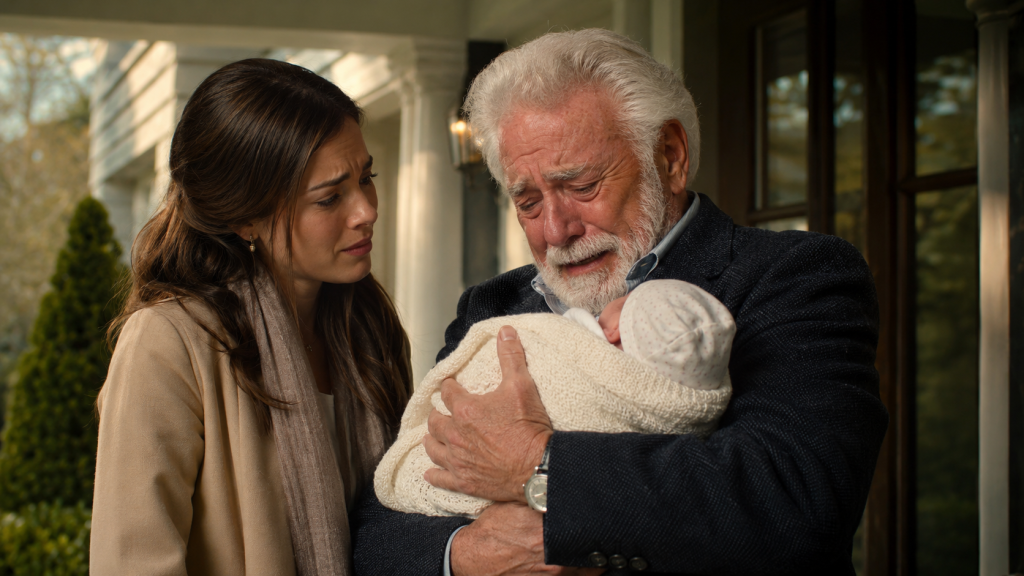
Across from me, Grandpa was still sitting in his chair with Nora tucked against his chest.
His face had gone completely white.
Caleb’s voice came through the phone again.
“Emma? Are you there?”
I swallowed.
“Yes.”
Grandpa’s eyes snapped toward mine.
I put the call on speaker.
“Caleb,” I said, barely recognizing my own voice. “Where have you been?”
Silence.
Then he exhaled.
“I know I owe you an explanation.”
“You disappeared the night I told you I was pregnant.”
“I know.”
“You changed your number.”
“I know.”
“You moved out of your apartment.”
“I know.”
“You left me to go through everything alone.”
My voice cracked on the last word.
Grandpa lowered his gaze.
Nora stirred against his chest.
For months, I had imagined what I would say if Caleb ever called.
I had imagined screaming.
Cursing.
Hanging up.
Telling him he had lost the right to ever know his daughter.
But now there was something much larger hanging over us.
Something terrifying.
“Why did Grandpa try to find you?” I asked.
Caleb went quiet again.
Then he said, “Because someone contacted me three weeks ago asking questions about my adoption.”
Grandpa closed his eyes.
I stared at him.
“You contacted Caleb?”
“I tried,” Grandpa whispered.
My anger turned toward him.
“You knew how to find him?”
“No. I hired someone.”
“Why?”
Grandpa looked at Nora.
“Because when you were in the hospital, you sent me her picture.”
I remembered.
The first photo I had taken after Nora was moved from the neonatal intensive care unit.
Her tiny face wrapped in a white blanket.
One bright blue eye.
One dark brown.
Grandpa had replied with three heart emojis and the words, She’s perfect.
I had thought he was simply overwhelmed.
Now I understood there had been something else behind that message.
“I saw her eyes,” Grandpa said. “And I started wondering.”
Caleb spoke through the phone.
“Wondering what?”
Grandpa leaned closer.
“What is your full name?”
“You already know it.”
“Say it.”
A pause.
“Caleb James Mercer.”
Grandpa’s fingers tightened around Nora’s blanket.
“And when were you born?”
“November fourth, 1996.”
Grandpa looked at me sharply.
I felt my stomach drop.
“What?” I whispered.
Grandpa shook his head slowly.
“That’s not right.”
“What isn’t right?” Caleb demanded.
“The baby your mother gave away was born in 1989.”
Caleb fell silent.
So did I.
For a moment, the only sound on the porch was the wind moving through Grandpa’s maple trees.
Then I stared at him.
“Wait.”
My thoughts struggled to catch up.
“You said Mom had a baby when she was seventeen.”
Grandpa nodded.
“And you thought Caleb might be that baby?”
“Yes.”
“But Caleb is only two years older than me.”
Grandpa looked confused.
“Yes.”
“Then how could he possibly be the son she had before I was born?”
His expression changed.
I saw the realization hit him.
He had been terrified.
So terrified by Nora’s eyes that he had connected pieces before checking whether they actually fit.
“Oh,” he whispered.
I almost laughed from pure relief.
Almost.
But Caleb spoke again.
“There’s more.”
The relief disappeared.
Grandpa looked at the phone.
“What do you mean?”
“The investigator you hired found something in my adoption records.”
Grandpa slowly handed Nora back to me.
I held her tightly.
“What?” I asked.
“My adoption wasn’t processed the way I was told.”
“Meaning?”
“There are two birth certificates.”
My chest tightened.
“What?”
“One lists my adoptive parents. That’s the one I’ve always had. But there’s another document attached to the sealed court file.”
Grandpa rose from the chair.
“What names are on it?”
Caleb hesitated.
“The father’s name is blank.”
“And the mother?”
Another pause.
“Rebecca Hale.”
Grandpa stumbled backward.
I caught the edge of the porch table before it tipped.
“Grandpa?”
He stared at nothing.
“No.”
“Who is Rebecca Hale?”
He didn’t answer.
“Grandpa.”
His lips parted.
Finally, he whispered, “Your mother’s sister.”
I felt as though the world shifted beneath me.
“My mother had a sister?”
“A half-sister.”
“You told me she was an only child.”
“That’s what your mother wanted you to believe.”
“Why?”
Grandpa rubbed both hands across his face.
“Because Rebecca disappeared from our lives long before you were old enough to remember her.”
Caleb’s voice hardened.
“Are you saying Rebecca Hale was Emma’s aunt?”
“Yes.”
My heart started pounding again.
That would mean Caleb was my cousin.
I looked down at Nora.
My beautiful sleeping daughter.
The relief I had felt only seconds earlier vanished.
Grandpa saw my expression.
“Emma, wait.”
“Wait for what?”
“We still don’t know that the document is real.”
“Why would it be fake?”
“I don’t know.”
Caleb spoke quietly.
“Neither do I. But there’s something else.”
I shut my eyes.
Of course there was.
“There’s always something else,” I whispered.
“The signature on the original birth certificate looks wrong.”
Grandpa froze.
“What do you mean?”
“I found examples of Rebecca Hale’s signature through old property records. They don’t match.”
Grandpa stepped closer to the phone.
“Not even close?”
“No.”
Grandpa’s face changed.
For the first time since I arrived, the fear in his eyes gave way to something else.
Recognition.
“Margaret,” he whispered.
“Who?” I asked.
But Grandpa was already walking toward the front door.
“Get inside.”
“Grandpa—”
“Emma, please.”
Something in his voice stopped me from arguing.
I carried Nora into the house while Grandpa hurried down the hallway toward his study.
The room smelled exactly as it had when I was a child.
Old books.
Wood polish.
Coffee.
He pulled open the bottom drawer of his desk and removed a small metal lockbox.
I had seen it hundreds of times.
He had never opened it in front of me.
His hands trembled as he entered the combination.
Inside were photographs, letters, legal documents, and one faded blue envelope.
Grandpa lifted it carefully.
“What is that?”
“Your mother gave this to me two months before she died.”
My throat tightened.
He handed it to me.
Across the front, in my mother’s handwriting, were four words.
For Emma, if necessary.
I stopped breathing.
I knew that handwriting.
I had birthday cards tucked into a box upstairs with the same looping E.
The same narrow M.
My mother had written my name.
“Why didn’t you give this to me?”
“She made me promise not to unless the past ever came looking for you.”
I stared at him.
“I think the past is standing on the porch.”
Grandpa nodded.
My fingers shook as I opened the envelope.
Inside were three pages.
The paper had yellowed around the edges.
I sat down.
Grandpa sat beside me.
Nora slept against my chest.
And I began to read.
My mother’s letter started simply.
My darling Emma,
If Dad has given you this letter, then something happened that I prayed would never happen.
There are things about our family I kept from you.
Not because I wanted to lie to you.
Because I wanted you to grow up without carrying the consequences of decisions that were made before you were born.
I looked at Grandpa.
He nodded for me to continue.
My mother explained that her father—my biological grandfather—had remarried when she was fourteen.
His new wife, Margaret, already had a daughter named Rebecca.
Rebecca and my mother were almost the same age.
At first, they became close.
Then the family changed.
My biological grandfather died suddenly when Mom was nineteen.
Margaret inherited most of his property.
Afterward, arguments erupted over money.
There were accusations.
Missing documents.
Accounts emptied.
Then Rebecca became pregnant.
According to my mother’s letter, Rebecca had wanted to keep the baby.
Margaret refused.
She arranged a private adoption through a lawyer she knew.
But there was a problem.
Rebecca changed her mind.
Three days after giving birth, she demanded her son back.
Margaret told her it was too late.
Rebecca disappeared shortly afterward.
For years, my mother believed she had run away.
Then she learned something terrible.
The adoption had never been finalized.
I stopped reading.
“Grandpa.”
He looked exhausted.
“Keep going.”
I forced myself.
According to Mom, Margaret had arranged for the baby to be moved between several families while paperwork was altered.
Not because she cared where he went.
Because she was hiding financial crimes connected to the estate.
Rebecca had discovered that Margaret had forged signatures and redirected money from trusts established by my biological grandfather.
If Rebecca returned and challenged her, everything could unravel.
The baby became leverage.
My mother spent years trying to find both Rebecca and her child.
Then, eventually, she found Rebecca.
Alive.
Living under another surname.
And without her son.
The letter continued.
Emma, there is one thing you must understand.
Rebecca’s son was born on March 18, 1989.
His name at birth was Daniel.
If anyone ever tries to tell you otherwise, check the date.
I read that sentence twice.
Then three times.
Caleb was still on the phone.
“March 1989?” he asked.
“Yes.”
“I was born in 1996.”
Grandpa sat heavily in his chair.
“So you cannot be Rebecca’s son.”
I covered my face.
Seven years.
There was a seven-year difference.
Whatever connection Caleb had to our family, he was not the baby my mother had written about.
Which meant he wasn’t my cousin.
I started crying.
Not graceful tears.
Not quiet ones.
I bent over Nora and sobbed from the sheer release of fear.
Grandpa put his hand on my shoulder.
“Oh, sweetheart.”
“You scared me half to death.”
“I know.”
“You looked at my daughter like I’d committed some terrible crime.”
“I panicked.”
“You should have checked the dates before saying anything.”
“You’re right.”
I looked at him.
Grandpa rarely admitted being wrong that quickly.
That almost made me cry harder.
Caleb spoke through the phone.
“Emma.”
I wiped my cheeks.
“What?”
“We still need to figure out why Rebecca’s name is on my birth certificate.”
Grandpa nodded slowly.
“That part matters.”
I looked down at the letter.
There was more.
Mom wrote that Margaret had continued using Rebecca’s identity after she disappeared.
Bank accounts.
Property documents.
Insurance paperwork.
Anything requiring a second person whose name Margaret could control.
Then came the sentence that changed everything.
If you ever encounter a document claiming Rebecca gave birth after 1991, it is almost certainly false.
She had emergency surgery that year and could never have another child.
My eyes widened.
“Caleb.”
“I heard it.”
Grandpa stood.
“If Rebecca couldn’t have children after 1991, she couldn’t possibly be Caleb’s biological mother.”
I stared at my phone.
“Then who is?”
Caleb was quiet for several seconds.
“I think I know how to find out.”
Three days later, Caleb came home.
I almost didn’t recognize him when he stepped out of the rental car outside Grandpa’s house.
He looked thinner.
His dark hair had grown longer.
There were shadows beneath his eyes.
But those eyes were exactly as I remembered.
One blue.
One almost-black brown.
Just like Nora’s.
He stopped when he saw me.
Neither of us moved.
For months, I had dreamed of this moment.
But dreams never include the awkward details.
The wind catching your hair.
The baby monitor clipped to your pocket.
The fact that you don’t know whether to hug someone or slap them.
Caleb took one step toward me.
“I’m sorry.”
I held up my hand.
“No.”
He stopped.
“You don’t get to begin with two words and think they cover eight months.”
“I know.”
“You missed everything.”
His face tightened.
“I know.”
“You missed the first ultrasound.”
“I know.”
“You missed hearing her heartbeat.”
His eyes filled.
“You missed me being terrified in a hospital room when the doctors told me something was wrong.”
He looked down.
“You missed her birth.”
“I know.”
“No, Caleb. You don’t know.”
He looked at me again.
“You’re right.”
The anger I had carried for months rose so sharply I could barely breathe.
“Why did you leave?”
He reached into his jacket and pulled out a folded envelope.
“Because someone made me believe staying would destroy you.”
I stared at the envelope.
“What does that mean?”
He handed it to me.
Inside was a photograph of me leaving my apartment.
Another of me walking into work.
Another of Grandpa driving me to a prenatal appointment.
My stomach turned.
“What is this?”
“They were mailed to me the night you told me you were pregnant.”
There was also a typed note.
LEAVE EMMA HALE ALONE.
IF YOU STAY, SHE WILL LEARN WHAT HER MOTHER DID.
IF YOU CONTACT HER AGAIN, THE OLD RECORDS BECOME PUBLIC.
I looked up.
“You received this that night?”
“Yes.”
“And you believed it?”
“Not immediately.”
“Then why didn’t you ask me?”
“Because there was something in the envelope that I recognized.”
He removed another paper.
A photocopy of his original birth certificate.
Rebecca Hale.
My aunt’s name.
“I thought you were related to me,” he whispered.
My anger faltered.
“What?”
“I didn’t know how. I didn’t know whether Rebecca was your mother’s sister or cousin or something else. But I knew your mother’s maiden name was Hale. You’d told me that much.”
He swallowed.
“I panicked.”
“So you disappeared?”
“I thought if there was even a chance we were close relatives, I needed to find the truth before I came near you again.”
“You could have told me.”
“Yes.”
“You should have told me.”
“Yes.”
“I spent months thinking you didn’t love me.”
His face broke.
“I loved you so much that I convinced myself disappearing was protecting you.”
“That isn’t protection.”
“I know that now.”
I looked away.
Forgiving him was not going to happen because he had returned with a tragic explanation.
Pain did not become harmless simply because it had been caused by fear.
But I also understood something I hadn’t before.
Caleb had not disappeared because he didn’t care.
He had disappeared because someone had deliberately terrified him.
Someone knew about our family.
Someone knew Rebecca’s name.
Someone knew I was pregnant before almost anyone else did.
Grandpa came onto the porch.
When he saw Caleb, he stopped.
Caleb stared back.
For a strange moment, neither spoke.
Then Grandpa walked forward.
“You have her eyes.”
Caleb glanced toward me.
“Nora?”
“No,” Grandpa said.
“Rebecca.”
Caleb went still.
Grandpa disappeared inside and returned holding an old photograph.
Two teenage girls stood beside a lake.
One was my mother.
I recognized her immediately.
The other girl had thick dark curls and mismatched eyes.
One blue.
One brown.
Caleb stared at the picture.
Then he whispered, “That’s impossible.”
Grandpa shook his head.
“It isn’t.”
“But you just said she couldn’t be my mother.”
“She couldn’t.”
“Then why do I look like her?”
Grandpa turned the photo over.
Written on the back were three names.
Laura.
Rebecca.
Samuel.
Caleb frowned.
“Who is Samuel?”
Grandpa looked toward me.
“Rebecca’s older brother.”
I stared at him.
“You forgot to mention another sibling?”
“It’s complicated.”
“Apparently everything in this family is complicated.”
Samuel was Margaret’s son from her first marriage.
He was almost ten years older than Rebecca.
Unlike Margaret and Rebecca, Samuel left home early.
He joined the Navy.
Then moved across the country.
Grandpa had met him only twice.
But genetics didn’t care about family distance.
If Samuel was Caleb’s father, Rebecca would be Caleb’s aunt.
Caleb would share her eye trait without being related to me by blood, because Rebecca and Samuel were my mother’s step-siblings.
Not biological siblings.
The connection between our families would be social and legal.
Not genetic.
Suddenly the puzzle had a possible solution.
We ordered DNA tests that afternoon.
Waiting for the results was unbearable.
During those ten days, Caleb stayed at a hotel.
He asked to see Nora.
I allowed it.
The first time he held her, he cried.
He didn’t try to hide it.
Nora stared up at him with her mismatched eyes.
Then she wrapped her tiny fingers around his thumb.
Caleb’s entire face collapsed.
“Hi,” he whispered. “I’m your dad.”
I had to leave the room.
Grandpa followed me into the kitchen.
“You all right?”
“No.”
He nodded.
“Fair enough.”
I watched through the doorway as Caleb rocked Nora gently.
“He abandoned us.”
“Yes.”
“But he thought he was protecting us.”
“Yes.”
“That doesn’t erase it.”
“No.”
“Why are you agreeing with everything?”
Grandpa opened the refrigerator.
“Because I spent thirty years thinking hiding things was the same as protecting people.”
He pulled out a pitcher of tea.
“It wasn’t.”
That silenced me.
The DNA results arrived on a Thursday morning.
Caleb came to Grandpa’s house.
We opened them together.
First, the most important result.
Caleb and I showed no close biological relationship.
I cried before I even read the rest.
He covered his mouth.
Grandpa leaned against the table and shut his eyes.
Then came the second result.
Caleb had matched with a man registered in the database as a paternal uncle.
The surname was Lawson.
Not Mercer.
Not Hale.
Lawson.
We contacted him.
His name was Michael Lawson.
When Caleb explained what he was trying to learn, Michael became silent.
Then he asked Caleb for his birth date.
November fourth, 1996.
Michael whispered something we couldn’t hear.
Twenty minutes later, he sent us a photograph.
Three men standing beside a fishing boat.
The youngest had dark curls.
A cleft chin.
And mismatched eyes.
His name was Samuel Lawson.
Margaret’s son.
Caleb’s biological father.
Caleb sat down.
“So Rebecca really was my aunt.”
“Yes,” Grandpa said.
“But not Emma’s blood relative.”
“No.”
“Then why was Rebecca listed as my mother?”
That question remained.
Michael answered part of it.
Samuel Lawson had dated a woman named Katherine Mercer in 1995.
Katherine became pregnant.
Samuel died in a construction accident before Caleb was born.
Katherine struggled financially.
Margaret appeared shortly afterward.
She offered help.
What Katherine hadn’t realized was that Margaret was still using Rebecca’s identity in financial schemes.
Somehow, during the adoption process, Rebecca’s name was inserted onto Caleb’s sealed birth record.
We still didn’t know why.
Then Grandpa received a call.
He listened for less than a minute before sitting down.
“What?” I asked.
He hung up.
“That was the investigator.”
“And?”
“He found Margaret.”
I stared.
“She’s alive?”
Grandpa nodded.
“Eighty-six years old. Living in a private assisted-living residence outside Richmond.”
Caleb looked stunned.
“She’s the one who sent me the photographs, isn’t she?”
Grandpa didn’t answer immediately.
But we all knew.
Two days later, we drove to Virginia.
I almost stayed home.
Nora was still small.
I was exhausted.
And some part of me wanted to stop digging.
We already knew Caleb and I weren’t related.
We knew Nora was safe.
Wasn’t that enough?
But another part of me remembered my mother’s letter.
If the past ever comes looking for you.
The past had come looking.
I wanted to know why.
Margaret lived in a beautiful place surrounded by gardens.
Nothing about it looked sinister.
That somehow made everything worse.
We found her near a large window in a sitting room.
She was tiny.
White-haired.
Wrapped in a lavender cardigan.
When Grandpa entered, she smiled.
“Thomas.”
Grandpa stopped.
“You remember me.”
“Of course I remember you.”
Then she saw me.
Her smile vanished.
For one strange second, I saw fear.
“Laura?”
“My name is Emma.”
Margaret stared.
Then she saw Caleb.
Her hands tightened around the arms of her chair.
“No.”
Caleb stepped forward.
“You know me?”
She turned toward the window.
“You shouldn’t have come.”
“That seems to be something people in this family say when they don’t want to answer questions,” I said.
Margaret looked at me sharply.
I placed my mother’s letter on the table.
“I know about Rebecca.”
Her face changed.
“And Samuel.”
Nothing.
“And the forged adoption records.”
Her mouth tightened.
Caleb sat opposite her.
“Why was Rebecca’s name on my birth certificate?”
Margaret closed her eyes.
For a long time, she said nothing.
Then she laughed.
Not because anything was funny.
It sounded tired.
“The dead are very inconvenient,” she said.
Grandpa stiffened.
“What does that mean?”
“Samuel died before the boy was born. Katherine Mercer wanted to arrange an adoption. There were complications.”
“What complications?” Caleb demanded.
Margaret studied him.
“You really do look like him.”
“Answer me.”
She sighed.
“Katherine owed money. Samuel had no estate worth speaking of. I offered to arrange everything.”
“Why use Rebecca’s identity?”
“Because I already had documents under her name.”
Grandpa stared at her.
“You forged them.”
“Yes.”
She said it without shame.
Just exhaustion.
“Why?” I asked.
“Money.”
One word.
That was all.
Money.
Margaret had redirected funds from multiple family trusts.
She used Rebecca’s identity to open accounts.
Later, when arranging Caleb’s adoption, she used those same documents because they were already authenticated.
It simplified the paperwork.
To her, apparently, people were paperwork.
Names were tools.
Children were problems to move from one place to another.
“Did Rebecca know?” Grandpa asked.
Margaret stared at the floor.
“Yes.”
“What happened to her?”
For the first time, Margaret looked genuinely sad.
“She left.”
“Where?”
“I don’t know.”
“You expect us to believe that?”
“It’s true.”
My mother’s letter said Rebecca had eventually contacted her.
Grandpa didn’t know that.
Neither did Margaret.
I decided not to reveal it.
Some secrets belonged to the people who survived them.
Then I asked the question that mattered most to me.
“Did you send photographs to Caleb?”
Margaret looked at me.
“No.”
Caleb leaned forward.
“Someone did.”
“It wasn’t me.”
“Who else knew?”
Margaret’s gaze moved from Caleb to Grandpa.
Then back to me.
“My son had a wife.”
“Samuel?”
“Yes.”
“He wasn’t married when he died,” Caleb said.
“Not Samuel.”
Confusion spread across Caleb’s face.
Margaret whispered, “My other son.”
Grandpa stared.
“What other son?”
Margaret almost smiled.
“You never knew everything about my family, Thomas.”
The irony would have been funny under different circumstances.
Her other son was named Richard.
He had spent decades managing parts of Margaret’s finances.
And unlike Samuel, Richard knew exactly what she had done.
When Margaret became ill, Richard learned that reopening old adoption records could expose forged documents linked to accounts he still controlled.
Caleb searching for his origins threatened him.
But why threaten me?
Because I was Laura’s daughter.
My mother had collected evidence.
Richard believed she might have passed it to me.
When Caleb and I became involved, Richard saw two dangerous branches of the past coming together.
So he separated us.
Or tried to.
He sent Caleb the photographs and the false warning.
He wanted Caleb terrified enough to disappear without asking questions.
“And he knew Emma was pregnant?” Caleb asked.
Margaret nodded.
“He had someone watching you.”
I felt sick.
Grandpa’s jaw clenched.
“Where is Richard now?”
Margaret looked at him.
“You should ask your investigator.”
We did.
Richard was arrested four months later.
Not because of us alone.
The financial crimes were extensive.
Forgery.
Fraud.
Identity theft.
Misappropriation of trust assets.
Our evidence simply gave investigators the missing connection between decades of records.
The strangest part was that his plan had nearly worked.
Not because it was perfect.
Because fear fills gaps faster than truth does.
Caleb saw Rebecca Hale’s name.
I saw Grandpa’s terror.
Grandpa saw Nora’s eyes.
Each of us assumed the worst before gathering the whole story.
That realization changed me.
But it didn’t immediately repair Caleb and me.
He wanted to come home.
I told him no.
Not yet.
He looked hurt.
“I understand.”
“I need you to understand something else.”
“Okay.”
“You don’t get to disappear when things become frightening.”
“I know.”
“No. Listen.”
He did.
“If we ever have any kind of future, you tell me the truth even when it’s ugly. Especially when it’s ugly.”
“I will.”
“You don’t decide what I can handle.”
“I won’t.”
“You don’t protect me by taking away my choices.”
His eyes lowered.
“I understand.”
I believed he meant it.
But trust isn’t repaired by one conversation.
So we started slowly.
Caleb came every Saturday.
At first, visits lasted two hours.
Then half a day.
He learned how Nora liked to be held.
How she hated cold bottles.
How she fell asleep faster when someone hummed badly.
Caleb was terrible at humming.
Nora adored it.
He changed diapers.
He attended pediatric appointments.
He woke up at four in the morning once when I called because Nora had a fever and I was scared.
He drove forty minutes without complaining.
Most importantly, he stayed.
When conversations became uncomfortable, he stayed.
When I was angry, he stayed.
When Grandpa confronted him about leaving me, he stayed.
When Caleb finally told Grandpa, “I thought Emma might be related to me, and I was ashamed that I had somehow failed to know something that important,” Grandpa didn’t excuse him.
He simply said, “Next time, ask.”
Caleb nodded.
“Next time, I ask.”
Grandpa changed too.
One evening, he brought the metal box into the living room.
He placed every letter and photograph on the table.
“No more secrets.”
There were dozens.
Pictures of Mom as a teenager.
Rebecca laughing beside a lake.
Samuel standing in a Navy uniform.
Old property records.
Letters.
A newspaper clipping.
And one photograph that stopped me.
My mother was holding me as a baby.
Beside her stood a woman with dark curls and mismatched eyes.
Rebecca.
On the back, my mother had written:
Emma meeting Aunt Rebecca.
I stared at Grandpa.
“I met her?”
“Once.”
“What happened to her?”
He looked toward my mother’s letter.
“There’s another envelope.”
He handed it to me.
Inside was an address.
No explanation.
Just an address in Oregon.
The investigator found her in two days.
Rebecca Hale was seventy-one.
Alive.
She had built a quiet life under the name Rebecca Warren.
When I called, she answered on the fourth ring.
“Hello?”
I couldn’t speak.
Something about hearing her voice shattered the distance between story and reality.
“Is this Rebecca Warren?”
“Yes.”
“My name is Emma.”
Silence.
Then a tiny intake of breath.
“Laura’s Emma?”
I started crying.
“Yes.”
Rebecca did too.
We talked for nearly three hours.
She told me my mother had saved her life.
Not literally.
But close enough.
After Margaret took her baby and threatened her, Rebecca collapsed emotionally.
My mother found her years later and helped her begin again.
Rebecca never recovered her son.
By the time they located him, he had been adopted by a loving family and was nearly eight.
Rebecca chose not to disrupt his life.
She watched from a distance.
Eventually, when he became an adult, she contacted him.
His name was Daniel.
They had built a relationship slowly.
He was alive.
He had children.
Rebecca was a grandmother.
For thirty years, she carried grief and gratitude at the same time.
“What about Caleb?” I asked.
“I’ve never met him.”
I explained everything.
When I finished, Rebecca was silent.
Then she laughed softly.
“The eyes.”
“Yes.”
“Samuel had them too.”
“So it came from Margaret’s side?”
“Her father. Apparently half the family carried the gene.”
That tiny biological detail had created months of terror.
I looked across the room at Nora sleeping in her bassinet.
“Would you like to meet her?”
Rebecca started crying again.
“Yes.”
She visited that Christmas.
Grandpa opened the door.
For a long time, he and Rebecca simply stared at one another.
Then she said, “You got old.”
Grandpa laughed so loudly Nora startled upstairs.
“You’re no spring chicken yourself.”
Rebecca hugged him.
I watched two people who had lived decades beneath the weight of the same secret finally put it down.
Caleb arrived later.
When Rebecca saw him, she touched her hand to her mouth.
“You look exactly like Samuel.”
Caleb smiled nervously.
“So everyone keeps telling me.”
She touched his cheek.
“You have his chin.”
Then Nora started crying.
Caleb lifted her from her carrier and brought her over.
Rebecca stared at her eyes.
One blue.
One dark brown.
For a moment, I was transported back to Grandpa’s porch.
The fear.
The confusion.
The terrible sentence.
This is impossible.
But Rebecca smiled.
“There they are,” she whispered.
“What?” I asked.
“The Lawson eyes.”
Caleb laughed.
And for the first time, those mismatched eyes didn’t feel like a warning.
They felt like history.
Complicated history.
Messy history.
But not shameful history.
A year passed.
Then another.
Caleb and I didn’t rush our relationship.
People expected us to.
They wanted a dramatic ending.
A wedding.
A perfect reconciliation.
But real life rarely repairs itself with a single grand gesture.
There were arguments.
There were days I wondered whether I could ever fully trust him.
There were nights when Caleb admitted he still hated himself for leaving.
We went to counseling.
We learned to say difficult things before they became unbearable things.
And slowly, trust returned.
Not the old trust.
Something stronger.
Trust built after seeing exactly how fragile it could be.
When Nora turned two, Caleb proposed.
Nothing elaborate.
No restaurant.
No crowd.
No photographer hiding behind a tree.
We were at Grandpa’s house.
Nora was chasing bubbles across the yard.
Grandpa was grilling hamburgers.
Rebecca was visiting from Oregon.
Caleb came over carrying a tiny wooden box.
He had made it with Grandpa.
Apparently the two of them had been secretly working in the garage for weeks.
He opened it.
Inside was my mother’s wedding ring.
Grandpa had kept it for me.
Caleb didn’t kneel immediately.
Instead he said, “I made a promise to myself that I would never make another life-changing decision without talking to you first.”
I laughed through tears.
“That is not a very romantic opening.”
“I’m nervous.”
“I noticed.”
He smiled.
Then his expression became serious.
“I can’t promise I’ll never be afraid again.”
I listened.
“But I can promise I won’t run.”
My throat tightened.
“I can’t promise we’ll never have secrets around us. Apparently your family has enough for several lifetimes.”
Grandpa shouted from the grill, “Watch it.”
Rebecca laughed.
Caleb continued.
“But I promise I won’t keep mine from you.”
Then he knelt.
“Emma, will you marry me?”
I looked at Nora.
She had abandoned the bubbles and was staring at us.
“Daddy sit down,” she announced.
Everyone laughed.
Caleb looked up at me.
“Well?”
I smiled.
“Yes.”
He stood so fast he nearly dropped the ring.
Grandpa cried harder than anyone.
We married six months later in Grandpa’s backyard.
Small ceremony.
Thirty people.
Rebecca came.
Daniel—the son she had lost and eventually found—came with his wife and daughters.
Michael Lawson came.
Even Katherine Mercer, Caleb’s biological mother, attended.
That relationship had taken time too.
Caleb learned that she had never abandoned him carelessly.
She had been twenty-two.
Alone.
Grieving Samuel.
Buried under debt.
Manipulated by Margaret.
She had believed adoption was the only way to give him stability.
For years, guilt kept her silent.
When Caleb finally met her, neither knew what to say.
So Katherine asked the simplest question.
“Were they good to you?”
Caleb smiled.
“My parents were wonderful.”
She cried.
“Then at least one thing went right.”
They built something from there.
Not a replacement for the parents who raised him.
Just another relationship.
Another piece of truth.
Grandpa walked me down the aisle.
Halfway there, he whispered, “Your mother would have loved this.”
I squeezed his arm.
“You think?”
“I know.”
At the altar, Caleb held my hands.
Nora stood between us wearing a ridiculous flower crown she had refused to remove all morning.
When the officiant asked for the rings, Nora announced, “I have them.”
She did not.
Grandpa did.
Everyone laughed.
It was perfect.
Not because our story had been perfect.
Because it hadn’t.
It had been frightening.
Painful.
Confusing.
Full of mistakes.
But we were there.
That mattered.
Years later, when Nora was old enough to ask why her eyes were different, I sat her beside me on Grandpa’s porch.
Grandpa was eighty-three then.
Slower.
Softer.
Still stubborn.
Nora pointed at her face.
“Why is this one blue and this one brown?”
I smiled.
“Because you inherited something special from your dad’s family.”
“Does Daddy have it?”
“Yes.”
“Did Grandpa?”
“No.”
“Did Grandma?”
“No.”
She frowned.
“Who did?”
I looked through the screen door.
On the wall inside Grandpa’s house hung the photograph of Rebecca and my mother beside the lake.
Another photograph now hung beside it.
Caleb holding newborn Nora.
Rebecca holding Nora at Christmas.
Our wedding.
Family, once scattered by secrets, gathered together in frames.
“Lots of people before you,” I said.
Nora thought about that.
“Were they nice?”
I laughed.
“Some were.”
“Were some mean?”
“Yes.”
She considered that with the seriousness only a five-year-old can manage.
“Which am I?”
I kissed her forehead.
“You get to decide.”
Grandpa smiled from his chair.
“That’s the right answer.”
I looked at him.
Sometimes I still thought about the day I drove up that driveway with my newborn daughter against my chest.
I remembered Grandpa spilling his coffee.
His smile disappearing.
His hands shaking.
The terror in his voice.
You have no idea what you’ve done.
At the time, I thought those words meant my life had been ruined.
Instead, they opened a door.
Behind it were secrets my family had buried for decades.
A stolen child.
A forged identity.
A frightened young mother.
A man who ran because someone convinced him love was dangerous.
A grandfather who confused silence with protection.
And a baby whose unusual eyes forced all of us to stop looking away.
Margaret died two years after we confronted her.
Rebecca chose not to attend the funeral.
Neither did I.
Grandpa went.
When I asked why, he shrugged.
“Some chapters deserve a period.”
Richard was eventually convicted on multiple fraud charges.
The case recovered part of the money stolen from family trusts decades earlier.
Rebecca received compensation.
So did Daniel.
Katherine’s name was formally restored to Caleb’s original birth record through a court proceeding.
For the first time in his life, Caleb had a birth certificate that told the truth.
He framed a copy.
I thought that was strange.
“Most people hide their birth certificates in filing cabinets.”
“Most people don’t spend thirty years wondering whether theirs is fiction.”
Fair point.
Grandpa eventually gave me the entire metal box.
“You keep it.”
I stared at him.
“Why me?”
“Because you’re the one who ended the habit.”
“What habit?”
“Hiding.”
I looked at the letters inside.
My mother had believed secrecy protected me.
Grandpa had believed keeping his promise protected me.
Caleb believed disappearing protected me.
Every one of them had loved me.
Every one of them had hurt me by deciding I couldn’t handle the truth.
That became the lesson I carried forward.
Especially as a mother.
When Nora asked questions, I answered them.
Age-appropriately.
But truthfully.
When she was seven, she asked why her father hadn’t been in photographs from when she was born.
Caleb and I told her.
He didn’t pretend he had been away for work.
He didn’t invent a heroic excuse.
He said, “Daddy got scared and made a bad choice. I left when I should have stayed.”
Nora frowned.
“Did Mommy get mad?”
I laughed.
“Very.”
“How mad?”
Caleb said, “Extremely.”
She looked at me.
“Did you yell?”
“Eventually.”
“Good.”
We laughed until Caleb threw a pillow at both of us.
That was our family.
Not flawless.
Not spotless.
But honest.
Grandpa lived long enough to see Nora turn ten.
By then, she loved woodworking.
That came from him.
Every Saturday morning, she disappeared into the garage wearing safety goggles far too large for her face.
Together, they built birdhouses.
Shelves.
A crooked stool.
And finally, a wooden chest.
The day they finished it, Grandpa called me outside.
Nora proudly lifted the lid.
Inside were photographs.
Letters.
A copy of Caleb’s corrected birth certificate.
My mother’s letter.
Rebecca’s lake picture.
Our wedding photograph.
Nora grinned.
“It’s our family box.”
I looked at Grandpa.
His eyes filled.
But this time, his tears didn’t frighten me.
“No locks?” I asked.
Nora shook her head.
“Nope.”
Grandpa smiled.
“No locks.”
That was the whole point.
When Grandpa died the following spring, he went peacefully.
At home.
In the room overlooking the trees he had planted before I was born.
I sat beside him.
Caleb sat on the other side.
Nora held his hand.
Rebecca flew in from Oregon in time to say goodbye.
Grandpa looked around at all of us and whispered, “Look what one little baby started.”
I laughed through tears.
“You mean Nora?”
He smiled.
“Who else?”
His eyes closed.
Then opened once more.
“You know, when I saw those eyes…”
“I know.”
“I thought the world was ending.”
“So did I.”
He squeezed my fingers weakly.
“But it wasn’t.”
“No.”
His gaze moved toward Nora.
“It was beginning.”
Those were the last words he ever spoke to me.
After the funeral, we gathered on the porch.
The same porch where everything had started.
Caleb sat beside me.
Nora leaned against my shoulder.
Rebecca held Grandpa’s old coffee mug.
For a while, no one said anything.
We didn’t need to.
The maple leaves moved in the evening wind.
Somewhere down the street, children were laughing.
Nora looked up at me.
“Mom?”
“Yes?”
“Do you think Grandpa can still see my eyes?”
My chest tightened.
“I think if there’s any way he can, he’s probably bragging about them.”
She smiled.
Caleb reached across and took my hand.
I looked at him.
The man who had disappeared.
The man who returned.
The man I had learned to forgive without pretending the hurt had never happened.
Then I looked at our daughter.
One blue eye.
One brown.
Once, those eyes had seemed like evidence of something terrible.
Instead, they had exposed the lies that had trapped three generations.
They gave Rebecca back part of her story.
They gave Caleb the truth about his parents.
They gave me answers about my mother.
They forced Grandpa to open the box he had kept closed for decades.
And eventually, they gave Nora a family that understood something none of us had understood before.
Love cannot survive forever on secrets.
It needs truth.
Even uncomfortable truth.
Especially uncomfortable truth.
Sometimes I imagine what would have happened if Nora had been born with two brown eyes.
Maybe Grandpa would never have questioned anything.
Maybe Caleb would have stayed gone.
Maybe Rebecca would have remained only a missing name in an old file.
Maybe Richard’s crimes would have stayed buried.
Maybe I would have spent the rest of my life believing the man I loved had simply abandoned me because becoming a father scared him.
One tiny genetic coincidence changed everything.
Or perhaps it wasn’t coincidence.
Maybe families have a way of carrying unfinished stories forward until somebody finally becomes brave enough to finish them.
Years later, I found the original blue envelope while helping Nora prepare a family-history project for school.
For Emma, if necessary.
I read my mother’s letter again.
This time, the final paragraph struck me differently.
I had been so overwhelmed the first time that I barely remembered it.
My mother had written:
If you are reading this, sweetheart, then the truth has probably arrived in a way neither of us would have chosen. Please don’t hate me for waiting. I thought silence would give you a peaceful childhood. Perhaps I was wrong. If there is one thing I hope you do differently, it is this: when you love someone, trust them with the truth.
I sat on the floor for a long time after reading that.
Then Nora came into the room.
“What are you doing?”
“Reading something your grandmother wrote.”
“The grandma I’m named after?”
Nora’s middle name was Laura.
“Yes.”
She sat beside me.
“Can I read it?”
I looked at her.
She was twelve.
Old enough to understand more than I sometimes wanted to admit.
I handed her the letter.
“Sure.”
No locked box.
No someday.
No pretending the past didn’t exist.
She read quietly.
When she finished, she leaned against me.
“Your mom sounds nice.”
“She was.”
“She made mistakes.”
“Yes.”
“So did Grandpa.”
“Yes.”
“So did Dad.”
I smiled.
“You’re noticing a pattern.”
She looked at me.
“Did you?”
“Did I what?”
“Make mistakes?”
I laughed.
“Many.”
“Like what?”
“I’ll give you the complete list when you’re thirty.”
She groaned.
“That’s hiding.”
I stared at her.
She grinned.
I narrowed my eyes.
“You are definitely your grandfather’s great-granddaughter.”
“That means I win.”
“You usually think that.”
That night, after Nora went to bed, I carried the blue envelope downstairs.
Caleb was in the kitchen washing dishes.
I wrapped my arms around him from behind.
He turned.
“What’s wrong?”
“Nothing.”
“You’re hugging me while I’m holding a dirty casserole dish. Something happened.”
I showed him the letter.
He read the final paragraph.
Then he smiled.
“Your mom would’ve liked you.”
I looked at him.
“I hope so.”
“She would’ve loved Nora.”
“That I know.”
He kissed my forehead.
Outside the kitchen window, I could see the edge of the porch.
That old porch had witnessed nearly every version of my family.
A terrified young mother arriving with her newborn.
A grandfather confronting a secret.
A runaway father returning.
An aunt coming home after decades.
A marriage proposal.
A child learning who she was.
Loss.
Forgiveness.
Truth.
And beginnings.
People sometimes ask me whether I regret meeting Caleb.
The answer is no.
Do I regret how he handled his fear?
Absolutely.
Does he?
Every day.
But our story was never about pretending betrayal didn’t matter because love eventually won.
It was about learning that forgiveness and accountability can exist together.
Caleb had to earn his place back.
Grandpa had to acknowledge that keeping my mother’s secret nearly caused another generation of pain.
I had to learn that anger could protect me but couldn’t guide every decision.
Rebecca had to decide whether reopening old wounds was worth finally speaking openly.
Katherine had to face a son she had loved from a distance for almost thirty years.
Every one of us had something to face.
And Nora?
Nora simply existed.
She didn’t fix us.
That was never her responsibility.
She simply revealed what was already there.
The love.
The fear.
The lies.
The unfinished business.
Her eyes made us look.
The rest was up to us.
On the tenth anniversary of the day I brought her home, we visited Grandpa’s grave.
Nora placed a small wooden birdhouse beside the stone.
She had built it herself.
One side was painted blue.
The other brown.
Caleb laughed when he saw it.
“Subtle.”
“She gets that from me,” I said.
Nora rolled her eyes.
“I get everything from everybody according to you two.”
She crouched beside Grandpa’s headstone.
“Hi, Grandpa.”
Then she told him about school.
Her friends.
The soccer team.
A science fair project.
She talked for nearly fifteen minutes.
Caleb and I stood several steps away.
Eventually, Nora turned.
“Can we get ice cream?”
“Absolutely,” Caleb said.
She ran toward the car.
I stayed behind for another moment.
My fingers brushed the top of the headstone.
“You were right,” I whispered.
The wind moved through the grass.
I smiled.
“You thought the world was ending.”
My eyes filled.
“But it was beginning.”
Then I walked toward my family.
Caleb was pretending he couldn’t unlock the car while Nora complained dramatically.
I called out, “Try the button in your hand.”
He looked down.
“Oh.”
Nora groaned.
“Dad.”
I laughed.
And in that ordinary little moment, I understood what Grandpa had spent his entire life trying to give me.
Not money.
Not protection.
Not even answers.
A home.
Not a building.
A place where the truth could arrive and still be survived.
Where mistakes had consequences but didn’t automatically become life sentences.
Where children didn’t inherit silence simply because adults were afraid.
Where love meant staying for the difficult conversations.
Where nobody had to earn the right to know who they were.
That became Grandpa’s real legacy.
And it became mine.
Sometimes the thing that terrifies you isn’t the truth.
It’s the story your fear invents before the truth has a chance to speak.
The afternoon Grandpa first held Nora, he saw her mismatched eyes and believed they meant something impossible.
He was wrong.
But those eyes did mean something.
They meant an old family secret could no longer stay hidden.
They meant a father had to return and explain why he ran.
They meant names written on documents would finally be questioned.
They meant a woman lost from our family for decades would find her way back.
They meant my mother’s final message would finally be read.
Most of all, they taught me something I would eventually teach my daughter.
You are not responsible for the secrets people kept before you were born.
You are not condemned to repeat their mistakes.
And knowing where you came from does not decide who you become.
Nora’s eyes came from Caleb’s family.
Her stubbornness probably came from me.
Her love of woodworking came from Grandpa.
Her habit of asking uncomfortable questions?
That belonged entirely to her.
And I hoped she would never lose it.
Because sometimes one uncomfortable question is all it takes to break a cycle that has lasted generations.
Grandpa had looked at my newborn daughter and whispered that I had no idea what I had done.
He was right about one thing.
I didn’t.
I had no idea that bringing Nora home would uncover thirty years of lies.
I had no idea that the man who disappeared would return carrying evidence that explained why.
I had no idea my mother had left me the truth in an envelope waiting for exactly that moment.
I had no idea I had an aunt named Rebecca.
I had no idea Caleb’s birth certificate was forged.
I had no idea one frightened decision made decades before either of us was born had quietly shaped both our lives.
And I certainly had no idea that the tiny baby sleeping peacefully in Grandpa’s shaking arms would become the reason all of us finally stopped running from the past.
But that is exactly what she did.
Not because she was born to save anyone.
Because when Grandpa looked into those two different-colored eyes, the past looked back.
And this time, nobody turned away.
💬THE END! THANK YOU FOR READING!