

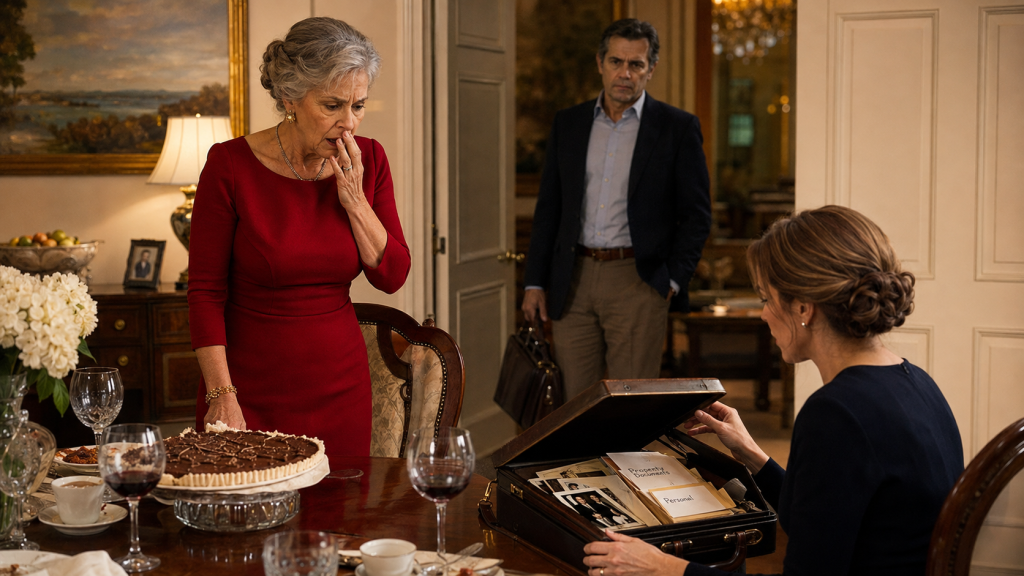
Inside Richard’s briefcase were dozens of small envelopes, each labeled with a date and a woman’s name.
Mom’s hands trembled as she reached inside.
For several seconds, nobody spoke.
The dining room still smelled like roasted chicken, rosemary potatoes, and the chocolate pie my mother had baked herself that afternoon.
There were birthday candles lying beside the pie.
One was still bent from where Chloe had knocked it over when she put the briefcase on the table.
Only ten minutes earlier, we had been worried that Richard was cheating.
Now none of us knew what we were looking at.
Mom picked up the first envelope.
“Margaret,” she read softly.
The handwriting belonged to Richard.
Inside were three photographs.
The first showed Richard when he was younger, maybe in his early forties, standing beside a beautiful dark-haired woman in a blue summer dress.
The second showed the same woman years later, sitting in a wheelchair.
The third showed Richard kneeling beside her in what looked like a hospital garden.
Mom stared at the pictures for a long time.
Then she looked at Chloe.
“You said you saw who he takes this to.”
Chloe nodded.
Tears still shone on her cheeks.
“I followed him to a care facility.”
Mom’s fingers tightened around the photograph.
“What kind of facility?”
“A memory-care place.”
My stomach dropped.
Mom slowly sat down.
Chloe continued.
“I know I shouldn’t have followed him. I know it was stupid.”
“What happened?” I asked.
She wiped her face with her sleeve.
“He drove about twenty minutes south. I stayed far behind him because I didn’t want him to see me.”
“How did you follow him?” I asked.
Chloe hesitated.
“I took my bike to the corner and called Mia’s brother. He was nearby.”
I closed my eyes.
“Chloe.”
“I know.”
“You got into a car with a seventeen-year-old to follow a grown man across town?”
“I know, Mom.”
“This conversation is definitely happening later.”
“I know.”
My mother barely seemed to hear us.
Her eyes remained fixed on Richard’s photographs.
“What did you see?” she asked again.
Chloe took a breath.
“He went inside carrying the briefcase. I waited outside for a few minutes, then I followed.”
My mother’s face turned white.
“And?”
“There was a nurse at the front desk. Richard knew her. She called him Mr. Dalton.”
That was Richard’s last name.
“Then he went into this sitting room.”
Chloe’s voice broke.
“There was a woman there.”
Mom looked down at the photograph.
“Margaret?”
Chloe nodded.
“She was in a wheelchair. She looked older than him. Or maybe just sick. I don’t know.”
My mother whispered, “What happened?”
“He sat beside her.”
Chloe began crying again.
“He held her hand.”
Mom closed her eyes.
“I knew it.”
“No, Grandma.”
“I knew there was someone else.”
“No.”
Chloe reached across the table.
“Please listen.”
Mom looked at her.
“She didn’t know who he was.”
Silence.
“What?”
“She kept calling him David.”
Mom frowned.
“Who’s David?”
“I don’t know. But Richard didn’t correct her.”
Chloe swallowed.
“He just smiled and told her he was happy to see her.”
Mom looked at me.
I could see confusion replacing heartbreak.
Chloe continued.
“The nurse brought them tea. Richard took things out of the briefcase. Letters. Pictures. Little envelopes.”
She pointed toward the open case.
“Those.”
Mom carefully opened another envelope.
Inside was a pressed flower.
A yellow daisy.
Under it was a handwritten note.
April 17.
Margaret remembered the lake today.
She asked whether the swans still come in spring.
I told her yes.
She smiled.
Mom read it twice.
Then she opened another.
June 2.
Margaret became frightened during dinner.
She did not recognize me.
The nurse suggested I leave early.
I sat in the parking lot for twenty minutes before driving home.
Another.
August 9.
She called me Richard today.
First time in seven months.
It lasted less than a minute.
Still counts.
Mom covered her mouth.
I felt something inside me shift.
This didn’t look like evidence of an affair.
It looked like a record of grief.
A private archive of a life disappearing one memory at a time.
Chloe reached deeper into the briefcase.
“There’s a folder.”
She handed it to Mom.
My mother opened it.
A marriage certificate was inside.
Richard Dalton.
Margaret Anne Dalton.
Married twenty-eight years earlier.
Mom stared at the page.
“They’re married.”
Nobody answered.
“She’s his wife.”
My mother looked completely shattered now.
I sat beside her.
“Mom.”
“He told me he’d never been married.”
The sentence came out barely above a whisper.
That changed everything.
Whatever sympathy we felt for Richard’s situation, he had lied.
Not avoided the subject.
Not kept details private.
He had lied.
My mother had asked him directly during their second month together.
I remembered because she had told me afterward.
He had said he’d had serious relationships, but marriage “never worked out for him.”
Now his wife was sitting in a memory-care facility twenty minutes away.
Mom stood abruptly.
“I want him out of my life.”
“Grandma,” Chloe said.
Mom shook her head.
“No.”
She closed the briefcase.
“He lied to me.”
Chloe looked terrified that she had caused something terrible.
“I’m sorry.”
Mom immediately softened.
“Oh, sweetheart.”
She walked around the table and hugged Chloe.
“You didn’t do this.”
“I shouldn’t have followed him.”
“That part was dangerous.”
Mom pulled back and held her face.
“But you didn’t create the truth.”
There was a knock at the front door.
All three of us froze.
Then another.
Mom’s eyes widened.
I stood.
“Stay here.”
I walked into the hallway.
Richard stood outside.
His face looked nothing like the calm, charming man who had left forty minutes earlier.
He was pale.
Panicked.
His hair was damp from the light rain outside.
“Is Chloe here?”
I stared at him.
“Yes.”
He exhaled.
“Thank God.”
He looked behind me.
“Is she all right?”
“She’s fine.”
“I saw her outside the facility. Then she disappeared. My briefcase was gone.”
His eyes moved past me.
He saw it sitting on the dining table.
Everything changed in his expression.
Not anger.
Defeat.
Richard stepped inside.
“Eleanor.”
Mom stood in the dining room.
“Don’t.”
He stopped.
Mom’s voice shook.
“Do not call me sweetheart. Do not call me Eleanor like nothing has happened.”
Richard glanced at Chloe.
“You opened it.”
Chloe lifted her chin.
“Yes.”
I expected him to become angry.
Instead, he simply closed his eyes.
“For once in my life,” he whispered, “I wish I’d been brave enough to tell the truth before someone found it.”
Mom stared at him.
“Are you married?”
Richard looked at her.
“Yes.”
The word landed like a stone.
My mother inhaled sharply.
“For twenty-eight years?”
“Yes.”
“And you told me you’d never been married.”
“Yes.”
Mom’s eyes filled with tears.
“Why?”
Richard didn’t immediately answer.
I stepped closer.
“You owe her more than silence.”
“I know.”
He looked toward the dining room table.
“Margaret was diagnosed with early-onset Alzheimer’s nine years ago.”
Mom folded her arms.
“That doesn’t answer my question.”
“No.”
Richard swallowed.
“It doesn’t.”
He walked toward the chair where he usually sat during Sunday dinner.
This time, he remained standing behind it.
“Margaret and I were married when I was twenty-nine.”
His voice became quieter.
“We met in graduate school.”
He smiled faintly.
“She hated me at first.”
Mom looked away.
Richard continued anyway.
“She thought I was arrogant. I thought she was impossible.”
Chloe sat quietly now.
“We were married six years later.”
Richard rubbed his palms together.
“We had a good marriage.”
His voice cracked.
“A very good marriage.”
Mom looked at him again.
“Then why are you dating me?”
Richard nodded slowly.
“Fair question.”
He stared at the floor.
“Margaret started forgetting things when she was forty-eight.”
“It was small at first.”
“She misplaced keys. Forgot appointments. Repeated stories.”
“Then one day she drove to the grocery store and couldn’t remember how to get home.”
He paused.
“She was forty-nine when we got the diagnosis.”
Mom’s expression softened despite herself.
Richard continued.
“I took care of her at home for four years.”
“I stopped working full-time.”
“I learned how to manage medications, meals, confusion, anger, fear.”
“Some days she knew me.”
“Some days she didn’t.”
“Eventually she began leaving the house at night.”
“One winter she wandered outside without shoes.”
“That was when the doctors told me home care was no longer safe.”
He looked at the photograph still lying on the table.
“Moving her into memory care was the worst day of my life.”
Nobody spoke.
“For two years, I visited every day.”
“Then every other day.”
“Eventually the counselors told me I needed to rebuild some kind of life.”
“I hated them for saying it.”
Mom whispered, “So you joined the gardening club.”
Richard nodded.
“A therapist recommended it.”
He gave a sad laugh.
“I didn’t even like gardening.”
Despite everything, Mom almost smiled.
Almost.
“Then I met you.”
Her smile disappeared.
“And decided to lie.”
Richard nodded.
“Yes.”
No excuse.
No justification.
Just yes.
Mom looked surprised by the honesty.
“I told myself I would explain eventually.”
“That is what cowards say when they are postponing the truth.”
Mom stared at him.
“You let me fall in love with you.”
Richard’s eyes filled.
“I know.”
“You came into my house.”
“Yes.”
“You sat at this table.”
“Yes.”
“You accepted my trust.”
“Yes.”
“And every Sunday you left before dessert because you were visiting your wife.”
Richard looked down.
“Yes.”
My mother turned away.
For several seconds, the only sound in the room was the refrigerator humming.
Then Mom asked, “Why 7:30?”
Richard looked confused.
“What?”
“Why did you always have to leave at 7:30?”
He hesitated.
“Margaret has severe nighttime confusion.”
“Sundowning?”
I asked.
Richard nodded.
“Around eight, she becomes very anxious.”
“She used to scream when the nurses tried helping her into bed.”
“Three years ago, I started visiting at the same time every night.”
“I sit beside her until she falls asleep.”
Mom looked stunned.
“Every night?”
“Almost.”
“Even when she doesn’t know you?”
“Especially then.”
Mom lowered her eyes.
Richard continued.
“She doesn’t remember our wedding.”
“She doesn’t remember our apartment.”
“She doesn’t remember the trip we took to Italy.”
“She doesn’t remember the dog we had for twelve years.”
“Most days she doesn’t remember my name.”
“But sometimes when I hold her hand, she stops being afraid.”
He wiped his eyes.
“So I go.”
Chloe whispered, “That’s what I saw.”
Richard looked at her.
“You shouldn’t have followed me.”
“I know.”
“But I understand why you did.”
He reached for the briefcase, then stopped.
“These envelopes are things I write down after visits.”
Mom glanced at them.
“Why?”
“So I remember for both of us.”
That sentence broke something in the room.
My mother sat down again.
Tears slid quietly down her cheeks.
Richard didn’t move toward her.
He seemed to understand he no longer had the right.
Then Mom asked the question I knew mattered most.
“Why did you tell me you were never married?”
Richard looked at her.
“Because the first time I tried telling someone the truth, she looked at me like I was a monster.”
Mom said nothing.
Richard continued.
“It was three years ago.”
“A woman I knew through work.”
“We had coffee a few times.”
“When I told her about Margaret, she said dating while my wife was alive was disgusting.”
He looked ashamed.
“She told people.”
“Suddenly everyone had opinions about what grief was allowed to look like.”
“I stopped trying to meet anyone.”
“Then I met you.”
His gaze softened.
“And I was afraid.”
Mom’s voice became sharp.
“So you protected yourself by deceiving me.”
“Yes.”
“That isn’t love.”
“No.”
Richard swallowed.
“It was fear.”
Mom stood.
“I need you to leave.”
His face fell.
“I understand.”
“You may have good reasons for the life you live.”
She pointed toward the briefcase.
“You may even be a devoted husband.”
Her voice broke.
“But you made me unknowingly participate in something I was never given the chance to understand.”
Richard nodded.
“I know.”
“I would never have asked you to abandon Margaret.”
“I know.”
“I would never have mocked you for caring for her.”
“I know.”
“But you decided for me.”
He closed his eyes.
“Yes.”
Mom pushed the briefcase toward him.
“Go.”
Richard picked it up.
He looked at Chloe.
“I’m glad you’re safe.”
Then he looked at Mom.
“I am sorry.”
Not dramatic.
Not pleading.
Just devastated.
Mom turned away.
Richard left.
The front door closed quietly.
My mother stood beside the chocolate pie.
Seven candles had burned halfway down.
We had used them to represent decades because seventy-two candles wouldn’t fit.
Mom looked at them.
Then she laughed once.
A terrible little laugh.
“I made his favorite.”
I hugged her.
She cried against my shoulder.
“I feel ridiculous.”
“You’re not.”
“I’m seventy-two years old.”
“So?”
“I should know better.”
“Know better than trusting someone?”
She didn’t answer.
Chloe joined the hug.
“I’m sorry, Grandma.”
Mom kissed her hair.
“You did something reckless.”
Chloe nodded.
“But you told me the truth.”
Another tear slid down Mom’s cheek.
“That matters.”
For the next three weeks, Richard didn’t call.
Mom didn’t call him either.
The red dress disappeared into the back of her closet.
The perfume stayed untouched.
She stopped attending the gardening club.
Sunday dinners felt strangely quiet.
Richard’s chair remained empty.
Mom pretended she didn’t notice.
Then something unexpected happened.
A letter arrived.
Not from Richard.
From Margaret’s sister.
Her name was Susan.
Mom almost threw it away.
Instead, she opened it at the kitchen table.
The letter was short.
Dear Eleanor,
You don’t know me, but I know about you.
Richard told me everything after your birthday.
I am not writing to defend his dishonesty.
He was wrong.
But there is something about Margaret you deserve to understand.
Before her illness became severe, Margaret made Richard promise something.
She told him that if the day came when she no longer knew him, he was not allowed to become a ghost beside her.
She told him to keep living.
Richard refused to discuss it for years.
I believe meeting you was the first time he actually tried.
He should have told you the truth.
But please understand this: you were not replacing my sister.
You were reminding Richard that he was still alive.
Mom read the letter twice.
Then a third time.
She handed it to me.
I finished reading.
“What are you thinking?” I asked.
“I don’t know.”
And she truly didn’t.
Another week passed.
Then the nursing facility called.
Mom almost didn’t answer because she didn’t recognize the number.
A woman named Denise introduced herself.
She was one of Margaret’s nurses.
“I hope I’m not overstepping,” Denise said.
Mom put the phone on speaker.
“I’m listening.”
“Richard was injured.”
Mom’s face changed immediately.
“What happened?”
“He slipped on the front steps outside his home.”
My stomach tightened.
“Is he okay?” Mom asked.
“He fractured his ankle.”
Relief and worry collided on her face.
“He’s home.”
Denise continued.
“He asked us not to contact anyone.”
Mom frowned.
“Then why are you calling me?”
Denise hesitated.
“Because Margaret is struggling.”
Mom looked at me.
“Richard hasn’t missed an evening visit in years.”
Denise’s voice softened.
“Three nights without him has affected her routine.”
“She doesn’t know exactly who she’s waiting for.”
“But she knows someone is missing.”
Mom closed her eyes.
“I’m sorry.”
“There’s something else.”
“Yes?”
“Richard talks about you.”
Mom stiffened.
“Here?”
“Not to Margaret.”
Denise clarified quickly.
“To the staff.”
“He told us he hurt someone he cared about because he was afraid honesty would cost him the relationship.”
Mom didn’t respond.
“I thought you deserved to know.”
The call ended.
Mom sat quietly for several minutes.
Then she stood.
“Where are you going?”
“To change.”
“Mom.”
She looked at me.
“I’m not forgiving him.”
“I didn’t say you were.”
“I’m bringing him soup.”
I smiled.
“Of course you are.”
An hour later, we arrived at Richard’s house.
The house Mom had never entered.
It was small.
Modest.
Nothing like the mysterious secret mansion we had jokingly imagined.
Richard opened the door using crutches.
When he saw Mom, he froze.
“Eleanor.”
“I brought soup.”
He stared at the container.
“You hate lentils.”
“I know.”
“You made lentil soup?”
“For you.”
“That seems unnecessarily hostile.”
Mom almost smiled.
“Move.”
Richard moved.
We stepped inside.
The first thing Mom noticed was Margaret.
Not the woman herself.
Her life.
Photographs covered the hallway.
Margaret laughing beside a lake.
Margaret holding a puppy.
Margaret decorating a Christmas tree.
Margaret and Richard dancing at their wedding.
But mixed among those old photographs were newer things.
A gardening-club flyer.
A picture of Mom standing beside sunflowers.
A birthday card she had given Richard.
Two lives.
Not overlapping exactly.
But occupying the same home.
Richard saw Mom looking.
“I didn’t know where else to put them.”
Mom touched the photograph of herself.
“I thought you were ashamed of me.”
Richard shook his head.
“I was ashamed of myself.”
We helped him to the sofa.
Then Mom said something surprising.
“Take me to meet her.”
Richard stared at her.
“What?”
“Margaret.”
“No.”
Mom blinked.
“No?”
“I won’t do that to you.”
“Richard.”
“She may become confused.”
“I understand.”
“She may say strange things.”
“I understand.”
“She may think you’re someone else.”
“I understand.”
Richard looked afraid.
Mom sat beside him.
“You spent six months making choices for me.”
Her voice softened.
“Stop.”
Richard looked at her for a long moment.
Then nodded.
Two days later, we went to the facility.
I offered to come inside.
Mom refused.
“This is something I need to do.”
Richard walked slowly beside her using crutches.
Chloe and I waited in the lobby.
Forty minutes later, Mom came out crying.
I stood immediately.
“What happened?”
She shook her head.
“Nothing bad.”
Richard followed.
His face was wet with tears too.
Mom sat beside me.
“She thought I was her sister.”
“What?”
“She kept calling me Susan.”
Mom laughed through her tears.
“Apparently Susan always wore red lipstick.”
Then her expression changed.
“She asked me whether Richard was behaving himself.”
I looked at him.
Richard smiled weakly.
“What did you say?”
Mom answered.
“I told her he was trying.”
Then she looked at Richard.
“And he is going to keep trying.”
Something shifted after that day.
Mom didn’t immediately restart the relationship.
She made rules.
Very clear rules.
No lies.
No convenient omissions.
No pretending Margaret didn’t exist.
Richard agreed.
He also started seeing a counselor again.
Mom returned to her gardening club.
Slowly, they began spending time together.
Coffee first.
Then walks.
Then dinners.
The first Sunday he returned to our table, everyone felt awkward.
Until 7:15.
Richard checked his watch.
Mom noticed.
“So.”
He froze.
“What?”
“Are you leaving?”
“Yes.”
Mom stood.
Richard looked worried.
Then she picked up two slices of pie.
“One for you.”
She handed him the second container.
“And one for Margaret.”
Richard stared at her.
Mom smiled.
“You can leave before dessert.”
She touched his cheek.
“Just stop lying about where you’re going.”
Richard started crying right there in our dining room.
Chloe whispered to me, “This family cries a lot.”
I whispered back, “Apparently.”
Months passed.
Mom occasionally visited Margaret with Richard.
Not often.
Just enough.
Some days Margaret smiled at her.
Some days she ignored her.
Once, she looked at Mom and asked, “Are you Richard’s girlfriend?”
Mom nearly dropped her coffee.
Richard turned bright red.
Margaret laughed.
For one astonishing moment, she seemed completely present.
“Good,” she said.
Mom blinked.
“Good?”
Margaret squeezed Richard’s hand.
“He gets lonely.”
Then the moment disappeared.
She looked toward the window.
“David should be here soon.”
Richard quietly wiped his eyes.
Mom reached beneath the table and held his hand.
Margaret lived another eighteen months.
Her health declined steadily.
Near the end, Richard spent more time at the facility.
Mom never complained.
Instead, she brought him dinner.
Sometimes she sat with Margaret.
Sometimes she waited outside.
One evening in late October, Margaret died peacefully in her sleep.
Richard called Mom first.
She drove to him at two in the morning.
He was sitting in the facility garden alone.
Mom sat beside him.
He didn’t speak.
Neither did she.
She simply held his hand.
Richard later told me that was the moment he understood the difference between being rescued and being accompanied.
Mom wasn’t there to erase his grief.
She respected it.
Margaret’s funeral was small.
Susan hugged Mom afterward.
“You gave him something I couldn’t.”
Mom shook her head.
“No.”
Susan smiled.
“You gave him permission to keep loving someone who was still here.”
Six months later, Richard finally stayed for dessert.
It happened on a Sunday.
No announcement.
No dramatic speech.
Seven thirty passed.
Then seven forty-five.
Mom looked at the clock.
Richard noticed.
“What?”
“You’re still here.”
He smiled.
“I am.”
Chloe brought out the chocolate pie.
Richard took a bite.
Mom watched him carefully.
“Well?”
He nodded.
“Worth waiting eighteen months.”
She laughed.
A year after Margaret died, Richard asked Mom to marry him.
Not with a giant diamond.
Not in a restaurant.
He asked in her backyard beside the rose bushes they had planted together.
Mom said no.
At least at first.
Richard looked completely stunned.
Then she laughed.
“I’m seventy-four years old.”
“So?”
“I don’t want a wedding.”
“Neither do I.”
“I don’t want thirty relatives judging centerpieces.”
“Absolutely not.”
“I don’t want a white dress.”
“I wouldn’t dare suggest one.”
She narrowed her eyes.
“And I’m not changing my name.”
Richard grinned.
“Eleanor.”
“What?”
“Are you saying no to marriage or no to weddings?”
Mom considered this.
Then smiled.
“Marriage sounds fine.”
They were married at the courthouse two months later.
There were seven people present.
Chloe carried sunflowers.
I signed as witness.
Susan came too.
She brought one photograph of Margaret.
Mom placed it quietly on a table at the dinner afterward.
Richard saw it.
He couldn’t speak for several seconds.
Mom squeezed his hand.
“People don’t disappear just because life continues.”
He kissed her forehead.
Years later, Chloe admitted something.
She had not taken the briefcase from Richard deliberately.
Not exactly.
When she followed him into the care facility, she had seen him place it beside a chair.
Then a staff member asked her who she was.
Panicking, Chloe grabbed the nearest thing and walked away.
The briefcase.
She hadn’t realized what she had done until she was outside.
By then, fear had turned into curiosity.
Curiosity had turned into suspicion.
And suspicion had brought the truth to our dining table.
I told her that stealing a briefcase was still unacceptable.
She agreed.
Richard laughed.
“Best theft of my life.”
Mom elbowed him.
“Do not encourage her.”
What happened that birthday night never became one of those family stories we laughed about casually.
Too much pain was attached to it.
Too many mistakes.
But it taught us something none of us expected.
Secrets are strange things.
Sometimes people keep them because they are cruel.
Sometimes because they are selfish.
And sometimes because they are terrified that the truth will make them impossible to love.
Richard had believed his life was too complicated to explain.
A wife who was still alive but no longer knew him.
A promise to keep living.
A grief that had no clean ending.
A new love he was terrified to lose.
So he tried to divide himself into two people.
The man who visited Margaret at night.
And the man who sat beside my mother at Sunday dinner.
Eventually those two lives collided.
They had to.
Because love built around a missing truth eventually becomes a house with a locked room.
Someone always finds the door.
Richard’s mistake nearly cost him my mother.
But what saved them wasn’t romance.
It wasn’t destiny.
It wasn’t even forgiveness.
It was honesty after dishonesty.
Work after damage.
Choice after fear.
Mom never pretended Richard’s lies were acceptable.
Richard never asked her to.
That mattered.
He apologized without demanding she forgive him.
He changed without demanding she notice.
And Mom eventually chose him again.
Not because she forgot what happened.
Because she understood it.
There is a difference.
Richard lived another twelve years.
He and Mom traveled.
Nothing extravagant.
Small trips.
Maine in autumn.
Charleston in spring.
A ridiculous cruise to Alaska where Mom complained for six straight days about the cold and then cried when they had to leave.
Richard joined three gardening clubs.
Apparently he decided to start actually liking gardening.
Every Sunday, he came to dinner.
And every Sunday, dessert became a joke.
At 7:25, Chloe would point dramatically at the clock.
“Richard.”
He would grab his imaginary briefcase.
“Oh no. Emergency plumber.”
Mom would laugh.
“Sit down.”
“Overseas client?”
“Sit.”
“Neighbor needs medication?”
“Richard.”
“Yes, dear.”
He stayed.
Every single time.
When Chloe graduated from high school, Richard was there.
When she left for college, he secretly slipped fifty dollars into her suitcase.
When she graduated from nursing school, he cried harder than Mom did.
Years later, Chloe chose geriatrics.
Specifically dementia care.
Nobody was surprised.
She once told me that night at Margaret’s facility changed her life.
“I thought I was following a cheater,” she said.
“Instead I found a man sitting beside someone who had forgotten his name.”
That image stayed with her.
It stayed with all of us.
Mom is eighty-six now.
Richard has been gone almost two years.
His photograph sits beside Dad’s on her dresser.
For a long time, I wondered whether that was strange.
Two men.
Two marriages.
Two chapters.
Then I realized Mom didn’t see them as competing stories.
Dad was the love of her first life.
Richard became the love of the life she never expected to have.
One didn’t erase the other.
That was something Richard taught all of us.
The heart is not a room with one chair.
Love does not always require forgetting what came before.
Sometimes it requires honoring it.
Last month, I visited Mom on a Sunday.
Chloe came too.
She’s thirty now.
She brought her own daughter, a four-year-old tornado named Sophie.
We cooked dinner in Mom’s kitchen.
At seven twenty-five, Sophie announced she wanted ice cream.
Mom looked at the clock.
Then she smiled.
“Perfect timing.”
Chloe noticed.
So did I.
Mom opened the freezer.
Inside was Richard’s favorite chocolate ice cream.
She still buys it.
Not every week.
Just sometimes.
We sat around the same dining table where Chloe had opened that briefcase fifteen years earlier.
The table has scratches now.
One chair wobbles.
Mom refuses to replace it.
Sophie sat where Richard used to sit.
She ate ice cream with both hands.
Chocolate covered her face.
Mom laughed.
Then she looked toward the empty chair beside her.
For the briefest moment, her expression became distant.
Not devastated.
Not lonely.
Just remembering.
Chloe reached across the table.
“You okay, Grandma?”
Mom smiled.
“Of course.”
Then she looked at the clock.
Seven thirty.
“He would have stayed for dessert,” she said.
Chloe smiled.
“Eventually.”
Mom laughed.
“Yes.”
“Eventually.”
And maybe that is the part I remember most.
Not the briefcase.
Not the lie.
Not the photographs.
Not even the heartbreak.
I remember the way people changed afterward.
Chloe learned that truth is rarely as simple as suspicion.
I learned that protecting someone sometimes means allowing them to make their own informed choices.
Richard learned that fear does not excuse deception.
And Mom learned that loving someone with a complicated past doesn’t mean accepting dishonesty.
It means deciding whether the truth, once revealed, is something you can live beside.
She could.
But only after Richard stopped hiding it.
Years before he died, Richard gave Chloe the old leather briefcase.
She laughed when she opened the box.
“You’re giving me evidence?”
Richard smiled.
“I’m giving you responsibility.”
Inside, the old envelopes were still there.
Margaret’s memories.
Dates.
Flowers.
Notes.
Photographs.
But there was something new.
A final envelope.
It said:
For Chloe.
She opened it.
Inside was a handwritten letter.
You were fifteen when you followed me.
I was furious for approximately thirty seconds.
Then I realized you had done what I had been too afraid to do.
You carried the truth into the house.
It hurt people.
Truth often does when it arrives late.
But the pain was not your fault.
The delay was mine.
Never confuse secrecy with kindness.
Never decide someone cannot handle the truth simply because you are afraid of their reaction.
Give people the dignity of choosing what they can accept.
Your grandmother deserved that from me.
I nearly lost her because I forgot.
Thank you for making me remember.
Chloe cried when she read it.
So did Mom.
Even Richard cried.
Again.
A family tradition.
When Richard died, Chloe brought the briefcase to the funeral.
Inside it were Margaret’s letters.
Mom’s wedding photograph.
A sunflower from Chloe’s graduation.
A drawing Sophie had made for him.
Two whole lives fit inside one battered leather case.
Maybe three.
Richard had once used it to separate his worlds.
In the end, it became the place where all of them belonged together.
Mom keeps it now.
It sits beneath her bed.
Every once in a while, she opens it.
She reads Richard’s notes about Margaret.
She reads letters he later wrote about her.
She doesn’t become jealous.
Not anymore.
She says the letters remind her of something important.
That people can love deeply more than once.
That grief and happiness can occupy the same heart.
That betrayal does not always mean a person is evil.
But remorse without change is meaningless.
And forgiveness without boundaries is dangerous.
Most importantly, she says the truth should arrive before someone has to chase it.
I asked her recently whether she would still have dated Richard if he had told her about Margaret on their first date.
Mom thought about it.
“For one date?”
“Yes.”
She smiled.
“Probably not.”
I laughed.
“Really?”
“I would have thought it sounded complicated.”
“It was complicated.”
“Exactly.”
“So Richard was right to be afraid?”
“No.”
Her answer came immediately.
“He was right that I might have walked away.”
She looked toward the window.
“But that was my right.”
I didn’t say anything.
She continued.
“Maybe I would have gone home.”
“Maybe I would have thought about it.”
“Maybe I would have called him the next day.”
“Maybe not.”
“But love is not getting someone to stay by hiding the door.”
That sentence stayed with me.
Love is not getting someone to stay by hiding the door.
Richard’s secret almost destroyed the most beautiful relationship my mother had experienced after widowhood.
But once everything was exposed, something healthier grew from the wreckage.
Not perfect.
Never perfect.
Just honest.
And maybe that was why it lasted.
The strange thing is, when I think back to Mom’s seventy-second birthday, I no longer remember the fear first.
I remember the pie.
Chocolate.
Richard’s favorite.
Mom had cut four slices before he left.
His plate sat untouched.
After Richard walked out of the house that night, Mom almost threw the entire pie away.
I stopped her.
“Why?”
“I never want to see chocolate again.”
“That feels dramatic.”
“I am allowed to be dramatic on my birthday.”
Fair point.
So we put the pie in the refrigerator.
Two days later, Mom ate one slice.
The next evening, another.
When Richard eventually returned for Sunday dinner months later, Mom made the same pie.
Not because she had forgotten.
Because she hadn’t.
She placed it in the center of the table and said, “Nobody leaves before dessert without telling the truth.”
Richard smiled.
“Understood.”
Years later, that became the joke everyone knew.
No one leaves before dessert.
Even now, every Sunday when we gather at Mom’s house, we stay a little longer than necessary.
We pour coffee.
We cut cake.
We talk.
Phones stay away.
Nobody rushes toward the door.
Maybe it sounds silly.
But rituals often begin where wounds once lived.
The place where something broke becomes the place people protect.
For our family, it was dessert.
For Richard, it was honesty.
For Mom, it was choice.
And for Chloe, it was that old leather briefcase.
The night she carried it through the front door, crying, she thought she had discovered proof that Richard was betraying her grandmother.
Instead, she uncovered something far more complicated.
A marriage that had ended without ending.
A promise made before memory disappeared.
A man divided by grief.
A woman brave enough to walk away from dishonesty.
And eventually, brave enough to return when honesty finally replaced it.
Sometimes the truth ruins everything.
Sometimes it saves everything.
But almost always, it changes the shape of what comes next.
That night changed all of us.
And for the rest of his life, whenever Richard glanced at his watch at exactly 7:26 during Sunday dinner, Mom would raise one eyebrow.
He would smile.
Then he would place the watch face-down on the table.
And stay.
Until dessert.
Always until dessert.
💬THE END! THANK YOU FOR READING!