

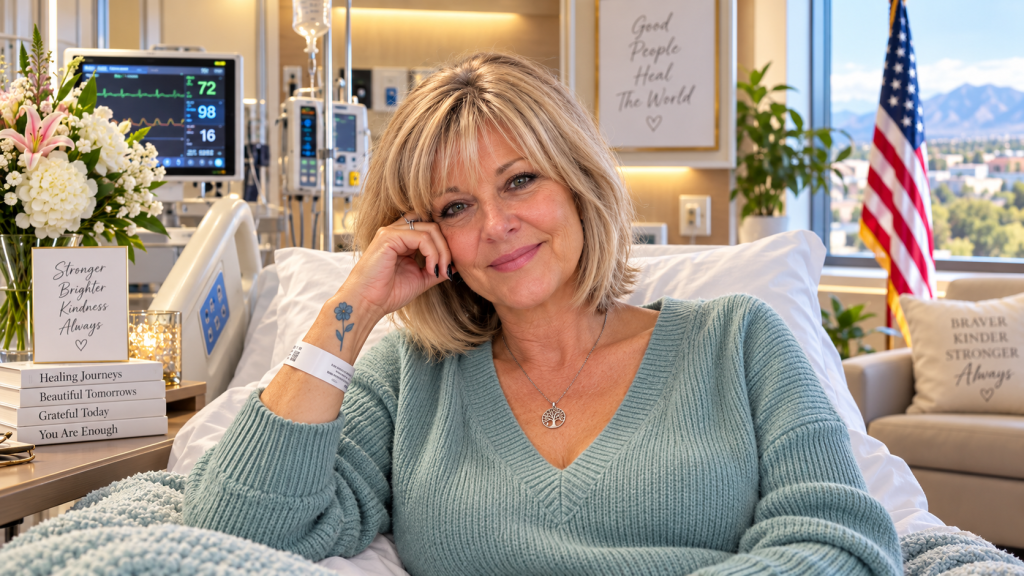
For my entire life, I believed the tiny blue flower tattooed on my mother’s wrist was nothing more than an old tattoo from her youth.
Then a hospital nurse noticed it—and immediately walked out to contact security.
Mom had carried that little blue flower for as long as I could remember.
It sat quietly on the inside of her wrist.
Small.
Faded.
Completely ordinary.
At least, that was what I had always assumed.
When I was young, I occasionally asked her about it.
“What does your flower mean?”
Her answer never changed.
“I got it when I was young.”
That was all she ever said.
No funny story about getting a tattoo with friends.
No explanation of why she chose a flower.
No memory she wanted to share.
Just those same few words.
Eventually, I stopped asking.
As I got older, the tattoo became such a normal part of Mom that I hardly noticed it.
Until last month.
Mom was scheduled to have a routine knee replacement, so I took the day off work and went to the hospital with her.
Nothing about that morning seemed unusual.
We checked in.
Completed the paperwork.
Answered the usual medical questions.
Spoke with several nurses.
Mom was nervous about the procedure, but that was understandable.
Everything seemed perfectly normal.
Then a nurse entered to prepare Mom’s IV.
She chatted casually with us while arranging the supplies.
Then she gently pushed up Mom’s sleeve.
And saw the flower.
Her entire demeanor changed.
Her hand stopped moving.
For several seconds, she simply stared at Mom’s wrist.
The reaction was subtle at first, but obvious enough that both of us noticed.
“Is something wrong?” I asked.
The nurse didn’t answer immediately.
Instead, she carefully pulled Mom’s sleeve back down over the tattoo.
Then she stood.
“Excuse me. I need to verify something.”
She left the room much faster than she had entered.
I looked at Mom.
“That was strange.”
Mom didn’t respond.
Her eyes remained fixed on the door.
And that was when I noticed something far more unsettling than the nurse’s reaction.
My mother looked terrified.
Not puzzled.
Not annoyed.
Terrified.
“Mom?”
“I’m fine.”
She clearly wasn’t.
About five minutes later, I heard several quiet voices outside.
Then two hospital security officers appeared in the hallway.
A doctor walked into the room behind them.
My stomach tightened.
He barely glanced at me.
He didn’t immediately reach for Mom’s medical chart either.
His attention went directly to her covered wrist.
“What’s going on?” I asked.
Nobody answered me.
The doctor stepped closer to Mom’s bed.
“Ma’am, would you mind showing me your wrist?”
Mom hesitated.
For the first time, I saw genuine fear cross her face.
Then, very slowly, she pulled back her sleeve.
The tiny blue flower appeared.
The doctor stared at it.
One second.
Two.
Three.
The room felt unnaturally quiet.
Finally, he asked:
“Where did you get this symbol?”
Mom’s face went completely pale.
She said nothing.
“Mom?”
Still nothing.
The doctor exchanged a glance with one of the security officers.
Then he looked back at her.
“Do you understand what this symbol represents?”
Mom’s fingers began trembling.
And suddenly, everything I had believed about that tattoo changed.
Maybe Mom hadn’t technically lied all those years when she said she got it while she was young.
But there was obviously an enormous part of the story she had never told me.
I stepped closer to her bed.
“Mom, what is going on?”
Her eyes filled with tears.
“What haven’t you told me?”
She looked at me.
Her lips parted.
For a moment, I thought I was finally going to hear the truth.
But before she could speak, the doctor turned toward the two security officers standing outside.
His expression had become completely serious.
Then he quietly said:
“Please close the door.”
One officer pulled it shut.
And as the click of the latch echoed through the room, I realized the tiny blue flower I had ignored my entire life wasn’t simply an old tattoo.
It was connected to something my mother had kept hidden for decades.
And whatever that secret was, someone at this hospital recognized it immediately.
The doctor waited until the door was fully closed before speaking again.
“My name is Dr. Samuel Grant,” he said. “Before we go any further, I want to make something very clear. Your mother is not in trouble.”
I looked at the security officers.
“Then why are they here?”
“Because this hospital has a protocol connected to a historical investigation.”
That sentence made even less sense.
Mom lowered her face.
Dr. Grant continued carefully.
“The flower on your mother’s wrist was used as an identification mark at a private children’s institution called Bellweather House.”
I turned toward Mom.
I had never heard that name.
Not once.
“You were in a children’s home?”
Her chin trembled.
“Yes.”
The answer came so softly that I almost missed it.
I stared at her.
Mom had always told me she grew up with distant relatives after losing her parents young.
She had never mentioned an institution.
Never mentioned foster care.
Never mentioned anything called Bellweather House.
“How old were you?”
“Eleven when I arrived.”
I felt the floor shift beneath everything I thought I knew about her.
Dr. Grant pulled a chair closer.
“Bellweather House operated in northern Pennsylvania from the late 1960s until the early 1980s. Officially, it was a charitable residence for orphaned and displaced children.”
“Officially?” I asked.
The doctor’s expression hardened slightly.
“Investigators later discovered serious irregularities in its records.”
Mom closed her eyes.
I looked between them.
“What kind of irregularities?”
Dr. Grant answered slowly.
“Children whose names were changed. Birth certificates that disappeared. Adoptions that were never legally documented. Transfers to other facilities with no receiving records.”
My mouth went dry.
“You’re saying children went missing?”
The doctor paused.
“That is what investigators believe.”
I turned toward Mom.
She looked as if she had aged ten years in ten minutes.
“Why did they tattoo you?”
Her right hand covered the flower on her left wrist automatically.
“We were told it was for identification.”
“We?”
Mom nodded.
“There were twelve of us in my group.”
Twelve.
I had spent my whole life looking at that flower without understanding that eleven other children might once have worn the same mark.
Dr. Grant leaned forward.
“Mrs. Bennett, the reason the nurse reacted is that this hospital has been cooperating with researchers and law enforcement working on unresolved Bellweather House cases.”
Mom flinched at the words law enforcement.
The doctor noticed.
“Again, you are not under investigation.”
One of the security officers spoke for the first time.
“We were asked to secure the room temporarily because another patient connected to the case is currently in this building.”
Mom’s eyes snapped up.
“What do you mean?”
The officer looked at Dr. Grant before answering.
“A woman was admitted yesterday after a minor cardiac episode. During intake, another staff member noticed the same blue flower tattoo.”
Mom stopped breathing.
At least, that was how it looked.
Her chest simply froze.
I grabbed her hand.
“Mom?”
She whispered one word.
“Evelyn.”
The doctor stared at her.
“How do you know that name?”
Mom began crying.
Not quietly.
Not the restrained tears she shed at funerals or sad movies.
These were the tears of someone who had been holding something inside for nearly half a century and had just discovered that the past was standing somewhere on the other side of the wall.
“She was my sister.”
Nobody spoke.
I sat down because my legs suddenly felt unreliable.
“You had a sister?”
Mom nodded.
“I had two.”
I stared at her.
All my life, my mother had told me she was an only child.
She had attended my wedding.
Held my daughter when she was born.
Sat beside me through every major event of my life.
And somehow I had never known that she once had two sisters.
“What were their names?”
“Evelyn and Rose.”
Her voice cracked on the second name.
Dr. Grant asked, “Was Evelyn older than you?”
“Yes. Three years older.”
“And Rose?”
“Six years younger.”
The doctor looked at the officer.
Something passed silently between them.
My stomach tightened.
“What?”
Nobody answered quickly enough.
“What is it?”
Dr. Grant exhaled.
“The woman upstairs is named Evelyn Mercer. She is seventy-five.”
Mom’s hand flew to her mouth.
“She would be seventy-five.”
“She told investigators years ago that she had two younger sisters.”
Mom made a sound halfway between a sob and a gasp.
“What names?”
The doctor hesitated.
“Margaret and Rosalind.”
My mother’s name was Margaret.
Everyone called her Maggie.
I had never heard Rosalind before.
But Rose suddenly made terrible sense.
Mom covered her face.
I wrapped my arms around her.
For several minutes, the hospital room disappeared beneath the sound of her crying.
When she finally lowered her hands, the fear on her face had been replaced by something almost harder to look at.
Hope.
Dangerous, fragile hope.
“Is she really here?”
Dr. Grant nodded.
“One floor above you.”
Mom tried to swing her legs over the side of the bed.
“I need to see her.”
The nurse, who had quietly returned, hurried forward.
“Mrs. Bennett, please don’t stand. You haven’t had surgery yet, but your knee is unstable.”
“I don’t care about my knee.”
“Mom.”
“I lost her forty-seven years ago.”
Her voice filled the room.
“I am not staying in this bed if Evelyn is upstairs.”
Dr. Grant raised one hand gently.
“We can bring her here if she is medically cleared and if she agrees.”
Mom sank back.
“If she agrees?”
“She has spent decades looking for family. This could be extremely emotional for her too.”
Mom wiped her cheeks.
“Tell her Maggie remembers the red scarf.”
Dr. Grant frowned.
“The red scarf?”
“She’ll understand.”
He nodded.
The doctor and one security officer left.
The room became quiet again.
I sat beside Mom and watched her stare at the door.
Then I finally asked the question that had been growing inside me.
“Why did you never tell me?”
Mom closed her eyes.
“I tried to bury it.”
“That doesn’t explain why.”
“No.”
She looked at me.
“And you deserve an explanation.”
For the next twenty minutes, while we waited to learn whether the woman upstairs was truly her sister, my mother told me the story she had hidden for almost fifty years.
She was born Margaret Sullivan in 1954.
Evelyn was born in 1951.
Rose came six years after Mom.
Their father, Daniel, repaired farm machinery.
Their mother, Helen, worked in a bakery.
They lived in a small town outside Scranton.
They were not wealthy.
But according to Mom, they were happy.
Then everything changed in 1965.
Their father died in an industrial accident.
Their mother struggled afterward.
Money disappeared quickly.
Bills piled up.
Then Helen became ill.
Mom still did not know exactly what sickness her mother had.
She only remembered the coughing.
The exhaustion.
The days when their mother could barely get out of bed.
A county social worker began visiting.
The family was told the three girls would be placed temporarily in care until their mother recovered.
“Temporary,” Mom said bitterly.
“That was the word they used.”
The girls were sent to Bellweather House.
Their mother visited twice.
Then the visits stopped.
Mom was told she had died.
No funeral.
No death certificate.
No grave they were allowed to see.
Just a staff member informing three frightened girls that their mother was gone.
A week later, the blue flowers appeared.
“They lined us up,” Mom said. “Twelve children. Six girls and six boys. They used a little needle machine. We were told it was a medical identification system because some children didn’t have reliable records.”
I looked at the faded flower on her wrist.
“You were eleven.”
“Yes.”
“Did it hurt?”
She gave me the saddest smile I had ever seen.
“Everything hurt then.”
Bellweather House separated children by age.
Evelyn lived in the older girls’ dormitory.
Mom lived downstairs.
Rose stayed with the younger children.
The sisters saw one another at meals and sometimes in the yard.
They developed signals.
Three taps on a table meant I’m here.
Two fingers touched to the heart meant I love you.
And the red scarf became their promise.
It had belonged to their mother.
Evelyn had managed to hide it beneath her clothing when they entered Bellweather House.
She cut it into three strips.
Each sister kept one.
“If we ever got separated,” Mom said, “we promised we’d bring the pieces back together someday.”
I felt tears burn behind my eyes.
“What happened?”
“Rose disappeared first.”
Mom stared through the wall as if watching it happen again.
“She was five.”
One morning, her bed was empty.
Staff said she had been adopted.
Mom asked where.
No one would tell her.
Evelyn demanded to speak to the director.
She was punished for causing trouble.
Two months later, another child vanished.
Then another.
Always the same explanation.
Adopted.
Transferred.
Placed with relatives.
But none of the children were allowed to say goodbye.
Then Evelyn disappeared too.
Mom had seen her sister at breakfast.
That afternoon, Evelyn’s bed was empty.
“I screamed until they locked me in a storage room.”
My hands clenched.
“Jesus.”
“They told me Evelyn had been placed with a family in Ohio.”
“Was she?”
“I never knew.”
Mom eventually escaped Bellweather House at seventeen.
Not dramatically.
Not through a window in the night.
She simply aged out and was placed in a work program.
By then, she had learned not to ask questions.
She worked at a diner.
Saved money.
Moved west.
Changed her surname after marrying my father.
She tried searching for Evelyn and Rose several times.
But this was before the internet.
Records were sealed.
Bellweather House closed.
Phone calls went nowhere.
Letters were returned.
Then Dad died when I was twelve.
Mom had to raise me alone.
Survival replaced searching.
Years became decades.
“I convinced myself Evelyn and Rose had new families,” she whispered. “I told myself maybe they were happy. Maybe finding me would only destroy whatever lives they had built.”
“So you stopped.”
She nodded.
“And I was ashamed.”
“Of what?”
“Of being one of those children.”
My heart cracked.
“You were a child.”
“I know that now.”
She looked down.
“But for a long time, I believed being unwanted was something shameful.”
I reached for her hand.
“You were never unwanted.”
She squeezed my fingers.
Before either of us could say anything more, someone knocked.
The door opened slowly.
Dr. Grant entered.
Behind him stood a silver-haired woman in a hospital robe beneath a cardigan.
She had a portable heart monitor attached to her chest.
A nurse supported one elbow.
The woman looked frightened.
Then she saw Mom.
Everything stopped.
Neither moved.
Neither spoke.
Mom lifted her trembling hand.
Three taps.
Against the bed rail.
Tap.
Tap.
Tap.
The woman gasped.
Her hand flew to her chest.
Then she touched two fingers to her heart.
Mom broke.
“Evie.”
The woman started crying.
“Maggie?”
They reached for each other at the same time.
The nurses helped Evelyn across the room.
My mother wrapped both arms around her sister.
And for the first time in forty-seven years, Margaret Sullivan Bennett and Evelyn Sullivan Mercer held each other again.
I had never witnessed grief and joy occupy the same moment so completely.
They cried.
Laughed.
Touched each other’s faces.
Repeated each other’s names.
Asked questions too quickly to answer.
“You’re alive.”
“I thought you were dead.”
“They told me you went to Ohio.”
“They told me you ran away.”
“I looked for you.”
“I looked too.”
Then Evelyn suddenly pulled back.
Her hands shook as she reached beneath her cardigan.
From a thin chain around her neck, she removed something wrapped in clear plastic.
A strip of faded red fabric.
Mom stared at it.
“No.”
Evelyn laughed through tears.
“You remember.”
Mom reached inside her purse.
She opened an old coin pouch I had seen a hundred times.
From the smallest compartment, she pulled another piece of red cloth.
I covered my mouth.
She had carried it all these years.
The sisters placed the strips side by side on the blanket.
The edges matched.
Two pieces of a scarf that had been cut apart more than half a century earlier.
But there was still a gap.
A third piece.
Rose.
Their smiles faded.
Mom looked at Evelyn.
“Did you find her?”
Evelyn slowly shook her head.
“I came close.”
That was when the story changed again.
Evelyn had not stopped searching.
She had been sent from Bellweather House to a family in Indiana under a private placement arrangement.
Her surname was changed from Sullivan to Parker.
Her date of birth stayed the same.
Her first name remained Evelyn because she refused to answer to anything else.
At eighteen, she requested her records.
She was told they had been destroyed in a flood.
She didn’t believe it.
Over the next fifty years, she collected everything she could find about Bellweather House.
Old newspaper clippings.
Church donation lists.
Employee names.
Former residents.
Court filings.
She found seventeen people who had passed through the institution.
Nine had blue flower tattoos.
Four remembered siblings who had disappeared.
Two discovered that their legal adoption dates did not match the dates they had actually entered their families.
One man learned his original birth certificate had been amended twice.
Then, three years earlier, a retired county clerk contacted Evelyn.
The clerk had discovered boxes of old Bellweather files in the basement of a decommissioned municipal building.
Most were damaged.
Some were coded.
But several contained references to what administrators called the Garden Program.
“That’s what the flower meant,” Evelyn said.
“The Garden Program?” I asked.
She nodded.
“Children marked with flowers were considered available for private placement.”
I felt sick.
“Available?”
“They treated children like inventory.”
My mother covered her mouth.
Evelyn continued.
“Blue flowers were children with missing, deceased, or vulnerable parents. Yellow marks meant voluntary surrender. Green marks meant medically complicated cases.”
I looked at Mom’s wrist.
Something I had once thought harmless now felt monstrous.
“Why tattoos?”
“Permanent tracking.”
Dr. Grant stepped in.
“That is still being investigated. Some researchers believe the marks allowed cooperating institutions and intermediaries to identify children whose paperwork had been altered.”
I stared at him.
“Was this trafficking?”
He chose his words carefully.
“There are allegations of illegal adoptions, fraudulent placements, and payments to intermediaries. Investigators have avoided using broader terms until the evidence is fully established.”
Evelyn reached for Mom’s hand.
“There’s more.”
Mom looked at her.
“What?”
“I found a file with Rose’s initials.”
Mom went still.
“What did it say?”
“R.S. Female. Age five. Blue Garden. Transfer approved.”
“To where?”
“The destination was coded.”
Mom leaned forward.
“Can the code be broken?”
“Maybe.”
Evelyn looked at Dr. Grant.
“That’s why I came to this city.”
I frowned.
“You came here because of Rose?”
She nodded.
“A former Bellweather nurse lives nearby. Her name is Agnes Holloway.”
Mom’s expression changed instantly.
“You remember her?”
“She used to work nights.”
“Yes.”
Mom looked horrified.
“She knew everything.”
Evelyn nodded.
“I found her three months ago.”
“Did you speak to her?”
“She refused.”
Evelyn explained that Agnes was ninety-two and living in an assisted-care facility affiliated with the same hospital network.
For years, she had ignored letters from former Bellweather children.
Then, two weeks earlier, she contacted Evelyn unexpectedly.
She said she wanted to talk before she died.
Evelyn traveled here.
The meeting had been scheduled for the previous afternoon.
Before she could reach the care facility, she experienced chest pain in the parking lot and was brought into the hospital.
That was why she was upstairs.
That was why the nurse had seen her tattoo.
And that was why the hospital had quietly activated a protocol created after researchers learned former Bellweather residents might appear in the region.
Mom’s surgery was postponed.
She didn’t care.
By noon, we were sitting in a private consultation room with hospital administrators, a social worker, a detective assigned to historical fraud cases, and an attorney representing several former Bellweather residents.
It felt unreal.
I had entered the building expecting to spend the afternoon waiting for Mom’s knee replacement.
Instead, I was watching her sign consent forms allowing investigators to photograph a tattoo tied to a decades-old mystery.
At three that afternoon, Agnes Holloway agreed to meet both sisters.
The hospital arranged secure transportation to the attached long-term-care wing.
Agnes looked tiny beneath a white blanket.
Her hair was thin.
Her face deeply lined.
But when Mom and Evelyn entered, the old woman’s eyes immediately went to their wrists.
She began crying.
“I knew this day would come.”
Mom stood at the foot of the bed.
“Where is Rose?”
Agnes closed her eyes.
Evelyn stepped closer.
“We don’t want revenge from you. We want the truth.”
Agnes opened her eyes again.
“The truth is worse.”
For nearly an hour, she talked.
Bellweather House had started as a legitimate church-supported orphanage.
Then funding collapsed.
A new director named Franklin Ward took over.
Ward discovered that wealthy couples desperate to adopt would pay enormous “donations” for children.
Especially healthy young children.
Some placements were legal.
Others were not.
Ward worked with a lawyer, a doctor, and at least one county official.
Parents in crisis were pressured into temporary custody agreements they did not understand.
Documents were altered.
Siblings were separated because single children were easier to place.
Children old enough to remember their families were given new names and moved across state lines.
The flower system identified which records had been modified and which children needed to be tracked carefully.
Agnes had been twenty-three.
Fresh out of nursing school.
She realized something was wrong within months.
But she was afraid.
Ward threatened employees who asked questions.
One clerk disappeared from the payroll after reporting irregularities.
Another was accused of theft and arrested.
“I told myself I was helping the children,” Agnes whispered.
“I told myself they were going to good homes.”
Mom’s voice shook.
“Where did Rose go?”
Agnes looked directly at her.
“I remember Rose.”
Mom grabbed the bed rail.
“She cried for you every night.”
Agnes started weeping.
“She carried a piece of red cloth.”
Evelyn covered her mouth.
Mom could barely speak.
“What happened to her?”
“She was placed with a couple named Whitmore.”
“Where?”
“Virginia.”
Mom’s knees nearly buckled.
I caught her elbow.
Agnes continued.
“The couple wanted a daughter under six. Ward arranged it privately. Rose’s name was changed.”
“To what?”
Agnes struggled to remember.
“I believe… Rebecca.”
Mom’s eyes closed.
“Rebecca what?”
“Whitmore.”
Evelyn immediately looked at the detective.
“Can you find her?”
He was already writing.
Agnes shook her head.
“There was a problem later.”
Everyone stopped.
“What problem?” I asked.
“The Whitmores learned the adoption papers were incomplete. They threatened to report Ward. He arranged new documents through someone in Richmond.”
“Did Rose stay with them?”
“I think so.”
“You think?”
Agnes looked ashamed.
“After 1972, I stopped having access to placement files.”
The detective asked if any original documents survived.
Agnes stared at him for a long moment.
Then she said something none of us expected.
“Yes.”
The room changed.
“Where?”
“I kept copies.”
Evelyn stood.
“You what?”
“Not everything. Only enough to prove what happened.”
Agnes explained that in 1978, after years of guilt, she secretly copied ledgers, coded placement cards, and correspondence.
She hid them in a metal document box.
When Bellweather House closed, she kept the box.
For decades, she was too afraid to come forward.
Then Ward died.
The lawyer died.
The doctor died.
Time kept passing.
Agnes grew older.
Eventually, fear became shame.
“I kept waiting for the right moment,” she said.
“There is no right moment after you have waited too long.”
“Where is the box?” the detective asked.
“In my apartment storage unit.”
By evening, investigators had secured it.
The next morning, the documents were transported to the police evidence unit.
Mom’s knee surgery was rescheduled for later in the week.
She refused to go home.
She stayed at a nearby hotel with me while Evelyn remained under observation.
For three days, we waited.
And during those three days, Mom and Evelyn tried to rebuild forty-seven missing years.
They compared photographs.
Evelyn had two sons and four grandchildren.
Mom showed her pictures of me, my husband, and our daughter.
They discovered they both hated cilantro.
Both slept with a fan running.
Both folded towels the same strange way.
Both kept emergency cash hidden inside old cookbooks.
It was funny until it wasn’t.
Every shared habit reminded them of all the years they had been apart.
Then, on Friday morning, Detective Lewis called.
“We may have found Rose.”
Mom stood so quickly she nearly fell.
“Where?”
“North Carolina.”
He explained.
A woman named Rebecca Whitmore Ellis lived outside Raleigh.
She was sixty-six.
The age matched.
Her adoptive parents were Harold and Joanne Whitmore, originally from Richmond, Virginia.
Rebecca’s amended birth certificate listed Richmond as her birthplace.
But the original filing number linked to the certificate had been created two years after her supposed birth.
Even more significant, hospital records contained no Rebecca Whitmore born on that date.
The detective had contacted her carefully.
He did not tell her she definitely had sisters.
He only explained that an investigation into historical adoption records suggested her childhood documentation might be inaccurate.
Rebecca agreed to speak with him.
Then she mentioned something.
A tattoo.
A tiny blue flower on her wrist.
Mom dropped the phone.
Literally.
It hit the carpet.
Evelyn started sobbing.
I picked it up.
“Detective?”
“I’m here.”
“Does she know?”
“Not everything.”
“When can they speak?”
“She wants to.”
That afternoon, we made a video call.
Mom sat beside Evelyn.
I stood behind them.
The screen flickered.
Then a woman appeared.
Gray-blond hair.
Soft face.
Nervous smile.
She looked nothing like Mom at first.
Then she lifted one eyebrow.
Mom did the exact same thing.
Everyone noticed.
Nobody knew what to say.
Finally, Rebecca spoke.
“They told me my birth name might have been Rosalind.”
Mom broke into tears.
“Rose.”
Rebecca stared at the screen.
Mom touched two fingers to her heart.
Rebecca’s expression changed.
“Oh my God.”
She disappeared from view for a moment.
When she returned, she was holding a small wooden box.
“My mother gave me this before she died,” she said.
“She told me I arrived with it.”
Rebecca opened the lid.
Inside lay a faded strip of red cloth.
No one spoke.
There was nothing left to question.
A week later, DNA confirmed it.
They were sisters.
All three.
The reunion happened in person one month later.
We rented a quiet house beside a lake because none of them wanted cameras, reporters, or strangers.
Rebecca arrived first.
When Mom saw her walking up the path, she whispered, “She still walks like she did when she was little.”
I don’t know how she could possibly remember that after more than fifty years.
But I believed her.
The three sisters stood in the yard.
No speeches.
No dramatic declarations.
They simply looked at each other.
Then Rose—Rebecca—held out the red cloth.
Mom and Evelyn brought theirs.
The pieces fit.
Not perfectly.
Time had frayed the edges.
But the pattern connected.
Their mother’s scarf became whole again.
They framed it afterward.
Not because it was valuable.
Because three frightened girls had once promised one another that if they were separated, they would somehow find their way back.
Against every reasonable expectation, they did.
The Bellweather investigation expanded rapidly after Agnes’s files were authenticated.
Dozens of former residents were identified.
Several families discovered altered adoption records.
Some found biological siblings.
Others learned painful truths.
One man discovered the mother he had believed abandoned him had written letters every month for seven years.
Bellweather administrators had never delivered them.
Another woman discovered she had a brother living less than thirty miles away.
They had unknowingly shopped at the same grocery store for years.
Investigators eventually confirmed that at least thirty-eight children had been moved through questionable or illegal placements.
There may have been more.
The full number will probably never be known.
Most of the people responsible were already dead.
There were no dramatic courtroom scenes.
No elderly mastermind led away in handcuffs.
Justice looked different.
Records were corrected.
Families were reunited.
Names were restored.
Government agencies formally acknowledged failures.
A compensation fund was created for surviving residents whose identities had been altered.
Agnes Holloway gave a recorded deposition.
She died eight months later.
Before she passed, Mom visited her once.
I asked afterward what they talked about.
Mom said, “Forgiveness.”
“Did you forgive her?”
Mom thought for a long time.
“I forgave the frightened twenty-three-year-old nurse.”
“And the woman who stayed silent afterward?”
She looked at the flower on her wrist.
“I’m still working on that.”
That answer felt honest.
Mom eventually had her knee replacement.
The same nurse who first noticed the tattoo prepared her IV again.
Her name was Tessa.
Mom thanked her.
Tessa looked embarrassed.
“I’m sorry I scared you that morning.”
Mom smiled.
“You gave me my sisters back.”
The nurse’s eyes filled with tears.
After surgery, Mom asked a tattoo specialist whether the blue flower could be removed.
I was surprised.
For years, she had hidden it beneath watches, bracelets, or long sleeves.
Now the symbol had become public evidence of what had happened to her.
But after thinking about removal for several weeks, she changed her mind.
Instead, she had the flower restored.
Not erased.
Restored.
The faded petals were carefully traced.
Then she added two smaller flowers beside it.
One for Evelyn.
One for Rose.
Evelyn did the same.
So did Rebecca.
I went with them.
Three elderly sisters sat in neighboring chairs, laughing nervously like teenagers.
At one point, Mom looked at me.
“You asked me what the flower meant when you were little.”
“I remember.”
“I gave you a terrible answer.”
“You gave me the answer you could give.”
She smiled.
Then she looked at the three flowers on her wrist.
“Now it means we survived.”
Months later, we learned something else.
Something that changed the story one final time.
Among Agnes’s files was a letter written by my grandmother, Helen Sullivan.
The woman Mom had been told died shortly after her daughters entered Bellweather House.
She had not died then.
She lived another eleven years.
The letter was addressed to the director.
It was dated seven months after Mom entered Bellweather House.
Please let me see my daughters.
My health has improved.
I have secured housing and work.
I am prepared to bring them home.
Please tell Evelyn, Margaret, and Rosalind that I have not forgotten them.
The letter had been stamped:
REQUEST DENIED.
Another letter followed.
Then another.
Then twelve more.
Helen had tried for years.
She contacted county officials.
Church leaders.
Lawyers.
Bellweather told her the girls had been legally adopted and could not be located.
She never stopped searching.
In 1976, she died from complications of heart disease.
Mom read every letter.
So did Evelyn.
So did Rebecca.
Nobody spoke for a long time.
Then Mom said something I will remember for the rest of my life.
“She wanted us.”
Three words.
That was all.
But I finally understood the shame Mom had carried.
For nearly sixty years, a part of her had believed she had been left behind because she was unwanted.
The truth was the exact opposite.
Her mother had fought for her.
Written for her.
Searched for her.
Loved her until the end.
We buried copies of the letters beneath a memorial stone beside Helen’s grave.
It took investigators months to find where she had been buried.
The sisters visited together.
Mom brought blue flowers.
Real ones.
Evelyn brought the restored scarf.
Rebecca brought a photograph of the three of them taken at the lake.
They stood before the stone holding hands.
“You found us,” Mom whispered.
Maybe Helen never knew that.
Maybe that was the tragedy.
But the daughters she had lost finally stood together again.
I used to think family history was made from the stories people told us.
Now I understand it is also made from the stories they cannot tell.
The silences.
The missing photographs.
The questions people avoid.
The objects we see so often that we stop wondering about them.
For me, it was a tiny blue flower.
I had seen it thousands of times.
At breakfast.
At birthday parties.
On the hand that tied my shoes.
On the wrist that checked my fever.
On the arm that held me when my father died.
I thought I knew everything important about my mother.
I knew how she took her coffee.
How she hated thunderstorms.
How she cried at old Christmas movies.
How she saved wrapping paper.
How she always carried peppermints in her purse.
But I had never known that somewhere beneath all those ordinary details lived an eleven-year-old girl standing inside an institution, holding a strip of red cloth and watching her sisters disappear.
I had never known that every time I asked about the flower, I was asking her to open a door she had spent decades trying to keep closed.
And I had never known that one observant nurse would eventually open it for her.
A year after the hospital visit, our entire family gathered at my house for Thanksgiving.
Evelyn came with her sons.
Rebecca brought her daughter and grandchildren.
Mom complained that my turkey was dry.
Rebecca agreed.
Evelyn defended me.
Within ten minutes, the three of them were arguing about gravy.
I stood in the kitchen listening.
Then I started laughing.
“What?” Mom asked.
“Nothing.”
“Clearly something.”
I looked at them.
Three sisters.
Three blue flowers.
Three pieces of red scarf framed above the fireplace.
“Just thinking how loud the house is.”
Rebecca smiled.
“You’ll get used to us.”
Mom reached for her hand.
“I hope not.”
Everyone laughed.
Later that evening, my daughter Lily sat beside Mom on the couch.
She was nine.
Almost the same age Mom had been when her family started falling apart.
Lily pointed at the flowers on Mom’s wrist.
“Grandma, what do those mean?”
The room went quiet.
For a second, I wondered whether Mom would fall back into the old answer.
I got it when I was young.
Instead, she smiled.
She pulled Lily closer.
“This one,” she said, touching the oldest flower, “was put there during a very sad time.”
Then she touched the two newer flowers.
“And these mean I found something I thought I had lost forever.”
“What?”
“My sisters.”
Lily looked across the room at Evelyn and Rebecca.
“You lost them?”
“For a very long time.”
“How did you find them?”
Mom glanced at me.
Then toward the framed scarf.
Then back at Lily.
“Because people finally started telling the truth.”
Lily considered that seriously.
Then she asked, “Is telling the truth always good?”
Mom smiled.
“Sometimes it hurts first.”
“And then?”
“And then you know where you are.”
I think that was the lesson Bellweather House had denied those children more than anything else.
They had stolen names.
Dates.
Parents.
Siblings.
History.
They had made people live inside uncertainty.
Truth did not undo that damage.
It did not give Mom back her childhood.
It did not return Evelyn’s missing decades.
It did not allow Rebecca to grow up knowing her sisters.
But truth gave them solid ground.
It gave them names.
Records.
Each other.
It gave them the knowledge that their mother had never abandoned them.
It gave them a story that belonged to them instead of one invented by strangers.
And sometimes, after a lifetime of uncertainty, that is its own kind of rescue.
The hospital still keeps a photograph of the blue flower symbol in its historical identification system.
Tessa told us several more former Bellweather residents were recognized after Mom.
Some had spent their entire lives believing their tattoos were meaningless.
One thought it was simply a strange birthmark modified with ink.
Another had been told it was a childhood medical marker.
A third had hidden his because he hated explaining something he did not understand.
Each recognition opened another file.
Another family.
Another unanswered question.
Not every story ended with reunion.
Some relatives had died.
Some did not want contact.
Some truths were too complicated to produce happy endings.
Mom understood that.
She never pretended her story meant every broken family could be repaired.
What happened to her was rare.
Extraordinary.
Almost impossible.
But it happened.
And because it happened, she stopped hiding her wrist.
That might be the change I notice most.
For decades, Mom wore long sleeves whenever possible.
Even in summer.
If she wore short sleeves, a watch covered the flower.
After the reunion, she stopped.
Now she wears bracelets that sit above the tattoo instead of over it.
She lets the flowers show.
When strangers ask, she sometimes tells them the whole story.
Other times she just smiles and says:
“They’re my sisters.”
That answer is enough.
Last week, I visited her apartment.
She was sitting near the window with a cup of tea.
Sunlight fell across her hands.
For a moment, the blue flowers seemed brighter than I remembered.
On the table beside her sat a photograph.
Three girls.
Not children.
Three elderly women standing beside a lake, holding pieces of red cloth.
I picked it up.
“You keeping this one here now?”
“Yes.”
She smiled.
“I spent too many years without pictures of my sisters.”
Then she grew quiet.
“You know what I regret?”
I sat beside her.
“What?”
“That I didn’t tell you.”
I shook my head.
“You weren’t ready.”
“I should have trusted you.”
“Mom.”
She looked at me.
“You survived something terrible. You got to decide when to talk about it.”
She stared toward the window.
“I thought silence protected you.”
“From what?”
“From inheriting my sadness.”
I took her hand.
The three flowers rested between our palms.
“I think children inherit silence too.”
She looked at me.
I immediately worried the words sounded harsher than I meant.
But Mom nodded.
“Yes.”
Then she squeezed my fingers.
“That’s why I’m talking now.”
And she does.
She talks to Lily.
She talks to researchers.
She recorded an interview for a historical archive.
She testified before a state committee reviewing old adoption practices.
She even agreed to speak at a gathering of former Bellweather residents.
The woman who once gave me only six words about the tattoo now stands in rooms full of people and tells the entire truth.
Her name was Margaret Sullivan.
She was eleven years old.
She had two sisters.
Their names were Evelyn and Rosalind.
They were separated.
Their records were altered.
Their mother searched for them.
And nearly half a century later, three pieces of red fabric came together again.
Sometimes people ask me whether I am angry that Mom kept such a huge secret from me.
I was, briefly.
At the hospital, I felt betrayed.
I wondered what else she had hidden.
I questioned every story she had ever told me.
But anger faded once I understood the difference between deception and survival.
Mom did not keep the truth from me because she wanted power over me.
She kept it hidden because it lived in the most wounded part of her life.
She had built walls around that eleven-year-old girl.
Then she built a marriage.
A family.
A career.
A home.
She became my mother without ever fully learning how to be someone’s daughter again.
I cannot resent her for needing time.
I am only grateful time did not run out.
That is what stays with me.
How close we came.
If Mom’s knee surgery had been scheduled at another hospital, perhaps nobody would have noticed.
If Tessa had been distracted, perhaps she would have pulled down the sleeve and continued the IV.
If Evelyn’s heart episode had happened one day later, she might not have been in the building.
If Agnes had died before contacting Evelyn, perhaps the records would have disappeared.
So many tiny coincidences.
One nurse.
One tattoo.
One hospital.
One day.
A lifetime turned on a faded blue flower barely larger than a coin.
People like to say the past is gone.
I no longer believe that.
The past sits quietly inside people.
In habits.
In fears.
In names they cannot explain.
In objects they refuse to throw away.
In scars.
In photographs.
Sometimes even in tattoos.
It waits.
Not always for revenge.
Sometimes it waits simply to be recognized.
And when that nurse lifted my mother’s sleeve, the past finally was.
She saw the flower.
She knew it mattered.
She asked a question.
And because someone finally asked the right question, three sisters found their way home.
Mom had been telling me the truth all along when she said:
“I got it when I was young.”
She just hadn’t told me what happened afterward.
Now I know.
The blue flower was never merely a tattoo.
It was a number without numbers.
A secret record written on skin.
A symbol of people who believed children could be renamed, relocated, and forgotten.
But they were wrong.
The mark they created to control those children eventually helped identify them.
The symbol meant to erase their history became the thing that restored it.
And my mother, who spent most of her life covering that flower, now shows it proudly.
Not because she honors the people who put it there.
Because they no longer own what it means.
She does.
Evelyn does.
Rose does.
They reclaimed it.
Three sisters.
Three flowers.
One family finally returned to itself.
And every time I see that little blue tattoo now, I no longer think of the secret my mother kept.
I think of the door that finally opened.
I think of Evelyn standing in that hospital room.
Three taps against the bed rail.
Two fingers over the heart.
I think of Rose appearing on a screen holding a strip of red fabric.
I think of my grandmother’s letters.
Please tell my daughters I have not forgotten them.
Most of all, I think of Mom sitting at Thanksgiving surrounded by the family she once believed was gone forever.
She waited almost fifty years to hear her sisters say her name again.
Maggie.
And somehow, after everything that had been taken from her, that name found its way home.
💬THE END! THANK YOU FOR READING!