

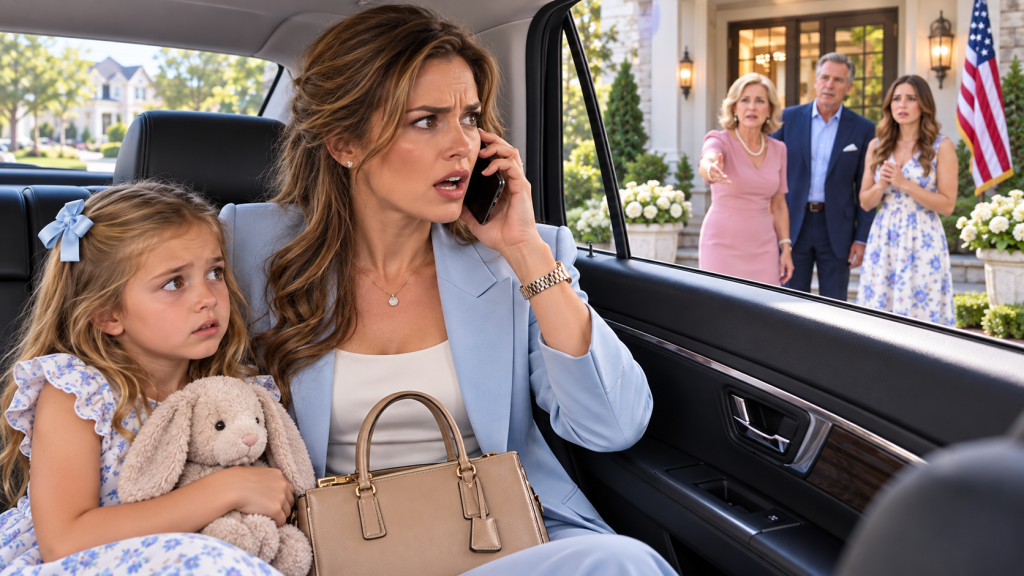
I was in an Uber halfway to my mother-in-law’s house when my lawyer called and yelled, “Stop. Do not go inside. It’s a setup.”
The driver’s eyes lifted immediately to the rearview mirror.
My six-year-old daughter, Sophie, sat beside me in her yellow dress, holding the apple pie she had helped me bake that afternoon.
She had insisted on making tiny hearts from the leftover dough and placing them around the crust because, according to her, “Grandma Linda likes pretty things.”
My fingers tightened around the phone.
“Rachel, what are you talking about?”
“Tell the driver to turn around,” my lawyer said. “Right now.”
Rachel Mercer was one of the calmest people I had ever met.
She had handled my separation for eight months without raising her voice once.
So hearing panic in hers frightened me more than the words themselves.
I leaned toward the driver.
“Could you pull over somewhere safe, please?”
“Of course.”
He slowed near the entrance to a shopping center.
Outside the window, the neighborhood looked painfully ordinary.
Clean sidewalks.
Fresh lawns.
White fences.
American flags hanging from front porches.
Families unloading groceries.
Children riding bicycles.
Everything looked peaceful.
That was the strange thing about family disasters.
They rarely announced themselves with thunder.
Sometimes they waited behind curtains in nice houses while dinner was warming in the oven.
My husband, Mark, had been gone for eight months.
Not dead.
Some days I thought death might have been easier for Sophie to understand.
Mark had simply decided one morning that our marriage was no longer convenient.
He packed his gym bag, a suitcase, and three expensive watches.
Then he withdrew almost all the money from our emergency savings account.
By lunchtime he was gone.
By the following week, I learned he had moved into a downtown condo with Vanessa, his twenty-seven-year-old assistant.
We had been married twelve years.
He ended it with a text.
I’m sorry. I need a different life.
Nine words.
That was apparently what twelve years of marriage was worth.
When I confronted him, he told me our home had become “too heavy.”
Too many doctor appointments.
Too many conversations about Sophie’s asthma.
Too many nights when I worried about ingredients at restaurants.
Too many responsibilities.
Sophie had asthma and several food allergies, including a serious peanut allergy.
She was not a sickly child.
She ran.
She danced.
She climbed trees.
She sang loudly in the bathtub.
But she needed adults around her to pay attention.
I carried a rescue inhaler.
I checked labels.
I spoke with teachers.
I reminded babysitters about emergency medication.
Mark once joked that I treated Sophie like “a tiny patient instead of a kid.”
His mother, Linda, agreed.
According to them, I worried too much.
According to Sophie’s pediatrician, I followed every medical recommendation exactly.
After Mark left, Linda began calling relatives.
Apparently I had driven her son away.
I had made the marriage unbearable.
I was controlling.
Cold.
Paranoid.
Obsessed with Sophie’s health.
At first, I defended myself.
Then Rachel told me to stop.
“Document everything,” she said. “Do not argue with people committed to misunderstanding you.”
So I saved messages.
I kept records.
I stopped reacting.
That morning, Linda had called unexpectedly.
I almost ignored her.
But she left a voicemail.
“Emma, please call me. It’s about Mark and Sophie.”
I called back.
Linda sounded as if she had been crying.
“Mark wants to apologize.”
I said nothing.
“He knows what he did was wrong.”
“He has my number.”
“He’s ashamed.”
“Mark has never been too ashamed to ask for something he wants.”
Linda inhaled slowly.
Then she used the sentence she knew would reach the weakest place in me.
“Please don’t punish a child because adults made mistakes.”
I closed my eyes.
Sophie missed her father.
That was the truth I could not escape.
She still drew pictures of him.
Still asked whether Daddy might come to her school performance.
Still saved one side of the couch for him during movie nights sometimes.
I hated Mark.
But I did not want Sophie to grow up believing I had stopped her father from trying.
“What does he want?” I asked.
“Dinner.”
“At your house?”
“Yes.”
“Why there?”
“Neutral ground.”
I almost laughed.
Linda’s house had never been neutral ground.
Still, I agreed.
For Sophie.
Not for Mark.
Linda sounded relieved.
“Six o’clock.”
“Fine.”
“And Emma?”
“Yes?”
“Don’t bring all Sophie’s medical things. I bought an inhaler for my house months ago. Let tonight feel normal.”
I hesitated.
“I usually keep hers with me.”
“I know. I’m trying to show you I’ve listened. I have one here.”
Something about her tone bothered me.
But I was tired.
Tired of being called dramatic.
Tired of arguments.
Tired of proving that caring for my child was not some psychological problem.
So I left Sophie’s backup inhaler at home.
Now, sitting in that Uber, I heard Rachel ask, “Did Linda specifically tell you not to bring it?”
“Yes.”
Her silence lasted half a second.
Then she said, “Emma, listen carefully. Linda filed an emergency custody declaration this afternoon.”
My body went cold.
“What?”
“Mark is at her house right now. There is a process server there, and a private family evaluator.”
I stared ahead.
“What custody declaration?”
“She claims you are unstable, financially desperate, interfering with Mark’s relationship with Sophie, and neglecting Sophie’s medical care.”
“That’s insane.”
“I know.”
“She barely sees Sophie.”
“I know.”
“Mark cancelled half his visits.”
“I know.”
“I have every appointment record.”
“I know. Emma, breathe.”
Sophie looked at me.
“Mommy?”
I forced my face to soften.
“We’re okay, baby.”
She looked unconvinced.
I turned slightly toward the window.
Rachel continued.
“They planned to serve you during dinner.”
“Why?”
“To provoke you.”
I froze.
“What?”
“Linda told the evaluator you have explosive emotional reactions. They planned to serve you unexpectedly, record the dinner, and use whatever reaction you had as evidence tomorrow morning.”
A bitter laugh escaped me.
“So they wanted me angry.”
“Yes.”
“They invite me to dinner, hand me custody papers, film me, and then say I’m unstable.”
“That appears to be the plan.”
I looked at Sophie’s little hands resting on the pie box.
My heart started pounding.
Rachel lowered her voice.
“There’s more.”
I almost did not want to hear it.
“What?”
“Linda told the evaluator Sophie has experienced repeated allergic reactions and breathing problems while in your care.”
“That is a lie.”
“I know.”
“She hasn’t had a serious reaction this year.”
“I have the pediatric records.”
“She hasn’t been hospitalized once.”
“I know.”
Then Rachel asked the question that changed everything.
“Emma, why did Linda ask you not to bring Sophie’s inhaler?”
I looked down at my purse.
The empty side pocket suddenly felt enormous.
“She said she bought one.”
“Did she?”
“I don’t know.”
“Tell the driver to go to a pharmacy.”
My mouth went dry.
“Rachel…”
“Now.”
I leaned forward.
“Could you take us to the nearest pharmacy?”
The driver nodded.
“There’s one about three minutes away.”
“Please.”
Sophie frowned.
“Are we not going to Grandma’s?”
“Not yet.”
“But Daddy is there?”
Her face brightened when she said his name.
It nearly broke me.
“I think so.”
“Can we still go?”
“We’ll see, sweetheart.”
Rachel remained on the phone.
“I’m emailing you the filing.”
My phone buzzed.
I opened the document.
The first page listed my name.
Emma Carter.
Respondent.
Underneath was a description of a woman I barely recognized.
Emotionally unstable.
Controlling.
Financially irresponsible.
Possibly abusing prescription medication.
I stopped.
“What prescription medication?”
“They don’t identify any.”
“I take antihistamines.”
“I know.”
I scrolled.
There were screenshots of messages between Linda and me.
Except they were cropped.
One showed me writing:
Please stop giving Sophie food without checking with me.
Missing was Linda’s earlier message admitting she had given Sophie homemade cookies from a neighbor without knowing the ingredients.
Another screenshot showed:
No, Mark cannot take Sophie overnight this weekend.
Missing was the sentence where Mark refused to tell me where he planned to take her.
They had stripped away context until responsible parenting looked like control.
Then I reached Linda’s sworn statement.
I have personally witnessed Emma forget Sophie’s medication on several occasions.
My stomach twisted.
It was completely false.
“She signed this?”
“Yes.”
“Under oath?”
“Yes.”
The Uber pulled into the pharmacy parking lot.
I kept reading.
Linda claimed Sophie often arrived at her house “wheezing and poorly cared for.”
Sophie had not been to Linda’s house in nearly three months.
I looked at Rachel’s email attachments.
Medical records.
School attendance.
Pharmacy receipts.
I had documentation for everything.
But suddenly that did not calm me.
Because if Linda was willing to lie under oath, what else was she willing to do?
Rachel asked, “Has Linda sent any unusual messages today?”
I opened our thread.
Most were ordinary.
Dinner at six.
Mark will be here.
Sophie still likes macaroni?
Bring her favorite sweater.
Then I saw one from earlier that afternoon.
Has Sophie had peanuts recently? I can never remember what she still reacts to.
I remembered feeling annoyed when I read it.
Linda had known Sophie’s allergies for years.
I had answered:
Peanuts are still one of her most serious allergies. Please do not give her anything with peanuts or prepared around peanuts.
Linda had responded with a thumbs-up emoji.
I read the exchange aloud.
Rachel went quiet.
“Screenshot it.”
I did.
“Send it to me.”
I sent it.
“What do you think it means?”
“I don’t know yet.”
“Rachel.”
“I don’t know, Emma. But I don’t like the timing.”
I climbed out of the car.
The driver said, “Take your time. I’ll wait.”
“Thank you.”
Inside the pharmacy, the pharmacist recognized me.
“Emma? Everything okay?”
“I need another rescue inhaler for Sophie.”
“Did you lose hers?”
“Something happened.”
She glanced at Sophie through the front window.
“I’ll see what I can do.”
A few minutes later, I had an emergency replacement.
When I returned to the Uber, Linda had called twice.
Mark had called once.
Then another call came.
Mark.
I let it ring.
A message appeared.
Mom says you’re late. Where are you?
Then Linda:
Dinner is getting cold.
Then Mark again:
Don’t start this tonight, Emma. Sophie deserves better.
Rachel said, “Do not respond.”
I stared at those words.
Sophie deserves better.
Coming from the man who had missed her last two school events.
The man who cancelled visits because Vanessa wanted to go away for the weekend.
The man who once told me a pediatric appointment was “my department.”
The Uber pulled away.
I turned toward Sophie.
She was looking down at her pie.
“Sweetheart?”
She did not answer.
“Sophie?”
Her expression had changed.
Guilty.
Nervous.
“What is it?”
“Nothing.”
I knew that face.
It was the same one she made when she accidentally broke something.
I touched her hand.
“You are not in trouble.”
She looked at me.
“Promise?”
“Promise.”
She hesitated.
“Grandma gave me something.”
My pulse stopped for what felt like a full second.
“What do you mean?”
“Today.”
“When today?”
“At school.”
I stared at her.
“Grandma came to your school?”
Sophie nodded.
“Outside.”
“Where outside?”
“By the fence when we were coming back from recess.”
My hands began to shake.
Linda was not allowed to pick Sophie up.
She was not on the emergency contact list.
“What did she give you?”
Sophie opened her small purse.
She reached inside.
Then she pulled out a chocolate candy bar.
I recognized the wrapper instantly.
Peanut chocolate.
My breath vanished.
“Sophie, did you eat any?”
She shook her head quickly.
“No.”
“Are you sure?”
“Yes.”
“Did you open it?”
“No.”
I grabbed her and hugged her.
She stiffened, surprised.
“Mommy?”
“You did so good.”
“Why?”
“Because you didn’t eat it.”
“I know I’m not supposed to.”
I kissed her forehead.
Rachel had heard everything.
“Emma.”
“Yes?”
“Do not throw it away.”
“I won’t.”
“What exactly did Linda say when she gave it to Sophie?”
I asked gently.
Sophie thought.
“She said it was a surprise.”
“Anything else?”
“She said don’t tell you yet.”
My stomach turned.
“Why?”
“She said you worry about everything.”
Rachel said, “Ask if Linda told her when to eat it.”
I did.
Sophie nodded.
“She said after dinner.”
The Uber driver’s eyes met mine in the mirror.
Even he understood.
I felt sick.
Then Sophie added, “Grandma said Daddy wanted to see what happens when Mommy doesn’t control everything.”
I closed my eyes.
Rachel’s voice became very calm.
“Emma, come directly to my office.”
“What are you thinking?”
“I am thinking we document everything before anyone has a chance to change their story.”
The ride downtown felt endless.
Sophie asked if Grandma was in trouble.
I told her I did not know.
Then she asked whether Daddy would still eat the apple pie.
I had to look out the window because tears filled my eyes.
When we reached Rachel’s office, she was waiting downstairs.
She hugged me first.
Then she crouched beside Sophie.
“Hi, Sophie. I have coloring books upstairs.”
Sophie smiled.
Inside, Rachel’s assistant brought her sealed crackers and apple juice.
Rachel placed the candy bar inside an evidence bag.
“You keep those in your office?”
Rachel gave me a tired smile.
“I represent divorcing families.”
Then her face became serious again.
“I contacted the school.”
“So fast?”
“I called while you were on your way.”
The principal agreed to check camera footage.
At 1:42 p.m., Linda’s car appeared near the school.
At 1:45, she walked toward the playground fence.
At 1:47, Sophie approached.
At 1:49, Linda handed something through.
The camera could not show exactly what it was.
But it showed that the meeting happened.
Rachel contacted the police.
That frightened me.
“Do we really need police involved?”
“Yes.”
“What if this ruins everything?”
Rachel looked at me.
“Emma, what exactly are you trying to preserve?”
I had no answer.
An officer arrived within half an hour.
He spoke gently with Sophie.
I stayed nearby.
He asked simple questions.
Did Grandma come to school?
Yes.
Did Grandma give you something?
Yes.
What did she give you?
Candy.
Did Grandma tell you to eat it?
After dinner.
Did Grandma say anything else?
Sophie looked at her shoes.
“She said Mommy makes everything scary.”
The officer wrote that down.
Then Sophie added, “Daddy wanted to know what happens when Mommy isn’t bossing everybody.”
I felt something inside me break.
Not loudly.
Quietly.
Because suddenly the entire evening made sense.
They had wanted a crisis.
Maybe not a severe one.
Maybe Linda truly believed Sophie’s allergy was exaggerated.
Maybe she thought a rash or cough would prove I overreacted.
Maybe Mark did not know about the candy.
But they had created a situation where my child’s safety had become part of a strategy.
That was enough.
The officer took the candy bar.
He told us there would be an investigation.
He carefully explained that the evidence did not yet prove Linda intended to cause harm.
I understood.
I did not want assumptions.
I wanted truth.
At 7:18 p.m., Mark texted again.
This is unbelievable. Mom worked all day making dinner. Stop using Sophie as a weapon.
Rachel said, “Now you respond.”
“What do I say?”
She dictated slowly.
Something came up. Sophie and I are safe. Please communicate through counsel regarding tonight.
Mark answered almost immediately.
Counsel?
Then:
What did you do?
Not:
Is Sophie okay?
Not:
What happened?
What did you do?
Rachel read it.
“Save that.”
At 8:04, Linda called.
Then again.
Then again.
Finally she left a voicemail.
We played it on speaker.
“Emma, I have no idea what ridiculous story Rachel has put in your head, but this was supposed to be a healing dinner. Mark is devastated. Sophie deserves her father. You need to stop being selfish and come here so we can discuss this like adults.”
Rachel paused the message.
“She doesn’t know you found the candy.”
“No.”
“Good.”
That night Sophie slept at my sister Anna’s house.
I stayed awake until almost three in the morning.
Every time I closed my eyes, I imagined the dinner we almost attended.
Linda serving food.
Mark watching me.
A private evaluator pretending to be a family friend.
A process server walking in.
Phones recording.
Everyone waiting for me to react.
I imagined Sophie reaching into her purse afterward.
Opening the candy.
I stopped myself there.
There are thoughts a mother cannot afford to finish.
At eight the next morning, Rachel picked me up.
The hearing was scheduled for nine.
Mark was already outside the courtroom.
Linda sat beside him.
She wore cream-colored slacks and a pale sweater.
She held tissues.
Vanessa was there too.
That surprised me.
Apparently Mark thought bringing the woman he left his family for to an emergency custody hearing was a reasonable decision.
Linda saw me.
Her face changed immediately.
Wounded.
Victimized.
As though I were the one who had betrayed her.
Mark stood.
“What the hell happened last night?”
Rachel stepped between us.
“Mr. Carter, please communicate through your attorney.”
He ignored her.
“Emma, Mom said police came to her house.”
I looked at him.
“Yes.”
“Why?”
“Ask your mother.”
Linda stood.
“What exactly are you accusing me of?”
Rachel touched my arm.
“Inside.”
The hearing began.
Linda testified first.
She cried beautifully.
She told the judge she had spent months watching her granddaughter become isolated.
She claimed I made Sophie afraid of ordinary life.
“She constantly tells that child food is dangerous,” Linda said. “Sophie is scared of everything.”
My hands tightened under the table.
The judge asked, “Does the child have medically documented allergies?”
Linda hesitated.
“Yes, but Emma exaggerates.”
Rachel looked at me.
That answer mattered.
Linda continued.
She said I was emotionally unstable after Mark left.
That I blamed him for everything.
That I refused reasonable access.
That Sophie frequently arrived at family gatherings with unnecessary medication.
Then Mark testified.
He said he loved Sophie.
That part, at least, I believed.
He claimed I had made communication almost impossible.
Rachel later introduced seventeen scheduled visits.
Mark had cancelled eleven.
He claimed I had excluded him from medical decisions.
Rachel showed emails inviting him to every appointment.
He claimed he worried I was struggling financially.
Rachel produced bank statements showing he had withdrawn $18,400 from our joint emergency account two days before leaving.
The judge stared at him.
“You removed nearly the entire emergency fund?”
Mark shifted.
“It was marital money.”
“And then you expressed concern that your wife became financially unstable?”
His attorney touched his elbow.
Mark stopped talking.
Then Rachel questioned Linda.
“Mrs. Carter, are you aware that Sophie has a diagnosed peanut allergy?”
“Yes.”
“How serious?”
“I don’t know.”
“Have you been informed it can require emergency treatment?”
“I suppose.”
Rachel handed documents to the clerk.
“These are the child’s records from her allergist.”
The judge reviewed them.
Rachel continued.
“Yesterday, did you ask Emma whether Sophie remained allergic to peanuts?”
Linda’s face changed.
“I may have.”
“Why?”
“I was preparing dinner.”
“Were you serving peanuts?”
“No.”
“Peanut butter?”
“No.”
“Dessert containing peanuts?”
“No.”
“Then why ask?”
Linda looked annoyed.
“I don’t remember.”
Rachel paused.
“Did you go to Sophie’s school yesterday afternoon?”
“No.”
The answer came too quickly.
Rachel looked at the judge.
“Mrs. Carter, are you certain?”
“Yes.”
Rachel produced printed surveillance images.
Linda at the school fence.
Linda speaking with Sophie.
Linda extending her hand.
Mark stared at his mother.
“What is that?”
Linda whispered, “I was just checking on her.”
Rachel said, “You just testified you were not there.”
“I misunderstood the question.”
The judge’s expression hardened.
Rachel continued.
“Did you give Sophie a candy bar?”
“No.”
“Did you give her anything?”
“I don’t remember.”
“Did you instruct her to hide anything from her mother?”
“Absolutely not.”
Rachel introduced the police report.
Then she introduced photographs of the sealed candy bar taken before police collected it.
She introduced Linda’s text asking whether Sophie was still allergic to peanuts.
The courtroom went very still.
Linda’s attorney whispered something to her.
Linda looked pale.
Rachel asked, “Did you give Sophie this candy?”
Linda stared at the image.
“No.”
Rachel waited.
Silence often does more than shouting.
Linda shifted.
“I may have given her chocolate.”
“Containing peanuts?”
“I didn’t read the wrapper.”
“Despite asking her mother about peanuts only hours earlier?”
Linda’s eyes filled with tears.
“I would never hurt my granddaughter.”
Rachel’s voice remained calm.
“That was not my question.”
Mark whispered, “Mom, what did you do?”
Linda turned toward him.
“Don’t start.”
The judge said, “Mrs. Carter, answer.”
Linda looked down.
“I gave her the candy.”
There it was.
I felt no victory.
Only nausea.
Rachel asked, “Why?”
“I thought Emma exaggerated.”
“You decided to test a child’s allergy?”
“No!”
Linda’s voice rose.
“I wasn’t testing anything.”
“Then why tell Sophie to eat it after dinner?”
“I didn’t.”
“The child told a police officer you did.”
“She misunderstood.”
Rachel leaned slightly forward.
“Did you tell Sophie not to tell her mother?”
Linda began crying.
“I only wanted one normal evening.”
“One normal evening that began with deceiving the child’s mother?”
“Emma controls everything.”
“What exactly were you trying to prove?”
Linda looked at Mark.
He looked away.
That was when the room changed.
Until that moment, Linda had believed Mark would protect her.
I saw the realization in her face.
Her son was going to let her stand alone.
Then she said the sentence that destroyed their entire plan.
“We needed documentation.”
Rachel went still.
The judge leaned forward.
“What documentation?”
Linda’s attorney closed his eyes.
“I misspoke.”
The judge repeated, “What documentation?”
Linda looked at Mark again.
He said, “Mom, stop talking.”
She stared at him.
“You knew.”
“I knew about dinner.”
“You knew why the evaluator was there.”
Mark’s face reddened.
“That was about custody.”
“You said we needed to show how she overreacts.”
“I never told you to give Sophie peanuts!”
The entire courtroom froze.
Linda pointed at him.
“You said Emma made the child think she was sick!”
“I said she worries too much!”
“You said we needed proof!”
The judge interrupted.
“Enough.”
Rachel stood quietly.
“Your Honor, we would like the record to reflect that both witnesses have now acknowledged the dinner was arranged in connection with obtaining evidence for this custody request.”
Mark’s attorney looked defeated.
The judge turned to Mark.
“Was a private evaluator present at the house last night?”
He hesitated.
“Yes.”
“Was Mrs. Carter told that?”
“No.”
“Was a process server present?”
“Yes.”
“Was Mrs. Carter told that?”
“No.”
“Were you planning to record the interaction?”
Mark looked down.
“Yes.”
The judge’s voice became colder.
“So you arranged what was presented as a family reconciliation dinner, brought in a hidden evaluator, arranged service of legal documents, planned to record Mrs. Carter’s reaction, and then used that anticipated reaction as part of an emergency custody strategy?”
Mark tried to explain.
“We were worried about Sophie.”
The judge stared at him.
“If you were worried about Sophie, why did you cancel eleven of seventeen scheduled visits?”
Mark said nothing.
Rachel then introduced the medical records.
Sophie’s pediatrician documented excellent compliance.
The allergist wrote that I consistently followed the emergency plan.
The school nurse confirmed Sophie always arrived with medication properly labeled.
There were no unexplained asthma attacks.
No neglected appointments.
No evidence of prescription abuse.
No evidence of financial instability.
Then Rachel presented every uncropped message.
One by one, the story Linda and Mark had built collapsed.
The judge denied Mark’s emergency custody request.
Immediately.
Then she ordered that his visitation remain supervised pending a full family evaluation.
Linda was ordered to have no contact with Sophie outside professionally supervised settings.
The court referred the matter involving the candy and school visit to child protective services.
The transcript was forwarded to investigators.
When the hearing ended, I sat still.
Rachel touched my shoulder.
“You did well.”
“I barely spoke.”
“Exactly.”
Outside the courtroom, Mark followed me.
“Emma.”
I stopped.
He looked exhausted.
“I didn’t know she gave Sophie that candy.”
I believed him.
And somehow that made me angrier.
“You helped create the reason she thought it was acceptable.”
His face tightened.
“That isn’t fair.”
“No?”
“I wanted to see my daughter.”
“You cancelled eleven visits.”
“I was working.”
“You missed her school play.”
“I had a client meeting.”
“You missed her allergy appointment.”
“You handle that stuff better.”
“That sentence is the problem.”
He stared at me.
I continued.
“You wanted the title of father without the inconvenience.”
“That’s not true.”
“You left.”
“I left you.”
The words came out sharply.
Then he stopped.
He heard what he had said.
I nodded.
“And you thought leaving me meant you could leave everything difficult too.”
He looked away.
“I love Sophie.”
“I know.”
“Then don’t take her away.”
“I’m not taking her anywhere.”
“What do you call this?”
“Consequences.”
Linda came through the courtroom doors.
Her eyes were swollen.
When she saw me, she started walking toward us.
Rachel stepped forward.
Linda stopped.
“I never wanted Sophie hurt.”
I looked at her.
“Then why was proving me wrong more important than checking a candy wrapper?”
“I thought you exaggerated.”
“You thought wrong.”
“I love that little girl.”
“Love does not excuse dangerous choices.”
Linda began crying.
“I just wanted my family back.”
I shook my head.
“No. You wanted your son to win.”
She looked as if I had slapped her.
I continued.
“You made Sophie part of a game she never agreed to play.”
For once, Linda had no answer.
The investigation lasted several weeks.
Police did not charge Linda with intentionally trying to poison Sophie.
There was not enough evidence that she wanted a severe reaction.
I was strangely relieved.
I did not want to believe she had wanted Sophie harmed.
But investigators confirmed she knowingly gave a peanut product to a child whose allergy had been explained to her that same day.
They confirmed she had gone to the school without permission.
They confirmed she told Sophie to keep the candy secret.
Child protective services described it as reckless judgment during a custody conflict.
Those words followed Linda into every later hearing.
Mark tried apologizing.
His first apology came by text.
I’m sorry things got out of control.
I ignored it.
A week later:
I never wanted Sophie endangered.
I ignored that too.
Then, nearly a month later, I received a longer message.
I wanted to hurt you because I was angry that you stopped needing me. I convinced myself you were keeping Sophie from me when really I was avoiding being her father whenever it was inconvenient. I let Mom tell me what I wanted to hear. I am ashamed.
I read it twice.
Then I saved it.
I did not answer.
An apology can be sincere and still not be enough.
Mark began parenting classes.
At first, I assumed it was only because the court required them.
Then he began doing things the court had not ordered.
He attended Sophie’s medical appointments.
He learned the correct dosage of every medication.
He asked the allergist questions.
He kept emergency medication at his condo.
He showed up early for supervised visits.
For the first time since leaving, he stopped treating Sophie like a prize to be won from me.
He started treating her like a child who needed him.
Sophie did not forgive him instantly.
Some days she ran into his arms.
Other days she barely looked at him.
Once, after a visit, she climbed into my car and asked, “Why does Daddy say sorry so much now?”
I thought carefully.
“Because sometimes grown-ups understand their mistakes late.”
“Does sorry fix mistakes?”
“No.”
She frowned.
“Then why say it?”
“Because saying sorry is the beginning. Changing what you do is the important part.”
She considered this.
“So Daddy has to do both?”
“Yes.”
She nodded.
“Okay.”
Children often understand accountability faster than adults.
Linda did not see Sophie for nearly seven months.
That was harder than I expected.
Sophie missed her grandmother.
She remembered gardening with Linda.
Christmas cookies.
Old movies.
Birthday balloons.
Children do not erase good memories because adults make terrible decisions.
I never told Sophie that Linda was a monster.
Because she wasn’t.
Monsters are easy.
Linda was more complicated.
She loved Sophie.
She also loved being right.
And during one terrible period, being right became more important than being safe.
Eventually, Linda completed counseling.
She followed every court requirement.
She wrote me letters I did not answer.
Most were apologies.
Some tried to explain.
I learned there is a difference between explanation and excuse.
After several months, the court allowed short supervised visits.
The first one happened in a family services center.
I brought Sophie.
Linda was already there.
She looked older.
Sophie held my hand tightly.
When Linda saw her, she started crying.
“Sophie.”
Sophie did not run toward her.
She stayed beside me.
Linda crouched.
“I missed you.”
Sophie stared at her.
Then she asked, “Why did you give me the peanut candy?”
The supervisor looked at Linda.
I said nothing.
Linda’s face crumpled.
“I made a very bad choice.”
“Did you want me to get sick?”
“No.”
The answer came immediately.
“Never.”
“Then why?”
Linda took a long breath.
“Because I thought your mommy worried too much. I wanted to prove I was right.”
Sophie frowned.
“So you gave me something bad?”
“Yes.”
“That doesn’t make sense.”
Linda laughed once through her tears.
“No. It doesn’t.”
Sophie looked at me.
Then back at Linda.
“Mommy says if someone is sorry, they don’t do it again.”
Linda nodded.
“Your mommy is right.”
That visit lasted forty-five minutes.
On the drive home, Sophie asked, “Do you forgive Grandma?”
“I’m still working on it.”
“Do I have to forgive her?”
“No.”
She seemed relieved.
“You can love someone and still need time.”
She stared out the window.
“I love her.”
“I know.”
“But I’m still mad.”
“That’s okay too.”
My divorce from Mark was finalized a year after he left.
I kept the house.
The court considered the money he removed from our account when dividing everything.
Mark repaid a large portion.
I received primary custody.
Over time, his supervised visits became unsupervised daytime visits.
Then weekends.
Not because I forgot what happened.
Because he did the work required to become safer and more reliable.
There is a difference between revenge and boundaries.
I wanted boundaries.
I wanted Sophie protected.
I did not want her growing up believing every person who failed once should disappear forever.
But I also did not want her learning that love meant accepting anything.
There had to be a middle ground.
Mark slowly found it.
One evening, nearly eighteen months after that Uber ride, he came to pick Sophie up for a weekend.
He arrived ten minutes early.
He had her medication bag.
He checked the expiration date on the inhaler in front of me.
He had called the restaurant they planned to visit and discussed the allergy policy.
I watched him.
“What?”
He looked nervous.
“Nothing.”
“You’re staring at me.”
“I remember when you called all of this obsessive.”
He lowered his eyes.
“I was an idiot.”
“That’s one word.”
He almost smiled.
Then he grew serious.
“I’m sorry.”
This time I believed him.
Not because the words were better.
Because his behavior had changed.
“You don’t need to apologize to me every time.”
“I know.”
“Just keep showing up for her.”
“I will.”
Sophie ran down the stairs.
“Daddy!”
He smiled.
And for the first time, that smile did not make me angry.
A few months later, Linda was allowed longer supervised visits.
Eventually, I agreed to attend one myself.
We sat in a park while Sophie fed ducks.
Linda and I stayed on a bench.
For several minutes, neither of us spoke.
Then she said, “I hated you.”
I turned toward her.
She stared at the pond.
“After Mark left, I needed someone to blame.”
“Why not Mark?”
Her eyes filled.
“Because then I would have had to admit what kind of man my son had become.”
I said nothing.
“So I blamed you. You were easier.”
“That almost cost Sophie.”
“I know.”
She wiped her cheek.
“I think about that every day.”
I watched Sophie laughing near the water.
Linda continued.
“I truly believed you exaggerated her allergy.”
“Even after doctors told you?”
“I told myself doctors were just being cautious because you were anxious.”
“That sounds convenient.”
“It was.”
I appreciated the answer.
No excuse.
Just truth.
She looked at me.
“I don’t expect you to forgive me.”
“I don’t know if I ever completely will.”
“I understand.”
“But Sophie loves you.”
Linda cried quietly.
“I know.”
“So if you are in her life, you respect every boundary.”
“I will.”
“One secret from her, one attempt to use her against me, one ignored medical rule, and we are done.”
Linda nodded.
“Understood.”
That was the beginning of a strange new relationship.
Not warm.
Not close.
But civil.
Eventually, peaceful.
Rachel remained part of our lives too.
Every year on Sophie’s birthday, she sent a book.
Never toys.
Books.
Sophie called her “the lawyer who saved dinner.”
Rachel always corrected her.
“I just made a phone call.”
But I knew better.
Sometimes timing changes everything.
I often thought about what would have happened if Rachel had called ten minutes later.
We would have reached Linda’s house.
Sophie would have carried her pie inside.
Mark would have hugged her.
Linda would have smiled.
Someone pretending to be a family friend would have been watching me.
The process server would have arrived.
I would have been handed papers accusing me of neglecting my own daughter.
Someone would have recorded my face.
Maybe I would have cried.
Maybe I would have shouted.
Maybe I would have said things I later regretted.
Then they would have taken my worst five minutes and presented them as proof of who I was every day.
And afterward, Sophie might have reached into her purse.
She might have opened the candy.
I never allowed myself to imagine beyond that.
Instead, I remembered the truth.
She did not eat it.
Because I had taught her not to.
All those times people said I worried too much.
All those labels.
Difficult.
Controlling.
Overprotective.
Paranoid.
None of those mattered when my daughter remembered one simple rule.
Never eat food you are unsure about.
Never keep a secret about medicine.
Never hide something that affects your body or safety.
That rule protected her when adults failed her.
Three months after the divorce was finalized, Sophie and I baked another apple pie.
She stood on a chair beside me, sprinkling cinnamon into the apples.
She was seven now.
One front tooth was missing.
Her hair had grown almost to her shoulders.
“Mommy?”
“Yes?”
“Can Grandma have some tomorrow?”
Linda had a supervised visit scheduled.
“If you want to bring her some.”
Sophie smiled.
“I do.”
Then her expression became serious.
“We check everything first.”
“Always.”
“No peanuts.”
“Definitely no peanuts.”
“No secret food.”
“Correct.”
“No secret medicine.”
“Correct.”
“And if a grown-up says not to tell you something?”
“That depends.”
She frowned.
I explained.
“Some secrets are fun. Birthday presents. Surprises.”
“But not scary secrets.”
“Exactly.”
“If it’s about my body or food or medicine, I tell you.”
“Yes.”
“Even if they say you’ll be mad?”
“Especially then.”
She nodded.
Then she went back to pressing tiny hearts into the pie crust.
The same tiny hearts she had made on the night everything changed.
I watched her little hands.
And for a moment, I felt something I had not felt in a long time.
Peace.
My phone buzzed.
Mark.
Can I call Sophie tonight?
I showed her.
She shrugged.
“After pie.”
I laughed.
“After pie.”
Later that evening, Mark called.
I stayed in the kitchen while Sophie talked to him from the couch.
She told him about school.
A science project.
A girl named Hannah who had traded pencils with her.
Then she told him we were taking pie to Grandma.
Mark was quiet for a moment.
“That’s kind of you.”
Sophie said, “Mom says people can make better choices.”
I looked away because my eyes suddenly filled.
That sentence stayed with me.
People can make better choices.
It did not erase the bad ones.
It did not make consequences disappear.
But it allowed the future to be different from the past.
For a long time, I thought justice meant watching Linda and Mark lose everything.
Their reputations.
Their relationships.
Their access to Sophie.
But eventually I understood that was anger talking.
Real justice looked quieter.
It looked like the truth surviving an attempted lie.
It looked like a judge refusing to reward manipulation.
It looked like a father being forced to face the damage he caused.
It looked like a grandmother learning that love without good judgment can still be dangerous.
It looked like a child learning that adults do not get automatic trust simply because they are family.
And it looked like me finally understanding that protecting Sophie did not require me to become hard.
I could still have compassion.
I could still allow change.
I could still build boundaries strong enough to keep us safe.
A few weeks later, I stopped at a coffee shop before work.
A man near the counter stared at me.
Then smiled.
“Pharmacy emergency.”
I stared back.
Then recognized him.
The Uber driver.
“Daniel?”
He laughed.
“You remember.”
“How could I forget?”
We spoke for a few minutes.
He asked about Sophie.
I told him she was doing well.
Then I said, “You helped us that night.”
He shook his head.
“I drove a car.”
“You waited at the pharmacy.”
“That was nothing.”
“You changed directions three times.”
“That’s my job.”
“You didn’t complain.”
He smiled.
“Sometimes people just need somebody to keep driving.”
I stood there holding my coffee.
Something about those words hit me harder than he probably intended.
Because that was exactly what the year after the hearing had been.
Keep driving.
Through court.
Through counseling.
Through anger.
Through apologies.
Through financial meetings.
Through Sophie’s questions.
Through Linda’s letters.
Through Mark’s attempts to change.
Through the nights I wanted to give up on everybody.
Just keep moving toward safer ground.
Eventually, without noticing exactly when, Sophie and I stopped living like people waiting for another disaster.
Our home became ordinary again.
Not the fake ordinary of Linda’s dinner plan.
Real ordinary.
Laundry.
Homework.
Grocery lists.
Lost shoes.
Burned toast.
Sunday cartoons.
One Saturday morning, Sophie climbed into my bed at 7:06.
“Mom.”
I opened one eye.
“What?”
“Pancakes.”
“No.”
“Why?”
“It’s seven in the morning.”
“Pancakes don’t know time.”
I stared at her.
Then laughed so hard I woke completely.
We went downstairs.
The first batch burned because Sophie insisted on flipping one herself.
The second batch was better.
We ate them with strawberries.
Syrup dripped onto the table.
Sophie told terrible jokes.
Sunlight came through the kitchen window.
No lawyers.
No documents.
No recordings.
No emergency hearings.
No hidden plans.
That morning mattered more than winning in court.
Because survival gets dramatic moments.
Peace gets quiet ones.
A year earlier, I would have thought victory was hearing the judge deny Mark’s request.
Now I knew victory could also be pancakes on a Saturday morning.
Months later, I attended Sophie’s school play.
She played a tree.
Not even the main tree.
Tree number four.
She had three lines.
I sat in the audience beside Anna.
Mark sat two seats away.
Linda sat at the far end of the row under the terms of her renewed contact agreement.
When Sophie walked onto the stage, all three of us smiled.
For one evening, nobody fought over who loved her more.
Nobody tried to win.
We simply watched.
After the play, Sophie ran toward us wearing cardboard leaves.
“Did you hear my lines?”
“All three,” I said.
Mark laughed.
“You were the best tree.”
Linda held out flowers.
Sophie looked at me first.
I nodded.
She accepted them.
“Thank you, Grandma.”
Linda did not cry.
She had learned not to make every moment about her emotions.
Another small change.
Another better choice.
On the drive home, Sophie said, “Everybody behaved.”
I almost choked laughing.
“Yes.”
“See? I told you grown-ups can learn.”
I looked at her in the mirror.
“You were right.”
She smiled proudly.
Sometimes children survive family conflict and emerge wiser than the adults who caused it.
I wish they did not have to.
But Sophie did.
Years from now, she may remember very little about that evening in the Uber.
Maybe she will remember the yellow dress.
Maybe the pie.
Maybe the candy.
Maybe she will remember me hugging her too tightly outside Rachel’s office.
I hope what she remembers most is this:
When something felt wrong, the adults responsible for protecting her finally listened.
Her lawyer listened.
Her school listened.
The officer listened.
The judge listened.
And her mother listened.
I also hope she remembers that she listened to herself.
She knew not to eat the candy.
She knew the secret felt wrong.
She spoke.
That mattered.
For a long time, I believed motherhood meant preventing every bad thing from reaching your child.
That is impossible.
The world will disappoint them.
People will lie.
Family members will fail.
Plans will collapse.
Children will face moments when we are not standing beside them.
What we can do is give them tools.
Teach them boundaries.
Teach them to ask questions.
Teach them that love never requires unsafe secrets.
Teach them that saying no does not make them rude.
Teach them that adults can be wrong.
Teach them that if something feels frightening, confusing, or unsafe, they can always tell someone they trust.
That became the lesson I carried from that night.
Not that everyone is dangerous.
Not that family cannot be trusted.
But that trust should never require silence.
Linda eventually earned more freedom with Sophie.
It took years, not months.
Mark became a much better father.
Not perfect.
But present.
Vanessa disappeared from his life less than a year after our divorce.
When he told me they broke up, I felt almost nothing.
That surprised me.
There had been a time when imagining their relationship ending would have felt like revenge.
By then, I simply did not care.
I had rebuilt too much of my own life to measure happiness by his.
I started traveling with Sophie.
Nothing extravagant.
Weekend trips.
Museums.
Small beach towns.
Once we drove four hours just to visit an aquarium she had seen online.
She pressed her hands against the glass while sharks swam overhead.
I watched her face light up.
That was when I realized something else.
For years, I had been so busy surviving the collapse of my marriage that I had forgotten life could still expand.
Mark leaving did not shrink our future.
It changed its shape.
Sometimes the thing you think destroyed your family simply reveals which pieces were never strong enough to hold it.
One night, years after the Uber call, Sophie found the old yellow dress in a storage box.
She held it up.
“Was this mine?”
“Yes.”
“When?”
“You wore it to a dinner we never attended.”
She thought.
“With Grandma?”
“Yes.”
Her eyes narrowed.
“The peanut night?”
I laughed softly.
“That’s one way to describe it.”
She sat beside me.
“Were you scared?”
“Yes.”
“A lot?”
“A lot.”
She looked at the dress.
“Did I cry?”
“No.”
“Really?”
“You mostly worried about the pie.”
She smiled.
“That sounds like me.”
“It does.”
Then she asked, “Did you know everything would be okay?”
I considered lying.
Parents often want children to believe we always know.
But I told her the truth.
“No.”
“What did you know?”
I touched the yellow fabric.
“I knew I had to protect you first and figure everything else out later.”
Sophie leaned against me.
“That worked.”
I kissed the top of her head.
“Yes.”
It did.
Not perfectly.
Not without pain.
But it worked.
And whenever someone asks me now how I survived the worst year of my life, I think about Rachel’s voice on that phone.
Stop.
Do not go inside.
It’s a setup.
Sometimes one warning changes a life.
Sometimes one saved text exposes a lie.
Sometimes one child refusing a candy bar changes a court case.
Sometimes one Uber driver turning toward a pharmacy instead of a family dinner becomes part of the reason a little girl goes home safe.
And sometimes the moment you believe your family is falling completely apart is actually the moment you finally begin rebuilding it on truth.
I never forgot the apple pie.
The first one went uneaten.
Rachel’s assistant eventually threw it away because it had been sitting too long.
Sophie was disappointed when she found out.
So we baked another.
And another.
Over the years, apple pie became our strange little symbol.
Whenever life felt uncertain, Sophie would say, “We need pie.”
The day my divorce became final?
Pie.
The day Mark completed his parenting program?
Pie.
The first successful supervised visit with Linda?
Pie.
The day Sophie finished elementary school?
Pie.
The first time she spent a full weekend with Mark and came home happy?
Pie.
By then, tiny hearts around the crust had become tradition.
Years later, when Sophie was old enough to bake one almost entirely by herself, she placed the final heart on top and said, “You know, Mom, we should thank Grandma for one thing.”
I stared at her.
“What?”
“She made us really good at pie.”
I laughed until tears came.
That was Sophie.
She could find light in places I would never have looked for it.
Maybe that was the greatest victory of all.
They had tried to turn her into evidence.
She remained a child.
They tried to make her medical needs into ammunition.
She grew up knowing how to care for herself.
They tried to make me look unstable.
Instead, their plan forced me to discover how steady I could be.
And while I would never say I was grateful for what happened, I became grateful for what came afterward.
Truth.
Boundaries.
Peace.
A stronger daughter.
A better understanding of forgiveness.
And the knowledge that when something feels wrong, walking away is not weakness.
Sometimes it is the bravest thing you can do.
That night, I never reached Linda’s dinner table.
And looking back now, I know that may have been the most important place I never went.
💬THE END! THANK YOU FOR READING!