

I brought my mother’s pearl locket to the church because I thought it would be the last gift I ever gave my daughter.
I had no invitation in my purse.
No seat reserved with my name on it.
No flower pinned to my dress.
Three weeks earlier, Julia had stood in my kitchen and asked me not to attend her wedding.
Yet there I was, sitting in the very last pew of St. Matthew’s Church, half-hidden behind a tall arrangement of white roses, watching my only child walk down the aisle toward the man she was about to marry.
And then that man looked past her.
Straight at me.
The smile disappeared from his face.
The color drained from his cheeks.
He released Julia’s hands in the middle of the ceremony.
“Daniel?” she whispered.
He did not answer.
He stepped away from the altar.
Then he began walking down the aisle toward me.
Every face in the church turned.
I wanted to disappear.
Instead, I clutched the small velvet box in my lap and remained frozen.
Daniel stopped three feet away.
His eyes were already filling with tears.
“Is it really you?” he asked.
I stared at him.
I had never met this man in my life.
And yet he was looking at me as if he had spent years waiting for me to walk through a door.
My name is Claire Bennett.
For most of my adult life, I believed I understood what mattered.
A safe home.
Food on the table.
Keeping promises.
Showing up when the people you loved needed you.
I had never cared much about expensive clothes, luxury vacations, private clubs, or whether the people around me considered my life impressive.
Maybe that was because I had spent too many years calculating exactly how much money remained after the mortgage, groceries, electricity, school fees, insurance, and whatever unexpected disaster had arrived that month.
My husband, Mark, died when Julia was six.
He left for work one Tuesday morning after kissing me on the forehead and asking whether I needed anything from the grocery store.
By that evening, I was a widow.
An aneurysm.
No warning.
No long illness.
No final conversation.
No chance to say all the things people imagine they will have time to say.
For months after his death, I would wake in the dark believing I heard him making coffee.
Sometimes I even rolled over expecting to see the outline of his shoulder beside me.
Julia would occasionally appear in my bedroom doorway holding her stuffed rabbit.
“Mommy?”
“Yes, sweetheart?”
“Did Daddy come home yet?”
Those were the moments that nearly destroyed me.
But when you are a parent, falling apart becomes something you schedule for later.
So I kept moving.
I worked in the mortgage department of a local credit union.
It wasn’t glamorous, but the job was steady.
I learned how to stretch a dollar until it practically begged for mercy.
Julia and I lived in a two-bedroom house with squeaky floors, mismatched kitchen cabinets, and a backyard barely large enough for a picnic table and a patch of tomatoes.
When she was eight, she drew a picture of the mansion she planned to buy for me one day.
It had twelve windows, three chimneys, a swimming pool, a fountain, and two enormous kitchens.
“Why two kitchens?” I asked.
She looked at me as if the answer were obvious.
“One for you and one for me. That way we can cook at the same time and never argue about the stove.”
I kept that drawing.
I still have it.
Maybe that is one reason what happened years later hurt so deeply.
Children are supposed to grow up.
They are supposed to discover worlds beyond ours.
I knew Julia would change.
I simply never expected the day would come when she would be ashamed of the woman who had raised her.
Julia had always been ambitious.
Not greedy.
Hungry.
There is a difference.
She wanted to see cities I had never visited, wear clothes I could never justify buying, and work in offices with glass walls and elevators that required security cards.
When she received a scholarship to a university two states away, I cried for nearly three days.
Half from pride.
Half because the house suddenly seemed enormous without her.
The first semester she called every night.
By her sophomore year, it became every few days.
By junior year, Sunday evenings were usually ours.
One Sunday she called sounding different.
There was laughter in her voice.
“I met someone.”
I smiled immediately.
“Someone?”
“Don’t start.”
“I haven’t said anything.”
“You’re smiling.”
“You can’t see me.”
“I can hear it.”
His name was Daniel Whitmore.
She described him as “almost irritatingly clever.”
He was finishing a graduate program in architecture and planned eventually to work with his family’s construction and development company.
“He makes me argue about everything,” she told me.
“That sounds exhausting.”
“It is.”
“You like him.”
A long pause.
Then she laughed.
“I really do.”
For the next year, I heard Daniel’s name constantly.
Daniel loved old buildings.
Daniel hated olives.
Daniel could cook exactly three meals and insisted all three deserved Michelin stars.
Daniel had once driven four hours because Julia mentioned she was sick and wanted chicken soup.
“He sounds kind,” I said.
“He is.”
“When do I meet him?”
“Soon.”
Soon became after midterms.
Then after graduation.
Then after Daniel finished a major project.
Then after Julia started a new job.
Something always came up.
I didn’t push.
Adult children deserve room to build lives that do not revolve around their parents.
When Julia called to tell me Daniel had proposed, we both cried.
I remember sitting at the same kitchen table where she had done homework as a child while she described the ring.
“It’s beautiful, Mom.”
“I’m sure it is.”
“He proposed by the fountain where we had our first real date.”
“Did you make him kneel?”
“He volunteered.”
“That’s promising.”
She laughed.
I could hear people talking in the background.
“Is Daniel there?”
“Yes.”
“Put him on. I want to congratulate him.”
There was a pause.
“Oh, he’s talking to someone.”
“That’s fine.”
“You’ll meet him soon.”
There was that word again.
Soon.
After the engagement, something changed.
At first, I blamed wedding stress.
Julia was busy.
Daniel’s family was helping plan what sounded like a large celebration.
There were tastings, photographers, musicians, dress fittings, guest lists, floral consultations, invitation proofs, hotel blocks, and things I had never realized weddings required.
I offered to help.
She always said everything was handled.
I planned dinner twice so I could finally meet Daniel.
Both times Julia canceled.
Once because Daniel had a business emergency.
The second time because she had forgotten about a bridal appointment.
I pretended it didn’t bother me.
Then, three weeks before the wedding, Julia appeared at my house alone.
She sat at the kitchen table.
I made coffee.
She barely touched hers.
“There’s something I need to talk to you about.”
Parents know that tone.
My stomach tightened.
“What happened?”
“Nothing happened.”
She stared at her cup.
“It’s about the wedding.”
I smiled, trying to lighten the mood.
“I already bought a dress.”
Her eyes lifted briefly.
“It’s blue,” I continued. “Very respectable. Nothing sparkly enough to blind the photographer.”
“Mom.”
Something in her voice stopped me.
She looked down again.
“Daniel’s family is… prominent.”
“I know.”
“His father rebuilt Whitmore Construction. They do huge projects now. Hospitals. Hotels. University buildings. There will be a lot of important people there.”
“That sounds nice.”
“It’s going to be formal.”
“I know how to behave at a wedding, Julia.”
“That’s not what I meant.”
But it was.
I felt understanding arrive slowly and coldly.
“You don’t want me there.”
Her face tightened.
“I think it might be easier.”
“For whom?”
She said nothing.
“Julia.”
She finally looked at me.
“You’re uncomfortable around people like them.”
I almost laughed.
“People like what?”
“You know what I mean.”
“No. Tell me.”
She swallowed.
“People who have money. Connections. People who move in different circles.”
I stared at my daughter.
The little girl who had eaten grilled cheese sandwiches while I worked late.
The teenager whose prom dress I had altered by hand because we could not afford the boutique version.
The college student whose car insurance I had quietly paid even when it meant delaying repairs on my leaking roof.
Now she was sitting in the kitchen where I had raised her, explaining that I did not belong among the people she wanted to impress.
“You think I’ll embarrass you?” I asked.
She did not deny it.
Sometimes the worst heartbreak makes almost no sound at all.
I looked toward the refrigerator.
A photograph of Julia at age nine was held there by a faded magnet.
She had missing front teeth and chocolate icing on her nose.
“Does Daniel know you’re asking me not to attend?”
Julia’s expression changed.
Only slightly.
But enough.
“Does he?”
“He doesn’t need to be involved in everything between us.”
“That wasn’t my question.”
She pushed back her chair.
“I just want one day without complications.”
I nodded slowly.
“All right.”
“Mom—”
“I won’t come.”
Her shoulders relaxed.
Relief.
My daughter was relieved that her mother would miss her wedding.
That hurt more than anything she had actually said.
“Thank you,” she whispered.
I walked her to the door.
She hugged me quickly.
I don’t remember hugging her back.
For the next three weeks, I behaved as though everything was normal.
I went to work.
Bought groceries.
Watered the plants.
Answered polite messages from relatives who assumed I would be at the wedding.
When my cousin Ellen asked where I was staying after the reception, I invented an excuse about feeling ill and said I might not attend after all.
I could not bring myself to tell anyone the truth.
Partly because I was embarrassed.
Mostly because I was still protecting Julia.
That is the strange thing about being a mother.
Even when your child hurts you, your first instinct can remain to shield them from consequences.
The wedding morning arrived on a beautiful Saturday.
I woke before sunrise.
For several minutes I forgot what day it was.
Then I remembered.
My daughter was getting married.
And I was not supposed to be there.
Around ten, I opened the hall closet.
On the top shelf sat a small wooden box that had belonged to my mother, Evelyn.
Inside was her pearl locket.
It wasn’t valuable in the way jewelry stores measure value.
The chain was thin.
The clasp had been repaired twice.
The pearl itself was slightly oval rather than perfectly round.
But my grandmother had worn it at her wedding.
My mother had worn it at hers.
And I wore it when I married Mark.
When Julia was twelve, she held it against her throat in front of my bedroom mirror.
“This is mine when I get married.”
“It is?”
“Yes.”
“Do I have a vote?”
“No.”
I laughed and promised she could have it.
Sitting alone at the kitchen table on her wedding morning, I realized that whatever had happened between us, I still wanted to keep that promise.
So I placed the locket in its velvet box.
My plan was simple.
Drive to St. Matthew’s.
Give the box to an usher.
Ask him to deliver it to Julia after the ceremony.
Leave before anyone noticed me.
I did not even wear the blue dress.
I wore a simple gray skirt, a cream blouse, and the same black shoes I wore to work.
When I reached the church, guests were still entering.
I stayed beside the stone wall until almost everyone had gone inside.
Then I walked toward the entrance.
An usher smiled at me.
“Bride’s side?”
I nearly said no.
Instead, I held out the little box.
“Could you give something to Julia Bennett after the ceremony?”
Before he could answer, the organ music changed.
Everyone inside rose.
The wedding was beginning.
I should have left.
I know that.
Instead, something stronger than pride pulled me forward.
Just one glimpse, I told myself.
One look at my daughter as a bride.
Then I would disappear.
I slipped into the last pew.
A tall arrangement of white roses hid part of me from the aisle.
Then Julia appeared.
And every painful word from our kitchen vanished.
All I saw was my little girl.
She wore a simple ivory gown.
Her hair was pinned back with tiny pearls.
For one impossible second, she looked six years old again, running toward me after school.
I remembered her walking through our hallway with a pillowcase over her head, humming her own wedding music.
Now the real moment was happening.
Without me.
Julia reached the altar.
Daniel smiled at her.
I could see immediately why she loved him.
There was warmth in his face.
Nothing arrogant.
Nothing cold.
He took her hands.
The minister began speaking.
Then Daniel’s eyes moved beyond Julia.
Toward the back.
Toward me.
At first, I assumed he was simply looking around the church.
Then he froze.
His hands fell away from Julia’s.
“Daniel?” she whispered.
He stepped backward.
The minister stopped speaking.
The guests began murmuring.
Daniel walked down the aisle.
Straight toward me.
“Is it really you?” he asked.
I stood slowly.
“I’m sorry?”
His eyes shone with tears.
Behind him, Julia had gone completely pale.
“Daniel,” she called. “Come back.”
He barely seemed to hear her.
“Are you Claire Bennett?”
“Yes.”
He exhaled sharply.
“I’ve been looking for you for almost two years.”
I stared at him.
“I don’t understand.”
Julia hurried down the aisle.
“Daniel, please. This isn’t the time.”
He turned toward her.
“You knew.”
It was not a question.
“Daniel—”
“You knew she was your mother?”
I looked between them.
“Of course she knew. Why wouldn’t she?”
Daniel stared at Julia with disbelief.
Then he reached into the inside pocket of his suit jacket.
He pulled out an old photograph.
The edges were worn from being handled many times.
He handed it to me.
My heart seemed to stop.
My mother stood in the photograph.
She looked perhaps forty.
Younger than I remembered her.
Beside her was a handsome young man wearing work clothes and holding a hard hat.
Around my mother’s neck was the pearl locket.
The same locket I was holding inside the velvet box.
“Where did you get this?”
“The man beside her is my father.”
I looked at him.
Then at the photograph again.
“Your father knew my mother?”
A movement at the front caught my attention.
A silver-haired man stood from the first pew.
He looked at me.
Then at the photograph.
His face changed completely.
“Oh my God.”
He walked quickly toward us.
Daniel stepped aside.
The man stopped directly in front of me.
“You’re Evelyn’s daughter.”
“Yes.”
He pressed his fingertips against his lips.
“I’ve tried to find you for years.”
“Why?”
“I’m Robert Whitmore.”
Of course.
Daniel’s father.
The wealthy businessman whose family Julia believed might look down on me.
Robert stared at me with such emotion that my confusion deepened.
“Your mother saved my family.”
I glanced at Julia.
She had begun crying.
“Someone needs to explain what is happening.”
Robert looked toward the altar and then around the crowded church.
“There probably isn’t a graceful way to do this here.”
Daniel’s voice hardened.
“Julia knew.”
Robert looked at him.
“Knew what?”
“I showed her this photograph almost two years ago.”
Robert turned slowly toward my daughter.
Julia closed her eyes.
“You recognized Evelyn?” he asked.
Julia nodded.
“And you knew we had been searching for her family?”
Another nod.
Robert looked genuinely stunned.
“Why didn’t you tell us?”
Julia whispered, “I was scared.”
“Scared of what?”
She did not answer.
The guests were whispering throughout the church.
The minister quietly approached.
“Would you like a few minutes somewhere private?”
“Yes,” I said.
Daniel said, “No.”
We all looked at him.
He stared at Julia.
“I want the truth first.”
She looked around.
“Daniel, please.”
“You made your mother sit in the back row of our wedding.”
Julia’s eyes widened.
“How do you know that?”
“Because you told me this morning your mother was too sick to attend.”
That was the first lie I knew about.
Apparently there were more.
Daniel’s jaw tightened.
“You said she was devastated she couldn’t be here.”
I felt something inside me crack again.
Julia looked at me.
“I’m sorry.”
“That doesn’t answer him.”
The minister stepped closer.
“Perhaps we should move to the family room.”
This time Daniel agreed.
The five of us went into a small room behind the sanctuary.
Julia sat on a chair near the window.
I remained standing.
Robert held the old photograph.
Daniel paced.
The minister quietly closed the door and gave us privacy.
For several seconds, nobody spoke.
Then Robert turned toward me.
“Your mother worked at First Community Savings, correct?”
“Yes.”
“I was twenty-three when I met her.”
He sat.
“My father owned a small construction company. Nothing like the business we have now. Six trucks, a rented office, fourteen employees.”
I listened.
“One of Dad’s business partners stole from him. Not a little. Almost everything.”
Robert explained that the partner had forged signatures, transferred money, hidden equipment, and disappeared.
The company was left with unpaid suppliers, tax problems, loans, and angry customers.
Robert’s father suffered a heart attack.
Suddenly, twenty-three-year-old Robert was trying to save a business he barely understood while supporting his mother and younger sister.
“No bank wanted us,” he said. “We were finished.”
My mother had worked in loan administration at First Community Savings.
One afternoon, Robert brought in another desperate application.
It was rejected.
My mother reviewed the paperwork after everyone else had gone home.
“She called me the next morning,” Robert said.
I smiled faintly.
“That sounds like her.”
“She told me our numbers were terrible.”
“That definitely sounds like her.”
Robert laughed softly.
Then his expression grew serious.
“She also said something in the records didn’t make sense.”
My mother discovered that several debts attributed to the construction company were connected to forged signatures and equipment transfers.
She helped Robert organize documents.
She referred him to a lawyer she knew through the bank.
She stayed after work for days, reviewing numbers she had no obligation to review.
Eventually, they proved the missing partner had committed fraud.
But even with that evidence, the business was close to collapse.
Payroll was due.
Suppliers wanted cash.
Projects would be canceled if workers could not return.
Robert’s family had no collateral.
“So Evelyn did something my father never forgave me for allowing.”
I knew my mother well enough to guess.
“She loaned you money.”
“More complicated.”
My mother had recently inherited a small house from her aunt.
She used that property to guarantee a private bridge loan for Robert’s father.
I stared at him.
“She risked a house?”
“Yes.”
“For people she barely knew?”
“Yes.”
I shook my head.
“She never told me.”
“She made us promise not to tell anyone.”
That also sounded exactly like her.
“How much?”
“Enough to cover three months of payroll and the most urgent suppliers.”
Robert swallowed.
“Fourteen people kept their jobs because of her.”
I looked again at the photograph.
I remembered my mother as practical.
Careful.
Sometimes stubborn.
I had never imagined this.
“You paid her back?”
“Every dollar within eighteen months.”
“Then you owed her nothing.”
“Financially, no.”
He looked toward the photograph.
“But some debts aren’t financial.”
Years later, after the company recovered and began growing, Robert tried to repay my mother in other ways.
He offered her investments.
She refused.
He offered to buy the inherited house for far more than it was worth.
She refused.
Finally, she told him if he truly felt indebted, he should do for somebody else what she had done for him.
Robert repeated her words.
“Give someone a chance before the world decides they aren’t worth one.”
I closed my eyes.
I could almost hear my mother saying it.
Robert later created apprenticeships for young people who struggled to find work.
He established an employee emergency fund.
He hired men and women who had been turned away elsewhere.
His father kept my mother’s words written on a card inside his desk.
When the older man died, Robert framed the sentence and hung it in the company headquarters.
“After your mother died, we lost contact with the family,” Robert explained. “We tried searching.”
“I married Mark and changed my name.”
“We eventually found your mother’s obituary, but there wasn’t enough information.”
Daniel stopped pacing.
“Until I found the photograph.”
He had discovered it while helping prepare materials for Whitmore Construction’s fiftieth anniversary.
Inside his grandfather’s locked metal file box were letters, financial records, and several photographs.
Daniel became curious about the woman his grandfather had described as the reason the company survived.
He searched for months.
Then, almost two years earlier, he showed the photograph to Julia.
Daniel looked at her.
“You stared at it for a long time.”
Julia nodded.
“You asked me what her name was.”
“Yes.”
“I told you Evelyn Parker Bennett.”
Julia began crying again.
Daniel continued.
“You said you had never heard of her.”
“I panicked.”
“Why?”
“Because she was my grandmother.”
“I know that now.”
“I didn’t know what to say.”
“You could have said, ‘That’s my grandmother.’”
“I know.”
“Instead, you lied.”
“I know.”
Daniel sat heavily.
I finally asked the question that mattered most to me.
“Why did you keep us apart?”
Julia stared at the floor.
No answer.
“Why did you cancel those dinners?”
“I was scared.”
“Of Daniel discovering who I was?”
“Yes.”
“Why?”
She wiped her face.
“Because by then I had already lied.”
“That isn’t enough.”
She looked up.
“I thought he would believe I had used him.”
Daniel frowned.
“Used me?”
“Your family has money. Connections. The company. If I suddenly said the woman your family had been looking for was my grandmother, I thought you would believe I had known before we started dating.”
“That makes no sense.”
“I know.”
Robert spoke gently.
“Julia, you couldn’t have known before Daniel found the photograph.”
“I know that now.”
Daniel leaned forward.
“No, you knew it then.”
She flinched.
He was right.
Fear alone didn’t explain everything.
I looked at my daughter.
“What else?”
“Mom…”
“Tell me.”
Her face crumpled.
“I was ashamed.”
The room went completely silent.
“Of me?”
She nodded.
There it was.
The truth I had already heard without words in my kitchen three weeks earlier.
Still, hearing it spoken hurt.
Julia began talking quickly, as if stopping would make it impossible to continue.
After college, she entered a world where everyone seemed wealthier, more connected, more sophisticated.
Her coworkers talked about ski trips, family beach houses, private schools, country clubs, and parents who could make one phone call and open doors.
Julia began feeling embarrassed by her background.
At first, she changed small details.
She described our working-class neighborhood as “an older historic district.”
She let people assume I was a senior banking executive instead of a mortgage officer.
She avoided mentioning how carefully we had lived after Mark died.
When people asked about holidays, she spoke vaguely rather than admitting that most years we stayed home.
None of those lies seemed enormous by themselves.
But they accumulated.
“When I met Daniel,” she whispered, “I wanted to be the kind of woman who belonged in his life.”
Daniel looked devastated.
“I never asked you to be anyone else.”
“I know.”
“My grandfather started as a carpenter.”
“I know.”
“My father spent part of his childhood living behind a workshop.”
“I know.”
“Then what exactly did you think we would judge?”
Julia looked at me.
“Her.”
Daniel closed his eyes.
I almost wished she had lied again.
But truth, once invited into a room, has a way of demanding everything.
“I hated myself for it,” Julia continued. “Mom was always good to me. Better than good. She gave me everything she could.”
“Then why?” I asked.
“Because I became obsessed with appearing successful.”
Her voice broke.
“And once Daniel showed me Grandma’s picture, everything got worse. Suddenly the person I had been minimizing was connected to the story his family respected most.”
She looked at Robert.
“You talked about Evelyn like she was extraordinary.”
“She was.”
Julia nodded.
“And I had spent years acting like my family wasn’t impressive enough.”
I finally understood.
She had not kept me away because she believed I would spill wine or use the wrong fork.
She kept me away because my presence threatened the false story she had built around herself.
“You weren’t afraid I would embarrass you,” I said.
Julia began sobbing.
“You were afraid I would expose you.”
“Yes.”
Daniel stood and walked toward the window.
For a long time, he said nothing.
Then he asked, “If Claire hadn’t come today, when were you planning to tell me?”
Julia looked at him.
“I don’t know.”
“After we were married?”
“I don’t know.”
“After five years?”
She cried silently.
“When we had children?”
“I don’t know.”
Daniel nodded slowly.
“That’s the part I can’t get past.”
“Daniel, please.”
“I love you.”
“Then don’t leave me.”
He looked at her.
“Love isn’t the problem.”
His voice softened.
“Trust is.”
I would remember those words for years.
Julia reached for him.
He stepped back.
The gesture broke my heart despite everything she had done.
I knew she deserved consequences.
But I was still her mother.
I spoke quietly.
“Daniel.”
He looked at me.
“Please don’t make a permanent decision in the worst hour of your life.”
He stared at me.
“You’re defending her?”
“No.”
I looked at Julia.
“She hurt me too.”
Then I turned back to him.
“But pain likes immediate answers. Immediate answers are not always wise ones.”
Robert nodded.
Daniel sat again.
“I’m stopping the wedding.”
Julia covered her mouth.
Daniel continued before she could speak.
“I’m not saying never.”
Hope flickered in her face.
“I’m saying I cannot make vows today while wondering which parts of our life are true.”
Julia nodded through tears.
“That’s fair.”
“No, it isn’t fair.”
She shook her head.
“It’s what I earned.”
Robert suggested we tell the guests there had been a private family emergency.
Julia wiped her face.
“No.”
We all looked at her.
She took a deep breath.
“I’ve hidden enough.”
“What are you saying?” I asked.
“I’m going to tell them.”
“You don’t owe two hundred people every detail of your life.”
“No.”
Her voice steadied.
“But I let people believe my mother stayed away because she was sick. She deserves better than that.”
I studied her.
For the first time that day, I saw something I recognized.
Courage.
Not the polished confidence she had learned in boardrooms and expensive restaurants.
Real courage.
The kind that makes you frightened and truthful at the same time.
We returned to the sanctuary.
Conversations stopped.
Julia walked to the front alone.
She asked the minister for the microphone.
Daniel remained near his father.
I sat in the first empty pew I found.
Not the back.
The front half of the church.
Julia looked over the guests.
Her hands shook.
“This ceremony is not continuing today.”
A wave of whispers moved through the room.
“And before anyone blames Daniel, please understand that he did nothing wrong.”
She looked toward me.
“My mother is sitting there because I asked her not to attend my wedding.”
The murmurs grew louder.
I lowered my eyes.
“I told myself it was because our families were different,” Julia said. “That I was protecting her from feeling uncomfortable.”
She swallowed.
“That was a lie.”
The church became still.
“I became ashamed of where I came from. Then I became ashamed of being ashamed. And instead of admitting what I had done, I kept lying.”
She explained that Daniel’s family had been searching for relatives of a woman named Evelyn Bennett.
She said Evelyn was her grandmother.
She admitted she had known for nearly two years.
She admitted she had prevented Daniel and me from meeting because she feared her lies would unravel.
Then she looked directly at me.
“My mother worked overtime when I needed braces.”
My throat tightened.
“She wore the same winter coat for almost a decade because every year there was something I needed more.”
I shook my head slightly.
She continued.
“When my father died, she was thirty-four years old. She grieved after I went to bed because she didn’t want me to be afraid.”
Tears blurred my vision.
“She attended every school performance. Every parent meeting. Every terrible piano recital.”
A few people laughed softly.
“She sent me to college while telling me not to worry about money, even when she was worrying about it every day.”
Julia’s voice broke.
“She never embarrassed me.”
Silence.
“I embarrassed myself.”
Someone behind me sniffed.
Julia put down the microphone.
For one second, nobody moved.
Then Robert stood.
He began clapping.
Daniel joined him.
Others followed.
I did not want applause.
I wanted my daughter.
So I walked toward her.
She watched me approach.
When I reached the altar, she whispered, “I’m sorry.”
I opened my arms.
She fell against me.
For a moment she was six years old again.
I held her tightly.
“You hurt me,” I whispered.
“I know.”
“I’m angry.”
“I know.”
“I don’t trust you the way I did yesterday.”
She began crying harder.
“I know.”
I kissed the side of her head.
“But I still love you.”
“I love you too.”
Then I remembered the velvet box.
I reached into my purse.
“I came here to give you something.”
Julia opened it.
Her breath caught.
“Grandma’s locket.”
“You always said you wanted it for your wedding.”
She touched the pearl gently.
“But I’m not getting married.”
“Not today.”
She looked toward Daniel.
He was watching us.
I closed the box and placed it back in my purse.
“I’ll keep it safe.”
“For when?”
I looked at her.
“When you’re ready to wear it for the right reasons.”
The guests gradually left.
There was no reception.
No first dance.
No photographs beneath the flower arch.
Thousands of dollars were probably lost that day.
I later learned the catering company donated much of the food to a shelter at Robert’s request.
The flowers went to a nursing home.
The wedding cake was cut and sent home with guests.
People will tell you a canceled wedding is a disaster.
Maybe it is.
But losing money is cheaper than building an entire marriage on something false.
Julia came home with me that evening.
She changed from her wedding gown into one of my old sweatshirts.
We sat at the kitchen table eating grilled cheese sandwiches and tomato soup.
For a while, neither of us spoke.
Then she looked around the kitchen.
“I used to think this house was tiny.”
“It is tiny.”
She smiled weakly.
“I used to love it.”
“You’re allowed to want more than what you grew up with.”
“I know.”
“You just don’t have to hate what came before.”
She nodded.
At almost midnight, Julia said, “Do you remember the house with two kitchens?”
I smiled.
“I still have the drawing.”
“You do not.”
I went to the hallway closet and returned with an old cardboard box.
Inside were report cards, photographs, birthday cards, school programs, and the crayon mansion.
Julia stared at it.
Then she laughed and cried at the same time.
“You kept this?”
“Of course.”
She traced one of the crooked chimneys.
“Why did I become like this?”
I sat beside her.
“You didn’t become one thing forever.”
She looked at me.
“You made some bad choices. Now you decide what happens next.”
“What if Daniel never forgives me?”
“He may not.”
Her eyes filled.
“And you?”
“I’m your mother.”
“That doesn’t automatically mean you forgive me.”
I took her hand.
“No. It doesn’t.”
She waited.
“I want to forgive you.”
She nodded.
“But forgiveness is not pretending nothing happened.”
“I know.”
“You damaged something between us too.”
“I’ll fix it.”
“You can’t fix trust like a broken chair.”
“What do I do?”
“Tell the truth long enough that people stop wondering when you’ll lie.”
She squeezed my hand.
Daniel did not call for four days.
Those were the longest four days of Julia’s adult life.
She checked her phone constantly.
I never told her to stop.
Some lessons do not become easier because your mother loves you.
On the fifth morning, a car pulled into my driveway.
Daniel came to the door.
He carried two coffees.
One for Julia.
One for me.
No flowers.
No dramatic speech.
He sat in my living room for almost three hours.
He asked Julia difficult questions.
When did the lies begin?
Who else had she misled?
Was she ashamed of him too in some way?
Had she ever lied about money?
Had she lied about relationships?
Had she hidden anything else?
Julia answered every question.
Sometimes the answer made her look worse.
She gave it anyway.
Once she said, “I don’t know why I did that.”
Daniel replied, “That answer I believe.”
By the end, he looked exhausted.
“So what happens now?” Julia asked.
“I don’t know.”
She nodded.
“I understand.”
Daniel rubbed his hands together.
“I don’t know whether we can repair this.”
Julia’s chin trembled.
“But I want to find out.”
She covered her mouth.
He raised a hand gently.
“Slowly.”
“Yes.”
“Counseling.”
“Yes.”
“No wedding date.”
“Yes.”
“No more managing how we look to other people.”
“Yes.”
“And if I ask you something difficult?”
“I tell you the truth.”
Daniel looked at me.
“Even if the truth costs something?”
I answered for Julia without meaning to.
“Especially then.”
He smiled faintly.
Their recovery took months.
There was no romantic montage.
No instant forgiveness.
Some days Daniel was warm.
Other days he seemed distant.
Sometimes Julia became frustrated because she felt she had apologized enough.
Then she would catch herself.
She attended therapy alone.
They went to counseling together.
She apologized to Daniel’s parents.
She apologized to relatives.
She corrected lies she had allowed coworkers and friends to believe.
One afternoon, she called me crying after telling a colleague that I had not been a banking executive.
I laughed.
“Julia, I promise you the world has survived the news.”
“I know. I just can’t believe I cared.”
“You cared because you thought your worth was contagious. If your mother looked important, maybe you did too.”
She went quiet.
“That’s exactly it.”
“Then learn something better.”
“What?”
“You don’t borrow worth from anyone.”
During those months, Robert Whitmore and I became friends.
People always ask whether there was romance.
There wasn’t.
We were simply two people connected by a woman who was no longer alive.
Robert told me stories about my mother I had never heard.
Apparently she once marched into the construction office carrying a broken calculator.
Robert had submitted incorrect figures three months in a row.
“She put the calculator on my desk and said, ‘Either this machine is broken or you are careless, and for your sake I hope it’s the machine.’”
I laughed until my stomach hurt.
“That was definitely my mother.”
He told me that after his father recovered, Evelyn made them sign a written repayment schedule even though the loan was private.
“She said kindness without paperwork was how families stopped speaking.”
“That was also definitely my mother.”
One afternoon, Robert invited me to Whitmore Construction headquarters.
The building was modern but not extravagant.
In the main lobby, beside photographs of major projects, hung a framed sentence.
GIVE SOMEONE A CHANCE BEFORE THE WORLD DECIDES THEY AREN’T WORTH ONE.
I stood beneath it.
My eyes filled.
“You remembered.”
“My father never forgot.”
Robert explained that the words had shaped company policy for decades.
Apprenticeships.
Emergency employee grants.
Second-chance hiring.
Scholarships.
Flexible loans for workers facing medical crises.
My mother had helped save fourteen jobs.
Those fourteen jobs had eventually created hundreds more.
I had spent my life thinking Evelyn’s greatest legacy was the pearl locket in my purse.
I was wrong.
Her real legacy could not fit in a box.
Robert asked permission to establish an annual scholarship in her name.
The Evelyn Bennett Opportunity Scholarship.
It would support students from single-parent or low-income homes entering architecture, construction management, skilled trades, finance, or engineering.
I cried before I answered.
“Yes.”
The first year, Julia volunteered to help review applications.
One evening, she sat at my kitchen table surrounded by essays.
She looked up.
“I used to think money was what separated people.”
“What do you think now?”
“Character does.”
“That lesson cost you a wedding.”
She laughed.
“And hors d’oeuvres for two hundred guests.”
“And a cake the size of a small refrigerator.”
“Daniel’s father still jokes about it.”
“How is Daniel?”
Julia smiled carefully.
“Good.”
“And the two of you?”
“Better.”
That word meant more than perfect.
Almost eleven months after the canceled wedding, Daniel asked Julia to meet him at my house.
He arrived carrying a large roll of paper.
“Please tell me you’re not redesigning my kitchen,” I said.
“Not exactly.”
He spread the drawing across the table.
It was an architectural plan.
A small house.
Wide front porch.
Garden.
Three bedrooms.
And two adjoining kitchens.
I stared at him.
Julia covered her mouth.
Daniel smiled.
“She finally showed me the drawing.”
“You cannot seriously be building this.”
“Probably not.”
“Good.”
“But I needed the design.”
“For what?”
He reached into his pocket.
Julia began crying before he even removed the box.
Daniel took her hand.
The ring was the same one from their first engagement.
“I didn’t buy another,” he said.
Julia laughed through her tears.
“I’m glad.”
“I’m not asking because we survived something dramatic.”
His voice grew serious.
“I’m asking because for eleven months I’ve watched you choose honesty when honesty made you uncomfortable.”
Julia nodded.
“I’ve watched you admit things before anyone could force you to.”
She squeezed his hand.
“I’ve watched you stop trying to be impressive.”
“That part has been surprisingly relaxing.”
He laughed.
Then his eyes softened.
“I don’t need perfect.”
He looked at her.
“I need true.”
Julia began crying harder.
“Will you marry me?”
“Yes.”
Then she looked at me.
“Mom?”
“What?”
“Say something.”
I wiped my eyes.
“Please don’t spend forty thousand dollars this time.”
All three of us laughed.
The second wedding was very different.
Forty-seven guests.
A garden behind a small inn.
Wildflowers instead of imported roses.
A local musician instead of a string quartet.
No engraved menus.
No enormous ballroom.
No people Julia barely knew.
The morning of the wedding, I was helping pin my hair when someone knocked.
Julia entered alone.
Her gown was simple.
Soft ivory.
No long train.
No cathedral veil.
She looked nervous.
And happy.
“Mom?”
“Yes?”
She held out her hand.
“Do you still have it?”
I knew immediately.
The velvet box was already waiting on the dresser.
I opened it.
Julia touched the pearl locket.
“Will you put it on me?”
I stood behind her.
My hands trembled while fastening the clasp.
The locket had been worn by my grandmother.
My mother.
Me.
Now Julia.
She touched the pearl at her throat.
“I wish Grandma could see me.”
I smiled at her reflection.
“She’d probably ask how much the flowers cost.”
Julia laughed.
“Then she’d complain that the florist charged too much.”
“Absolutely.”
Her expression changed.
“I’m sorry.”
“For what?”
“That first wedding.”
“We’ve talked about it.”
“I know.”
She turned toward me.
“But sometimes I think about you driving there alone with this locket.”
I said nothing.
“You thought you weren’t wanted.”
“I was hurt.”
“And you still came.”
“I came to leave the locket.”
“But you stayed.”
“Only because the music started.”
She smiled through tears.
“Thank God it did.”
I hugged her.
When the ceremony began, Julia and I walked together toward the garden.
She had asked me to accompany her down the aisle.
At the front, Daniel waited.
This time, when he looked past Julia and saw me, he did not leave the altar.
He smiled.
I smiled back.
Robert sat in the first row on the opposite side.
Beside him stood a small framed photograph among the flowers.
My mother.
Young.
Standing beside Robert.
Wearing the pearl locket.
The minister spoke about honesty.
About trust.
About marriage being less about promising never to fail and more about promising not to hide when failure happens.
When Daniel and Julia exchanged vows, neither promised perfection.
Daniel said, “I promise to ask instead of assume.”
Julia said, “I promise to tell you the truth before fear has time to rewrite it.”
I cried harder at that than I had at the first wedding.
After the ceremony, Daniel asked me to remain near the front.
He carried an envelope.
“Oh no,” I said.
Julia laughed.
“You’re not escaping.”
Daniel handed it to me.
Inside was a copy of the first scholarship certificate issued in my mother’s name.
The recipient was nineteen-year-old Maya Hernandez.
Her father had died when she was seven.
Her mother worked nights at a grocery distribution warehouse.
Maya wanted to study architecture.
I could barely read through my tears.
Daniel said, “Your mother gave my family a future. We decided the best way to repay that gift was to keep passing one forward.”
I looked at Julia.
She was crying too.
For years, I had measured my life by what I could not provide.
The bigger house.
The expensive vacations.
The right clothing.
Connections.
Influence.
Money.
Yet there I stood surrounded by proof that none of those things had ever been the measure of a life.
My mother had changed one family’s future through kindness.
I had raised a daughter through grief and financial struggle.
Julia had made terrible mistakes, faced them publicly, and done the painful work of changing.
Daniel had learned that forgiveness did not mean forgetting.
It meant deciding whether someone’s actions after failure were worthy of renewed trust.
At the reception, Julia found me standing alone near the garden gate.
She rested her head against my shoulder.
“Mom?”
“Yes?”
“I don’t want the house with two kitchens anymore.”
“Good. Cleaning one kitchen is enough.”
She laughed.
“I want something else.”
“What?”
She looked across the garden at Daniel.
Then toward the photograph of my mother.
“I want to become someone my children will never feel they need to hide.”
I squeezed her hand.
“You already know how.”
“How?”
“Tell them the truth about where they came from.”
“And if they’re embarrassed?”
“They’ll grow up.”
“What if they make terrible mistakes?”
“They probably will.”
Julia laughed.
“Very comforting.”
I touched the pearl at her throat.
“A mistake is something you did. It doesn’t have to become who you are.”
Two years later, Julia and Daniel had a daughter.
They named her Evelyn Claire Whitmore.
Evie.
When little Evie was six months old, Julia brought her to my house one afternoon.
I entered the kitchen and found my daughter sitting at the table with the old crayon drawing spread in front of the baby.
“This,” Julia was explaining seriously, “is the mansion your grandmother was promised.”
Evie slapped her hand against the paper.
Julia laughed.
“Exactly. Terrible architecture.”
I leaned against the doorway.
For a moment, time folded in on itself.
I saw my mother.
I saw six-year-old Julia.
I saw myself after Mark died, frightened but pretending not to be.
I saw the church.
The back pew.
Daniel walking toward me.
The photograph.
The canceled wedding.
The second wedding.
The locket.
All of it had begun on a day I believed would be one of the saddest of my life.
Sometimes I wonder what would have happened if I had left the velvet box with the usher and driven home before the organ began playing.
Perhaps Daniel eventually would have discovered the truth.
Perhaps Julia would have confessed.
Perhaps Robert would have found me another way.
Maybe.
But perhaps years would have passed.
Julia might have married Daniel while carrying a lie between them.
Daniel might have continued searching for Evelyn’s family without realizing he had already found them.
Robert might have died never knowing what happened to the daughter of the woman who had once saved his father’s business.
Instead, I stayed.
I sat in the back row because I believed it was the only place where I was allowed to exist without embarrassing my daughter.
And the man standing at the front of the church recognized that I belonged somewhere else entirely.
Not because I had money.
Not because I had status.
Not because my clothing was expensive enough.
Not because of the people I knew.
He recognized me because decades earlier, my mother had performed an act of kindness with no expectation that anyone would ever repay it.
My mother used to say something when I was young.
“You rarely get to see where kindness ends.”
As a child, I thought she meant people forgot favors.
Now I understand.
Kindness does not end where we think it does.
One person helps another.
That person becomes capable of helping ten more.
A frightened young businessman gets another chance.
Fourteen workers keep their jobs.
Fourteen families keep food on their tables.
A company survives.
The company grows.
Hundreds of people eventually find work.
Scholarships are created.
A nineteen-year-old girl receives a chance to study architecture.
A granddaughter learns humility.
A marriage survives because two people decide the truth is worth the pain.
And one pearl locket travels quietly from generation to generation, carrying a story far more valuable than the pearl itself.
Years later, Julia still occasionally apologizes for that first wedding.
Usually it happens around our anniversary dates.
Her wedding anniversary.
My birthday.
The anniversary of Evelyn’s scholarship.
Once, while helping me wash dishes, she said, “Do you ever think about what I said in your kitchen?”
“Yes.”
Her face fell.
I dried my hands.
“I remember.”
“I wish you didn’t.”
“I don’t.”
She looked surprised.
“Why?”
“Because I also remember what happened afterward.”
She leaned against the counter.
“I don’t deserve how kind you are about it.”
I shook my head.
“This isn’t kindness.”
“What is it?”
“Perspective.”
I placed the dish towel down.
“We are not only the cruelest thing we have said.”
Julia listened.
“We are not only the worst decision we have made.”
Her eyes filled.
“We are also what we do when the truth finally stands in front of us and there is nowhere left to hide.”
She smiled faintly.
“You always make everything sound simple.”
“It wasn’t simple.”
“No.”
“It took years.”
She nodded.
“But you did the work.”
Julia chose to face what she had done.
Daniel chose to give her the opportunity to rebuild trust without pretending trust had never been broken.
And I learned that loving my daughter did not require pretending she had never broken my heart.
It required enough honesty to tell her that she had.
And enough hope to leave room for her to become someone better than the woman who had.
The pearl locket belongs to Julia now.
One day, if Evie wants it, it will belong to her.
And when that day comes, I hope someone tells her the whole story.
Not the polished version.
Not the version where everyone behaved perfectly.
The true one.
About the grandmother who entered a church intending only to leave a gift.
About the daughter who had asked her mother to stay away.
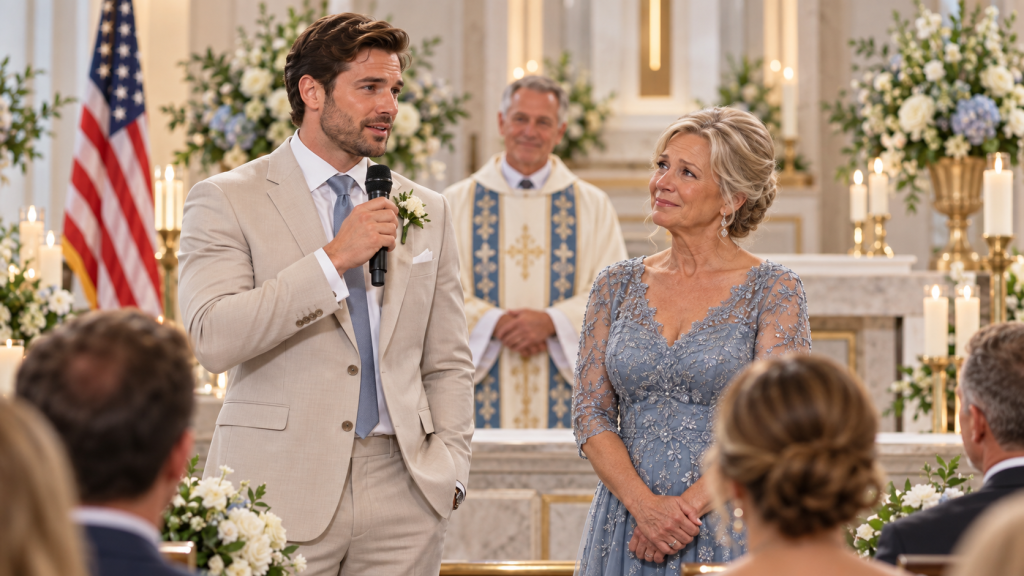
About the groom who stopped his own wedding because he recognized the face of a woman he had never met.
About the photograph hidden for decades.
About the young banker named Evelyn who once risked nearly everything to help a struggling family because she believed people deserved chances.
About the granddaughter who became so desperate to appear important that she forgot the quiet greatness already inside her own family.
About the wedding that had to fall apart before a marriage could eventually be built honestly.
And most importantly, I hope they tell Evie what happened after everything went wrong.
Because that is the part people leave out.
Everyone likes stories about shocking secrets.
The photograph.
The locket.
The interrupted ceremony.
The canceled wedding.
But the most important moments came later.
At my kitchen table.
In counseling offices.
During uncomfortable conversations.
In apologies that did not immediately earn forgiveness.
In ordinary days when Julia chose honesty even though nobody was applauding.
That is where people actually change.
Not during the dramatic moment when everyone discovers the truth.
But afterward.
When no one is watching.
When there is no audience.
When the easier lie is still available and you choose the harder truth anyway.
That is how my daughter found her way back to me.
That is how Daniel learned to trust her again.
That is how I learned that dignity has nothing to do with the chair you are given at someone’s wedding.
I had entered that church believing I belonged in the last pew.
I left knowing that the people who truly loved me had never measured my worth by money, clothing, education, or status.
And neither should I.
My mother understood that decades before I did.
Sometimes I hold her old photograph and wonder whether she imagined any of this.
Did she know that helping Robert would one day connect our families?
Did she imagine her granddaughter marrying his son?
Did she imagine that her pearl locket would become the key to uncovering a secret generations later?
Of course not.
That may be the most beautiful part.
She did not help Robert because she knew what would happen.
She helped because it was right.
And perhaps that is the lesson I want Evie to understand someday.
Do the right thing even when there is no reward.
Tell the truth even when it costs you.
Love people enough to forgive them, but love yourself enough not to pretend their choices did not hurt you.
Never be ashamed of the people who sacrificed so you could stand somewhere they never had the chance to stand.
And never confuse wealth with worth.
Because on the morning of my daughter’s first wedding, I walked into a church feeling like the poorest woman in the room.
I wore an ordinary blouse.
I carried an old locket.
I planned to sit nowhere.
Speak to no one.
And disappear before my daughter knew I had come.
But by the time I walked out of that church, I understood something that changed me forever.
The most valuable thing I carried that morning was not the pearl.
It was the story behind it.
A story of sacrifice.
A story of kindness.
A story of mistakes.
A story of truth.
A story of forgiveness.
And a reminder that sometimes the moment that looks like the end of a family is actually the moment everyone finally stops pretending.
That can be where healing begins.
That can be where trust begins again.
And sometimes, if you are very lucky, it can even be where an old promise finds its way home.
💬THE END! THANK YOU FOR READING!