

My SIL’s kids broke my $2,000 television, and then I overheard her whisper to them, “Good job. I’ll buy both of you toys for that.”
For several seconds, I couldn’t move.
I stood in the hallway holding a pair of cleaning gloves and a black trash bag, staring at the wall while my heart pounded so hard I could hear it in my ears.
Until that moment, I had believed what everyone else believed.
That the shattered television in our living room had been an accident.
An expensive accident, certainly.
A frustrating one.
But still an accident caused by two little boys who had gotten carried away while playing.
Then I heard my sister-in-law Rachel’s voice again.
“That’s exactly what you were supposed to do.”
My stomach turned.
Her six-year-old son, Caleb, whispered something.
Rachel answered, “Of course. I promised you, didn’t I? You and Noah can pick whatever toys you want.”
Then she laughed softly.
“If they have enough money to renovate their whole house and spend two thousand dollars on a television, they have enough money to replace it.”
I closed my eyes.
Suddenly, the broken screen wasn’t the thing upsetting me most.
It was the realization that Rachel had deliberately used her own children to destroy something in our home.
And if I had walked into that hallway thirty seconds later, I never would have known.
My husband Daniel and I had spent nearly two years renovating that house.
We weren’t wealthy.
That was the part Rachel never seemed to understand.
We were simply careful.
We had bought the house after almost a decade of renting and saving.
When we first moved in, the kitchen cabinets were peeling, the upstairs bathroom leaked through the ceiling, and the living room carpet looked as if it had survived several generations of children.
But we loved the place.
It had a little backyard.
A covered porch.
Three bedrooms.
And most importantly, it belonged to us.
Daniel and I did as much renovation work ourselves as we could.
He learned how to install laminate flooring by watching tutorial videos.
I spent three weekends sanding and repainting kitchen cabinets.
We saved for new appliances instead of putting them on credit cards.
When we couldn’t afford something, we waited.
There were months when almost every spare dollar disappeared into paint, lumber, plumbing repairs, or replacement fixtures.
We skipped vacations.
We ate at home.
Daniel brought lunch to work.
I stopped buying clothes unless I genuinely needed them.
Little by little, the house changed.
The old carpet disappeared.
The walls were painted.
The kitchen brightened.
The leaking bathroom finally stopped leaking.
The living room became our favorite place.
There was one thing Daniel had always wanted to add.
A huge television.
He loved football, documentaries, and action movies.
I loved old mysteries and dramas.
Friday nights had always been our movie nights, even back when we lived in a cramped apartment and watched everything on a secondhand forty-inch screen.
Once the renovation was nearly finished, Daniel stood in the living room one evening and said, “You know what this room needs?”
I looked around.
“A plant?”
“A television.”
“We have a television.”
He pointed at our old one.
“That is technically a television.”
I laughed.
“What do you want?”
He stretched his arms dramatically.
“Something enormous.”
I rolled my eyes.
But I wanted it too.
So we started another savings envelope.
Every paycheck, we added something.
Sometimes two hundred dollars.
Sometimes fifty.
Sometimes nothing, because real life got in the way.
It took six months.
Finally, we had enough.
We bought an eighty-five-inch television for just under two thousand dollars.
The day it was delivered, Daniel acted like a ten-year-old at Christmas.
The installers mounted it carefully on the living room wall.
When they left, Daniel stood in front of the blank screen with his hands on his hips.
I walked up beside him.
“You know it isn’t even turned on.”
“I’m appreciating it.”
“It’s a black rectangle.”
“It’s a magnificent black rectangle.”
I laughed.
For the next week, he found excuses to sit in the living room.
He watched weather reports on it.
He watched cooking shows even though he barely cooked.
He watched a documentary about trains and then admitted he wasn’t actually interested in trains.
I teased him constantly.
But secretly, seeing him so pleased made me happy.
Then his thirty-ninth birthday arrived.
Instead of going out, Daniel wanted a family dinner at our house.
“My parents can come,” he said. “Rachel and Eric too. The boys can play. Nothing fancy.”
The moment he mentioned Rachel, I hesitated.
He noticed.
“You don’t want her here.”
“I didn’t say that.”
“You made the face.”
“What face?”
“The Rachel face.”
I laughed despite myself.
Daniel sat beside me.
“I know she can be difficult.”
“Difficult is one word for it.”
His sister had never liked me much.
I still didn’t fully understand why.
From the beginning of our relationship, Rachel seemed determined to find something wrong with everything I did.
At our wedding, she complained about the food.
When we bought the house, she said the neighborhood was inconvenient.
When we painted the kitchen cabinets white, she announced that white kitchens were already outdated.
When I bought new dishes, she asked why anyone needed “fancy plates when paper plates work fine.”
She criticized my cooking.
My curtains.
My haircut.
My garden.
Once, she even complained about the hand soap in our guest bathroom.
Most of her insults were disguised as jokes.
If I reacted, she would smile innocently.
“I’m only teasing.”
Daniel knew it bothered me.
Several times, he had told her to stop.
But their mother, Linda, hated family conflict.
Whenever Rachel upset someone, Linda’s response was always the same.
“She doesn’t mean anything by it.”
Or:
“You know how Rachel is.”
Or:
“Just ignore her. It’s easier.”
For years, I had followed that advice.
I told myself keeping peace was more important than proving a point.
So I swallowed comments.
Changed subjects.
Smiled when I wanted to scream.
Unfortunately, all that patience taught Rachel exactly the wrong lesson.
It taught her there were no consequences.
Still, Daniel’s birthday mattered to me.
“Invite everyone,” I said.
“You sure?”
“Yes. I’ll survive one evening.”
On Saturday afternoon, I started cooking.
Roast chicken.
Garlic potatoes.
Green beans.
Fresh bread.
Chocolate cake.
Daniel’s parents arrived first.
Linda brought a salad even though I had told her not to bring anything.
Robert, Daniel’s father, carried a bottle of wine.
Then Rachel arrived with her husband Eric and their boys.
Caleb was six.
Noah was four.
I genuinely liked the children.
They were energetic, curious, and usually sweet.
Whatever problems I had with Rachel, I never held them against her sons.
The boys came inside carrying a backpack of action figures and toy cars.
Rachel followed.
She stepped into the living room.
Then she saw the television.
Her eyebrows lifted.
“Well.”
There was that tone.
Daniel smiled.
“Finally bought one.”
“How much was it?”
I was in the kitchen doorway.
I nearly answered, “None of your business.”
Instead, Daniel said casually, “About two thousand.”
Rachel stared at him.
“Two thousand dollars?”
Daniel shrugged.
“Yeah.”
“For a television?”
“Yes, Rachel. That is generally what people do when they buy televisions. They exchange money for them.”
Eric laughed.
Rachel ignored him.
“I can think of about a hundred better things to spend two thousand dollars on.”
Daniel smiled.
“Good thing you didn’t pay for it.”
Rachel’s expression tightened.
I should have paid more attention to that expression.
Instead, I went back into the kitchen.
Dinner began normally.
Everyone sat around the table.
Robert told stories about Daniel as a teenager.
Linda brought out an old photograph that embarrassed him.
The boys ate three dinner rolls and almost none of their vegetables.
For a while, everyone laughed.
Then Rachel tasted the sauce.
“This is salty.”
I kept eating.
Linda tried it.
“It tastes fine to me.”
Rachel shrugged.
“Maybe I’m just used to lighter food.”
Ten minutes later, she commented on our dining chairs.
Then she asked how much our new light fixture cost.
Then she said our renovation must have been “nice for people with money to burn.”
Finally, Eric quietly said, “Rachel, could you just eat dinner?”
She glared at him.
I said nothing.
Daniel’s foot touched mine under the table.
I looked up.
He gave me a grateful smile.
After dinner, the adults stayed at the table with coffee while the boys went into the living room.
They had their toys.
I could hear them talking.
Nothing seemed unusual.
Then came the crash.
The sound was enormous.
Everyone froze.
Daniel stood so quickly his chair nearly tipped over.
“What was that?”
We rushed into the living room.
The moment I saw the television, my stomach dropped.
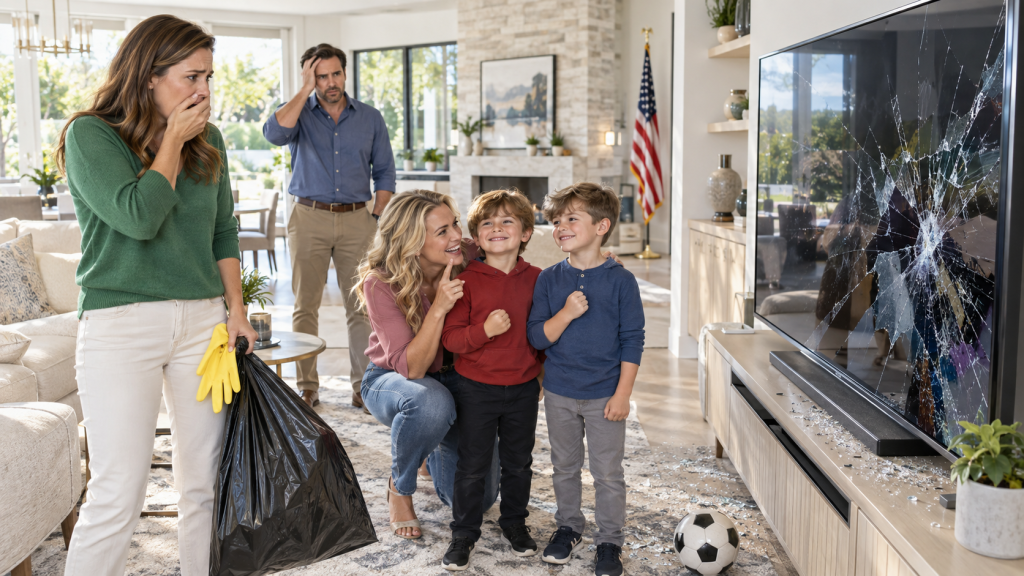
The screen was shattered.
A spiderweb of cracks covered the right side.
Dark lines spread through the display.
A soccer ball rested beneath it.
Caleb stood near the couch.
Noah stood several feet away.
Both boys looked frightened.
Daniel stared at the screen.
“No.”
For a moment, nobody said anything.
Then he looked at the boys.
“What happened?”
Caleb immediately looked toward Rachel.
At the time, I didn’t understand why that mattered.
Later, I would replay that moment again and again.
Rachel rushed forward.
“They’re kids, Daniel.”
“I know they’re kids. I asked what happened.”
“The ball hit the television.”
Daniel looked down.
“What ball? They didn’t come in here with a soccer ball.”
Rachel folded her arms.
“They found one.”
I frowned.
“Found one where?”
She shrugged.
“How should I know?”
I looked at the boys.
“Were you playing soccer inside?”
Caleb looked at his mother again.
Rachel stepped between us.
“Please don’t interrogate them.”
“Nobody is interrogating anyone.”
“They’re already scared.”
Daniel rubbed both hands across his face.
The excitement he had felt over that television only a week earlier was gone.
I felt awful for him.
I turned toward Rachel.
“Okay. We don’t need to argue in front of the boys. But we should talk about the repair.”
She frowned.
“What about it?”
“The television is brand new.”
“So?”
I thought I had misunderstood.
“So your children broke it.”
Rachel gave a sharp laugh.
“You can’t seriously expect me to buy you a television.”
“I asked whether we could discuss splitting the repair cost.”
“Oh, absolutely not.”
Daniel looked at her.
“Rachel.”
She became defensive.
“They’re four and six years old!”
“Yes,” I said.
“And you bought an expensive television and put it right where children play. That’s not my responsibility.”
For a second, I actually had no response.
“Where exactly should we have put our living room television?”
“That’s not my problem.”
Eric looked embarrassed.
“Rachel, stop.”
She turned toward him.
“What?”
“You don’t need to talk to them like that.”
“Whose side are you on?”
“There aren’t sides. Our kids damaged their television.”
“By accident!”
The boys were watching all of us.
That ended the conversation for me.
I didn’t want them standing in the middle of a screaming match.
“Everyone go back to the table,” I said.
Daniel looked at me.
“I’ll help.”
“No. It’s your birthday. Finish your coffee. I’ll clean up.”
I walked toward the laundry room for gloves and trash bags.
Once I was alone, I let myself breathe.
My hands were shaking.
I reminded myself that it was only a television.
Nobody had been hurt.
Things could be replaced.
But what bothered me was Rachel’s attitude.
Not one apology.
Not one offer to help.
Instead, she blamed us for owning something expensive.
I put on the gloves.
Then I grabbed a large trash bag and headed back.
That was when I heard voices in the hallway.
Rachel.
And the boys.
I stopped before turning the corner.
“Good job,” she whispered.
I froze.
“That’s exactly what you were supposed to do.”
Caleb said something quietly.
Rachel answered, “Yes. I promised. I’ll buy both of you toys.”
My heart began pounding.
Noah said, “The dinosaur?”
“Yes, the dinosaur.”
Then Rachel laughed.
“If they have enough money to renovate this whole house and buy that stupid television, they can afford another one.”
For a moment, I thought I might be sick.
The boys hadn’t accidentally broken our television.
Rachel had told them to do it.
I wanted to march around the corner immediately.
But I stopped myself.
Rachel would deny it.
I knew her.
She would say I had misunderstood.
She would accuse me of inventing the conversation because I disliked her.
She might pressure the children to lie.
Then I remembered the security camera.
Three months earlier, after a package disappeared from our porch, Daniel had installed a small indoor camera near the entryway.
It covered most of the living room and part of the hallway.
It also recorded audio.
I quietly backed away.
Nobody noticed me go upstairs.
I entered our bedroom, locked the door, and opened the security application.
My fingers trembled as I found the recording.
I rewound to before the crash.
There was Rachel.
Everyone else was at the dining table.
She slipped into the living room.
She reached into a large tote bag she had brought inside earlier.
Then she pulled out the soccer ball.
My mouth fell open.
She had brought it.
Caleb and Noah looked confused.
Rachel handed the ball to Caleb.
The audio was faint, but clear enough.
“Remember what Mommy said.”
Caleb shook his head.
Rachel crouched beside him.
“Just kick it toward the TV.”
He hesitated.
“What if it breaks?”
“That’s the idea.”
I covered my mouth.
Caleb looked frightened.
Rachel smiled.
“You’re not going to get in trouble. Mommy says it’s okay.”
Then Noah asked, “Do we get toys?”
“Yes. Both of you.”
She stood.
“Do it when everyone is talking.”
A few minutes later, the crash happened.
I kept watching.
The camera also recorded Rachel speaking to them afterward.
“Good job.”
“Exactly what you were supposed to do.”
“Don’t tell anyone.”
I sat on the edge of our bed.
My anger changed.
It became colder.
Clearer.
For years, I had tolerated Rachel because everyone wanted peace.
But this wasn’t a sarcastic comment.
This wasn’t criticism over dinner.
She had deliberately destroyed our property and used her children to do it.
Enough.
I saved the footage.
Then I downloaded another copy to my laptop.
Then I emailed a copy to myself.
I returned downstairs about ten minutes later.
Rachel was eating cake.
When she saw me, she smiled.
“Get everything cleaned up?”
That smile told me she thought she had won.
“Almost,” I said.
“Well, accidents happen.”
I looked directly into her eyes.
“Yes,” I said.
“Sometimes they do.”
She looked away first.
When everyone finally left, Daniel closed the front door and leaned against it.
“What a birthday.”
I walked into the living room.
“Sit down.”
He frowned.
“What happened?”
“Just sit.”
I opened my phone and played the security recording.
Daniel watched silently.
When Rachel handed Caleb the soccer ball, his face changed.
When she told him to kick it toward the television, he stood up.
By the time the recording ended, he was furious.
“She told them to do it.”
“Yes.”
“She brought the ball.”
“Yes.”
“I’m calling her.”
He reached for his phone.
I stopped him.
“No.”
“No?”
“If you call her now, she’ll scream, deny it, blame us, and somehow make herself the victim.”
Daniel stared at me.
“Then what do you want to do?”
“I want her to have time to understand exactly how serious this is.”
That night, we prepared an envelope.
I printed the receipt showing what we had paid for the television.
I contacted the electronics store the following morning and sent them photographs of the damage.
They confirmed that replacing the panel would cost nearly as much as buying another television.
I printed their estimate.
Then I printed several still images from the security footage.
One showed Rachel holding the soccer ball.
Another showed her giving it to Caleb.
Another showed her pointing toward the television.
I typed out a short transcript.
Finally, I wrote:
“Rachel, we know the television was deliberately damaged. The security camera recorded what happened before and after the incident. We expect reimbursement for the full replacement cost. Please contact us within ten days to arrange payment.”
Daniel read it.
“That’s it?”
“That’s enough.”
But there was another conversation we needed to have.
With his parents.
The next afternoon, Linda and Robert came over.
When Daniel told them what happened, Linda initially looked confused.
“Rachel told the boys to break it?”
Instead of explaining, I played the video.
Linda covered her mouth.
Robert leaned closer to the screen.
When it ended, nobody spoke for several seconds.
Finally, Robert said, “Play that again.”
I did.
The second time, he shook his head slowly.
“What in the world was she thinking?”
Linda’s eyes filled with tears.
“Maybe she was angry.”
Daniel stared at her.
“Mom.”
“I’m not saying it was right.”
“It sounds like you’re about to explain it.”
“She’s been under stress.”
I finally spoke.
“Linda, with respect, this is exactly why Rachel believes she can do things like this.”
Linda looked at me.
“What do you mean?”
“Every time she hurts someone, the family explains her behavior instead of expecting her to answer for it.”
“That isn’t fair.”
Daniel interrupted.
“It is fair.”
His mother looked stunned.
He continued.
“When Rachel insulted Claire at our wedding, we were told to ignore her.”
Linda looked down.
“When she screamed at Eric during Christmas, everyone pretended nothing happened.”
Silence.
“When she insulted Dad at Thanksgiving two years ago, he was the one who apologized so dinner wouldn’t be ruined.”
Robert slowly nodded.
Daniel said, “We keep calling it keeping the peace. It isn’t peace. It’s everyone being afraid of Rachel’s reaction.”
Linda’s eyes filled with tears.
For once, she didn’t defend her daughter.
That evening, Daniel drove to Rachel’s house.
I offered to go with him.
He shook his head.
“I don’t want an argument. I’m handing Eric the envelope and leaving.”
That was exactly what he did.
He returned twenty minutes later.
“What happened?”
“Eric answered the door. I gave it to him.”
“Rachel?”
“She yelled from the kitchen asking what it was.”
“And?”
“I told Eric he should read it.”
Forty-five minutes later, my phone rang.
Rachel.
I answered.
She was shouting before I said hello.
“Cancel it!”
I pulled the phone away from my ear.
“What?”
“You know what!”
I looked at Daniel.
He was sitting across the kitchen.
I put the phone on speaker.
“Rachel, calm down.”
“Don’t tell me to calm down! Cancel it! Please. Anything but this!”
I frowned.
“Cancel what?”
“The package! The complaint! Whatever you’re doing!”
“We haven’t filed anything.”
Silence.
Then she said, “You recorded me.”
“Our security camera recorded what happened in our house.”
“That’s illegal!”
“No, it isn’t.”
“You were spying on me!”
“You knew the camera was there. Daniel showed it to everyone when he installed it.”
Another silence.
“You had no right to send those pictures.”
“We had every right.”
Rachel’s voice became higher.
“They’re children!”
“You told the children to do it.”
“That isn’t what happened.”
I almost smiled.
There it was.
The denial I had expected.
“Rachel, we have video.”
“You misunderstood.”
“We have audio.”
No answer.
Daniel leaned toward the phone.
“Why?”
Rachel stopped breathing for a second.
“Daniel?”
“Yes.”
Her voice became smaller.
“I didn’t know you were listening.”
“That doesn’t answer me.”
She started crying.
At first, I thought it was another attempt to escape responsibility.
Then I heard Eric in the background.
“Tell them.”
Rachel snapped, “Stay out of this.”
“No,” Eric replied. “I’ve stayed out of enough.”
Daniel and I exchanged a glance.
I asked, “What is going on?”
Then Rachel said the sentence that changed the entire situation.
“You don’t understand why I wanted that television broken.”
Daniel frowned.
“What does that mean?”
Rachel began crying harder.
“It wasn’t really about the TV.”
“What was it about?”
She didn’t answer.
Eric did.
“Money.”
Silence.
Daniel said, “What money?”
Rachel said, “Eric, stop.”
He ignored her.
“She owes almost forty thousand dollars.”
Daniel looked at me.
I thought I had misheard.
“Forty thousand?”
Rachel sobbed.
“Not exactly.”
“How much exactly?”
“Thirty-eight thousand something.”
Daniel sat back.
“How?”
The story came out slowly.
Credit cards.
Personal loans.
Buy-now-pay-later accounts.
Store cards.
Vacations they couldn’t afford.
Expensive clothes.
Furniture.
Gifts.
Trips.
Restaurants.
Rachel had hidden much of the debt from Eric.
Whenever one card reached its limit, she opened another.
Whenever he questioned a bill, she claimed it was already handled.
She borrowed money from one account to pay another.
For years, she had tried to maintain a lifestyle she couldn’t afford.
Meanwhile, Daniel and I had been quietly saving.
When she saw us improve our house, she assumed we were wealthy.
We weren’t.
We were simply spending money we had already saved.
But Rachel didn’t see the months of waiting.
She only saw the finished kitchen.
The new floors.
The bathroom.
And finally, the television.
“That night,” she whispered, “I saw that huge screen and I just hated you.”
I didn’t respond.
She continued.
“I thought, of course they bought another expensive thing. Of course they did.”
Daniel said quietly, “We saved six months for it.”
“I know that now.”
“You knew it then. I told you.”
“I didn’t want to hear it.”
That sentence was probably the most truthful thing she had said.
I asked, “So you told your children to destroy it because you were jealous?”
She didn’t answer.
“Rachel?”
“Yes.”
The word came out barely above a whisper.
I felt angry.
But I also felt something else.
Sadness.
Not enough to excuse her.
But enough to understand how badly resentment had consumed her.
Daniel said, “You could have talked to us.”
“And said what? That I hate walking into your house because everything reminds me how badly I’ve messed up my own life?”
“Yes.”
Rachel laughed bitterly through her tears.
“You wouldn’t understand.”
“Maybe not,” he said. “But destroying our stuff wasn’t the answer.”
She became quiet.
Then she said, “I’ll pay.”
I looked at Daniel.
He looked at me.
“With what?” he asked.
“I’ll figure it out.”
“You said you’re almost forty thousand dollars in debt.”
“I know.”
Eventually, we agreed to a repayment plan.
Two hundred fifty dollars each month until the full cost was repaid.
Everything would be written down.
No arguments.
No pretending.
No excuses.
Rachel agreed immediately.
But I had another condition.
“You need to apologize to Caleb and Noah.”
She sounded confused.
“To the boys?”
“Yes.”
“Why?”
I couldn’t believe she had to ask.
“Because you’re their mother.”
“What does that have to do with—”
“You taught them to destroy someone’s property because you were jealous.”
Silence.
“You told a six-year-old and a four-year-old that doing something wrong becomes okay when an adult promises them toys.”
She stopped crying.
I continued.
“And when they hesitated, you told them they wouldn’t get in trouble because Mommy said it was okay.”
Rachel whispered, “I wasn’t thinking.”
“Exactly.”
Daniel nodded.
“If you want us to move forward, you apologize to them too.”
She agreed.
The following Sunday, Rachel and Eric came over with the boys.
The broken television still hung on the wall.
We hadn’t replaced it.
Rachel stared at it when she entered.
Nobody mentioned it.
We sat in the living room.
Rachel called Caleb and Noah over.
She knelt.
“I need to tell you something.”
Caleb immediately looked uncomfortable.
“What?”
“What I asked you to do last weekend was wrong.”
He stared at her.
She continued.
“I should never have told you to kick the ball at Aunt Claire and Uncle Daniel’s television.”
Noah asked, “But you said it was okay.”
“I know.”
His answer made Rachel’s face crumble.
She took his little hand.
“I was wrong when I said that.”
Caleb asked, “Are we in trouble?”
My heart hurt.
Rachel shook her head.
“No. You’re not in trouble.”
“But we broke it.”
“I told you to.”
Caleb looked at me.
“I’m sorry.”
I crouched beside him.
“I know.”
He whispered, “Mom said you had lots of money.”
I glanced at Rachel.
Her eyes were red.
I said gently, “Even if somebody has lots of money, we still don’t break their things.”
He nodded.
“And if a grown-up tells you to do something that feels wrong, you can always ask another grown-up you trust.”
Rachel closed her eyes briefly.
Noah suddenly said, “Can I still get my dinosaur?”
For a second, nobody knew what to say.
Then Eric laughed.
Daniel started laughing.
Even Rachel laughed through her tears.
“No,” she said.
Noah looked devastated.
“But maybe for your birthday.”
He considered this.
“Okay.”
Then Rachel stood and faced me.
“I’m sorry.”
I waited.
She swallowed.
“I’m sorry I deliberately told my children to break your television because I was jealous of you.”
That was probably the hardest sentence she had ever spoken.
“And I’m sorry I blamed you afterward.”
Daniel folded his arms.
Rachel looked at him.
“I’m sorry I ruined your birthday.”
He nodded.
“I appreciate you saying that.”
She seemed surprised he didn’t immediately hug her and announce everything was forgiven.
That was another change.
For once, nobody rushed to remove the discomfort she had created.
Over the following months, Rachel paid exactly what she had promised.
Two hundred fifty dollars.
Every month.
The first payment arrived in an envelope.
The second came by bank transfer.
By the third month, she stopped complaining about it.
Eric took over most of their household finances.
Together, they met with a debt counselor.
Rachel canceled several credit cards.
She sold clothes, bags, and furniture she didn’t need.
She started working Saturday evenings at a local event hall.
One afternoon, Linda called me.
“She seems different.”
“So do you.”
She laughed softly.
“I suppose I deserved that.”
Linda admitted something I never expected.
“For years, I thought keeping everyone calm was the same as keeping everyone close.”
I listened.
“But really, I was teaching Rachel that everyone else would adjust around her.”
“That’s what Daniel said.”
“I know.”
She paused.
“I owe you an apology too.”
“You didn’t break the television.”
“No. But I asked you to tolerate things I wouldn’t have tolerated myself.”
That conversation mattered to me almost as much as Rachel’s apology.
Because family patterns don’t come from one person alone.
Sometimes everyone participates without realizing it.
Months passed.
Family gatherings slowly became less tense.
Rachel stopped criticizing everything.
At Thanksgiving, she walked into our dining room and noticed we had replaced the old table.
I saw the familiar expression forming.
She opened her mouth.
Then stopped herself.
“That’s a nice table.”
I stared at her.
She frowned.
“What?”
“Nothing.”
Daniel walked into the kitchen behind me.
“Did she just compliment something?”
“Quiet. Don’t scare her.”
We both laughed.
Rachel heard us.
“I can still insult it if you prefer.”
“No,” I said. “We’re enjoying the moment.”
By spring, most of the television debt had been repaid.
Then one Saturday afternoon, Rachel arrived unexpectedly.
The boys were with her.
She handed me an envelope.
“What’s this?”
“The rest.”
I opened it.
Inside was the remaining balance.
“You didn’t have to pay it early.”
“I wanted to.”
“How?”
“I sold some things.”
I looked at her.
She smiled faintly.
“Things I bought because I wanted people to think I had money.”
That sentence stayed with me.
Then she turned toward her car.
“There’s something else.”
Caleb and Noah returned carrying a wooden picture frame.
It was clearly handmade.
The corners weren’t quite straight.
There were fingerprints in the paint.
Inside was a drawing.
Four stick figures stood in front of an enormous television.
Above them were the words:
FAMILY MOVIE NIGHT.
I laughed.
“This is beautiful.”
Caleb smiled proudly.
“We made it.”
Noah pointed toward the corner.
“I made the dinosaur.”
There was, indeed, a large green dinosaur beside the television.
Daniel walked through the door while we were admiring it.
He looked at the drawing.
“Why is a dinosaur watching television?”
Noah stared at him like he had asked the stupidest question in human history.
“Dinosaurs like movies.”
Daniel nodded.
“Obviously.”
We hung the picture in the living room.
Right beside our replacement television.
Yes, we eventually bought another one.
Another eighty-five-inch screen.
Almost the same model.
The first evening we used it, Daniel stood staring at it again.
I walked beside him.
“Don’t say it.”
He smiled.
“It’s magnificent.”
“You’re ridiculous.”
But I kissed him anyway.
Several weeks later, we hosted a family movie night.
Rachel brought popcorn.
The boys brought blankets.
Linda and Robert sat on the couch.
Eric and Rachel took the loveseat.
The children stretched out on the rug.
Halfway through the film, I looked around the room.
A year earlier, I never would have imagined us sitting together peacefully.
The strangest part was realizing the television itself had never been the real problem.
The problem had existed long before that screen shattered.
Rachel’s jealousy.
Her financial dishonesty.
The family’s habit of excusing her.
My habit of staying silent because I thought silence meant maturity.
Daniel’s reluctance to challenge his sister because he wanted to protect his mother from conflict.
All of it had been building.
The broken television merely forced us to stop pretending.
One evening several months later, Rachel and I were alone in the kitchen after dinner.
She volunteered to help wash dishes.
That alone was shocking.
She picked up one of my coffee cups and laughed.
“What?”
“Remember when I told you these cups were ugly?”
I smiled.
“You’ve insulted so many things in this house that I honestly can’t keep track.”
She winced.
“I really was awful.”
“Sometimes.”
“You can say yes.”
“Fine. Yes.”
She laughed.
Then her expression became serious.
“I hated coming here.”
That surprised me.
“Why?”
“Because every time I walked into this house, I saw something you and Daniel had finished.”
I waited.
“The kitchen. The floors. The bathroom. The living room.”
She looked around.
“And every improvement reminded me that you were moving forward while I was drowning.”
“We weren’t competing with you.”
“I know.”
“We never thought we were better than you.”
“I know that too.”
She dried a plate.
“But I convinced myself you did.”
“Why?”
“Because if you were arrogant, then I could hate you instead of admitting I hated my own choices.”
That answer was painfully honest.
She continued.
“I kept buying things because I thought eventually I would feel successful.”
“Did you?”
“No.”
She smiled sadly.
“I just got bills.”
I laughed.
She did too.
Then she said, “When I saw that television, I thought it represented everything unfair about my life.”
“But it didn’t.”
“No. It represented six months of you two saving money.”
“Exactly.”
She nodded.
“I know.”
That conversation was the first time I felt like Rachel and I truly understood each other.
We never became best friends.
I don’t think every difficult family relationship needs to transform into some perfect friendship.
Sometimes respect is enough.
Boundaries are enough.
Honesty is enough.
The boys remembered what happened too.
Almost a year later, Caleb was playing outside with a soccer ball.
It rolled toward our front door.
He chased it.
Then stopped.
He picked up the ball and called inside.
“Aunt Claire?”
“Yes?”
“Can the ball come inside?”
I looked at Daniel.
He bit his lip to keep from laughing.
“No, sweetheart.”
“Okay.”
Caleb carefully placed it beside the porch before entering.
Daniel whispered, “He’ll remember that rule until he’s ninety.”
“Probably.”
The real test came one year after the incident.
Daniel’s fortieth birthday.
Again, we invited everyone.
Again, I cooked dinner.
Again, the boys played in the living room.
But this time, no soccer balls appeared.
Rachel arrived carrying a small wrapped gift.
After dinner, she handed it to Daniel.
“For you.”
He opened it.
Inside was a miniature toy television.
The whole table burst out laughing.
Daniel held it up.
“What is this?”
“Your emergency replacement.”
I laughed so hard my stomach hurt.
Then Rachel pointed at her sons.
“And neither of you is allowed to kick anything at it.”
Caleb covered his face.
“Mom!”
Noah yelled, “I didn’t even kick it last time!”
That made everyone laugh harder.
For a few minutes, the room felt completely normal.
And as I looked around the table, I realized something.
Families can survive terrible moments.
But they can only survive them honestly.
Pretending something didn’t happen isn’t forgiveness.
Avoiding conflict isn’t peace.
Excusing someone over and over isn’t kindness.
Sometimes people need consequences before they are willing to change.
Rachel needed to repay the money.
She needed to admit what she had done.
She needed to apologize to her children.
She needed to face the debt she had hidden.
And our family needed to stop rescuing her from every uncomfortable consequence.
But I learned something too.
For years, I thought being a good person meant staying quiet.
I thought if I ignored enough insults, eventually Rachel would appreciate my patience.
She didn’t.
My silence simply taught her she could keep going.
Setting boundaries didn’t destroy the family.
It actually gave us a chance to rebuild it in a healthier way.
Our replacement television still hangs in the living room today.
It works perfectly.
But it isn’t the thing I notice when I walk into that room.
Beside it hangs the crooked wooden frame Caleb and Noah made.
Four stick figures.
A giant television.
And one green dinosaur.
Sometimes guests ask why there is a dinosaur in our family portrait.
Daniel always answers before I can.
“Because dinosaurs like movies.”
And every time, I laugh.
The shattered television cost two thousand dollars.
But in a strange way, what happened afterward was worth far more.
Rachel stopped pretending her unhappiness was everyone else’s fault.
Eric finally learned the truth about their finances.
Linda realized that constantly smoothing over conflict wasn’t helping her daughter.
Daniel learned that protecting his family sometimes meant confronting someone he loved.
And I learned that kindness and boundaries can exist together.
You can forgive someone without pretending they did nothing wrong.
You can love someone without allowing them to disrespect you.
You can understand why someone behaved badly without excusing what they did.
And sometimes, the strongest thing you can say is simply:
Enough.
Rachel once believed breaking our television would make her feel better.
It didn’t.
Instead, it shattered the story she had been telling herself for years.
That everyone else had easier lives.
That other people’s success was an insult to her.
That if someone owned something she couldn’t afford, they deserved to be brought down.
Once that story disappeared, she finally had room to build something better.
Her own life.
Her own stability.
Her own peace.
And perhaps the most surprising part happened two years later.
Rachel called me one afternoon.
“Are you home?”
“Yes.”
“Can I stop by?”
“Sure.”
Twenty minutes later, she appeared carrying a folder.
For half a second, I had a ridiculous flashback to the night of the broken television.
“What’s that?”
She smiled.
“Good news.”
We sat at the kitchen table.
She opened the folder.
Inside was a statement showing the balances of her remaining debts.
Several accounts were marked zero.
One small loan remained.
“I’ll finish paying it next month.”
I stared at her.
“You paid off almost forty thousand dollars?”
“Eric and I did.”
“That’s incredible.”
She smiled.
“We sold things. I worked weekends. He took overtime. We stopped pretending we had to keep up with everybody.”
She looked around my kitchen.
“Especially you.”
I laughed.
“I’m proud of you.”
Her eyes immediately filled with tears.
That surprised both of us.
“Really?”
“Yes.”
She looked down.
“I don’t think you’ve ever said that to me.”
“You’ve never given me this particular reason before.”
She laughed through her tears.
Then she reached across the table.
“I’m glad you had that camera.”
I stared at her.
“That might be the strangest thing you’ve ever said.”
“I mean it.”
“You were screaming about it being illegal.”
“I know.”
“You threatened to call a lawyer.”
“I know.”
“You called me insane.”
“I definitely remember that.”
I smiled.
“So why are you glad?”
She thought for a moment.
“Because if you hadn’t caught me, I probably would’ve kept blaming everyone else.”
That answer stayed with me.
Sometimes consequences feel cruel when they first arrive.
But consequences can also be mirrors.
They force us to see ourselves without excuses.
Rachel finally saw what jealousy had turned her into.
And thankfully, she didn’t like what she saw.
So she changed.
Not instantly.
Not perfectly.
But genuinely.
The following month, when she made the final payment on her own debt, she invited the entire family to dinner.
At her house.
For years, she had always complained about hosting because her home wasn’t “nice enough.”
This time, she didn’t apologize for anything.
Not the old dining table.
Not the small television.
Not the mismatched chairs.
She simply cooked.
We ate pasta.
The boys argued over garlic bread.
Linda spilled water.
Robert told the same story twice.
And nobody cared what anything cost.
At one point, I noticed Rachel looking around the table.
She caught my eye.
Then smiled.
Later, while we were clearing dishes, she said quietly, “This is what I thought money was supposed to buy.”
“What?”
“This.”
She gestured toward the dining room where everyone was laughing.
“Feeling like I have enough.”
I dried a plate.
“And now?”
“Now I know enough isn’t a number.”
I smiled.
“Look at you getting philosophical.”
“Debt counseling changed me.”
We laughed.
On the drive home, Daniel was quiet.
I asked what he was thinking.
“My sister seems happy.”
“She does.”
“I haven’t seen her like that in years.”
I reached over and squeezed his hand.
He smiled.
Then he said, “Still can’t believe she murdered my television.”
I burst out laughing.
“It was a television, Daniel.”
“It was magnificent.”
“You had it for one week.”
“The best week of my life.”
I smacked his arm.
He laughed all the way home.
And that is how a shattered television, two little boys, one jealous sister-in-law, and a security camera forced an entire family to finally deal with problems we had been ignoring for years.
Would I ever want to go through it again?
Absolutely not.
Would I still confront Rachel if I could go back?
Without hesitation.
Because the lesson I learned wasn’t really about replacing something expensive.
It was about knowing when patience becomes permission.
For years, Rachel mistook our silence for weakness.
She believed we would always tolerate the next insult because we had tolerated the previous one.
She was wrong.
And strangely enough, discovering that boundary ultimately helped her more than our silence ever did.
Sometimes loving people means supporting them.
Sometimes loving people means forgiving them.
And sometimes loving people means refusing to protect them from the consequences of their own choices.
Today, when Rachel comes over, she sometimes sits directly beneath the television.
I tease her about it.
“Careful. Expensive electronics nearby.”
She rolls her eyes.
“Are you ever going to let that go?”
“Probably when we’re eighty.”
Then she laughs.
And because life has a sense of humor, Noah—the four-year-old who once asked for a dinosaur as payment for breaking our television—is now obsessed with soccer.
He plays on a youth team.
He’s actually very good.
But before every family gathering, Rachel gives him the same warning.
“The soccer ball stays outside.”
He groans.
“We know, Mom.”
Caleb adds, “We’ve known for years.”
And Daniel says, “I just want everyone to appreciate that my television survived another Thanksgiving.”
Even Robert laughs.
The story that once made us furious has become something we can finally joke about.
Not because what Rachel did was harmless.
It wasn’t.
But because she took responsibility.
That makes all the difference.
An apology without change is just noise.
Rachel changed.
And because she changed, forgiveness became possible.
If there is one thing I would tell anyone dealing with a difficult family member, it is this:
You do not have to choose between cruelty and silence.
There is another option.
You can be calm.
You can be fair.
You can tell the truth.
You can set a boundary.
And then you can allow the other person to decide what they do with it.
Some people will walk away.
Some will become angrier.
But occasionally, someone will finally look at themselves and decide they want to do better.
Rachel did.
And that is why the most valuable thing in our living room isn’t the eighty-five-inch television.
It’s a crooked frame made by two little boys.
Because every time I look at it, I remember exactly what our family learned.
Things can be replaced.
Trust takes longer.
Resentment grows when nobody talks about it.
Silence does not always mean peace.
And people can change—but only after they stop blaming everyone else.
Rachel wanted to teach us a lesson by destroying something we loved.
Instead, life taught her one.
And in the end, it taught all of us something too.
💬THE END! THANK YOU FOR READING!