
The clock on my nightstand read 5:02 AM.
Thanksgiving morning.
Outside, freezing rain tapped against the windows like fingernails. The wind pushed dead leaves across my porch, and the little American flag beside the front steps snapped sharply against its pole.
Inside, my kitchen still smelled like pumpkin pie, dark coffee, and cinnamon. I had been awake since four, preparing the side dishes Chloe loved because she and Marcus were supposed to come by for dessert after spending Thanksgiving dinner with his family.
That had been the arrangement.
I had not liked it, but I had accepted it.
Three years earlier, when my daughter married Marcus Hale, I promised myself I would not become the kind of mother who interfered every time her adult child made a decision she disliked.
So I had smiled when Marcus corrected Chloe in front of people.
I had remained quiet when he began checking her phone.
I had swallowed my anger when his mother, Sylvia, referred to Chloe’s engineering salary as “cute little money” despite the fact that my daughter earned more than most people in their neighborhood.
I had told myself Chloe was intelligent.
Capable.
Independent.
If she needed me, she would ask.
At 5:02 that morning, my phone began to ring.
Marcus.
I stared at his name for two full seconds before answering.
“Hello?”
His voice came without a greeting.
“Come pick up your garbage.”
My hand tightened around the edge of the kitchen counter.
“Where is Chloe?”
“Downtown bus terminal.”
I stopped breathing.
“What?”
“Your daughter decided last night was the perfect time for another hysterical episode. I’m hosting my CEO for Thanksgiving dinner, Eleanor. I have clients coming. I have neighbors coming. I don’t have time to babysit a woman who can’t control herself.”
In the background, someone laughed.
A woman.
Sylvia.
Marcus’s mother.
“Tell her about the rug,” Sylvia called.
Marcus sighed theatrically.
“And she destroyed my mother’s Persian rug. Five thousand dollars. I expect reimbursement.”
“Marcus,” I said carefully, “why is my daughter at a bus terminal before sunrise?”
“Because I put her there.”
For a moment, I thought I had misunderstood him.
“You did what?”
“I drove her downtown and left her there.”
Something cold moved through me.
It was not panic.
Not yet.
It was the kind of stillness I used to feel before walking into a courtroom where everyone expected me to lose.
“Is she injured?”
“She’s dramatic.”
“That is not what I asked.”
“I’m not doing this with you.”
Behind him, Sylvia said loudly, “Tell the old woman to collect her brat and keep her away from decent people.”
Marcus chuckled.
Then another female voice drifted through the phone.
Younger.
Sleepy.
“Marcus, where are the champagne glasses?”
I heard him cover the receiver.
“In the dining-room cabinet, Lauren.”
Lauren.
I knew that name.
Chloe had mentioned a Lauren from Marcus’s office several times during the past year.
Always casually.
Lauren needed a ride.
Lauren had joined their gym.
Lauren had started attending work events with Marcus.
Lauren had accidentally left an earring in Marcus’s car.
Every explanation had been reasonable when taken separately.
Together, they suddenly became something else.
“Who is Lauren?” I asked.
Marcus went silent for half a second.
Then he laughed.
“You need to mind your own business.”
“My daughter is my business when you abandon her at a terminal in freezing weather.”
“She’s an adult.”
“So are you.”
“I said come get her.”
The call ended.
I stood in my kitchen holding the phone long after the screen went dark.
For most of my professional life, anger had been a luxury I refused to indulge before gathering facts.
Juries did not convict because a prosecutor was furious.
Judges did not sign warrants because someone had a bad feeling.
Cases were built on timelines.
Witnesses.
Records.
Physical evidence.
Admissions.
Patterns.
I had spent decades teaching younger lawyers that the difference between revenge and justice was discipline.
I needed that discipline now.
I grabbed my coat and keys.
Then I stopped in the hallway.
At the back of the closet, behind old winter blankets and a box of Christmas decorations, sat a small black lockbox.
I had not opened it in almost four years.
I carried it to the table.
Inside were old credentials, commemorative coins, photographs from cases I had long ago stopped discussing, several business cards, and the identification I had once carried into federal buildings every morning.
Marcus had never seen any of it.
Neither had Sylvia.
To them, I was simply Eleanor Bennett, Chloe’s widowed mother.
They knew I had worked for “the government.”
Marcus once joked that I had probably spent thirty years filing tax forms.
I had let him believe it.
There had been no reason not to.
My career was over.
My daughter’s marriage was supposed to belong to her generation, not mine.
But as I looked at those old credentials, I remembered something one of my mentors had told me decades earlier.
Retirement ends your authority.
It does not erase what you know.
At 5:19 AM, I backed my SUV out of the driveway.
The streets were nearly empty.
Holiday decorations glowed behind dark windows. A bakery truck moved slowly through an intersection. A lone snowplow scattered salt over the bridge leading downtown.
I called Chloe three times.
No answer.
At 5:36, I called the terminal.
A tired employee answered.
“I’m trying to locate my daughter,” I said. “Twenty-eight years old. Brown hair. Her name is Chloe Hale.”
There was a pause.
“Is she wearing a gray sweater?”
My stomach dropped.
“Yes.”
“You need to get here.”
“What happened?”
“I don’t know, ma’am. She’s outside near Bay Six. Security tried to bring her in, but she keeps saying someone told her she wasn’t allowed inside.”
“Who told her that?”
“I have no idea.”
I pressed harder on the accelerator.
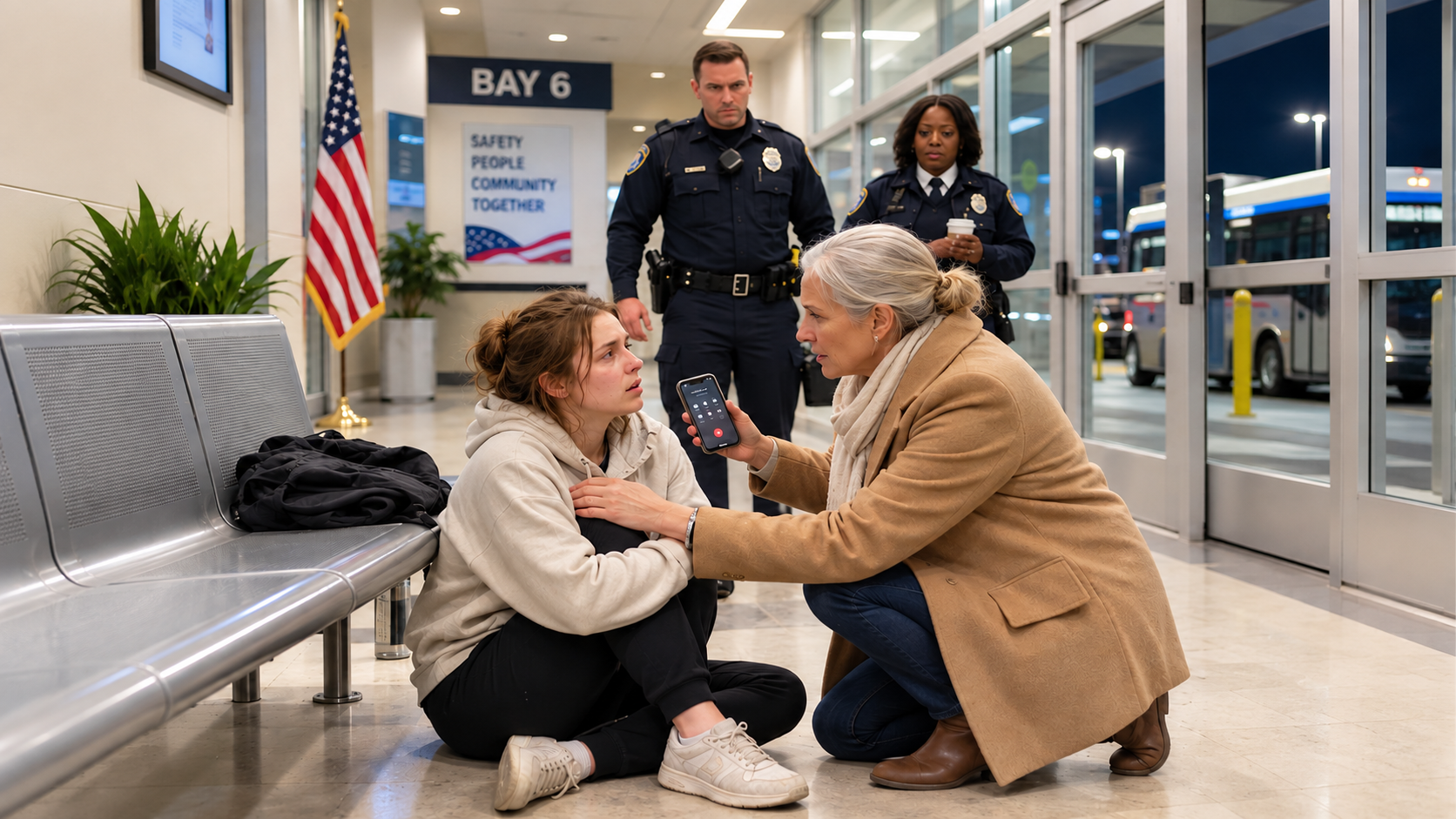
At 5:43, I pulled into the bus terminal.
Fluorescent lights buzzed over cracked pavement. The automatic doors opened and closed as workers prepared for the morning routes.
I saw a security guard standing outside.
Then I saw the bench.
Then I saw my daughter.
For one second, my mind refused to understand what my eyes were seeing.
Chloe was curled on the metal bench beneath a broken streetlight.
She had no coat.
One shoe was missing.
Her gray sweater was torn near the shoulder.
Her hair, usually neatly tied back, hung across her face.
Her lips were pale.
Her fingers looked blue.
I left the SUV running.
“Chloe!”
Her head moved slightly.
I dropped to my knees in front of her.
“Baby, look at me.”
Her eyelids fluttered.
“Mom?”
“I’m here.”
Her entire body shook so violently that her teeth clicked.
I removed my coat and wrapped it around her.
“What happened?”
Her hand closed weakly around my sleeve.
“They hurt me.”
My throat tightened.
“Who?”
“Marcus.”
She swallowed.
“And Sylvia.”
The security guard took a step closer.
I glanced at him.
“How long has she been here?”
He shook his head.
“I came on duty at five. She was already outside.”
“Why wasn’t she brought in?”
“We tried. She panicked when we touched her. Said her husband told her police would arrest her if she made trouble.”
Of course he had.
Fear was easier to maintain when the victim believed every door led to another punishment.
I turned back to Chloe.
“Tell me what happened.”
Tears filled her eyes.
“Marcus has been seeing Lauren.”
“I heard her on the phone.”
Chloe gave a tiny nod.
“I found messages Tuesday night. He told her Thanksgiving was going to be their ‘first real family dinner.’ I asked him about it last night after Sylvia arrived.”
“What happened?”
“Marcus said I was humiliating him.”
Her voice trembled.
“Sylvia said Lauren understood how to support a successful man. She said I had been holding Marcus back because I kept refusing to transfer my savings into the investment account he opened.”
That caught my attention.
“What investment account?”
Chloe looked confused.
“He said it was for our future. He wanted me to move my inheritance into it.”
My husband had left Chloe money when he died.
Not millions.
But enough to give her security.
“Did you transfer anything?”
“No.”
I exhaled quietly.
Good.
“Keep going.”
“They told me I needed to apologize to Lauren.”
“For your husband having an affair?”
Chloe almost laughed.
It came out as a broken sound.
“I said no. Marcus grabbed my phone. Sylvia took my purse.”
My anger sharpened.
“Then?”
“They wouldn’t let me leave.”
The security guard looked at me.
That sentence changed everything.
“Wouldn’t let you leave how?” I asked.
“Marcus stood in front of the door. Sylvia took my keys. They kept telling me to sign something.”
“What?”
“I don’t know. Some agreement. It said I was leaving voluntarily and giving Marcus temporary control over the house and our accounts.”
“Did you sign it?”
“No.”
For the first time, something like pride appeared in her exhausted expression.
“I told them I’d rather sleep outside.”
Her eyes filled again.
“Then Marcus said that could be arranged.”
The automatic terminal doors opened behind us.
Warm air rolled across the sidewalk and vanished.
“What happened to your face?”
Chloe touched her cheek.
“Marcus shoved me when I tried to get my phone back. I fell into the table.”
“And the torn sweater?”
“Sylvia grabbed me when I tried to run upstairs.”
I forced myself to keep my voice level.
“Anything else?”
“They put me in the garage for a while.”
“How long?”
“I don’t know.”
“Was the garage heated?”
“No.”
My chest tightened.
“She said cold air would calm me down.”
The security guard muttered something under his breath.
Chloe kept talking.
“Then Lauren came over.”
“What did she do?”
“She asked if I was still there.”
Chloe stared toward the empty bus lanes.
“Mom, she was wearing my robe.”
That detail hurt Chloe more than the cold.
I could hear it.
“Marcus told me I was making everyone uncomfortable. Sylvia said Thanksgiving was important for Marcus’s career because his CEO was coming, and Lauren would sit beside him instead of me.”
My hands felt numb.
“Then what?”
“They made me clean the dining room.”
“What?”
“Sylvia knocked a glass of red wine onto the rug and said I had done it. She filmed me trying to clean it.”
There it was.
Staging.
Manufacturing a narrative.
“They wanted video showing you damaging property.”
Chloe nodded.
“Marcus kept saying nobody would believe me because I’m emotional.”
“Are there cameras in the house?”
Her eyes lifted.
“Yes.”
“Where?”
“Front door. Garage. Kitchen. Dining room. Hallway.”
“Do they record continuously?”
“I think so.”
“Cloud storage?”
“Marcus installed the system.”
I leaned closer.
“Does Sylvia know?”
“I don’t think she remembers the dining-room camera. It’s inside a smoke detector housing.”
That was the first piece of evidence I could almost see.
“What happened after they filmed you?”
“Marcus made me get into his car. I thought he was taking me to a hotel.”
She started shaking harder.
“He took my coat before I got out.”
“Why?”
“He said it belonged to him because he bought it.”
“What about your shoe?”
“I lost it when he pulled me out.”
“Did he see it?”
“Yes.”
“What did he do?”
“He threw it into the car.”
The cruelty of that detail landed harder than I expected.
Then Chloe’s eyes rolled upward.
Her body went limp.
I caught her.
“Chloe!”
At 5:47, I called 911.
“I need Advanced Life Support at the downtown bus terminal, Bay Six. Adult female unconscious after prolonged cold exposure, possible assault, possible unlawful restraint. Send police.”
The dispatcher asked if the attacker was nearby.
“No.”
“Are you safe?”
“Currently.”
“Do you know who assaulted her?”
“Yes.”
“Who?”
“Her husband and possibly his mother.”
I looked toward the security camera above the terminal doors.
“And I need the terminal surveillance preserved immediately.”
The dispatcher paused.
“Ma’am?”
I opened the lockbox I had carried from the car.
“My name is Eleanor Bennett. I’m a retired federal prosecutor. I understand I have no current authority. I’m telling you that because I know precisely what evidence may disappear if this is treated casually.”
The dispatcher’s tone changed.
Not because I had power.
I did not.
But because I was telling her I understood the difference between accusation and preservation.
“Understood.”
“Please have responding officers document her condition before transport, preserve terminal video, identify the driver who left her if the cameras captured the vehicle, and note that there may be relevant electronic evidence at the residence.”
“I’ll relay that.”
“Thank you.”
The ambulance arrived four minutes later.
The paramedics moved quickly.
One cut Chloe’s sweater sleeve to attach equipment while another wrapped heated blankets around her.
“Temperature’s low.”
“How low?” I asked.
“Low enough that we’re going now.”
Police arrived before they loaded her.
A young officer approached me.
“Ma’am, I need a quick statement.”
“You’ll have one. First photograph her condition.”
He looked toward the ambulance.
“Our body cams are running.”
“Good. Make sure that remains preserved.”
His expression sharpened.
“You law enforcement?”
“Former federal prosecutor.”
“Former?”
“Very.”
That almost made him smile.
“Then you know I can’t just go kicking in a door because you say so.”
“I would be disappointed if you did.”
He nodded.
“Good.”
“I’m asking you to do this correctly.”
I gave him Marcus’s name, address, vehicle description, phone number, and Sylvia’s information.
Then I said, “There may be video inside the residence documenting what happened. If they know police are involved, there is a risk of destruction.”
He wrote that down.
“I’ll call my sergeant.”
“Also, Marcus may try to frame this as a marital argument. Please note her exposure, missing shoe, lack of coat, and current medical condition.”
“I have eyes, ma’am.”
“I know.”
I softened my voice.
“My daughter nearly stopped responding in my arms. Forgive me if I’m precise.”
His face changed.
“Understood.”
At the hospital, Chloe was taken immediately into treatment.
I sat outside with her remaining shoe in a clear property bag the officers had given me.
It was absurd what your mind chooses to focus on during catastrophe.
I kept staring at that shoe.
Black leather.
Size seven.
Small scratch near the heel.
I had bought her the pair for her birthday.
Across town, Marcus was probably setting a Thanksgiving table.
I imagined polished silverware.
Wine glasses.
Place cards.
Candles.
Lauren in my daughter’s chair.
At 7:11 AM, a doctor came out.
“Mrs. Bennett?”
I stood.
“I’m Chloe’s mother.”
“She’s stable.”
My knees almost gave way.
“She has significant cold exposure, dehydration, bruising, and a head injury we’re evaluating. Nothing currently appears life-threatening, but we’re keeping her for observation.”
“Can she talk?”
“A little.”
“Police need a statement.”
“When she’s medically ready.”
I nodded.
The doctor studied me.
“There’s something else.”
“What?”
“Some of the bruising is older.”
The hallway seemed to narrow.
“How old?”
“Different stages. Days. Possibly weeks.”
I closed my eyes.
Three years of telling myself not to interfere.
Three years of believing Chloe would tell me.
The doctor continued gently.
“Victims don’t always disclose everything at once.”
“I know.”
I had said those words to juries.
To agents.
To frightened witnesses.
Knowing them professionally did nothing to prepare me for hearing them about my child.
When Chloe woke again, I sat beside her.
For several minutes, neither of us spoke.
Then she whispered, “I’m sorry.”
I stared at her.
“For what?”
“For ruining Thanksgiving.”
Something inside me broke.
I took her hand.
“Chloe, listen to me. There is no Thanksgiving dinner on earth worth what happened to you.”
She began to cry.
“I should’ve left months ago.”
“Maybe.”
She looked surprised.
I squeezed her fingers.
“But shame belongs to the people who hurt you, not to the person who hoped things would improve.”
Her lips trembled.
“I didn’t want you to know.”
“Why?”
“Because you warned me about him.”
I looked away.
“I warned you he was controlling. I did not predict this.”
“I thought you’d say ‘I told you so.’”
“I would rather bite through my own tongue.”
That produced the smallest smile.
Then she closed her eyes.
“There’s more.”
I waited.
“Marcus has been using my name.”
“How?”
“Credit cards. Business accounts. Maybe loans.”
“Do you know that?”
“I found statements.”
“Where?”
“My desk.”
“Still at the house?”
“Yes.”
“Anything digital?”
“I emailed some screenshots to myself.”
“Do you still have access to that email?”
“Yes.”
“What else?”
“He kept asking me to sign tax documents.”
“What documents?”
“I don’t know. He said his accountant needed them.”
“Did you sign?”
“Some.”
My old instincts stirred.
Not the instincts of a mother.
The instincts of a prosecutor seeing a pattern grow beyond domestic violence.
“Did Marcus ever ask for your Social Security number?”
“He already had it from our mortgage paperwork.”
“Did he use your engineering credentials for anything?”
Her eyes opened.
“How did you know?”
“Guess.”
“He asked me to review construction plans for a development his company was financing.”
“Did you?”
“I looked at them once and told him the numbers didn’t make sense. The safety calculations were wrong.”
“What did he say?”
“He got angry.”
“When?”
“Two months ago.”
“Did you put anything in writing?”
“I emailed him.”
That mattered.
“What development?”
“Westbridge Commons.”
I knew the name.
Everyone in the city did.
A massive redevelopment project involving federal tax incentives, municipal grants, and private financing.
Marcus’s company had been celebrating it for months.
“Chloe, did he ever ask you to certify anything?”
“Yes.”
My pulse changed.
“What?”
“A structural review.”
“Did you?”
“No. I refused.”
“What happened?”
“He said I was embarrassing him in front of his partners.”
I sat back.
This was no longer one thing.
It was many things touching each other.
That did not mean all of them were crimes.
But it meant investigators needed to look.
At 8:03, I stepped into the hallway and called Daniel Reyes.
He answered on the fourth ring.
“Eleanor?”
His voice had aged.
So had mine.
“Happy Thanksgiving,” he added cautiously.
“I need help.”
Silence.
Daniel had worked fraud cases with me for nearly fifteen years.
He knew I did not use those words casually.
“Talk.”
I told him enough.
Not conclusions.
Facts.
Chloe’s injuries.
The staged rug incident.
The pressure to sign financial documents.
Possible use of her identity.
Possible certifications related to Westbridge Commons.
Possible destruction of digital evidence.
When I finished, Daniel exhaled.
“You understand I can’t launch a federal case because your son-in-law is a monster.”
“I know.”
“And domestic assault belongs with local authorities unless there’s a federal hook.”
“I know.”
“But the financial and project issues could be something.”
“Exactly.”
“Do you have documents?”
“Not yet.”
“Then don’t touch anything you’re not legally entitled to access.”
“I taught you that.”
“You taught everyone that.”
“What can you do?”
“I can make calls. I can tell the right people there may be evidence worth preserving. Nothing more without facts.”
“That’s all I want.”
He paused.
“Is Chloe safe?”
“Yes.”
“Then stay with her.”
“I intend to.”
At 8:27, the local detective assigned to Chloe’s case arrived.
Detective Nina Alvarez was in her forties, calm, direct, and unimpressed by my résumé.
I liked her immediately.
“I know who you are,” she said.
“Who I was.”
“Good. Then you know you’re the victim’s mother today.”
“Yes.”
“Not the prosecutor.”
“Yes.”
“If you interfere with my interviews—”
“I won’t.”
“If you contact the suspects—”
“I won’t.”
“If you tell me how to write my warrant affidavit—”
“I will think about it very loudly and remain silent.”
She almost smiled.
“Excellent.”
Alvarez interviewed Chloe for nearly an hour.
I stayed outside.
When she emerged, she looked angry.
Professionally angry.
Contained.
“Your daughter gave us enough for immediate action on the assault and unlawful restraint allegations,” she said.
“What about the house?”
“We’re working on that.”
“Video?”
“Working on it.”
“Marcus?”
“Do not call him.”
“I haven’t.”
“Good.”
At 9:14, Marcus called me.
I stared at the screen.
Alvarez saw his name.
“Answer.”
“Speaker?”
She shook her head.
“Put it on speaker only if you’re comfortable. Don’t bait him.”
I answered.
“Eleanor.”
His tone was furious.
“Where is Chloe?”
“You left her at a bus station.”
“I asked where she is.”
“She’s receiving medical care.”
A pause.
“For what?”
I almost laughed.
“You truly want to ask me that?”
“She was fine when I left her.”
Detective Alvarez wrote something down.
“You left her outside without a coat.”
“She refused to take it.”
That was new.
His story had already begun changing.
“She also apparently refused one of her shoes?”
Silence.
“I don’t know what you’re talking about.”
“You called me and said to pick up my garbage.”
“I was angry.”
“You said you put her there.”
“I drove my wife somewhere she demanded to go.”
Another change.
Alvarez kept writing.
Then Marcus said something interesting.
“You need to tell her not to make false accusations. My security cameras prove everything.”
I looked at Alvarez.
She raised an eyebrow.
“Good,” I said. “Then I’m sure the police will appreciate those recordings.”
Silence.
Longer this time.
“What police?”
I said nothing.
“Eleanor.”
Still nothing.
His voice changed.
“You called the police?”
“My daughter arrived at a hospital injured after being abandoned outside in freezing weather. What exactly did you expect?”
“You have no idea what you’re doing.”
That almost amused me.
Almost.
Then Sylvia’s voice erupted in the background.
“Give me the phone!”
Marcus must have handed it over.
“You vindictive old hag,” Sylvia shouted. “Chloe attacked me. She destroyed my property. We have witnesses.”
“Excellent.”
“What?”
“Give their names to the police.”
“You think because you worked some little government desk job you can threaten us?”
“I haven’t threatened anyone.”
“Marcus has powerful people coming to this house today.”
“I’m sure the police will be delighted to meet them.”
Sylvia hung up.
Detective Alvarez looked at me.
“You enjoyed that.”
“A little.”
“Don’t do it again.”
“Fair.”
At 9:36, officers arrived at Marcus’s house.
I learned what happened later from reports, testimony, and one especially memorable body-camera recording.
The dining room was already set for twenty people.
A long table beneath a chandelier.
White plates.
Crystal glasses.
Autumn flowers.
Silver napkin rings.
At the head of the table was a card reading MARCUS.
Beside it was another.
LAUREN.
Chloe’s place card had been thrown into a kitchen trash can.
Sylvia was in a silk blouse instructing caterers when the doorbell rang.
Marcus opened it.
Two uniformed officers stood outside with Detective Alvarez’s colleague.
Behind them was a digital-evidence technician.
Marcus tried confidence first.
“Can I help you?”
“We’re here regarding an incident involving Chloe Hale.”
“My wife is unstable.”
“We’d like to discuss that.”
“This is Thanksgiving.”
“Yes, sir.”
“I have important guests arriving.”
“Yes, sir.”
Marcus began to close the door.
The detective stopped him.
“We also have legal process regarding surveillance footage and certain electronic records. Please do not interfere with any devices in the residence.”
That was when Sylvia appeared.
“You cannot enter my son’s home.”
The detective looked at her.
“Do you live here?”
“No.”
“Then please step back.”
Marcus’s face reportedly changed when he heard the words legal process.
He glanced toward a tablet on the kitchen counter.
An officer noticed.
“Sir, don’t touch that.”
“I’m turning off music.”
“Don’t touch it.”
“I said I’m turning off the music.”
The officer stepped forward.
“Hands where I can see them.”
Thanksgiving stopped being elegant very quickly.
Lauren came downstairs wearing Chloe’s robe.
There is body-camera footage of the exact moment she realized police were in the foyer.
She froze halfway down the staircase.
One hand went to the collar.
“Marcus?”
The detective looked up.
“Who are you?”
“Lauren Pike.”
“Do you live here?”
“No.”
“Were you here last night?”
Lauren looked at Marcus.
The detective noticed.
“Please don’t look at him. I asked you.”
“Yes.”
“What time did you arrive?”
“I don’t know.”
Marcus interrupted.
“She doesn’t have to answer you.”
The detective turned toward him.
“I’m aware of her rights.”
Then the doorbell rang again.
Marcus’s CEO had arrived.
So had his wife.
Behind them were two senior executives, a city council member, and their spouses.
Nobody was arrested at the dining table.
Real life is rarely that theatrical.
Instead, everyone stood in the foyer watching officers carry equipment cases through a house decorated for Thanksgiving while Sylvia tried to explain that this was a family misunderstanding.
Marcus’s CEO asked one question.
“Is this related to the company?”
Marcus said no.
The detective said, “We’re not discussing the investigation.”
Which was not reassuring.
By 10:15, most guests had left.
The turkey remained uncooked.
The champagne stayed unopened.
The caterers packed quietly.
And then the camera recordings began telling their own story.
The front-door camera showed Chloe trying to leave at 11:42 PM.
Marcus blocked her.
The hallway camera showed Sylvia taking Chloe’s purse.
The garage camera showed Chloe being pushed through the interior door.
At 12:08 AM, Marcus turned off that camera.
But he forgot the dining-room camera.
That one captured almost everything.
Audio included.
Sylvia telling Chloe nobody would believe her.
Marcus ordering her to sign the agreement.
Chloe refusing.
Lauren entering through the kitchen.
Sylvia pouring wine onto the rug.
Marcus laughing while his mother told Chloe to kneel and clean it.
Chloe demanding her phone.
Marcus shoving her.
Chloe striking the edge of a chair.
And finally, at 2:19 AM, Marcus saying, “Take her downtown. She can figure out where she belongs.”
The exterior camera showed him loading Chloe into his car.
The terminal cameras completed the timeline.
At 2:47 AM, Marcus’s vehicle entered the drop-off lane.
He pulled Chloe from the passenger side.
She stumbled.
One shoe came off.
Marcus picked it up.
For half a second, the video showed him staring at it.
Then he threw it into the car.
He drove away.
Chloe remained outside for nearly three hours.
That afternoon, Detective Alvarez came to the hospital.
She sat beside Chloe.
“We recovered video.”
Chloe began crying before Alvarez finished the sentence.
“Does it show what happened?”
“Yes.”
“All of it?”
“Enough.”
Chloe covered her face.
I thought the tears were fear.
They were relief.
“They said nobody would believe me.”
Alvarez leaned forward.
“I believe evidence.”
Chloe lowered her hands.
“And your evidence is very strong.”
Marcus was arrested that evening.
Not dramatically.
No federal agents stormed Thanksgiving dinner.
No helicopters.
No shouting squad.
Just two officers at a house that was suddenly very quiet.
He was taken into custody on charges connected to assault, unlawful restraint, and other alleged offenses identified by local prosecutors.
Sylvia was also arrested after investigators reviewed the recordings and witness statements.
Lauren was not arrested that day.
She hired a lawyer.
Then she started talking.
People do that when they realize loyalty is not reciprocal.
By Friday morning, Marcus’s employer placed him on leave.
By Monday, he had been terminated.
But the story did not end there.
The domestic case had opened a door.
Behind that door were documents.
Chloe recovered enough to access her email.
She showed Detective Alvarez several messages from Marcus.
One read:
Just sign the engineering certification. Nobody checks this stuff once financing closes.
Another:
Stop pretending you understand business. I need your license number, not your opinion.
Another:
If you don’t cooperate, don’t blame me when your inheritance disappears in legal fees.
Daniel called me Tuesday.
“We need to talk.”
I walked into my backyard so Chloe wouldn’t hear.
“What did you find?”
“I can’t discuss an active investigation.”
“Then why call?”
“To tell you that your instincts weren’t wrong.”
“That is almost discussing it.”
“I’m retired too someday. Let me practice being vague.”
I waited.
He continued.
“Westbridge Commons received federal funding.”
“I knew that.”
“There are questions about certifications, contractor invoices, and money movement.”
“Marcus?”
“I didn’t say that.”
“You called me.”
“I’m aware.”
I smiled despite myself.
“Daniel.”
“Eleanor, stay out of it.”
“I am out of it.”
“Good.”
“How far does it go?”
He sighed.
“You were always unbearable.”
“And usually right.”
“Goodbye, Eleanor.”
The line went dead.
Two weeks later, federal subpoenas went out.
The news reported that investigators were reviewing financial records connected to Westbridge Commons and several related companies.
Marcus’s name appeared in the third paragraph.
Then the first.
Then the headlines.
Investigators alleged that fraudulent certifications had been used to accelerate financing and approve work that had not met required standards.
Chloe’s engineering license had allegedly appeared on preliminary documentation she had never approved.
Her electronic signature had been copied.
That was the part that frightened her most.
“They used my name.”
“Yes.”
“What if someone had gotten hurt?”
“You refused to approve the plans.”
“But my name was there.”
“Without permission.”
She stared at the news report.
“For months he told me I was paranoid.”
I turned off the television.
“Manipulation works best when someone makes you distrust your own memory.”
She looked at me.
“You sound like a prosecutor.”
“I was one.”
That finally made her laugh.
The divorce began in December.
Marcus fought everything.
The house.
The accounts.
The car.
The furniture.
He claimed Chloe had abandoned the marriage.
His lawyers withdrew that argument after receiving the terminal video.
He claimed she had been unstable.
Then her attorney requested the complete home-camera archive.
That argument disappeared too.
Sylvia gave an interview to a local blogger insisting her family had been destroyed by an “overreaching mother-in-law with government connections.”
I never responded.
That drove her crazy.
People accustomed to controlling a story often cannot tolerate silence because silence gives them nothing to fight.
Instead, I spent my time helping Chloe rebuild ordinary things.
We bought her new clothes.
She changed every password.
She froze her credit.
She opened accounts at a new bank.
She replaced her phone.
She began therapy.
She moved into my guest room.
At first, she apologized for everything.
For leaving towels in the bathroom.
For sleeping late.
For not eating dinner.
For crying.
For being quiet.
One night, I heard a glass break in the kitchen.
I ran downstairs.
Chloe stood frozen beside the sink.
A drinking glass had slipped from her hand and shattered across the floor.
She was staring at me in terror.
“I’m sorry.”
I stopped.
Not because of the glass.
Because I understood.
“What do you think I’m going to do?”
Her mouth opened.
Nothing came out.
I slowly picked up the broom.
“Chloe.”
She looked at me.
“It’s a glass.”
Tears formed instantly.
“I know.”
“No.”
I set the broom aside.
“It’s just a glass.”
She began sobbing.
I held her in the middle of the kitchen while broken glass remained scattered around our feet.
That was the moment I finally understood how much had happened inside that marriage long before Thanksgiving.
Bruises heal visibly.
Fear does not.
The federal case widened after New Year’s.
Marcus had not operated alone.
Several executives, subcontractors, and consultants came under scrutiny.
His former CEO was not charged, but the company cooperated with investigators and admitted internal controls had failed.
Lauren became a cooperating witness.
Through her attorney, she provided messages Marcus had sent over more than a year.
Some were romantic.
Others were financial.
One mattered greatly.
If Chloe won’t sign, I’ll use the scan from last year. Nobody will know the difference.
Another message from Lauren asked:
Isn’t that illegal?
Marcus replied:
Only if someone cares enough to look.
Someone had cared enough to look.
By spring, he faced not only the state case involving Chloe, but federal charges connected to fraud, identity misuse, and conspiracy allegations tied to the development project.
I attended none of his federal hearings at first.
Chloe did not want to.
Then one morning in April, she changed her mind.
“I want to see him.”
“You don’t have to.”
“I know.”
“Why now?”
She thought for a moment.
“Because I’m tired of remembering him as the man standing in the doorway.”
So we went.
The federal courthouse had changed since my retirement.
New security scanners.
Different paint.
Younger marshals.
But the smell was the same.
Paper.
Coffee.
Old stone.
I sat beside my daughter on a wooden bench while lawyers moved through the hallway carrying files.
A young prosecutor hurried past us.
For a second, I saw myself at thirty.
Always late.
Always carrying too much.
Always convinced every case could be solved by working one more hour.
Then Marcus was brought in.
He looked smaller.
Not physically.
Psychologically.
The tailored suits were gone.
The certainty was gone.
He saw Chloe.
Then he saw me.
His expression hardened.
During a break, he passed close enough to whisper, “You did this.”
Chloe heard him.
Before I could answer, she stood.
“No.”
Marcus stopped.
Chloe’s voice shook, but she continued.
“You did.”
He stared at her.
“You turned my mother against me.”
“She found me on a bench.”
“You ruined my career.”
“You used my name.”
“You destroyed our marriage.”
“You brought your girlfriend into my house while I was locked in the garage.”
A marshal stepped closer.
Marcus looked around.
People were watching.
That used to be his favorite weapon.
Public embarrassment.
This time, it belonged to him.
Chloe took one breath.
Then she said the sentence I will remember for the rest of my life.
“You kept telling me nobody would believe me. The truth is, you were terrified someone finally would.”
She sat down.
Marcus walked away.
My daughter’s hands were shaking.
I took one.
“You okay?”
“No.”
She swallowed.
“Better than before.”
The criminal cases took months.
Law is slower than anger.
Documents must be reviewed.
Motions filed.
Experts consulted.
Witnesses interviewed repeatedly.
There were no magical shortcuts because I used to be a prosecutor.
If anything, I was more careful than anyone about staying outside the process.
I knew exactly how dangerous it was when personal emotion contaminated legitimate evidence.
So I waited.
Chloe rebuilt.
She rented a small townhouse near her office.
The first night there, she invited me for dinner.
We ate pizza on the floor because her furniture had not arrived.
She had one plate.
Two forks.
Three moving boxes.
And peace.
“I thought starting over would feel bigger,” she said.
“What does it feel like?”
“Quiet.”
“Quiet is underrated.”
She smiled.
Then she showed me something.
A framed copy of her engineering license.
I had seen it before.
But underneath it was a note she had written to herself.
My name belongs to me.
I looked at her.
“Good rule.”
“I’m learning.”
Marcus eventually entered guilty pleas in parts of the federal case while continuing to contest other allegations.
The state domestic case also resolved after months of litigation.
I will not pretend the outcomes repaired everything.
Courtrooms can assign responsibility.
They can impose consequences.
They cannot return a freezing Thanksgiving morning to the people who lived through it.
Sylvia avoided the fantasy ending she had imagined for herself.
Her social circle shrank.
People stopped inviting her places.
Not because I orchestrated anything.
Because evidence has a social life of its own.
Once the recordings became part of public court proceedings, her friends heard her voice telling Chloe that nobody would believe her.
They heard her laugh.
They heard the glass hit the rug.
They heard her say, “Lauren deserves your chair more than you do.”
Some people defended her.
Some said families make mistakes.
Some blamed stress.
Some blamed alcohol.
Others quietly disappeared.
Consequences are not always handcuffs.
Sometimes they are empty chairs.
A year after that Thanksgiving, Chloe asked if we could host dinner at my house.
“Just small,” she said.
“How small?”
“You. Me. Daniel if he’s free. Detective Alvarez. Maybe a couple people from work.”
“You’re inviting the detective who investigated your husband to Thanksgiving?”
“She likes pie.”
“She does.”
“And no assigned seats.”
I smiled.
“Absolutely no assigned seats.”
Thanksgiving morning arrived cold again.
At 5:02 AM, I woke naturally.
For several seconds, I lay still.
Then I saw the clock.
5:02.
Exactly one year.
I walked into the kitchen.
Chloe was already there.
She wore pajamas and thick socks, stirring coffee.
“You’re up early.”
“So are you.”
She looked at the clock.
We both understood.
Neither of us said anything for a moment.
Then she lifted her mug.
“To bus terminals?”
“Absolutely not.”
She laughed.
“To better Thanksgivings.”
I raised mine.
“To better Thanksgivings.”
By afternoon, the house was full.
Daniel brought wine.
Detective Alvarez brought two pies despite my telling her I had already made three.
Chloe’s coworkers brought enough food for thirty people.
Someone burned the rolls.
Someone spilled cranberry sauce.
Daniel dropped a serving spoon.
Nobody screamed.
Nobody apologized for existing.
At one point, Chloe knocked over a glass of red wine.
It spread across my cream tablecloth.
The entire table went silent for half a second.
Chloe stared down at it.
I stared at her.
Then Detective Alvarez grabbed a napkin.
“Well,” she said, “at least we have probable cause to buy a new tablecloth.”
Daniel laughed so hard he nearly choked.
Chloe began laughing too.
Soon everyone was.
I watched my daughter press a napkin into the stain while tears of laughter ran down her face.
A year earlier, wine on a rug had been used to humiliate her.
Now wine on a tablecloth was just wine on a tablecloth.
That was healing.
Not forgetting.
Not pretending.
Changing what ordinary moments meant.
After dinner, Chloe and I stood alone on the porch.
Snow had begun falling lightly.
She wrapped her coat tighter.
A new coat.
One she had bought herself.
“Mom?”
“Yes?”
“Why didn’t you ever tell Marcus what you used to do?”
I smiled.
“He never asked.”
“Seriously.”
“I am serious.”
“He thought you were harmless.”
“I was harmless.”
She gave me a look.
“To people behaving legally.”
I laughed.
Then she became quiet.
“Did you know something like this would happen?”
“No.”
“Did you hate him from the beginning?”
“No.”
She looked surprised.
“I disliked how he spoke to you. I disliked how he tried to control rooms. But people can be arrogant without being criminals.”
“So when did you know?”
“That morning.”
“At the terminal?”
“No.”
“When?”
I thought back.
The phone ringing.
Marcus’s voice.
Come pick up your garbage.
“When he called you garbage.”
Chloe looked toward the snow.
“Why?”
“Because people reveal themselves most clearly when they believe the person listening has no power.”
She absorbed that.
Then she smiled faintly.
“He really thought you had no power.”
“He confused quiet with powerless.”
“And retirement with stupid.”
“That too.”
She laughed.
I looked through the window at the people around my dining table.
Daniel arguing about football.
Alvarez cutting another slice of pie.
Chloe’s coworkers stacking dishes.
Nobody competing for the best chair.
Nobody being measured by salary, status, or usefulness.
I thought about the old lockbox upstairs.
The credentials inside it had once defined much of my life.
For years, that badge opened secured doors.
It got me past checkpoints.
It told strangers what institution stood behind my name.
But it had not saved Chloe.
The ambulance crew saved her from the cold.
Doctors treated her injuries.
Detectives gathered evidence.
Technicians preserved recordings.
Lawyers built cases.
Chloe herself refused to sign away her rights.
The badge had not been magic.
It had simply reminded me, at the moment I needed it most, who I had spent thirty years learning to be.
Calm.
Precise.
Patient.
And unwilling to let intimidation replace evidence.
A few months later, I opened the lockbox one final time.
Chloe was helping me clean the closet.
She held up the old credentials.
“You keeping these?”
I looked at them.
“No.”
“Really?”
“I don’t need them anymore.”
She smiled.
“You going to throw them away?”
“No.”
I took them from her and placed them inside a small frame beside a photograph of my late husband.
Not because I missed the authority.
Because I wanted to remember the lesson.
Power is temporary.
Character is portable.
Chloe stood beside me.
“What are you going to put under it?”
“Nothing.”
“You should.”
“What?”
She thought for a moment.
Then she took a small piece of paper and wrote something.
She slid it beneath the frame.
I read the words.
They underestimate quiet women at their own risk.
I laughed.
“That sounds like something Sylvia would call threatening.”
“Good thing it’s not her house.”
We left it there.
Years from now, perhaps nobody will remember Marcus Hale.
Westbridge Commons will eventually become just another building with apartments, offices, and people rushing through the lobby.
The courtroom files will move into archives.
The recordings will become old evidence.
The winter bench outside Bay Six will probably be replaced.
But I will remember that morning.
I will remember my daughter’s blue fingers gripping my sleeve.
I will remember the missing shoe.
I will remember the doctor telling me some bruises were older.
I will remember how close I came to confusing patience with respect for her marriage.
And I will remember what happened afterward.
Not because I destroyed Marcus.
I did not.
His own choices did that.
Not because I used secret power.
I had none.
I simply knew that when cruel people depend on silence, the most dangerous thing you can do to them is preserve the truth.
Marcus believed a polished dining room could hide what happened in the garage.
Sylvia believed respectability could erase cruelty.
Lauren believed she was stepping into another woman’s chair.
They were all wrong.
A camera remembered.
A terminal remembered.
A hospital remembered.
My daughter remembered.
And once she was safe enough to speak, the rest of us listened.
The next Thanksgiving, when everyone had gone home and the dishes were stacked beside the sink, Chloe hugged me at the front door.
“Good night, Mom.”
“Good night.”
She walked toward her car.
Then she turned.
“Oh, and Mom?”
“Yes?”
“If I ever marry again, you’re telling him you were a federal prosecutor on the first date.”
I smiled.
“Why?”
“So he knows.”
“Knows what?”
She grinned.
“Not to leave me at a bus station.”
I laughed so loudly the neighbor’s porch light came on.
Chloe waved, climbed into her car, and drove away wearing both shoes, her own coat, carrying her own phone, heading toward a home whose keys belonged only to her.
I stood on the porch until her taillights disappeared.
Then I went inside.
The old lockbox remained upstairs.
Closed.
Empty of anything I still needed.
And for the first Thanksgiving in a very long time, every chair at my table had belonged to whoever chose to sit in it.
No permission required.
No apology demanded.
No one forced out into the cold.
That was enough.
More than enough.
It was freedom.
💬THE END! THANK YOU FOR READING!